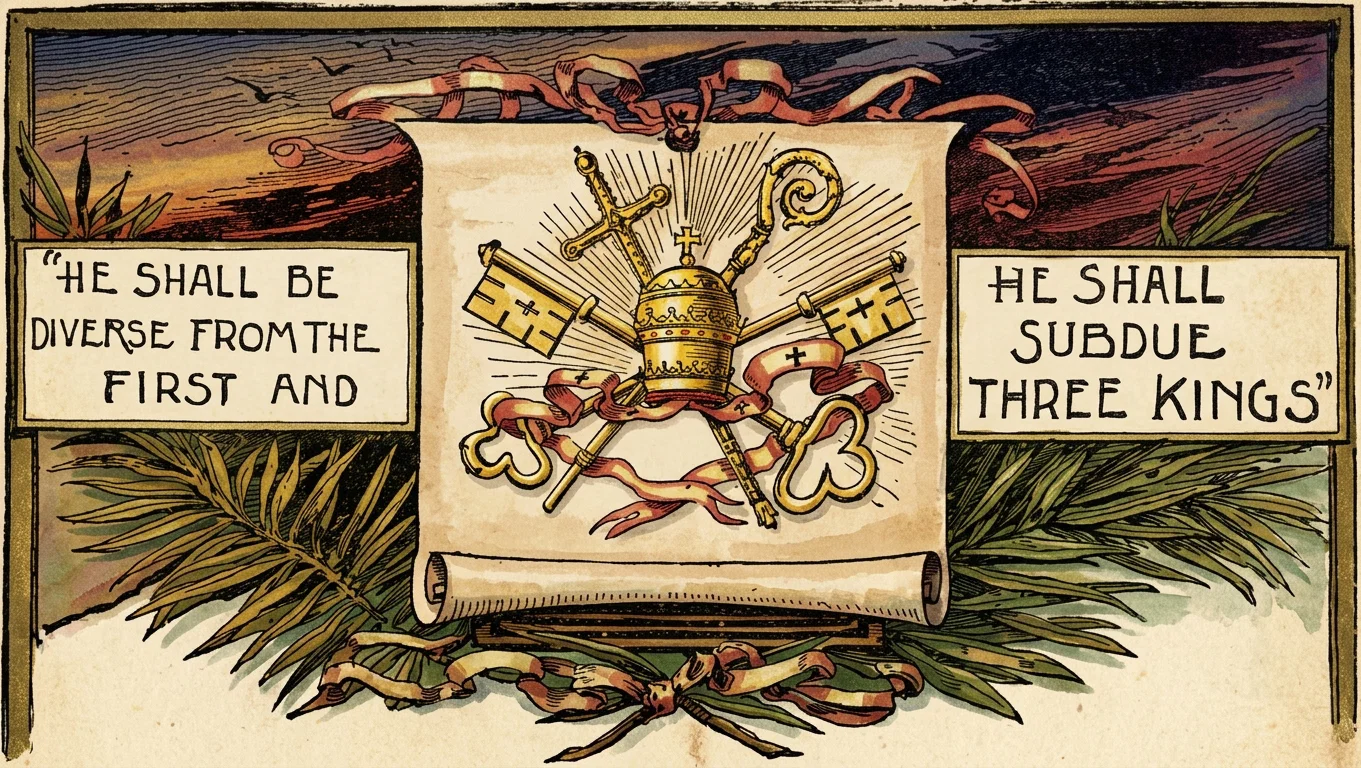
In the Scriptures a horn is used as a symbol of power or exaltation, either temporal or spiritual. The “ten horns” of the “fourth beast” brought to view in this chapter represent kings, or kingdoms (verse 24), of a secular nature, and in Luke 1:68, 69 we read: “Blessed be the Lord God of Israel; for He hath visited and redeemed His people, and hath raised up an horn of salvation for us in the house of His servant David.” See also Ps. 75:4, 5, 10.
Among the ten horns on this fourth beast, which we have shown in a former article represents the Roman Government, it is said that “another shall rise after them; and he shall be diverse from the first, and he shall subdue three kings.” Note that he shall rise after the ten. We have found that the ten horns on the beast stand for ten parts or kingdoms into which the beast-kingdom was divided, and we have shown from history that Rome was so divided, the division having been completed in the year A.D. 476. Then it must be after this time that the horn arose which was “diverse” from the others. The ten horns represented temporal kingdoms, therefore that one which was “diverse” must be of a different nature; and in looking for its counterpart in history, we must seek a power in Rome, other than a secular power, that was capable of destroying secular kingdoms.
This “little horn” is described in verse 8 as having “eyes like the eyes of a man, and a mouth speaking great things.” That the prophet saw a power which rose gradually is shown in the fact that he saw the horn when it was “little,” yet it became “more stout” than the others. It was able to pluck up three of them, and of course it had previously brought the others under its control.
Now what power ever arose in the Roman Empire, other than secular power, that had such influence? Every one who knows anything of history at all, knows that the papal power alone fills the specification. Other characteristics of this little horn are, “He shall speak great words against the Most High, and shall wear out the saints of the Most High, and think to change times and laws [‘the law,’ R. V.]; and they shall be given into His hand until a time and times and the dividing of time.” Verse 25.
How would one speak against the Most High?—The most common way is to make light of His Word, or to place some other authority over it. The apostle Paul prophesied of a power whom he called the “man of sin,” the “son of perdition.” Of him he said, “Who opposeth and exalteth himself above all that is called God, or that is worshiped; so that he as God sitteth in the temple of God, showing himself that he is God.” 2 Thess. 2:3, 4. Continuing, he said, “For the mystery of iniquity doth already work. . . . And then shall that wicked be revealed, whom the Lord shall consume with the spirit of His mouth, and shall destroy with the brightness of His coming.” Verses 7, 8. This is evidently the same power shown to Daniel in the symbol of the little horn, for each continues till the coming of the Lord.
The papal power has spoken against the Most High by setting up the traditions of the church and the decrees of the popes above the authority of the Scriptures. Not only so, but it has introduced the worship of images into the church in the face of the second commandment of the Decalog, and established the observance of the first day of the week instead of the seventh, which is the Sabbath day according to the fourth commandment. Specifications might easily be introduced to sustain the charge that flagrant violation of every commandment is included in the doctrines of that church, but let the following partial list of presumptive titles of the popes suffice for the charge of posing as above God: “His Holiness,” “Lord God the Pope,” “Key-bearer of the Kingdom of Heaven,” “Most Powerful Word,” “Supreme Chief,” “Lion of the Tribe of Judah,” “Ruler of the House of the Lord,” “King of kings and Lord of lords,” “Infallible Pope.” Especially in setting up the Sunday-sabbath institution has this power fulfilled the words of the prophecy that he shall “think to change times and laws.”5
That the growth of the Papacy, or Papal Church-and-State principle, was a gradual work, is aptly expressed by Dr. Killen, in the preface to a work entitled “The Ancient Church”:—
In the interval between the days of the apostles and the conversion of Constantine, the Christian commonwealth changed its aspect. The bishop of Rome—a personage unknown to the writers of the New Testament—meanwhile rose into prominence, and at length took precedence of all other churchmen. Rites and ceremonies of which neither Paul nor Peter ever heard, crept silently into use, and then claimed the rank of divine institutions. Officers for whom the primitive disciples could have found no place, and titles which to them would have been altogether unintelligible, began to challenge attention, and to be named apostolic.
But this power was to pluck up three of the ten horns, or kingdoms; did the Papacy do this? If so, when, and how? and which were the three? In answer to these queries, let it be remembered that the ascendency of the Roman Catholic Church—the outgrowth of the Church-and-State principle—was not attained without a struggle. The Arians, or followers of Arius, a learned presbyter of Alexandria, were for a long time formidable opponents of the Catholics, altho the Council of Nicaea, called by the Emperor Constantine in A.D. 325, decided against Arius and he was banished to Illyria.
In a Church-and-State government like that of Rome, an extensive religious controversy would naturally involve political complications, and in the breaking up of the empire, the bishop of Rome, whoever he might be, took advantage of every possible occasion to further his ambition to be recognized as the head of all the churches. Being at the seat of empire, he had the advantage of extraordinary prestige and influence. But this ambition was bitterly opposed by three of the ten kingdoms, in which the Arian influence predominated. At last, however, they were in turn overwhelmingly defeated—their horns were plucked up. These kingdoms were (1) the Heruli, defeated in A.D. 493, (2) the Vandals, “plucked up” in 534, and (3) the Ostrogoths, who were overcome in 538.
In 533 the Emperor Justinian issued a decree that the bishop of Rome should be the head of all the churches, and true and only corrector of heretics. But this decree could not go into effect until the last of the opposing powers were put out of the way, which occurred in 538. This accomplished, the Papacy, with all the civil powers of the western empire behind it, entered upon its terrible work of “correcting heretics,” or, in the words of the prophecy, wearing out the saints. For how long?—“Until a time and times and the dividing of time.” We have not space to work out this problem in detail; in brief, it is literally three and a half years, a time being a year. It is the same period that is spoken of in Rev. 13:5 as forty and two months, and in chapter 11:3 and 12:6 as “a thousand two hundred and three-score days.” In prophetic time a day stands for a year. See Num. 14:34; Eze. 4:1–7. In Jewish time a year was 360 days—twelve months of thirty days each. Then 1,260 days would be that number of years for the Papacy to carry on its work of wearing out the saints.
How zealously it did the work of “correcting heretics” (those opposed to its doctrines and methods) is told in the history of what is known as the Dark Ages. The victims of her “correction,” by one means or another, are estimated at 50,000,000 or more—much more than by all the Jewish and pagan persecutions combined. The 1,260 years of the prophecy would reach to A.D. 1798. What occurred then to mark a limit to the devastating work?—The work of the Reformation had wielded its influence, together with the religious liberty decree of the empress of Austria, and the coming up of the republic of the United States. These influences had put a stop to the actual persecutions in the more enlightened countries, and the crowning act was the taking of the pope prisoner by French troops in the year 1798. He was kept in exile until he died some two years later. The persecution actually stopped because of unpopularity some twenty years before the power to persecute was taken away, thus agreeing with the words of Christ, when, speaking of this “great tribulation,” he said, “Except those days should be shortened, there should no flesh be saved; but for the elect’s sake those days shall be shortened.” Matt. 24:22.
“But the judgment shall sit, and they shall take away his dominion, to consume and to destroy it unto the end.” To the end of what?—To the end of the kingdom symbolized by the beast of which the little horn is an adjunct. This is shown by the following verse: “And the kingdom and dominion, and the greatness of the kingdom under the whole heaven, shall be given to the people of the saints of the Most High, whose kingdom is an everlasting kingdom, and all dominions shall serve and obey Him.” The same thought is expressed in verses 21, 22: “I beheld, and the same horn made war with the saints, and prevailed against them; until the Ancient of Days came, and judgment was given to the saints of the Most High; and the time came that the saints possessed the kingdom.”
It will be said that Rome is not making war on the saints now, and the end has not come; nor has the kingdom been given to the saints. There is a point in connection with this matter that is not brought out in this prophecy. This same power is mentioned in Revelation 13, where it is said to have been “wounded to death,” and “his deadly wound was healed; and all the world wondered after the beast.” Verses 3. “And all that dwell upon the earth shall worship him, whose names are not written in the book of life of the Lamb slain from the foundation of the world.” Verse 8. Then that power is yet to fulfil the remainder of the prophecy, persecuting the saints until the time comes for them to possess the kingdom, and the Lord shall come to give it to them. Then, as with the image of Nebuchadnezzar’s vision, the God of heaven will set up a kingdom that will destroy all earthly powers, and stand forever. Then, as in Paul’s prophecy, “that man of sin” will be “destroyed by the brightness of His coming” who will set up the everlasting kingdom.
Is it not patent that Rome is fast recovering her prestige and political influence among the nations? And is it not her boast that “Rome never changes”? What, then, may we expect when the “deadly wound” is healed? The “sure word of prophecy” will never fail.
W. N. G.
THE UNIVERSAL IDOLATRY.
THE worship of the sun has been nearly, if not wholly, in some of its phases at least, universal. All the oriental nations had the sun under one name or another enshrined among their gods, and the red men of the Occidental Continent were also worshipers of the orb of day. In Wyoming is a place called “Sundance.” A correspondent, to whom we are grateful, sends us the following poem, giving the origin of the name. It is from the Sundance Gazette:—
Sundance Mountain.
By Mary Byron Reese
BY MARY BYRON REESE.
Rare monarch of the mighty plain,
Like upturned palm outstretched to God,
Where painted warriors to the sun
In weird, wild dance their homage trod,
From wigwams clustering at thy base,
Blue, misty wreaths soared far above,
Where youthful braves and dark-eyed maids
Crooned back and forth their lays of love.
Upon thy crest brave Custer swept,
With anxious gaze and eagle sight,
The dark-browed hills and beetling crags,
Where danger lurked ’mid vale and height;
Where swarthy foes in ambush hid,
With stealthy tread and bated breath,
Weaving the web that soon must snare
Brave heroes in the thrall of death.
Vanished the red men from the mount,
Their warriors crowd no more its base,
The warwhoop wakes no answering ring,
For songs of peace usurp its place,
And pale-faced children shout and play
Where savage hordes triumphant trod,
While church spires point and praises rise
’Bove mount and sun to nature’s God.
THE SABBATH.
By G. B. Thompson
1. FOR whom was the Sabbath made?
“And He said unto them, The Sabbath was made for man.” Mark 2: 27.
2. When was it made?
“And on the seventh day God ended His work which He had made; and He rested on the seventh day from all His work which He had made. And God blessed the seventh day, and sanctified it; because that in it He had rested from all His work which God created and made.” Gen. 2: 2, 3.
3. Who made the Sabbath?
“All things were made by Him [Christ]; and without Him was not anything made that was made.” John 1: 3.
NOTE.—Christ being the one who created all things (Col. 1: 16; Heb. 1: 2), it is quite apparent that He made the Sabbath at the close of His work, and gave it to man as a sign of His creative power. Being the one who worked, He is the one who rested; the Sabbath is, therefore, His rest day.
4. Will the Lord ever change the Sabbath?
“My covenant will I not break, nor alter the thing that is gone out of My lips.” Ps. 89: 34.
5. Will the blessing ever be removed from the day?
“I know that, whatsoever God doeth, it shall be forever; nothing can be put to it, nor anything taken from it; and God doeth it, that men should fear before Him.” Eccl. 3: 14.
6. Can man change the day?
“Behold, I have received commandment to bless; and He hath blessed; and I can not reverse it.” Num. 23: 20.
7. Did Jesus observe the Sabbath?
“I have kept My Father’s commandments.” John 15: 10.
“And He came to Nazareth, where He had been brought up; and, as His custom was, He went into the synagog on the Sabbath day, and stood up for to read.” Luke 4: 16.
“Leaving us an example, that ye should follow His steps.” 1 Peter 2: 21.
8. Did the holy women observe the day after the resurrection?
“And they returned, and prepared spices and ointments; and rested the Sabbath day according to the commandment.” Luke 23: 56.
9. Which day is the Sabbath “according to the commandment”?
“But the seventh day is the Sabbath of the Lord thy God.” Ex. 20: 10.
10. Which day did the apostles keep?
“And Paul, as his manner was, went in unto them, and three Sabbath days reasoned with them out of the Scriptures.” Acts 17: 2.
11. Was the Sabbath binding at the destruction of Jerusalem, A.D. 70?
“But pray ye that your flight be not in the winter, neither on the Sabbath day.” Matt. 24: 20.
12. Was it observed by the revelator?
“I was in the Spirit on the Lord’s day.” Rev. 1: 10.
13. Will the Sabbath be observed through eternity?
“For as the new heavens and the new earth, which I will make, shall remain before Me, saith the Lord, so shall your seed and your name remain. And it shall come to pass, that from one new moon to another, and from one Sabbath to another, shall all flesh come to worship before Me, saith the Lord.” Isa. 66: 22, 23.
G. B. THOMPSON.
Newburg, W. Va.
ETERNAL LIFE AND IMMORTALITY.
THERE is a difference between eternal life and immortality, and yet the two terms are often used interchangeably. Hereby often arise misunderstandings.
In our last week’s issue it was shown that eternal life is the life of the eternal God, that it is all life as that life comes from God; and the only reason why it is not eternal life in everything on this earth is that sin has perverted the law of that life, and in those who have come under the perverted law, it ends in death. But in Jesus Christ it is accessible to all men by faith. Those who by faith yield to God’s eternal law receive the eternal Spirit of God. The law received in Christ Jesus does not condemn; it becomes “the law of the Spirit of life in Christ Jesus.” He who once wandered blindly in the bondage and darkness of sin, can by “the power of an endless life” in Christ Jesus “walk not after the flesh, but after the Spirit.”
All the power there is is in life. God is the Creator, the mighty God, because He is “the living God.” As long as the sinner endeavors to live above sin by the power of the perverted life in him, he will fail. “Alienated from the life of God,” he can not keep the law of God. But the Lord longs to give him His Spirit, that in the erstwhile sinner “the righteousness of the law may be fulfilled.” Rom. 8: 4. “Now if any man have not the Spirit of Christ, he is none of His.” Verse 9. “Nevertheless I live; yet not I, but Christ liveth in me.” Gal. 2: 20. What life did Christ live in Paul? Was it not the life of God, eternal life?
This life we hold by faith, conditionally, but not the less actually. This earnest money is the same as that used for the final payment. It differs not in kind, but in quantity. Tho conditional, it is not the less actual. To him who endures to the end it will be given absolutely.
Immortality means deathlessness, and is the stamp of incorruptibility. In its very essence and origin God alone is immortal. 1 Tim. 1: 17; 6: 16. The original of the word aphthartos means undecaying, uncorruptible. That immortality God promises to render to His children at the last day. Rom. 2: 7. At Christ’s coming this corruptible will put on incorruption. 1 Cor. 15: 53. But it will be given only to those who are faithful to the end, to those who “love our Lord Jesus Christ in sincerity [incorruption].” Eph. 6: 24. It will be God’s stamp of the incorruptible character, the character which has endured every test of Satan, and by the power of the endless life conquered. This is expressed in other words in Phil. 3: 20, 21. The Revised Version is quoted: “For our citizenship is in heaven; from whence also we wait for a Saviour, the Lord Jesus Christ; who shall fashion anew the body of our humiliation, that it may be conformed to the body of His glory, according to the working whereby He is able even to subject all things unto Himself.”
The power by which Christ has conquered is the power of the Spirit or life that is in Him. It is that power which He gives to us; it is that power which raised Him from the dead (see Eph. 1: 19–23). The same power, the same life, which is in the Head of the church is in the body, and in each member in particular. And as the life of God in Christ enabled Him to form an incorruptible character, so the same power in us brings “into captivity every thought to the obedience of Christ.” 2 Cor. 10: 5.
Upon the character of such Christ places the seal of immortality at His coming. The incorruptible character will live in an incorruptible body. The body humiliated by sin and death will be no more, and the people of God will live forever.
Man, therefore, was not created immortal, incorruptible. This was shown by the fact that he soon became corrupted in both character and body. He was not created mortal, for had his obedience continued, he would never have known death. He had a sinless body, and possessed eternal life, but his character was not formed, his immortality was not assured.
God gives to all who will submit to Him His own mighty, eternal Spirit, bearing His own life as it pulses from the throne of the universe. He who will let that life work in him in harmony with God’s holy law, will develop a character like the law, like the Spirit, like our Master, Christ Jesus; and upon him will the Lord bestow the gift of eternal deathlessness, of unending incorruptibility at His coming. “And they shall see His face; and His name shall be in their foreheads.”
Reader, do you wish the immortal body and unending existence?—Then by faith in Christ seek the incorruptible character.
THE MOVING SPIRIT IN SPIRITUALISM.
By T.
WHAT are the “spirits” consulted by the “spirit medium”? The claim is that they are the spirits of our dead friends. But how can that be true since the Bible says “the dead know not anything”? and further that “there is no work, nor device, nor knowledge, nor wisdom, in the grave whither thou goest”? Eccl. 9: 5, 10. Another scripture says, “For in death there is no remembrance of Thee; in the grave who shall give Thee thanks”? Ps. 6: 5. In another passage we are told that “the grave can not praise Thee, death can not celebrate Thee; they that go down into the pit can not hope for Thy truth.” Isa. 38: 18.
If “they that go down into the pit can not hope for God’s truth,” how can they converse with a “spirit medium”? If “the grave can not praise” the Lord, how can it send forth its slumbering people at the call of Spiritualism? Since “there is no work, nor device, nor knowledge, nor wisdom, in the grave,” is it not absolutely impossible for the dead to talk with us? And, further, “the dead know not anything.” These scriptures are plain, and sufficient to show that the “spirit medium” is wholly cut off from conversing with the dead.
But does not the medium converse with some kind of spirits?—Most assuredly. Let the inspired Book tell what they are. “God spared not the angels that sinned.” 2 Peter 2: 4. Note that there are “angels that sinned.” What are these sinning angels doing now? A scripture will answer, “Wo to the inhabitants of the earth and of the sea! for the devil is come down unto you, having great wrath, because he knoweth that he hath but a short time.” Rev. 12: 12. This text states plainly that the “devil is come down” to the “inhabiters of the earth.” And in this connection read a further text: “For they are the spirits of devils, working miracles, which go forth unto the kings of the earth, and of the whole world, to gather them to the battle of that great day of God Almighty.” Rev. 16: 14. This scripture assuredly reveals to us that there are “devils,”—that is more than one of these “fallen angels,” and that they “work miracles,” as they “go forth” to “the whole world.” And it should be observed that they thus “go forth unto the kings of the earth, and of the whole world, to gather them to the battle of that great day of God Almighty.”
Another scripture speaking of “that great day”—of which the second appearing of our Lord is the one central feature, says, “Whose coming is after the working of Satan with all power and signs and lying wonders.” 2 Thess. 2: 9. Then Satan, the great prince of these7legions of fallen angels, as he goes forth to the “whole world” just before the coming of Christ, really does “wonders.” But they are “lying wonders.” And how clearly the Scripture reveals that when he pretends to present our dead friends to us he is simply before us himself under the mask of a delusive “lying wonder”!
Believe him not, for the Master tells us that “he is a liar, and the father of it.” John 8: 44. And since the Word of God makes it so clear that the “spirits of devils” have gone forth to “the whole world” to wage their last and most desperate warfare against the candidates for salvation, we should be on our guard. Now is the time above all others when we should make the Bible our most trusted counselor and guide. Study its sacred pages constantly, closely, and confidently, for that Book of books discloses every hidden snare, and clearly lights up the way to everlasting life and joys. T.
THE FRIEND OF SINNERS.
JESUS CHRIST is the Friend of sinners. This was one of the charges which His enemies brought against Him while He was here upon earth.
They said, “Behold, . . . a friend of publicans and sinners!”
And again they said in scorn “that He was gone to be a guest with a man that is a sinner.”
And yet again they said, “This man receiveth sinners and eateth with them.”
Blessed name of contempt, “Friend of Sinners!”—your Friend, my Friend. He is the Friend of all sinners. He who knew no sin, became sin for us that we might be made righteous in Him. 2 Cor. 5: 21. He is the Friend of sinners to take away the sin. The poor, loathsome leper, from which every one shrank with horror, could come to Him with the pitiful prayer, “Lord, if Thou wilt, Thou canst make me clean,” and the Friend of sinners stretched forth His ever-gracious hand and touched him, and said, “I will; be thou clean,” and immediately the leper was cleansed.
That miracle was wrought and recorded that the lowest sinner might have hope. Jesus Christ is as able, as willing, to save the lowest sinner as He was to save that leper.
O soul sunken in sin, do you not want to be saved? Do you wish a Friend who can save you?—Go to Jesus Christ; He “receiveth sinners.” Others may spurn you, repulse you; but He will not. He “gave Himself for us, that He might redeem us from all iniquity.” So has He redeemed, so will He cleanse you. Do not wait to make yourself better; you can not do that. He wants you to come just as you are, just as the leper did. Go to Him; He “receiveth sinners;” He will receive you, for He declares again, “Him that cometh unto Me, I will in nowise cast out.”
“Sing it o’er and o’er again,
Christ receiveth sinful men.”
A WORD TO OUR READERS.
By Editor
The Helping Hand Mission.
TWENTY-FOUR years ago THE SIGNS OF THE TIMES was started to preach the Gospel of the kingdom of God, the present truth for this time. It was not established to build up a business, or a sect, or to make money, but to preach the Gospel of Christ, and to save souls.
Many times since that day its publishers have found at the close of the year the balance on the wrong side of the ledger; the expense was greater than the financial income. But never have they considered for a moment that the publication of the paper should cease. It could not till its work was done. The message which it bears must be given to the world, as Christ has commanded. Rev. 14:6–14. When the Lord’s work for human salvation is finished, then will the mission of THE SIGNS OF THE TIMES be accomplished.
Those who publish the paper do not receive one cent of dividend when the paper pays. The company which publishes it is a stock company, but no dividends are paid. And thousands of dollars have been expended in purely missionary work since its organization.
THE SIGNS OF THE TIMES is devoted to the work of saving men. Every dollar’s profit will be used in making the paper better and in saving souls. It preaches a practical Gospel, an operative faith. In the Gospel of Christ is power to save. The faith of Jesus is operative, and results in working.
Believing this, and realizing the need of action now in these times of need as never before, THE SIGNS OF THE TIMES becomes financially responsible for “The Helping Hand Mission” in San Francisco. This mission is just opening in two buildings, 641 to 647 Commercial Street, that place in the city where help is needed most, where the wrecks of saloons are stranded, where the idle congregate, where many, as worthy souls as we, drift, while looking, longing for employment, for clothing, for food, for the barest necessities of life, but finding none. The power of God’s Gospel of grace in word and deed is able to save these. THE SIGNS OF THE TIMES believes this, and therefore it has given its aid to this work.
But it does not want to do this alone; and it can not do it alone. A paper is not made up of its editors and publishers alone; it must have its constituents, its patrons, its supporters, subscribers, friends. THE SIGNS OF THE TIMES counts on these as a part of its family, of its band of helping hands for this good work. And while it will do all in its power to lift up the fallen and help the needy, absolutely without regard to creed or sect or race or color, it desires the help of every heart which God has made willing and able to assist in this work.
HELPING HAND MISSION BUILDINGS BEFORE RENTING.
When this mission is opened in February it will mean an expenditure of $3,000 at least in the fitting up of the buildings, beds, restaurant, bath-room, reading-room, etc. It will require $100 a month for rent, besides incidental expenses in the way of gas and fuel. This will be met by donations and by the SIGNS OF THE TIMES, as a part of which we count our friends all over the world.
Accompanying is a cut of the fronts of the buildings which we have secured. These buildings are together about 45 feet front by 60 feet deep, three stories high, with basements. The building on the left, where formerly was the “Commercial Saloon,” is also noted as an old training-place of the redoubtable John L. Sullivan, and a portion of the basement has a cement floor which marks the place of the sponging off. The basement seems to have been a general pugilistic arena, for man, beast, and fowl, for cruel dog and cock-fights were among the amusements served up to the sporting habitues of the place.
Altho Monday, January 24, was a holiday in California, and a special gala day in San Francisco, in celebrating the fifty-year jubilee of gold discovery, many hearts burdened for the poor and needy, gave a portion or all of the day in the cleaning up and preparing of these buildings for the Lord’s work. Among these were many hands in the employ of the SIGNS office. Here also came a California University student. One rescued through the jail-work from a greater bondage than iron bars and locks, gave also in gratitude a day. Accountants, printers, book-binders, foreman of pressroom, mechanics, etc., all engaged gladly in work for the Master. It was not outwardly a lovely scene from an artistic and esthetic point of view, but it was a pleasing picture from the view-point of the cross of Calvary.
But of this we shall have more to say hereafter. Elsewhere is given a report of receipts, as furnished by our secretary and treasurer. These receipts we shall report from week to week in a general way. If the donors desire their names to appear, we will acknowledge gifts in this way. But let this be stated clearly.
We still want, for the Saviour’s sake and humanity’s sake, money, blankets, sheets, pillow-slips, dishes, chairs, beans, grains, fruits, etc. Send all moneys to Helping Hand Mission, care SIGNS OF THE TIMES, Twelfth and Castro Streets, Oakland, Cal., and all provisions, blankets, clothing, etc., to Helping Hand Mission, 641 Commercial Street, San Francisco. Cal.
WHAT SHALL WE CALL THESE?
THE Christian Work of January 6 says:—
Happily the opening of the year again finds the world at peace:
Nor war nor battle’s sound
Is heard the earth around.
But how long shall this be? That depends upon the strength of mutual interests which will prevent conflict. By and by it will be a question of the application of the Golden Rule to the conduct of nations. That will mean the ushering in of the “Age of Gold.”
But what shall we call the state of things in Cuba and in British India and in Africa? And what shall we call the vast amount of strife almost as wicked as war? God’s age of righteousness and peace will be a far different one from this. The world will not be found at peace till Christ, the King of Peace, shall reign.
The Worship of the Past
The Christian Advocate tells us that “in May next Florence [Italy] will celebrate the four hundredth anniversary of the burning of Savonarola as a heretic. The Catholic clergy, headed by the archbishop, will hold a solemn religious service in his honor.” In our Lord’s day the Pharisees, the “orthodox” sect of their time, built and garnished the sepulchers of the righteous whom their fathers killed, and then stained their own hands in the blood of Him who spoke through those slain by their fathers. Matt. 23:29–31. Well did James Russell Lowell sing:—
“For humanity sweeps onward; where to-day the martyr stands,
On the morrow crouches Judas with the silver in his hands;
Far in front the cross stands ready, and the crackling fagots burn,
While the hooting mob of yesterday in silent awe return
To glean up the scattered ashes into History’s golden urn.”
Britain’s Warship Building
HERE is a straw which shows how strongly the war-winds are blowing, and, incidentally, by contrast the lack of real Christian spirit in the world. Great Britain, the most Christian country of the earth, is now building 87 war ships, with a total displacement of 318,612 tons, 53 of which are for her own service, 34 for other countries. The average tonnage is over 3,600. At two millions each they would cost the pretty sum of $174,000,000.
An Illusion.
By T.
Gen. Nelson A. Miles, in the January Forum, speaking of impressions on the subject of war that many hold, which to his mind “are not well founded,” says, “One is that we have reached the millennium, that the world has become sufficiently enlightened to abhor war, and to settle all its national and international affairs on intelligent and humane principles. What facts warrant such a pleasing sentiment, belief, or hope? The heralds of time that record the passing years and months, record also national strife and wars in some part of the world. There never was a time in the whole history of the world when so much ingenuity, wealth, and skill were employed in the invention and construction of the appliances of war. The fact that the art of man has utilized high explosives and metals of the most extraordinary and hitherto unknown density and tenacity, together with electricity and other modern appliances, does not indicate that wars will be less frequent, or that the destruction of life will be so great as to prevent the use of such appliances. With all these changes, the principles of war have not changed, tho the tactics used by the contending forces have been modified.”
The foregoing paragraph most assuredly presents the correct view of the situation. The worst snare that can be laid is the “illusion” of a false hope. The prophet says, “They have healed also the hurt of the daughter of My people slightly, saying, Peace, peace; when there is no peace.” Jer. 6:14. It is indeed pleasant to think that “wars are forever at an end.” But, as General Miles says, “What facts warrant such a pleasing sentiment, belief, or hope?” Sentiments, no matter how pleasing or desirable they may be, can never be realized unless they have some sort of a substantial basis. And in the presence of the most vigorous preparations for war, and the most intense war spirit that the world has ever seen, how can any one be saying, “Peace, peace”? In thus saying, “Peace, peace, when there is no peace,” surely there can be no mistake that this prophecy is being most literally fulfilled.
T.
THE INCREASING EPIDEMIC OF CRIME.
By T.
The alarming increase of crime is causing men everywhere to seriously ask, “What are we coming to?” And many able editorials are being written, urging that active measures be taken by the people and the government to suppress this tidal wave of lawlessness. The New York Tribune of January 11 has the following:—
Criminals Becoming Bolder.
“The practise among burglars and highwaymen of using torture to compel their victims to tell where they may have hidden their money, seems to be on the increase, and thieves appear to be even more ready now with knife or pistol than they were in former years. It is painfully evident that murderous criminals now feel less fear of punishment in many parts of the country than they felt in the eighties or the early nineties. These public enemies are encouraged to maim and to mutilate, to wound and to kill, because too many of the policemen and the constables, the sheriffs and other officers of the law, in cities, townships, and villages, are slow and stupid, and because in a lamentable number of instances the worst of law-breakers are not punished as they deserve to be punished. In almost every State of the Union the failures to inflict adequate penalties for the taking of human life are frequent, and in the comparatively few cases in which murderers are finally put to death, the delays are usually so excessive that law-breakers are encouraged to defy the statutes. Hosts of lawyers in the United States exhibit extreme ingenuity in protecting assassins from the gallows or the electric chair. . . . “Acts of violence, street fights with knives and pistols, shootings from ambush, unjustifiable killings of all kinds, are appallingly frequent in the North and in the East, as well as in the West and in the South. The States, the Legislatures, the bench, the bar, and all the people of this country, need to feel that the nation is shamed by the inexcusable delays in putting murderers to death, and by the almost innumerable instances in which men who have taken human life are shielded from adequate punishment.”
How forcibly does this great and ever-increasing plague of crime remind one of the prophecy: “Hear the Word of the Lord, ye children of Israel; for the Lord hath a controversy with the inhabitants of the land, because there is no truth, nor mercy, nor knowledge of God in the land. By swearing, and lying, and killing, and stealing, and committing adultery, they break out, and blood toucheth blood.” Hos. 4:1, 2. Other scriptures also show that the last days are to be made “perilous” by the prevalence of crime. Reader, as you view the situation to-day, do you not find an inner conviction that the “last days” are reached?