The Youth’s Instructor, Vol. 50, No. 50.

When God Makes Christmas Presents
Earlier text: LEAVES FROM A MAPLE TREE

Better Than Ever

Special Features for 1903
It is the constant aim of the publishers of the YOUTH’S INSTRUCTOR that it shall grow from year to year—not grow away from its readers, but increase in interest, helpfulness, and efficiency in its particular field. As we have tried to plan to attain this result during the coming year, we have been made to rejoice again and again at the willing response and hearty co-operation of those who freely put their time and thought and love into the work they do for the INSTRUCTOR.
A few of the special topics give an idea of what the INSTRUCTOR will be during the coming year:—

Our Servants the Words

For a long time we have wished for a series of articles on the study of words for the student boys and girls of the INSTRUCTOR family,—articles that should be instructive but not prosy, educative and at the same time bright and attractive. And now we are glad to announce that beginning early in the coming year, the INSTRUCTOR will give to its readers such a series, written by Prof. L. T. Curtis, of the Healdsburg school, who treats this somewhat staid subject in a delightfully original way.
Following are a few of the titles under which these articles will appear:—
Why is a Horse a Horse?
Etiquette of Words.
The Dictionary as a Fashion Catalogue.
Where Word Fashions Come From.
Why Words Are Good or Bad.
Making Words Our Servants.
The Tyranny of Words.
Overworked Words.
Long or Short — Saxon or Foreign.
Words in Overalls and Broadcloth.

For the Boys and Girls Who Make Things

Under the general heading “Around the Work Table,” Edison Driver will make practical illustrations of some of the laws of physics, giving “a general understanding of matter, heat, sound, light, electricity, etc.” That sounds rather like study, doesn’t it? So the author says, but in the same sentence he adds: “But it must be play or nothing! Get a boy really interested in making things, and he will learn more science in an evening hour than could be drilled into him in weeks. Of course the general objection to making things is that it requires materials and tools not at hand. But work out a series of scientific diversions in which the pocket-knife, the old, dull saw, some pins, and a few sticks are made to fashion real machines, and you have the boy on your side every time. The boys who are helping me in my experiments grudge the time to eat, when a steamboat or a telegraph is being constructed.”
Here are some of the subjects that will be considered by those who gather “Around the Work Table:”—
How to Make an Electric Motor for Fifteen Cents.
A Flying Machine from Old Tin, with a short sketch of the history of flying machines.
What Can Be Done with a Microscope.
Pyrography, or Burnt Wood Work.
Simple Telephones — How to Make and Use.
Knife-work in Soft Woods.
How to Tie Knots — some string games.
Bubbles and Balloons — a bubble game. What bubbles have taught the world.
Steam: Its History and Application. How to make an engine in half an hour.

Through Germany, Switzerland, and Italy

Those who like to travel will enjoy this series, in which E. R. Palmer will take the INSTRUCTOR readers on a “personally conducted” journey through three of the most interesting countries of Europe. As he made the trip himself only last summer, he will be able to point out the most interesting features along the way, and keep you from missing anything you might wish afterward you had seen. These articles will not be a compilation of guide-book descriptions, but will tell the things the writer himself noted,—the things that interested him, and that will interest you.
In another vital point these articles of travel will differ from other similar articles—the primary object of the writer being to interest his readers in these countries as mission fields, in which they may one day have the privilege of witnessing for the Master by proclaiming the advent message.
Here are some of the subject-titles of these articles: The Cologne Cathedral, The Castled Rhine, Through the Alps, Lake Geneva, The St. Gothard Tunnel, The Strasburg Clock, and The German Battle-fields of the Reformation, including Worms, the Wartburg Castle, and Wittenburg.
The description of Rome will be of special interest, including, The Vatican; St. Peters’, and other ex-territorial possessions of the pope; How a Pope Is Chosen; The Roman Forum; The Coliseum; The Palatine Hill, or the Palaces of the Cæsars; and the Catacombs.
All these articles will be illustrated with views gathered by the author on his journeys.

Education From Soil and Seed

A series of twenty lessons in Agricultural Science, “intended to place before the youth some of the important things to be learned from the soil, which is the source of the world’s wealth, and from the seed, which brings much of this wealth within our reach.” These important articles will be written by Prof. J. C. Rogers, who has charge of this branch of instruction at Walla Walla College, and who has made the subject of scientific agriculture a special study for a number of years. “To this series I shall try to bring the best of what I have gathered from all sources,” says Mr. Rogers; and we feel that it is not too much to say that the young people who read these articles will have most of the advantages that would be afforded by taking the study in school.

Missions and Missionaries

The subject of missions—what has been and is being done, the great need in the fields abroad, and the openings for consecrated workers—will be kept prominently before the readers of the INSTRUCTOR during the coming year. Those who have followed the thrilling Story of Our Matabele Mission will welcome the announcement that Miss Houser will write, sometime during 1903, The Story of Our Island Missions, bringing into the narrative something of the early history of missions in these islands, and showing how the faithful work of the pioneer missionaries has prepared the way for the giving of the last message.

Especially for the Children

All the children who know the Children’s Page know and love “Aunt Betty,” who has a little flock of her own, and so may be depended on to know what children need and like. In this number Aunt Betty tells the remarkable but true story of a maple tree,—“Leaves from a Maple Tree” (we surmise you have already read it, for we notice that the Children’s Page is usually the first that is read),—and you will be glad to know that she will continue to write for this page all the year through.
“What the South Wind Did for Fuzzy Fluff,” will be told by Minnie R. Stevens, who will also write a number of other little nature stories for the children. And Mr. Bralliar, who has already told you the story of some of his pets, promises to write the history of a pet sand hill crane and a number of other animal stories. He will also write “Some Curious Things about Our Common Plants”—a series of simple articles for the younger readers, the object of which will be to get the boys and girls to open their eyes and see the remarkable things all around them.

Other Features

Under the subject-title, “Scraps from Nature’s Book,” Prof. J. S. Osborne will contribute a series of science and nature studies early in 1903. Dr. Reed will also give a series of nature studies, and B. E. Crawford will continue to write about “The Plants of Garden, Field, and Forest.” In the future these last-named articles will be somewhat less technical than formerly, and so better adapted to the general reader, though the student will still find them of sufficient weight to bear study.
The general departments will be filled from week to week with bright, fresh articles, all of which will tell for Christian living and character building.

A Holiday Suggestion

If you read the INSTRUCTOR yourself, why not make it possible for some one else to have the same pleasure? What better Christmas or New-year’s present could you make to your boy or girl friends than a year’s subscription to the INSTRUCTOR—a gift that will remind them fifty-one times of your love and thoughtfulness, and be a source of pleasure and instruction all the year through?
Think the matter over, and send the name of your friend, with the subscription price, to the office of the YOUTH’S INSTRUCTOR, 267 Main Street, West, Battle Creek, Michigan.

XIII — The Real Presence Restored

(December 27)
LESSON SCRIPTURES: In Synopsis.
MEMORY VERSE: “For yet a little while, and he that shall come will come, and will not tarry. Now the just shall live by faith.” Heb. 10: 37, 38.
God sent his Son, our Lord Jesus, to do for us what we were not able to do for ourselves. He lived a life of righteousness, and that righteousness is counted ours by faith.
This is the gospel, the good news of salvation. God’s provision to save man from sin, and give him eternal life, is nothing more than that about which we have studied during the quarter—Christ in the flesh.
Paul, writing to the Romans (chapter 1:16) says: “I am not ashamed of the gospel of Christ: for it is the power of God unto salvation to every one that believeth.” Writing to the Corinthians, he says, “We preach Christ crucified, unto the Jews a stumbling-block, . . . but unto them which are called, . . . Christ the power of God.”
But this gospel is the power of God unto salvation to every one that believes. Sinners are saved—made righteous, or justified by faith, in Christ, the power of God. This is righteousness, or justification by faith. And every one who is justified enjoys the presence of Christ in the heart. John 15: 5, 7; Rev. 3: 20. He comes to take up his abode with the sinner who believes.
So in taking away the continual, the real presence of Jesus, the papacy took away the very life of the gospel, and substituted a self-made righteousness—righteousness by works, for the righteousness of God, or righteousness by faith. This we have seen from our former lessons.
The Reformation of the sixteenth century was an attempt to restore this fundamental doctrine of Christianity. The statement of the historian of the Reformation, D’Aubigné, is significant: “The church had fallen because the great doctrine of justification by faith in the Saviour had been taken away from her.”
The teaching of the Scriptures on the subject of justification by faith was both the cause of the Reformation and the power which wrought for the Reformers. This very truth brought light to Luther’s soul. Three times in his experience, while seeking for light, God spoke to him through the words, “The just shall live by faith.” The third time they were brought to him so forcibly was when he was making that memorable ascent of Pilate’s Stair on his knees; and he arose in amazement, and fled from the place. His heart was stirred. From this time forward this truth burned into his life. It became not only the power of God to save Luther, but the power of God to reform the church. Says D’Aubigné: “This mighty word . . . proved a creating word both for the Reformer and for the Reformation. It was by it that God then said, ‘Let light be: and light was.’”
In our day a message is to be given announcing the fall of the church (Rev. 14: 8), and a call is to be made for a separation from this fallen church. It is but a continuation of the work to which God called Luther, and its keynote is the same—“The just shall live by faith.” It is clear, then, that the purpose of the third angel’s message—the message against the beast and his image—must be to make ready a people prepared for the coming of the Lord, by restoring the continual, which the horn, the papacy, has taken away. This means the experience of the real presence of Christ in the heart, the experience of the doctrine of justification by faith.

Questions

1. Why did God send Jesus into the world? Rom. 8: 3.
2. What is God’s provision to save man called? Then what is the gospel?
3. What was the inspired definition of the gospel, given by Paul to the Romans?
4. What other term does inspiration use identically with the gospel?
5. To how many is the gospel the power of God unto salvation? How alone can the sinner be justified? Then in reality what is the gospel?
6. What is the experience of the justified one? Then what did the papacy do in taking away the continual?
7. What does the historian of the Reformation say was the cause of the fall of the church? What fundamental truth of Christianity was the power that wrought in the Reformation?
8. How was this truth burned into Luther’s soul? For further information see “History of Reformation,” Vol. I, pages 186–198. What significant statement does the historian make concerning this scripture?
9. What special message has been committed to the last church?
10. What relation does our work sustain to the work of the Reformation? Then in reality what will be accomplished by preaching the third angel’s message?

THE INTERMEDIATE LESSON

XIII — Review

(December 27)
LESSON SCRIPTURE.—Acts 7: 2-35.
In the word of God we have a review lesson that covers just the ground of this quarter’s lessons. Instead of going over all the chapters that we have been studying, let us take this one chapter in the New Testament, that the Spirit of God has given us, for our review. If you study it carefully during the week, it will bring fresh to your minds the history that we have been over. Beginning with the promise to Abraham, it takes us through the history of Israel in Egypt, down to the call of Moses to be their deliverer.
1. Where was Abraham living when God first appeared to him? Acts 7: 2. Where did God lead him? Verse 4.
2. How much of the land did God give him? Verse 5. Yet what had God promised?
3. What did God tell Abraham about his seed? Verses 6, 7. What son was born to Abraham? To Isaac? Of whom was Jacob the father? Verse 8.
4. What wicked thing did the sons of Jacob do? Verse 8. What did God do for Joseph in Egypt? Verse 11.
5. What came over the lands of Egypt and Canaan? How did this affect Jacob’s family? What did they hear? Verse 12. What did Jacob therefore do? What took place at the second visit? Verse 13. What did Joseph do for all his kindred? Verse 14.
6. When Jacob died, where was he buried? Verse 16. Tell why he wished to be taken back to Canaan?
7. What took place in Egypt when the time drew near that God had promised to bring the children of Israel out? Verses 17-19. Who was born about this time? Verse 20. Why was he not killed, like the other baby boys?
8. What kind of man did Moses grow to be? Verse 21. What did he do when he was forty years old? Tell why he had to flee from Egypt. Where did he go?
9. How long did Moses stay in the land of Midian? Tell how God called him to go again to Egypt. What had the people refused? Yet what did God do?

SOLID THROUGH TRAINS OF

WIDE VESTIBULE COACHES and PULLMAN SLEEPING CARS BETWEEN
Battle Creek and Chicago, Buffalo, New York, Philadelphia, Toronto, Montreal, Boston
For time-tables, descriptive matter, and information, apply to any representative of the company.
Toronto, Montreal, Boston

SENT ON THREE DAYS' TRIAL FREE! THE CO-RO-NA MEDICATOR CURES CATARRH
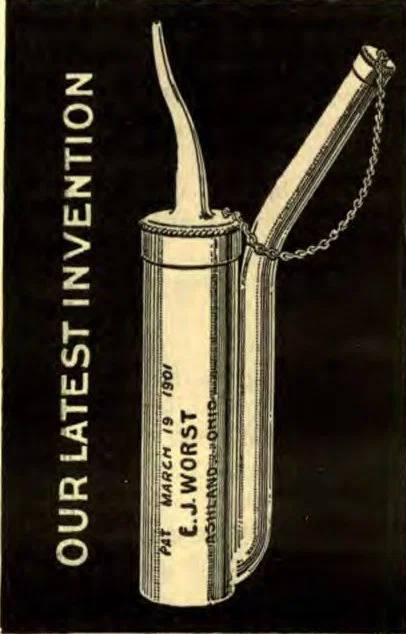
TWO THIRDS ACTUAL SIZE
Head-Colds, Pains and Roaring in the Head, Partial Deafness, Sore Throat, HEADACHE, La Grippe, and all Diseases of the air passages by inhalation. The most perfect appliance ever offered.

SPECIAL OFFER.

For a short time I will mail to any reader naming this paper, one of my new improved CO-RO-NA MEDICATORS, with medicines for a quick home cure, on three days' trial FREE. If it gives perfect satisfaction, send me $1.00 (half price), if not, return it at the expired time, which will cost you only three cents postage. Could any proposition be fairer? Address,
E. J. WORST,
16 ELMORE BLOCK, ASHLAND, OHIO.

AGENTS WANTED.

EDITORIAL NOTE.—If you have the slightest symptoms of Catarrh, or are easy to take cold, you should send for a Co-Ro-Na on the easy terms offered. In writing be sure to name this paper.

Gifts for Jesus

THIS is the time of year when the thoughts of all the world are turned to gift-giving, in celebration of God’s gift of his dear Son to the world. Is it not appropriate that at this time we should remember those less fortunate and happy than ourselves with some of the good things our Father has lent to us, even as the Wise Men of the East laid their gifts at the feet of the baby Jesus? “For inasmuch,” he tells us, “as ye have done it unto one of the least of these my brethren, ye have done it unto me.”
There is another way to bring a gift to Jesus during this Christmas week—to remember the offering to foreign missions with a gift that shall be sweet with sacrifice, and cheerfully bestowed. It is the love that enters into our gifts that makes them of value—but let us not forget that true love always gives willingly of its best. God gave the best Gift in heaven to us; let us give to him our hearts, our lives, and all that we have.

Unto You Is Born This Day a Saviour
Now it came to pass in those days, there went out a decree from Caesar Augustus, that all the world should be enrolled. . . . And all went to enroll themselves, every one to his own city. And Joseph also went up from Galilee, out of the city of Nazareth, into Judea, to the city of David, which is called Bethlehem, because he was of the house and family of David; to enroll himself with Mary, who was betrothed to him, being great with child. And it came to pass, while they were there, the days were fulfilled that she should be delivered. And she brought forth her firstborn son; and she wrapped him in swaddling-clothes, and laid him in a manger, because there was no room for them in the inn.
And there were shepherds in the same country abiding in the field, and keeping watch by night over their flock. And an angel of the Lord stood by them, and the glory of the Lord shone round about them: and they were sore afraid.
And the angel said unto them, Be not afraid; for behold, I bring you good tidings of great joy which shall be to all the people: for there is born to you this day in the city of David, a Saviour, who is Christ the Lord. And this is the sign unto you: Ye shall find a babe wrapped in swaddling-clothes, and lying in a manger. And suddenly there was with the angel a multitude of the heavenly host praising God, and saying, Glory to God in the highest, And on earth peace among men in whom he is well pleased.
And it came to pass when the angels went away from them into heaven, the shepherds said one to another, Let us now go, even unto Bethlehem, and see this thing that is come to pass, which the Lord hath made known to us. And they came with haste, and found both Mary and Joseph, and the babe lying in the manger. And when they saw it, they made known concerning the saying which was spoken to them about this child. And all that heard it wondered at the things which were spoken unto them by the shepherds. But Mary kept all these sayings, pondering them in her heart.
And the shepherds returned, glorifying and praising God for all the things that they had heard and seen, even as it was spoken unto them.
— American Standard Revision, Luke 2: 1-20.

You have reached the end of this edition.

The Youth’s Instructor · Dec 18, 1902