The Youth’s Instructor, Vol. 50, No. 50.

When God Makes Christmas Presents

The Youth’s Instructor

Dec 18, 1902

Review and Herald Publishing Company · Battle Creek, Michigan · Dec 18, 1902

When God Makes Christmas Presents

A Christmas Story

JUST why Julius Atler’s parents saw fit to name him after a Roman conqueror would be hard for me to tell. Perhaps they admired Cæsar’s genius, and thought his very name would one day inspire their young son to mighty deeds. However that may be, the boy was “Julius,” and never in the wide world did heroic name rest so ill on boyish shoulders. For he was not a conqueror; he was a complete failure—a perfect specimen, a model of his kind!
If nature had only given him a mind, he told the minister, things would have been all right. But as it was, there was no use in talking success to him! He’d read “success” books, dozens of them, and they didn’t fit his case at all. They were written, he asserted positively, for people who had latent possibilities all wrapped up in themselves, that needed only a few strings cut, and a little unrolling done, and lo! there were Fame and Fortune with scarce an effort. As for him, he had a miserable little brain, with no possibilities at all!
I don’t deny that Julius’s brain was “miserable,” the way he used it,—any brain would be,—and for a fact it was small. But at the same time it was fair of quality, and he need not have worried. A vest-pocket chronometer often keeps far better time than the great steeple-clocks—if you treat it right.
But Julius didn’t see the philosophy of that. He simply clung to the one morbid idea that because he didn’t have a steeple-clock brain, therefore he was doomed to failure.
None of us young people liked “Jule,” as we called him. We couldn’t bear his shrinking, funeral-faced ways; so when we had parties and things, we naturally left him out. Of course we were sorry for him, now that he was getting on toward twenty, and old enough to show some life and spirit; but what good would inviting him to things do? To go where others were gay and jovial, only made him more miserable. He seemed to feel himself a victim to the spite of nature, and there was no help for it.
He was getting worse and worse, too. The doctor at last began to warn Mr. Atler. “If that boy doesn’t quit his worrying, he’ll lose his mind, sir! You’d better see to it that he has something to take his attention off himself.”
So, as the holidays were coming on, the lad was sent on a visit to his brother Fred in Boston town.
Fred was not named after any conqueror; but he had striven with circumstances, and become a successful and respected artist—the pride of the family and of many friends. Of course he and his wife did their best to entertain Julius. They took him around to see the sights; visited the great stores, decked out in splendor and filled with holiday throngs; went to the best concerts; frequented the art galleries and the museums; and, in short, went wherever an atmosphere of cheerfulness abounded, and things were such as would make a boy’s heart light and glad. Surely all these things ought to warm up a chunk of ice, they thought; and it really did seem a wonder that Julius didn’t thaw out a mite. But, no! He didn’t care to go, or see, or hear. Everything bored Julius. Nature hadn’t given him a good brain! and, poor boy, that was all he could think of.
The entertainers soon saw there was no virtue in perseverance with him; so Fred went back to his work on a new painting, leaving the brother to shift for himself.
Now, Julius liked the studio. He enjoyed watching his brother paint, and moreover in the studio he was out of the way of “visitors;” so it came to pass that he spent a good part of his time there. Pictures, as nothing else, seemed to draw him out of himself; for like his brother, he had a strong artistic temperament.
And there the new painting began to interest him. In it a young man was sitting at a study-table covered with books. Across it a learned old professor sat in the attitude of listening intently to some question the youth was asking. In the face of the young man was perplexity; in the face of the old, encouragement, wisdom, and love. It was called, “The Training of the Prince.”
Julius learned that in countries where kings live, the princes and princesses are provided with teachers to accompany them, play with them, work with them, and study with them at all times, so to help and guide them continually that they may become great men and women.
“Ah!” thought Julius, “perhaps if I could have such a training,—if I could have some one always on hand to help me that way, answer my questions, and show me just what to do,—I could be something, even yet.” So he went on with his dream, painting bright pictures of what he could do and what he could be, till he was all aglow with enthusiasm. But soon again came the thought, “You can’t have the teachers, you know,” and back he was thrown on his old despair. He was again a victim of nature’s spite, feeling worse than before, utterly forsaken and wrecked!
“I’m going home in the morning,” he burst out. “I just can’t stay here any longer.”
“Why, Jule!” said Fred, “going to leave us on Christmas day! Surely you’ll stay to-morrow?”
But Julius could not be persuaded. He packed his things, and prepared to take an early train for Willowby.
That night being Christmas eve, the little family, Fred and his wife and child, gathered around the fireplace, played some simple games, and told stories, while the sad-faced brother sat back in a cozy corner, looking on gloomily, but not caring to join them. By and by the hour of retiring came, and Fred took down the old Bible to read the “chapter,”—this time the fourteenth of John. By the flickering light he read those familiar words where Jesus comforts his disciples. “Let not your hearts be troubled,” and all down the page till he came to the promise of the Teacher, the Comforter, which Christ would send to teach all things, and abide forever, that men’s joy might be full.
“What!” thought Julius, listening intently, “what is that about a Teacher to teach you all things? Why, that fits the painting to a T, surely.” And all at once the parallel of the chapter and the picture burst in on his mind with irresistible force. Was it possible that his air-castles could be real! Was it possible there was a Teacher for him? Eagerly he asked Fred to read the chapter again. The brother and his wife were surprised at the interest of his tone. What could it mean?
In the fire Julius’s imagination traced over the “Training of the Prince,” glorified and real. He himself the prince—a prince of the house of David, an heir together with Christ! Across the table, with a look on his face of ineffable love, wisdom, and kingly might, sat the greatest Teacher the universe knows, the Spirit of God—the Comforter. Ah, now he saw it all! Like the kings of the earth, the King of kings has provided for the training of the princes and princesses who one day will wear the crowns. It mattered not about the small brain now, the King would make up for it. With its healing balm, the reality of Christianity swept in over his mind, filling it with peace and content.
“Fred,” he said, in a voice that was strained to keep back the joy he felt, “Fred, if you don’t mind, I think I won’t go home in the morning!”
“Why, God bless you, brother!” exclaimed Fred, “nothing can make me happier than to know that you will stay.” The others added their heartfelt thankfulness to Fred’s, and then wishing him good night, they left the boy sitting by the fire.
“I think,” said Fred, as they mounted the stairs, “I think Julius has received a Christmas gift from God to-night.”
And Julius had. Often since then I have seen the lad go to the hardest kind of study, and work with the confident air of one who is sure of success. He worked just as if he felt the presence of the Great Teacher by his side, ready to help him do that for which his natural powers are inadequate. And he succeeds, as he only can to whom God gives success. He doesn’t claim success on his own merits, either, but says plainly that God gave him a Christmas present once, and he has it yet.
EDISON DRIVER.

Christ Is Born in Bethlehem

It was midnight in Judea, And beside a quiet stream, There were watchful shepherds seated, Pondering o’er some holy theme. ’Twas the coming Son of David Thrilled their hearts and woke their tongues; ’Twas the name of the Messiah That inspired their prayers and songs. Lower, lower, lower, Each reverent voice became, As his glory they repeated, And breathed his holy name.
O’er the hills in old Judea Hovered an expectant throng, Till a new-born baby’s wailing On the breeze was borne along. “Joyful tidings! joyful tidings!” Spoke an angel voice to them, “For to-day the Son of David, Christ, is born in Bethlehem.” Nearer, nearer, nearer, Came the angel as he spoke, And the whole celestial company Into joyful chorals broke:—
“Unto us a Son is given,— Wonderful! the Prince of Peace! Unto us is born a Saviour, And his reign shall never cease!” O, the blessed, blessed tidings Echoed o’er and o’er again,— “Glory, glory in the highest! Peace on earth; good will to men!”
Higher, higher, higher, Rose the glad, triumphant strain,— “Glory in the highest, glory! Peace on earth; good will to men!”
MRS. ELIZABETH ROSSER.

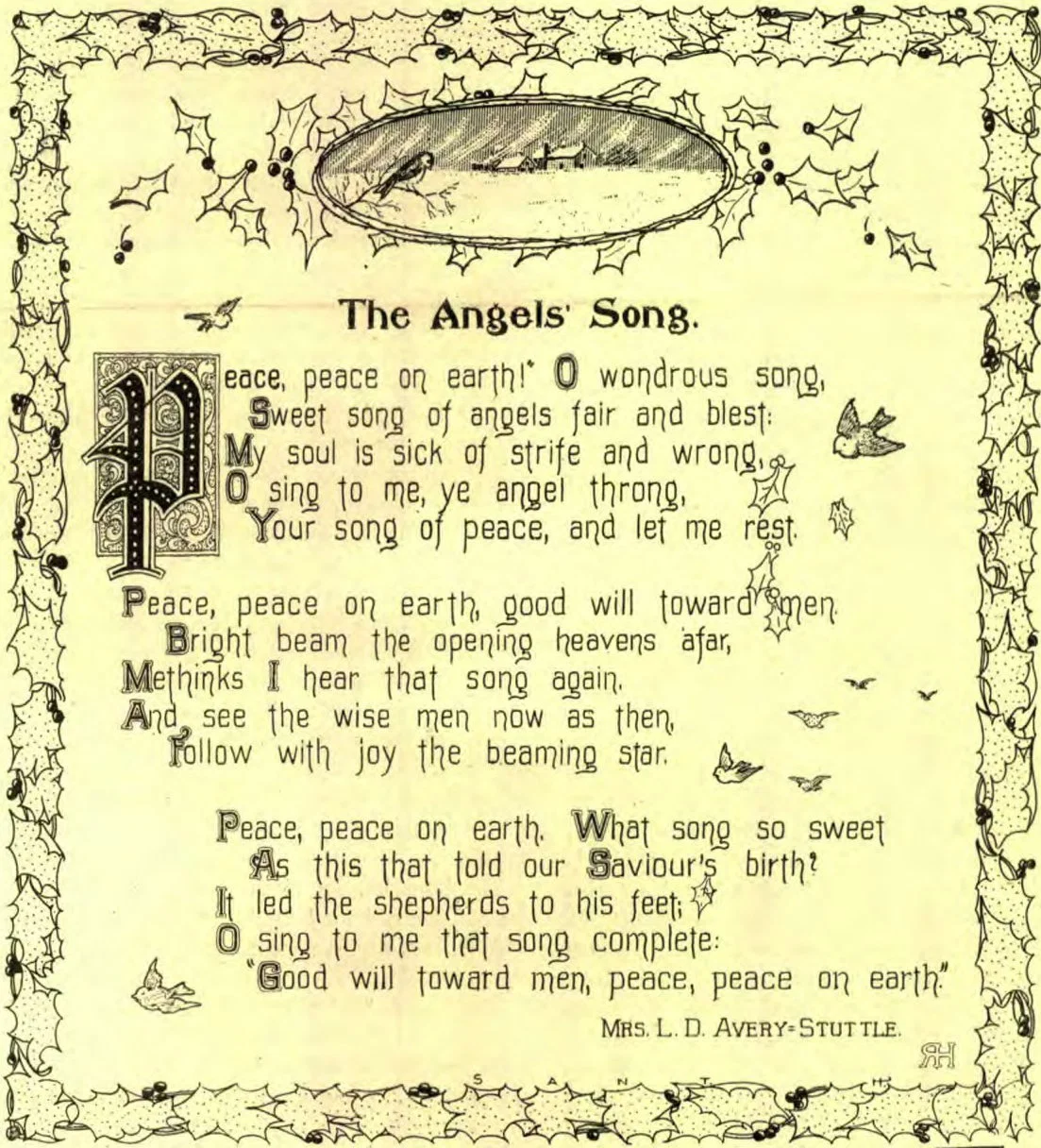
The Angels' Song.

Peace, peace on earth! O wondrous song, Sweet song of angels fair and blest; My soul is sick of strife and wrong, O sing to me, ye angel throng, Your song of peace, and let me rest.
Peace, peace on earth, good will toward men, Bright beam the opening heavens afar, Methinks I hear that song again, And see the wise men now as then, Follow with joy the beaming star.
Peace, peace on earth. What song so sweet As this that told our Saviour's birth? It led the shepherds to his feet; O sing to me that song complete: “Good will toward men, peace, peace on earth.”
Mrs. L. D. Avery-Stuttle.

The Week of Prayer

THE WEEK OF PRAYER for this year has been appointed to be held December 20-27.
There are many urgent reasons why Seventh-day Adventists should at this time devote a few days to special Bible study and fervent prayer. And there are good reasons why all our young people and youth should take an earnest, active part in this season of devotion and consecration to the Master.
Prayer is communion with God. The place of prayer, no matter where, or how humble, is the audience chamber where Jesus and humanity meet. Prayer subdues the spirit, softens the heart, anoints the eyes, and brings the whole being into sweet harmony with God.
The coming week of prayer, if observed in God’s way, will bring wonderful blessings to the cause of Christ. It will give us new and larger views of the Lord’s plan for saving sinners, and will fill our hearts to overflowing with God’s love for sinners. This will lead us to make a new consecration of our lives and our money to the work of saving sinners.
The week of prayer should bring a new spiritual life to the church. It should start a revival and a reformation that will lift the people of God onto higher ground. It should cause the worldly to sever the ties that bind them to the world. It should lead the selfish to share their blessings with their fellow men.
All this will greatly strengthen the missionary cause of this people. The ranks of workers in every department will be increased. Many more will go abroad into the needy, neglected fields so white for the harvest. A larger stream of our money will flow to those fields. These results must follow the week of prayer before us.
The hour has struck for a larger work to be done. The call for help from many lands is loud and imperative. We are not answering these calls as we should.
The Lord has not only opened the whole world to us, but has gone before us, and made such preparation for us that the people are pleading with us for more messengers. The situation is marvelous. We do not appreciate it. Once we had to work to gain a foothold in these countries by hard struggles. No one knew us, no call came for us; but this has all been changed. The work we have done in foreign lands has opened to us vast fields white for the harvest.
The readings for the coming week of prayer should be of special interest to our young people. The general subject of all the readings will be Service. The specific features of the subject that will be presented in the readings will be: Saved for Service; Open Doors for Service; Preparation for Service; True Motive for Service; Consecration of Means to Service; Definite Aim for Service; Macedonian Calls to Service.
Let me suggest that all the readers of the INSTRUCTOR make an earnest effort to attend all these readings. If possible, secure a copy of the readings, and give them careful study.
For our own personal awakening, for the uplifting of the church, and for the salvation of a lost world, every believer in the third angel’s message should enter most heartily into the services of the week of prayer. We invite the INSTRUCTOR family to join us in this. And we wish every member just the blessing and help needed now. A. G. DANIELLS.

Encouraging Reports

Two active Societies have been organized in the Maritime Provinces. The one at Halifax has seventeen members, and the St. John, New Brunswick, Society reports fourteen members. Both of these hold weekly meetings, and take up the studies published in this Department. It is most encouraging to note that these young people have caught the real spirit of this movement, for they seem to realize that holding young people’s meetings is not all there is to the young people’s work. The secretary of the Halifax Society says: “Some of our members have been visiting the sick in their homes and in the different institutions, taking with them fruit, flowers, and literature. Others have sold papers. Thirty-nine Signs and Reviews have been sold; 913 pages of tracts, and 393 papers distributed; two copies of ‘Patriarchs and Prophets,’ and one copy of ‘Looking unto Jesus’ sold. Six yearly subscriptions for The Life Boat have been taken. Three dollars and thirty-one cents was collected, and $2.00 of it used in renewing a club of the INSTRUCTOR for the young people on the island of Barbados. The interest in our meetings is very good, and still increasing.”
The members of the Society in St. John are nearly all children. They have taken ten orders for The Life Boat, and have sold twenty-five copies. Some of the older members have distributed over one hundred copies.
We are all glad for every evidence that the Young People’s work is coming to mean service. The avowed “aim” of this organization will yet be achieved, and “The Advent Message to all the world in this generation” be accomplished. Let the young people and children everywhere join in this grand final missionary crusade.
MRS. L. FLORA PLUMMER.

Bethlehem

O LITTLE town of Bethlehem, How still we see thee lie! Above thy deep and dreamless sleep The silent stars go by; Yet in thy dark streets shineth The Everlasting Light; The hope and fears of all the years Are met in thee to-night.
O morning stars, together Proclaim the holy birth! And praises sing to God, the King, And peace to men on earth! For Christ is born of Mary; And gathered all above, While mortals sleep, the angels keep Their watch of wondering love.
O Holy Child of Bethlehem! Descend to us, we pray; Cast out our sin, and enter in; Be born in us to-day! We hear the Christmas angels The great, glad tidings tell; O, come to us, abide with us, Our Lord Immanuel!
— Phillips Brooks.

The Weekly Study

(December 21–27)
THE WEEKLY STUDY is again omitted, that the young people may join with the church in the closing services of the week of prayer. In the next issue the regular studies will be resumed.

An Australian Christmas

CHRISTMAS is the one holiday universally observed throughout Christendom. Wherever a knowledge of the Saviour of man has gone, and in all places where the beautiful story of his birth has been told, gifts are bestowed by friends upon one another, and especially upon the young, in commemoration of the gifts of the wise men to the infant Messiah.
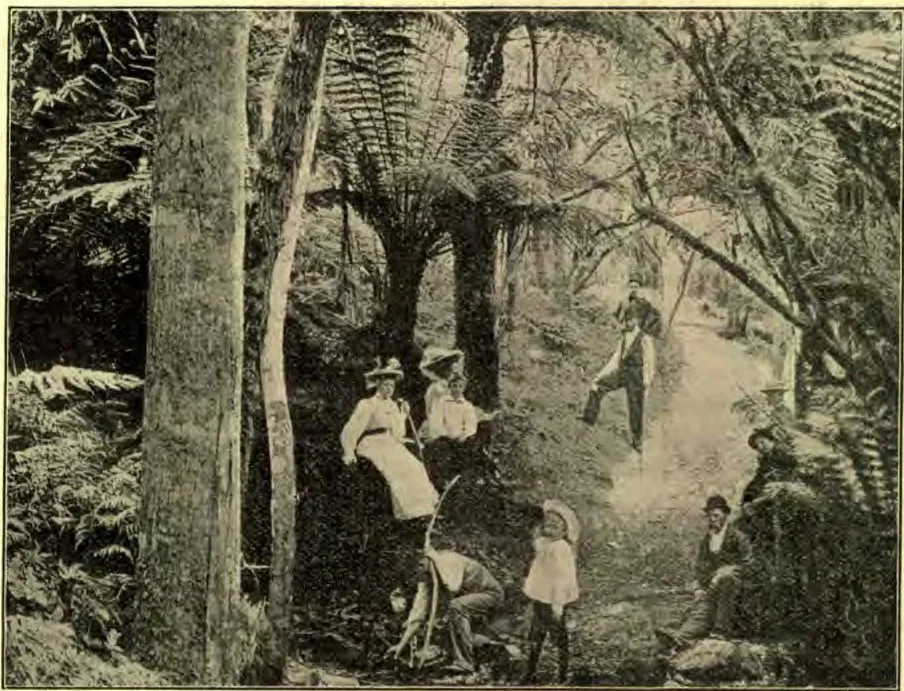
AN AUSTRALIAN CHRISTMAS SCENE
This pretty custom, harmless, perhaps even commendable in itself, has been carried to great extremes. The day once set apart to religious services and reminders of Bethlehem’s triumph, has now largely been perverted to selfish gratification. Among the many reforms in which we trust the INSTRUCTOR readers are having a large part, is the excellent one of giving on Christmas to the Saviour and his work on earth, which course certainly has the precedent set by the “wise men from the East.”
As to the exact day on which Christ was born, we need not be concerned. There is no command for its observance, as there is for the Sabbath, neither can any one be sure that the day now observed is the correct one. Indeed, the only thing about it of which we may be reasonably sure is that the day now recognized as the birthday of Jesus is not the right one. In Luke’s record we read that there were “shepherds abiding in the field, keeping watch over their flock by night.” Now we may be quite sure that in the latitude of Palestine they would not be thus engaged on the night of the twenty-fifth of December.
But it was of the day in Australia, not in the northern hemisphere, about which we set out to write. Being on the opposite side of the earth as regards both latitude and longitude, Christmas here is different in many respects from Christmas in America. In the first place, it begins about fifteen hours earlier, as this land is west of the world’s day-line. Another thing that seems very odd to all who have been reared in a cold country, is to have Christmas come in midsummer. The day corresponds to the twenty-fifth of June in America and England, as far as seasons are concerned, and is therefore often very hot. Instead of going skating or coasting, the people go to the seaside or to the country to spend the day. Thousands of children may be seen playing in the sand on the beach, which extends for miles in the southern suburbs of Melbourne. Many in this great city go to the mountains for the cool shade and sparkling spring water which are there found in striking contrast to the barren plains and waterless deserts of the Australian interior.
Our illustration shows a typical Christmas scene at Fern Tree Gully, a beautiful resort about twenty-eight miles from Melbourne. The place takes its name from the giant fern-trees which grow at the sides of the little mountain stream its whole length of about three miles. But they are by no means confined to this place, being found in many of the gullies of the Dandenong and Dividing ranges. These fern-trees are some of nature’s wonders. Never being frozen, they continue to grow from the top for hundreds of years, the brown, hairy stem, or trunk, often a foot or more in diameter, appearing entirely lifeless up nearly to its top. A little fern tree is seen in our picture just behind the ladies in the center of the view. Another one much taller will be noticed immediately to the right of the small one mentioned; but the picture was not finished high enough to show much of its wide-spreading top. The older trees are from forty to sixty feet high, and many of their trunks are covered with green parasites of various kinds, which are quite common in this country. A very small fern-tree is shown in the lower right-hand corner.
In Australia, as in England, the day after Christmas is called “Boxing day,” and is everywhere observed. Originally it was set apart as the day for giving presents, or “Christmas boxes,” as many call them. When this was done, it was intended to make the twenty-fifth of December a religious day entirely, followed by the feasting, merrymaking, and giving of presents the next day. But now in England and Australia the days are both largely used as days of drunkenness and gluttony. Like Thanksgiving day in America, the religious features have to a great extent been forgotten, and consideration is given only to the natural inclinations of the human heart.
All who are likely to forget the real meaning and object of Christmas should read Isa. 9:6. This passage gives a beautiful prophetic announcement of the first Christmas morning, and the names properly belonging to the child then born. The seventh verse tells of the endless peace and justice of the throne thus established.
H. E. SIMKIN.

The Gift of a Friend

A CHILD'S first sorrow comes when he learns that he is not understood. And when that child has become gray-haired and feeble, he looks back over his life, and sees that his greatest sorrows have been those caused by the misunderstanding of the world. Men do not understand, men do not pity. The cry of the common heart is a cry for sympathy.
The sweetest note of the Christian music is “Immanuel” — “God with us!” The supreme message of the manger — for in it is the whole gospel — is that God was incarnate in humanity. Henceforth this is to be an ever-newer earth; for into it has come an understanding and sympathizing Friend of man.
No more can we sob away our lives in loneliness. No more can we sorrow and suffer alone. No more have we a high priest who can not be touched with the feeling of our infirmities. The birth of Christ has brought to every heart, no matter how sore or how sinful, a Friend who knows us, pities us, loves us.
Ring out! ring out, glad bells, to every aching, lonely soul, the good tidings of great joy, “Jesus knows!” — Well-Spring.

Missionary Women in Persia

“THE greater number of contributors to the support of women missionaries in far countries have not seen and can not know at what a cost of self-renunciation and discomfort and deprivation and peril to health, life, and limb the missionary pursues her calling,” says John Kimberly Mumford, who, in a late number of the Youth’s Companion, gives the following graphic picture of the life of women missionaries in Persia:—
“Broadly speaking, there are two phases of the missionary woman’s work in the East,—first, at the stations in the large cities, and on the road.
“This latter is called ‘village work,’ or ‘itinerating,’ or ‘touring,’ according as the period passed in each town or huddle of mud huts or tents be long or short.
“In northern Persia, which has great altitude, and hence bitter cold and snows, suggestive of upper Canada, the missionaries, like the nomad shepherds, pass the winter months in the towns. The time is taken up with healing the sick and helping the poor, who are a multitude, teaching the ambitious and holding religious meetings.
“When the heaviest of the snow has gone, and the spring floods in the rivers have subsided, they start out into the mountains, to wander about until fall, from village to village, from camp to camp, a great part of the time among half-tamed people to whom robbery and murder are only pastimes.
“Shortly after arriving in the city of Tabriz, in the month of May, I paid a call at the mission house. There was a ponderous wooden door, opening in one of the mud walls which make up well-nigh all the outward show of a Persian town; a long walk through an inclosure, the vegetation of which was most grateful to the sight, past some tidy brick school buildings, and up to a wicket gate which gave approach to the yard and doorway of the hospital.
“A native servant answered the summons of the bell, and took our cards to the missionaries, who could not then receive us, for the good reason that within the building at the time a score or more of native women awaited medical treatment, and listened meanwhile to the reading of Bible stories and explanation of the Christian beliefs. While we stopped at the door, others, heavily robed and veiled, came down the long walk and passed in, bound upon like errands.
“We went away, and on the following day were bidden to dinner at the mission. Arriving, we were shown into neat living-rooms, carpeted after the Eastern manner, but fitted with the furniture and decorations of an old-fashioned American home. All about the plain place was evident the familiar New England neatness, a cleanliness comforting after the tangled, noisy, malodorous bazaars and the dirty streets through which we had come. Birds were singing among the trees in the garden.
“ ‘Dr. Bradford’ somehow suggests a professional-looking gentleman, preferably of middle age, with a gray beard and a stock. I found some difficulty in reconciling the name with the presence of a tall and most gracious young lady.
“She conducted me through the establishment, which, I believe, was a gift to the mission board from the former owner, an American.
“There was a small but neat and well-stocked dispensary, arranged similarly to those in some of the smaller hospitals at home. In the wards, upon shining cots, were child patients, their yellow skins showing a deeper yellow, and their big, dark eyes bigger and darker against the white linen. They were, for the most part, victims of typhoid fever, sufferers for the sin of municipal dirtiness.
“I wondered what they were thinking—those who were old enough to think; how it seemed to be taken out of the filthy places some of them called home, out of the dampness and the pestilential stenches, and without money and without price to be laid in these cleanest of clean beds, under the ministrations of such women as these.
“The Oriental is acquisitive. He loves dearly to get something for nothing, but he is human, and I thought the knowledge of these things being done for him out of the unselfishness which is the foundation of the despised Christian faith must needs provoke a wavering in his mind as to the preferability of Mohammed’s gospel. I said as much to the mission doctor.
“ ‘Well, they are grateful,’ she said. ‘More so, I think, than some of the patients in charity hospitals at home; for these people expect so little, and being cured seems such a magician’s work to them, that they are overwhelmed with what is given, and given freely. How much of our teaching do they absorb along with the medicine? That is hard to say. Not much of dogma, perhaps, but more of the spirit, I think, than can very well be measured.
“ ‘The promulgation of a faith in Persia, where its own beliefs are so deeply ingrained, is necessarily slow work at best. There is the training of centuries to overcome, and ignorance such as prevails here makes always an unreceptive ground; but much of the old superstition and intolerance are disappearing, and friendly appreciation and intelligent interest are taking its place. That is a result worth having worked for.
“ ‘The time passed here in the station is recreation time, in a way,’ she continued, ‘for here the people come to us. In the other branch of the work we go to them, and the way is very rough and very long. But they need help so badly!’

“Through the Kara Dagh

“When I called at the mission a week later, to take leave before departing from Tabriz, I was told that Dr. Bradford had gone away to the north, on a tour of some months through the Kara Dagh Mountains, accompanied by one other missionary woman and a single servant.
“ ‘A tour through the Kara Dagh Mountains’ sounds like a summer trip through the Alps or the Highlands, or some hills nearer home. But it is not the same.
“The Kara Dagh — Black Mountains — is an impregnable sort of rampart, lying across the northern border of Persia, between the Caspian and the Black Seas. Its ravines and crags are peopled with more races and representatives of more creeds than anybody has ever been able to enumerate, and when the tribes are not fighting collectively with the soldiers of the shah, they are burning villages and killing one another, either in reprisal for recent wrongs or in the prosecution of feuds centuries old. Among their fastnesses they hardly acknowledge an imperial sway. Their local law is the old one that ‘he shall take who has the might, and he may hold who can.’
“To the traveler entering these parts, arms are essential; the look of them is deterrent. The tales you may hear from the missionaries of adventures with this gentry would make a very exciting volume. But except in the very roughest and out-of-the-way regions, the missionary women who have once been over the road are recognized and deferred to. Even the robbers let them pass, and indeed from the time they reach the mountains, they are too busy doctoring the sick to find time to be robbed.
“Eternal vigilance is necessary, none the less, and at nightfall, after a day of surgical work and dispensing of medicines, the missionary woman has to go about her quarters, whether in camp or under roof, and chain up and lock up everything, from her medicine-chest to her horse’s feet. If this precaution were neglected, the expedition would be doomed to terminate then and there.
“The equipment is meager at best. Beds, blankets, sleeping-bags to keep out the tarantula and as many of his minor kindred as may be, rain-coats, and plain cooking utensils, are all packed in two mafrashes, or carpet-trunks, and lashed to the sides of a pack-horse.
“On the top of them the attendant rides, usually; for to cut the ropes of the pack-animals of a caravan, whether great or small, and stampede them off into the hills, or to loose the lashings and lighten the horse or mule of his burden under cover of the darkness,—these are favorite tricks of the Persian robber.
“When the woman doctor from the mission has once become known through the hill country, her coming is awaited like the advent of spring or the harvest-time. The sick are brought, sometimes on horseback, sometimes on litters, sometimes on camels, to the village where it is known she will halt.
“When she arrives, her work is ready for her. The lame, the halt, the blind, the fever-stricken, the dropsical, the paralytic, all are waiting, the sickest laid in rows just outside the door. Men, women, and children come running from the fields, begging to be cured of their infirmities.
“One missionary woman skilled in medicine reported two hundred patients a day, with forty operations on the eye alone, during the space of three weeks. All the work was performed in the most unwholesome of surroundings, and with the minimum of antiseptic safeguards; sometimes with the rain pelting in on her through the gaping roof, and two inches of viscous mud on the floor of what her patients called a dwelling.
“And when the afflicted of one settlement have been set to rights, there is the road again, with the killing heat and dust, the insufferable hills, the swamps, the torrents to ford, and the gentleman in the gully scowling along the sights of a first-class modern rifle (the wonder is how he came by it), and demanding sugar for his tea, money, jewelry, or whatever may go to make a respectable profit from so fair an opportunity.
“Then follows more of the sick and the loathsome, for they are everywhere in Persia. So on, month after month, until snow comes and drives the travelers from the roads, and the nomads down from the mountain ranges, into their lowland huts, which all summer long have stood tenantless.
“It is not golf, and it is not surf-bathing, and it is not moonlight sails or a cruise up and down the panoramic coast of Norway; but the missionary woman, coming back to the station, writes it down in her diary as ‘a blessed summer,’ and over the frowning heights of the Kara Dagh is a trail of good deeds.”

To-Day

O NIGHT of nights! O night Desired of men so long! The ancient heavens fled forth in light To sing thee thy new song; And shooting down the steep, To shepherd folk of old, An angel, while they watched their sheep, Set foot beside the fold.
It was so long ago; But God can make it now, And as with that sweet overflow, Our empty hearts endow. Take, Lord, these words outworn, O, make them new for aye, Speak—“Unto you a child is born,” To-day—to-day! to-day! —Jean Ingelow.

On the Hills of Bethlehem

On the bleak hills of Judea, When the night had settled down, With its calm and holy quiet Over meadow, field, and town; While above the bright stars glistened, Of the gloom the only light, Hardy shepherds watched in patience By their flocks so meek and white.
Quietly the sheep browsed near them, And when satisfied, lay down Side by side in woolly winrows, On the hillside bare and brown; Till at last the whole flock, gentle, Rested at the weary feet Of the shepherds, holding converse In low voices strong and sweet.
On this scene the gates of heaven Suddenly were opened wide, Pouring a celestial radiance O’er the rugged mountain-side; And the shepherds’ awe-struck faces, Lifted to that wondrous light, Shone with glorious reflection Of the heavenly glory bright.
Then a form of matchless glory Flashed upon the dazzling scene, And the face of God’s own angel Bent above with smile serene; While in voice to match his beauty, Terrible but wondrous sweet, He addressed the startled shepherds, Trembling at his shining feet:—
“Fear ye not! Good news I bring you! Christ the Lord is born this day, Down below in David’s city, Cradled in a manger’s hay.” Then a host which followed after, Like the angel, pure and bright, Raised a song whose wondrous music Reached from earth to realms of light,—
“Glory! Glory in the highest! On earth peace! Good will to men!” Thus they sang the hallowed anthem On the hills of Bethlehem.
As it came, the vision vanished. In an instant all was still,— Angels gone; the light departed; Hushed the song upon the hill. But the shepherds, awed and wondering What it all should mean to them, Left their sleeping flocks, and hurried Down the hills toward Bethlehem.
Filled with guests was David’s city; Far and near, they all had come, Till each inn possessed not even Room for but another one. Then came Joseph, worn and weary, But was forced to turn away With his wife, and seek a shelter In the stable on the hay.
Near them soft-eyed kine were feeding Close to beasts of burden pressed, But the place was sheltered, quiet, And it furnished needed rest; So they tarried, and a manger Served for couch until the morn, And ’t was there the King of Heaven, Christ, the Son of God, was born.
There his mother fair caressed him, As alone a mother may, And when hushed to slumber, laid him In the manger on the hay; There the raptured shepherds found him, As the angels told them when They had sung triumphant anthems On the hills of Bethlehem.
All they’d witnessed, told the shepherds, Ere with joy they did depart; And the story Mary cherished, Pondering within her heart. So may we the same sweet story Ponder o’er each year, as when Angels sang their joyous anthem On the hills of Bethlehem.
MINNIE ROSILLA STEVENS.

Knowing Evil Only as Evil

“It is foolish to say that one needs to be acquainted with sin in order to avoid it. All the knowledge one needs of any form of evil, that he may keep clear of it, is the knowledge that it is evil.”
Continue reading: LEAVES FROM A MAPLE TREE