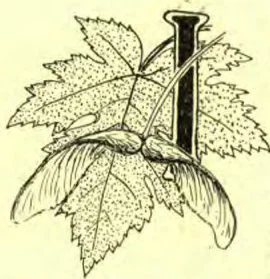
I was a tiny seed, with two wings. The wind whisked me off the twig where I had been growing, bowing and bending with every breeze, and carried me far from my Mother Maple. I fell in a soft, mossy spot on a sunny bank sloping toward the great river. The sky was not always bright, though, nor the bank always sunny; for soon it began to rain,—oh, how it rained!
“A WHITE FOOT INTO THE EARTH”
If I had not been caught between the roots of a wild rosebush, I should certainly have been washed down into the river. Then I knew the rainy season, of which Mother Maple had told me, had begun. After a while the nights grew colder, and I thought I would surely freeze. But a soft, white blanket was spread over me, and I slept, warm and snug, for a long time.
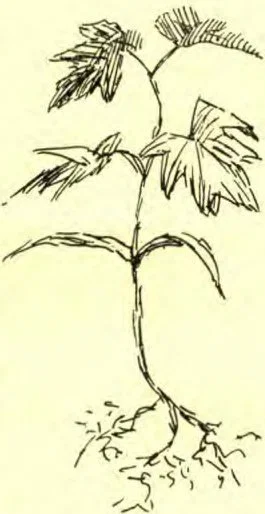
When I woke, I began to stretch myself, and presently sent a white foot down into the earth, and a crumpled, green hand up into the air.
The sun was shining, and all the land was sweet with spring. It seemed a happy thing to be alive, and I lifted up my fluttering hands in praise. I was a Little Tree.
How I loved sweets! I reached about with my tiny root-mouths, and supped up all the sweetness I could find. I loved to live by the rosebush; for she, too, was sweet, and when she was covered with bloom, the bees and butterflies hovered about her all day.
“MIGHT HAVE NIPPED ME OFF”
Then, too, if it had not been for the protection of her sharp thorns, some hungry creature might have nipped me off, and I should never have grown up to tell this story.
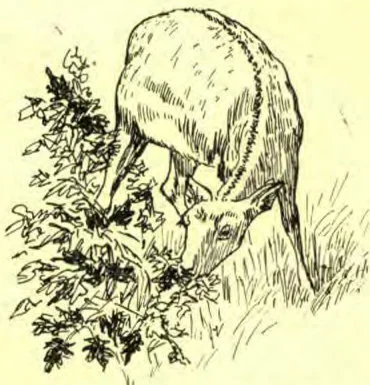
But by and by I grew taller than the bush, and then the deer used to browse my leaves and tender twigs in the spring; but I did not care, for I knew they could not harm me, and soon I was a great Forest Tree.
“SAWED INTO LOGS”
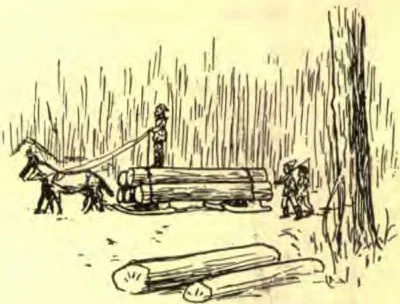
Years and years I grew on the beautiful river bank, and host after host of winged seeds I had sent out, until I stood in a grove of soft maples. At last I was cut down, sawed into logs, rolled into the river, and floated downstream to a great, noisy mill, where I was cut into pieces two and one-half feet long, sawed into thin boards that tapered from the center toward the ends, bound with hoops, had two heads put in,—and I was a Barrel.
“Now,” I thought, “I wonder what I shall be used to hold. I hope it will be sweet, or, at least, pure and good. I would be willing to carry flour or salt, but if I should be filled with rum or beer, I should feel terribly.”
I had quite a while to think of it; for I was loaded, with hundreds of others just like me, upon a ship that sailed off down the Pacific Coast. By and by I came to a factory full of sweet smells, where I was filled, and to my joy, I was a Barrel of Sugar.
Away, away to the north and east I was sent, to a place so cold that it would have frozen the sap in my veins, if it had not long ago dried out of me. Here, after lying for some time in a warehouse, I was taken into a store, where parcels of sweetness were dealt out from me to dozens of people. As the grocer weighed out the last pound for a pleasant-faced young lady, I asked myself, “What next?” As if in answer to my question, she said to the grocer,— “And, please, Mr. Jones, send up an empty barrel.”
So her parcels were packed into me, and I was carried to her house, and set in a corner of her kitchen. “What in the world will she use me for?” thought I. “I shall never again carry anything so good as my last load, I am sure.” And this remark shows how little an empty barrel may know.
But what I did not know, I was soon to find out. It was dusk when I was taken from the kitchen to the dining-room. I knew it was the dining-room, though I had never been in one before, by the pretty round table and the shining dishes in the cabinet. But if the table was “set,” it seemed that I was the one to be fed—such a queer meal, and so much of it—parcels and packages of every shape and size.
“You’ll never be able to get all these things in that barrel, Patty,” said a gray-haired lady, doubtfully, looking first at the table and then at me.
“Huh! I should say not!” cheerfully echoed her young brother, sniffing with undisguised longing the neat little packages of wholesome sweets that formed a pyramid on one corner of the table.
“AND THEN THE UNPACKING BEGAN”
“Here, you rascal!” cried Patty, gaily, “you’re not to touch, taste, nor handle, sir!” whisking the goodies out of reach. “Bring some old papers, please, and the hammer and nails, and we’ll proceed to show how everything’s going to find a place. Everything must,” she added, soberly, to her mother; “there isn’t a thing here that these children or their dear mother can spare. I only wish there were twenty times as much.”
Patty worked while she talked, and one by one the bundles were being placed in me. Sometimes they had to come out again, and once every single398thing was taken out, and all packed in again, more closely than before.
“Dear old Barrel!” said Patty, as she and the Boy put in the last things, squeezed them down, and nailed the head in place,—“dear old Barrel! you don’t look very stout, and you have a heavy load and a long journey; but you’ll be very careful, won’t you, and not fall apart, but take everything safely to the mother and her boys and girls?”
So I was packed, until, what with the parcels, what with the love and good wishes patted down among them, and especially, what with the happiness I was to carry to that pioneer family I had heard so much about, I was sure my hoops would burst. And then I was a Christmas Barrel.
As I was loaded on a west-bound train, “Dear me!” thought I, “I do believe this is the sweetest load I’ve carried yet; and I’m sure somebody is going to be very glad to get me.” At last I was rolled from the cars, at the depot of a city very near the spot where I had grown long before; and the very next day I was put on a wagon, and carried out into the country.
It was dark when I was taken from the wagon, at the door of a little cabin that reminded me of the homes of the settlers who built about me when I was a Little Tree.
Here I was met by an expectant group of boys and girls, whose jubilant spirits could hardly be held in check until the owner of the team had driven off.
“O, what a big barrel!”
“It won’t come in at the door!”
“Yes, it will, too! There was no room to spare though.”
“Please open it right away, papa!” came a chorus of voices, as the door closed.
“Papa is cold and hungry, children; wait till he has had his supper,” said their smiling mother.
So I stood in the middle of the floor, greatly admired and wondered over, while the father ate his supper, which was much shortened out of regard for the impatience of the young folks. Perhaps, too, he might have been a little curious himself to see what I held.
“Here’s the hammer, papa!” cried one of the boys.
“Here’s the ax, papa!” cried the other.
“It is pretty late; don’t you think we might wait until morning? The children really ought to be in bed,” said mama.
“Ah, well, Christmas comes but once a year,” said papa; “and such a Christmas as this is not apt to come that often. I think we had better open it to-night;” and he looked questioningly at mama, who was smiling mischievously, for she was only trying them.
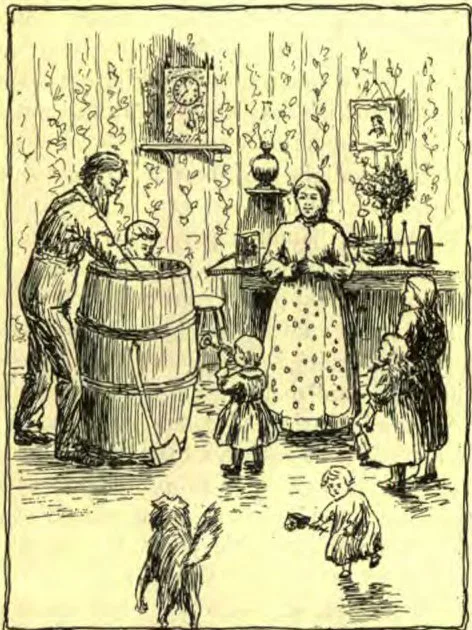
So they all stood around me while my head was taken out; and then the unpacking began,—and what was there they didn’t find in me! School-books, story-books, picture-books, song-books, paper and pens and pencils, pins and needles and thread, toys and games for the boys, dolls and silk scraps for the girls, dishes, quilts, and (relief for that burden of the pioneer mother’s heart), clothing, were taken out amid delighted “oh’s” and “ah’s” from the children, while the mother looked as if she didn’t know whether to laugh or cry.
But the chief delight and admiration of young and old seemed to be a pretty, green-enameled, iron doll-bedstead, with its mattress, blankets, sheets, and cunning little pillows. And oh! the dolls that were to occupy it! They were enough to satisfy the heart of any little girl-mother, especially the blue-eyed beauty in really, truly, long baby-clothes.
Well, all good times must come to an end, and so did theirs, for that night; for the children had to go to bed at last, with shining eyes, and tongues that could hardly keep still, while the happy father and mother put my contents away,—not all back in me again, for they never have been all back in me, although I still stand, as a table, an honored article of furniture in the cabin.
But I am always spoken of as
THE BARREL
AUNT BETTY.
First Lessons in Geography
By F. Bralliar
Lesson XVI
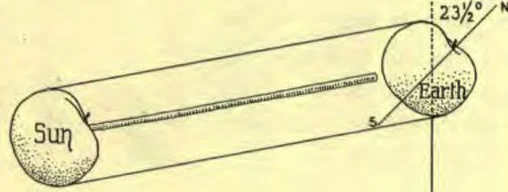
Since there has been a change in the earth's axis, there have been four seasons in the temperate zones. This is because there is more light on some parts of the earth at certain times than at others. To illustrate: Place a pencil through an apple; then put the apple on an upright stick, so that the pencil is tipped twenty-three and one-half degrees from the perpendicular. (See illustration.) This apple, we will say, represents the earth, and the pencil represents the earth's axis.
Now put another apple on the table to represent the sun. Light moves only in straight lines; so we will put a straight stick in this apple, reaching from it to the first apple, to represent the rays of light that come from the sun to the earth, and reach past the other pole. Of course, there are many rays from the sun, but one stick may be used to represent all of them. Move the stick to any position on the apple that represents the sun, and notice that the results are the same.
The apples should have been placed so that the north pole is pointing away from the sun. Now we have winter north of the equator and summer south. Move the earth-apple one fourth of the way around the sun, taking care that its axis points in the same direction all the time. Now you will see that the sun's rays fall on all the earth every day. When the real sun's rays fall on the earth in this way, it is spring north of the equator and autumn south.
Now, move the apple another quarter of the way around, and notice that the sun's rays reach only one end of the earth-apple. When this is so, it is summer north of the equator and winter south.
Again move the earth-apple another fourth of the distance around the sun-apple. Now, the sun shines again on all the earth, and it is fall north of the equator and spring south. Then move the earth-apple the rest of the way around the sun-apple. Now the sun falls as it did at first, and we have winter again.
As this change in the position of the earth's axis took place at the flood, and will not be righted till the earth is made new, God tells us that as long as the earth stands, summer and winter shall not fail to come in their season.
REVIEW.—In what zones do we have four seasons? Name these seasons. Tell what causes them.
NOTE TO TEACHERS.—It is intended that this lesson should be made largely an oral one. Use the illustration given, or some other simple arrangement of objects, till the idea is grasped. Do not attempt to enter too much into detail in this grade.
Lesson XVII
We learned in our last lesson that there has been a change in the position of the earth's axis since creation. This change causes a difference in temperature on different parts of the earth's surface. And this, in turn, makes the seasons, and also causes the winds to blow.
Try to drop a piece of tissue-paper or a bit of down on a hot stove. What happens? What causes it to rise? In the same way the hot air in the torrid zone rises. There the sun shines straight down, and makes the air very warm, and this warm air rises. The air at the poles is always cold and heavy. This is because the sun does not shine straight down there, and part of the year it does not shine there at all. When the rays of the sun do touch the poles, they shine at an angle of twenty-three and one-half degrees; so the earth there never gets quite warm.
If you try to take a can out of a pail of water, you know how the water will run in to fill the place where the can was. So the cold air at the poles flows in to fill the place where the hot air in the torrid zone rises. As it is always hot in the torrid zone, the cold air from the poles always flows toward the equator. There are so many things on the land to stop those winds that they are usually found only on the ocean. “The wind goeth toward the south, and turneth about unto the north; it whirleth about continually, and the wind returneth again according to his circuits.”
If you have ever been standing in a wagon when the team started up quickly, you will remember that you found it hard not to be thrown down, because you399could not start so quickly. So the cold air at the poles is not moving very fast toward the east. As it comes south to where the earth is moving very rapidly, it can not keep up. So these winds, instead of blowing south in the northern hemisphere, blow southwest; and in the southern hemisphere they blow northwest. These winds we call Trade-winds. They blow in the temperate zones, and in the same direction all the year.
The hot air that rises in the torrid zone sinks to the earth again, just as your piece of tissue-paper fell to the floor as soon as it was away from the heat of the stove. So the air flows back again to fill up the place where the cold winds came from. These winds nearly always blow on the ocean, usually from the northeast. They are called Counter Trade-winds, and have a great effect on the climate. So it is plain that Solomon understood how the Lord makes the wind blow to keep some parts of the earth from getting too cold, and other parts from getting too hot.
REVIEW.—What effects have been made on the earth by the change in position of the earth's axis? Why is it warm in the torrid zone and cold at the poles? What are trade-winds? From what directions do they blow? What are counter trade-winds? In what zones do they blow?
NOTE TO TEACHERS.—Do not attempt to be too technical in this lesson. It is intended to teach that God has provided a way to regulate the temperature in the earth. See that the pupils are able to explain the cause of winds, and know in what direction they blow, as well as their names. F. Bralliar.
Christmas Carol
By J. G. Holland
THERE'S a song in the air!
There's a star in the sky!
There's a mother's deep prayer,
And a baby's low cry!
And the star rains its fire while the beautiful sing,
For the manger of Bethlehem cradles a King.
In the light of that star
Lie the ages impearled;
And the song from afar
Has swept over the world.
Every heart is aflame, and the beautiful sing
In the homes of the nations that Jesus is King.
We rejoice in the light,
And we echo the song
That comes down through the night
From the heavenly throng.
Aye! we shout to the lovely evangel they bring,
And we greet in his cradle our Saviour and King.
— J. G. Holland.
Never Outgrown
WINIFRED was a timid little girl, and it was with thought of her need of encouragement in times of childish fear that her father wrote on the fly-leaf of the Bible which he gave her on her eighth birthday the verse, “What time I am afraid, I will trust in thee.”
It was a favorite verse of her father’s. He had gone to the war when a mere lad, and had been in battle and lost an arm. He told Winifred that the verse had always done him good, and he thought that it would be a good one for her.
Winifred looked at her father’s empty sleeve, then read the verse again, and thought that if that verse could make her worthy to be a soldier’s daughter, she would gladly learn it.
“What time I am afraid!” There were times enough and things enough to cause a little girl to fear. There was darkness, and there were dogs, and there were men who looked wicked and dangerous. Winifred recited the verse very often, and it gave her comfort. She said it to herself many hundreds of times, and meantime the years passed, and the little girl became a woman and a mother.
“The things to be afraid of changed as I grew up,” she said. “The occasions for fear were other than those that troubled me when I first learned the verse. But I made the discovery that the verse expanded as the girl grew into the woman; and it was just as good to inspire moral courage as it once had been to help me to go to bed in the dark.”
“It is not the only verse of the kind,” suggested the friend to whom she related the experience. “It is one of the constant discoveries of those who have learned to love the Bible, that as they outgrow the conditions that first brought them comfort from it, the Bible grows with them, and proves adequate for their needs.”
“I know that has been true in my experience,” said Winifred. “The fears of the girl and the fears of the woman have found their help in that trust of which the psalmist wrote, and that love that casteth out fear, about which St. John told.” — Selected.
Moravian Mission Work in Greenland
“Two years ago the Moravians gave up mission work in Greenland that they had carried on since 1733; and now only a few hundred of the people there are still heathen, while these are mostly in parts of the country that are almost impossible to reach.”