After seven months’ stay in Sin-tsai Hsien, our mission station here in Honan, we decided to move farther south, and make Lo-shan, one of the outstations, our future home. Early in May Mr. Pilquist started by mule cart on a two-days’ journey, to secure a house in that place. On Friday afternoon he reached the town; and on Sabbath he had a much-needed rest, and met with a few inquirers and a number of people who had heard of his arrival, and had come to see him.
The day after, he started out to find a suitable house; and by the loving providence of the Lord, that same day, before sunset, premises containing six houses and four big courtyards were secured both cheaply and satisfactorily.
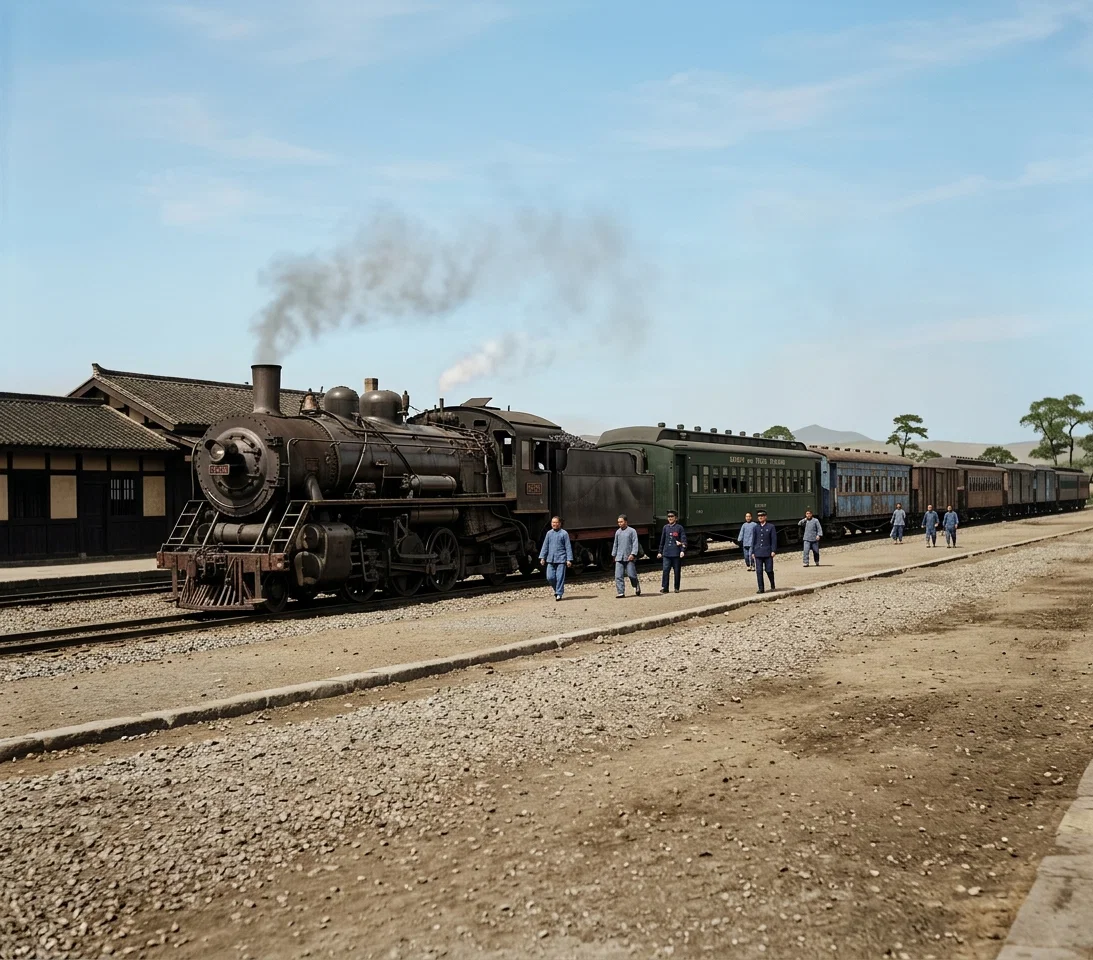
TRAIN ON THE HANKOW AND PEKING RAILROAD
In Inland China, and especially in this province so newly opened to Christianity, it was indeed remarkable that he was able to rent in such a short time. “For he knoweth our frame; he remembereth that we are dust.” The Heavenly Father saw our great need, and his ever-present help favored our move to this place.
During the fortnight’s absence, Mr. Pilquist went to Hankow, bought some lumber, etc., and returned again to look after a number of workers who were repairing the houses. A few days more, and he was again in Sin-tsai Hsien, helping me with the packing.
Looking back to my short stay in Sin-tsai Hsien, I must say that most of the time has been spent in weakness. But the supernatural power and strength from on high have proved a wonderful blessing during the months past. No wonder, then, that my strong feelings caused the tears to flow when I cast a last look into the room where sickness, sorrow, and utter helplessness had met with the almighty and sympathizing Jesus, “a very present help in trouble.” And there once more I knelt down in thankful remembrance of his life-giving power which restored me to health that memorable day in January. Here, in this very room, the heavenly host ministered unto me. Here the ever-compassionate Father, Son, and Holy Spirit were with me in lonely hours, and their mighty presence changed the death-bed and spread heavenly light and comfort all around.
It was indeed heaven on earth. And how I long for the perfect experience when we shall behold the King of kings in his beauty! “I shall be satisfied, when I awake, with thy likeness.”
As I look back, I am tempted to ask myself, Was my stay of any profit? Did I accomplish anything? It is not for me to answer these questions; the final day of harvest will surely give the best answer. But so far as human eyes may see, I believe that my feeble efforts, put forth in His name, were not in vain. Certainly our hearts ache to see so little fruit come out from the hard-worked soil in China. But, praise the Lord, it is not altogether fruitless, although it seems so.
Had you seen the poorly clothed women and children flocking in to visit me for the last time, and heard their friendly talks and expressions of sorrow to part from one who had just become their friend, I am sure your heart would have thrilled with hope. I used to gather them around me in a humble room in their neighborhood every other day, and in a simple way tell them the “old, old story.” These ignorant, neglected, and ill-treated women had begun to understand a little, and, “Now you are going to leave us,” were their solemn words. Yes, I was going to leave them, and make room for the new workers. Our friendly conversation in the courtyard under the blue sky came to a close, and we separated to finish our daily duty. Then a last farewell, and I saw them no more.
Among these women were a few who regularly attended both the Sabbath and the weekly meetings. Another was my trained Bible woman, Mrs. Chen, who was converted after my healing. Her husband is one of our earnest converts from Sin Iang Cheo, our first mission station in this province. I felt the separation from her more than I can tell, but it was not my privilege to have her future help in my lonely work among the women of China. May the Lord make her a blessing in that place.
We heartily enjoyed the tour down river to this place, and when the houseboat was exchanged for bamboo rafts, our children’s delight was beyond expression. It was interesting to see how they enjoyed running barefoot in the refreshing water along the river bank, sometimes helping to pull the rafts forward in the shallow water.
After about eight days’ slow progress, we reached our destination safely, for which we feel thankful.
Lo-shan, Honan, China.
The South German Conference
By L. R. Conradi
L. R. CONRADI
The annual meeting for the South German Conference convened at Stuttgart, a city of two hundred thousand inhabitants, January 11-15. There were delegates from Wurtemberg, Bavaria, Baden, Hesse, and Alsace-Lorraine. The conference sessions were held in the regular meeting-hall of the church at this place, which now numbers over sixty members, while the evening services were held in a music-hall, which was crowded every night. Elders H. F. Schuberth and J. T. Boettcher, and the writer assisted in the meetings.
This conference contains a population of thirteen million, and while the South for a time remained rather behind the North in its growth, yet recently it has been coming up well, and the last year shows a healthy increase. Although the president had comparatively little help, yet one hundred and seventeen were baptized, and seven were added by vote, increasing their membership to four hundred and one. The tithe was $4,381, against $4,102 in 1903; and their offerings $954, while for the previous year the offerings were $594.
The South German Conference paid two tithes to the German Union this year, and although its income was not equal to its expenses by about eleven dollars, yet it had a small surplus from 1903, so that this deficit was easily covered.
Several new churches and companies were added during the year. Very singular is it that these companies and churches were raised up in Bavaria, where we have had the most difficulty in our efforts to carry forward the work. After we had been operating a while in this kingdom, the government stopped our meetings. We have twice appealed to the government to be at least tolerated. In this we have both times been refused. In Nurnberg we have a church of about forty members, and each one who attended the Lord's supper was13fined twelve dollars. I visited one of the higher officials. He excused himself on account of the law. He said that we had liberty, for there was a statute passed in 1803 granting religious liberty; but at the same time it states that no religion can be introduced without the consent of the king. As the king has twice refused to grant us this right, we must still suffer the consequences. But while the government may try to restrain, yet God's Spirit is not bound by earthly powers and governments. It is this very part of the South German Conference that has made the greatest advancement the past year, and we had quite a good representation from that kingdom at the meeting. The church at Ulm, a city of fifty thousand, has also shown a good increase. We were glad to see so many men at the meeting,—men who have lately embraced the message. Twelve were baptized at the conference.
The delegates and the brethren throughout the field have shown a real interest in the financial support of the cause, as they have given liberal Sabbath-school and First-day offerings, and have heartily supported the suggestion to take up a special collection for the Washington fund. Brother Weber was unanimously chosen president for another year, and he will have one ordained minister to help him. Brother Erzenberger is also expecting to settle in this conference, and although he is in the employ of the Union, yet he will help the South German field as much as possible. The conference has three licentiates and five Bible workers to begin the new year.
The canvassing work has shown more growth in the South German Conference than in any other field of the Union, the sales advancing from seven thousand dollars to twelve thousand dollars. One brother sold eight hundred and sixty-five copies of “Great Controversy” in 1904.
There was perfect union in the deliberations of the business sessions. A good spirit prevailed. The work as a whole has shown greater evidences of prosperity than during any previous year.
Friedensau, Jan. 31, 1905.
Experiences in Cuba
By Joseph Clark
JOSEPH CLARK
Two years ago I came here with my family to do self-supporting missionary work, and began day-labor in a large improvement colony, conducted by American capitalists. Later I worked in the young orange groves covering one thousand acres. I have enjoyed opportunities for doing personal work.
When we came here, we could not rent a house. But we have since been blessed in buying a small house and ten acres of good land, with some orange-trees and nursery stock, on time, only paying interest, which is the same as rent. This company gives colonists the privilege of working for them just when they wish, and is very kind about the Sabbath.
The Lord has blessed all of us in selling some of our small books, Spanish and English Testaments, and Signs, and distributing several thousand pages of literature to natives and Americans. We have been permitted to do more for the American negroes here in five months than we did in the States in five years.
The Northern Baptists have begun to hold occasional meetings here. People of the different races gather in the hall, and join in singing familiar gospel hymns, and seem hungry for the word of life. I hope that we may soon have a minister located here. He could find plenty to do among the American settlements, while studying the language. This would help him to get acquainted with the work for the natives.
In business the natives are very shrewd; in their homes they are very kind and hospitable. This causes one to desire to work for them. Many can read. Wages are not so high as in the States; sugar, honey, rice, native fruits, and clothing are cheaper; flour is four cents a pound, corn two cents, beans ten cents. Two crops of corn and beans can be raised each year. Bananas, pineapples, and oranges can be raised during almost all the year.
MORRO CASTLE, ENTRANCE TO HAVANA
A few middle-aged men who wish to leave the cities, and who have good health, and are not afraid of pioneer life, could work here in the country. Cuba seems to be a healthier place than the Gulf States. The language is not difficult.
While this is a very difficult field for canvassers of Protestant books, owing to low wages and high expenses, still the present looks like a providential time to at least begin the work in this long-neglected near-by field.
The dry season, from November to May, is a favorable season for people from the Northern States to enter Cuba. No bad fevers prevail. The government is actually getting our towns cleaner, from a sanitary standpoint, than are many towns in the United States.
Those coming here to do gospel work should bring books and Bibles in both English and Spanish, and be prepared to spend some time and money in this pioneer work to get it started. They should not expect to make wages.
All the large towns have a number of Americans. Several American colonies need thorough work. Those having a regular income could come here and learn the language and do good work. It costs more to farm here than it does in the States. Do not expect perfection in Cuba.
I believe there is considerable property among our people that is not being made use of, as rings, jewelry, town lots, farms, etc., which, if sold now while we can sell, and used to start a work in needy mission fields, would result in the salvation of precious souls. Brother, sister, do you want to help some Cuban to be freed from sin? The work is the Lord’s. If he impresses you to do something, do not say No. Our time to work is becoming shorter.
Mission Notes
It is announced that every African tribe from the mouth of the Kongo to Stanley Falls, a thousand miles in the interior, has the Bible in its own language.
WHILE the Russian war-ships were passing through the Suez Canal, B. F. B. S. colporteurs were allowed on board, and during one day and one night sold to the sailors seven hundred copies of the Scriptures.
THE only institution in India conducted by Protestants for the deaf and dumb, is that of the Church of England Mission in Palam-cottah. It is caring for and educating about a hundred deaf and dumb children. Their progress is said to be rapid, and their achievements wonderful.
OF the Christian women in India, more than thirty per cent can read. But among the women of India as a whole, only seven out of one thousand can read.
A MISSIONARY, who is working among the lepers at Pakhoi, South China, describes one of these poor folk who, though bodily Mr. Ready-to-halt, is spiritually Mr. Greatheart. “He has lost one of his legs, his hands are stiff and useless, besides which he is very weak in body. Nevertheless he can do something, and by the grace of God he does it. During the past three weeks he has been out into the country with a bundle of Gospels, etc., which he has sold to the value of 1,300 cash. You will understand what an amount of work and preaching this means when I tell you that the most expensive book he carried was worth ten cash, and many were only three cash each.”
China
By Mrs. J. N. Anderson
CANTON.— Mr. Anderson is now up the coast at Amoy, in the interest of our work there.
In his last letter, our dear Brother Kei describes his position by reference to the sparrow in Ps. 102:7. He has a brave spirit, but is standing against tremendous odds. Heretofore his wife has zealously advocated the truth among her friends and neighbors; but lately, he says, she has shown a personal interest, and he hopes may take a decided stand to live the message.
'So far as we have heard, the others who are interested stand about as at the first—waiting to see if the work is to have permanent backing. Some time ago some native Baptists went there, and gathered up quite a company. But their work was not given foreign support and was soon abandoned. The people found it embarrassing to return to their old associations, and this makes them a little cautious about another move of that kind. We are still earnestly hoping for a man to take up work there before my husband leaves for General Conference. [Brother and Sister Hankins, of Iowa, are now en route to China.]
Brother Kei is studying the Cantonese dialect, and in a few months we shall be able to speak to him without an interpreter.
Mr. Anderson expects to leave here about January 20 for a trip to Honan, which will require five or six weeks’ time, as he wishes to visit each company at the station,—there are four companies now,—and if possible hold meetings for one week with them.
MRS. J. N. ANDERSON.
Fiji
By J. E. Fulton
OUR work is progressing. Our brethren are finishing the church. Books and papers are being sold. An Indian storekeeper gave me an order for twelve books the other day. He subscribed for a paper also. Yesterday I secured an order from a Solomon Islander for a book. We are of good courage in the Lord. We hope to push the work.
We came a few miles up the river, and stopped in front of the house of a native whom I knew to be interested. His wife was away, but he did all he could for us. We had a fine visit. He still seems to have a deep interest in our work. We left with urgent invitations to return. He gave us sugar-cane, pineapples, and two fine bunches of bananas. We thank the Lord for the divine graces implanted by the Creator in all hearts.
We stopped overnight at Kamba Point at a native village. We were warmly received. Our host gave us a basket of mummy-apples and some fine drinking nuts. In the morning we were again supplied with nuts, fruits, fish, and vegetables, all of which we accepted but the fish. We gave out tracts and papers, sold a book, and had a few visits. During the twenty-four hours of the Sabbath I spoke about six times. Some of our brethren were away, but we had a pleasant time with those present. Last night I spoke in another town to a large and interested house. I trust that others here will soon obey the truth. We are going to another village to-night, where we have a few Sabbath-keepers, to-morrow to another, and Wednesday to still another, and Thursday shall return to this place. We hold meetings each evening.
(Later.) We had a very good time at Ra, and I believe our trip there will result in good. On Sabbath about fifty of our people were present. I held meetings every night, with good congregations. We visited the roko (high chief), and had a good time with him. He is very favorable to us, though he is not religious. He is fair, and tries to help every good cause. He gave me the courthouse to hold a meeting in. The Wesleyans have the same privilege, for they have no church.
J. E. FULTON.
The Pennsylvania Sanitarium
By W. J. Fitzgerald
THREE years ago the present month a sanitarium was opened in Philadelphia by Dr. A. J. Read and a corps of assistants. Although very little has been said concerning this institution by the denominational press, yet it has been doing a vigorous and considerable work from its opening until the present time. Twelve or more persons have engaged in the work. Generally speaking, the institution has prospered financially, by gathering to itself a fair patronage of patients able and willing to pay reasonable rates. This has made it possible for a considerable amount of charitable work to be done for those not able to pay the regular rates.
From the beginning, the work has been hindered because of lack of room, and because the house was not such as would invite those persons who have plenty of money. The need of larger and better quarters has been very apparent for some time.
We believe that the Lord has enabled us to purchase a most attractive and desirable property. About fifteen years ago a wealthy contractor purchased several properties. After removing the houses from the ground, he had erected a magnificent private dwelling facing on Girard Avenue, and a beautiful office building just to the rear of the dwelling, and facing on South College Avenue, the street which runs in front of the famous Girard College. When this property was complete, it cost over one hundred thousand dollars. A great mistake was made in building such an expensive and elaborate private residence in that locality of the city. Financial reverses came to the owner of the property. Real estate values depreciated, and the property passed into other hands, entailing great loss upon the original owner. We purchased the property for $29,750. Taking into consideration carpets and other articles of furniture which came to us with the house, the purchase price is reduced to $29,500.
We shall be enabled to conduct the work upon a dignified and proper scale in this property. Such patients as will be able to pay more money into the institution will be brought here. This will make it possible for more free work to be done.
In view of the fact that Philadelphia is the third city on the continent in point of population, and doubtless the first as a center of medical importance, it has seemed most desirable that our medical work be properly represented here. A commodious and attractive property will make it possible for a consecrated and efficient force of laborers to do a work that will adequately represent the rational reform movement which has been committed to our hands.
Doubtless some who read these lines will desire to aid this important work in this great city. To such we will say15that donations of any amount will be gratefully accepted.
You may also aid by encouraging persons of your acquaintance who need sanitarium treatment to come to the Pennsylvania Sanitarium, which, after May 1, will be located at 1929 Girard Ave., Philadelphia, Pa. We also ask the aid of your prayers.
W. J. Fitzgerald,
President Board of Trustees.
India
By A. G. Watson
CALCUTTA.—The call for our literature from all over the field still continues, yes, is even increasing. Inquiries regarding health foods and garments are also received. To-day a request came from a minister who has been a subscriber to the Oriental Watchman for several months, for literature on the different points of our belief. I have asked him to mention the subjects on which he would like reading-matter, and on hearing from him, shall supply him accordingly. —A. G. WATSON.
Japan
By F. W. Field
TOKYO.— We observed the week of prayer here and at Wakamatsu last week. At Kobe they will be a week or two later. We wait for the readings, then observe the season as soon as we can.
Two more are reported as having united with the Pamegi (Korea) church. Brother Kuniya writes also that they expect to have baptism in Kobe again very soon. And at our meeting in Tokyo yesterday, the names of two candidates were announced to the church. So the work moves along, even though it seems but slowly.
F. W. FIELD.
Colorado
By G. W. Angleraberger
DENVER.—The work is moving onward here. We have organized a class in the church to work with The Family Bible Teacher, and Wednesday afternoon of each week is being spent in this work. We come together in the church, and each member is supplied with the number we wish to use that day. We then engage in an earnest season of prayer, after which we all go to our district for work. The Lord is blessing, and openings are being secured for Bible readings. The Lord is greatly blessing in our church services also. March 25 twenty-one souls were buried in baptism; many of these were young people for whom Brethren Meade MacGuire and Farnsworth have been earnestly working. The rest are the fruits of our Sunday evening services, and other efforts. G. W. ANGLERABERGER.
Peru
By H. F. Ketring
MOLLENDO.—It is now more than three weeks since I left Valparaiso, and over eight weeks since I left home. It will be about three months yet before I return to my home.
VIEW OF MOLLENDO, FROM THE HARBOR
O; the darkness of these worse than heathen countries! I read of the heathen in China and other countries, how they come and beg the missionaries to teach them about Jesus. How the heart of the worker must bound when one comes to him in such an inquiring way! In Chile it is dark, but here it is still darker. In Chile it is possible to hold meetings, but here the law strictly forbids it. And, worst of all, the people are so deluded that they really think they are Christians.
Yesterday I was in a house to introduce our paper, believing that the inmates were interested in the gospel. I asked the young lady if mass was said every day in the church across the street. “Yes, every day.”—“Do you go to confession, too?”—“Yes.” “How often do you go to confession?”—“About once a month.” “Do you believe that the priest can really forgive your sins?”—“Being the minister of God, why not?” “But do you know that he is the minister of God?”—“Of course.” “But the Bible teaches that only God can forgive sins.”
I then asked, “But do not the priests do wicked things?” “How can the minister of God do wrong?” was her reply. These people are taught, and they believe it, that whatever a priest does is right.
I asked, “Do you believe in purgatory—that when one dies, he must go there to be purified?”—“I believe all that the ‘fathers’ teach us.” “But,” I said, “the Bible says that the blood of Jesus Christ his Son cleanses us from all sin.” “O, that is your explanation! The ‘fathers’ explain all those things to us.” “And when your father died, did you have mass said for him to get him out of purgatory?”—“Yes, sir.” “And how much did it cost?”—“O, I do not know. Mother made the contract with the priest.”
And thus the conversation continued. I gave her a paper, with the prayer that it might open her eyes.
One can read histories of Roman Catholicism, but until coming to one of these countries, he can not imagine the import of her cup ‘full of abominations and filthiness of her fornication.’ If some of those Protestants in the United States who are so anxious to shake hands and make friends with the Roman Catholic Church, and yield the reins of government into her hands, could spend a year or two in one of these countries, they would show a very different attitude toward her.
But I am thankful that our work is yielding some fruit. We are now established in Valparaiso, with a good central location, and at a moderate cost for a large city. Our rent is only a little more than ten dollars a month, that is, the part for which the mission pays. We also have a small hall for meetings, which is full every night of service. We began meetings soon after I reached Valparaiso, in August, and have them three nights in the week. That is all we can attend to, with the other work that must go forward. Before I left, eight or ten had renounced their idolatry, and had decided to keep the commandments of God. Others were interested. Thus you see that the Spirit of God is working with the people.
One family came on Friday night, then on Sabbath, and the lady arose and testified. On Sunday night they came again, and on Monday I visited them, and found their house full of images of the Virgin and of the saints. I spoke to them about their images, and they decided to get rid of them. The next day they broke them down, and destroyed all but one of the Virgin, which cost ten dollars United States gold. That they gave to me. They continue to come every night, and all except the oldest son keep the Sabbath; his mother told me that she was going to see his employer, and if he could not continue his work and keep the Sabbath, he would quit. It truly seems wonderful how quickly the Spirit of God can do a work upon hearts. Two more who had formerly gone off with the fanatical movement have returned, and humbly confessed their wrong, and have begged admittance once more to the church.
I am still on the steamer, as it goes slowly. We shall reach Callao-Lima in two or three days. I am busy writing and translating all day long, and sometimes until eleven o’clock at night; so my time is not lost.
H. F. KETRING.
New South Wales Camp-Meeting
By E. H. Gates
THE annual camp-meeting of New South Wales, Australia, was held December 29 to January 8, at Mosman, one of the suburbs of Sydney.
In some respects this was the best camp-meeting ever held in this State. From fifty to sixty tents were pitched on the ground, but I can not report the exact number of persons in attendance. Besides the regular conference ministers, there were only two or three general workers present.
Profitable youth’s and children’s meetings were held daily. There was a nice class of young people in attendance, many of whom seemed to realize the importance of the present time. In our future work in the mission fields, we build great hopes on these devoted youth.
At the beginning of the first Sabbath, a large company gathered in the commodious, clean, and well-arranged tabernacle, to welcome the holy day. To me this was one of the sweetest occasions of the kind in my experience. The peace of heaven brooded over the scene.
The services of the Sabbath were principally conducted by Elders Starr and Cobb. The words spoken at the dictation of the Spirit were responded to by many hearts, and about eighty came forward to renew their consecration, some to seek God for the first time.
At the evening meetings there was a fair attendance and increasing interest to hear the reasons of our peculiar faith, as set forth by the different conference workers. Dr. Kress spoke three or four times on health subjects.
The second Sabbath was the crowning day of the meeting. After a discourse by Elder Cobb, practically the whole congregation made a forward move to seek God for a new consecration. In the afternoon the writer spoke to a large congregation, on our foreign missions, after which Brother McGowan was ordained to the gospel ministry.
On Sunday Brother Salisbury, manager of the Echo Publishing Company, and Brother Johansen, general canvassing agent, set before the people the matter of the transfer of the Echo printing-office from the city of Melbourne to a country place, and asked the brethren to make pledges to support this move. (Our union conference committee had16previously recommended this transfer.) In about thirty minutes, 638 pounds ($3,190) was pledged. This is a move which we are certain will result in great blessings to the cause in Australasia and its mission fields, as well as to those who have given so liberally.
Before the meeting closed, thirteen repentant souls were baptized. Several have begun the observance of the Sabbath as the result of the meeting, and services are being continued on the same grounds each evening.
E. H. GATES.
Canadian Sanitarium
By W. H. Thurston
The work at the Knowlton Sanitarium is progressing, and the patronage is gradually increasing, but the Board is laboring under pressing difficulties and great perplexity at the present time. A moderate addition to the building, and equipments and better facilities are needed in order to do successful work, and to give satisfaction to the public.
In the first place, the property was bought very reasonably, and all agreed that it was an opening for the starting of the medical work, for which there seemed to be a demand in the Canadian Union Conference. The work was very satisfactory to all during the first year, and the second year started in with better prospects and greater responsibilities.
The Canadian brethren are doing what they can to supply the needed improvements and enlargement of the building, and at the annual meeting last fall they were much encouraged with the prospect of some help from the States. We were hopeful of raising three thousand dollars in the States for this worthy enterprise. At the College View Council the brethren favored the raising of this amount, and recommended that we solicit the funds in the Lake and Central Union Conferences. The matter was taken up by personal effort and by correspondence, and a little money was raised. The churches that I visited in Wisconsin responded freely, and some others I believe have contributed some; but very little has been received outside of this.
I mention the matter in this way that all may understand the situation, and that as we present the matter again, all who have not contributed to this fund, and who can and will do so, will be prompt with their contributions, so the work may not be hindered.
Now brethren, we appeal to you once more in behalf of the Knowlton Sanitarium. Knowlton is located about seventy miles east of Montreal in the province of Quebec, a very desirable place for a sanitarium. We desire to raise four thousand dollars to make the necessary improvements. The Quebec Conference has undertaken the task of raising one thousand dollars of this money, and we appeal to our brethren in the States to raise three thousand dollars with what has been contributed. We are asking our brethren in the other conferences in Canada to contribute to this fund, and no doubt they will assist, more or less, as they are able. I know that in some union conferences in the States great efforts are being made to build up this same line of work, but it appears to me that the Lake Union, Central Union, and Northern Union Conferences can give us the desired help, and it is to these conferences we especially appeal.
This amount of money will put the Knowlton Sanitarium in shape for successful work, and it will then be self-supporting, and a great blessing to the cause in Canada. We appreciate the fact that there are many calls for means, and this is due to the advancement and enlargement of the work.
We believe that all our people are loyal to the cause, and desire to see the work develop and extend to all the earth; and just to the extent that we all put our shoulders to the wheel and lift, the work will move on.
We desire to see the work in Canada become self-supporting and develop workers for the Master, and we hope that time is not many years hence. But at the present time we need help, and we believe the desired amount is forthcoming. Now, brethren, do not pass this matter lightly by. Please consider it carefully, and decide what you can do for this important work at this time.
I have written to several local conferences, according to arrangements, and some have replied that they will assist us. We trust they are working this matter up, and that we shall hear from them soon.
We do not desire to keep this matter ever before the people, neither do we intend to do so. We hope that a sufficient number will be impressed with this need at this time to furnish the desired amount, that we may go on with the work in hand without delay.
Dr. W. H. White, the sanitarium physician, will write something for the benefit of our people respecting the work at the Knowlton Sanitarium, and perhaps others will join us in setting the matter before you, that you may fully understand the situation, its work, and needs at this time.
We feel grateful to all our people who have contributed to the work in this field, and feel sure that many will come to our relief at this time. I would suggest that all money for this purpose be sent to the conference treasurers, specifying what it is for, and the treasurers will send it to Elder S. A. Farnsworth, Knowlton, Quebec, Canada.