"Sin is the TRANSGRESSION OF THE LAW." 1 John 3:4.
"Nay, I had not known sin, but by the LAW; for I had not known LUST, EXCEPT the LAW had said, Thou shalt not covet." Rom. 7:7.
2. What comes in consequence of sin?
"Sin, when it is finished, BRINGETH FORTH DEATH." James 1:15.
3. How many have sinned?
"For ALL have SINNED, and come short of the glory of God." Rom. 3:23.
4. How many, then, are subject to death?
"And so DEATH passed upon ALL MEN, for that all have sinned." Rom. 5:12.
5. As the race is not responsible for Adam's sin, who saves all, irrespective of character, from its consequences?
"For as in Adam all die, even so in Christ shall ALL BE MADE ALIVE." 1 Cor. 15:22.
6. But what does God offer to those who believe in Jesus Christ?
"For God so loved the world, that He gave His only-begotten Son, that WHOSOEVER BELIEVETH IN HIM should not perish, but have EVERLASTING LIFE." John 3:16.
7. What does He do to meet our sinful natures inherited from Adam?
"Where SIN ABOUNDED, GRACE DID MUCH MORE ABOUND; that as sin hath reigned unto death, even so might GRACE REIGN THRU RIGHTEOUSNESS UNTO ETERNAL LIFE by Jesus Christ our Lord." Rom. 5:20, 21.
8. What is our nature and hold on life by human birth?
"Children of disobedience," "children of wrath," "without Christ, . . . having NO HOPE, and without God in the world;" "ALIENATED FROM THE LIFE OF GOD." Eph. 2:2, 3, 12; 4:18.
9. What, then, is absolutely necessary that we may become connected with God and life?
"Ye must be BORN FROM ABOVE," "born of water and of the Spirit." John 3:3-7, margin.
10. But what if we reject the light which comes by faith in Christ?
"He that believeth not the Son shall not see life, but the WRATH OF GOD ABIDETH ON HIM." John 3:36.
11. What compensation will he then receive for his service in sin?
"And these shall go away into EVERLASTING PUNISHMENT." Matt. 25:46.
NOTE.—Not everlasting punishing, but punishment, a completed process; literally, "everlasting cutting off" from life.
13. What is this everlasting punishment?
"When the Lord Jesus shall be revealed from heaven with His mighty angels, in flaming fire taking vengeance on them that know not God, and that obey not the Gospel of our Lord Jesus Christ; who shall be PUNISHED WITH EVERLASTING DESTRUCTION from the presence of the Lord, and from the glory of His power." 2 Thess. 1:7-9.
14. What will be the last great test of character?
"For the FIRE SHALL TRY EVERY MAN'S WORK of what sort it is." 1 Cor. 3:13.
15. How extensive shall be this fire?
"The ELEMENTS shall MELT WITH FERVENT HEAT, the earth also, and the WORKS THAT ARE THEREIN SHALL BE BURNED UP." 2 Peter 3:10.
16. What will kindle this fire?
"For Tophet is ordained of old; yea, for the king [Satan] it is prepared; he hath made it deep and large; the pile thereof is fire and much wood; the BREATH OF THE LORD, like a stream of brimstone, doth kindle it." Isa. 30:33.
"Then shall that wicked be revealed, whom the LORD SHALL CONSUME WITH THE SPIRIT OF HIS MOUTH, and shall DESTROY with the BRIGHTNESS OF HIS COMING." 2 Thess. 2:8. See also Jer. 4:23-26.
17. When the children of Israel had laid all their sins upon the altar in the sacrifice, how did the brightness of God's presence affect them?
"There came a FIRE OUT FROM BEFORE THE LORD, and CONSUMED upon the altar the burnt offering and the fat; which when all the people saw, they shouted, and fell on their faces" (For joy in worship; see 2 Chron. 7:3). Lev. 9:24.
18. When Aaron's sons identified themselves with sin by offering strange fire before God, how did the shining forth of God's presence affect them?
"And there went out FIRE FROM THE LORD, AND DEVOURED THEM, and they died before the Lord." Lev. 10:1, 2.
19. Who only can endure the fire, the light, the glory, of God's presence?
"Who among us shall dwell with the devouring fire? ['Our God is a consuming fire.' Heb. 12:27; Ex. 24:17.] who among us shall dwell with everlasting burnings? He that WALKETH RIGHTEOUSLY, and speaketh uprightly; he that despiseth the gain of oppressions, that shaketh his hands from holding of bribes, that stoppeth his ears from hearing of blood, and shutteth his eyes from seeing evil; he shall dwell on high." Isa. 33:14-16.
"He that committeth sin is of the devil; for the devil sinneth from the beginning. For this purpose the Son of God was manifested, that He might DESTROY THE WORKS OF THE DEVIL." 1 John 3:8.
"That thru death He might DESTROY HIM that had the power of death, that is, THE DEVIL." Heb. 2:14.
23. What other testimony is given concerning Satan and those identified with him?
"For, behold, the day cometh, that shall burn as an oven; and all the proud, yea, and all that do wickedly, shall be stubble; and the day that cometh shall BURN THEM UP, saith the Lord of hosts, that it shall leave them NEITHER ROOT [Satan] NOR BRANCH [the wicked]." Mal. 4:1.
"Therefore will I bring forth a fire from the midst of thee; it shall DEVOUR THEE, and I will bring thee to ashes upon the earth in the sight of all them that behold thee. . . . And NEVER SHALT THOU BE ANY MORE." Eze. 28:18, 19.
NOTE.—It is impossible for us to give the many, many scriptures which deal with the end of those who reject God's plan of salvation, who refuse the remedy which would save them from death. Read Psalm 37, where the contrast is sharply drawn between the future life of God's children and the destruction of the finally impenitent. Read Obadiah 16; read Matt. 3:10-12, where the wicked are likened to chaff. And so they are likened in many scriptures to the most inflammable materials—wood, hay, stubble, chaff, tow, etc. Every seeming text against these plain, positive ones can be shown to be in harmony with them. The eternal misery of the wicked would never have been taught if men had not believed the unscriptural doctrine of the immortality of the soul.
24. What question does an apostle ask in 1 Peter 4:17?
"What shall the END be of them that obey not the Gospel of God?"
"Behold, the righteous shall be recompensed IN THE EARTH; much more the WICKED AND THE SINNER." Prov. 11:31.
27. When all sin and its effects, and all who have identified themselves with sin, have passed away, what shall be said of this earth and all places cursed by sin?
"Behold, I make ALL THINGS NEW." Rev. 21:5.7"And THERE SHALL BE NO MORE CURSE; but the throne of God and of the Lamb shall be in it; and His servants shall serve Him; and they shall see His face; and His name shall be in their foreheads." Rev. 22:3, 4.
28. What is God's desire concerning the wicked?
"Say unto them, As I live, saith the Lord God, I HAVE NO PLEASURE IN THE DEATH OF THE WICKED; but that THE WICKED TURN FROM HIS WAY AND LIVE: TURN YE, TURN YE FROM YOUR EVIL WAYS; FOR WHY WILL YE DIE." Eze. 33:11.
Deuteronomy 30 is a blessed assurance of God's mercy, with the solemn and awful fact that the choosing rests with the individual soul. Chapter 31 records the final charge to Moses, the law delivered to the priests, and the commission to Joshua. Chapter 32 is a song taught by Moses to Israel to call to remembrance their own nothingness and God's goodness and power. Chapter 33 is the prophetic blessing of Moses upon the tribes. Chapter 34 records Moses' vision and death. It may have been written by Eleazar the priest. The last three chapters of Deuteronomy are themselves largely poetry, hence no psalm is given.
Joshua, we have already learned, came out of Egypt with Israel; was among the faithful ones to the end; was among the twelve spies, and chosen to succeed Moses in Israel. His name was originally Hoshea (salvation), changed by Moses to Jehoshea (Jehovah is my salvation), afterward shortened to Joshua. In later times in the Septuagint and the New Testament it took the form of Jesus. Acts 7:45; Heb. 4:8. Joshua was a type of Jesus.
The book of Joshua, written doubtless by him, contains the account of the settlement of the chosen people in Canaan. Its first chapter records God's charge to His servant, and the plea of the two and one-half tribes. Chapter two is the story of the two spies, and Rahab's act of faith. Her lying is not justified,—lying is never justifiable,—but she did not know its evil. She did believe in the Gospel of Israel's coming. God blessed her, not because of her lie, but in spite of it.
Chapters 3, 4, 5 record the impressive passing of the Jordan, and the reconsecration of the people to God. Then came the Representative of God's army to assure Israel of God's presence. Chapter 6 is the story of Jericho's destruction, which might have been her salvation if she had opened to the hosts of God. It was God's invisible army which cast down the walls. Chapters 7 and 8 show the awful results of even one sin and sinner among God's people; and chapter 9 shows the result of not seeking God, but trusting to outward appearance. It cost Israel the handicap of a foreign element for centuries. Chapter 10 is the chronicle of many battles, and the conquering of several petty kingdoms, the people of which it would have been a perversion of mercy to spare and allow them to continue to propagate a like seed.
Psalms 84 to 88 are especially rich and beautiful in devotional, uplifting thought. Psalm 89 is prophetic of David and David's greater Son—Jesus Christ. Psalm 90 is "A Prayer of Moses the Man of God," in which is set forth the vanity of life and the importance of seeking God.
Studies in the Book of Daniel
A Prophecy of the Nations
God in History.
Babylon.
DANIEL VII will be divided into three lessons: (1) Babylon, the First of the Four Beasts; (2) Medo-Persia, Grecia, Rome; (3) The Little Horn. Read the first seven verses of the chapter as follows:
"In the first year of Belshazzar king of Babylon, Daniel had a dream and visions of his head upon his bed: then he wrote the dream, and told the sum of the matters. Daniel spake and said, I saw in my vision
by night, and, behold, the four winds of the heaven strove upon the great sea. And four great beasts came up from the sea, diverse one from another.
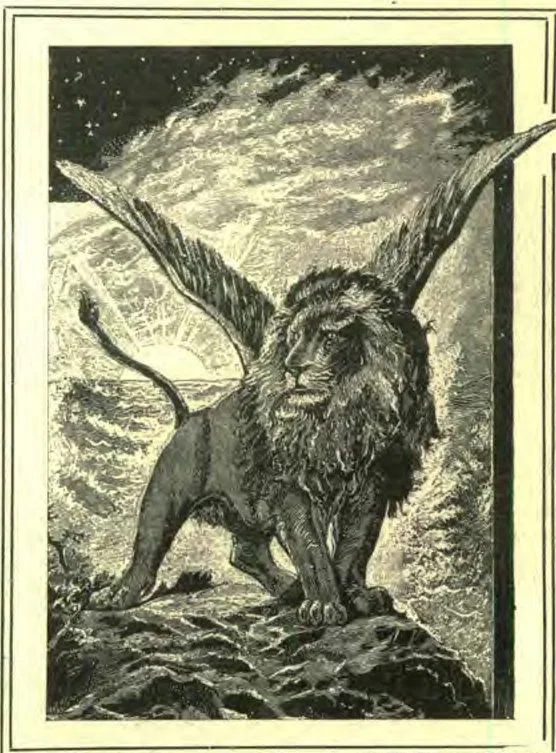
"The first was like a lion, and had eagle's wings: I beheld till the wings thereof were plucked, and it was lifted up from the earth, and made to stand upon the feet as a man, and a man's heart was given to it.
"And behold another beast, a second, like to a bear, and it raised up itself on one side, and it had three ribs in the mouth of it between the teeth of it: and they said thus unto it, Arise, devour much flesh.
"After this I beheld, and lo another, like a leopard, which had upon the back of it four wings of a fowl; the beast had also four heads; and dominion was given to it.
"After this I saw in the night visions, and behold a fourth beast, dreadful and terrible, and strong exceedingly; and it had great iron teeth: it devoured and brake in pieces, and stamped the residue with the feet of it: and it was diverse from all the beasts that were before it; and it had ten horns."
Let the vivid picture be stamped on the mind.
The vision is given in the first year of Belshazzar, three years before Babylon fell, or B.C. 541. Belshazzar had just been appointed joint ruler with his father Nabonidus. The father was engaged in building temples and shrines to the gods; the son seemed to be the active public ruler.
On this occasion the dream and vision came to Daniel. "If there be a prophet among you," the Lord declares to His people, "I Jehovah will make Myself known unto him in a vision, I will speak with him in a dream." Num 12:6. God was speaking in His regular appointed way thru Daniel, that the ages might know, that the people in "the latter days" might read, of God's foreknowledge and power, and, thus learning, believe His Gospel and be saved. "Remember the former things of old; for I am God, and there is none else; I am God, and there is none like Me; declaring the end from the beginning, and from ancient times things that are not yet done; saying, My counsel shall stand, and I will do all My pleasure." Isa. 46:9, 10. Blessed is the man who yields to God's holy purpose, that God may work in him His good pleasure, after the counsel of His own will, to the praise of the glory of His grace.
Read again the vision of the four beasts. Let the whole scene enter the mind. Put yourself in the prophet's place. See yourself the vision of God. You are standing upon the shore of the great sea, lashed into fury and made to boil in tumult by fierce and opposite winds. As you watch the raging waters, you see four wild beasts come up out of the sea, all alike fierce and cruel, yet totally different in form and kind. Each beast of the first three is unnatural, even of its kind, in form, in members, or in attitude.
By a great and magnificent image, God impressed the mind of the idolatrous king Nebuchadnezzar. By wild and cruel beasts, God revealed to His prophet and people the true nature of earthly empires.
What do these beasts symbolize? The angel of God answers the question: "These great beasts, which are four, are four kings, which shall arise out of the earth." (Read verses 15-17.) The Septuagint reads: "These four beasts are four kingdoms that shall rise up on the earth; which shall be8taken away." They represent the four great dynasties of earth; the same four that had been revealed to Nebuchadnezzar in the four parts of the great metallic image—the gold, the silver, the brass, the iron, and iron and clay. The great sea, the mighty, restless, surging water, is a fitting symbol of the restless, heaving, tossing tides of humanity's great sea, divided among the nations and tribes of the earth. Rev. 17:15; Isa. 8:7. The winds are fitting symbols of the strife and war among nations and governments. Jer. 25:32. As the result of the strife and war, four great kingdoms, or dynasties, appear.
The first of these beasts, the lion, represents Babylon, or Chaldea. So when Jeremiah saw in vision the army of Babylon marching upon Jerusalem, he declared: "The lion is come up from his thicket, and the destroyer of the Gentiles is on his way." Jer. 4:7. And as to the eagle's wings, the same prophet declares: "Behold, he shall fly as an eagle." Jer. 48:40; see also Hab. 1:6-8; Eze. 17:3. The lion with the eagle's wings represented Babylon, that "mighty nation," that "ancient nation," the beginning of kingdoms. Jer. 5:15. The word "ancient" means from time not known, whose antiquity is hidden. The record in Genesis clearly intimates that it was the very first city after the Flood, the beginning of the kingdom of Nimrod, the first of the rebel kingdoms against God. Gen. 10:10, 11. Erech (Ur) and Accad and Calneh and Assyria and Nineveh came later. The first of all, the mother of all the cities of pride, was Babylon, who by the wine of her lustful idolatry hath "made all the earth drunken." Jer. 51:7; Rev. 14:8; 17:2. "Their judgment and their dignity proceed from themselves." Hab. 1:7.
In all the ancient world it was the great seat of learning. Its universities surpassed all others. Wherever the mightier warriors might be, Babylon ruled. Assyria might be dominant in the martial field; Babylon reigned in character-molding power, in religious influence. The center of influence might sometimes change to some other great center for a few years or centuries, but in its origin it was Babylonian.
Until 1820, forgetting or not believing the Bible, men had supposed that Babylon was an empire which began at a late date in the world's history; founded, in fact, on the ruins of the old Assyrian empire. In this conception they had ignored the Bible, and the state archives of Babylon and Nineveh had not yet been unlocked to the world. Now it is clearly seen by the historical records of Babylon that she was among the most ancient of cities.
The archeologists tell us that its first inhabitants were not Semitic, but called by some scholars Sumerian (from Shinar, as given in the Bible), by others Accadian. One theory is that these were Mongols, others that they were a mixed people. Rogers tells us that "the solution of the question is not yet found." How much better it would be to go to the old Book, and find that the first builders of Babylon belonged to the Hamitic branch of Noah's family, and that among the first cities builded by them were Babel (Babylon), Erech (Ur), Accad, and Calneh, in the land of Shinar (hence Sumer, Sumerians). Gen. 10:10. Shinar was the name the land retained to Biblical times. Accadian, now considered a Sumerian dialect, was from the name of a tribal city.
From these Hamitic tribes came the cuneiform text, the perversion of true religion to nature-worship, and the inerasable scarlet of fornication,—unlawful union of religion with the state,—by which Babylon has stained all the nations of earth. Even the Assyrian kings in the time of Nineveh's greatest glory, honored Babylon, counting it one of the highest privileges to bow before the great god Marduk, and receive the kingdom from his hand. Rogers says:
"The origin of the city of Babylon is veiled in impenetrable obscurity. The first city founded upon the site must have been founded fully four thousand years before Christ, and it may have been much earlier. . . . From about 2300 B.C. the influence of the city extends without a break to the period of the Seleucides. No capital in the world has ever been the center of so much power for a period so vast."
Babylon, or her great ruler, Nebuchadnezzar, came to know God, as recorded in chapter 4. To the king who lived for this world only, as a beast lives, came the knowledge that the "Most High ruleth in the kingdom of men, and giveth it to whomsoever He will," and the acknowledgment of God. The man's heart came to the beast; but upon the death of that truly great ruler, Babylon sank to a lower level, till finally the empire succumbed under the weak and lust-loving king, Belshazzar.
[The next article will be the explanation of the other three symbols, the bear, the leopard, and the ten-horned beast.]
'The first was like a lion, and had eagle's wings.' Dan. 7:4.
God's Presence, and Sin.
THE great Jehovah is transcendently, ineffably holy. "Dwelling in the light which no man can approach unto; whom no man hath seen, nor can see," are not empty words; nor do they mean that the great God surrounds Himself arbitrarily with unapproachable splendor in order to impress His creatures with His greatness. Vain man does this; but behind the outward show there is the vain man still, whom the meanest, lowest, and basest may approach and even slay. But with God all this indescribable, unbearable radiance is but the natural forthshining of the glory of His character, awe-inspiring to all His creatures, terrifying only to the sinful and mortal. For it is the sinful and mortal only who can not see His face and dwell in His presence. For did not Jesus declare of the angels who minister to His little ones that in heaven they "do always behold the face of My Father who is in heaven"? Matt. 18:10. And is it not also promised that beyond the centuries and travail of sin, the servants of God "shall see His face"? Rev. 22:4. Yea, in His "presence is fulness of joy;" "at His right hand are pleasures forevermore." Ps. 16:11. And all that fulness of joy and eternal pleasures lie at the end of "the path of life."
It is sin which can not exist in God's presence, and mortal man has been possessed of sin or contaminated and affected by sin thru all the ages. Therefore he can not approach the ineffable glory of God. Therefore he can not, with mortal gaze, pierce the insufferable glory which surrounds the divine presence. In the light of the insufferable splendor, of perfect, infinite righteousness, he can not exist. Therefore, and it was spoken even to Moses, "the man of God," "Thou canst not see My face; for man shall not see Me and live." Ex. 33:20.
Because of this, God in mercy veils His transcendent glory to mortal man. Therefore He comes in clouds, upon which, in the subdued radiance of hope, glows the rainbow of promise. Therefore, too, when He sends His messages of love and mercy to sinful man, He sends them by men, lest He terrify those whom He would save by love. Therefore, also, when the Eternal Logos came to this world to demonstrate the everlasting love of God, He came clothed in the flesh, man among men.
But in all these manifestations of God, the glory is there, hidden tho it be; and it is there also to destroy sin. But it will not enter the heart of the human without his consent. The power over sin is not potentially in the sinner. He is sin's slave, often sin's willing slave. But the power over sin is potentially in God's word, in "every word" of God's messages to men. We may reckon that word powerless, even as the Jews reckoned Jesus, a mere man, a sinner, a devotee of Beelzebub. Even so will we turn His abundant blessing into curses. Or we may take His Gospel message as the power of God unto salvation, even as Peter accepted Jesus as "the Christ, the Son of the living God." Even so will God's presence, potent with the ineffable glory of His righteousness, come into our hearts and banish sin.
Witness the poor leper, the very personification of sin, bow before Jesus, saying, "Lord, if Thou wilt, Thou canst make me clean." Listen to the reply to the ears of faith, throbbing with the living power of God, "I will; be thou clean." Behold the marvelous results; the corrupt mass changes to the health and beauty of the little child. Even so He cleanses hearts. Listen to His words to His disciples: "Already ye are clean because of the word which I have spoken unto you." John 15:3. Sinner, let God's presence come into your heart in the omnipotent word. It will cleanse away the sin, and enthrone Christ as Lord of all. Having Him as the Indweller in your heart, you will welcome Him when He comes in all the glory of God: "Lo, this is our God; we have waited for Him, and He will save us." Then will the word which has made you an incorruptible, deathless character give you an incorruptible, deathless body forever.
"The earth is Jehovah's, and the fulness thereof." Long has He waited to come unto it again in the forthshining of His wonderful glory. He is waiting, pleading, for men so to yield to Him that they can bear His presence in His own glory. Sometime every decision of the human will have been made, and Deity will, in undimmed brightness, come into His own possessions—His by creation and redemption. That coming, that revealing of His presence, will be the eternal test of all character. His own, those in whom He dwells by faith, those who know righteousness, the people in whose heart is His law, will be changed from glory to glory, transmitted into immortals of God. Those who do not, would not, know Him, who have identified themselves with sin, will perish in the unsurpassable splendor, be destroyed by the forthshining of His presence.
Sinner, turn to Him now, and partake of His glory. Lay all human pride and exaltation in the dust, and let Him come in as your all in all. Child of God, be not cast down. Press on. Let the cleansing word day by day do its revealing, cleansing work. "It doth not yet appear what we shall be; but we know that, when He shall appear, we shall be like Him; for we shall see Him as He is. And every man that hath this hope in Him purifieth himself, even as He is pure." "The pure in heart . . . shall see God."
IN the studies of this wonderful book of Romans, the verses considered for the last two or three weeks have presented to us the plan upon which God bestows His gift of righteousness upon the repentant sinner. The next verses to be considered tell of the very desirable condition into which the individual is brought who has accepted and acted upon the plan.
"Being therefore justified by faith, we have peace with God thru our Lord Jesus Christ; thru whom also we have had our access by faith into this grace wherein we stand; and we rejoice in hope of the glory of God. And not only so, but we also rejoice in our tribulations: knowing that tribulation worketh steadfastness; and steadfastness, approvedness; and approvedness, hope; and hope puteth not to shame; because the love of God hath been shed abroad in our hearts thru the Holy Spirit which was given unto us." Rom. 5:1-5.
In these verses Paul reaches one of his wonderful conclusions: "Therefore," that is, because of the acceptance of the plan presented in preceding statements, we are "justified by faith." To "justify" is to make righteous; it is to bring the character into harmony with the law of God. Paul has presented the plan upon which this great work may be done, and the individual who has accepted it is spoken of as having already passed into the actual possession of the indescribable blessedness of justification or right doing.
"Being therefore justified by faith," having actually passed into the possession of the gift of righteousness, "we have peace with God thru our Lord Jesus Christ." The only thing that puts any one at variance with God is sin; it is wrong doing. And the thing that brings us back into harmony with Him is righteousness, right doing. And being thus put into harmony with God by His own plan and by His own power, we have a peace that can not be described. And we are secure in our possessions of this peace, for we know that God accepts the work of His own hand. He accepts promptly every individual who will receive His free gift of salvation thru Christ.
We have this peace "thru our Lord Jesus Christ." It comes to us thru the mighty Source of all power. This peace does not come from any of the transitory promises or plans of men. It comes from none other than God. Then it is an abiding peace, for it is on a strong foundation. We may have it forever.
"Thru whom [Christ] also we have had our access by faith into this grace wherein we stand." The apostle continues to emphasize the fact that we receive all these great blessings from God by faith; and having received them by faith we are able to "stand." God does not give us some unstable thing, but gives a cleansing and a peace and a power that strengthen us to "stand."
And having received this justification we9rejoice in hope of the glory of God. One of the most blessed of the fruits of the Spirit is joy, and joy gives rejoicing. There is no true joy anywhere outside of the gift of the righteousness of Christ. The wrongdoing that is so natural to man fills one with remorse and sadness, but he who has passed from death unto life thru Christ is filled with the joy that can not be described; it must be possessed in order to be understood and realized. The soul that is made sad by the buffetings and remorse of sin should seek the Fountain of Life and taste of this rich and abiding joy.
"And not only so, but we also rejoice in our tribulations: knowing that tribulation worketh steadfastness; and steadfastness, approvedness; and approvedness, hope; and hope putteth not to shame; because the love of God hath been shed abroad in our hearts thru the Holy Spirit which was given unto us." Verses 3-5. The joy of the Christian becomes so deep and so helpful that he learns to rejoice even in his "tribulations." We rejoice not because of the affliction of the tribulation itself, but because of the "steadfastness," the "approvedness," the "hope," and the "love of God" that are implanted within us. The tribulation is necessary to the working out of the righteous character. And so the individual can rejoice in the midst of it because he can see by faith the end that the Lord is seeking to accomplish in him. "Wherein ye greatly rejoice, tho now for a little while, if need be, ye have been put to grief in manifold trials, that the proof of your faith, being more precious than gold that perisheth tho it is proved by fire, may be found unto praise and glory and honor at the revelation of Jesus Christ: whom not having seen ye love; on whom, tho now ye see Him not, yet believing, ye rejoice greatly with joy unspeakable and full of glory: receiving the end of your faith, even the salvation of your souls." 1 Peter 1:6-9.
Sunday Law: A False Christian Union
"God's eight-hour bill" is what a Sunday-law man calls a Sunday law. In a meeting recently held in London the Bishop of London said that he had been over to America and seen how all the churches over here were uniting in Christian progress, and he was determined to unite those in England on all the points that he could. As we have many times outlined before, the great center of so-called Christian union is the Sunday, and so the bishop stated, "In regard to Sunday we have one of the greatest points on which Christians can be united. I look on the observance of Sunday as one of the finest pieces of Christian evidence we have, and it is a piece of evidence which can not be refuted. Secondly, we have in Sunday what I will call the working charter, and as a clever man observed to me the other day, Sunday is God's eight-hour bill. The first use of Sunday," he tells us, "is worship." And the first use of the Sunday law is to place men in that position where they must go to church. Is it not a strange thing that a bishop of one of the great divisions of Christianity should take a religious institution for which there is absolutely no authority and elevate it to the one position above all others which will unite Christianity? All such union, however, is not union. At the very most it can only be said to be a federation, a federation that is not approved of in the word of God.
The Fearful Kongo State
The Fearful Kongo State.—Up to the present time, notwithstanding all the agitation, all the exposition of the relentless rule of Leopold of Belgium, all the protests, all the negotiations and attempts at legislation, affairs in the Kongo are not bettered; Belgium's cruel, merciless king is still at the head. The only hope that the Kongo Reform Association has is international interference; but even here the wealth taken from the impoverished and maimed natives is used to corrupt governments and their officials. A recent report tells us that the old king is stricken with an incurable disease; namely, gangrene, necrosis of the bones of the heel. Amputation may help, but it is not probable. Is it divine retribution, or the legitimate crop of vicious sowing? Thank God, the time is soon coming when the oppressor shall cease.
Cancer Treatment and Surgery
Hopelessness of Cancer.—An editorial in the New York World tells us that Dr. Robert Bell, formerly senior physician of the Glasgow Women's Hospital, says that "during fifteen years' experience as an operating surgeon, he has been unable to give a single success in dealing with cancer." This doesn't mean that they have died under the knife or immediately afterward; but it does mean that no permanent benefit has been derived from the excising of the disease by surgery. In a book on cancer, Dr. Saleeby expresses the opinion that the knife may in time be discarded. There are physicians who can cure cancer if they can treat the patient in time. Most of these are ignored or discounted by the regular profession because they do not do it in the regular way; but certainly with such a confession as that from Dr. Bell, one would be justified in trying what the regular practitioner might call quackery. It certainly would prove as productive of benefit, according to their own confession, as the present method of surgery. Dr. Bell suggests that the disease is amenable to treatment thru diet and the reclamation of the vitiated cells by means of a healthier blood stream.
Anarchists and Assassins.
been killed had it not been for the timely assistance of his eighteen-year-old boy, making it necessary for the anarchist-assassin to divide his attentions between the young man and his father. The boy had his body pierced by a bullet, but the chief himself escaped with slight injuries, and succeeded in shooting the anarchist dead.
The anarchist, doubtless, represents a very small body of men. But there is a much larger class that are all the time uttering inflaming words against various classes of individuals with whom they do not agree, and this incendiary language is continually creating more and more of this half-crazy, lawless element.
But the agitator has not done anything like the evil in the direction of anarchy as the so-called “higher critic,” joined by the antinomians, who have been discrediting the plain teaching of the word of God. Some men will choose to do right because they learn to love the joy of right doing. But the greater majority will become very reckless when they are made to believe that they will never have to meet the Most High God face to face at the bar of eternal judgment and justice.
Most of the anarchists are fatalists of the worst type, and are also decidedly infidel if not atheistic. In many instances they may have been brought into this condition by being compelled to observe and deal with the hypocrisies and even cruelties that have been perpetrated in the name of the Christ of God. And here is where the higher intelligence of the age should have met them with the pure Gospel of Christ and showed them the better way. But instead they have been met by the critic that is abroad thruout the world casting discredit upon the Bible.
There has been a generation of seed-sowing. The reaping has scarcely commenced.
First Principles of Freedom.
[The following editorial from the Moscow (Idaho) Star-Mirror, a one-time strong Sunday advocate a correspondent writes us, is worthy of reproduction.]
THE revival of Sunday laws in various cities is distinctly a religious movement. The laws in the first place reflected the religious creeds and predilections of their authors.
In taking notice of the flaming zeal which everywhere accompanies Sunday-law enforcement, it should be remembered that, notwithstanding the pious inspiration of Sabbatarianism, the courts have held almost without exception that legislation of this kind can be sustained only on secular grounds. To advance religious belief as a reason for Sunday blue-laws would be to nullify them.
We have the strange spectacle, therefore, of religious laws enacted and enforced at the demands of religionists, and upheld by the courts which deny that they are religious laws and assert that they are nothing more than police and health measures.
This is a situation calling for a little common honesty and for some genuine American backbone. If the laws are to be enforced in obedience to a religious demand and for religious purposes, they should be carefully revised by the law-making powers, for it is probable that the best religious sentiment to-day is not reflected in these fantastic enactments.
It may be doubted if a convention of any church would reenact the old Sunday code in its entirety. When we consider that most people are attached to no church and that many churches are liberal in the matter of Sunday diversions, it will be seen that any revision of these laws would probably result in expunging nine-tenths of them from the statute-books.
Religious laws having no standing in court except on false pretense that they are secular in purpose ought to be easily repealed. When they were first enacted in this country they had the weight of the church, of wealth, of nine-tenths of the population and practically all respectability behind them. It is not so now. Compelling their rigid execution at this time, a few zealots are simply invoking the authority of sanctimonious lawgivers dead and gone for the regulation of people of different beliefs, different tastes, and different necessities.
We are to remember also that true American liberty had some of its most important beginnings in successful assaults upon these very laws. It was not until the people had learned to question the despotic power of the New England theocracy and the state church of Virginia that they ventured to assail the awful pretensions of George III, who ruled by divine right. Sam Adams in Massachusetts and Thomas Jefferson in Virginia were hounded to their graves by the element which supported the blue-laws.
These men and others almost as celebrated held that emancipation from ecclesiastical authority was essential to liberty. What would they have thought of 80,000,000 people subjected to religious laws which gained their force by judicial denials of the self-evident fact that they are religious laws?
It is maintained in some quarters, and with reason, that repeated invasions of popular rights during the last thirty or forty years have resulted in a serious curtailment of liberty. If reasonable and harmless diversions on Sunday may now be prohibited by a small religious element, backed by a notorious false pretense in the courts, it must be that there has also been a most emphatic loss of independence on the part of the people. The worst of all slaves are those who willingly bend to the yoke.
Many important questions are pressing for settlement, but they all shrink into insignificance in comparison with this one, involving as it does the personal liberty of millions. Tariffs, trusts, currency, rebates, and all such problems will hardly be dealt with wisely by men who are not free or by courts which are terrorized or insincere.