An organization called the Model License League, having its headquarters in Commercial Building, Louisville, Ky., presents what it calls a “Solution of the Liquor Problem,” in the outline of a model license, one so framed as to make it of great interest to the liquor dealers themselves to keep it, making licenses transferable, fining minors who represent themselves to be over eighteen in order to procure intoxicants, and taking the saloon out of politics. All this might be good, if—
To us it seems that the very best way to regulate the saloon is to abolish liquor selling, and let the men go into other business. If license must be, the model license might be well worth trying, but it does not seem reasonable that a man should want11to even consider the licensing of that which is more productive of crime than anything else which exists.
Secret Commissions.
IN New York City a wholesale house recently sold a bill of goods to a retailer to the amount of $1,550, and secretly gave to the purchasing agent of the retail firm $75.00 as a bribe for favoring them with the order. The retail firm found out that the transaction was made in this way and refused to pay the bill and also refused to return the goods. The matter was carried into the courts and the stand that the retailers had taken was confirmed. Thus the wholesale house was out the entire bill of goods, the costs of the trial, and also the money paid as a bribe to the agent of the retail firm.
This one case would not be particularly significant were it not for the fact that the custom is quite general among many wholesale firms and agencies to pay bribes to the purchasing agents of retailers to get them to favor their houses with their orders. In this way the purchasing agent gets a salary from the house that employs him and also gets his commission from the firms that sell him goods. The pernicious influence of such a system should be apparent to any one.
There is scarcely a nook or cranny of the business world that has not been pervaded by the bribe-giver and the bribe-taker. And nothing can more completely take away the manhood of an individual than to become a party to such transactions. It is nothing short of straight-out robbery. And it is the meanest kind of robbery at that, for the individual being robbed is one that has placed the utmost confidence in the honesty of the one that is doing the robbing. This sort of robber masquerades in the clothing of respectability and claims to be an honorable and upright man; in this guise he ingratiates himself into the confidences of his employer and then deliberately and coolly proceeds to rob him.
The greed for gain, the love of money, the desire to get rich quickly so that money can be expended extravagantly, are the crying evils of this day. And men and women who think should see how the various methods by which money is obtained are driving true-hearted integrity and honesty away from the people of this generation. And it should never be lost sight of that just such conditions as these are abundantly described in the Bible as the conditions that would prevail in the time just preceding the second coming of Christ.
What Would You Call It?
In the SIGNS of January 1, on the last page, was the following note:
The Times and the Law.—Some are perplexed over the word "times" in Dan. 7:25. The little horn power thinks to change times and law. "The times and the law" the American Standard Revision reads. Other translations read, "The appointed times and the law;" that is, the times appointed of God and the law of God. The word "times" is translated from "zemawn," defined by Strong "an appointed occasion, times." It comes from "zamawn," "to fix," rendered "appoint." Every instance where it occurs in Scripture is as follows: rendered "season" in Eccl. 3:1; Dan. 2:21; 7:12; rendered "time," Ezra 5:8; Neh. 2:6; Esther 9:27, 31; Dan. 2:16; 6:10, 13; 7:25. It will be seen from its use in these texts that it has no definite reference to feast, but definite times appointed by either man or God. In Dan. 7:25 it refers to times appointed of God that apostasy could only "think" to change. The two earliest appointed times of God are the day and its place in the week."
And this is what one of our critics, whose chief burden is to set others right, has to say to a brother upon this note, and which this brother publishes:
"We will consult Strong's Exhaustive Concordance and Dictionary of Hebrew and Greek Words for the words "time" and "times" in the texts cited in the Signs: Eccl. 3:1, "times," Heb. word, "ethe," pronounced "ayth," "time, now, when, as even time, meal-time, what time;" Dan. 2:21, "times, iddan, id-dawn, a set time, a year, time;" 7:12, "times, iddan;"Ezra 5:8 (3); Neh. 2:6; Esther 9:27, 31; Dan. 2:16; 6:10, 13; 7:25; "times, Z'man, Zem-awn, an appointed occasion, season, time." I find no such word as Zamawn. The paragraph you referred to is very deceptive wisdom; it is a mere bluff; but bluffs will not satisfy men's souls in the day of judgment.
Let us remark: (1) There are three mistakes in the note in the SIGNS; namely, two typographical errors. (a) Ezra 5:8, ought to read Ezra 5:3; (b) the Hebrew word is transliterated "zamawn" instead of "zawman." Gesenius transliterates "zahman." The last is not at all misleading.
(c) The original occurs in four other places in the Scriptures; namely, Dan. 3:7, 8; 4:36; 7:22, rendered in each place "time."
2. The SIGNS made no reference to any English word which comes from "ethe," or "iddan." In every instance the word we cited came from "zemawn." But we did not say that "times" in Eccl. 3:1 came from "zemawn," but that "season" did. We did not say that "times" in Dan. 2:21 and 7:12 came from "zemawn," but that "season" in both these texts came from that word.
3. Let the reader look up each and every one of these scriptures, and note where the "bluff" lies. We give again every reference where the original word occurs, which is rendered "times" in the expression "the times and the law," with its rendering in English: It is rendered "season" in Eccl. 3:1; Dan. 7:12; "seasons" in Dan. 2:21; "time" in Neh. 2:6; Esther 9:27; Ezra 5:3; Dan. 2:16; 3:7, 8; 4:36; 7:22; "times," Esther 9:31; Dan. 6:10, 13; 7:25—in all fifteen times, clearly referring in all places to definite time, or season, appointed times of God or man. The little horn should think to change the appointed times and the law, very evidently, it seems to us, referring to times connected with the law, the changing of which resulted in the change of the law, and thus defying the authority of God.
Great Foes in Small Things.
[The paragraphs that follow give something of an idea of the menace that some of the very little things of this world offer to the welfare of mankind. The paragraphs are selected from trustworthy sources and doubtless give the facts as closely as they can be gathered.]
Menace of a Flower.
The water hyacinth, a beautiful marine plant of green leaves and exquisite flowers, which has done such great damage to commerce in Louisiana and Eastern Texas, says the Houston Post, is making its appearance in the ship channel. A few years ago the water hyacinth was brought from Florida to Louisiana as a floral ornament. Last year the government expended $200,000 in an effort to control the pest, and has only partly succeeded. Streams and bayous which once carried big barges of lumber in Louisiana and Eastern Texas have been closed to navigation by the rank vegetation of the hyacinth. The Sabine River above Orange has become filled with the plants, and it is related that these all grew from a few plants carelessly thrown into the river by some housewife when the plants she had in a tub as an ornament became too numerous.
The Menace of Rats.
In his annual report, Surgeon-General Wyman, chief of the Marine Hospital Service, who has had charge of the government's fight against the plague in San Francisco, ascribes the prevalence of the disease among rats to fleas. Scientists accepted this fact some years ago. Last summer in England, Dr. J. Ashburton Thompson, head of the Public Health Department of New South Wales, after wide experience with the plague in Australia, expressed the positive conclusions not only that there would be no plague in man without plague in rats, but that the plague in rats would be harmless except for the assistance of the flea. There was no communication of the infection from rats direct, he said, but a flea that has bitten a plague-rat, if it bites another animal can give that animal the plague.
The indirect way of suppressing the plague is to exterminate the rats. During the last four months of 1907, over 130,000 rats were destroyed in San Francisco. Of 11,391 examined by the Health Department, only 136 were infected with the plague. At the same time, up to November 19, there had been ninety-six cases and sixty deaths from the plague in that city since the outbreak of the disease last May.
To prevent the plague from spreading in the Philippines the Health Board seven years ago began offering a bounty for every rat killed. In India a similar campaign is carried on against the animal pests. In the six years following 1900, when the plague threatened Japan, nearly 5,000,000 rats were killed in Tokyo alone, and Japanese scientists urged an international movement to vanquish the disease by exterminating its propagator, the rat.
Our own Department of Agriculture last spring joined the campaign against the noxious rodent with the statement that the common brown rat probably costs the American farmer $100,000,000 a year. The average cost of feeding a rat on grain is about fifty cents a year. What rats destroy in eggs, poultry, game, and other birds can not even be estimated. In Denmark, the loss by rats is put at $3,000,000 and in France at $40,000,000 annually.
To combat so persistent an enemy of health and property, nothing less than a systematic, scientific plan of warfare throughout the world can be wholly effective.—New York World.
North Collinwood Fire.
In a suburb of North Collinwood, ten miles from Cleveland, Ohio, a fire broke out in the schoolhouse in which were about 325 children between the ages of 6 and 15. Altho the school had been drilled to march out orderly in case of fire, the teachers were not able to prevent a panic which soon resulted in the children piling up in great heaps at each of the two outside doors, and the latest reports are that 167 of the children and two of the teachers were burned to death; there are a number of others in the hospitals and homes of the neighborhood that are not expected to live. The stories of the efforts of the frantic parents and friends in trying to rescue the inmates of the burning building are too heart-rending to repeat. This marks another one of the awful calamities that are marking these days thru which we are passing.
A Satanic Invention.
A Satanic Invention.—Of course every weapon for the destruction of human life is a Satanic invention; but the one recently invented by young Maxim is preeminently so. It has all the potency of the modern rifle, but is both smokeless and noiseless. Even the inventor is conscience-stricken, and hopes that the government will purchase the invention and keep it a secret. If it were in the hands of criminals, untold evil could be wrought with almost no risk of detection. This is one item of many which faintly indicate what the conflict of Armageddon will be when the slain shall be from one end of the earth to the other.
Catholic Missionary Work.
Catholic Missionary Work.—The Superior General of the Paulist Fathers, Geo. M. Searle, states in an appeal which he has sent out that "We have during the past ten years collected over $100,000 for the missionary needs of the United States." None of this is used for the members of the organization. The mission of the Paulist Fathers is to convert men to the Catholic fold, and the uncertain conditions in the Protestant church make good soil for the Catholic propaganda.
Astrology.
Astrology.—Sir David Gill, the astronomer, declares that there is not the remotest scientific basis for astrology. He regards all the predictions of astrology as the purest rubbish. Of course, as he declares, "predictions will be fulfilled now and then, if they are made on a sufficiently wide basis, but the charlatans who make the predictions know very well that they are only humbugging the public, and the public is the most gullible creature that it is possible to imagine."
Injurious Larvae.
The "Weekly News Letter" of the University of California reports "untold damage" from the larvae of the "crane fly," in a district in central California, to the roots of the growing grass and grain, utterly destroying the crop. University experts have been studying the pest, but thus far "there seems to be no remedy." The greatest damage for this year is over. Better things are hoped for in the future.
Political Conventions.
The Republican party will hold its national convention in Chicago, June 16, and the Democrats will hold theirs in Denver on July 7.
Prohibition.
The year 1907 was a great year for prohibition. First of all it was the year of the Chinese Imperial¹ Edict against opium. How all Christian nations ought to rejoice over that! Missionaries in the interior of China, and who are acquainted quite generally with Chinese life, tell us that the law is being enforced, and that thoroly.
Georgia and Alabama both voted prohibition during the year. One hundred counties in Connecticut were won to prohibition, and it has been seriously proposed, it is said, to make that a presidential issue for the Democratic Party.
Oklahoma entered the Union with a law forbidding the manufacture and sale of intoxicants; and the sewers of Oklahoma City, when the constitution went into effect, were flushed with 2,300 barrels of contraband beer. Some of the poor slaves to the habit drank out of the sewers.
Two of Delaware's counties went dry at the November election. Chicago added a square mile to its prohibition territory. Thousands of the employees of the Chicago and Northwestern Railroad took the pledge.
Over in Europe, the government of Rumania has planned drastic measurements to check drunkards by placing the sale of brandy and whisky under the control of the state, and saloons under the control of the municipalities.
What a blessing it would have been if San Francisco after her experiment in prohibition had so remained until the present time. It can be safely said that a great deal of her political corruption has been fostered by the murky atmosphere of saloons.
Mr. J. W. Elsworth, the New York millionaire coal dealer, offered the town of Hudson the sum of $300,000 for a new municipal light plant and a new sewerage system if the town passed prohibition. As a result the town voted prohibition 266 to 138.
The Volcano in Savaii.
By C. H. Parker
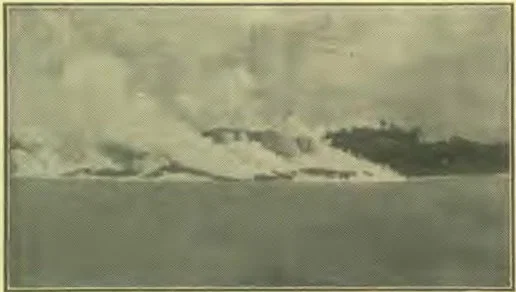
MANY of the readers of the SIGNS have become more or less acquainted with the volcano of the Samoan Group. It is on the island of Savaii, which is the largest island of this archipelago. No one can form a just idea of it until he sees it with his own eyes. There have been a number of eruptions previously, but this seems to be the longest in duration. Fully two years have passed since this last eruption began, and it has lost none of its initial energy.
The crater is about twelve miles from the coast, and it pours forth a constant stream of molten lava, which flows down in this liquid state till it drops over the cliffs into the sea.
One strange feature of this volcano is that the lava is not thrown up into the air, but is more like a mighty artesian well. It has formed its own channel to the sea, filling up valleys and crossing rivers. A hard crust has formed over this channel up near the crater, while the heated mass flows on underneath. Further down it again emerges and runs on till it reaches the ocean.
It is a grand and awe-inspiring sight to see it pouring thru numerous channels down over the rocks into the sea. When it comes in contact with the water below, there are great explosions, and the water is lifted in the air to a great height. At night the track of the lava can be seen for a number of miles by the glowing light. It looks as if there had been a great conflagration and only the burning embers were left.
The light of this volcano can be seen thirty-five miles away. Surely "Tophet is ordained of old; yea, for the king it is prepared; he hath made it deep and large: the pile thereof is fire and much wood; the breath of the Lord, like a stream of brimstone, doth kindle it."
All of these manifestations of what is in the bowels of this earth should convince us that God has prepared His great arsenal of fire to forever blot out sin from His dominion. "But the day of the Lord will come as a thief in the night; in the which the heavens shall pass away with a great noise, and the elements shall melt with fervent heat, the earth also, and the works that are therein shall be burned up."
The great question for you and for me to face is, Where will we stand in that day—under the shadow of the Almighty, or with no place for shelter? May the Lord help us to build wisely to-day for the future. The sure foundation is the word of God. It is the rock which is higher than I.
C. H. PARKER.
The Song of Moses and the Lamb.
IN the 14th chapter of Exodus, we have a thrilling account of how the Lord saved Israel out of the hand of the Egyptians. After their deliverance, "Then sang Moses and the children of Israel this song unto the Lord, and spake, saying, I will sing unto the Lord, for He hath triumphed gloriously; the horse and his rider hath He thrown into the sea, the Lord is my strength and song, and He is become my salvation." Ex. 15:1, 2.
The song of Moses was a song of victory, sung by Israel because God had graciously delivered them from the hand of their enemies. Thru faith in a living God that great multitude passed thru the Red Sea without the loss of one, and stood together on the other shore, peaceful and happy. Surely they had abundant cause for rejoicing, and how fitting that their gratitude should find expression in song. The Lord seemed nearer to them than He had ever been before; and they marveled at His works and glorified His name.
In the 15th chapter of Revelation, we have an account of a people that had been in conflict with earthly powers. A strong effort had been made to cause them to "worship the beast and his image, and receive his mark." See Rev. 14:9-12. But the effort had not proved successful. The revelator, in speaking of them, said: "And I saw as it were a sea of glass mingled with fire: and them that had gotten the victory over the beast, and over his image, and over his mark, . . . stand on the sea of glass, having the harps of God. And they sing the song of Moses the servant of God, and the song of the Lamb." Rev. 15:2, 3. As the song sung by the children of Israel anciently was a song of praise and thanksgiving to God because of their gracious deliverance from the hand of their enemies, so will "the song of Moses and the Lamb" be sung by the remnant people of God as a song of experience and victory because of deliverance from their enemies.
Just as the Egyptians opposed Israel, so will the nations of earth array themselves against a people who will not "worship the beast and his image, and receive his mark." And because of their faithfulness in keeping all of the commandments of God rather than the commandments of earthly powers, the Bible says, "The dragon was wroth with the woman [the church], and went to make war with the remnant of her seed [the last church], which keep the commandments of God, and have the testimony of Jesus Christ." Rev. 12:17. A decree will go forth to utterly destroy all who keep God's commandments. Rev. 13:11-17.
At the last moment God will interpose to save His people, but every soul will be severely tried; his faith in the living God thoroly tested, and thru trials and persecutions he will be prepared to sing "the song of Moses and the Lamb" in the kingdom of God.
May all who read the following hymn, found in "Songs for Service in Church and Home," sing it with the writer in that glad day when all conflict with the wicked powers of earth shall have forever ceased, and Christ shall reign thru His own mighty power and immeasurable love.
The Song of Moses and the Lamb.
We shall sing the song of Moses and the Lamb,
If upon our brow we have our Father's name;
On Mount Zion we shall stand,
With a harp in every hand,
While we sing the song of Moses and the Lamb.
Chorus:
Singing, singing, while the heavens and the earth are ringing,
And the angels low are bending,
And the golden harps are blending
With the lovely song of Moses and the Lamb.
We shall sing the song of Moses and the Lamb,
While the angels bow before the great I AM;
Standing on the crystal sea,
Bearing palms of victory,
While we sing the song of Moses and the Lamb.
We shall sing the song of Moses and the Lamb
While the universe will praise Him with a psalm;
At whose feet the angels fall,
While we crown Him Lord of all,
And we sing the song of Moses and the Lamb.
We shall sing the song of Moses and the Lamb,
And the tree of life shall yield its healing balm;
There from pain and sorrow free,
And to all eternity
We shall sing the song of Moses and the Lamb.
CHAS. P. WHITFORD.
Lava at Joskaihai, Savaii.
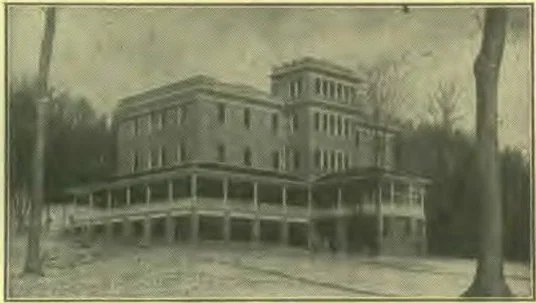
Wabash Valley S. D. A. Sanitarium, Lafayette, Indiana.
The Hand of the Most High.
By Annie Johnson Flint
("I have graven thee upon the palms of My hands." Isa. 49:16.)
O, I KNOW that my name on Thy palms is graven,
I remember the years of Thy hand most High;
How it has sheltered and held and guided
'Neath clouded heaven or open sky.
I lean on Thine arm and Thy hand upholds me;
Thy power protects and Thy strength defends;
Still Thou wilt hide me and keep me and lead me
Till home is reached and the journey ends.
—Annie Johnson Flint.
Wanted for Missionary Work.
SIGNS, Life and Health, and any literature suitable for missionary work. -W. H. Loose, 317 Wood-year St., Baltimore, Md.
SIGNS, Watchman, tracts. Mrs. James F. Woods, 322 S. Detroit St., Warsaw, Ind.
Our Work and Workers.
THERE are fifty Sabbath-keepers in Peru, an increase of twenty-eight in the last year.
AT Copeland, Idaho, where Brother C. J. Rider presented the truth, five have accepted the message.
A CHURCH of sixteen was organized near Hooker, Texas, by Brother David Voth, early in the present year.
A NEW church building was dedicated at Cottage Grove, Ore., February 22. Brother C. W. Flaize gave the dedicatory sermon.
BROTHER F. W. PAAP, writing from Victoria, Australia, tells of baptizing twenty-three candidates near that city recently.
"NOTWITHSTANDING the dragon's continued battle, seven have begun keeping the Sabbath, and I hope to see them all in the truth."—W. F. Talburt, Stratford, Texas.
BIBLE-READINGS and individual work among the people of Muscatine, Iowa, with public meetings as the interest increased, have brought seventeen to the light of the truth. Brother and Sister G. P. Hawkins have been conducting the work.
Book Notices.
By Editor
“Bird Notes Afield.” Essays on the birds of the Pacific Coast, with a Field Check List. By Charles Keeler. Price, $2.00 net. Paul Elder & Co., San Francisco and New York.
This is a finely written, beautifully printed volume, uniquely gotten up, done in a rough, durable, crash-cloth cover, illustrated side and back. A little more than one-half of the unique volume consists of charming essays, Birds and Bird Haunts on the Beach, To the Farallone Islands off San Francisco Bay, Birds of Berkeley in the Pine Woods, In a Mission Patio, Among the Deep Somber Redwoods, In Sight of Shasta,—fourteen different sketches in all, admirably illustrated with reproductions of bird photographs. The last part of the volume is a descriptive list of the land birds of California, with a key and a splendid index. It seems as if every lover of birds would delight in the volume.
“Assimilative Memory; or How to Attend and Never Forget.” By Prof. A. Loisette. Price, $2.50. Funk & Wagnalls Company, New York and London.
It was not many years ago that men were taking lessons of Professor Loisette and paying as high as twenty-five dollars a course. Later, when large classes were formed, tuition for the course of ten lessons dropped to five dollars. That was the price of his book, if we rightly remember, when first placed upon the market. Now the complete course is offered for one-half that price. Professor Loisette claims that he was the first teacher to declare and insist that memory is not a separate faculty, but a physiological and psychological property of each mental act, and that such act records and retains the history of its own action; that memory is in reality concrete. The basis of his system is to learn by thinking. His method is to acquire first the Habit of Attention, then the Habit of Thinking, and these combining form the Habit of Assimilation. We do not recall one of Professor Loisette’s pupils who did not say that he was benefited by the lessons. This book opens them to all.
“Nephilim.” By William J. H. Bohannan. 236 pages, illustrated. $1.50 post-paid. Reeve A. Silk, Publisher, 1 Madison Ave., New York.
The attempt of the author is to show the errors of “science” in the cosmogony of the earth, and to present a theory which the author believes is in perfect harmony with the Bible. Some of the chapter headings give a fair idea of the scope of the work: The Basis of Science, The Newtonian System, The Form of the Earth, The Tides, The Wire-wound Rings, the Fields of the Rings, Motion of Rotation or the Ring of Regular Form, The Atom, The Constitution of the Heavenly Bodies, Gravitation, Inertia and Momentum, The Solar System,—twenty-three sections in all, closing with the Bible. The author believes that the Bible is the test of all science. We read to the last section before we find the meaning which the author attaches to the Biblical term “Nephilim,” sometimes translated giants. Mr. Bohannan’s book certainly gives food for thought, and, whether the reader agrees with all his conclusions or not, its perusal will at least be quite likely to affect his confidence in the scientifico-traditional views of creation. The author strikes some mighty blows.
“The Greatest Fact in Modern History.” By Whitelaw Reid. Price, 75 cents net. Thomas P. Crowell & Co., New York.
This little book is a paper prepared by the Hon. Whitelaw Reid, the American ambassador to Great Britain, on invitation of Cambridge University, and delivered in the Senate House of that university as the opening address of the course on the Eighteenth Century, for the summer meeting of 1906. The subject was chosen by the university. This “Greatest Fact” which Mr. Reid presents is the Rise and Development of the United States. It is a strong, clear review of the circumstances, motives, and principles which led to the formation and founding of the United States of America.
“Indian Myths of South Central California.” By A. L. Kroeber. Price, 75 cents. The University Press, Berkeley, Cal.
This issue is No. 4 of Vol. 4 of the University of California publications on American Archeology and ethnology. The pamphlet is written by one who has put years of study upon the Indians in the Golden State, their various types, arts, languages, dialects, traditions, and religions. In most of the myths the animals are deified, and in many cases they take on the lowest forms of nature worship. There are also gleams of light, which show that sometime their ancestors had much clearer ideas than their descendants now have. There are many passages which indicate degeneration and a far remove from their primitive traditions. They are useful chiefly in tracing likeness and relationship between the tribes, and in revealing how degenerate human beings without God become.
“A Supplemental Bible Question Course of Fifty-two Lessons.” By John B. Smith. Price, 50 cents net. The Sunday School Times Co., Philadelphia, Pa.
This little book is not designed to take the place of regular Bible studies in Sabbath-school or seminary, but to supplement these by arousing general interest in Bible study. It is a helpfully suggestive little book.
“The Second Book of Samuel with Map, Introduction, and Notes.” By Rev. A. F. Kirkpatrick, B.D. Price, one shilling. C. J. Clay & Sons, Cambridge University Press Warehouse, Ave Maria Lane, London.
This booklet is one of a series entitled, “The Smaller Cambridge Bible for Schools.” The map is clear and the notes brief and lucid, and generally excellent.
“Gems of Thought,” selected and arranged by Henry B. Damon, Katonah, New York. Price, 50 cents. Address the author.
This little booklet is admirably done on superfine paper, bound in deckle-edged imitation parchment. While the selections are not numerous, they are choice. The book would make a neat birthday or holiday gift.
“The House of a Hundred Doors.” By Will M. Clemens. Second edition. The Hawthorne Press, New York and London.
This little volume of less than a half-hundred pages presents in story form, in a striking way, the horrors and cruelties of vivisection.
“Bible Hero Classics.” Twelve little booklets giving in the language of the Scriptures the lives of (1) Abraham, (2) Jacob, (3) Joseph, (4) Joshua, (5) Samuel, (6) Solomon, (7) Elijah-Elisha, (8) Daniel, (9) Ruth-Esther, (10) Samson-Gideon, (11) Moses, (12) David. Numbers 1 to 10, six cents, post-paid; Numbers 11, 12, double size, ten cents, post-paid. In quantities cheaper. Hope Publishing Company, 150 Michigan Ave., Chicago.
These little booklets are designed to be read by the multitude, that all may learn of the marvelous wealth and value of Scripture biography. Each one makes an interesting story for evening reading. The same company publish “His Life,” the Gospel narrative, “His Friends,” and “His Great Apostle,” all in the language of the Bible.
“The Wonderful Story of the Wonderful Book,” “4500 Miles by Wagon in Utah and Idaho During 1906,” “Mormonism Proclaiming Itself a Fraud,” are booklets from the Utah Gospel Mission, Cleveland, Ohio. Their design is to teach the sufficiency of the word and to show some of the fallacies of the Mormon doctrine. A Biblical student might wish a number of things different in the setting forth of the doctrines of the Bible, but nevertheless the tracts are instructive. If there were more Bible and less theology, the tracts would be more effective.
In Far Uganda.
PRIVATE letters to Brother G. A. Baker of this office from his son and wife in Uganda, East Africa, tell of the progress now being made in their mission school. They were erecting a one-story building 28 by 70 feet, 10 feet high. It will be used for school and chapel. The body is of stone with thatched roof. Sometimes as many as 600 come to service when the tax-gatherer is not around. The natives are lazy and shiftless and filthy, but teachable. They make a picturesque and grotesque sight in all manner of dress and undress. They have never known what it is to work. The pure heathen are more susceptible to truth than those who have been affected by Mohammedanism. It is difficult to keep them at work; they are "eye-servants," and one of the most trying things is to teach a man how, and then have him stay away and send a raw substitute. About the only way is to keep their pay-day some distance ahead. Salt costs sixteen times as much as it does in England. While Brother Baker superintends the buildings, Mrs. Baker looks after the sick and wounded, and she has much of it to do. In the meantime they are endeavoring to shed light into the darkened minds of these children of nature. God is blessing them with good health.
Mend Your Hot-water Bottles and Agateware.
You can depend upon Patent Patches to securely mend your hot-water bottles. Twenty-five cents for nine patches, a wrench, and instructions for using the patches.
Agatitis will mend agate, enamel, iron, tin, and woodenware, and may be used for other things too numerous to mention here. Enough material, with instructions for use, to mend thirty to forty holes, for thirty cents. Coin or postal order preferred. Your neighbors will surely want one or both of these articles. If you will secure their orders and send them with your own, you will be helping on a good work, and at the same time get some articles that will give satisfaction by demonstrating their usefulness. Address,
H. F. PHELPS, Station F, Minneapolis, Minn.
Testimonies for the Church. By Mrs. E. G. White.
By Editor
Bound in eight volumes, of from 300 to 770 pages each, each volume containing a complete index of subjects. Volume 1 contains a brief sketch of the early life and Christian experience of the writer of the Testimonies, together with Testimonies Nos. 1 to 14. Volume 2 contains Testimonies Nos. 15 to 20. Volume 3 contains Testimonies Nos. 21 to 25. Volume 4 contains Testimonies Nos. 26 to 30. Volume 5 contains Testimonies Nos. 31 to 33. Volume 6 contains Testimony No. 34. Volume 7 contains Testimony No. 35, price, 75 cents. Volume 8 contains Testimony No. 36, price, 75 cents. Bound in cloth, per volume, $1.00; sheep, $1.50. Full set, eight volumes, cloth, $7.50; sheep, six volumes, 1 to 6, $9.00. Volumes 1 to 6 are obtainable in limp leather, with round corners, per volume, $1.50. Volumes 7 and 8 are also bound in limp leather, price each, $1.25.
Address this office.
Uncle Ben's Cobblestones
Uncle Ben's Cobblestones. Familiar talks with boys and girls about the common articles of every-day use, such as air, water, sunshine, fire, smoke, glass, coal, salt, paper, matches, etc.
Uncle Ben has a very pleasing way of telling about the origin and use of these various things. There is a ray of sunshine streaming thruout the whole book, and yet it does not touch the fickle so prevalent in books for children.
The purpose of the book, aside from the useful information given, seems to be soul-culture, for we observe on every page a moral fragrance that will impress young minds in the right way. Uncle Ben tells about more than one hundred different things in all, and intersperses with happy thoughts that bring good cheer to young and old. 221 pages, price, $1.00. Address this office.
The Gospel Primer
Gospel Primer, The.—The object of this little book is to teach reading, and at the same time combine lessons that will instil into the mind of the learner the truth of the Gospel. The first pages are devoted to the alphabet, each letter of which combines with some Bible scene. The remaining part of the book is given to Bible stories, made so simple that any child can understand them. Each story is illustrated with a full-page engraving. 128 pages, board covers, cloth back, cover design in gilt and colors, 35c; fine English cloth, embossed cover, lemon edges, 60c. Address this office.
My Garden Neighbors
By L. A. Reed
Garden Neighbors, My.—By L. A. Reed. A new nature-study book just fresh from the press. All will.be interested in the true story of the sparrows who learned to imitate the bluebirds, of the cat that went wild, of the cowbird that imposed on a sparrow, and all the others in this instructive and entertaining book. It contains 256 pages with over fifty illustrations, several of them colored. Bound in cloth, $1.00. Address this office.
Bible Student's Subject Index
Bible Student's Subject Index.—An alphabetical arrangement of more than 1200 subjects, any of which may be found in less than a minute. Prepared by W. H. Wild, 169 Maple St., Hinsdale, Ill. Price, 6 cents.