Your ShelfYour Projects

Signs of the Times, Vol. 23, No. 48.

Editorial
Earlier text: Editorial

JOTTINGS FROM RUSSIA. NO. 3.

AFTER the close of the general gathering on the Don, I spent some time in the Caucasus, the district lying between the Black and Caspian Seas. Near the center of this region, extending from sea to sea, is the Caucasus range of mountains, the highest peak being Mt. Elbruz. 18,526 feet.
To the south of this range lies Georgia, with Tiflis as chief town; and next south lies Armenia. In the war of 1877–78, this country south of the mountains, Georgia, and a part of Armenia extending to Mt. Ararat, was taken from Turkey by Russia.
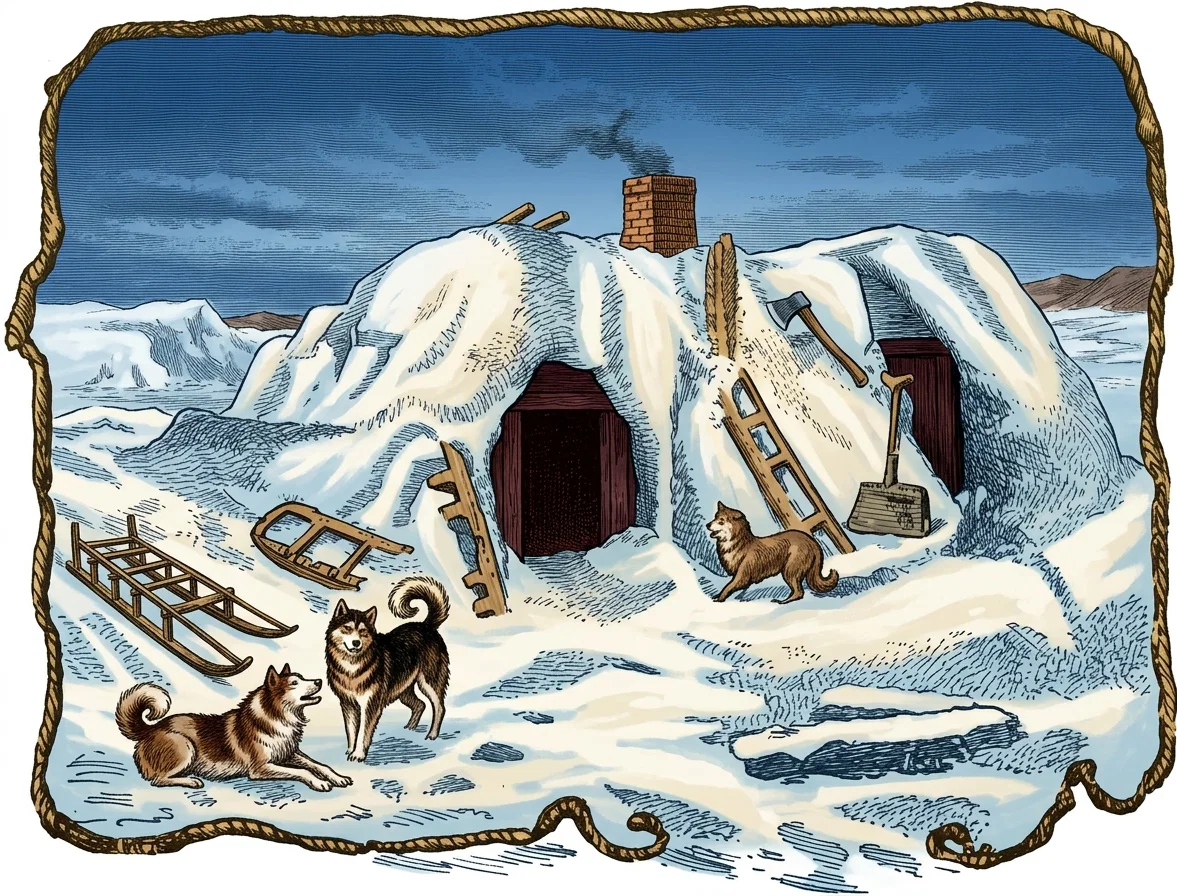
Exile's Hut—Without.
To the east of the mountains, on the shore of the Caspian, at Baku, are the great petroleum wells of Russia. A railway through Tiflis connects Baku with the Black Sea at Batoum, and the oil is conducted through large pipes from the wells to Batoum, a distance of several hundred miles, so that it flows from the wells into tank-ships on the Black Sea, whence it is transported to the various ports of Europe.
South of the mountains, the country extending down to the plains of Nineveh and Babylon is quite hilly; to the north, there is considerable rolling prairie, reminding one of Dakota and Nebraska.
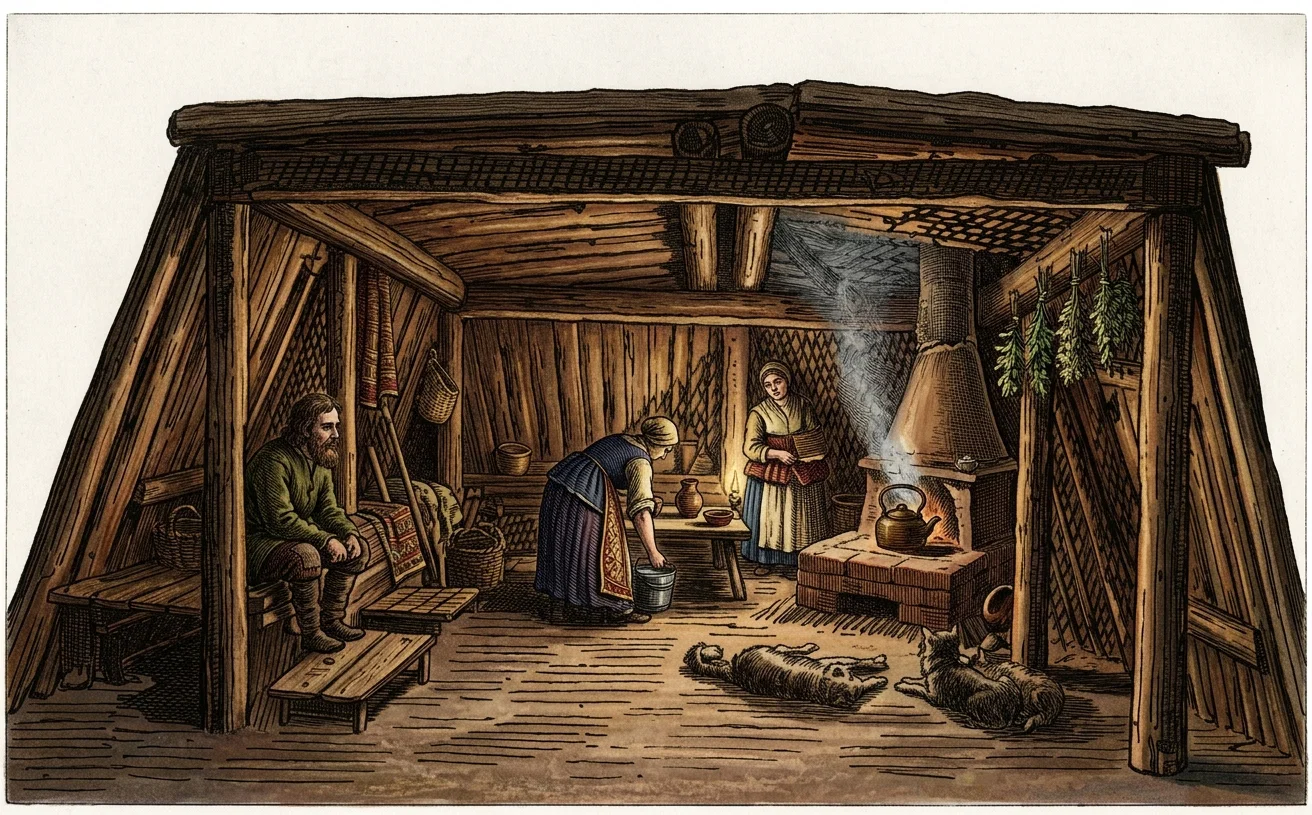
Exile’s Hut—Within.
Exile’s Hut—Within.
Until recently, this fertile region was like the ‘wild west’ of America in Indian days, various tribes of Asiatics taking the place of the redskins. After a long and expensive struggle, Russia subdued or dispersed these roving robbers. The worst of these tribes were the “Tscherkess” (Circassians), who long held the mountains as a fortress, and, like the Midianites and Amalekites in the days of Israel, made raids on the harvests of the settlers. When no longer able to withstand Russia, rather than submit to government, they fled to Turkey, where they still live after their old fashion,—by plunder,—chiefly in Asia Minor, while the Turks regret the day when they granted them asylum.
The Caucasus is now settled by Russians, Germans, Esthonians, Tartars, Tscherkess, Cossacks, and Kalmucks. Some of these Asiatics are learning agriculture from the Europeans, but they make rather awkward work of it. They use mostly the Syrian oxen and camels, and go to town with large two-wheeled carts, with axletree of wood. When the road is muddy, some of the wheels do not turn at all, while those that do turn, creak so frightfully as to cause the horses they meet to shy off to some distance on the prairie. The Germans are by far the best farmers. A Russian prince, governor of the Caucasus, on a recent visit to the villages, highly complimented the Germans for the thrifty appearance of their villages, while he severely scored the Russians for the dilapidated, semi-barbarous condition of their villages, roads, and bridges. Russian roads, and especially bridges, have long been a proverb, but no less proverbial is the manner in which the Russian teamster crosses these bridges, on which a European would scarce risk his life or team; as tho there were absolutely no hope in cautious driving, the teamster removes his cap, crosses himself in the Greek fashion, which embraces about twice as many movements as the Roman fashion, commits his destiny to some saint, and, cracking his whip, slams his team through at break-neck speed.
In the Caucasus, the villages are mostly mud huts covered with straw, the stable and dwelling-rooms usually being in one building. The ground serves as floor, chaff being occasionally used as an improvement on the bare earth. These huts serve as excellent breeding-ground for the least desirable sorts of insects. One is sometimes tempted to believe that the third plague of Egypt was transferred to this country. The families which desire to be “up” in the world whitewash the outside of the house. The Russians are taking lessons from the German settlers, and are making improvements.
Altho nearly all fruits flourish in this region, the average farmer has none; neither has he learned the relation of a good garden to his table. With some, even potatoes are a luxury. Flesh, cabbage, wheat, and rye bread, and tea, constitute his bill of fare the year round, except in summer and autumn, when water-melons and bread are the chief diet. One reason why fruit is so little grown is that most of the land is owned by the nobility and rented to the farmers, never for a period exceeding six years. The Asiatics are mostly herdsmen, under cover of which some of them carry on horse and cattle stealing as sort of side occupation.
The message, entering this field some seven years ago, has gained a good foothold. Some of the Germans have suffered considerable persecution, first, at the hands of the Russian officials at the instigation of prejudiced fellow-Germans; and, second, on account of Sunday work. But they have survived all, and now are little interfered with. But as the truth extends, new members will doubtless have a similar experience, for where the Church-and-State machine is always in readiness to grind, prejudice and hatred of the truth will not fail to operate it.
It was in this field that the truth first broke the ranks of the Russians. But from the first man of this nationality to embrace it, to the present, the enemy has disputed every foot of vantage-ground. The first man was banished to the Persian border, but the seed sown by him continued to bear fruit and multiply until there are now over a hundred in this region. Several others have been banished; but the work among this people in this district advances now faster than ever, while those in banishment sow the seed in new fields.
While in the Caucasus, I held meetings at four centers, at which most of the Germans were gathered. The truth has the same blessed effect here as elsewhere, refreshing and rejoicing the soul. The members in this field sense the fact that the time has come to go forward and respond heartily to efforts made in this direction. As our members here come in contact with various classes of Asiatics, these are learning of the message; thus while our missionaries are working at the great Asiatic field from the east, we trust that from Russia the truth will enter the same field from the west.
H. P. H.
Sebastopol, November 4.

A CLOSER UNION.

That Catholics and so-called Protestants are drawing closer together is a self-evident proposition, and the most interesting question that can be asked in relation to this changed state of feeling is, Are the Catholics and Protestants making equal concessions, or are the advances, with the necessary yielding of the ground of contention, all upon one side? Dr. J. H. Barrows, famous as the organizer and director of the Parliament of Religions held in connection with the World's Fair in Chicago, has lately visited Germany, and has written his impressions of religious matters in the land of the Reformation for the New York Independent. While still holding, or claiming to hold, that the Reformation was the most important revolution from the establishment of Christianity to the present hour, Dr. Barrows believes that the reasons for the use of the name “Protestant” do not exist at the present time; that the name is an unfortunate one, since it recalls old animosities, and emphasizes differences between two great bodies of professing Christians.
He further says:—
I know that the Evangelical Union in Berlin represents a movement of earnest resistance to the increasing power of the Roman Church; but, on the other hand, was there ever a time in the history of modern Christendom when so many things pointed unmistakably toward reunion? In America and France, in England and Germany, I have discovered that Christian hearts on both sides of the chasm are finding each other out in love. I have heard a Catholic archbishop, with a temper of friendliness and concession that would have startled our spiritual ancestors, say: “I do not pretend as a Catholic to have the whole truth, or to have solved all the problems of the human mind. I can appreciate, love, and esteem any element of truth found outside that great body of faith.” He expressed the hope that the day has “dawned when in every nation the idea of oppressing a man for his religion will be swept away.” This archbishop does not stand alone.
This way of trying to heal the breach by putting a bridge of brotherly love across the chasm, is unique in its way, but it can be accomplished only at the expense of truth—truth for which countless thousands of martyrs have perished at the stake, by the tortures of the Inquisition, by fire and sword, and by every conceivable way that the devotees of the Catholic Church, goaded on by papal decrees, could invent. Could Dr. Barrows have visited the old Inquisition in Nuremberg while in Germany, could he have gone through the “torture chamber” and have seen the hundreds of terrible implements of torture, which, by orders of the highest dignitaries of the Catholic Church, were once used there upon those who in that day were not ashamed of the appellation of “Protestants,”—could he have seen those things, and then, while sitting in that chamber so suggestive of unspeakable and horrible atrocities, have read the defense of the Inquisition, which only a few months ago appeared in the columns of the Catholic Mirror, he would have been slow in coming to the conclusion that the Catholic Church has changed in character since the days of the Reformation, or that Protestants can affiliate themselves with her without compromising the truth for which their spiritual fathers laid down their lives.
Dr. Barrows admits that the Catholic Church is “hampered by its past, and appears to be bound by a doctrine which makes it responsible for the papal and churchly teachings of other ages;” but he does not seem to realize that the present Church of Rome, far from feeling hampered by its past, glories in it, and holds up its past record and the Dark Ages as a history of which the church is proud. As an illustration of Catholic teaching upon this point, we will here give a quatrain verse which appeared upon the first page of the Catholic Mirror, of October 23, entitled, “The Middle Ages”:—
“She calls them dark, those ages when the light Of faith restored to earth primeval May; Vain Bigotry, that, like the bird of night, Is sightless in the dazzling glare of day.”
According to the sentiment of this poem, the ages when the Inquisition flourished, when no one could breathe anything different from what the church believed but on peril of his life—this time was one of dazzling light—the “primeval May” of the world, and those who protested were vain bigots, who, like night birds, can not see in the light. This is the sentiment of the Catholic Church of to-day in regard to her cruel and shameful past. And if that time was so lovely, why should she not wish to restore it? And who but vain bigots would stay her hand?
These considerations furnish sufficient evidence that there can never be any union between Catholicism and true Protestantism, and that any union that may be consummated will be the result of a shameful surrender of a so-called Protestantism to the never-relaxing and pretentious claims of Rome. That a union involving the surrender of so much can be discussed with equanimity evinces that a spirit of surrender is affecting the Protestant host. Then when Protestantism shall have apostatized so much that this union can be formed, what may we expect but the fulfilment of the prophecy, “And the dragon was wroth with the woman, and went to make war with the remnant of her seed, which keep the commandments of God, and have the testimony of Jesus Christ”? Rev. 12:17. M. E. K.

“THE MOST HIGH RULETH.” NO. 7.

When Daniel, by revelation of the God of heaven, rehearsed King Nebuchadnezzar’s dream to him, he did not stop to ascertain from the king if the rehearsal was correct. There was no question about that, for God had shown it to him. So he confidently asserted, “This is the dream, and we will tell the interpretation.” Then without hesitation he proceeded:—
“Thou, O king, art a king of kings; for the God of heaven hath given thee a kingdom, power, and strength, and glory. And wheresoever the children of men dwell, the beasts of the field and the fowls of the heaven hath he given into thine hand, and hath made thee ruler over them all. Thou art this head of gold. And after thee shall arise another kingdom inferior to thee, and another third kingdom of brass, which shall bear rule over all the earth. And the fourth kingdom shall be strong as iron; forasmuch as iron breaketh in pieces and subdueth all things; and as iron that breaketh all these, shall it break in pieces and bruise. And whereas thou sawest the feet and toes, part of potter’s clay, and part of iron, the kingdom shall be divided; but there shall be in it of the strength of the iron, forasmuch as thou sawest the iron mixed with miry clay. And as the toes of the feet were part of iron, and part of clay, so the kingdom shall be partly strong, and partly broken. And whereas thou sawest iron mixed with miry clay, they shall mingle themselves with the seed of men; but they shall not cleave one to another, even as iron is not mixed with clay. And in the days of these kings shall the God of heaven set up a kingdom, which shall never be destroyed; and the kingdom shall not be left to other people, but it shall break in pieces and consume all these kingdoms, and it shall stand forever. Forasmuch as thou sawest that the stone was cut out of the mountain without hands, and that it brake in pieces the iron, the brass, the clay, the silver, and the gold, the great God hath made known to the king what shall come to pass hereafter; and the dream is certain, and the interpretation thereof sure.” Dan. 2:37-45.
Thus the history foreshadowed in the image described in this chapter began with the kingdom of Babylon under Nebuchadnezzar; particularly after it had acquired universal jurisdiction “Thou art this head of gold.” The king had been anxious to know concerning the future, and the God of heaven, who had laid such great responsibility upon him, would give him the desired information. “After these shall arise another kingdom.” This expression shows that Nebuchadnezzar stood for the kingdom of Babylon, for that other kingdom did not arise immediately after his personal reign ended. The kingdom of Babylon continued until the reign of Belshazzar, at which time six kings had succeeded Nebuchadnezzar, the last two, Nabonadius and his son Belshazzar, reigning conjointly.
Notwithstanding the great wealth and power and prestige of the kingdom of Babylon, it was but about sixty-four years after the prophecy of its downfall until it was overcome by the “inferior” kingdom which was to succeed it. It is said that throughout the kingdom there was a quite general disposition to revolt because King Nabonadius neglected the court and religion, leaving all to his profligate son Belshazzar. Be this as it may, Cyaxeres, or Darius, king of the Medes, in conjunction with his nephew, Cyrus, a Persian officer, led out in the rebellion.
After conquering other principal strongholds, Cyrus, who commanded the combined armies of the Medes and Persians, besieged the city of Babylon. Considering the massive walls and great brazen gates of the city, and the vast resources on the inside, the attempt to conquer it with the implements of war then in vogue seemed futile indeed. But the Most High, who “ruleth in the kingdom of men,” had decreed its downfall. He had even named its conqueror, Cyrus, many years before he was born. See Isa. 44:28 to 45:6.
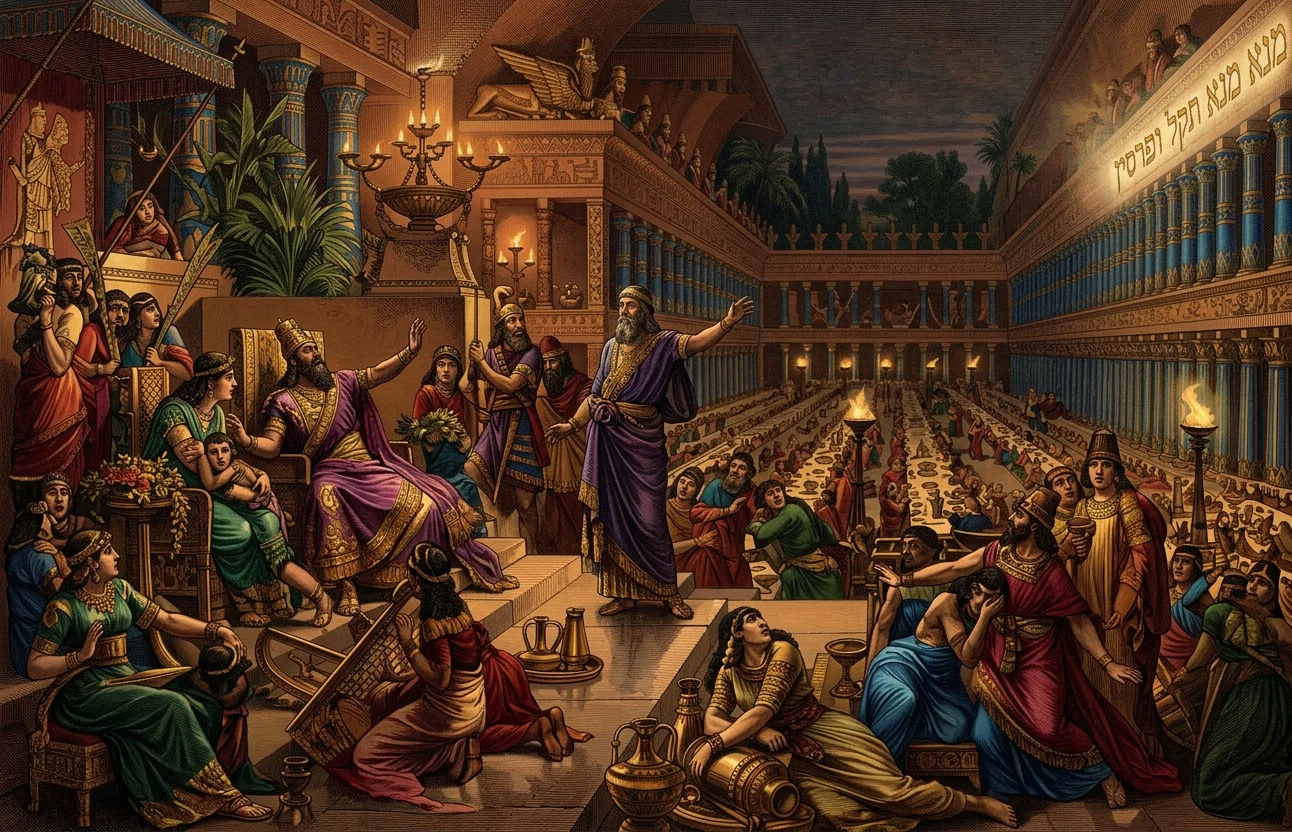
The downfall occurred on the fatal night of Belshazzar’s noted feast, when in the midst of hilarious revelry the king saw a mysterious hand writing on the wall the words, “Mene, mene, tekel, upharsin.” Again the “wise men” of Babylon, perhaps some of the same ones who had failed to show Nebuchadnezzar his dream, were called. They were asked to translate the mysterious writing on the wall, but, as in the former case, they utterly failed. Again Daniel was brought to the front, now an old man, and again honored his God by interpreting the writing for the king. These were the ominous words: “God hath numbered thy kingdom, and finished it. . . . Thou art weighed in the balances, and art found wanting. . . . Thy kingdom is divided, and given to the Medes and Persians.”
During the siege the army of Cyrus had made all preparation to turn from its course a large portion of the river which ran under the walls and through the center of the city. When it was known that all the city was given up to feasting and drunkenness, the water was turned off, and the besieging army passed under the great walls in the river bed. Ordinarily this stratagem of itself would not have given them any special advantage; for great walls were also built along both banks of the river throughout its course within the city. At all the crossings of the river there were great gates of brass, which were kept securely fastened at night. But God had said by his prophet Isaiah, as before cited, that he would help Cyrus, “his anointed.” He had said, “I will loose the loins of kings, to open before him the two-leaved gates; and the gates shall not be shut.”
Through the general feeling of security, the Babylonians had that night given themselves up to feasting and revelry, and the gates of these inner walls were not shut. So the great army of the Medes and Persians came in upon them unawares. They marched directly to the palace of the king, who was taken in the midst of the great confusion of the hour, and promptly put to death. The record is brief: “In that night was Belshazzar the king of the Chaldeans slain. And Darius the Median took the kingdom, being about threescore and two years old.”
The “head of gold” is gone. The “breast and arms of silver,” denoting a kingdom “inferior” in wealth and grandeur, was Medo-Persia. But the prophecy points to a “third kingdom of brass, which shall bear rule over all the earth.” To fulfil this prediction, Medo-Persia must needs give way; so history attests that such was the case. The armies of Darius and Cyrus overthrew Babylon in 538 B.C. Medo-Persia was the recognized master of the world until 331 B.C., about 207 years, with twelve successive kings. Then came Alexander the Great, at the head of his invincible army from Macedon, and, conquering the hosts of the Medes and Persians, at the battle of Arbela, B.C. 331, set up the “third” kingdom. In the final struggle, the invading army of Alexander numbered but one to twenty, but “the Most High ruleth in the kingdom of men;” he “removeth kings and setteth up kings;” numbers count for naught when the Word of the Lord is at stake. So the kingdom of Grecia became the “third kingdom” which was to “bear rule over all the earth.”
Grecia ruled the world from 331 to 161, or 170 years. Then came “the legs of iron,” or the “fourth kingdom” of the image. It was to subdue all things. What kingdom was this? Again history answers. The successor of Grecia in universal empire was Rome. Stronger than any of its predecessors, it held the reins of absolute control longer than all of them combined, that is, about 644 years. But the feet and toes of the image, being part of iron and part of clay, two ingredients that will not cling together under pressure, indicate a breaking up of universal empire; and the best demonstration of the fulfilment of this part of the prophecy that can be presented is the map of that part of the world which comprised the center of Rome’s ancient power, namely, Europe, Asia, and Africa.
When the iron empire began to break up, no human power could hold it together, and none has been or will be able to reconstruct its like. The sundered kingdoms that represent the iron structure “shall not cleave one to another, even as iron is not mixed with clay.”
The feet and toes of iron and clay, substances which will not cleave together, illustrate the fragile foundation upon which the whole structure of earthly empire stands. What only would be necessary to destroy the whole system of human government?—Merely a blow upon its insecure foundation, its inharmonious elements. So the interpretation of the dream tells us that in the time of the divided condition of earthly empire—the very time in which we are now living—the God of heaven will set up a kingdom which shall never be destroyed. This kingdom will not occupy the earth simultaneously with, nor be constructed out of, any of the preceding kingdoms. It is a stone “cut out without hands;” it strikes the whole system of earthly government on its brittle foundation, and destroys it all. The iron, the clay, the brass, the silver, and the gold—every phase of human rule, from the lowest to the highest—will become as chaff, which the wind drives away, and no place will be found for them; because the kingdom which the God of heaven will set up will fill the whole earth.
Not a particle of any of the corrupt civil governments of earth will have any place in that kingdom. They will have served their purpose, to be blotted out forever. “My kingdom is not of this world,” says the King, and his word is true to the letter. The ushering in of his kingdom will be the last act in the routine of removing and setting up kings. Not only will the kingdoms of this world be blotted out, but their territory will be baptized and purified by fire; and in its place will be a “new earth, wherein dwelleth righteousness.” See 2 Peter 3:10-13. History attests the fulfilment of the interpretation of the dream-image even into the feet and toes; who can be so skeptical as to doubt that the only remaining feature of the prophecy will as surely come to pass, and that in the very near future? “The dream is certain, and the interpretation thereof sure.”
W. N. G.
THE LAST MAD REVEL—BELSHAZZAR'S FEAST.

Be Brave Enough to Be True

WOMEN must be brave enough at home and amongst friends to stand opposed to all that is false and unwomanly and untrue, whether it be in regard to books, or habits, dress, associations, or pleasures. O, be brave enough to be true! God will help you, and every one of you will be a power in the world.—Rev. Floyd W. Tompkins, Jr.

A Great Career, a Grand Opportunity

“EVERY day we rise to a great career, a grand opportunity. Into the smallest work and act we may put the most divine or the most devilish spirit.”

The Power of Light Words

“LIGHT words of those whom we love and honor, what a power they are, and how carelessly wielded by those who use them! Surely for these things also God will ask an account.”

WEIGHED IN THE BALANCE.

The lords were assembled, the gay lords assembled, The princes assembled in grandeur and might, While mighty Belshazzar, the great king Belshazzar, The gay king Belshazzar, did feast them that night.
“Bring forth all the vessels, the bright golden vessels, The fair, sacred vessels,” commanded the king, “Which were in the temple, the beautiful temple, The wonderful temple; go, haste ye and bring, “That I and my princes, my fair lords and princes, My ladies and princes, in them may drink wine; For who such great power can show for an hour— Such wonderful power as this power of mine?”
Then brought they the vessels, the fair, sacred vessels, And drank in the vessels and worshiped alone The idols of silver, of gold and of silver, Of brass and of silver and iron and stone.
Then in that same hour, that brief selfsame hour, That terrible hour most dreadful of all, Came forth a man's fingers,—came forth bloodless fingers,— Came white, livid fingers, and wrote on the wall.
Then in great consternation, in dread consternation, With awful sensation the word passed around: “Thou art weighed in the balance, Jehovah's dread balance, Jehovah's just balance, and wanting art found.”
Thus, while the world feasteth, in revelry feasteth, In carelessness feasteth, the summons will come: “The Bridegroom appeareth, his chariot-car neareth, The universe heareth; make haste to thy doom.”
But yet there is mercy, for sinners there's mercy, For all there is mercy while Jesus yet pleads; His blood still availeth, His prayer now prevaileth, His love never faileth, He still intercedes.
MRS. L. D. AVERY-STUTTLE.
Battle Creek, Mich.

Quickened by What?

No. 673. Quickened by What?

In Rom. 8:11 we read that it is the Spirit of Christ dwelling in the Christian that will quicken his mortal body in the resurrection. Now, the sinner not having the Spirit in him, what will quicken or make him alive in the resurrection? J. M.
God's Word is power and life. “All that are in the graves shall hear his voice, and shall come forth; they that have done good, unto the resurrection of life; and they that have done evil, unto the resurrection of damnation.” John 5:28, 29. Rom. 8:11 does not state or imply that the Spirit will dwell in the dead bodies of the righteous. It dwells in their mortal bodies in this life. It quickens the mortal body now in this life; and it will raise up that body even tho the believer dies; but nevertheless it will be done by the voice of Jesus Christ.

No. 674. “Sons of God.”

WHO were the “sons of God” mentioned in Gen. 6:1, 2? Kindly explain. E. Z.
The “sons of God” were the righteous seed of Seth. See Gen. 4:26, margin: “Then began men to call themselves by the name of the Lord.” The “sons of God” are those who bear his character. See Mark 3:35; Matt. 7:21. Gen. 6:1, 2 is a record of how these sons of God were led astray and corrupted by uniting with the “daughters of men,” evidently of the seed of Cain, those whose love was of the earth. Such in general has always been the effect of intermarriage between the church and the world.

No. 675. Rom. 14:5.

TO WHAT day does Rom. 14:5 refer? SEEKER OF THE TRUTH.
In its local application to the condition of affairs in the church at Rome when Paul wrote, we believe it refers to Jewish feasts and festivals, like the Passover, the observance of which was a matter of indifference, concerning which there should have been no controversy. Of course, the principle can be given a broader application.

No. 676. The Two Witnesses.

WHAT is the meaning of Rev. 11:3, and who are the two witnesses? CONSTANT READER.
God's law of witness is that there shall at least be two witnessing to the same thing. Deut. 19:15; Matt. 18:16; 2 Cor. 13:1. The two witnesses of Jesus Christ was God's Word in the Scriptures, and God's Word in the life and works of Christ. John 5:36, 39. Thus the Father and Son witnessed to the same thing. John 8:17, 18. Thus the Old Testament, the Scriptures which went before on Christ, and the New Testament, in which are recorded the life and works of Christ, are God's witnesses of the ages. In a still broader sense, the two witnesses of God are his written Word and the living epistle of his true church, in whom that Word is inwrought and revealed. It was dimly revealed during the 1,260 days of Rev. 11:3. This was prophetic of the Dark Ages, of the union of Church and State—A. D. 538 to 1798—when the enemy through an apostate church endeavored to destroy the witnesses of God's Word. They prophesied in sackcloth, in mourning, in persecution, but they were not destroyed. Their power is in God, and the oil of the grace of his Spirit supplies the power so that every word will prove effectual, every prophecy will be fulfilled. See “Great Controversy,” chapter 15.
WILL you please explain 1 Cor. 14:34, 35? M. M. D.
The instruction of the apostle doubtless had reference to abuses which had crept into the church at Corinth. There was confusion, discord, etc. His instruction was given to correct this. That the apostle or the Word of God does not enjoin silence upon women in any proper sphere is shown by such texts as Acts 2:17; 21:9; 1 Cor. 11:5, 13–15. In the last scripture the apostle points out what the manner of women ought to be who pray or prophesy in public.

No. 678. Josephus' Discourse on Hades.

(a) Is “Josephus' Discourse Concerning Hades” genuine? (b) Is there any other Jewish writing in which Hades is pictured as he describes it there? If so, will you give the quotation? W. H. S.
(a) There are scholars on both sides of the question of its genuineness. (b) There is the parable in Luke 16:19–31; and Doddridge says (quoted by the Emphatic Diaglott): “Dr. Lightfoot and others have shown that the Jews in their Gemara have a parable much to the same purpose.”

RELIGIOUS CONDITION OF THE HINDUS.

One of the prominent characters of the World's Parliament of Religions was the Swami Vivekananda, a Hindu monk. On his return to Hindustan he gave a course of lectures in Madras, and from these the Independent quotes from the Indian Mirror a portion, showing, in the opinion of the monk, the religious condition of the Hindus. He first tells us that the old Vedic religion was beautiful and pure, but this was destroyed by the lower races which accepted Buddhism. And here is the result in the decay of religion and race:—
“Before a century had passed, they brought out their snakes, their ghosts, and all the other things their ancestors used to worship, and thus the whole of India became one degraded mass of superstition. . . . I have neither the time nor the inclination to describe to you the hideousness that came in the wake of Buddhism. The most hideous ceremonies, the most horrible, the most obscene books that human hands ever wrote or the human brain ever conceived, the most bestial forms that ever passed under the name of religion, have all been the creation of degraded Buddhism. . . . The Tartars and the Beluchis and all the hideous races came to India and became Buddhists, and assimilated with us [Indians] and brought their national customs, and the whole of our national life became a huge page of the most horrible and most bestial customs.
“Compared to many other races, I must tell you in plain words we are weak, very weak. First of all is our physical weakness. That physical weakness is the cause at least of one-third of our miseries. We are lazy, we can not work; we can not combine; we do not love each other; we are immensely selfish; we are what the women of Europe are; not three of us can come together without hating each other, without being jealous of each other. That is the state in which we are, hopelessly disorganized mobs, immensely selfish; fighting each other for centuries, whether a certain mark is to be put this way, or a certain that way; writing volumes and volumes upon such momentous questions as whether the look of a man spoils my food or not. These we have been doing for the last few centuries. We can not expect anything more, except what we have just now, of a race whose whole brain energy has been occupied in such wonderfully beautiful problems and researches. And we are not ashamed. Ay, sometimes we are; but we can not do what we think! Think we many things and never do; till, parrot-like, thinking has become a habit and never doing. . . . We have lost faith. Would you believe me, we have less faith than the English men and women, thousand times less faith? These are plain words, but I say them; can not help it. . . . Your blood is only a pint of tar, your brain is sloughing, your body is weak. You talk of reforms, of ideals, and all these for the last 100 years; and when it comes to practise, you are not to be found anywhere; so that you have disgusted the whole world, and the very name of reform is a thing of ridicule to the whole world. The only cause is you are weak, weak, weak; your body is weak, your mind is weak. You have no faith in yourselves. Like the downtrodden and broken-back-boneless worms you are.”
To this the Independent adds: “That is plain talk. And here in this country are mannish women and womanish men looking to India for light, where this man, who knows India from Hardwar to Cape Comorin, sees only, in his own capitals, “THE MOST ROTTEN SUPERSTITIONS IN THE WORLD.” This is Buddhism in its ripened state.

Seeing Today Through Tomorrow’s Eyes

“THERE was a wise man in the East whose constant prayer was that he might see to-day with the eyes of to-morrow.”

FOOTBALL.

An eastern newspaper says: “There are two directions in which the modern game of football excels all other out-of-door games; first, in the drawing power of the game as a crowd getter; second, as a means for killing and maiming people.” Nine, we believe, is the number killed to date this year, and nearly three hundred have been maimed and crippled for life. Press and pulpit cry out against pugilism, and it is a brutal and degrading sport or “profession,” but in its results it is not as bad as football. After the recent game between Yale and Princeton in New Haven was a grand drunken carouse lasting from Thursday night till Sunday morning. Betting like drinking was fast and furious. Many were arrested and locked up, tho the police were unusually lenient. Says a reputable correspondent of a New York paper:—
“Students shrieked, smashed each other’s hats, tore each other’s clothes, poured beer down each other’s necks, swore, and sang. It seemed as tho at least every other man to be found anywhere was drunk. But by repeated attempts to count the drunken men in various places, and assorting those who appeared to be college boys from the others, I could not possibly estimate less than one thousand drunken students in New Haven last night.”
‘Here’s to good old Yale, Pour it down, pour it down.’
The above old refrain could be heard from one end of New Haven to the other.” And to complete the picture numerous lewd women led away to deeper dishonor many of the tipsy boys.
Fifty years of pugilism we venture to say have not killed and maimed and ruined as many as football has this season. And then the attendant gambling grows as the game grows popular. Men wager their last sesterce on the oftentimes brutal slogging contest, as the old Roman wagered his on the gladiatorial shows. We are living Pagan Rome’s days over again. The ancient bejeweled maiden or dame on the Tiber cheered on to death the gladiators who fought to amuse them, and the modern beflowered or beribboned maiden or dame cheers on to crippledom and often death their favorite college eleven. “Are we better than they?—No, in nowise;” for both American and Roman, Christian tho one profess to be and pagan the other, are both examples of the instincts and savagery of the natural heart of man, which Christianity, not civilization, alone can overcome.
Continue reading: SECOND COMING OF CHRIST