“And it came to pass in Iconium, that they entered together into the synagogue of the Jews, and so spake, that a great multitude both of Jews and of Greeks believed. But the Jews that were disobedient stirred up the souls of the Gentiles, and made them evil affected against the brethren. Long time therefore abode they speaking boldly in the Lord, which bare witness unto the Word of his grace, granting signs and wonders to be done by their hands. But the multitude of the city was divided; and part held with the Jews, and part with the apostles. And when there was made an assault both of the Gentiles and of the Jews with their rulers, to entreat them shamefully, and to stone them, they became aware of it, and fled unto the cities of Lycaonia, Lystra and Derbe, and the region round about; and there they preached the Gospel.
“And at Lystra there sat a certain man, impotent in his feet, a cripple from his mother’s womb, who never had walked. The same heard Paul speaking; who, fastening his eyes upon him, and seeing that he had faith to be made whole, said with a loud voice, Stand upright on thy feet. And he leaped up and walked. And when the multitudes saw what Paul had done, they lifted up their voice, saying in the speech of Lycaonia, The gods are come down to us in the likeness of men. And they called Barnabas, Jupiter; and Paul, Mercury, because he was the chief speaker. And the priest of Jupiter whose temple was before the city, brought oxen and garlands unto the gates, and would have done sacrifice with the multitudes. But when the apostles, Barnabas and Paul, heard of it, they rent their garments, and sprang forth among the multitude, crying out and saying, Sirs, why do ye these things? We also are men of like passions with you, and bring you good tidings, that ye should turn from these vain things unto the living God, who made the heaven and the earth and the sea, and all that in them is; who in the generations gone by suffered all the nations to walk in their own ways. And yet he left not himself without witness, in that he did good, and gave you from heaven rains and fruitful seasons, filling your hearts with food and gladness. And with these sayings scarce restrained they the multitudes from doing sacrifice unto them.
“But there came Jews thither from Antioch and Iconium; and having persuaded the multitudes, they stoned Paul, and dragged him out of the city, supposing that he was dead. But as the disciples stood round about him, he rose up, and entered into the city; and on the morrow he went forth with Barnabas to Derbe. And when they had preached the Gospel to that city, and had made many disciples, they returned to Lystra, and to Iconium, and to Antioch, confirming the souls of the disciples, exhorting them to continue in the faith, and that through many tribulations we must enter into the kingdom of God.”
QUESTIONS.
(1) Name the two apostles whose labor is recorded in Acts 13. (2) What places did they visit, as recorded in that chapter? (3) What occurred at the last place mentioned? (4) How were the apostles treated? (5) What did they do? and to what place did they go?
6. When they came to Iconium, what did they do? How did they speak? Verse 1.
7. What did the unbelieving Jews do? Verse 2.
8. What evidence have we that the apostles were not discouraged by this prejudice against them? What, indeed, seems to have been the cause of their long stay in Iconium? How did they speak while there? What did the Lord do as they spoke? What testimony did the Lord give to the Word? Verse 3.
9. What effect did the preaching of the Gospel have on the people of the city? What evidence is there that the entire city took their stand either for or against the truth? Verse 4.
10. To what did the prejudice which the Jews had created against the apostles finally lead? Verse 5.
11. What did the apostles then do? To what portion of the country did they go? Verse 6.
12. What did they do there? Verse 7.
13. Tell the condition of the lame man at Lystra, who heard Paul preach. Verse 8.
14. When Paul saw him in the congregation, what did he perceive? Verse 9.
15. What did he say to him? What immediately took place? Verse 10.
16. What did the people say when they saw this miracle? Verse 11.
17. What names did they give to the apostles? Verse 12.
18. What did they at once proceed to do? V. 13.
19. When the apostles heard of it, what did they do? Verse 14.
20. How did they address the people? What did they say of themselves? What did they say they were preaching? In what character did they present God in contrast with the gods that the people worshiped? Verse 15.
21. What did God allow in time past? Verse 16.
22. What did he nevertheless not neglect? How does God give all men witness of himself? Verse 17.
23. How did this presentation of the true God affect the people of Lystra? Verse 18.
24. What reversal of public opinion soon took place? Who were instrumental in stirring up this persecution? How severely was Paul treated? V. 19.
25. What took place as the disciples stood round his body? What evidence have we that Paul was not at all dismayed by what had taken place? Where did the apostles next go? Verse 20.
26. What was their course after preaching at Derbe? Verse 21.
27. What did they do on their return journey? Of what was Paul well qualified to assure the disciples? Verse 22.
28. Give a brief summary of the first twenty-two verses of this chapter.
NOTES.
1. PREJUDICE and opposition usually have the effect of discouraging workers, or at least of causing them to think that the field is not a profitable one to remain in; what was the effect on the apostles? Note verses 2, 3. “The unbelieving Jews stirred up the Gentiles, and made their minds evil affected towards the brethren. Long time therefore abode they speaking boldly in the Lord.”
2. NOTE especially the influence of the preaching as indicated in verse 4. It was not for nothing that the apostles abode in Iconium a long time, in spite of, or, rather, because of, the prejudice. They remained until all in the city had taken their stand either for or against the truth. Can the “multitude of the city” mean any less than all in the city? Does the statement that “the multitude of the city was divided, a part held with the Jews, and a part with the apostles,” give any indication of the proportion of believers in the city?
LESSON XIII.—SUNDAY, DECEMBER 26, 1897.
REVIEW.
NOTE.—The experiences of Paul during the time covered by the lessons of the quarter may be outlined as follows: “The attack upon him in the temple; his rescue and Roman citizenship; in prison at Cæsarea; preaching before Felix; preaching before Agrippa; the first journey by sea; the storm; the shipwreck; experiences in Malta; greetings on the way to Rome; in prison at Rome; writing epistles; waiting for the crown.”
LESSON 1.—Paul's Last Journey to Jerusalem. Acts 21:1–15. Golden Text: “I am ready not to be bound only, but also to die at Jerusalem for the name of the Lord Jesus.” Acts 21:13. The incidents of the lesson are Paul's journey from Miletus to Jerusalem, saluting the brethren on the way, and the prophecy of Agabus in regard to Paul's captivity.
LESSON 2.—Paul a Prisoner at Jerusalem. Acts 22:17–30. Golden Text: “If any man suffer as a Christian, let him not be ashamed.” 1 Peter 4:16. Paul in making his defense tells of the vision given him while praying in the temple, and the command of the Lord to him to leave Jerusalem and preach the Gospel to the Gentiles. The uproar caused by the Jews results in preparation for Paul's scourging, whereupon he declares his Roman citizenship.
LESSON 3.—Paul before the Roman Governor. Acts 24:10–25. Golden Text: “Fear thou not, for I am with thee.” Isa. 41:10. Paul makes his defense before Felix against the accusations of the Jews; and also preaches to Felix and Drusilla in regard to faith in Christ.
LESSON 4.—Paul Before King Agrippa. Acts 26:19–32. Golden Text: “Whosoever therefore shall confess Me before men, him will I confess also before My Father which is in heaven.” Matt. 10:32. Paul has been kept in prison at Cæsarea two years before being brought before the king. He now makes his defense before Agrippa and Festus.
LESSON 5.—Paul's Voyage and Shipwreck. Acts 27:13–26. Golden Text: “Be of good cheer; for I believe God, that it shall be even as it was told me.” Acts 27:25. During the disheartening storm Paul comforts the crew and passengers, tells of the message brought him by the angel, and foretells that they will be wrecked upon a certain island without loss of life.
LESSON 6.—Paul in Melita and Rome. Acts 28:1–16. Golden Text: “We know that all things work together for good to them that love God.” Rom. 8:28. The lesson deals with Paul's experience in Melita and the completion of his journey to Rome.
LESSON 7.—Paul's Ministry in Rome. Acts 28:17–31. Golden Text: “I am not ashamed of the Gospel of Christ; for it is the power of God unto salvation to every one that believeth.” Rom. 1:16. Paul addresses the Jews at Rome, and continues there two years preaching the Gospel, “none forbidding him.”
LESSON 8.—The Christian Armor. Eph. 6:10–20. Golden Text: “Be strong in the Lord, and in the power of his might.” Eph. 6:10. The entire lesson is an exhortation to the Christian to triumph over wickedness within the church and without by the help of the Gospel armor.
LESSON 9.—Salutary Warnings. 1 Peter 4:1–8. Golden Text: “Be ye therefore sober, and watch unto prayer.” 1 Peter 4:7. The apostle here warns the followers of Christ against the wickedness specially prevalent among the Gentiles. It is a temperance lesson.
LESSON 10.—Christ's Humility an Exaltation. Phil. 2:1–11. Golden Text: “Let this mind be in you, which was also in Christ Jesus.” Phil. 2:5. Paul urges upon Christians a spirit of humility, giving us the great example of the humiliation of Christ. He also points out the exaltation which such humility brings, as exemplified in the exaltation of Christ by the Father.
LESSON 11.—Paul's Last Words. 2 Tim. 4:1–8, 16–18. Golden Text: “I have fought a good fight, I have finished my course, I have kept the faith.” 2 Tim. 4:7. This is Paul's charge to Timothy in reference to the spiritual food which he should give to the followers of Christ.
LESSON 12.—John's Message about Sin and Salvation.131 John 1:5 to 2:6. Golden Text: “If we confess our sins, He is faithful and just to forgive us our sins.” 1 John 1:9. John exhorts the Christian to walk in the light of God and keep all the commandments of God, showing that if we know God we will keep his commandments.
1. WHAT two topics fill the eighth chapter of Acts?
2. What is the leading topic in chapter 9?
3. Name the other two notable things that are recorded in the same chapter.
4. With what is the tenth chapter entirely occupied?
5. What do we have in the first portion of the eleventh chapter?
6. What is introduced in the last portion?
7. To what wonderful event is the twelfth chapter mainly devoted?
8. What is introduced in chapter 13?
9. Name the different places visited by Paul that are named in chapter 13.
10. Name the leading characters mentioned in this chapter, and tell what part each acted.
11. Relate the experience of Paul and Barnabas at Antioch in Pisidia.
12. Give an outline of Paul's discourse there.
13. Where do you find the account of the baptism of the Ethiopian eunuch?
14. Relate the story of Peter's imprisonment and escape and tell where it is found.
15. Mention in their order the circumstances connected with the conversion of Cornelius.
16. Where is the account of Simon the sorcerer?
17. How many times in these chapters are we told about the Holy Spirit speaking and working with the disciples? Give the instances.
18. Where do we find the history of Saul's conversion? Relate it.
19. From the record that we have studied in Acts, and from other Scripture, give a description of Saul as persecutor.
20. Name the cities so far as we have studied that were the scenes of great Gospel work. What was done in each?
21. Where and in what connection are the words, “God is no respecter of persons”?
22. Give the quotations in these chapters from the book of Isaiah. Tell where found, repeat them, state the connection in which they occur in Acts.
23. Tell what portion of the Psalms is quoted.
24. Where, and in what connection, are the words, “Jesus Christ maketh thee whole”?
25. Where do we find the statement that the prophets teach justification by faith?
26. Where have we the record of the raising of Dorcas?
27. With what was Jesus anointed? Where do you find the statement?
28. In what two places in the portion of Acts thus far studied, do we learn that repentance is a gift from God?
29. What evidence can you give that the preaching of Jesus necessarily includes baptism?
News and Notes
FOREIGN.
—The bubonic plague is still rampant in India, and is extending to cities which had not been attacked by it before.
—A report comes from Khartoum that several Christians have been murdered at that place by order of the khalifa.
—Holland’s queen has been denied the pleasure of the bicycle, her council having decided that bicycle riding was incompatible with the dignity of her position.
—A collision between a freight and passenger train at Warsaw, Russia, on November 30, resulted in the death of eleven persons. Twenty-two others were seriously injured.
—Mlle. Chauvin, an accomplished lady of Paris, having made application for admission to the bar, has been refused such permission, notwithstanding the French code contains no text prohibiting women advocates.
—The Brazilian Chamber of Deputies approved, on November 26, the Franco-Brazilian arbitration treaty, within the terms of which will fall the disputed boundary question between Brazil and French Guiana.
—Fighting is reported to have taken place between the revolting Albanians and the forces of the sultan. The Bulgarian and Servian Governments have despatched considerable bodies of troops to the disaffected districts.
—A despatch from Assuncion, Paraguay, says that Colonel Hermoso has planted the Paraguayan flag on Bahai negro territory, which is in dispute with Bolivia, and has erected and garrisoned two forts to protect the acquisition.
—According to advices from Hongkong, China, has agreed to cede to England a large strip of territory near that city, and the islands in its vicinity, England’s object being to increase her garrison and fortifications at that port.
—Two fast trains crashed together at the Tournay railway station, France, on November 24. Several cars were ground into splinters, twelve persons were killed, the bodies of several being badly mutilated, and nine were severely injured.
—The Spanish national sport, bull-fighting, is being introduced into France in spite of the law against it. The French are said to be taking to this brutal sport with avidity. When the officers of the law interfere, the fine is paid, and the exhibition goes on.
—The English Government has expressed its desire to have the United States authorize a British company to land a cable on one of the Hawaiian Islands, which would connect Canada and Australia. The French Government will oppose such authorization.
—It is believed that an attempt was recently made to wreck the United States consulate in Havana. The watchman found a gas-pipe bomb in the doorway of the building. The bomb was turned over to the police, and the matter was at once hushed up by the Spanish officials.
—There is possibility of a considerable change for the better in religious matters in Russia, owing to the appointment of Count Ignatieff as procurator of the Russian Synod. It is believed that the hostility of the Synod to religious liberty will be materially lessened by this appointment.
—The German Reichstag was opened on November 30 by the emperor in person, who made a long speech advocating the necessity of extensive additions to the German navy. The German squadron in Chinese waters is to be increased by three war ships, and the emperor’s brother has been placed in command of this second squadron.
—It is generally reported in Rome that King Humbert is about to abdicate in favor of his son, the prince of Naples. As the prince is far more favorably inclined toward Russia than toward either Austria or Germany, it is considered that this step will seriously affect the triple alliance. In view of this Austria and Germany will oppose the change.
—Several different plans are now being inaugurated for transportation to the Klondike mining regions. One Canadian company is making preparations for a sleigh road from some point on the Canadian Pacific Railway north along the Mackenzie River, and then west to Dawson. Another will build a railroad over Skagway Pass. An English company will build a wagon road over White Pass, to be followed by a railroad, while several American companies are working on similar propositions.
—Prince Oscar Bernadotte, of Sweden, second son of King Oscar, has decided to become an African missionary. He was married ten years ago to a lady not of royal birth, in consequence of which he lost all rights, prerogatives, and titles of the royal family, and became a plain citizen. His wife, who is also deeply religious, will accompany him in his missionary work.
—Notwithstanding Russia’s threat to collect unpaid indemnity if Turkey increases her navy, the sultan has authorized the Turkish minister of marine to contract with Herr Krupp for the building of four new ironclads. It is surmised that Germany has influenced Russia to permit the increase without carrying out her threat. The sultan has also placed with the same firm an order for 150 large cannon.
—A report was received in London on November 26 that an engagement had taken place between British and French forces in west Africa. This report is discredited, but it seems evident that the French have seized the village of Nikki, which is in territory recognized to be under British influence, and also the village of Broussa. The people of both nations are now realizing the danger of having their armed forces in such close proximity, and are fearful of the outcome.
—The Haitian Government has asked the United States to use its good offices in her behalf for the settlement of the controversy between Haiti and Germany. It is alleged that the United States Government will not seek to interfere with Germany’s attempt to collect the indemnity claimed unless in so doing she should attempt to seize Haitian territory. The American cruiser Marblehead has been despatched to Port-au-Prince to look after American interests.
—Owing to the continued rioting in the Austrian Reichsrath, the Austrian premier has resigned, and his resignation has been accepted by the emperor. Baron von Gautsch has been chosen to form a new ministry, and promises changes in the obnoxious language ordinances which have been the cause of the difficulty. Sympathetic riots have also occurred in the streets of Vienna and Prague, in which a number were injured by the bayonets of the soldiers who dispersed them.
—A severe battle is reported between Cubans and Spaniards in the province of Pinar del Rio. It seems that the Spaniards attacked the positions of the Cubans on two successive days, but were effectually beaten off, with a loss of over 200 killed. General Pando, who was recently appointed by General Blanco to supervise military operations in Cuba, is reported to have been killed in an engagement with insurgents in Santa Clara province. The Spanish garrison at Guiza recently sustained a loss of fifty killed during an attack of the Cubans.
—The German minister of foreign affairs has paid a visit to the pope on behalf of the emperor to give the “Holy Father” the “fullest assurances of the importance attached to the maintenance of good relations between the Vatican and the Kaiser.” He assured the pontiff that a regularly accredited ambassador would be sent from the German court to the Vatican. France and Russia have both recently commissioned ambassadors to the Vatican. The report states that from now on every great power in Europe except England and Italy will be represented at the court of the Vatican.
—The Canadian officials at Dawson City have issued a bulletin urging all who are insufficiently supplied with provisions for the winter to go down the river to Fort Yukon, as the supplies at Dawson are insufficient for its inhabitants. Many have heeded the warning. Since this action was taken it is reported that two steamers with about 146 tons of provisions have reached the city, which will in a measure alleviate the wants of the ice-bound miners. The two steamers were stopped at the point of Winchesters, when they had reached Circle City, and relieved of about thirty tons of winter supplies before they were allowed to proceed.
—The demands which Germany has made upon China in consequence of the murder of two missionaries are as follows: The execution of the murderers; the punishment of the implicated officials; the reconstruction of the mission buildings, which were destroyed by the mob; the payment of an indemnity of 600,000 taels to the relatives of the missionaries, and the payment of a heavy indemnity to cover the expenses of the German naval demonstration in Kiaou-chau Bay, and the maintenance of the garrison landed from the fleet. China will refuse to consider any of these demands except those directly connected with the murder of the missionaries.
—Another disastrous hurricane, or typhoon, has swept over the Philippine Islands. The storm, which occurred on October 6, was one of the worst that ever visited the islands. It is estimated that 500 Europeans and about 6,000 natives perished. The entire southern portion of the island of Samar was devastated. On October 12 a terrific storm swept down on the island of Leyte, and in thirty minutes the capital, Tacloban, was a mass of ruins. One hundred Europeans and a great number of natives perished here. The town of Hernina was swept away by the flood which accompanied the typhoon, and the fate of its 5,000 inhabitants was uncertain at last accounts.
—Thirty men were killed and forty injured by an explosion of fire-damp in a coal mine at Homburg, Bavaria, on December 1.
—A disastrous storm swept the coasts of England and the continent on November 26, doing an incalculable amount of damage. From present estimates it seems that at least a score of vessels have been wrecked, but it is impossible to state the number of lives lost. In the vicinity of Norfolk five vessels went down with all on board. The brig Rugby went down off Hemsby, only one of the ship’s company escaping. An unknown vessel was wrecked at Bridlington, and her entire company perished. The steamer Rose of Devon went down at Red Ruth with her crew of twelve. An unknown vessel was lost at Berwick-on-Tweed with all on board, and twenty-five lives were lost by wrecks between Yarmouth and Bacton. Severe losses of property on land are also reported from Liverpool and other places.
DOMESTIC.
—Twelve Alaska gold seekers, who left Skagway for Dyea on November 17 in an open fish boat, were capsized in a squall and driven out to sea. All were drowned.
—The Kansas Board of Agriculture has issued a statement of the net increase of the value of Kansas crops and herds during the year, and places it at $40,554,231.
—California is making preparations for the celebration of her Golden Jubilee, the fiftieth anniversary of the discovery of gold in that State. The celebration will begin January 24, and last one week.
—A meteorite weighing about ten pounds fell at Binghamton, N. Y., recently, which when broken open disclosed a metallic tablet bearing peculiar markings. It is claimed by some that this must be a message from Mars.
—It is reported that Governor Pingree, of Michigan, has purchased an asphalt lake in Venezuela for the purpose of breaking the asphalt combine in the United States and permitting local contractors to engage in street paving.
—The only woman monk in the world now lives in Chicago. She is known as the Swami Abhayanada, and the religion she teaches is that of Brahmanism. It is her object to found a universal religion for all peoples and nations. Her followers now number about one hundred.
—The New York Board of Health is becoming somewhat alarmed over the remarkable prevalence of consumption in that city. Dr. Biggs, speaking for the board, has declared that one out of every seven deaths in the city is due to that disease, and that among the working classes tuberculosis claims one in four.
—Banker Spaulding, ex-president of the Globe Savings Bank, of Chicago, has been given an indeterminate sentence to the penitentiary. He was charged with embezzling funds of the University of Illinois, of which he was treasurer, the discovery of the embezzlement having been brought to light through the failure of the bank.
—The United States revenue cutter Bear sailed from Seattle on November 27, to carry food to the crews of the eight whaling vessels imprisoned in the ice of the Arctic Ocean north of Alaska. The distance from the place at which the Bear will land its overland party to the frozen-in whalers will be about 1,000 miles, and the route will be along the coast line.
—A remarkable discovery of prehistoric remains has been made in Indian Territory by Archaeologist Walters. The discovery consists of an ancient battleground, evidently the scene of the last stand made by the Mound-Builders against the Maya Toltecs. From extensive excavation made it is believed that at least 100,000 warriors met death here, and that the battle occurred 2,000 years ago.
—The pastor of the First Baptist Church, of Trenton, N. J., has introduced the novel feature of girl ushers into his church service. He reports that the innovation was a great success, both in drawing a crowd, and in filling the contribution plates, which were carried around by the young ladies, and states that he believes in getting people to the church regardless of the means employed as long as they are honest.
—The Pacific Cable Company, whose directors are prominent New York capitalists, has announced that it will lay a cable line from the Pacific Coast to Hawaii within eighteen months. Plans have been prepared for 9,000 miles of cable, running to Japan, China, and Australia. This cable company will have close connections with the Western Union, the Mexican, and the Central and South American Telegraph Companies.
—Mgr. Martinelli, papal delegate to the United States, has advised the Vatican not to array itself against the cause of Cuban independence and in favor of the maintenance of Spanish rule in Cuba, as such a course would be detrimental to the interests of Catholicism in the United States. He states that there will be great losses to the Catholic Church in America unless it can be shown that the bishops have thrown their influence upon the popular side.
Specimen Page from the ILLUSTRATED BIBLE TREASURY
Portion of Our Bible
Copyrighted by Thos. Nelson & Sons, 1886.
THE OLD TESTAMENT.
THE FIRST BOOK OF KINGS.
CONNECTION.—The two books of Kings evidently form one whole, and they are counted as one book in the Hebrew Canon. The division into two was introduced in the old versions, which reckoned the books of Samuel and the Kings as a continuous series, calling them the four books of the Kingdoms, or of the Kings, a title which is retained in our A. V. The division into two is less happy in the case of the Kings than in that of Samuel; for 1 Kings breaks off at an arbitrary point of no special significance in the history. The name given to these books is quite appropriate, for they relate the history of the kings from the accession of Solomon to the Babylonian Captivity. This whole period may be divided into three great sections, marked by great facts in the history of the monarchy—viz. 1. The period of the undivided kingdom under Solomon (1 Kings 1–11); 2. The history of the divided kingdom (1 Kings 12 to 2 Kings 17); and 3. That of the remaining kingdom of Judah, after the ten tribes had been swept away (2 Kings 18–25). For convenience, however, we shall follow the division imposed upon the English version.
CONTENTS.—The first book falls into three divisions. 1. The reign of Solomon (1–11) forms a well-defined section of the book. There is a close connection between the beginning of the book and the close of the second book of Samuel, inasmuch as David, though old and infirm, is still reigning, and does not disappear from the history till Solomon is on the throne. The succession is secured by the prudence of Nathan, David’s trusty adviser, in the face of an attempt to set Adonijah on the throne (1). Solomon, being publicly proclaimed king, receives from his father a charge as to the measures he should take for the security of his throne, a charge which he executes on David’s death (2). The young king, being invited in a dream to choose for himself, asks wisdom in preference to wealth and greatness (3, 1–15), and soon after gives a proof of his wisdom in deciding a difficult case presented to him (3, 16–28). Great as well as wise, he has high officers placed up and down the country for administration. The people are numerous and contented, and his fame spreads into neighboring lands (4). In particular Hiram, king of Tyre,
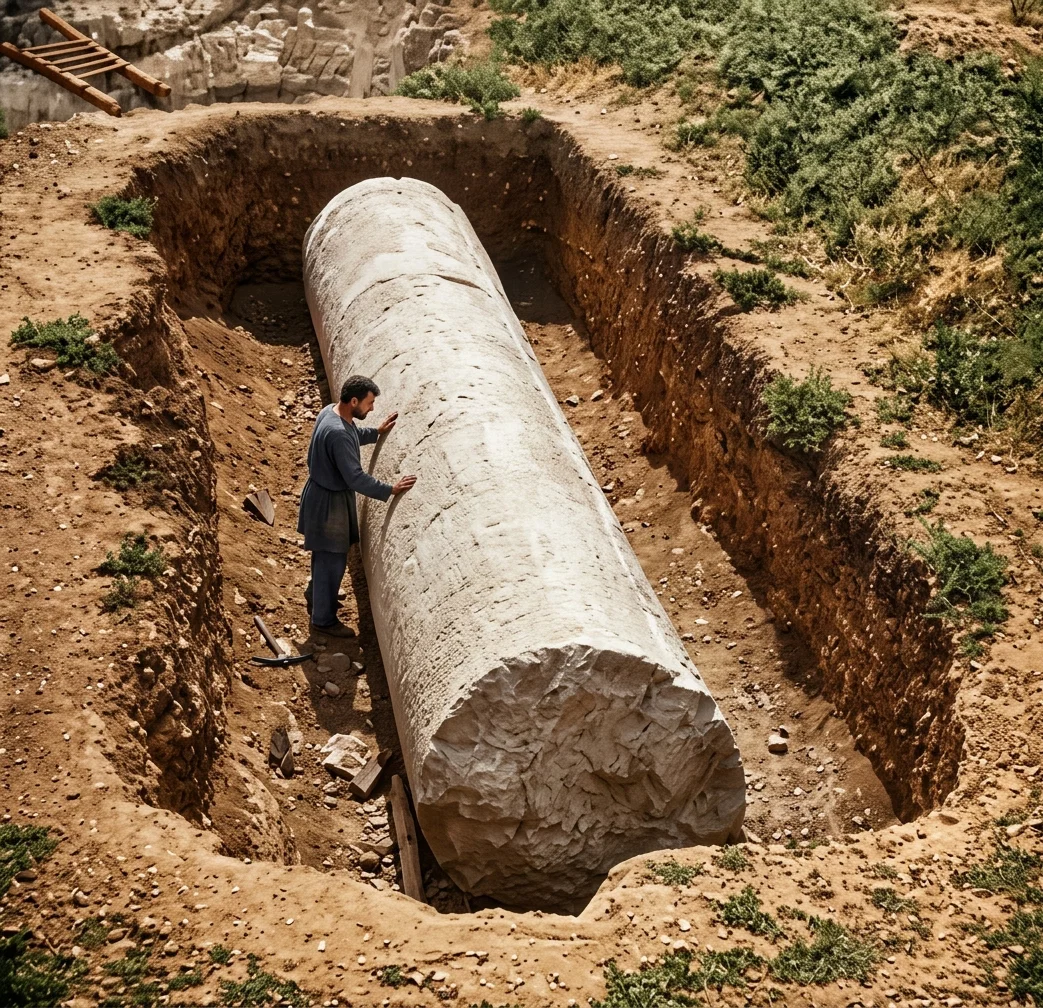
PILLAR IN QUARRY NEAR JERUSALEM.
(From a Photograph.)
Supposed to have been prepared for one of the temples.
We Will Send the Bible Free
Post-paid, for Seven New Names and $7.00.
Solicit the subscriptions and make it free for yourself. The price of the SIGNS is $1.00 per year. The Bible will be sent to any of these subscribers for $2.00 extra.
The Bible and papers will be sent to different addresses if desired.
Your name on the cover for twenty-five cents extra.