Prince Albert Victor, the prospective heir to the throne of England, made his maiden speech the other day, to an assembly of lads of his own age. “Whatever is worth doing at all, is worth doing accurately,” he said; “whether you sharpen a pencil or black your boots, do it thoroughly and well.”
A young lad who was a pupil at Rugby school was noted for his bad penmanship. When his teachers remonstrated, he replied, “Many men of genius have written worse scrawls than I do. It is not worth while to worry about so trivial a fault.”
Ten years later, this lad was an officer in the English army, doing service in the Crimean war. An order he copied for transmission was so illegible that it was given incorrectly to the troops, and the result was the loss of a great many brave men.
A few years ago, the keeper of a life-saving station on the Atlantic coast found that his supply of powder had given out. The nearest village was two or three miles distant, and the weather was inclement. He concluded that as it “was not worth while to go so far expressly for such a trifle,” he would wait a few days before sending for a supply.
That night a vessel was wrecked within sight of the station. A line could have been given to the crew if he had been able to use the mortar, but he had no powder. He saw the drowning men perish one by one in his sight, knowing that he alone was to blame. A few days afterward he was dismissed from service.
The experience of every man will suggest similar instances that confirm the truth of the young prince’s advice.
Whatever is right to do, should be done with our best care, strength, and faithfulness of purpose. We have no scales by which we can weigh our duties, or determine their relative importance in God’s eyes. That which seems a trifle to us may be the secret spring which shall move the issues of life and death.—Youth’s Companion.
A WATCH MADE OF STRAW.
An ingenious young man, who was sentenced to pass five years in a prison at Karthaus, in Bohemia, has succeeded in making a curious watch. It is mainly of straw, and is not nearly as heavy as the ordinary time-piece. The inside works comprise a few bits of straw, some cotton, two needles, and a pin. A piece of paper forms the dial. It will run six hours, and will keep good time.
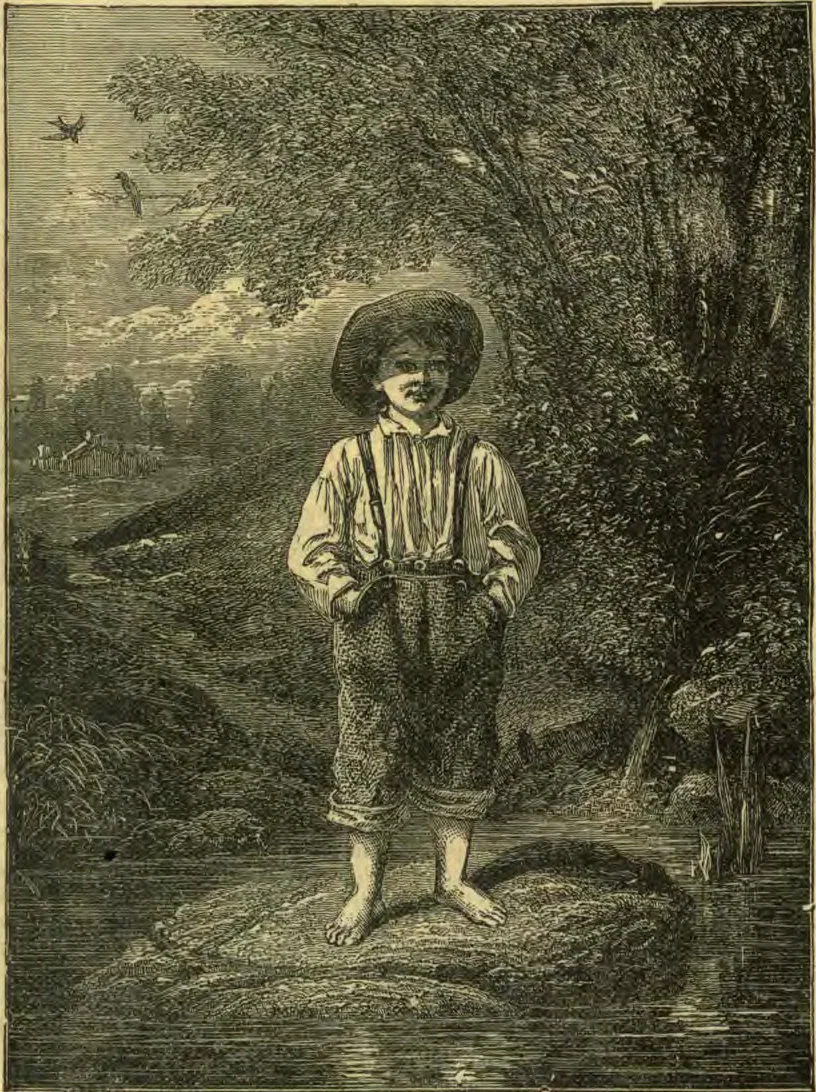
THE BAREFOOT BOY.
By Whittier
Blessings on thee, little man,
Barefoot boy, with cheek of tan;
With thy turned-up pantaloons,
And thy merry whistled tunes;
With thy red lips redder still
Kissed by strawberries on the hill;
With the sunshine on thy face,
Through thy torn brim's jaunty grace;
From my heart I give thee joy,—
I was once a barefoot boy!
Prince thou art,—the grown-up man
Only is republican.
Let the million-dollared ride!
Barefoot, trudging at his side,
Thou hast more than he can buy
In the reach of ear and eye,—
Outward sunshine, inward joy,—
Blessings on thee, barefoot boy!
O for boyhood's painless play,
Sleep that wakes in laughing day,
Health that mocks the doctor's rules,
Knowledge never learned of schools;—
For, eschewing books and tasks, Nature answers all he asks!
Hand in hand with her he walks,
Face to face with her he talks,
Part and parcel of her joy,—
Blessings on the barefoot boy!
O for boyhood's time of June,
Crowding years in one brief moon,
When all things I heard or saw,
Me, their master, waited for.
I was rich in flowers and trees,
Humming-birds and honey-bees;
For my sport the squirrel played,
Plied the snouted mole his spade;
For my taste the blackberry cone
Purpled over hedge and stone;
Laughed the brook for my delight
Through the day and through the night,
Whispering at the garden wall,
Talked with me from fall to fall;
Mine the sand-rimmed pickerel pond,
Mine the walnut slopes beyond,
Mine, on bending orchard trees,
Apples of Hesperides!
Still, as my horizon grew,
Larger grew my riches, too;
All the world I saw or knew,
Seemed a complex Chinese toy,
Fashioned for a barefoot boy!
Cheerily, then, my little man,
Live and laugh as boyhood can!
Though the flinty slopes be hard,
Stubble-speared the new-mown sward,
Every morn shall lead thee through
Fresh baptisms of the dew;
Every evening from thy feet
Shall the cool wind kiss the heat: All too soon these feet must hide
In the prison cells of pride,
Lose the freedom of the sod,
Like a colt's, for work be shod,
Made to tread the mills of toil,
Up and down in ceaseless moil;
Happy if their track be found
Never on forbidden ground;
Happy if they sink not in
Quick and treacherous sands of sin.
Ah! that thou couldst know thy joy,
Ere it passes, barefoot boy!
—Whittier.
LITTLE PHEBE.
By Ada L. Clarke
It was in a simple fishing-village upon the coast of Maine that I first met Phebe Morrison. She lived with her parents in a cosy red house, built near the shore. From her window she could look far out to sea, and at night she was soothed to sleep by the solemn roar of waves upon the rocks.
Her father was a young fisherman; and her mother was a busy little woman, whose days were spent in doing all she could for Phebe, while at the same time she kept the red house bright and clean, and waited upon the small store, which to help her husband she had set up in the front room. Here was a counter, over which she handed many a package of tea and sugar; besides fishing-tackle, nails, confectionary, and I know not what. Sometimes Phebe was allowed to wait on customers; but oftener she was scampering over the slippery rocks, or wading in the shallow water near the shore, where the breakers sent cool spray into her eyes, and made the brown curls roll up into tight rings about her face and neck.
I never knew how God's love fell into little Phebe's heart. Her mother found time on Sundays to teach her child something about God; but the busy woman seldom thought of it again throughout the week.
But Phebe did; and often she would sit upon the rocks, her brown hands folded upon her knee, and wish she could see Christ walking upon the waves as the Bible said he once walked to Peter long ago.
One day her father thought he would give Phebe a rare treat, and so took her with him a little way out to sea in his trim fishing-boat.
Well, it was a merry day. The big fish came bobbing up on her father's hook; the summer wind filled the sail; and the white-caps looked like the clouds that floated across the sky.
Oh, who would dream such pretty things could grow so terrible! The fisherman was so eager drawing in the fish that he did not notice the black cloud rising in the west, till shadows dimmed the sun; and then he knew the danger that lay ahead.
A storm of wind was upon them. With a wild glance at his smiling child, the fisherman gathered in the swaying sail; and telling Phebe to hold on tight, he tried to row for the distant shore.
Overhead, the sky was a tender blue; but out of that bank of cloud rushed a gale of wind which tossed the boat like a cork, lashed the waves to fury, and sent them over the sides till the water covered Phebe's feet.
“Phebe,” shouted the fisherman, above the roar, “can you help father bale out?”
“Yes, sir,” she replied bravely, grasping a tin pail he held toward her; and so the strong man and the tender child began a fight with death.
“Are you afraid, Phebe?” called the father.
“Yes, I am afraid; but God will see to us,” rang out the young voice above the wind.
“Oh, Phebe, you are a good girl! Pray for us so we need not die,” exclaimed the fisherman; and while the sea lashed the frail boat, a sweet voice took up that pitiful prayer of the disciples: “Lord, save us, we perish!”
In a little while the black clouds parted into paths of light, the wind grew still, and the fisherman and his child glided smoothly across the rippling waves. Oh, joy when they saw the red house upon the shore! Oh, joy when they saw the mother weeping and laughing in its doorway! And the sea never soothed a happier heart to rest than Phebe Morrison's, as she lay in her little bed, and remembered how the Saviour had hushed the storm.—Ada L. Clarke.
Winnie, Johnny, and the Rosy Apple
“Now, do you suppose,” said Johnny, as his little cousin laid away her largest, rosiest apple for a sick girl, “that God cares about all such little things we children do? I guess he is too busy taking care of the big folks to notice us much.” Winnie shook her head and pointed to mamma, who had just lifted baby from his crib: “Do you think mamma is so busy with the big folks—helping the girls off to school and papa to his office—that she forgets the little ones? She thinks of baby first, ’cause he’s littlest and needs it most. And God knows how to love as well as mamma.”
Letter Budget.
By Editor
May E. Cronk, of Saginaw Co., Mich., writes: “I am nine years old, and read in the Third Reader. I am staying with my grandparents. They love to read your publications, but they are not Sabbath-keepers. I love to read the INSTRUCTOR, and wish to take it six months, and send it to my cousin six months. I send my love to the INSTRUCTOR family.”
We are glad to send you the paper, May, and hope you and your cousin will both find it so interesting that you will wish to take it longer.
A letter from Maudie A. Chapman, of Kalamazoo Co., Mich., says: “I have learned to write now, so I do my own writing; and as I have never seen a letter in the Budget from this place, I thought I would write one. I am nine years old, and have two brothers. We lived in Kansas before coming to Michigan. There are another family besides ours, and an old lady, here, who keep the Sabbath. I send you the ‘Honey Bee’s Song,’ which I hope you will print. I want to be ready to meet the INSTRUCTOR family in the new earth.”
Maud’s letter was written with care, and was nearly as easy to read as print. The spelling was almost perfect. When adding ing to the word write, the letter e, at the end of the word write, should be dropped; thus, writ-ing, instead of write-ing. To be able to write a good hand is a valuable accomplishment; but to be able to spell correctly is better.
Davie Rees, writing from Howard Co., Ind., says: “This is my first letter to the Budget. I have two sisters. My oldest sister died last fall, and we laid her away to wait for the time when the Lord will wake her. I want to live so that I can be with her when this earth is made new. We have taken the INSTRUCTOR since I can remember. We go to Sabbath-school every Sabbath. I have sold several copies of ‘Sunshine at Home,’ and I am going to canvass more for it. I want to meet all the INSTRUCTOR family in heaven.”
Possibly some whom you canvass for “Sunshine” may appreciate a copy of the INSTRUCTOR. Try it sometime, if you have spare copies.
Cornelia Van Gandy, a little girl ten years old, writes from Deer Lodge Co., Montana Territory. She says: “I have two brothers and two sisters. I also have two grandmothers. My uncle has only one arm. My great grandma is seventy-nine years old. Her hip was injured, and she is so lame she can only take a few steps with a crutch and a cane. She is coming to stay with us a week or two. We are working for mother, to earn money for the missionary children. We are going to take our money for them to-day. I go to day school and Sunday-school.”
Cornelia has a fine chance to do missionary work among her own friends, by lightening their burdens, and weaving sunshine into their lives. Nobody can bring more happiness into the home than little boys and girls who cheerfully do the little, every-day duties of life. Faithfulness will bring its reward to them as much as to the missionary in foreign lands.
Lillie J. Beebe writes from Larimer Co., Col., where she is visiting relatives. She is a little lame girl, whose father bought her a wagon so she could go to school. Her father takes the INSTRUCTOR. They have Sabbath-school at their own home, where she has five sisters and two brothers, making quite a Sabbath-school class. Lillie is ten years old, reads her Bible, and is trying to be a good girl, so she can meet the readers of the INSTRUCTOR in the new earth.
In the new earth the helpless will not be dependent upon some one to draw them from place to place; for the lame shall leap as the hart. Shall you be there, Lillie?
Our letter box is yet so full that we have decided just to print the writers’ names of all letters remaining in it up to May 1. These little boys and girls love the INSTRUCTOR and the Sabbath-school. A few may have no Sabbath-school privileges, but all are trying to be Christ-like, hoping to be rewarded with the faithful. May none of our letter-writers fail of this reward.
Up to May 1 we have received letters from the following: Nancy A. Evans, Emma Johnson, Libbie Stanton, Willie Winchell, Rosalie Mulqueen, Edith Mack, Esther Doty, Zoa M. Huffman, Blanche E. Flora, Emma B. Smith, Jessie Bear, Ella Decker, Rachel Taggart, A. Bailey, Minnie Robbins, Lillie Gorrell, Mollie D. Jones, Valentine Ferrell, Willie Stocking, Eddie Barnhart, Melia Carnahan, Eddie Gros, Olive O. Nettleingham, Eva Emery, Neville C. Hampton, Selecta Dick.