Your ShelfYour Projects

Signs of the Times, Vol. 30, No. 8.

BABYLON IS FALLEN
Earlier text: NOT THE LAW, BUT MEN'S HEARTS, TO BE CHANGED

LOVE IN THE HOME.

LOVE is mighty; it is all-powerful; it is all-conquering—because it is the name of the Eternal. It is the opposite of selfishness; it is the embodiment of every virtue. The wise man says there is a time to love. Surely, then, there must be a place in which it is laudable and appropriate to manifest that love; and, certainly, if there is one place above another where the truest and tenderest love ought to reign, and where it should be manifested in all its sovereign beauty every hour of the day, that place is at home.
In our common translation of the Bible this love is sometimes called "charity." "What!" somebody says, "how can I have charity at home? I supposed charity was only to be exercised toward my neighbors." No greater mistake can be made. Love suffereth long, and still forgets not to be kind.
When the mother is weary and nervous from overwork; when baby is unusually fretful; when the bread has refused to rise, and the cake is burned,—then is the time for the exercise of that beautiful love which is kind even tho it has suffered long, and which thinks only of others in its own sweet self-forgetfulness.
Love takes no notice of the mistakes of loved ones; love will not upbraid and torture the sensitive child because of some trifling blunder. "In honor preferring one another," is the blessed motto of charity.
Nor will true love forget to speak a word of kindly cheer to the aged. Grandpa and grandma are perhaps very near the last mile-stone. The road grows more lonely as the dim sight fails to discern the flowers along the way, and the dull ear no longer hears the music of the bird songs. O, the loneliness of old age where there is no love to cheer, and where the kiss of affection is not often stamped on the furrowed brow!
Then there are the children. God bless the little ones! Happy indeed is that home where the innocent prattle of childish voices is heard. Suppose the floor is strewn with playthings when the elegant Mrs. Blank comes to make her first formal call. Suppose baby John has a few chairs harnessed to serve in the capacity of horses when papa brings a strange gentleman home to dinner. Is this any reason for the exhibition of impatience and ill-temper, or for those telltale lines between the brows to grow deeper? Shall the sharp word cause the sweet baby lips to quiver, and the loving, innocent eyes to fill with tears? O, how sad that we should forget so often that the baby fingers which cause us so much annoyance may be "stiff and cold to-morrow"!
Then, there are the boys and girls, who demand, and by right should have, a large inheritance of love. If the mother refuses this sympathy,—this love,—be sure the girls and boys will seek it elsewhere. And sometimes, in their heart-hunger, they mistake passion,—selfish, cruel, corrupt, vile,—for love, pure and holy,—love, of which passion is the counterfeit.
God pity the boys and girls,—and there is an army of them,—upon whose young lips no mother's kisses are pressed morning and evening, and upon whose head no father's hands have rested in benediction. Then, what an opportunity is presented in the home life for the exercise and cultivation of love between brothers and sisters.
Have you ever thought what a sad life must have been led by poor Joseph—the young dreamer, envied and hated by his brothers, and sold into cruel slavery by those of his own blood, and that at a time when he was taking great pains to make them a visit and bring them a message from home? Think of the homesick boy—a mere lad—lost and bewildered, wandering in the fields in search of those brothers whose superior age and strength should have constituted them his guardians, but whose perfidy consigned him to years of bondage and imprisonment! What a cruel welcome they gave him! "Behold, this dreamer cometh!" Hungry for the love that was his by right, but which in all his boyhood had never been granted him, save by his aged father, he undertook the long journey from Hebron to Shechem, hoping, without doubt, that the stony hearts of his brethren might be melted. How often we read the story, and in our hearts condemn the cruel brothers of the innocent dreamer. But when we apply this story to our own lives, are we sure we are guiltless? Have we always manifested the love and appreciation to our own, which were their rightful heritage?
Then we read the story of David and his elder brother, and how we despise the envy of Eliab, as that sarcastic, sneering question comes ringing down the ages, "Where are those few sheep in the wilderness?" But are we certain that our own hearts have never cherished envy toward those for whom we should ever feel the warmest love?
O ye fathers and mothers, brothers and sisters! let us not only cherish love in our hearts for our own, but let us so manifest it that there can be no doubt about it in the minds of our loved ones. Let us not be ashamed to bestow the kiss of affection upon those who would prize it more than riches. Then, from the home, let us allow our love to branch out and widen and widen, until the whole perishing world, hungry for the grasp of friendship and the tender word of cheer, shall be included in the benediction of our prayers. Then shall we be better prepared to dwell forevermore in that home of perfect love which our Elder Brother is preparing for us.

THE CURSE OF THE WINE "INDUSTRY."

[Mae Guthrie Tongie, in Union Signal.]
HERE is a bit of history from real life:—
A young married couple came out from Germany, and settled in Sonoma County, Cal. The man planted a vineyard, and began to make wine, of which the family partook freely. Six children were born. One of these—a little boy—was found dead, having fallen upon his pocket knife. Another son died of typhoid fever when about twenty years of age—died with a curse upon his lips. Another died at the beginning of young manhood of quick consumption, aggravated by the use of wine. Another mounted his horse one day, and rode away, and never returned. The supposition is that he drowned in fording the river while intoxicated. The fifth and last son developed heart disease as the result of excessive wine-drinking, and died subsequently from the effects of a blow from his drunken father. The only daughter died in an insane asylum. The mother, a woman of some refinement, became insane, and died from the effects of drinking and her husband's brutality. The father was the last to succumb, meeting a wretched death, the victim of his own insatiable appetite for wine. The foregoing is but one of several similar instances where whole families have been wiped out as by the hand of some pursuing Nemesis.
With tears running down her cheeks, a gentle Christian woman—my hostess for a day and night—said, as we parted: " When I came here ten years ago, my two older sons were pure and good. Today they are both drunkards. O, this wine business is an awful thing! It is an octopus that drinks the blood of human hearts," and her eyes rested anxiously upon the fair-haired boy of fifteen years, her third and youngest son.

THE DEAR LITTLE WIFE AT HOME.

The dear little wife at home, John, With ever so much to do— Stitches to set, and babies to pet, And so many thoughts of you— The beautiful household fairy, Filling your heart with light; Whatever you meet to-day, John, Go cheerfully home to-night.
For tho you are worn and weary, You needn't be cross or curt; There are words like darts to gentle hearts; There are looks that wound and hurt. With the key in the latch at home, John, Drop troubles out of sight; To the dear little wife who is waiting Go cheerfully home to-night.
You know she will come to meet you, A smile on her sunny face; And your wee little girl, as pure as a pearl, Will be there in her childish grace; And the boy—his father's pride, John, With eyes so brave and bright; From the strife and din to the place in peace Go cheerily home to-night.
What tho the tempter try you, Tho the shafts of adverse fate May bustle near, and the sky be drear, And the laggard fortune wait? You are passing rich already, Let the haunting fears take flight; With the faith that wins success, John, Go cheerily home to-night.
—Reynold's Newspaper.

THE WORK OF THE SUPREME COURT JUSTICE.

[Henry Carlton Lewis, in the Pilgrim for January.]
In bygone days the Justices lodged in one house. After dinner they met in solemn consultation over cases. Now they gather in the consultation room in the basement of the Capitol every Saturday to discuss the cases which have been argued during the week, and to arrive at decisions. To this room no one is admitted, not even the clerk of the Court.
One Justice writes the opinion of the Court in each case unless there be dissenting voices, in which event another Justice writes the dissenting opinion. The preparations of these decisions takes place at the homes of the Justices to whom assigned and the decisions are then brought to the consultation room and read to the full Bench. If they are approved, they are handed down on Monday, which is decision day. Certain classes of cases are assigned to certain Justices who are considered specialists. To one Justice is assigned patent cases, to another land cases, to another some other class, but they are all supposed to be—and in fact are—sufficiently well informed on all of the subjects considered to render an accurate decision on the points in dispute.
There is but one session of the Court each year. This begins on the second Monday in October and ends at the pleasure of the Court. During a portion of the year the Justices act as judges in the nine judicial circuits of the United States. In the circuit work they are assisted by circuit and district judges to whom are delegated such portions of the work as the justices desire. Each justice is now assigned to a particular circuit.
The Chief Justice receives a yearly salary of ten thousand five hundred dollars; the Associate Justices, ten thousand dollars. The tenure of office is for life. Any Justice may, however, retire on full salary when seventy years of age, provided he has served ten years. Each Justice is allowed a private secretary at a salary of sixteen hundred dollars a year.
Official etiquette requires that the members of the Court shall call on the President and Vice-President annually on the first day of the session. They are also required to call on the President on New Year's Day. These calls are made in ordinary street garb, but each Justice is accompanied by his body servant, who sits on the box of the carriage. The Chief Justice is presented first, and after that the order of seniority in service is respected. Once during the year the President entertains the Court at dinner.

ASTOUNDING! MARVELOUS! UNPRECEDENTED!

Lowest Prices Ever Known for Standard Works

A GREAT OPPORTUNITY FOR EVERY BIBLE READER

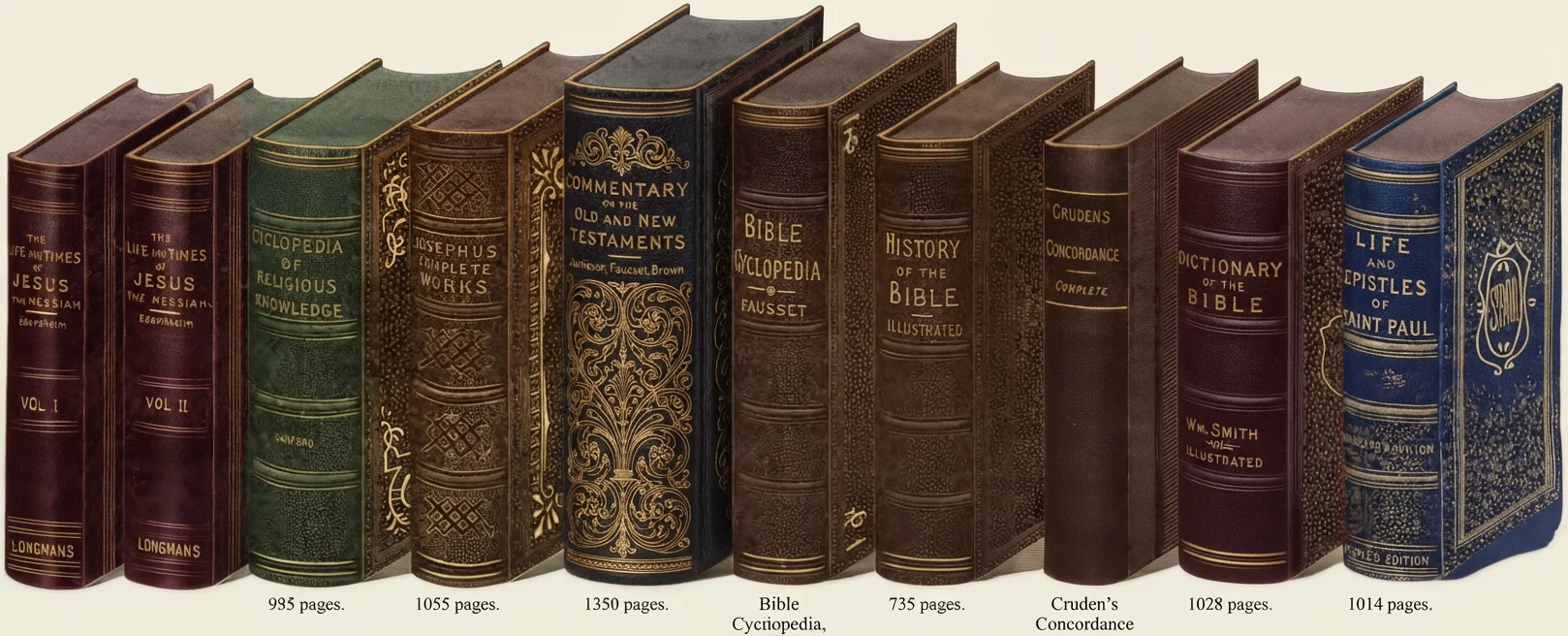
10 BOOKS THE GREATEST RELIGIOUS BOOK OFFER WE HAVE EVER MADE, A COMPLETE STANDARD BIBLE REFERENCE LIBRARY $10.00
This great religious library of ten books will surely prove invaluable to Pastor, Superintendent, Teacher, or Bible Scholar, and a storehouse of scriptural information to every home. They stand among the highest in Biblical Literature, are all new, clearly printed, strongly and handsomely bound in cloth and perfect in every way, all of which we guarantee.
NOTE TO "SIGNS OF TIMES" READERS.—We give to the army of SIGNS OF THE TIMES readers an opportunity to secure this standard religious library at an unheard-of price and on very easy terms of payment. Thousands of purchasers wonder how we can supply such large, handsome, clearly printed, and strongly bound books at such a marvelously low price, and the glowing commendations received from them testify their appreciation, and that they are happy, grateful, and satisfied.
Customers living west of the Rocky Mountains may send, if they choose, $2.50 in addition to purchase price and we will prepay freight charges and guarantee delivery to any station.
TAKE NOTICE Former Price $41.00 Now Only . . . 10.00 Your Choice of 6 Volumes $6.50

THE COMPLETE WORKS OF FLAVIUS JOSEPHUS
JAMIESON, FAUSSET, AND BROWN'S BIBLE COMMENTARY

By Robert Jamieson, D. D., St. Paul's, Glasgow; Rev. A. R. Fausset, A. M., St. Cuthberts, York, and David Brown, D. D., Prof. of Theology, Aberdeen. A complete commentary—critical, explanatory, and practical—on the Old and New Testaments, 1,280 pages, bound in cloth. Former Price $7.50. The body of the work consists of notes that are concise, learned, free from verbiage and easily understood, that elucidate and explain difficult passages of Scripture, or whose import is not readily apprehended. Far in advance of the older works now in use, it is also the most practical, suggestive and scientific.
Rev. H. Clay Trumbull, Editor of the Sunday-School Times: "I do not know of its equal within its scope and cost."
Rev. J. H. Vincent, Bishop M. E. Church: "It deserves a place on the table of every Bible student."

THE COMPLETE WORKS OF FLAVIUS JOSEPHUS

The celebrated Jewish Historian, translated from the original Greek by William Whiston, A. M. Large octavo, cloth, 1,056 pages, nearly 100 illustrations. Former Price $4.00. In this great work is contained the History and Antiquities of the Jews, Destruction of Jerusalem by the Romans; also Dissertations concerning Jesus Christ, John the Baptist, James the Just, and the Sacrifice of Isaac.

ILLUSTRATED HISTORY OF THE BIBLE

By Rev. John Kitto, D. D., F. S. A. It contains 735 double column pages, 220 engravings, printed from excellent plates, on good paper, strongly bound in cloth. Former Price $4.50. No modern writer has contributed more largely to enrich the biblical literature of our time, or to clothe with a fresh and living interest the main personages and incidents in Bible History than John Kitto in this magnificent work. Deeply interesting and instructive, and abounding in striking pictorial illustrations, it should have a place in every home. Over 100,000 copies of this popular work have been sold.

CRUDEN'S COMPLETE CONCORDANCE

By Alexander Cruden, M. A. Contains 756 large octavo pages, clearly printed, handsomely and strongly bound in cloth. Former Price $1.50. Scripture is the best interpreter of Scripture, and next to the Bible, no volume is of greater value to the Bible student than Cruden's Concordance.

SMITH'S DICTIONARY OF THE BIBLE

Edited by William Smith, LL. D., Classical Examiner of University of London. Contains 1,024 large octavo pages, printed on excellent paper, finely illustrated, handsomely and strongly bound in cloth. It formerly sold for $4.50. An indispensable aid to ministers, teachers, families, Sunday-school superintendents, and Bible readers generally. This is undoubtedly the best work of its kind in the English language.

DIRECTIONS FOR ORDERING

Send $10.00 and we will forward the ten books at once. Send $2.00 and promise to pay $1.00 a month for ten months, making $12.00 as complete payment, and we will forward the ten books at once. Send $6.50 and we will forward any six of the volumes you may select at once. Send $2.00 and promise to pay $1.00 a month for six months, making $8.00 as complete payment, and we will forward your selection of six volumes at once. You pay freight or express charges on above plans, and we guarantee safe delivery to any station in the United States or Canada.

EDERSHEIM'S LIFE AND TIMES OF JESUS THE MESSIAH

(2 Vols.) The Authorized American Edition. By Alfred Edersheim, M. A., Oxon, D. D., Lecturer Oxford University. Two volumes. Former Price $6.00. Royal 8vo, 1,524 pages, handsomely bound in silk cloth. Gives a full account of the society, life and development—intellectual and religious—in Palestine, to serve as a frame and background for the picture of Christ. The fresh study of the text of the Gospels makes the book an historical commentary on the Four Gospels.
The Sunday-School Times recommends it: "It is positively refreshing to read a life of the Saviour which is critical in the best and truest sense of the word and is biblical at the same time."

CONCISE CYCLOPEDIA OF RELIGIOUS KNOWLEDGE

Biblical, Biographical, Theological, Historical, Geographical, and Practical. Edited by Rev. E. B. Sanford, D. D., assisted by a brilliant gallery of Biblical Scholars and Divines. Complete in one volume, nearly 1,000 pages, beautifully illustrated, cloth binding. Regular Price $3.50. To the seekers after knowledge this work will prove a surprising storehouse of information regarding Church History, Bible History, Bible Names, Places, Customs, Doctrines, Creeds, Denominations, The Early Church, The Story of the Reformation, the various Young People's Societies, Theologians, Scholars, Cathedrals, Churches, etc.
The Christian Endeavor World, Boston: "Knowledge is here available for which many have not known just where to turn."

CRITICAL AND DEPOSITORY BIBLE CYCLOPEDIA

Compiled and written by Rev. A. R. Fausset, A. M., joint author of the Jamieson, Fausset, and Brown Bible Commentary. It contains 750 three-column pages, 600 illustrations, cloth binding. Regular Price $5.00. This great work is the result of seven years of labor by the author, contains 3,700 articles, and presents a completeness, conciseness, and thoroughness, such as to make it a perfect Bible Cyclopedia. It sets forth briefly and suggestively those doctrinal and experimental truths which are contained in the written Word itself.
J. W. Bashford, D. D., President Ohio Wesleyan University: "It is a most admirable aid. I hope ten thousand teachers will use it inside the next six months."
Rev. Dr. T. DeWitt Talmage: "It is in advance of all books in that line—unique, learned, accurate and valuable."

THE LIFE AND EPISTLES OF ST. PAUL

By Rev. W. J. Conybeare, M. A., of Cambridge, and J. S. Howson, D. D., of Liverpool. Formerly sold for $4.50. Contains 1,014 large octavo pages, many fine illustrations, maps, charts, etc., is printed on the same quality of paper and in the same size as Smith's Dictionary of the Bible, and is bound in uniform style. There is no work that will compare with this in giving a life-like picture of the great apostle and the work which he did.

WE WILL FORWARD BY PREPAID EXPRESS ANY BOOK DESCRIBED IN ABOVE LIST ON RECEIPT OF $2.50

In all cases where books are sent by mail or express we guarantee safe arrival at destination, and will make good any loss in transit.
TAKE NOTICE! We will take back any or all books that are not satisfactory in ten days after examination, and will return money deducting only the return freight or express charges. This marvelous offer is limited, and money will be returned if the books are exhausted and we can not fill your orders. As to our responsibility, we refer you to the SIGNS OF THE TIMES, or any commercial agency. Established 1866. THE S. S. SCRANTON COMPANY, Publishers, Hartford, Conn. Mention the SIGNS OF THE TIMES when you order

CHRISTIANITY IN THE WEST INDIES.

BY F. I. RICHARDSON.

THE Moravians have been among the foremost in missionary enterprise and zeal. The writer, having picked up some bits of their history of self-denial and devotion and the blessings which have followed, would present it to the readers of the Signs of the Times, hoping it may encourage others in the great work before us.
"The Unita Fratrum," or Moravian Church as it is commonly called, was founded in Bohemia, in 1457, by followers of John Huss, the Bohemian reformer and martyr. It soon spread to Moravia, whence it derives its name.
After flourishing for a century and three quarters, it nearly received its death-blow at the hands of Ferdinand II., a bigoted Romanist. But a hidden seed remained in Bohemia and Moravia, secretly cherishing the faith and traditions of their fathers.

They Find a Friend.

In 1722 a number of these descendants of the Brethren, together with other awakened compatriots, emigrated to an estate belonging to the Count Zinzendorf, in upper Lusatia, Saxony, and there founded Herrnhut, which grew to be a flourishing town. Here, under the fostering care of this devoted man, the Moravian Church sprang into new life.
Count Zinzendorf belonged to an Austrian house of high antiquity. The first ten years of his life he spent with his grandmother. In that time, she, like the mother of Moses, so thoroughly instilled into his young mind the principles of the love of Christ, that, altho in after years his friends tried to dissuade him, and he was sent away to college and educated for the profession of law, and at the age of nineteen was sent to gay and dissolute France, where he spent some time, he remained steadfast to the teachings received in early boyhood. In his fourth year he began earnestly to seek after God; and while yet a child he framed a covenant which ran thus: "Be Thou mine, dear Saviour, and I will be Thine;" and it was often renewed afterward. Aware that powerful temptations would await him in France, he resolved firmly to maintain his Christian position, and hence wrote, "If the object of my being sent to France is to make me a man of the world, I declare that it is money thrown away; for God will, in His goodness, preserve in me the desire to live only for Jesus." Thus did God raise up a person to provide an asylum for those impoverished exiles from Bohemia. "I will never leave thee, nor forsake thee."

A Needy Field.

When Count Zinzendorf was at Copenhagen attending the coronation of King Christian VI., some of his attendants met a negro named Anthony, who dwelt upon the sad condition of Africans in the island of St. Thomas, and particularly that of his sister, who wished to be taught the true religion. This man afterwards visited Herrnhut, and a simultaneous desire was kindled independently in the hearts of two young men to devote themselves to Gospel work among the slaves in the West Indies. One of the two, Leonard Dober, was a potter; and with him was associated David Nitschmann. Their funds amounted to a trifle over three dollars apiece. Count Zinzendorf took them in his carriage as far as Bautzen, and then, with a blessing, bade them Godspeed. A bundle on their back their only luggage, they set out thence on foot for the capital of Denmark, a distance of six hundred miles. Pious persons on whom they called by the way, tried to dissuade them; only one in that whole distance spoke an encouraging word. But special service for God never fails of special help from God. They reached Copenhagen, where they at first meet ridicule and opposition. They are told that no captain will take them on his ship; that, if they reach St. Thomas they will be unable to support themselves. Frightful stories are related about the ferocity of the Caribs. The two brethren do not argue the matter, and make but little effort to answer objections; they keep quietly about their business of trying to reach the West Indies, ready to go into slavery themselves in order to reach the negroes, as Anthony had represented would be necessary.
Cane-cutters of Jamaica.

The Way Opens.

An unseen hand was guiding, the adorable Comforter was sustaining these devoted men. At last their Christian constancy won favor and efficient sympathy. The royal chaplains became interested; so did a few other high officials, who gave enough to pay their fare out, as well as to procure tools for carrying on their trades. Some members of the royal family, among them the queen, lent their aid. The Princess Amelia, unsolicited, gave them money toward their expenses, and a large Dutch Bible, which proved a very seasonable gift, for, being refused passage on any Danish ship, they were compelled to avail themselves of one from Holland, and embarked October 8, 1732. Here, too, as often, the good hand of God was visible in the very disappointment. St. Thomas had been in possession of the Netherlands; the negroes spoke Dutch, and the missionaries now had an opportunity, during their voyage, to learn the language which would be required in their work.
The day after landing, Dober and Nitschmann went in search of Anthony's sister, and, finding where she lived with her husband and younger brother, they made known Anthony's salutation. By request, they opened and read his letter to her, in which occurred the quotation, "This is life eternal, that they might know Thee, the only true God, and Jesus Christ whom Thou hast sent." Beginning then and there, they preached the Gospel to the heathen slaves gathered round. The negroes understood the drift of the message, and clapped their hands for joy. Every opportunity for instructing the blacks was improved, and among those early awakened were Anthony's sister and her husband.
After some months Nitschmann, according to previous arrangement, returned to Europe. Then a year and four months passed before Dober heard from Herrnhut. While sitting by a watch-fire one evening, suddenly three men stood before him. A vessel had just come in, bringing from Herrnhut missionaries destined for this and the neighboring island of St. Croix. An appointment as general elder at Herrnhut caused Dober to return to Germany in 1735. But the precious seed he had sown not only brought forth fruit to the honor and glory of God before he was called away, but it has gone on bearing fruit, aided by other missionaries from other denominations, until it has spread over the entire West Indies, and thousands of these benighted heathen souls have been brought to accept the Gospel plan of salvation.

Now Hearing the Last Message.

In 1892 the Third Angel's Message reached the West Indies. God has blessed our efforts, until in Jamaica alone, more than fourteen hundred have accepted the truth, and a good beginning has been made in Barbadoes, Trinidad, and a few other islands. But, with all that has been done, only a commencement has been made. On many of the islands there is not a single laborer, and where there are workers there is a call for more. Where are the Dobers and Nitschmanns who will say, "Here am I, Lord, send me"?

THE HEART OF THE GOSPEL.

A STORY is told of Lapaux, a member of the French Directory, that with much thought and study he had invented a new religion, to be called "Theophilanthropy," a kind of organized Rousseauism, and that, being disappointed in its not being readily approved and adopted, he complained to Talleyrand of the difficulty found in introducing it.
"I am not surprised," said Talleyrand, "at the difficulty you find in your effort. It is no easy matter to introduce a new religion. But there is one thing I would advise you to do, and then, perhaps, you might succeed."
"What is it? What is it?" asked the other with eagerness.
"It is this," said Talleyrand, "go and be crucified, then be buried, and then rise again on the third day, and then go on working miracles, raising the dead, and healing all manner of diseases, and casting out devils, and then it is possible that you might accomplish your end."
And the philosopher, crestfallen and confounded, went away silent.—Selected.

GO.

BY LAURA C. HUTCHINS.
Go LIFT up the weak and the fallen; Go visit the lonely and sad; Go deal out thy bread to the hungry; Go see that the naked are clad.
Go visit the widow and orphan; The sick, the afflicted, and lone; Go comfort the stranger, the mourner; Go make all their sorrows thine own.
Go lighten the bands and the burden; Go see that the captives are free. Lo, this is the fast He hath chosen, And this the thanksgiving He'd see.
Removing thy foot from His Sabbath, Deferring thy pleasure His day, Then light shall break forth mid thy darkness; His glory shall lighten thy way.

ANOTHER STEP FORWARD.

From The Missionary Review of the World we take the following interesting report from Japan:—
The friends of missions know how much trouble has been experienced in Japan in reference to the holding of mission property, inasmuch as by Japanese law foreigners could not legally acquire real estate. In view of this difficulty, our Japan Mission (Congregational) has, after protracted effort, secured legal incorporation, with full permission for the new corporation to hold real or personal estate in the empire. All members of the mission may be chosen as incorporators, and hereafter all property that may be desired may be secured and held with a clear title, which none can question.
Once more has God given to His church an open door in Japan. For some years, while it has appeared to be open, it was but an outer door. Following the early promise of our mission work, which encouraged the hope of a speedy evangelization of the islands, and led to the earnest, but almost vain, appeal to the church to seize the fleeting opportunity, came the reaction toward a rationalistic theology, invertebrate and nerveless, which threatened to kill the native church by stopping its aggressive efforts, and to destroy all outside interest by its failure to offer anything better than the old ethical philosophies. The past year a general discontent with existing conditions, an awakening of the Japanese to a realization of the insufficiency of their own systems, together with other causes, led to the inauguration of the Twentieth Century Special Union Evangelistic Movement, in which the different denominations have co-operated. Conducted in a large measure by the natives themselves, with the aid and counsel of the missionaries, this evangelistic campaign, begun in the spring of 1901, and resumed in the fall of the same year, has resulted in twenty thousand inquirers of all ranks and conditions, exclusive of the one thousand four hundred students who expressed a purpose to begin a Christian life. The end is not.
The attempt of the Conservative party to exclude Christianity from the education of Japan has failed. The new educational code, backed by imperial rescript, had but a temporary triumph, and once more our schools are free to teach Christian truth. The latest news from Japan is almost the best of all. The native leaders in theological thought have come out clearly and strongly in a declaration of their loyalty to the Word of God as the only infallible rule of faith and practise, and to Jesus Christ as the divine Son of God.

OUR WORK AND WORKERS.

THE Wisconsin Reporter notes the addition of two more to the company at Birnamwood.
A NEW church-school building at Battle Creek, Mich., was dedicated on the 16th inst.
IN the West Michigan Herald, Brother R. C. Horton reports the baptism of six candidates at Casco.
THE Indiana Reporter notes that thirteen new Sabbath-keepers have been added to the ranks at West Lebanon.
A CANVASSER' institute will be held at Du Quoin, Ill., March 8-21, under the auspices of the Southern Illinois Conference.
THE brethren at Lindsay, Ont., have purchased a lot on which there is a building which they are converting into a meeting-house.
IN connection with meetings held at Killbuck, Ohio, by Brother B. L. House, six have accepted the Sabbath "according to the commandment."
A NEW Sabbath-school of twenty members at Chicago Heights is reported in the Recorder by Brother Victor Thompson. He adds, "We have commenced to teach a few Chinamen here to speak and read English by the use of 'Gospel Primer.'"
A LACK of faith is sure to bring its regrets. We notice a report from a certain city, in which the writer says: "We had no trouble in selling the 150 SIGNS of the special number at ten cents each. We only regret that we did not order 500 or 1,000."
A LETTER from Brother C. H. Castle, secretary of North England Conference, notes the organization of three churches in that conference thus early in the present year,—in Manchester, Birkenhead, and Leicester. Mrs. Castle began a church school at Kettering—the first in England—January 4.
A ROOM at our industrial school building at Minetto, N. Y., has been dedicated to the purposes of a reading-room, as there was no such place in the town. As the town is near the city of Oswego, the editors of that city gave some good volumes and maps for the room. Other outside friends contributed to the work of finishing and furnishing. Of course our own literature is conspicuous, and the room is open to the public Sunday afternoons, and Tuesday and Thursday evenings. The room can also be used for advanced classes. Brother S. H. Lane delivered an address at the dedication, which was well attended by residents of the town.
THE following extract from a letter from Brother John Hoffman, of Abo, Finland, is published in the Workers' Bulletin: "In Helsingfors, Elder Anderson has a good interest. Here at Abo a few are interested, but they are so slow to take their stand. But God is working on some hearts, and we hope that some may take their stand for Him and His truth. Generally, all the free churches, as they call them here, do not have very many in attendance. But the Lutheran State church is packed all the time. There are many priests here, and they have meetings in nearly all the halls besides their church. They hold their people in very strong bands, so it is hard for any one to break away."
THE school at Sheridan, Ill., has added a small printing plant, making one more feature to its industrial character.
Our "Index" describes all lamps and their proper chimneys. With it you can always order the right size and shape of chimney for any lamp. FREE. Macbeth, Pittsburg, Pa.

ANNUAL MEETING NOTICE.

THE Second Annual Meeting of the Pacific Union Medical Missionary and Benevolent Association, for the purpose of electing seven directors and transacting any other business that may properly come before the meeting, will be held on Wednesday, March 9, 1904, at 12 o'clock M., at room 203 Parrott Building, San Francisco, Cal. W. R. SIMMONS, President. E. E. PARLIN, Secretary.
It is expected that the meeting will be called to order and duly adjourned to Monday, March 28, 1904, the day following the adjournment of the meeting at Healdsburg, Cal., of the Pacific Union Conference.

INFORMATION WANTED.

MRS. MARTHA HERRICK, station A., N. Pasadena, Cal., desires her father, James M. Lee, or her brothers, Hendrick, Benjamin, Bartholomew, and Matthew, to know that her husband is dead, and she is sadly in need of assistance. When last heard of these relatives were in Topeka, Kansas, and Beatrice, Neb.
CLAUDE LAW, of Canby, Iowa, who was working at Ames, Iowa, left that place on the evening of Dec. 23, 1903, and has not been seen or heard from since. He is 21 years of age, height 5 feet 10 inches, weight about 150 pounds. He generally went smooth shaved. Any one who can give information as to his whereabouts will confer a great favor by addressing his father, S. D. Law, Canby, Iowa.

WANTED FOR MISSIONARY WORK.

(Always prepay postage.) SIGNS, Southern Watchman, Life Boat, Bible Training School, health publications, and tracts (Spanish or English). Address, Mrs. S. S. Kreamer, Alamogordo, N. M.

RIPE OLIVES.

I STILL have some of those delicious, ripe, pickled olives. Orders will be filled, while they last, at the following prices:—In lots of 16, 30, 50, or 60 gallons, at 40 cents per gallon. In 4, 5, 8, or 10 gallon lots, at 45 cents per gallon. Marysville, Cal. A. E. CRIST.
Continue reading: SEED SOWING IN JAPAN