The Youth’s Instructor, Vol. 47, No. 30.

THE NEW ZEALAND MAORIS

The Youth’s Instructor

Jul 27, 1899

Review and Herald Publishing Company · Battle Creek, Mich. · Jul 27, 1899

THE NEW ZEALAND MAORIS.
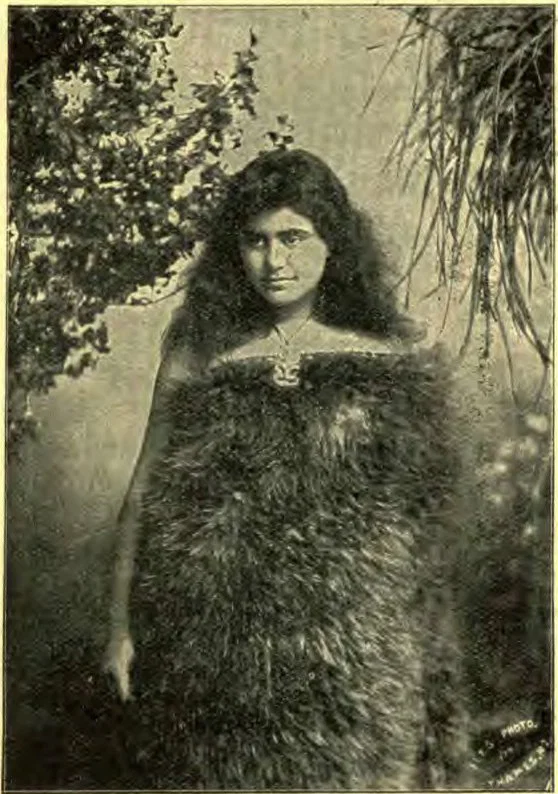
The Maoris are kind and affectionate in their behavior one to another. A common method of salutation is to rub their noses together. They evidently believe in “women’s rights;” for in almost any group of men may be seen women taking a prominent part in the conversation. Perhaps they think it is no more than their due, since a heavy share of the work also falls to their lot.
MAORI GIRL IN NATIVE DRESS.
TAMATI WAKANENE: A FINE SPECIMEN OF NATIVE TATOOING, TAKEN FROM LIFE.
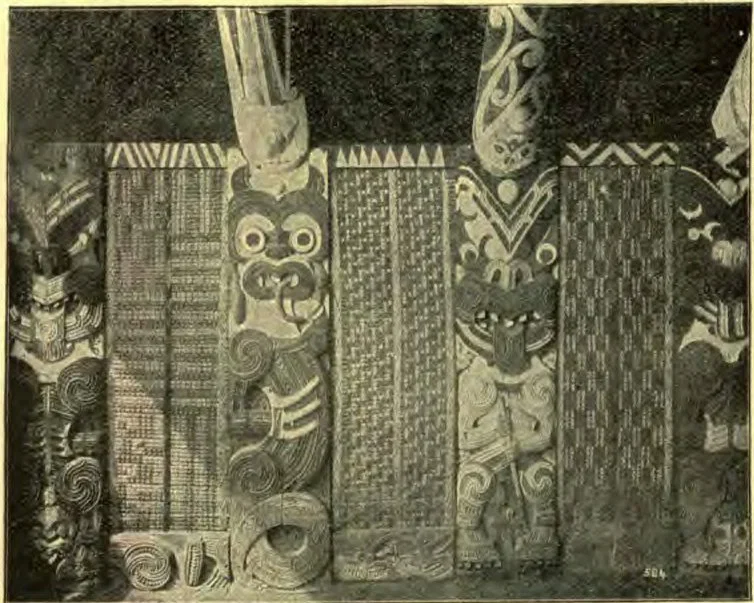
SIDE WALL OF MAORI SCHOOLHOUSE, COMPOSED OF CARVED PILLARS AND WOVEN MATTING.
The children are as quick, bright, and inquisitive as children usually are. They gladly form the acquaintance of strangers, and greet them with tanagua (how do you do?). The names given them always have some significance; such as, Rangiwhatitiri (thundering day); or Hinetira (daughter of the sun).
Each one who attended the conference was warmly greeted on his arrival, and the most unbounded hospitality was extended to all. One party, that came the afternoon of the second day, were welcomed with shouts and cheers as they came over the river; and then all proceeded in silence to the meeting-ground. Before their arrival, a large picture of a native man about thirty-five years of age was brought out, and placed upright on a beautiful mat. In front of the picture some garments, apparently belonging to a young child, were placed. The new arrivals were the friends and relatives of the man in the picture; and as they advanced, those already on the ground formed a semicircle around the picture, and a woman standing near it extended her hands toward the advancing party, and began a solemn, mournful, wailing cry, in which she was joined by all the company. A listener could not but think of the words of the prophet: “Thus saith the Lord of hosts, Consider ye, and call for the mourning women, that they may come; and send for the cunning women, that they may come: and let them make haste, and take up a wailing for us, that our eyes may run down with tears, and our eyelids gush out with waters.”
Though ignorant of the cause of mourning, the effect of listening to that wail of sorrow could hardly fail to bring tears to the eye of the spectator. Death comes to every land and people, and in sorrow all the world are kin. The cause of this demonstration was the death of a prominent chief, whose portrait was before the company; the clothing had been worn by a child of the same family, who had died but a few days before. As the mourners drew near, they joined in the mourning; and it was continued for several hours. As twilight came on, the two companies still sat facing each other, giving utterance to their sorrow in low, mournful wails.
At this conference there were present thirty-eight Mormon missionaries from Utah. All were young men, most of them under thirty years of age. They pay their own passage to New Zealand, and are supported by their families or friends in the United States while here. In this way they are no expense to their church or mission board. They live among the Maoris, and in about six months have sufficient knowledge of the language to converse with them. In a year they are able to preach. Two are appointed to each locality, and they labor together. They claim four thousand converts to their religion, but probably the number is much smaller. After working here three years, they are allowed to return to Utah, and their return passage is paid by the church they represent. Most of them go home, and their places are filled by others.
The Maoris are ready to imitate the vices of the European rather than his virtues. They are fond of alcoholic drinks and tobacco, and women and girls smoke as well as the men. These bad habits are almost universal. The Mormons have done more than many other missionaries to correct these evil practises. At this conference Mr. Farnsworth was invited to speak twice on the subject of temperance. He spoke through an interpreter, and used Dr. Kellogg’s temperance charts to illustrate his remarks, and show the listeners the physical effects of alcohol and tobacco on the human body. All present appeared much interested in the facts presented.
There were no seats in the place of meeting, except those occupied by the elders. The Maoris sat or reclined on the floor, in any position that best suited their comfort or inclination. Before different groups might be seen a pile of boots and shoes, which had been deposited there till the close of the meeting.
While the different meetings were in progress, four or five young men might be seen standing in different parts of the room, each having a long stick in his hands. Their business was to keep the congregation awake; and when the quantity of food consumed is taken into consideration, the wonder was that any one could keep his eyes open. If one was so unfortunate, however, as to become drowsy, a gentle poke with the stick, or a sharp rapping against a post near his head, was sufficient to bring him to his senses. Probably not half of those on the ground attended the meetings. Visiting and the preparation of food seemed to be the favorite occupation. Often during some service a sharp squeal and the barking of dogs told of some porker doomed to die to feed the congregation assembled for worship.
In consequence of their wrong habits of living, largely taught them by the Europeans, the Maoris have become greatly weakened physically. Formerly they ate but little meat except fish. Now they use it to excess. Their teeth decay early, and lung difficulties are common. They need to be patiently taught the effect of wrong habits, and to leave off the things hurtful to them. They have been wronged and cheated till they have become suspicious; but when once their confidence is won, they are ready to follow the teachings of those who would do them good. It is said that their language is easy to learn. They have no books except the Bible and a few small books, yet they are fond of reading. Boarding-schools, where they can obtain a free education without cost, except to furnish their clothes, are established in different parts of the colony.
There should be earnest, devoted young people who would teach this people the religion of Jesus Christ, especially that phase of the gospel relating to the care of the body. The enemy has sowed the field of their hearts with tares, yet there must be many sheaves gathered from these children of nature to make glad the harvest of the Lord.
MRS. V. J. FARNSWORTH.

THE CHARACTER THAT GOD APPROVES.

I.

The youth need to be instructed, carefully and prayerfully, that they may build their characters upon the abiding foundation. The reason so many make grievous blunders is that they do not heed the teachings of experience. The counsel of parents and teachers is lost upon them, and they yield to the temptations of the enemy. God loves the youth. He sees in them great possibilities for good, if they will realize their need of Christ, and build upon the sure foundation. He also knows their trials. He knows that they will have to battle against the powers of darkness, that strive to gain control of the human mind; and he has opened the way by which young men and young women may become partakers of the divine nature. The good they may accomplish by uniting themselves to Christ they will never know until, as overcomers, they enter the kingdom of Christ.
Character does not come by chance. It is not determined by one outburst of temper, one step in the wrong direction. It is the repetition of the act that causes it to become habit, and molds the character either for good or for evil. Right characters can be formed only by persevering, untiring effort, by improving every entrusted talent and capability to the glory of God. Instead of doing this, many allow themselves to drift wherever impulse or circumstances may carry them. This is not because they are lacking in good material, but because they do not realize that in their youth God wants them to do their very best. If the youth to-day would stand as Daniel stood, they must put to the stretch every spiritual nerve and muscle. The Lord does not desire that they shall remain novices. He wishes them to reach the highest point of excellence. He desires them to reach the very highest round of the ladder, that they may step from it into the kingdom of God.
The youth who leave their homes, and are no longer under the watch-care of their parents, are to a large extent left to choose their own associates. They should remember that the eye of their Heavenly Father is upon them, and that he sees their every necessity, their every temptation. There are always to be found in schools some youth who, by their course of action, reveal that their minds are cast in an inferior mold. Through unwise training in childhood, they have developed one-sided characters; and as they have advanced in years, these defects have remained to mar their experience. By precept and example, these souls lead astray those who are weak in moral power.
Time is golden, dear youth. You must not imperil your souls by sowing wild oats. You can not afford to be careless in regard to the companions you choose. Dwell upon that which is noble in the characters of others, and these traits will become to you a moral power in resisting the evil and choosing the good. Set your mark high. Your parents and teachers, who love and fear God, may follow you with their prayers day and night, they may entreat and warn you; but all this will be in vain if you choose reckless associates. If you see no real danger, and think you can do right as well as wrong, just as you choose, you will not discern that the leaven of wickedness is insidiously tainting and corrupting your mind.
Christ was afflicted, insulted, abused; on the right hand and on the left he was assailed by temptation, yet he sinned not, but presented to God a perfect obedience, that was entirely satisfactory. By this he removed forever every semblance of excuse for disobedience. He came to show man how to obey, how to keep all the commandments. He lay hold of divine power, and this is the sinner’s only hope. He gave his life that man might be a partaker of the divine nature, having escaped the corruption that is in the world through lust. “Behold the Lamb of God, which taketh away the sin of the world.”
God has given the youth talents to improve for his glory; but many apply these gifts to unsanctified, unholy purposes. Many have abilities which, if cultivated, would yield a rich harvest of mental, moral, and physical acquirements. But they do not stop to consider. They do not count the cost of their course of action. They encourage a recklessness and folly that will not listen to counsel or reproof. This is a terrible mistake. Young men would be sober-minded if they realized that God’s eye is upon them, that angels of God are watching the development of character, and weighing moral worth.
MRS. E. G. WHITE.

Comfort One Another: A Poem on Friendly Kindness

“COMFORT one another; With the hand-clasp close and tender, With the sweetness love can render, And the look of friendly eyes. Do not wait with grace unspoken, While life's daily bread is broken; Gentle speech is oft as manna from the skies.”

DISHONESTY OF DEBT.

We all remember the aphorism of Mr. Micawber on this theme: “Earn twenty shillings a week, and spend nineteen—happiness! Earn twenty shillings a week, and spend twenty-one—misery!” To live within one’s income is not only a prudent thing: it is a right thing and a necessary thing; and the smaller the income, the greater the necessity. Let a young man cut off every extravagance, and deny himself even food, rather than plunge into debt, in the foolish hope that things will come out right some day. To the man of fine conscience there is a sense of degradation in debt. He knows that the debtor is nothing more nor less than a thief. He is deliberately keeping in his own pocket that which ought to be in somebody else’s pocket. He has sold himself into slavery to his creditor. The clothes on his back are not his own, and the very meal he eats is stolen. To the upright man such a condition of things is torturing and intolerable, and that is what every youth ought to feel.—Forward.

ANSWER HIM SOFTLY.

Answer him softly. You can not know, In the depths below, How sharp was the struggle, the fight he made, Ere the price he paid, And yielded his soul to the tempter’s power In a hasty hour.
Answer him softly, lest you be tried On your weaker side, And fail, as before you so many have done, Who in thought had won,— Failed, too, ere temptation had spent its force In its subtle course.
Answer him softly; for none can tell When the storm-clouds swell, Whose bark shall weather the tempest, or whose Shall the venture lose. Speak gently: the weakest may stand the gale, And the strong may fail.
— Selected.

GRIEF-STRICKEN ANIMALS.

A MEMBER of a shooting-party killed a female monkey, and carried it to his tent. The tent was soon surrounded by forty or fifty monkeys, who made a great noise, and seemed disposed to attack the aggressor.
They retreated when he presented his fowling-piece, the terrible effect of which they had witnessed, and appeared quite to understand; but the head of the group stood his ground, chattering furiously. The sportsman, who perhaps felt some compunction for having killed one of the family, did not like to fire at the creature, and nothing short of firing would suffice to drive him off.
At length the monkey came to the door of the tent, and finding threats of no avail, began a lamentable moaning, and by the most impressive gestures seemed to beg that the slaughtered animal might be given back. The dead body was accordingly given to him. He took it sorrowfully in his arms, and bore it away to his waiting companions.
Those who witnessed the extraordinary scene resolved never again to fire at one of the monkey race.
A case equally pathetic occurred at Chalk Farm, near Hampton, in England. A man set to watch a field of peas, which had been much preyed upon by pigeons, shot an old male pigeon that had long been an inhabitant of the farm. Its mate immediately settled upon the ground by its side, and showed her grief in the most expressive manner.
The laborer took up the dead bird, and tied it to a short stake, thinking the sight of it would drive away other depredators. The bereaved bird, however, did not forsake her mate, but continued day after day walking slowly round the stick.
The kind-hearted wife of the bailiff of the farm at last heard of the circumstance, and immediately went to afford what relief she could to the poor bird.
On arriving at the spot, she found the hen-bird much exhausted. It had made a circular beaten track around the dead pigeon, giving now and then a little spring toward him. On the removal of the dead bird, the hen returned to the dove-cot.—Selected.

THE HISTORY OF A B C.

The Latin Alphabet.
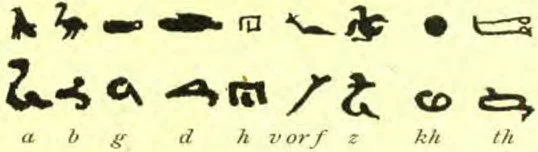
The ancients believed letters were invented by Cadmus, and that he taught them to the Greeks; but the Egyptian monuments have shown us that letters were not invented at all. We now know that before men used letters, they wrote by means of pictures, and that letters are, in fact, a sort of pictures; though those who use them long ago forgot this, and made them badly. Many people since the Greeks, and even some men of great learning, have supposed that certain letters, or kinds of letters, were invented by somebody; but this is not easy to believe; for though it is easy enough to invent new letters, it is almost impossible to get everybody to use them.
EGYPTIAN PICTURE-LETTERS AND LETTERS
PROPER.
EGYPTIAN PICTURE-LETTERS AND LETTERS PROPER.
The pictures which were the Egyptian letters were not very artistic; they were rather stiff-looking—what an artist would call “conventional.” They were written upon different materials, but those that have come to us were mostly either carved on stone or written with a reed upon papyrus,—a kind of primitive paper. Those carved in stone were, of course, made slowly and carefully, as letters are that are cut on stone in these days; but those written on papyrus, being made more rapidly, and being also written with ink, were not likely to be so well shaped; and as one scribe copied after another, and not after the stone-cutters, the pictures became so very bad that they no longer looked like pictures at all. Indeed, they were not pictures, they were letters; for they no longer stood for things, but for words and sounds. A picture of a lute, for example, stood for the word “nefer” and also for the sound of n. Most of us have seen this done in rebuses, where the word “amen” may be represented by A and a picture of some men, though the second syllable of the word has no connection with the word “men.”
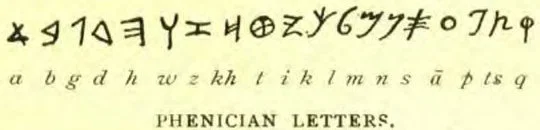
These Egyptian letters were learned by the Phenicians,—the people of Tyre and Sidon,—who were great traders, and were used by them in their business letters, and in notes, bills, and ledgers. The ships of Tyre went to every part of the Mediterranean, even to Spain and western Italy; and everywhere they traded, they left their letters behind them. This was the origin of the Greek alphabet.
PHENICIAN LETTERS.
PHENICIAN LETTERS.
The earliest Greek writing we know is found on monuments. It is quite different from the writing on papyrus, or even from the Phenician letters; for the carefully cut forms and sharp angles have returned with the return to stone, though the pictures have not. The Greek letters look more than ever unlike the early picture-writing, and are rather geometrical, with squares, straight lines, and crosses.
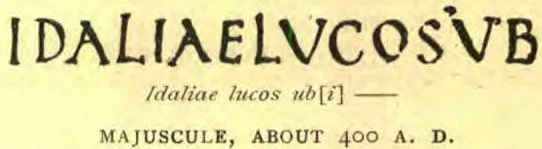
Out of one of these Greek alphabets grew the Latin,—the alphabet we use to-day. The earliest Latin writing is much younger than the early Greek; it is, indeed, of about the same date as the Greek of classical literature,—the Greek that is read in schools. The early Latin letters are not very different from our ordinary capitals. There were no small letters till late in the Middle Ages.
MAJUSCULE, ABOUT 400 A. D.
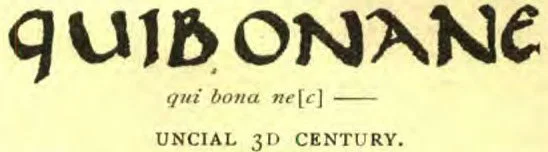
The old square capitals are called “majuscules,” and were copied directly from the monuments. This is why they have sharp corners and straight lines. In cutting or scratching on stone, it is easier and more natural to make straight lines than curves, easier to make angles than turns. But in writing with a pen or pencil, it is not at all easy to make straight lines; and the large, fine majuscule capitals soon began to give place to letters in which curves and turns took the place of straight lines and angles. This sort of writing was called uncial,—inch-long,—because the letters were still large, compared with those that followed.
All this is true only of book-letters, which were made carefully, and were often very beautiful, usually much more so than our letters printed from types. But for one book transcribed, hundreds of letters were written, and thousands of pages of notes, memoranda, accounts, and other such writings were made. These were seldom on parchment, generally on wooden tablets covered with a thin coat of wax. They were written hastily, as we write to-day, and the letters were made in the easiest way possible. This is called the “cursive,” or “running” hand. There was also another sort of writings,—records, deeds, mortgages, and the like,—that were copied somewhat carefully, by scribes, in what is called the “charter” hand.
UNCIAL 3D CENTURY.
UNCIAL 3D CENTURY.
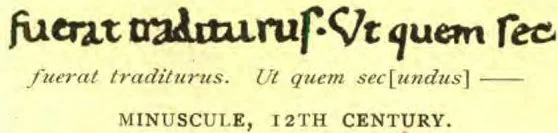
It is natural for human beings to grow weary in well-doing. Good results of any sort cost labor and time. When excellence of a certain sort is much sought after, men will take pains to do their best in that way; but when interest dies out, effort flags, and poor work is the outcome. So it came about in the natural course of things that scribes began to imitate the cursive writing, which was so much easier than the old majuscule and the uncial; and a new style, small and round, became the common book-hand. From its smallness, this kind of writing was called “minuscule.”
MINUSCULE, 12TH CENTURY.
The scribes, who, in the Middle Ages, were invariably monks, took pains to make the first letter of a paragraph, a sentence, or an important word, plainer and more handsome than usual. The first letter of a chapter was made very beautiful with gold and colors, and many hours, or even days, were sometimes spent on a single initial. For these more carefully made letters the handsome majuscules were used. Thus it came to be the rule to use two styles of letter on the same page,—one for ordinary running work, and another, larger and finer, at the beginning of sentences and of certain kinds of words.
At about the time that the world became well settled in this custom, the invention of printing came, and froze the book-hands into type, so that further growth was prevented. Thus we still use the old majuscule letters at the beginning of sentences and of some words, and the newer minuscules in all other places.
The cursive style, however, went on developing, altered only by the growth of time and the change from reeds to goose-quills and from quills to pens of metal, and is now the only style of writing much used, because our books are all printed from types.
C. B. MORRILL.

A Yorkshire Socialist and the Two Pigs

A YORKSHIRE socialist, explaining to a friend the principles of socialism, remarked that all possessions should be shared equally.
“If you had two horses,” said the friend, “would you give me one?”
“Of course,” replied the socialist.
“And if you had two cows, would you do the same?”
“Of course I would.”
“Well, suppose,” said the friend, slowly, you had two pigs, would you give me one of them?”
“Eh! that’s gettin’ ower near home,” said the other, slyly; “tha knows I’ve two pigs.”
All of which goes to show how much more natural it is to give away our neighbor’s belongings than our own.

The Astounding Adverbs.

One evening a gentleman came home with a budget of news. An acquaintance had failed in business. He spoke of the incident as “deliciously sad.” He had ridden up-town with a noted wit, whom he described as “horribly entertaining;” and, to cap the climax, he spoke of the butter that had been set before them at a country hotel as “beautifully rancid.”
The young people stared, and the oldest daughter said, “Why, papa, I should think you were out of your head.”
“Not in the least, my dear,” he replied, pleasantly; “I’m merely trying to follow the fashion. I worked out ‘beautifully rancid’ with a good deal of labor. It seems to me rather more effective than ‘awfully sweet.’ I mean to keep up with the rest of you hereafter. And now,” he continued, “let me help you to a piece of this exquisitely tough beef.”
Adverbs, he says, are not so fashionable now as they used to be in his family.—Boston Post.

A DISTINCTION.

DOUBTLESS many an overworked business man has often found himself looking back longingly to the happy days before he was “successful.” The Youth’s Companion neatly illustrates this point by a little story:—
“Yes, I suppose you may call Eben a successful man. He does a good business, but to my mind he isn’t prosperous.”
So said Mrs. Tracy to her sister, who had congratulated her on the purchase by her husband of a mill, which he was thought to have bought at a bargain.
“Well,” returned her sister, “it seems to me everything he touches comes out just right. He’s the busiest man in town.”
“That’s just it,” retorted Mrs. Tracy. “He’s busy, and he succeeds in his doings, but that isn’t progressing—not as I understand it. You see,” she continued, “when we were first married, he leased the little wool-mill on the stream, and got along first-rate. He wasn’t over-busy, and we used to ride around together every afternoon, and have good times.
“But he began to make money, and buy more wool and more mills to take care of it, and more storehouses to put it in, until it takes about all his time to get from one mill to another. Sometimes I see him on Sabbath, but he is generally busy resting up to start again. He’s about as much a slave as if he was chained in a galley.”
“Yes, but he does make money.”
“Well, perhaps so, but it all goes to buy more wool. If anybody hankers for lots of wool in this world, that’s one thing. Eben has any amount of wool; but when it comes to getting the real, solid goodness out of life, and enjoying it, he’s forgotten how. Really, as I look at it, Eben is the most unprosperous man in town.”
Continue reading: INTO THE LIGHT