“That is good; now I will give you a few more texts to place with those. Read 2 Tim. 3: 1-5.”
Grace read, and then exclaimed, “Why, May, it says that those who do all these wicked things have a form of godliness! What does that mean?”
“It means that they profess to be God’s people, but that they deny the power that always accompanies true godliness. Paul says that the gospel of Christ is the power of God unto salvation, to every one that believeth; but these people deny that truth, and turn to civil governments for the power.”
“That is just what our Christian Endeavor Society is doing. I never knew it before.”
“Nor I; but just as soon as those texts were placed together, I saw it; and I can not tell you how it made me feel.”
“It is so plain! Of course if those belonging to this society find no power in the ‘form of godliness,’ which they possess, they will naturally seek for it somewhere else; and if they do not turn to God, they must turn to men, to earthly governments.”
“How I wish all the members of our society had been present when those thoughts were brought out! I am sure most of them are honest and sincere, and think they are doing Christ service. They do not realize that they are working contrary to the principles that he laid down.”
“Susie Elliot was here this morning, telling me of some new plans for work, which were adopted at the last meeting, and which we had decided were just the thing. Now I know better. It is a terrible thing to work against God; and I am sure that is what we have been doing.”
“I am glad he looks at the heart. He knows we did it ignorantly, and will forgive us if we ask him. Since receiving those texts, I have found several others that have helped me, and I will give them to you. Paul says: ‘Knowing therefore the terror of the Lord, we persuade men,’—persuade, not compel. Joshua said, ‘Choose ye this day whom ye will serve.’ In the last chapter of the Bible we read, ‘Whosoever will, let him take the water of life freely.’ Jesus himself said, ‘If any man hear my words, and believe not, I judge him not;’ and if Christ, who knew the hearts of all men, would not judge them, surely his followers have no right to do so.”
“Of course not. We have had a great deal of zeal, without much knowledge; but the Lord has verified his promise, ‘If any man will do his will, he shall know of the doctrine.’ Have you any more texts?”
“Yes, a few. Verse 8 of James 5 says: ‘Be ye also patient; stablish your hearts: for the coming of the Lord draweth nigh.’ The preceding verses show that there will be many rich people on the earth at that time, and the Lord speaks especially to them. He says: ‘Go to now, ye rich men, weep and howl for your miseries that shall come upon you. Your riches are corrupted, and your garments are moth-eaten. Your gold and silver is cankered; and the rust of them shall be a witness against you, and shall eat your flesh as it were fire. Ye have heaped treasure together for the last days. Behold, the hire of the laborers who have reaped down your fields, which is of you kept back by fraud, crieth: and the cries of them which have reaped are entered into the ears of the Lord of sabaoth.’ So you see that these strikes, this growing trouble between the rich and the poor, is another sign of the end. The Lord himself says so. Elder Barnes read several other passages, which I did not get; but here are two, showing how the two classes, the wicked and the righteous, will receive Christ when he comes. The first is in Isa. 25: 9. Please read it.”
“‘And it shall be said in that day, Lo, this is our God; we have waited for him, and he will save us: this is the Lord; we have waited for him, we will be glad and rejoice in his salvation.’”
“‘And the kings of the earth, and the great men, and the rich men, and the chief captains, and the mighty men, and every bondman, and every freeman, hid themselves in the dens and in the rocks of the mountains; and said to the mountains and rocks, Fall on us, and hide us from the face of him that sitteth on the throne, and from the wrath of the Lamb: for the great day of his wrath is come; and who shall be able to stand?’ O May! I do hope that we shall be among those who are waiting for him,—those who rejoice to see him coming! It would be awful to be lost, to be banished forever from his presence!”
“There is a verse in 2 Tim. 1: 12, which is a great comfort to me. Perhaps it will help you.”
The girls turned to the text, and Grace read: “‘For I know whom I have believed, and am persuaded that he is able to keep that which I have committed unto him against that day.’ How good that is! I am sure that if we place ourselves unreservedly in his hands, he will carry us through.”
“Well, we haven’t had any of the texts on the resurrection; and as it is late, we shall have to leave them for next time.”
LENA E. HOWE.
BUILDING A COTTAGE.
By W. K. Loughborough
The Window-Frame.
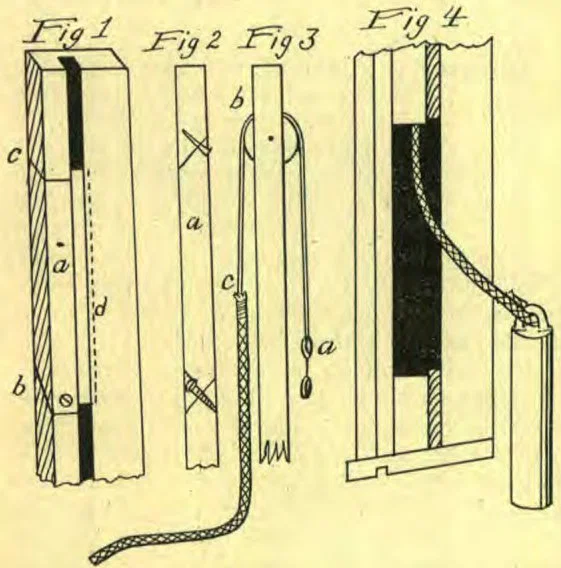
This week I will give some instruction about putting the pocket and weights into a window-frame. We will take the pocket first. Fig. 1 represents a portion of a window-jamb. You will see the jamb cut at b and c, and at the dotted line d, leaving a piece, a, which can be taken out. In Fig. 2 you will see the edge of the same jamb with the piece a in place. Run your saw into the jamb at b and c (Fig. 1), saw down to the check-stop groove at d, then split the piece out. From the piece thus split out, cut off about one fourth of an inch on the back, at the upper end; then drive the head ends of two sixpenny nails into the jamb for the piece to lie against. Afterward bore a hole, and insert a No. 10 seven-eighths-inch screw. See Fig. 2. When you are ready to put in the windows, take out the check-stop and screw, when the piece a can be removed. This piece should be out next to the blind-stop. In nailing on the blind-stop, be careful not to nail into the pocket, and thus prevent the removal of the piece a.
In Fig. 3 you will see the upper end of a section of a jamb, with a pulley inserted. This shows how to put in the cord, and attach it to the weights. The best cord for the weights is braided silver-lake cotton cord. It is very smooth and hard. To put this cord in place you will need a piece of fine linen cord about the size of a fish-line. To the ends of this attach two small lead weights, as shown in Fig. 3, at a. This apparatus is called a “mouse.” Attach the mouse to the weight-cord at c. Now put the mouse through the pulley at b (the weight of the leads will draw the cord down); then put your hand into the pocket, catch the mouse, draw the cord through the pulley, and tie it to the weight, as shown in Fig. 4. Next put the weight into the pocket. Bore a seven-eighths-inch hole about half an inch deep in the edge of the sash, one foot from the top. From this hole to the top of the sash plow a three-eighths-inch groove three eighths of an inch deep. In the end of the cord that goes into the sash, tie a single knot. Place the knot in the hole, the cord in the groove, and a No. 10 inch screw through the knot into the window-sash. Insert the piece a, put in the sash and check-stop, always letting the outer sash down to the window-sill; then you will have no trouble in putting the stop in place.
While we are on this subject, we will also consider the pitch, or slant, of the window-sill. It should be one eighth of an inch to the inch, which you will find by placing your bevel at one-half inch on the blade and four inches on the tongue. I trust I have made this so plain that you all understand it.
W. K. LOUGHBOROUGH.
Selfishness and the Nobility of True Friendship
“If we would have friends that are worth having, we must love them more than we love ourself. Selfishness eats out all the possible nobility of friendship.”
APPEAL
By Celia Thaxter
The childish voice rose to my ear,
Sweet-toned and eager, praying me,
“I am so little, Granna, dear;
Please lift me up, so I can see!”
I looked down at the pleading face,
Felt the small hands’ entreating touch;
And, stooping, caught in swift embrace
The baby boy I loved so much,
And held him up, that he might gaze
At the great pageant of the sky,—
The glory of the sunset’s blaze,
The glittering moon that curved on high.
With speechless love I clasped him close,
And read their beauty in his eyes,
And on his fair cheek kissed the rose,
Sweeter than blooms of paradise.
And in my heart his eager prayer
Found echo, and the selfsame cry
Rose from its depths through heaven’s air:
“O gracious Father, lift me high!”
“So little and so low am I,
Among earth’s mists I call to thee;
Show me the splendors of thy sky;
O lift me up, that I may see!”
— Celia Thaxter.
THE VOICE WITHIN.
A LITTLE Quaker girl one day
Paused in her busy round of play,
As her dear mother came that way.
“May I?” she said, as soft and clear
She whispered in her mother’s ear,
So low that no one else could hear.
Her mother answered as she smiled:
“By nothing wrong be thou beguiled;
What says the voice within thee, child?”
The little Quaker went her way;
Soon back she came, I heard her say,
“The little voice within says, ‘Nay.’”
O children! heed the voice within;
The little voice your hearts would win,
And keep your feet from paths of sin.
— Selected.
THE CATTLE.
By E. E. Adams
READ the twenty-fourth and twenty-fifth verses of the first chapter of Genesis, which tell us that “God made the . . . cattle after their kind.” Everything that God made belongs to him. The earth is the Lord’s, and the fulness thereof, because he made it and filled it. The sea is his; for he made it: we ourselves belong to him; for he made us. And so God says of the cattle that he has made, “Every beast of the forest is mine, and the cattle upon a thousand hills.”
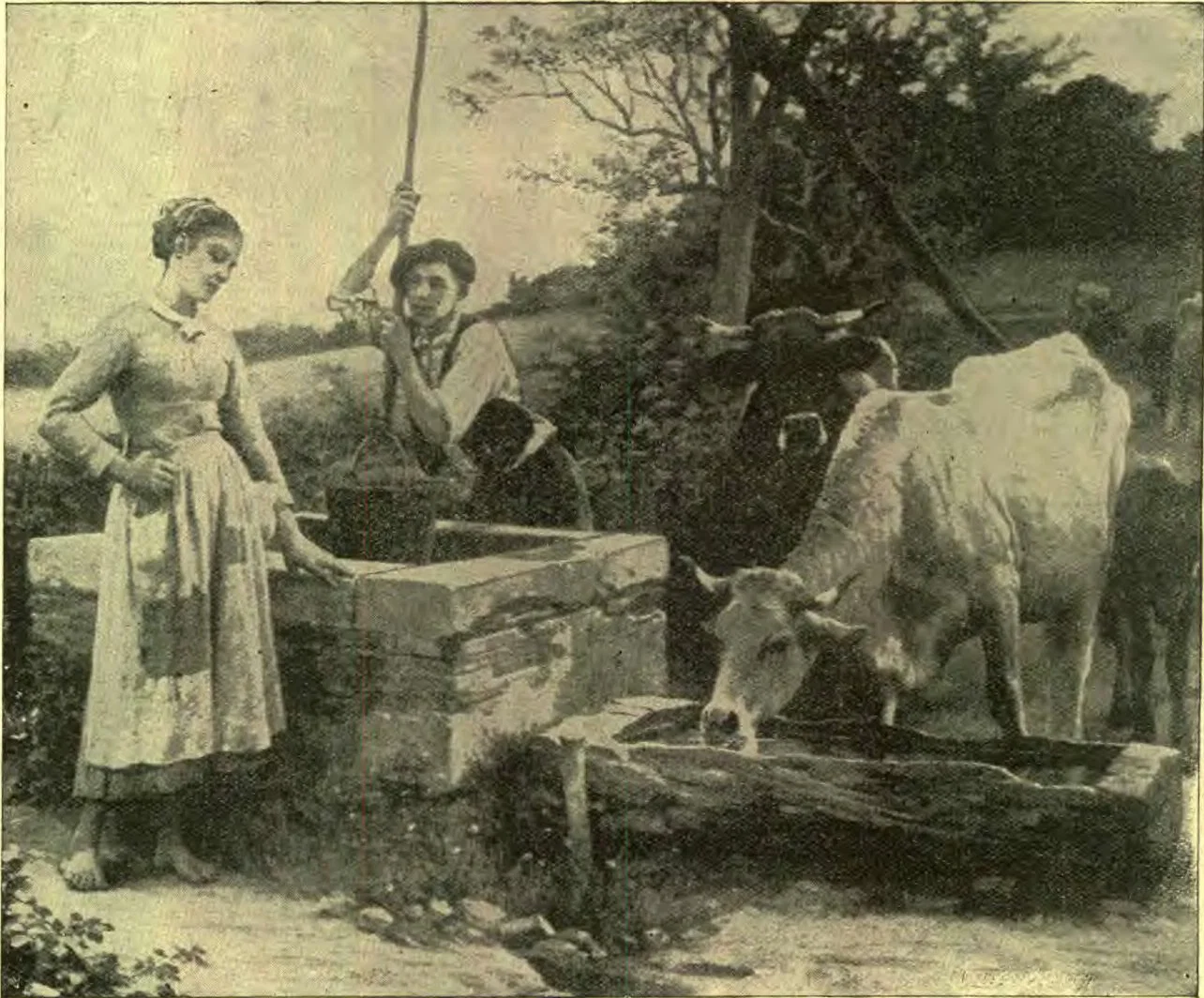
CATTLE AT THE DRINKING-TROUGH.
And God thinks of, and cares for, everything that belongs to him; and so “he causeth the grass to grow for the cattle.” He who made them knows exactly what they need, and creates just the right kind of food for them.
At the time of the flood, we are told that “God remembered Noah, and every living thing, and all the cattle that was with him in the ark.” He thought not only of Noah and his family, but he also remembered the cattle, which are just as much his.
And again, when Jonah was angry because the Lord did not destroy Nineveh as he had purposed to do, God reminded Jonah that there was “much cattle” in the city, as well as many people. To the people of Israel, he gave special instruction about the treatment of cattle.
All these things show us with what loving care God thinks of his cattle, and we may be sure he notices just how they are treated by those who have the care of them. God made man “to have dominion over the cattle,” to rule them. That meant that he was to take care of them, to guide, protect, and feed them. God is the Ruler of the whole universe, and has dominion over all, because he has the power to supply all the needs of every creature.
If you have some pet animals, you know that you must see that they are well supplied with the right kind of food, and kept comfortable and happy as far as it is in your power to make them so. Thus when God gave to man the whole animal creation, he meant to use man as the channel through which he would supply all their needs, and keep them in a state of perfect happiness.
But oh, what a sad change sin has brought, and how man has fallen from his dominion! For now, instead of being the one through whom the needs of all other animals are supplied, he takes from them all to supply his own needs. He takes the skin from the cattle, fur and hair from other animals, the shell from the tortoise, the ivory from the elephant, and even the feathers from the birds, to make clothes and ornaments for himself. If he feeds any of the animals for a time, it is only that he may use their strength to do his work, or at last feed on them,—use their flesh for his own food.
The time is coming when God’s loving purpose will be fulfilled, when all creation’s groans will cease, and man’s dominion be restored. Then he will again be king over the whole earth, not to “exercise lordship” over God’s creation, but to be the one through whom God will give happiness to all his creatures.
E. E. ADAMS.
QUEER NEIGHBORS.
I WAS sitting under a tree on a warm afternoon, watching for Tommy to come home from school. Tommy is a dear little fellow, and I like to meet him at the gate when school is out.
It was not yet four o’clock; so I looked about for something to help pass the time, and what should I see but Mr. W., just coming in from a hunt?
Now if you should look out of your window, some fine day, and see your next-door neighbor walking briskly along, with a fat grizzly bear tucked under one arm, I think you would be surprised.
Even if grizzly bears were as common as red squirrels, you would not expect a man to be strong enough to carry one in that way. Mr. W.’s game was not a grizzly bear, but it was two or three times as large as he was, and it did look odd to see him hurry along, just as if it were nothing at all.
Now, what kind of game do you suppose it was? It was not brown nor black nor gray nor white nor striped nor spotted. It did not have fur nor feathers nor down nor hair nor wool. It could not fly nor jump nor walk nor run nor swim. But Mr. W. seemed to prize it very highly; and I thought to myself that it ought to keep his whole family in food for a long time.
I do not know Mr. W.’s strange family. I have heard that he carries concealed weapons, and you know that is a bad thing to do, and is against the law. Mr. W. is very trim and neat in his dress, but I fear he is a sad scamp for all that.
It seems strange that with all his fine airs he should bring up his family underground. Out here in the West, such dwellings are called dug-outs; and you may be sure that people who can afford any other kind of house do not live in them. Even poor folks will not put up with them except while the country is very new.
But Mr. W., who really appeared like quite a dandy in his glossy hunting-suit, laid down his game in full view, and began to open the passage into his dug-out; for he did not even have a door, nor so much as an old blanket for a screen, but had the entrance blocked up with chunks of earth, each one as large as his head. When he had pulled out these chunks of earth, he brought his game up to the opening, and went down-stairs backward, dragging it after him.
He was gone some little time, and I wondered if he were salting it down for future use. I wished I might follow, and see how his house looked inside; but I could not, and besides, it would have been very rude indeed.
At last he came up-stairs, and began to close the doorway. He picked up chunks of earth and fitted them in nicely. If he found one that did not make a smooth joint, he carried it off some distance, so there would be no pile of earth, however small, to mark the place of his house.
“Who would have thought,” said I to myself, “that these odd people could live almost next door without our ever seeing their dug-out?” Then I looked down the street for Tommy, for I wanted to show him the queer little house.
Just at that moment, away flew Mr. Wasp, right over my head; and though I searched right and left, I could not find the funny little dug-out where he had so cunningly hidden his great green worm.—Selected.
The Little Moments That Pass Away
“Just a little moment,
Passing on its way;
Tell me what the little moments say.
‘While I’m passing, use me;
Surely don’t abuse me.’
Swift the little moments fly away.”
What is known of the life of Ezekiel? With whom was he carried into captivity? Where did he settle? How long did he prophesy? Where is his tomb said to be? When did Ezekiel begin to prophesy? About whom is the prophet speaking in this lesson? When would these blessings come? What is meant by a new heart? What by a new spirit? By a stony heart? By a heart of flesh? From what should they be cleansed? What should be taken away? What should the people remember? When? What had been their condition? Why should these blessings be granted? By whom? What had been the great sin of Israel? What was the result of the captivity? What was the condition of the land during the captivity? What should it be after the return? What should be rebuilt? By whom should this be done?
NOTES.
1. Of Ezekiel, the great prophet of the captivity, not much is known. He was a priest, carried into captivity with Jehoiakim, and was in Babylonia when Jerusalem was destroyed. He prophesied for at least twenty-two years, beginning about 594, B. C., and was the agent by whom reformation was wrought in Israel. He settled on the banks of Chebar with a Jewish colony. Chebar was probably not a river; but a canal made by the king. The supposed tomb of Ezekiel is in Mesopotamia.
2. Because Israel had forsaken God, their protection and strength, they became the prey of destroyers. They became corrupt idolaters and sorrowful captives. Their afflictions caused them to turn back to God. “When the judgments of the Lord are in the land, the wicked learn righteousness.” Their own backslidings convicted them. Eating the fruit of their own doings filled their mouths with ashes; and in famine, literal and spiritual, they longed for the Living Bread. God does not willingly afflict nor grieve the children of men. “Whom the Lord loveth he chasteneth;” and though “no chastening for the present seemeth to be joyous, but grievous: nevertheless afterward it yieldeth the peaceable fruit of righteousness unto them which are exercised thereby.” God had not forsaken Israel in their captivity; and through his prophet he sent to them “exceeding great and precious promises,” that by these they might become partakers of the divine nature.
3. “Then will I sprinkle clean water upon you.” The Israelites were captives among the heathen; Israel itself was a desolation, Jerusalem a ruin, the temple leveled to the earth. “I will take you from among the heathen, and gather you out of all the countries, and will bring you into your own land.” The meaning of this promise is clear, and was fulfilled when Zerubbabel, Ezra, and Nehemiah led back the successive returns from Babylon to Palestine. But living among the heathen, it would be impossible to escape ceremonial defilement, so as to unfit them for engaging in the services of the temple; hence the Lord adds, in verse 25, “Then will I sprinkle clean water upon you, and ye shall be clean.” See directions in Num. 19: 9-18, on cleansing of ceremonial defilement. The clean water is not pure water, but water with the ashes of a red heifer (offered in sacrifice),—a type of the blood of Christ. See Heb. 10: 22.—Johnson.
4. “A new heart also will I give you.” The fountain of uncleanness is the heart. It is as an unhealed ulcer that spreads fever through every vein. What more precious promise could be given than this one? To accomplish this promise is the object of the cross. “The light shining from the cross reveals the love of God. His love is drawing us to himself. If we do not resist this drawing, we shall be led to the foot of the cross in repentance for the sins that here crucified the Saviour. Then the Spirit of God through faith produces a new life in the soul. The thoughts and desires are brought into obedience to the will of Christ. The heart, the mind, are created anew in the image of him who works in us to subdue all things to himself.”—The Desire of Ages, page 176.
5. “Cause you to walk in my statutes.” The test of faith is obedience. The proof of the new heart is the new life. “I will put my Spirit within you.” The controversy is going on between every soul and the Spirit of God. The Spirit pleads, strives, for entrance, for possession. He is with us; but only that he may be in us. When the Spirit has possession, the Christian walks in God’s statutes; “and,” says John, “hereby we do know that we know him, if we keep his commandments.”
6. Not only were they to be saved from uncleanness of heart, but also from temporal need. “Happy is that people, whose God is the Lord.” With blessings within and without, no wonder they remembered their evil ways! With the manifestation of God’s bountiful love, no marvel they loathed themselves for their past rebellion and ingratitude!
7. Then the land that was “desolate” becomes “like Eden.” The waste cities are inhabited, the rebellious wolves become the sheep of His pasture,—just what the Good Shepherd longs to have them. And for all these promises the Lord says, “I will yet be inquired of by the house of Israel, to do it for them.” The return from captivity belongs to all who are backslidden, and Israel’s experience is a type of the joy of the return to God.
The Chicago Drainage Canal
The Chicago Drainage Canal.—It is expected that this canal, upon which Chicago has expended thirty-two million dollars, will be opened for use next December. It extends from Robey Street, on the west fork of the south branch of the Chicago River, thirty-two and one-half miles southwest, to the Des Plaines River. This river flows into the Illinois, and the Illinois into the Mississippi. The canal is intended to carry off the sewage from the city, and it is estimated that it will draw off three hundred thousand cubic feet of water every minute from Lake Michigan.
Indian Mummies.—
While on a prospecting and hunting trip in the Cascade Mountains not long ago, two white men discovered, quite by accident, two mummified bodies. These bodies had been originally wrapped in the skins of animals, and treated with some preservative substance. Flesh, bones, and covering were very dry and hard. The discovery of these mummies causes a great deal of fruitless speculation; for it is impossible to tell to what people they belonged, or when they lived, or the object of their preservation. The shape of the head and other peculiarities seem to warrant the conclusion that they were Indians.
The Samoan Islands
The Samoan Islands.—During the last few months the Samoan Islands have received an amount of attention quite out of proportion to their size and importance. This group, consisting of ten inhabited and two uninhabited islands, with an area of seventeen hundred square miles and a population of thirty-six thousand souls, lies two thousand miles southwest of the Hawaiian Islands, on the direct route between San Francisco and Australia. The principal export is dried cocoanut; but in 1876 the total valuation of this exported product was only a little over two hundred thousand dollars. The recent trouble in the islands, arising over the question of kingship, has been settled by the Samoan Commission, who have decided to abolish the kingship altogether, though Malietoa's claim to the throne was confirmed. Four thousand rifles were surrendered, and a form of government was suggested. This provides for “a legislature elected by popular vote; but the real governing body will be a council of three,—one delegate from England, one from the United States, and one from Germany, who will advise and assist a governor.”
The Philippine Situation.
Notwithstanding the glowing reports and sanguine expressions of that portion of the press favoring the present strife in the East, the situation is far from satisfactory to any one. From the actions of Dewey, Funston, Hale, and many other officers who have already left the islands, or have signified their intention of doing so, it appears that those in charge there are anxious to quit the scene of carnage, and are not desirous of reaping the “honors” (if there are any?) at the finish. The privates have no means of escape, as none but officers have the privilege of resignation, or a choice in their location. For months weekly reports have said that “the conflict is drawing to a close,” “the situation is well in hand,” and “peace will soon be restored;” but now the Secretary of War has issued a call for ten regiments, or over thirteen thousand volunteers, for the Philippine service! Dr. Charles A. Mc Queston, of General Otis’s staff, who recently arrived in San Francisco, says: “Unless troops, thousands of them, are sent to the aid of our men there, they will be driven back into Manila in the next few months. As a matter of belief, the Filipinos think they have the Americans licked already. The volunteers all want to return home.” The North American says: “The death-roll in the Philippines has already outstripped that of our war with Spain, and what has been gained? The Philippine war is a horror. It has brought a sense of blood-guiltiness upon the people which can not longer be endured without vehement protest.” The latest reports are that “the rainy season is on in earnest, and the American soldiers are now fighting with the elements. Storms work havoc, roads are made impassable, and navigation in the Bay of Manila is rendered impossible. Some of the companies are now separated by streams six feet wide.” If the men responsible for this wicked war were obliged to take a hand in it themselves, and suffer the exposure that the poor soldiers, who can not escape, have to suffer, it would end at once. Selfishness destroys all the better instincts of humanity.
TIME: A. D. 30. PLACES: Galilee, village of Samaritans, Jerusalem. PERSONS: Jews, woman taken in adultery, Samaritans, brothers of Christ, temple officers, Nicodemus, chief priests and Pharisees, Christ, disciples.
1. What general gathering of the Jews occurred in the autumn? John 7:2; What did Jesus' brothers wish him to do? Vs. 3, 4. What led them thus to speak? What was Jesus' reply? Vs. 6-8. Later, what did Jesus do? V. 10. Not seeing him at the feast, what did the people do and say? Vs. 11, 12.
2. At what time did Jesus make his appearance, and what did he do? V. 14. As the Jews marveled at his learning, what did he say concerning it? Vs. 16-18; What questions did he ask them? V. 19. What was their reply? V. 20. To what did Jesus then call attention as evidence that they did seek his harm? Vs. 21-23.
3. What questions relative to Jesus were then asked by some? Vs. 25, 26. With what thought did they close their hearts against him? V. 27; What contrast did Jesus then draw between himself and them? Vs. 28, 29. As he thus spoke of his divine nature, what different effects were produced upon the people? Vs. 30, 31. What did the leaders of the people now do? V. 32; What statements did Jesus then make, and what questions were raised? Vs. 33-36.
4. Near the close of the feast, what stirring appeal did Jesus make? Vs. 37, 38. To what did he refer by “living water”? V. 39. What was the effect of this appeal? Vs. 40, 41, 43, 44. What scripture was quoted to show Christ to be the true Messiah? V. 42.
5. What conversation took place upon the return of the officers? Vs. 45-49. Who came in at this point to defend Jesus, and with what words? Vs. 50, 51. How was he reproached? V. 52.
6. How was Jesus treated by the Samaritans on this trip to Jerusalem? Luke 9:51-53. How was their action regarded by James and John? V. 54. What did Jesus say to them by way of rebuke? Vs. 55, 56.