The Youth’s Instructor, Vol. 65, No. 10.

Miscellaneous Items From Around the World

The Youth’s Instructor

Mar 6, 1917

Review and Herald Publishing Assn. · Takoma Park Station, Washington, D. C. · Mar 6, 1917

Miscellaneous Items From Around the World

German children go to school from seven in the morning until eight at night.
Read “Ann of Ava” as soon as you can get the book. It costs only sixty cents, and is a thrilling account of Mr. and Mrs. Judson’s experience in Burma.
The seismograph, originally designed to detect earthquakes, is being used in Europe to locate the enemy’s big guns. A trained observer can distinguish accurately between the disturbance caused by a falling projectile and by gunfiring, and can tell the number, position, and caliber of the guns.
Niagara Falls now is more beautiful in darkness than in sunshine. Four batteries of lights — each battery comprising twenty-five lamps of 500,000-candle-power — illuminate the massive flood and the whirlpool below. The lights are focused so carefully that from no point does the slightest glare strike the eyes of the observer.
There are now several hundred lepers scattered through seventeen States. The national government is appropriating about $140,000 a year for the care of lepers, there being leper colonies at Carville, Louisiana; Penikese, Massachusetts; and San Francisco, California. Missionary funds amounting to $33,000 annually are used to bring added care, comfort, and consolation to these afflicted ones.
Dictating while driving in the motor car is a method devised by Thomas A. Edison to save time while traveling from his home to his laboratory. For this purpose a phonograph has been installed in his closed car, an Owen magnetic; and the records for his stenographer can be made conveniently while the machine is in motion. This device is worthy of consideration as a very practical saver of hours of time.
The Imperial Valley of Southern California, not so long ago, knew only cactus and sage bush, tarantulas and rattlesnakes, as its products. In 1916 it shipped away 100,000 bales of cotton, 10,000 carloads of cantaloupes, and many other products besides. Each new irrigation project, such as the Great Salt River Dam near Phoenix, Arizona, which irrigates 200,000 acres, adds to the sum of our naturally productive resources. Less than a score of years ago, South Texas, in the Brownsville and Laredo districts, was a wilderness of chaparral thickets. Today there goes north each year many thousand carloads of early vegetables from these redeemed waste lands.
Governor Stanley of Kentucky recently prevented the lynching of Judge Bush and Attorney Smith, by a mob infuriated over the fact that these two men had permitted the postponement of the murder trial of an accused Negro and had taken the prisoner out of town to prevent a lynching. The governor rushed across the State, in a private car, to the town of disorder, where he faced the mob, and declared: “I am here to uphold the law and to protect this court, with my own body if necessary.” His appeal to the citizens to respect the law finally quieted and disbursed the mob. The governor then left the town, taking the judge and attorney with him. If all men who have sworn to uphold the law and protect life had the courage of Governor Stanley, there would be fewer lynchings.
At a recent meeting of the Royal Institution, London, Sir James Dewar exhibited a remarkable soap bubble that he had blown a month before, and which was still as perfect as when formed. It is described as a glowing sphere of iridescent color, showing no signs of “blackness,” which is the prelude of collapse. The longevity of the bubble is described by Lord Rayleigh as a case of suspended gravitation, which is due to the fact that it was blown in and with clean air, free from motes or small particles of solids, which, so far as soap films are concerned, appear to be the seeds of decay.—Scientific American.
The last survivor of those who were present at the funeral of the great Napoleon has just died in a suburb of London. She was Mrs. D. Owen, daughter of Capt. James Bennett, of the St. Helena regiment. She was nearly ninety-six years old. Mrs. Owen was born on the island on Jan. 26, 1821, and when a few months old was taken by her mother to the emperor’s funeral on May 9. When the body was exhumed in 1840, she was one of the women of St. Helena who worked and presented an embroidered silk flag which was unfurled at the stern of the boat containing the coffin as it left the shores of St. Helena.

Germany’s Food Problem

GERMANY was carried through last year on her potatoes, but this summer the crop was a failure. Instead of the fifty million tons of potatoes usually raised, the harvest only yielded twenty million tons. Consequently, the government has reduced the daily potato ration from one and a half pounds to three-quarters of a pound per person. The butter allowance is two ounces a week, and hard to get. The allowance of war potatoes is four pounds a week. Infants in most places are kept supplied with milk, but there is little left for others. The city of Mainz, which used to consume 40,000 quarts of milk a day, now has only 4,000. Meat and eggs, when obtainable, are four times the ordinary price. Imported foods, such as rice, coffee, and tea, are limited and expensive. Sugar is scarce, and in place of it coffee is sweetened with saccharine, a coal-tar product several hundred times sweeter than sugar, but of no nutritive value.
The expectation that the appointment last fall of Herr von Batocki as food dictator with almost unlimited powers would settle the difficulty has not been realized. His plan for the control of the food supply of the empire as a whole, in order to secure an equitable distribution, did not work out well, and he is now endeavoring to establish a regional system by which the farmers of a given locality shall be responsible for feeding the towns dependent upon them.—The Independent.

Rest in God Before Rejoicing

“WE must rest in God before we can rejoice in him.”

How to Speak for Jesus

The Missionary Volunteer program for March 17 is on “Speaking for Jesus.” In one topic eight reasons for taking part in testimony meeting are presented. The value of the activity of the tongue is well presented. “But how can I speak in meeting?” is often asked. “How can I take part on the program when asked to do so?” These are important questions. Below we give ten rules for gaining freedom in verbal expression. These are given by a writer for the special benefit of Christian young people.

“The Longing for Power”

“First rule for obtaining freedom of expression: Want it. I am sometimes tempted to be very impolite when I hear people say, ‘How I wish I could speak or pray in the prayer meeting!’”
“‘Wish!’ I want to exclaim. ‘Why, you haven’t even the desire of a wish! By their fruits ye shall know them,—wishes, as well as everything else. Do men gather dumbness from longing, or sluggishness from desire? One hearty wish would at least bud into one timid little word.’”
“Let us not cheat ourselves. A desire for the ability of expression means vastly more than envy of some one who has it, or uneasy sense that we are not doing our duty. It means that earnest asking for a thing with the prayer of our whole being, which Christ said always finds what it seeks. We can never get power of expression until we thus want it.”

“Work for It”

“Second rule: Work for it. Zeal is the mother of expression, but observation is its father. Study those that have this power, to imitate, not their manner, but their method of obtaining their manner. Ask them how they overcame their difficulties. Read widely, especially in the best expressed of all books, the Bible. Think seriously, not scorning the thoughts God gives you. Write constantly; nothing better drills the tongue than the pen. Talk in private on the themes which will be your public topics. Ask advice, read, think, write, converse; in all these ways you must work, if you truly want the power of expression.”

“Make Preparation”

“Third rule: Make preparation. Not merely the general preparation I have outlined, but special preparation for each occasion. ‘Why,’ some one objects, ‘didn’t Christ say, “It shall be given you in that same hour what ye shall speak”?’ Yes, but whom was Christ then addressing?—His chosen disciples, men who had left all to follow him, men whose every moment was engaged in the most active and effective preparation for public speech.”
“And that is the only kind of special preparation I would advise you to make. Fill yourself full of the subject. They spent their lives in that task; do you spend half an hour daily?”
“Have you ever seen a flower open? A few minutes it was hidden modestly in its green wrappings, and now it startles us by its splendid beauty. Surely God gave it in that hour what it should speak. Surely there was no rehearsing of that opening. No; but what a life of preparation, from the flower to the bud, back to the stem, the two little tentative leaves, the seed, the rootlets, the soil, the sun, the rain! A Christian should indeed speak extempore, out of time, out of such a whole lifetime of preparation.”},{

The Keys of the Caribbean

For more than fifty years intermittent negotiations have been carried on between the United States and Denmark, pending the purchase of the Danish West Indies. These were finally closed on January 17, when for the consideration of $25,000,000 the islands of St. Thomas, St. John, and St. Croix, with a total area of one hundred and thirty-eight square miles, formally passed into the control of the United States. Under the present treaty this government is to protect the Danish national church in the islands; the arms and military stores of the Danish government, which are to remain its property, are to be removed as soon as practicable; and certain grants, concessions, and licenses which the people have enjoyed are to be maintained. But Old Glory will float over 33,000 of Uncle Sam’s family who have been more than anxious for adoption since the days of Lincoln and Grant.
While these tiny bits of land in “the American Mediterranean” are of problematic economical value, their strategic worth is inestimable. “These ocean outposts will strengthen our navy’s grasp and be of far-reaching value to the preparedness program upon which the United States has entered.” Their price is approximately that of one superdreadnaught, and in a crisis they might be worth more to us than a whole fleet of warships. They are vital links in the chain of defenses guarding our treasured Panama Canal from intruders.
St. Croix and St. John are extremely fertile, the former being noted for its famous bay rum. “St. Thomas, though less fortunate in the matter of soil, holds within its tiny self a pearl of great price—the deep, landlocked harbor of Charlotte Amalie,” a most magnificent naval base. The entrance is a narrow opening, and the ships that slip through from the stormy outside come to anchor in “a broad sheet of mirrorlike blue water guarded by a continuous circuit of lofty hills.” Military engineers agree that a moderate sum spent upon fortifications will make the island impregnable. “In fact, St. Thomas has often been called the Gibraltar of America.”
The people are industrious, and anxious for economic development which Denmark has not been able to carry forward. The money offer, liberal as it was, did not induce the Danish government to withdraw from the islands. It was not until the islanders made it known through local councils, mass meetings, and delegates that they desired annexation to the United States that the Danish people voted their consent to the change. And now in simple faith these islanders look to us, eagerly confident that the time of prosperity for which they have waited so long is near at hand. It is to be hoped that the officials appointed to administer their government “will be men of tact and experience, men who will respect the self-respect that is characteristic of the natives of the Danish islands.” Loyal Americans are glad to share with them the protection of the stars and stripes—the flag of our glorious republic, and—
“Long may it wave O’er the land of the free, and the home of the brave.”
LORA CLEMENT.

An Interesting Harbor Experience

ONE day in September last year, while I was delivering a Bible to the captain of an American ship, a steamer pulled in on the opposite side of the pier. Having just finished my work, I stepped across and boarded the other ship. A number of men were clustered around a table in the cabin dining-room. I had with me a few packages containing about eighteen numbers each of the Review Extra, now known as Present Truth series.
I presented my card to the men, and they gave me a hearty welcome, asking me to be seated. They at once began asking questions about the city and about the progress of the war. They told me of their escape from the German submarine that had just left Newport, and had sunk so many ships off Nantucket. I placed in the hands of each one two copies of the Review leaflets, and then opened my valise and laid on the table our small books, “The Vatican and the War,” “The World’s Crisis,” “Armageddon,” and some of our magazines. I reserved our large books because I was impressed that the men would not take the larger publications, and my impression was right, for I found out that all the men were Roman Catholics.
The steward, who was present, said, “The chief engineer will be here in a few minutes, and he takes delight in such reading matter as you have. It may pay you to see him.” As I was talking to them upon the coming of the Lord and the nearness of the event, the chief engineer came in, and noticing the Review Extras on the table, inquired what all those papers meant. I told him they were printed in the interest of present conditions of the governments of the world and of the near coming of Jesus, and then handed him a package containing a full set of the Extras.
Being impressed that this man was honest in heart, and would most likely take some of our larger publications, I showed him “Daniel and the Revelation” and “The Great Controversy,” and he purchased both books, paying cash for them. He invited me to his room, and then asked if I could not secure a Bible for him. I usually carry Bibles with me, but did not happen to have one this time. The next evening I returned with the Bible I had promised him, and had a good talk with him.
A month later I received a letter stating that he had returned to the harbor from Newfoundland, and wished me to call and see him. As soon as I entered his room he began telling me how much he enjoyed the Review Extras, and of the precious things that he found in them. During his month’s trip he had read all the papers, sitting up at night until one and two o’clock, studying the leaflets with the Bible and with the texts that were in the papers, for the Spirit of the Lord had aroused an interest in his heart. As he looked earnestly into my face, tears came into his eyes, and he said, “It is true that the world is not following the teachings of the Bible, but the traditions of men. According to what I have learned in reading these papers, the Sabbath of Jehovah is being trampled underfoot, and I cannot do it longer.”
While talking with me, he had a cigarette in his fingers. The stains on his hands showed me he was a devotee to the tobacco habit. He asked me if I thought it was a sin to smoke. I told him that for me it would be a sin, for I wanted my temple to be the dwelling place of the Holy Spirit, and therefore I would not use that which marred the temple in any way. He had used tobacco for almost thirty years, and he said, “I cannot get rid of it. I am a slave to it, and smoke as many as sixty cigarettes a day. I wake up in the night and smoke. I drink, have a bad temper, use profane language, and do other things I should not. I desire greatly to get rid of these habits, but I cannot do it.”
I pointed him to the great Life-giver, Jesus, who can recreate man and give him power to overcome. He requested that I pray with him, which I did. The Spirit of God came into his heart, and completely changed him. When he arose from his knees, he walked over to the porthole at the side of the room and threw his cigarettes into the ocean. From that day until now he has had no desire to return to the tobacco habit, and he is deeply grateful to the Lord for the power which came into his life to help him overcome his evil habits.
For three months I have watched him grow, and it is like watching a plant grow. He has become clean and kind and gentle. He was baptized by Professor Everson recently, having accepted all of the present truth, and a happier man you would not care to meet. He resigned his position with his ship’s company, and is now planning to take up mission work among sea-faring men. He is studying a prospectus for that work. Our hearts rejoice that not only he but many more are now accepting the gospel message for this time.
CAPT. J. L. JOHNSON.

That Home Letter

“No letter from John tonight, mother?” “No, father; but I wouldn’t worry any more. John must be all right or we should hear.” So father goes back to his work a little comforted; and mother goes on—worrying.
Just why the average young man will not write good home letters is a mystery that no parents have ever solved. He pleads that he has not time to write the long, loving messages that his conscience demands of him. But his father and mother who have sent him through college and should now be thinking of laying up something for their old age, have time to earn a few extra dollars each summer to send to their boy on his birthday. “I wonder what he will do with his present this year,” the mother muses as she cans several baskets of fruit for market. “Think of it, father, our John is almost twenty-six!”
The chances are that mother will never know how that ten dollars was spent. Parents know so little about their absent sons!
“‘I am well and getting along famously.’ That ought to satisfy any one,” argues John to himself as he writes his weekly or monthly home letter. But his parents, back there in the little village or on the farm, want to know how many men are working under him or with him, what salary he gets, where he goes to church and how he likes the minister, how his room or home is furnished, and what he has to eat. If he is married, his wife will probably supply the information, but it would mean so much more to the parents if it came in John’s own handwriting.
“It seems ridiculous to keep telling folks that our boy is well,” said a mother, “but that is really all we know about him.”
“Except his views about the war,” added her husband grimly. “I guess he’s forgotten that we have a daily paper now. Didn’t he say what he is getting in that new position of his? It would give me something definite to think about.”
“Why, father, you don’t spend all your time thinking about what John is doing and getting, do you?” asked mother.
“He’s the only boy we have, you know,” the man apologized. Mother knows. For a month she has thought of little except the Thanksgiving box she is planning for him.
As it happens, this particular John is doing very well, but he does not consider a salary of a thousand dollars anything to boast about. But to his parents out there on the farm a thousand dollars would seem a good deal of money, and so it would to the neighbors. Some day, of course, John will come home and show folks what a college education and a few years of hard work can do for a man. He may even give a library to the town. But until he has “made good” according to city standards, he cannot see that there is anything to write about.
Some men are incredibly careless. A salesman in a large department store was startled one day when a traveling man came to his counter and inquired for his health; he had been asked, he said, to look up the young man the next time he came to the city.
“Wh-what?” stammered the young man. “I wrote home last week—or the week before—or—”
“Nine weeks ago, they told me,” said the stranger with a smile, as he turned away.
“I can’t understand why you worried about me,” the son wrote home that night. “I’ve been very busy, and you know how I hate to write letters. I never can think of anything to say. I never wrote an interesting letter in my life.”
But whatever the quantity or the quality of these letters from absent sons may be, mothers will keep on writing “just the same.” Thousands of Johns are sure of at least fifty-two long, loving letters each year.
What would John do without his weekly letter from home?—Youth’s Companion.

Shells That Bring Tears

PROJECTILES asserted to be a new horror added to war are mentioned from time to time in the dispatches and described in The Lancet (London), in the shape of shells which distribute, when they burst, a substance that irritates the eyes, causing a copious flow of tears. Any one who has peeled onions knows how the sulphur oil causes discomfort and a flow of tears, and can appreciate to a small extent what the “tear bombs” mean to the men in the trenches. No one has accused the Germans of shooting onions at their enemies. Acrolein, another tear excitant, is also thought out of question. Formaldehyde has been suggested. But the suspected new seasoning for the daily dish of explosives is pepper, which grows so abundantly in Hungary.— Literary Digest.

Roumania and Her Problems

AMONG Europe’s small kingdoms is that of Roumania, which is about one fifth the size of Texas, with a population one-half million less than that of Pennsylvania, or less than 8,000,000. Roumania is bordered on the south by Bulgaria, on the west by Serbia and Austria-Hungary, and on the north and east by Russia. The Black Sea also touches it on the east. These countries contain a large number of Roumanians, enough to give a “restored” Roumania a population of 12,000,000. And the hope of a “reunited” Roumania was one of the elements entering into this country’s decision to cast in her lot with the belligerents.
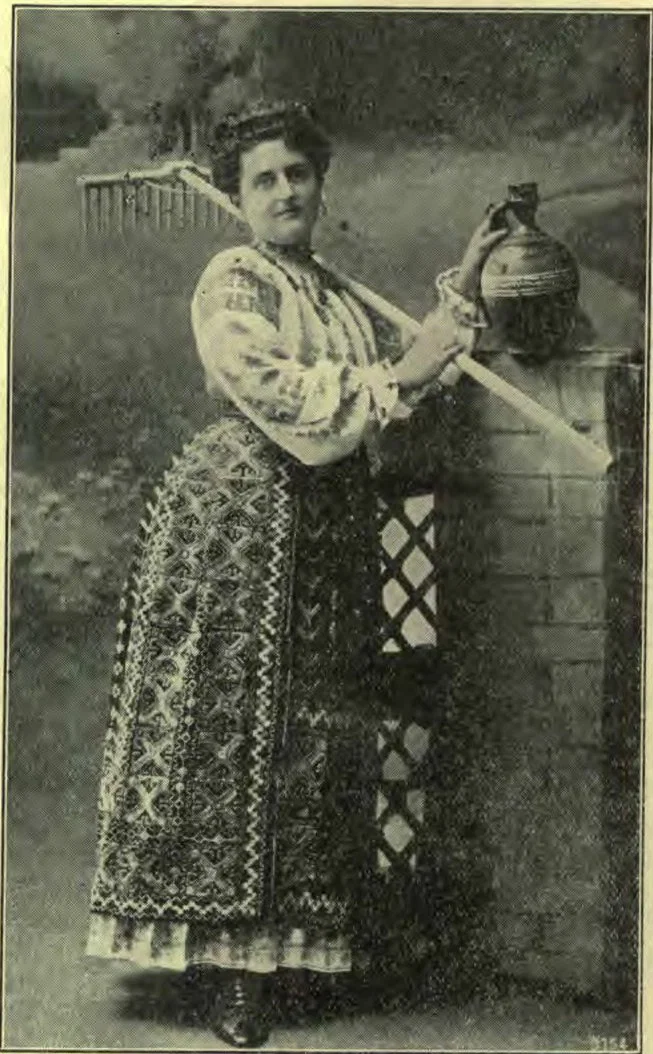
A ROUMANIAN BEAUTY
A ROUMANIAN BEAUTY
“Few states in history have been called to such momentous decisions as Roumania faced when it plunged boldly into the Niagara of blood and carnage that has rolled down over Europe for these two long years. But both hope and fear beckoned the Roumanians—the hope of a greater Roumania and the fear of a strangled homeland.”
“If the Central Powers won with Roumania on their side, they might, they felt, get something out of Russia; but Transylvania and Bukowina would still be beyond their grasp. On the other hand, they believed Russia would give them the beautiful Bessarabia, an adjoining Russian province which once belonged to Roumania, as a prize for participation on her side, and the Allies Bukowina and Transylvania on condition of an allied victory.”
So Roumania is in the war, “led by hope and impelled by fear;” and whatever the outcome, it will mean much to her.
The Roumanians are proud of their Latin descent . There are comparatively few cities, so the peasant class greatly predominates, and these, with their peculiar customs, their striking superstitions, and their primitive views of things in general, make an interesting people. Large families are a mark of honor. “Inside the homes, poverty is everywhere manifest. The floors are of earth, on which the family go about barefoot, in order to save the costly shoes. The oven is of earth; the bed is a plank, set against the wall; and the artistic is supplied by a single cheap icon. Opulent peasants may go so far as to cover their walls with a cheap cloth, which gives a decidedly pretty effect; but they are the exceptions. For food on their table, there is one dish that is common to all, and that is a soft meal of maize. In addition, there will be mangoes, the poor man’s friend in the Balkans, either stuffed with cabbage, roasted, or boiled, and, possibly, that of a potato. Sheep’s cheese is also served; but bread is a rarity, and then it is of the black variety always. Meat, of course, is to be had on great occasions only.”
“At one end of the village stands the symbol of their wrongs—the home of the landed proprietor, to whom the adjoining thousand-odd hectares of land belong. Seldom, if ever, is the noble here. He lives in Vienna or Paris, and leaves the place in charge of some Greek or Macedonian, who has the stewardship for a term of five years, with the intent of making all he can, first for himself, and then for the proprietor.”
“The peasant woman usually grows some silk. She buys the silkworm eggs, and uses the spare bed, if there be one in the house, as a hatchery. She feeds the worms on mulberry leaves, and if the ants do not invade the place and destroy the worms, she soon has enough fiber for a veil or a waist. She spins and weaves it herself.”
“The average Roumanian peasant is not given to the kind of thrift that leads him often to a savings bank. The patrimony of his sons and daughters is more often good will, good health, and an honest mind, than it is land, or money, or houses. So narrow is the margin upon which a young couple starts out in life that it has come to be a proverb among them, ‘Married today and out at the elbows tomorrow.’ For children come apace, and the prices of the things the peasant has to sell are even lower than the prices of those he has to buy, and not until his own labors are supplemented by those of sons and daughters has he much chance to prepare for even the shortest of rainy days.”
The queen of Roumania would not change places with any monarch in the world. She loves her tiny kingdom, and wants every one else to love it too.
“Twenty-three years I now have spent in this country,” she says in the Chicago Tribune. “I have moved about among its humble citizens; have freely entered cottages, and taken the newborn babes in my arms.”
“Many a hearty welcome has been given me, the peasants receiving me with flower-filled hands. As the rustic riders gallop out to meet me, the bells ring and gayly clad women and children flock out of the houses to strew flowers.”
“On a burning summer’s day I came to a tiny town that was almost entirely of Turks. They became excited at sight of a woman in strange attire, called me sultana, and wanted to touch my fingers and my clothes. They patted my back, and even chucked my chin, and jabbered and fought over me, overwhelming me with kind wishes.”

When Love Triumphs

“When a young Roumanian peasant lad’s thoughts turn to love and his mind begins to incline toward marriage, he goes to his mother, rather than to his sweetheart, with his tale. He tells her all about it, but rarely thinks of confiding the happy secret to his father; for Roumanian peasant fathers have faced the stern realities of life so long that they are apt to forget that they were once boys, and therefore have little sympathy with lovelorn tales.”
“But the mother acts as ambassador to the father, and if he can be induced to look with favor upon the lover’s choice, he calls in two of his best friends in the village, tells them of the son’s dreams, and asks them to accompany the said son to the house of the object of love’s young dream. Mayhap the girl herself has not yet received from the youth a single hint of his love; but even so, as he and his spokesmen approach the house, she suspects the object of his visit, and peeps through any crack or cranny that is convenient.”
“If it happens to be winter, the father of the girl invites the company in, and, surmising their mission, gives some hint as to his attitude by the way he looks after the fire. If he keeps it burning brightly, they know he is favorable. If he lets it die down a little, they understand he is only of an open mind on the subject. But if he lets it go out entirely, there is no use arguing the question.”
“It usually happens that the father of the girl is of an open mind, and the boy’s spokesmen tell what a fine, husky young fellow he is, what a good brother he is to his sisters, what a good son to his mother, what his patrimony is, and how industrious he is.”

The National Dance

“The Roumanian peasants have a saying that they must dance on Sunday to keep the creak out of their bones on Monday. Most of the dances are at the public houses,—dance halls under the blue sky, as it were,—and young and old gather there. The old folk spend the day with the tipple, while the young ones dance. There is very little drinking on any other day of the week, and a tipsy man, except on Sunday, is seldom seen.”
“The national dance is a sort of cross between a jig and the game of ring-around-the-rosie. All the dancers clasp hands and form a ring. They then begin a stepping, swaying motion that never moves them out of their original tracks, and to the music of the Tsigana band they keep it up for hours.”
“The dances are organized by the boys of the community. They arrange for the music, provide the refreshments, and preside as masters of ceremonies. When the girls reach marriageable age and have been sufficiently instructed in the household arts, they are allowed to attend these dances as participants. ‘She dances at the dance,’ is the peasant way of saying that a girl has made her début, and is eligible for matrimonial attentions.”

Community Service

“‘Many hands make light work,’ is another proverb of the Roumanian peasant, often put into practice. Almost every night there is a neighborhood gathering like the old-fashioned apple cutting or apple-butter boiling in early American rural history. The houses have their turns at these parties, and there is always a kettle of cornmeal mush and baked pumpkin and potatoes and popcorn ready for the occasion. All hands join in the evening program of combing, carding, and spinning the household supply of wool or flax, the while neighborhood gossip passes current among the elders, and occasional words of love or childish jest among the more youthful members of the party.”

Signs and Portents Govern Peasant Life

“The Roumanian peasant is much given to superstition, and he has a sign for everything. If shingles are not nailed on a roof in the proper sign, they will turn up at the ends; if potatoes are not planted in the proper sign, they will grow on top of the soil and be a failure; if you have money in your pocket when you see the new moon, you will not ‘go broke,’ at least not until another new moon comes. On the other hand, it is held to be dangerous to announce to those in the house that the new moon has appeared, for in that case all the pots and pans in the kitchen will be broken before the waning moon passes.”
“When a peasant child is christened, all of those present assume the relation of godparents, and it is a superstition that there must be no intermarriages between godfathers and godmothers. The result is that christenings are not widely attended, and those with matrimonial ambitions eschew them entirely.”
“The utmost care is taken by some to prevent a child from seeing its image in a mirror before it is three years old; for if it does, it will become a victim of the ‘falling sickness,’ which will send it stumbling through life.”
“The girls of Roumanian country districts take great pride in a clear, healthy complexion. . . . They take red and white threads, twist them into cords, from which they suspend coins around their necks. These talismans they wear from the dead of winter to the moment they see the first blossom of spring, feeling sure that thereby they will guarantee themselves a milk-white complexion, rosy cheeks, and ruby lips.”
Bukharest, the capital of Roumania, presents a very different picture to the one just drawn of the peasant life. They call their national capital “The Paris of the East,” and “in the character of its architecture, the ways of its people, the prices in force at its hotels, it justly deserves the title it has vauntingly assumed.” Nobody but the poorest thinks of walking in Bukharest. “Nearly all the ‘cabbies’ own their own teams of long-maned, flowing-tailed Russian horses. They are Russian exiles of the Skoptzy sect.”
“They wear great blue-black velvet coats, the skirts of which reach the ground. Their waists are bound about with multihued sashes, the flowing ends of which drop back over the seat, and one can guide his driver by pulling one end or the other of this sash when language difficulties stand in the way.”

Prince Charles the Miracle Worker

“Forty years ago Roumania was, both as to country and as to capital, one of the most backward nations of Europe; and then it called Prince Charles of Prussia to its throne. Although he had to travel to Bukharest incognito in order to escape the secret service of Austria, which was determined to keep him out, he immediately set to work to bring the country up to a higher standard. The story of his reign, which closed with his death soon after the European war began, is largely the same sort of story of development as that of Germany during the reign of his Hohenzollern kinsman. King Carol, as he was called, had for his queen Elizabeth, a German princess, better known by her pen name of Carmen Sylva. She, too, was spared the sorrows of Roumania’s hour of decision, having died a few months ago. They had one child, but it died in infancy, and Carmen Sylva turned her interest to the poor of the country and to letters and music. It is said that she was perhaps the most talented queen of her generation. She could converse in six languages; she wrote some thirty books; she composed an opera that was staged and praised on the continent, and her symphonies and songs have won a place in the world of music. Likewise she was no mean wielder of the brush, and was an expert needlewoman. Her pride was her work for the blind, for whom she founded an institution in Bukharest.”
“The present king is a nephew of King Carol. His wife is a granddaughter of Queen Victoria, and therefore a first cousin of most of the reigning heads of Europe.”
“Under the new era initiated and carried down to the present by the Hohenzollern dynasty, Roumania has gone far ahead of her neighbors of the Balkan region, and the visitor to Bukharest early finds that its people resent the idea of being classed with the Balkan States. They feel that they are the superiors of the Serbs, the Bulgars, the Montenegrins, and the modern Greeks.”
“It is true that their country is far in advance of other Balkan countries. Fast express trains run daily the length and breadth of the state; ports on the Danube collect and ship the produce of the country to various parts of the world; a fast Roumanian steamship line carries European mails from Kustendje, on the Black Sea, to Constantinople and other eastern centers of commerce; and several cities, both in size and style, resemble more closely the cities of Europe than do the other Balkan capitals.”
When King Carol assumed the throne, it became one of his principal aims to free his country from the suzerainty of Turkey; so one of the first acts of Roumania after the war between Russia and Turkey began in 1875, was to declare her independence of Turkey. In 1881 the Roumanians decided that they were entitled to the rank of a full-fledged kingdom, and so made proclamation to that effect, and crowned their ruler with a crown of steel made from a cannon captured by himself in the battle of Plevna.

The Persecuted Becomes the Persecutor

“Always bitterly resentful of ill treatment toward any of her race by other countries, she has forgotten to show that charity toward others under her power that she asks for her people from other nations. Her treatment of the Jew has been almost as harsh as that patient race has experienced at the hand of any oppressor.”
“It is hard to conceive in our own great land of liberty and equality how any nation could make such proscriptions against a race as Roumania has made against the Jew. No one is allowed to employ a Jew who does not also employ two Roumanians, and that means nonemployment for the sons of Israel. Jews are not allowed to be bankers, druggists, tobacconists; they have no standing in court, no right to employ counsel, no right to send their children to school except they pay for the privilege, which is free to all others. They cannot own farm land, are denied the right of holding government positions, and are prohibited from organizing or controlling stock companies or corporations. Furthermore, although some of them for forty generations have lived in Roumania, they are aliens still, under Roumanian law.”
“When the Powers assented to the creation of Roumania, one of the terms of the agreement was that all of her subjects should stand equal before the law. But later, Roumania decided that she would consider the Jew an alien, and so the agreement was nullified, with no hand raised in an effective protest.”
“The persecution, however, is economic rather than religious, for the experience of all eastern Europe has been that the Jew, under a free competition, manages to prosper where others barely exist, and so the attempt is made to handicap him as an equalizing process. Yet in spite of all his tribulations, in spite of governmental processes which would seem to leave nothing to the Jew but to emigrate, he manages to keep the noose from strangling him and to survive the fierce struggle.”
“While Roumania thus makes the Jew an alien, she does not regard him so when she needs men for her army. Then he is Roumanian from the crown of his head to the sole of his foot, although even in the army he cannot become an officer or escape the menial jobs that military operations always involve.”
“The water passeth and the stones remain,” so say the people of this doughty kingdom, referring to their own persistence as a people in spite of the floods of humanity that have swept over their territory. May it be so in this time, the most critical of their experience.
Continue reading: THE TENT ON THE BASEBALL LOT