The Youth’s Instructor, Vol. 65, No. 10.

Miscellaneous Items From Around the World
Earlier text: THE TENT ON THE BASEBALL LOT

XI — Paul’s Farewell Meeting with the Elders at Ephesus

(March 17)
LESSON SCRIPTURE: Acts 20:16-38.
MEMORY VERSE: “Remember the words of the Lord Jesus, how he said, It is more blessed to give than to receive.” Acts 20:35.

Questions

1. Why did Paul sail by Ephesus without stopping? Why was he in such haste to reach Jerusalem? Acts 20:16. Note 1.
2. To what place did he call the Ephesian elders? What did he say they knew? Verses 17, 18. Note 2.
3. How did he serve the Lord while with them? Verse 19.
4. What did he not keep back? How did he teach? Whom did he teach? What did he teach? Verses 20, 21.
5. What did he say of his visit to Jerusalem? What did he know was waiting for him in every place? Verses 22, 23.
6. How did he feel in all his trials and difficulties? Verse 24.
7. What did he say concerning a future visit? Verse 25. Note 3.
8. Repeat the challenge he gave these elders. Verses 26, 27.
9. To what did he ask them to take heed? Who had made them overseers? What price had been paid for the church? Verse 28. Note 4.
10. What did he say he knew would come after he was gone? Verse 29.
11. What would some of these to whom he was speaking do? Verse 30.
12. For this reason what did he tell them to do? How long had he labored for them? What had he done without ceasing? Verse 31. Note 5.
13. To whose care did he commend them all? What did he say would build them up? Verse 32.
14. What had Paul not coveted? Verse 33. Note 6.
15. How were his necessities provided for? For what others did he furnish support? Verse 34.
16. In what had he been an example to them? What words of Jesus did he say should be remembered? Verse 35.
17. How did Paul conclude his address to the elders? Verse 36.
18. Describe the parting that then took place. For what did they sorrow most? How far did they go with him? Verses 37, 38. Note 7.

Questions for Diligent Students

1. Relate some of the trials Paul passed through in Ephesus.
2. Why should we repent toward God? Why should we have faith in Jesus? Give Bible proof.

Notes

1. It took four days to sail from Assos to Miletus. While waiting for his ship, Paul sent for the elders, that he might pray and counsel with them. Miletus was about thirty miles from Ephesus.
2. There must have been great joy in Ephesus when the elders learned that their beloved teacher was at Miletus, and had sent for them. The journey would not seem long, and both Paul and the elders must have rejoiced when they met. Probably they met in some secluded place, as the company was small compared with the great crowds that came to the theaters. Today those great buildings lie in ruins, while the words spoken by Paul live and still speak to those who will listen. Paul was a very humble man. Though educated, eloquent, and having had a wonderful experience at his conversion, yet we never hear of him boasting. He worked with his hands to earn his support while he preached.
3. Paul did not intend to say this would be his last meeting with these brethren, but the Spirit of the Lord revealed this truth to him, and confirmed his fear that he should never see them again.
4. If we would help others, our own lives and example must be like Jesus’. Paul did not exhort any to care first for themselves, that is, to love themselves most, but for the sake of others to be right with God.
5. Not only should elders and grown people take heed, but boys and girls need to be careful, to take heed to themselves. Let us set our goal, and begin to live now so we can reach it. By taking care in the doing of even the least important things, we may be of service to God and helpful to others.
6. “Some of the Ephesian brethren were wealthy, but Paul had never sought personal benefit from them. It was no part of his message to call attention to his own wants.”
7. When Paul had finished speaking, he knelt down and prayed for those whom he had been warning and teaching. Great was the grief of these workers as they remembered that they should never see their beloved pastor and teacher again. After going with the apostle to the boat, no doubt they began their homeward journey, talking by the way of the words he had spoken to them.

Sewing Snap Fasteners: Marking Placement with Chalk

When sewing on snap fasteners, sew the under half, the part with the round nub that fits into the larger half, to the material first. When all the under halves are in place, rub chalk — lump starch will do — on the ends of the nubs; then adjust the hem on which the upper half of the fastener is to be sewed. Press firmly. The chalked nubs will mark the spot for the middle of the top half of the fastener.

Church Unity

The Protestant churches of America for a long time have been looking toward and working for a union of the churches; but a new phase of church unity seems to have developed only recently. The Independent of January 22, says of this:—
“One momentous consequence of the present war may prove to be that the national churches of England and Russia will find it easy to understand each other and to arrange some kind of coöperative union. At least the fear of this has apparently penetrated the Vatican and stirred the Pope to action. A statement made this past week by Dr. Palmieri, of the Library of Congress, and based, so the press reports indicate, on private advices from the Vatican, runs to this effect: That the Roman See, disturbed by the rapprochement between the Anglican Communion and the Orthodox Church of Russia, is about to launch under its own egis a movement for Christian unity.
“A contributing factor in disclosing the progress of this parley between Russia and English-speaking episcopacy is the cordial reception given by the Russian hierarchy to the proposal of a World Conference on Faith and Order, planned by American Episcopalians. Clearly the prestige of Rome would suffer an incalculable loss if there should be formed, apart from her, a union of all the other churches which claim apostolic orthodoxy and catholicity. One can imagine a confederacy of the Russian, Greek, Anglican, and American Episcopalian churches, involving such a mutual recognition of each other’s orders and beliefs, and such a common refusal to recognize the primacy of the Roman See, as would present to Rome a far more disheartening situation than the defection of all the multiplying sects of Protestantism. ‘Of course Rome cannot see with indifference,’ Dr. Palmieri is quoted as saying, ‘the growing friendship between Anglicanism and Orthodoxy.’
“Within Protestantism the resulting movement toward mutual understanding and coöperation is pronounced and vigorous, and now with Anglican and American churchmen making overtures, not unwelcome, to Russian orthodoxy, and with the Pope determining to join the movement lest unity be wrought apart from him, how interesting the situation grows!”
All such indications of a federation of the churches cannot fail to bring to mind those graphic and significant words of the servant of God:—
“When Protestantism shall stretch her hand across the gulf to grasp the hand of the Roman power, when she shall reach over the abyss to clasp hands with Spiritualism, when, under the influence of this threefold union, our country shall repudiate every principle of its constitution as a Protestant and Republican government, and shall make provision for the propagation of papal falsehoods and delusions, then we may know that the time has come for the marvelous working of Satan, and that the end is near.
“As the approach of the Roman armies was a sign to the disciples of the impending destruction of Jerusalem, so may this apostasy be a sign to us that the limit of God’s forbearance is reached, that the measure of our nation’s iniquity is full, and that the angel of mercy is about to take her flight, never to return. The people of God will then be plunged into those scenes of affliction and distress which prophets have described as the time of Jacob’s trouble.”—
“Testimonies for the Church,” Vol. V, p. 451.

Learn What Right Is Like

“LEARN what right is like, And in the darkest battle field Thou'll know full well just where to strike.”

Burying the Dead

AN experiment is to be tried at Teachers' College, Columbia University, which if successful will mean a complete modernizing of our American school courses from the kindergarten through the high school. The experiment is trying out a “modern school” idea advocated by Dr. Charles W. Elliott and other leading educators. In this school Greek and Latin will have no part. The time for language study will be given entirely to modern languages, such as German, French, and Spanish. Sciences will be emphasized. New methods of teaching literature will be tried, and practical industry and the domestic arts will be prominently featured in the courses. Organized recreation, play, and games will be provided for in the courses. No attempt will be made to drag the reluctant student through courses that are designed to discipline the mind. The training will be secured through the careful and thorough study of subjects that are in themselves valuable. The experiment is to be thoroughly tried out, and will be watched with interest by both educators and their victims.—Selected.

Man and Woman

Man and woman balance the scale of humanity. They are corresponding counter-proportions. Man as illustrating the ideal half of humanity, represents power, courage, use; and woman, illustrating the other ideal half of humanity, represents love, beauty, happiness. Man is the prose of humanity; woman, the poetry. Man and woman share humanity differently, but equivalently. Man reasons; woman knows. Man is a philosopher; woman, a magician. Man’s intellect is more abstract; woman’s more imaginative. Man’s qualities are solidity, decision, sternness; woman’s are brightness, grace, and sweetness. The forces of man’s nature are roused into exercise by ambition; the forces of woman’s by love. Man gives from principle; woman, from sympathy. Man is less impressionable; woman is more impressionable. Man’s constitution inclines him to justice; woman’s inclines her to mercy. Man is the majesty of force; woman is the majesty of gentleness. Each is completed in the other. God created them one, and designed them to will, think, and act in harmony. The division doubles their pleasures, their unity is the perfecting of each self. Man and woman are king and queen of nature. When both reign in unity, their sovereignty is complete, their humanity is divine, because an adequate dwelling and throne for God.—J. Pulsford.

Is the Bubble Fountain Safe?

THE “bubble fountain” has been regarded as the last word in sanitary science, so far as the public supply of drinking water is concerned. Yet an investigation made at the University of Wisconsin shows that this device was probably an agent in infecting a whole dormitory at that institution, and that it may be a very active factor in transmitting disease.—Literary Digest.

The Key to All Doors

“THE key to all doors is not ‘I will,’ but ‘I must.’”
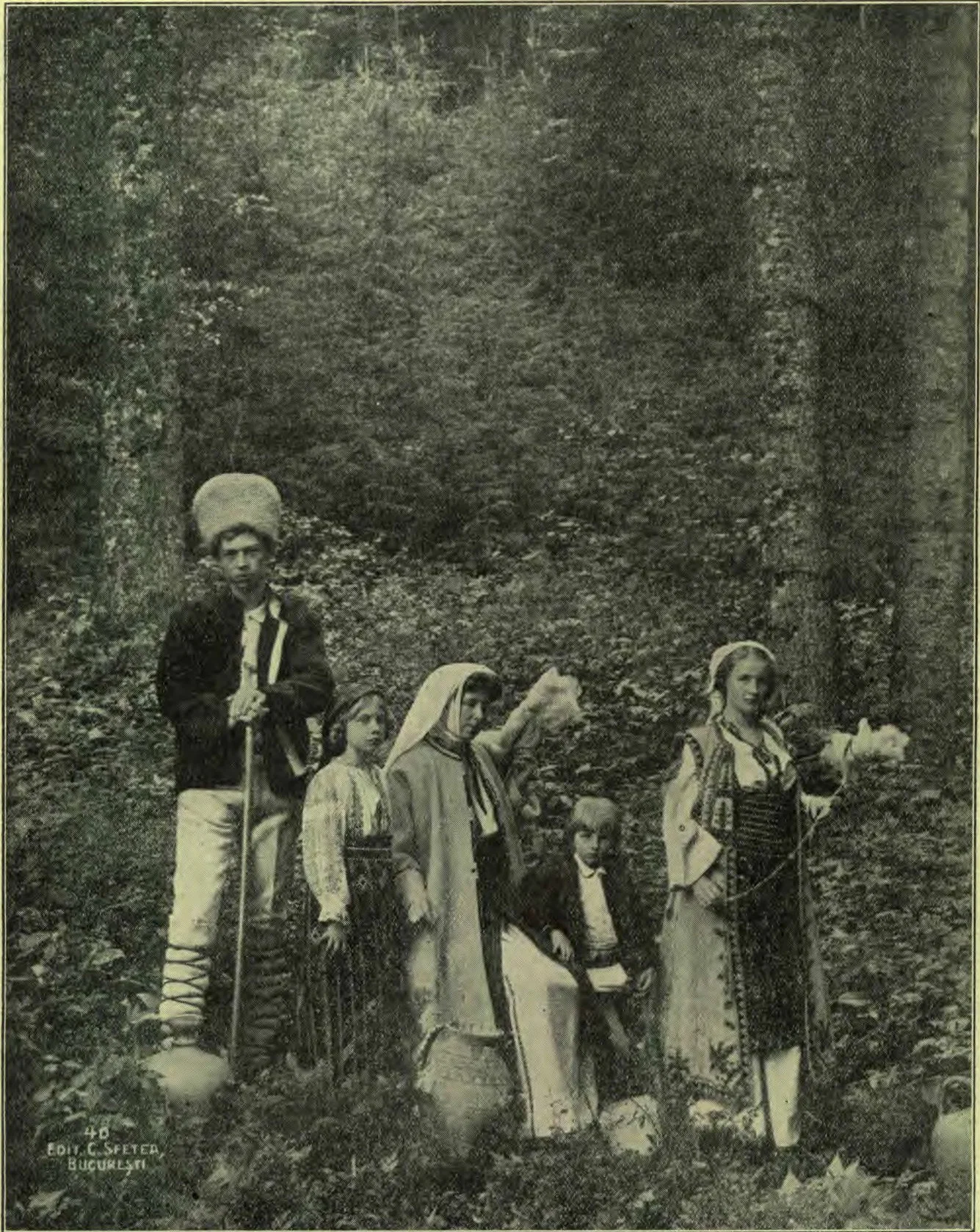
MEMBERS OF ROUMANIA'S ROYAL FAMILY. AT THE LEFT IS PRINCE CHARLES; AT THE EXTREME RIGHT, PRINCESS MARIE
THE EARLY MORNING OFTEN FOUND JESUS IN SOME SECLUDED PLACE, MEDITATING, SEARCHING THE SCRIPTURES, OR IN PRAYER.

You have reached the end of this edition.

The Youth’s Instructor · Mar 6, 1917