THE TENT ON THE BASEBALL LOT
Donald and His Friends Help Pitch It
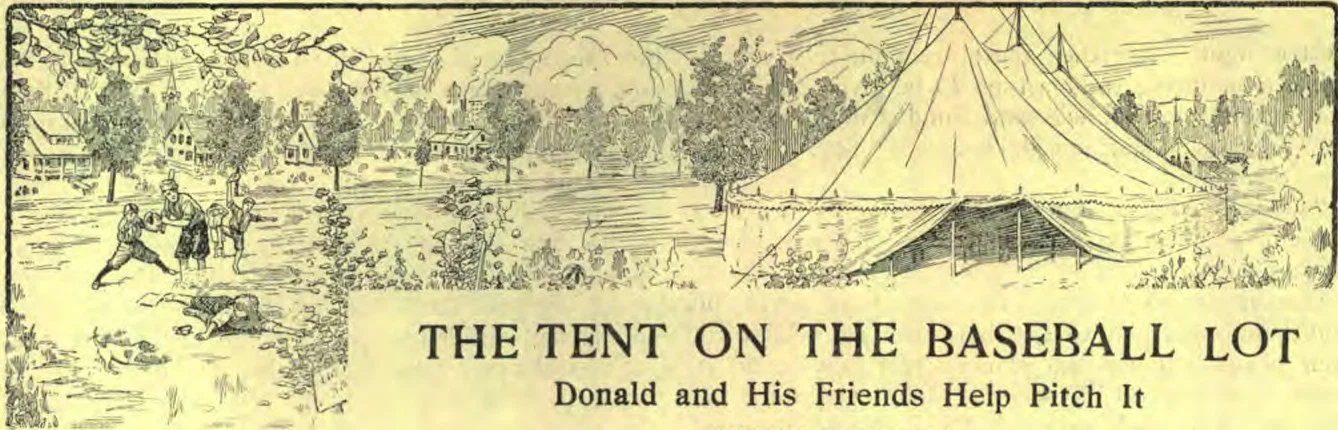
DONALD and his playmates were playing ball on the lot when the wagons drove up with the tent outfit. They did not stop playing, nor give very much attention to the wagons when they stopped at the front part of the lot, not knowing what they contained.
Soon a man walked from the wagons to where the boys were playing. A ball which had just been struck drove straight toward him with considerable force; but without apparent effort he put out his right hand, caught it easily, and threw it back to the pitcher. This was done so deftly and with such a friendly smile that the boys found themselves liking this stranger.
“Boys,” he said, “can you stop playing a few minutes, while I ask you some questions? I want to talk with you about this lot.”
Talk with them about the lot! That could mean only one thing, and that was that they would have to stop playing ball there. A look of gloom settled over their faces. The stranger dropped in their estimation. He had come to take away their ball ground.
“You see, I have leased this lot to pitch a tent on,” he began. At that a look of interest came into the boys’ faces. A tent always meant fun of some kind. Perhaps this was a show, or a merry-go-round. If so, they would get some fun out of it, even if they did lose their ball ground.
“I think the tent can be pitched in such a way as not to interfere with your ball playing,” the stranger continued. That was all the boys waited to hear before letting out a yell. Here was a man who liked boys well enough to do a little thinking in their interest, and their friendship was on a solid foundation from that moment. Anything they could do for this big, genial stranger who smiled so pleasantly they would do gladly.
“So I thought we would better get together and plan where to pitch this tent so that it would interfere with your ball ground just as little as possible,” the stranger finished. The boys looked at each other. They were all thinking the same thing, and that was that most of the men they knew had so little respect for the rights of boys that they would have gone ahead without saying a word, and pitched the tent just anywhere, without any regard at all for the boys’ ball ground. This man was all right, they decided. He knew boys.
“Say, Mister, what kind of tent are you going to put up—a merry-go-round?” asked Bert Anderson.
“No,” the man said, “we are going to have a series of meetings, religious meetings, and there will be sermons, and lectures, and Bible studies.”
The boys’ faces fell. It wasn’t going to be anything they would be interested in, they felt sure. But the man had not finished talking.
“And we are going to have some pictures—stereopticon pictures—about things I know you boys will be interested in. We are going to have some seats just especially for you fellows.”
The boys looked pleased, and their waning interest was at once revived.
“How much will it cost?” Tom White asked.
“Cost!” the man exclaimed. “Why, there will be no charge for any of these meetings. They will be free to every one who comes. You just come in and take a front seat, and bring your mothers and fathers with you. They will enjoy the meetings, too.”
While the man was talking with the boys, the men at the wagons were unloading a lot of lumber and poles and stakes, and one of them now called out, “Brother Harris, where shall we begin driving stakes?”
The man with whom the boys had been talking replied, “Just wait a minute until the boys and I decide it.”
Then he said to the boys: “I am afraid we shall have to cut off a part of your diamond, the home plate at least. Do you think there will be room to make another diamond?”
“Sure, Mister, go ahead,” the boys cried out together, “we’ll fix it up all right. There is plenty of room left for a ball ground.”
The men began then to drive the stakes, measuring the distance between them carefully, and getting them all a certain distance out from a stake which they had placed in the center. The boys had lost interest in their ball game, and stood about watching the work of getting the tent ready to pitch. They held on to the guy ropes when the three big center poles were raised. They looked on with interest as the men began to lace up the ends of the tent with the two big splices. They helped the men tie the ropes at the edge of the tent to the stakes. And then they had a great deal of fun running under the tent as the men began to lift it from the ground with the tackle. Finally it was up in position, and then the wall began to be snapped on, inclosing an area which would seat fully a thousand persons.
One of the most interested of the boys was Donald Hunter, a lad about thirteen years of age. He lived with his father, mother, and sister Margaret in the next block from where the tent had been erected; and as he watched the preparations which were being made for the meetings, he made up his mind to be present at the first meeting. He had been especially attracted to the man who was called “Brother Harris,” and he now went up to him, and asked:—
“Will the meetings begin tonight?”
“No, there is too much to be done before the meetings can begin. There are the seats to place, and the platform to build, and the tent must be wired for10electric light. And then there are thousands of circulars announcing the meetings to be given out. The first meeting will be held next Sunday night.”
“Circulars!” exclaimed Donald. “Say, I’ll help give them out.”
“Good! And if you will select seven other boys to help, you can do the whole job. I’ll pay you a quarter each to do it.”
Donald rushed to where the other boys were, and told them of the plan to distribute circulars. They got their heads together and planned just how to do it, laying the city off in sections, and appointing the boys to cover each section. Then Donald returned to Brother Harris, and told him they were ready to begin. But he was told that this work was not to be done until Thursday. It was then Monday. Donald said they would all be ready to go to work early Thursday morning.
That night all the boys told their parents of the tent, and of the meetings that would begin the next Sunday night, and secured their consent to attend the first meeting.
The next day, Tuesday, the boys helped spread a thick covering of shavings over the ground inside the tent, and over this the seats were placed in rows. The platform was finished before night came, and preparations were made to do the wiring the next day.
On Wednesday the electricians came and finished the wiring, and at the same time the platform was trimmed and decorated. Potted plants were set along the edge of the platform, and overhead a large motto was placed on which were the words, “The Entrance of Thy Words Giveth Light.” At each end of the platform were white pillars which upheld the framework on which the motto was set. A piano and an organ were placed on the platform, in addition to a number of chairs and the pulpit. The structure was trimmed with green burlap, which, together with the potted plants, of which there were a great number, made a beautiful bower of green.
Thursday morning the boys started out with the circulars, and before night they had pretty well covered the entire town. When they returned to the tent at night, Brother Harris met them and paid them a quarter each for their work. By this time the boys felt that they were a part of the campaign, and they were doing all they could to help in every way. Two small tents had been erected alongside the big tent, one for a reception tent, and the other as a home for a young man who was called “the tent master.” The tent master entertained the boys that evening by telling them a number of Bible stories. Brother Harris, with his wife and son, had secured rooms near by.
While the boys played ball Friday, the workers at the tent completed the preparations for the opening meeting of the series. The grounds about the tent were raked over carefully, and everything was put in apple-pie order. When the boys went home that evening, they noticed that everything had been completed, and all the tools about the tent had been put away.
Saturday morning the boys were out playing ball again, but they noticed that no one was at work at the tent. When they went to the small tent, they found the tent master sitting quietly reading his Bible, and dressed in good clothes. He invited them in, and told them the story of Daniel, the Hebrew captive in Babylon, a story which they enjoyed greatly. He told them that Brother Harris would tell them a great deal more about Daniel on Sunday night, and that there would be pictures thrown on the screen.
That night the boys all went to bed determined to be the first ones at the tent the next night. Donald Hunter had been so enthusiastic about the tent, and about Brother Harris and his kindness, that his whole family had decided to go with him to the first meeting. And many other people throughout the city had made the same decision. What they saw and heard at this meeting I shall tell in another story.
A Word to the Finding-Out Club
By Editor
MANY excellent lists of answers are sent to the editor, the questions being intelligently and correctly answered, the papers neatly written, and all the rules of the Finding-Out Club fulfilled. There are some persons, however, who fail to meet the demands for membership in the club by writing on both sides of the paper, using pencil instead of ink, and not giving the date of the paper containing the list of questions answered.
You may be interested to know that only one person was brave enough to attempt to answer the list found in the INSTRUCTOR of Dec. 5, 1916. Mr. Reese sent in a good list of answers. But the next list that appeared brought in fifteen sets of answers. In the main these were all good papers. The following persons would have graced our club membership if they had answered accurately the fifth question of this series:—
Irene MacDonald
Lenna Hough
Lois Lillian Gilstrap
C. W. Bruce
W. S. Reese
Nellie M. King
Pearl L. Goodrich
Helen Dykstra Beguelin
These must have failed to note that President Wilson was born in the Old Dominion State.
If one uses ruled paper, please do not write anything at all above the first ruled line. The line itself suggests that the writing should begin on it, and not above it.
The names of the animals shown in the picture never appeared in the INSTRUCTOR. They are herewith given in the order they appear in the picture from left to right:—
The papers of Mrs. McIntire and Miss Laing answering the last list of questions in 1916 came too late to be counted in on the 1916 list, so we welcome them to membership in the 1917 club.
Members of the 1917 Finding-Out Club
C. W. Bruce
Grace D. Bruce
Herbert F. Demorest
Mrs. Grace Hoover
Mae C. Laing
Mrs. F. M. McIntire
W. S. Reese
Susan A. Walde
George F. Webb
May Wilhelm
William F. Wood11
For the Finding-Out Club
1. WHAT is the Septuagint?
2. What is the Douay Bible?
3. What place did vowels have in the original Hebrew text?
4. When was the Bible divided into chapters?
5. When was it divided into verses?
6. What queen inaugurated her long and prosperous reign by pressing to her heart and lips a copy of the Bible?
Answers to Questions in “Instructor” of February 6
1. Submarine boats are fitted with gyroscope compasses, so that they may be able to steer correctly when submerged. They also have one or more periscopes.
2. The origin of London will probably always remain a subject of dispute, for want of decisive facts. There is practically no record of British London. Bishop Stillingfleet held that London was of Roman foundation, and not older than the time of Claudius.
3. When chemically pure, iron is silver-white in color. It is a metallic element which is malleable and ductile, strongly attracted by magnets, readily oxidized in moist air, and attacked by many corrosive agents. Steel is iron which is malleable at least in some one range of temperature, and also is either cast into an initially malleable mass, or is both so cast and so capable of hardening. It is much harder and more elastic than iron.
4. A whale is not a fish. It is a mammal.
5. Glass is an amorphous substance, consisting ordinarily of a mixture of silicates, but in some cases, of borates, phosphates, etc. Most glass is made by fusing together some form of silica, as sand; an alkali, as potash or soda; and some other base, as lime or lead oxide.
Thoughts for the Thoughtful
There shall be “wars and rumors of wars.” Certainly this text is meeting fulfilment at the present time.
“When they shall say, Peace and safety; then sudden destruction cometh upon them.” Already thirteen nations have declared themselves anxious to join a league to enforce peace. No subject so engages the thought of the people today as does the peace question, unless it be the war problem.
“He shall plant the tabernacles of his palace between the seas in the glorious holy mountain; yet he shall come to his end, and none shall help him.” The Allies demand that Turkey shall be driven from Europe, that Russia may have Constantinople as one of the conditions of their willingness to lay down arms.
“For as in the days that were before the flood they were eating and drinking, marrying and giving in marriage, until the day that Noe entered into the ark, and knew not until the flood came, and took them all away; so shall also the coming of the Son of man be.”
“Lovers of pleasure more than lovers of God.” The Saturday Evening Post says: “New York has this winter a tremendous army of free-handed spenders and pleasure seekers.”
“To regale the crowds which have come to them this winter the cabaret managers have outdone themselves. Not only have the arts of wining and dining been developed to a new point of sophistication, but forms of entertainment more costly than ever have been introduced. One hotel pays a team of exhibition dancers fifteen hundred dollars a week, and its nightly expense for music is two hundred and fifty dollars. Several of the cabarets offer musical shows with large, marvelously costumed choruses and some of the highest-priced comedians of the stage. Three or four skating troupes, representing outlays of from five hundred to a thousand dollars a week, are performing in different of the night resorts. At one establishment an Old World marionette show has been introduced with great success; it is only one feature in a long program, but it costs two hundred dollars a week. One of the very largest of the hotels has begun the transformation of the entire acreage of its roof into three vast connecting rooms with glass partitions between: in one room there will be general and exhibition dancing, in another ice skating, in a third roller skating. More than a hundred thousand dollars will have been spent upon this project. If the proprietor of any one of these places was convinced that his particular pleasure-hungry throng wanted all-night grand opera, he would hire the most expensive singers in the world.”
“All this is made possible not alone by the size of the crowds, but by their prodigality. White-light prices have reached a staggering level. It has become perfectly ridiculous for any one even to consider entering most of the cabarets this winter without leaving all thought of expense behind. Only a flushed carnival crowd that had cast away every consideration but a good time, would permit the imposition which the horde in the metropolis accepts with a careless grin.
“Practically all the big cabarets now levy in one form or another an admission fee. These charges vary from seventy-five cents to two dollars. . . .
“But the admission fees are only the beginnings. Once within any of the great cabarets of New York, one encounters a scale of prices which only a demand vastly exceeding supply could make possible. For example, eggs, which in various forms have become the almost universal supper dish of the city, are invariably at least a dollar a portion, and a portion is never served for more than one. Cocktails range from twenty-five to forty cents, champagne from six-fifty to seven-fifty a bottle. Rolls and butter are commonly twenty-five cents a person, and small cups of black coffee a quarter each. There are plenty of fat purses to stand this sort of thing, and the cabarets can this season successfully take the position that those who object to their charges may stay away. . . .
“What it all comes to is that people from all over America have this winter swarmed to New York in such numbers, with such fat purses and so bent upon pleasure, that a not inordinate evening—an evening in which little, or perhaps no, wine is purchased—now means an expenditure, for three or four persons, of from fifty to a hundred dollars; and night after night thousands of persons are spending such sums and more for their gayeties.”
Strict Honesty
If I were a young man or a young woman, starting out on my own responsibility, I would make it a life rule never to take anything that did not belong to me. I should never deceive myself by making believe it was right to take something I felt obliged to take when there was no one looking. If one has a right to a thing at all, he has a right to take it at any time, before anybody.
Yet how many employees who would feel insulted if any one should intimate that they would take a postage stamp or stationery from an employer, do not hesitate to steal his time by clipping their hours, coming in late, writing personal letters during business hours, being absent from their work more than their allotted lunch time, or shirking work when the boss is not around?
These things are just as dishonest as it would be to take his money. What is the difference between taking twenty-five cents out of the money drawer or taking a piece of merchandise, and stealing half an hour or an hour of your employer’s time during the day by all sorts of ingenious schemes? — Selected.
Writing as Playing the Reader's Mind
“PLAY on the reader’s mind as you would on a piano, with words as keys—that is all there is to writing.”
Witnessing for Jesus
By Ella Iden
ELLA IDEN
It had been a warm afternoon, and the game had been a very interesting one. The boys were tired, and had thrown themselves down on the grass under the big maple at one corner of the ball field, where they were resting and cooling off.
“Boys,” Tom Brown remarked, “what do you say to coming over here next Sunday afternoon and having a game of ball with the Chambersburg boys? It can’t do any harm to come down for an hour or so. How would three o’clock suit you?”
“Not me,” piped up little Tim Jones. “I have to go to choir practice down at the ’Piscopal church.”
“And I have to go to Sunday school,” said Archie Moore.
“And so do I,” “And I,” chimed in several others.
After nearly all had expressed themselves for or against the time suggested for the game, Tom turned to Ralph Baker, and with a sweeping bow said, smilingly, “Boys, why can’t you all be like our friend Ralph here? He never objects to Sunday games, and is always on hand when we want him. Perhaps he has no choir practice or churchgoing to call him away. How about it, Ralph?”
Ralph colored to the roots of his hair. “Yes,” chorused the other boys, “tell us about it, Ralph; don’t you have to go to church? Don’t believe we ever saw you at Sunday school. What are you anyway, a Latter-day Saint?”
Ralph’s face grew still redder, but he said nothing. Then suddenly jumping up, he exclaimed, “Come, boys, let’s see who can reach that big oak over there before I do!” and he was off like a streak, glad of any excuse to change the subject, and to break away from his teasing companions.
That night as he and his mother studied the Sabbath school lesson, as it was their custom to do each evening at family worship, Ralph was especially impressed with the story, which dealt with the closing scenes in the life of Jesus. It told of the final meeting at the Mount of Olives, the earnestness with which Jesus talked to his disciples just before his ascension, and the final leave-taking. Then came the memory verse, “Ye shall be witnesses unto me.” Witnesses—the word somehow impressed itself upon his mind.
“Mother,” he asked after a while, “what is a witness?”
Mother seemed to understand what he was thinking about, and she answered:—
“Why, Ralph, a witness is one who bears testimony to a thing. In the way Jesus used it, it means one who is ever ready to speak a word for the Saviour—to tell the glad tidings that he is soon coming again. A witness for Jesus is never ashamed to show his colors.”
Ralph was an honest boy, and as he listened to his mother’s words, conscience was speaking to him in a still, small voice. “Do you know,” it was saying, “do you know that you really denied Jesus today by being ashamed to tell the boys what you believe? Do you know that you missed a golden opportunity to speak for the Master?” Yes, he knew it; and as he thought about it, he was filled with remorse for his lack of courage. Why hadn’t he just told the boys the truth, and let them know that he was really proud of his religion—for down deep in his heart he was. Oh, if he had another opportunity he surely would improve it! Let the boys laugh if they would.
Next day as he was coming home from the grocery, he cut across the field to shorten the distance. When he neared the big maple, he saw that some of the boys were talking animatedly together. At his approach one of them called out, “Here comes our Latter-day Saint!”
Ralph smiled good-naturedly, and asked, “Haven’t you boys figured out yet what church I belong to? Well, guess I shall have to come to the rescue and help you out. I want to tell you that I am a Seventh-day Adventist, and am proud of it.”
The boys exchanged glances; then Tom Brown spoke up, “What does it mean, anyway? I never heard of one, did you, boys?” The boys shook their heads.
“Well, the name itself means that we keep the seventh-day Sabbath as God tells us to do in the fourth commandment, and Adventist means that we are expecting that Jesus is coming back to this earth again soon. Listen, boys! if you want to hear something interesting, just come over to our Sunday night service next week, and I’m sure you’ll be glad you came.”
The following Sunday evening two of the boys walked into church with Ralph Baker, just as the opening hymn was being announced. They were but boys, yet how intently they listened to every word that was said!
A few months later, when the minister asked for an expression from the audience as to who would obey God’s commandments and keep his Sabbath, Fred and Robert arose. Do you think that Ralph was happy that night? and do you think that it paid to witness for Jesus?
Purpose and Perseverance Like Damascus Steel
“HIGH purpose and perseverance are to the man what the threads of silver are to Damascus steel—welded into the whole, that the blade, though it may be bent double, will not break.”
All this God was to the psalmist. All this he has been to trustful men and women in all lands through all ages. All this he desires to be to you.
God will be your defense. He desires to be your fortress, and protect you from all the dangers that beset your pathway; to be your deliverer from all fears that arise in your heart; to be your shield and buckler from all unkindness hurled your way. He wishes to be your tower of strength, so that when overwrought nerves make you want to fly and make things about you fly, he may preserve your calmness and give you rest. When everything goes wrong and you do not know where to stand, he wants to be the eternal rock14under your feet that your steps slide not. He longs to be your refuge from every sorrow your heart knows; and he yearns to be your hiding place from the enemy of souls.
God will be your success. He desires to be your light, your strength, your goodness, your glory; and with these equipments for your life work, success is inevitable. Allen Gardiner did not fail. God was his success. His death did more than years of service could have accomplished, for it called scores of workers to rescue the perishing in Patagonia. Napoleon once said to his generals: “I beg of you, gentlemen, plan by larger maps!” That is what we need to do, and when God is your light, you will lay your plans on the large map of eternity; you will see things in their true values; you will fill your life with things of eternal worth. When he is your goodness, your strength, your glory, you will have a character that will stand the final test; you will succeed.
God will be your courage. Think of the precious hours, the much-needed strength that fear and worry consume every day! These destroyers have a first mortgage on many lives. Do they consume a part of your reserve strength? Then think what it will mean to have a confidence that never gives way to fear; a hope that never yields to despair; a trust that never loses itself in worry. Why, it would change the whole enterprise of living! You would have energy for doing exploits.
And if you make God your best friend, you shall not want for happiness. He will be your song. Wherever you go he will be the secret, unfailing spring of joy. Paul and Silas sang in prison; and although prison walls unseen by the eyes of others are hindering you from enjoying some of the things for which your heart longs, you will still be happy if God is your song.
And wealth! With God for your portion, you can never know poverty! “The cattle upon a thousand hills” are his; all the silver and gold are his; and if he is your portion, then you are a joint heir of his wealth. He may not give you a big allowance here, but he will sustain you and supply all your wants. This is a beautiful truth; but you and I may not begin to realize it till we cross some Sahara in life where the fewer blessings lead us to see the Giver of them all.
Nor does he leave without companionship those who choose him. Like a tender shepherd he guides them, protects them, provides for them, watches over them, comforts them — yes, ministers to all their needs. Some young people hesitate to choose God for their companion. They fear the loneliness of the way; and not till they taste and see can they know that better than any or all other companionship is that which God offers them. Who would not rather cross the continent alone with his best friend, than in a company of mere acquaintances?
But God offers more than companionship to those who choose him. Moses learned to know God pretty well during the forty years he spent with the flocks in Midian; he became still better acquainted with him while in the wilderness for forty years with the returning captives; and during these years of homeless wandering he learned that God is the home of his people. It is not the rooftree that makes the home: “Where mother is, that’s home.” But as the years go by and the grave claims the home-makers, we may look up and say with David: “Lord, thou hast been our dwelling place in all generations.” How swiftly and sadly generations follow each other, like waves breaking on a lonely shore. But God remains; and “God is the home of all who find any real home among these fluctuating nothings of this world’s shadowy things.”
But God wants to be more than a home to you. God will be salvation to all who will live with him on the earth. Yes, he will save them, and upon the sea of glass, amid the redeemed, they will sing the undying song of Moses and the Lamb. May God count on hearing your voice in that grand chorus?
March 17: Joshua 23, 24. Last words and death of Joshua.
Joshua
If ever a man was called to fill a hard place, Joshua was. But it is doing hard things that makes heroes. Joshua had to take up the work of Moses, who had led Israel out of Egypt, through whom God had given them the law, and who had been their faithful leader, ruler, and judge for forty years. It is always hard to step into the place of a great man. And not only this, but Joshua took the leadership of Israel at the time of a great crisis. They were just at the border of Canaan, with its giants and walled cities. Nearly forty years before this the fathers of the present generation had turned back in discouragement. More than this, the Israelites were not trained warriors; they were a nation of shepherds and farmers. Yet the idolatrous inhabitants of their promised land must be driven out.
But Joshua had shown himself to be a strong man, and a faithful servant of God. As a young man he was leader in the battle against Amalek (Ex. 17:8-13). He had for a long time been Moses’ minister (Ex. 24:13; Joshua 1:1). As one of the twelve spies sent15into the land from Kadesh, Joshua had recommended that they should go up at once and possess the land (Numbers 14). Thus he had shown himself a man of faith and courage.
Before Moses’ death, Joshua was chosen to be his successor (Num. 27:18-23), and after the death of the great leader, the Lord gave him a special charge and told him how he could succeed (Joshua 1:1-9). It would be well for us to give special attention to this instruction. Joshua was promised “good success” if he would do certain things. And as Missionary Volunteers we shall have success if we do these things.
What are these secrets of success?
First of all, he was to learn the law by heart, and make it his meditation day and night. (He surely kept the Morning Watch.) Then he was to strictly obey the law—every bit of it. Then God promised to be with him as he was with Moses. He was to go right at it to conquer the land, and was to have every place that the sole of his foot should tread upon. He was to keep in mind, too, the great extent of the territory that God had promised them. And because of all these assurances he was to be of good courage always.
Joshua’s success indicates that he learned these secrets. He was in partnership with God, and “he carried others along with the irresistible swing of his enthusiastic confidence,” and nothing could stop him. When they started to cross the swollen Jordan without boats, the water rolled back before them and they went over dry-shod. Jericho fell without the loss of a man. For seven years, Joshua led his army in successful conquest. By his central campaign he drove a wedge into the middle of the country. Then he captured the southern cities, and later by a brilliant maneuver he defeated the armies of the north. The land was divided, as the Lord had directed, and each tribe was assigned the duty of completing the conquest of its own territory.
When Joshua knew that his end was near, he called first the elders and leaders of Israel (Joshua 23), and then the people (Joshua 24), for final instructions and warnings. What a wonderful testimony he bore, that “not one thing” had failed of all that God had promised (23:14), and he repeated to the leaders the same exhortation he had received from the Lord at the beginning of his leadership (23:6).
The character of Joshua is well summed up in this: “Throughout he is the fearless soldier, the straightforward leader, the simple, unquestioning executor of the divine will.” M. E. K.
Missionary Volunteer Society Programs for Week Ending March 17
THE programs for this date, with notes, illustrations, and other helpful material, will be found in the Church Officers' Gazette for March.