THE church at Nazareth, India, holds two Harvest Ingathering services a year, one in the spring, and the other in the fall. At their last service a collection of more than 617 rupees was made in tithes and offerings. Neighboring churches cannot understand how our church of fifty-six can give more than three times what the pucka mission gives with a membership of eight hundred communicants.
While working on a well for the mission station at Kalyan, India, four large cobras and one krait were killed. Two of the cobras were five and one-half feet long. One of the native mission boys and a horse were killed some time previously, doubtless by one of these cobras. Our missionaries who live constantly amid such dangers, are wonderfully kept by the power of God.
Electric lights and fans in the Lucknow office have greatly moderated the unpleasantness of summer days and evenings; and the office workers are glad to come to work when the temperature is from 100° to 110°. Electric punkahs have also increased regularity and punctuality in Sabbath school and church attendance.
A sister passing through a Chinese village left some tracts where they fell into the hands of a physician. He read one of the leaflets, accepted its teachings, and converted one room of his dispensary into a chapel, where on the Sabbath day, instead of carrying on his regular work, he met those interested in the new teaching. As the result of these Bible studies, he, with seven others, came to our general meeting held in Canton, where he was baptized.
About ten years ago a business man of Shanghai, China, purchased “Thoughts on Daniel and the Revelation” from one of our colporteurs. Only recently, however, did he read the book. Having found it of great interest, he purchased from the Shanghai conference office “Bible Readings for the Home Circle,” “Heralds of the Morning,” “The Coming King,” “Past, Present, and Future,” “His Glorious Appearing,” “Capital and Labor,” “Bible Footlights,” “Our Paradise Home,” and an assortment of tracts. He also subscribed for the Signs of the Times and the Watchman.
Modern Babel
By Edith M. Graham
EDITH M. GRAHAM
Of ancient Babel we read: “Therefore is the name of it called Babel; because the Lord did there confound the language of all the earth: and from thence did the Lord scatter them abroad upon the face of all the earth.” Gen. 11:9.
The eastern part of the United States has become modern Babel, from a reversing of the procedure, for here the Lord has gathered people from almost all the countries in the world. He had a purpose in the scattering; therefore we may conclude that he also has a purpose in the gathering.
Here are a few facts concerning modern Babel:
Sixty-six languages are spoken in New York City. In 1910 there were twenty-three cities in the United States of twenty-five thousand inhabitants or more, where more than half the male population of voting age were foreign born. In Duluth, Minnesota, 74 per cent; in New York City, 71 per cent; in Chicago, 67 per cent; and in Boston, 63 per cent of the children are the progeny of foreign-born fathers. What these people will become depends very largely upon how they are treated. As one writer says:
“Most of those who come to us are predisposed in favor of our institutions. They are generally unacquainted with the true character of these institutions, but they all know that America is the land of freedom and of plenty, and they are favorably inclined toward the ideas and obligations which are bound up with these blessings. They are open to American influence, and quickly respond to a new and better environment.
“They naturally look up to us, and if with fair and friendly treatment we win their confidence, they are easily transformed into enthusiastic Americans. But if by terms of opprobrium, such as Sheeny and Dago, we convince them that they are held in contempt, and if by oppression and fraud we render them suspicious of us, we can easily compact them into masses hostile to us, dangerous to our institutions, and organized for the express purpose of resisting all Americanizing influences.”
What brings all these people here? The reason can be summed up in two words—money and freedom. In some cases poverty leads them to a country where they have been told big wages are paid. Sometimes persecution drives them here. They all come to find something better than that which they had in their old homes. One boy tells his story as follows:
“I can never forget that evening four years ago. It was a cold December. We were in a big room in our log house in Lithuania. My good, kind, thin old mother sat near the wide fireplace, working her brown spinning wheel, with which she made cloth for our shirts and coats and pants. I leaned my head on her dress, and kept yawning and thinking about my big goose-feather bed. My father sat and smoked his pipe across the fireplace. Between was a kerosene lamp on a table, and under it sat the ugly shoemaker on a stool finishing a big yellow boot.
“At last the boot was finished. My father stopped smoking and looked at it. ‘That’s a good boot,’ he said. The shoemaker grunted. ‘That’s a poor boot,’ he replied, ‘a rough boot like all your boots, and so when you grow old you are lame. You have only poor things, for rich Russians get your good things, and yet you will not kick up against them. Bah!’
‘What good will such talk do me?’ said my father.
“‘You!’ cried the shoemaker. ‘It’s not you at all. It’s the boy—that boy there!’ and he pointed at me. ‘That boy must go to America!’
“Now I quickly stopped yawning, and I looked at him all the time after this. My mother looked frightened, and she put her hand on my head. ‘No, no; he is only a boy,’ she cried. ‘Bah!’ cried the shoemaker. ‘He is eighteen and a man. You know where he must go in three years more.’ We all knew he meant my five years in the army. . . .
“‘And what is this?’ he cried, and pulled out an old American newspaper, printed in the Lithuanian language, and I remember he tore it, he was so angry. ‘The world’s good news is all kept away. We can read only what the Russian officials print in their papers. Read? No, you can’t read or write your own language, because there is no Lithuanian school—only the Russian school—you can only read and write Russian. Can you?—No, you can’t! Because even those Russian schools make you pay to learn, and you have no money to pay. Will you never be ashamed—all you?’
“‘Now I looked at my mother, and her face looked frightened, but the shoemaker cried still louder. ‘Why can’t you have your own Lithuanian school?—Because you are like dogs; you have nothing to say, you have no town meetings or province meetings, no elections. And why can’t you even pay to go to the Russian school?—Because they get all your money. And so your boy must never read or write, or think like a man should think.’
“He kept looking at me, but he opened the newspaper and held it up. ‘Some day,’ he said, ‘I will be caught and sent to jail, but I don’t care. I got this from my son in Chicago, who reads all he can find, at night. My son got it in the night school, and he put it in Lithuanian for me to see.’ Then he bent over the paper a long time, and his lips moved. At last he looked into the fire, and then his voice was shaking and very low:
“‘We know that these are true things; that all men are born free and equal; that God gives them rights which no man can take away; that among these rights are life, liberty, and the getting of happiness.’
“He stopped, I remember, and looked at me, and looked at me, and I was not breathing.”—“The Incoming Millions,” p. 22.
These people are coming here because they are reaching out for better things, though perhaps they are hardly conscious of what they are really hungering for. What they need is the gospel, which will give them true happiness and liberty.
Whence do these people chiefly come? and what kind of people are they? Most people know what the English, Germans, Irish, Scots, Swedes, and Danish-Norwegians have done in the past, and what they are now. The bulk of the immigrants during recent years have not been from these nations, but from the southern and eastern parts of Europe. They are largely Italians and Slavs.
The Italians who first came were of a very low class, and engaged in ragpicking, organ grinding, and similar pursuits. This has caused Americans generally to regard all the Italians who come as of this class, but this is about as intelligent an idea of them as that which some people in Europe have of the United States, that outside of New York and a few other cities this country is still a land of painted savages. It will be a surprise to many to learn that among the immigrants in one year eleven of the professions were represented by over eight hundred persons, and that sixteen grades requiring skill were well represented.
The Italians are a temperate race, arrests for intemperance among them being three in a thousand in one State against three in a hundred among the northern races, including the Scotch, Irish, English, and German, and this is about the average proportion. They are a thrifty people; for there are far fewer paupers among them than among the Irish, French, and Germans, and fewer even than among the careful Scotch people. Many of these immigrants are such as the young man described below:
“On a trolley in New York, I sat next to a handsome young Italian, with a face that resembled strongly that of the Neapolitan boy in the famous painting. The complexion was the rich olive, the eye clean and frank. ‘How long have you been in this country?’ ‘Nearly four years.’ ‘You speak English very well,’ for the accent was unusually good. ‘Pretty well,’ with an appreciative smile; ‘I have been in night school every year. I want to learn many things.’ ‘Why did you come to America?’ ‘Make more here. In Naples I get only twenty cents a day; now I get one dollar twenty-five.’ ‘What are you doing?’ ‘I drive a team. At first I was put on the railroad, but I got a better job where I could learn something. I shall get dollar and a half a day pretty soon.’ ‘But Italy is such a beautiful country, don’t you miss your home?’9‘No work there—this beautiful country too.’ ‘Is your family here?’ ‘One brother; the others are in Naples. We send them money to live; they live cheap there.’ ‘Are you going back when you save money enough?’ ‘To see them, yes; to stay, no; I like it better here.’
“I found that he was thoroughly American in his ideas; he had better advantages here, and was bound to study and get ahead. He did not go to church; did not care about the priests over here, and felt free now to do as he pleased. He was the best type of the Italians, healthy, honest, ambitious. He had received no schooling in Italy, but was educating himself as rapidly as possible, and using the night schools as his opportunity.”—Id., p. 203.
Next to the Italians come the Slavs, who include the Poles, Slovaks, Hungarians, Croatians, Slovenians, Lithuanians, Ruthenians, Bohemians, Moravians, Rumanians, Russians, Dalmatians, Bosnians, Herzegovinians, Serbians, Bulgarians, and Montenegrins, though some think the Hungarians and Bulgarians more properly belong to the Mongolians. The Rumanians, too, are largely of Italian descent.
These Slavs are unquestionably not so well developed mentally as are the Italians, and are more illiterate. They have been purposely kept in ignorance, that they may be the more easily kept in subjection by their rulers. As we study their history we can see that they are not lacking in mental possibilities. The Poles stand highest among them, and they are a remarkable people, with a great love for liberty. In the sixteenth century Poland was the most tolerant country in Europe, and an asylum for persecuted Protestants. Later, through Jesuit instrumentality, its religious liberty and nationality were lost. Among its great men were Copernicus the astronomer, Kosciuszko the patriot warrior, and Chopin the composer.
The Slavs become miners and factory workers chiefly, though a small part till the land. The Bohemians settle quite largely on the land, and soon make good citizens.
As is said by one writer, “Immigrant isolation is a greater peril than immigrant ignorance. The only way to prevent it is to take an interest in the welfare of these newcomers, and be willing to undergo some sacrifice to make that interest known.” Few feel that sense of responsibility for the salvation of these foreigners that really belong to them.
“In a class of intelligent men and women engaged in the study of this problem of immigration and assimilation, the teacher asked all of the class who lived in communities where the foreigners were present in considerable numbers to raise their hands. Nearly every hand went up. ‘Now let those of the class who have taken pains to learn how many of these foreigners there are, what races they represent, and what are their conditions and needs religiously, raise their hands.’ Out of the seventy persons present, only three responded to that inquiry. ‘The moral is obvious,’ said the teacher quietly; and there was profound stillness in the room. ‘I have only to ask you if the result of our inquiry does not suggest either a lack of vision or a neglected duty.’”—Id., p. 127.
This brings to our minds the fact that the foreigners cannot be saved as a whole, but as individuals, and therefore they must be sought out and won in an individual way. Human nature is the same the world over, and the Christ-love is as powerful to win the people of any one nation as it is of others.
Pick Up the Golden Nuggets
By M. V. D.
ON the floor of the gold-working room of the United States mint at Philadelphia is a wooden latticework which is taken up before the floor is swept; thus fine particles of gold dust to the value of thousands of dollars are saved every year.
“Every successful man has a network called system, which he uses to catch the raspings and parings of existence,—those leavings of days and wee bits of hours which the majority of people sweep into the waste of life.
“He who hoards and turns to account all odd minutes, half hours, unexpected holidays, gaps between times, and chasms of waiting for unpunctual persons, achieves results which astonish those who have not mastered this secret.”
The Reading Course books for 1917-18 accord golden opportunities for self-improvement, even though life’s duties exclude luxurious leisure for reading. “Oh, it’s only five (or ten) minutes to mealtime—there’s no time to do anything now!” is a common expression, and many spare moments are lost for lack of definite planning. It is a wise suggestion to keep a Reading Course book in some place where occasional glimpses will remind you of your resolution.
“The plea that we have no time for culture will vanish as soon as we desire culture so much that we begin to examine seriously into our present use of time.” Five or ten minutes a day spent with a good book will be well worth while. Ten minutes a day is one whole hour a week—fifty-two hours a year; and there are always some days in each week when more than ten minutes can be devoted to reading. Do not despise the day of small things. Procure a set of the Reading Course books,—one book at a time, if you can do no better,—and begin to utilize the few moments at your command.
Here is indeed “A Splendid Record,” which we copy from the Southern Union Worker of June 21, 1917:
“Mrs. W. H. White is the first person in the Southern Union to finish all the Young People’s Missionary Volunteer Reading Courses. In appreciation of the privilege accorded her, she says: ‘I heartily recommend them to both old and young. I certainly do appreciate having access to a library of such good books. I found them to be entertaining, instructive, inspiring, and uplifting; and I hope this year will see many take advantage of the opportunity the library affords, and finish the courses. I have read eleven of the books in less than two and a half months, in my spare moments and on Sabbaths. I do all my own work, including washing, ironing, sewing, and helping attend the garden. Few of us realize the value of spare moments.’”
Some wait ever for the morrow;
Present hours slip by;
“So little can be done today—
What’s the use to try?”
Notice, he who grasps the moments,
Every one that flies,
Is the man in life’s short contest
Who obtains the prize.
It is now time to place orders for the Reading Course books. If your order is not yet in, this is a matter which should have your first attention. Write your tract society secretary, or the Missionary Volunteer secretary of your conference. M. V. D.
Sweet Words
THINK not, because thine inmost heart means well
Thou hast the freedom of rude speech; sweet words
Are like the voices of returning birds,
Filling the soul with summer, or a bell
That calls the weary and the sick to prayer,
Even as thy thought, so let thy speech be fair.
— Selected.
Forging Character Through Daily Effort
You cannot dream yourself into a character; you must hammer and forge one.—Froude.
Tribute to Mother
JOSEPHUS DANIELS, Secretary of the Navy, recently wrote a letter to the Y. M. C. A. of Richmond, Virginia, containing a tribute to his mother, which is so tender and beautiful that we quote from it: “I owe every measure of success I have achieved in life to my good old-fashioned mother. In my boyhood days, after the desolation of the war in the South, it was a great struggle for a widow to rear her three boys. With no money, by her energy and ability she earned enough to rear and educate them. When, as a youth in my teens, I found the Wilson Advance for sale, my mother mortgaged her little home in order to help me get the money with which to purchase the paper, and enter upon the ambition of my life to be a journalist. There are no greater pleasures in my life than when my mother comes to visit me in Washington, or when I am able to visit her in Goldsboro. When I go to see her at Goldsboro, I am reminded of Harry W. Grady’s story of his visit to his mother in Athens, which says: ‘I don’t think I ever felt happier than when I reached the little home of my boyhood. I got there at night. She had saved supper for me, and she had remembered all the things I liked. She toasted me some cheese over the fire. Why, I had never tasted anything like it since I put off my round jackets. And then she had some home-made candy she knew I used to love, and, bless her heart! I felt just sixteen again as we sat and talked, and she told me how she prayed for me, and thought of me always, and what a brightness I had been to her life, and how she heard me coming home in every boy that whistled along the street. When I went to bed, she came and tucked the corners all around me in the dear old way that none but a mother’s hands know, and I felt so happy and peaceful and so full of tender love and tender memories that I cried happy, grateful tears until I went to sleep.’ My own visits home are not unlike Grady’s, and I always come away with a new inspiration for tomorrow’s duties and a new sense of strength to perform them.” This sentiment has an echo in the hearts of millions of American men. On our patriotic anniversaries and in these stirring times it should be remembered that the greatest things in church and state and the sweetest things in individual life grow out of a sanctified Christian motherhood.—Christian Herald.
The Broken Wheel
By M. E. K.
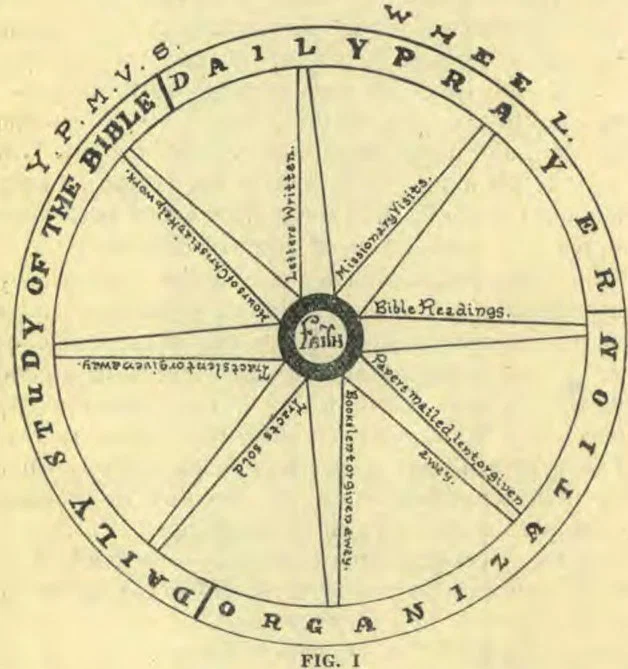
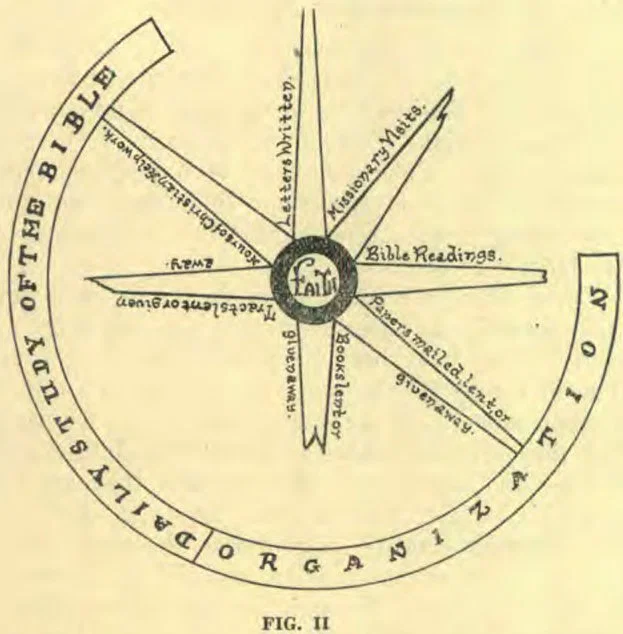
IN connection with our training school at Lucknow, India, there is a Missionary Volunteer Society. Accompanying this is a diagram which was used one Sabbath by the leader, Maung Ba Tin, a student from Burma, to stimulate the activity of the members. First he drew the perfect wheel, and then, according to failures, erased spokes and rim. His own explanation is given with the diagram.
FIG. I
FIG. II
In another column there is also an article written by this young man, which shows the great influence of friends for good or evil. It is the duty and privilege of every Missionary Volunteer, the world around, to be a soul-winning friend. M. E. K.
The Missionary Volunteer Wheel
By Maung Ba Tin
THE Missionary Volunteer Society wheel represents the different kinds of work outlined to be done by the members of the society. The rim of the wheel is composed of three principal parts, organization, daily prayer, and daily study of the Bible. Faith, which is represented by the hub, is the center, or source, of all missionary effort, for work is the outcome of faith in the life of the true servant of Christ.
The wheel in perfect condition, as shown in Fig. I, means that the members are putting forth energetic effort in every phase of missionary work.
If the members neglect to do any given work, a part of the spoke which represents that respective work will be erased according to the proportion of failure. Thus, as shown in Fig. II, the spokes representing the missionary visits, Bible readings, books lent or given away, tracts sold, and tracts lent or given away are imperfect because these lines of work were neglected by some of the members. Daily prayer for the work and for personal strength is neglected, so that part of the rim is wanting.
MAUNG BA TIN.
Burma.
Spending Money With Good Reason
NONE should spend money without being able to give a good reason for the way in which it is spent.
Reputation Versus Character
“SOME people pay so much attention to their reputation that they lose their character.”
Butterball’s Expensive Meal
By Robert Yocum
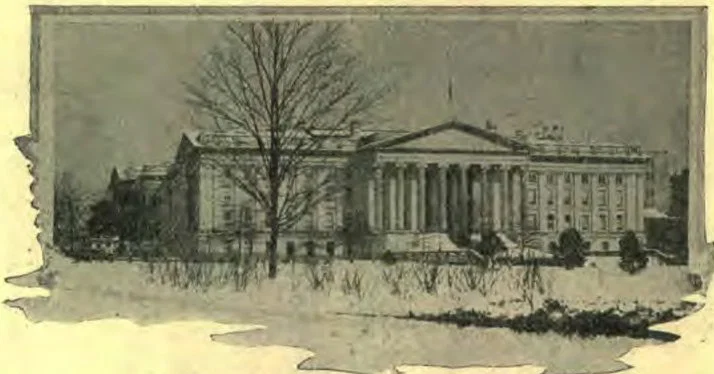
The Treasury Building, Washington, D. C.
In the twenty years or so that I have spent as a guide in the city of Washington I have never known a dull day. I suppose one reason is that I am really interested in the work that goes on in the various government offices and buildings, and that I feel I’m doing my bit in explaining to sight-seers how the machinery of their government is kept running. Besides, I meet all kinds of people, and get a lot of pleasure out of them. First and last, I’ve picked up some interesting stories from the people I’ve guided.
Last year in the spring a high school class from one of the northernmost counties of New Hampshire was visiting Washington, and I took them through the national Treasury. I had shown them the strong steel vaults that contain millions of dollars in gold and silver and untold more millions in bulky bales of greenbacks and yellowbacks. I showed them also the money-laundry machines that wash soiled bills, and the macerater that destroys old bills that have been redeemed.
Altogether, it was an impressive hour for the young people, yet I noticed that one of the younger boys of the class—Reddy Hosmer I think the others called him—still cast inquiring glances round him, as if he were not quite satisfied with what he had seen. As we started to leave, he rather bashfully said that he wanted to see Amanda Brown.
“She is the woman who saved Grandfather Hosmer’s eight hundred and thirty dollars that Butterball ate up,” he explained diffidently.
His classmates seemed to know the joke, whatever it was, for they at once began to laugh uproariously.
“Certainly, you shall see Mrs. Brown,” I said, and led them back to the door of a little room.
There, before a table by a great window, sat an elderly lady, with a calm, thoughtful face. Ready at her hand stood various magnifying glasses, together with certain other instruments of her own devising. She was deftly spreading out on cards the size of bank notes some fragments of mutilated bills.
Mrs. Amanda Brown is the most skilful expert in the world in identifying defaced, burned, shredded, or otherwise mutilated bank bills. Numbers of them come almost constantly to the Treasury, with requests, sometimes piteous, that the money be refunded.
Something much like awe was in Reddy Hosmer’s face—awe and a vast respect. The incident of his grandfather’s eight hundred and thirty dollars plainly had been a tragic one in the Hosmer household. I inquired about it, and when he had got over his first bashfulness he told the story.
“Grandfather sold his wood lot last year,” he began. “The big paper company that runs the mills over at Berlin Falls, New Hampshire, had been trying to buy that wood lot for four or five years, but he wouldn’t sell it. First they offered him four hundred dollars for it, and a while afterward five hundred, and then six; but grandfather hung on to it, till finally they offered him eight hundred and thirty, and he took it.
“The company’s agent came and brought a lawyer with him to have the writings done, and to pay for it. When the deed was made out and grandfather had signed it, the agent started to hand him a check for the eight hundred and thirty dollars; but grandfather had kept one hand on the deed.
“‘No, siree,’ he said to the agent, ‘I don’t want none of your little pieces of paper. When I sell ye a wood lot, I’m going to get my money for it. I want to see the color of your money, sir.’”
“The agent laughed and looked at the lawyer, and he laughed, too.
“‘All right, Mr. Hosmer,’ the lawyer said. ‘We can’t object to that. You keep your deed till tomorrow. We will bring your money tomorrow noon.’”
“And they drove off, still laughing.
“‘They can’t come any of their games on me,’ said grandfather.”},{
“Anyhow, they came back the next day and paid grandfather the eight hundred and thirty dollars in new bills. There were sixteen fifty-dollar bills and three tens. Grandfather counted the money over twice.
“‘That’s right, gentlemen,’ he said, and then handed them the deed.”},{
“They took it, and the lawyer said, ‘You are as smart as the best of them yet, Mr. Hosmer, if you are eighty years old. I shall know better next time than to try to get the start of you.’ They both shook hands with him, very friendly, and then went away, still smiling, but at what we could not guess.
“After they had gone, grandfather counted his money again, and after that he sat and fingered those new fifty-dollar bills for a long time. But at length he strapped them all up in the little old leather pocketbook that he generally keeps in a drawer of his writing desk in his own room, which is on the ground floor just behind the sitting-room.
“At supper time he said to father that he meant to put that money as soon as he could into a mortgage, where it would be drawing interest; and he thought he knew a man over at Colebrook who wanted to hire some money. He told father he wanted him to take him over to Colebrook the next day to see this man.
“The desk in grandfather’s room stands close by the window; and almost always, mornings, when it is fair, after grandfather comes out to breakfast, mother slips in and opens the window to air the bed and freshen the room. She did that the next morning, but did not stop to tidy up. Grandfather had counted his money again after he got up that morning, but instead of putting his pocketbook back in the drawer had left it on the leaf of the desk, as he often did; and that was how Butterball came to get hold of it.”
“Tell him who Butterball was!” several of Reddy’s classmates exclaimed.
“Oh, yes!” said Reddy, blushing. “Of course you wouldn’t know. Butterball was a little Jersey heifer; we called her that because the skin under her hair was just the color of butter. She was a year old, and had always come to the house when she got loose at the barn, for mother had made a kind of cosset of12her. Butterball would come on the run to the kitchen door or windows and put her head in, for mother to give her apples or potatoes or brown crusts of bread. If she didn’t get some sort of titbit, she would bawl and go lowing round the house just like a spoiled child. She’d got to be such a nuisance to every one that father was constantly threatening to turn her into veal.
“That morning it was rather chilly, and we had the kitchen door and windows closed. While we were at the breakfast table we heard Butterball low outside, but did not pay any attention to her. After a while grandfather finished his breakfast and went to his room. Then suddenly we heard him shouting. Oh, what a noise he made! Before any of us could get to the door of his room he rushed out, bareheaded, shouting:
“‘Stop her! Catch her! Make her drop it! She’s got my pocketbook in her mouth! If you don’t catch her soon, she’ll swallow it.’”
“We all ran out and round the house—and there stood Butterball by grandfather’s window, chewing something! Maybe she had mistaken grandfather’s little fat old pocketbook for a potato or a crust of bread. At any rate, she had it in her mouth and was munching away at it.
“Father tried to get hold of her horns, but we were making such an outcry that I suppose we scared her, for she turned and ran for the barn.”
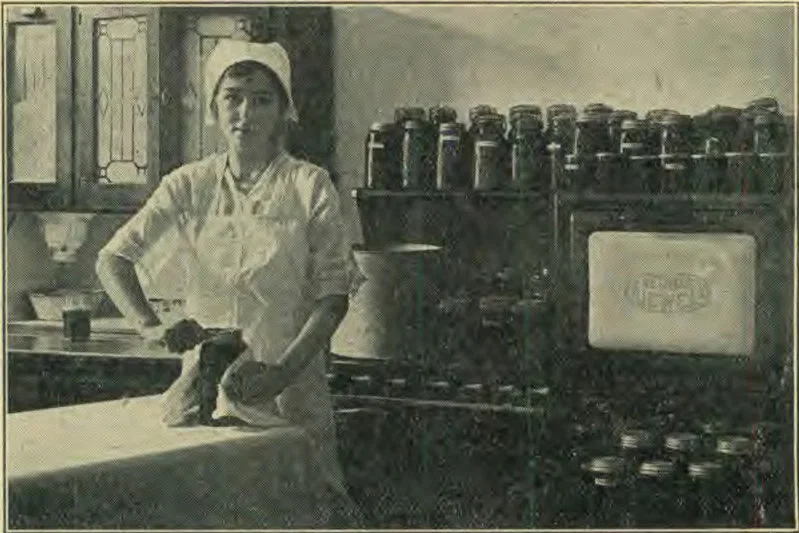
Miss Ethel Longacre, Takoma Park, D. C., is the first person to express to the editor of the "Instructor," by word or deed, any interest in the "Instructor" Canning Club, and though she is just past the age indicated for membership in the club, her picture, showing forty-five cans of fruit and vegetables, the results of her work as far as quantity is concerned, is herewith shown. We are sorry the picture does not reveal the excellent quality of her work. Miss Ethel was given first prize in a canning exhibition when only thirteen years of age, by the Takoma Park Canning Club, which is conducted under the auspices of government experts. We hope there are many others who will express in so admirable a way their interest and knowledge of the art of canning fruits and vegetables. Who will be the second to meet the requirements of the "Instructor" Canning Club? See "Instructor" of July 3.
“Grandfather made a grab for her tail and just managed to catch hold of it.
“‘Head her off!’ he cried, as he struggled in vain to bring her to a standstill. ‘Get her by the throat, some one! Don’t let her swallow!’”
“But Butterball ran, dragging grandfather after her, and reached the barn in spite of us. There we closed round her, and father seized her by the head and wrenched her mouth open, but it was empty. She had swallowed the pocketbook!
“Oh, what a rumpus grandfather made! I’m sure you could have heard him a mile!”
“‘Eight hundred dollars gone down that pesky critter’s gullet!’ he cried over and over again. ‘Eight hundred and thirty dollars!’”
“Five minutes later poor Butterball was veal. In her stomach was found a slimy wad that you hardly would have recognized as grandfather’s pocketbook. Evidently the heifer had been munching on it a long time before grandfather caught sight of her. We opened the purse a little, and could see that the bills were all chewed into pulp together, and the drier the wad got, the worse it looked.
“‘It’s a dead loss!’ said grandfather, with a groan. ‘My wood lot’s gone!’”
“But father had heard that the government sometimes redeemed mutilated money, and so the next day we put the wad into a little box and sent it on here by express, with a letter telling what bills there were and what had happened to them.
“Grandfather declared a dozen times, if he did once, that no one could make anything out of it; he was all cast down at having lost the money. But, to his great astonishment, three weeks later he received a letter in a big official envelope of the Treasury Department, which contained sixteen new fifty-dollar bills and three tens! The letter said that Mrs. Amanda Brown, the government expert, had been able to identify each one of the bills, and that the government took great pleasure in refunding them.”—Robert Yocum, in Youth’s Companion.
The Story of Silk
By Rose Madeline Brown
WE all know that silk comes from the silkworm, but the story of this discovery is very interesting. About twenty-six hundred years before Christ, there lived in China a little girl fourteen years old, known as the lady of Si-ling, who was the wife of a famous emperor. One morning she was walking in her garden with her ladies in waiting, when she noticed a peculiar caterpillar. While she was looking at it, she was attracted by its strange movements. She watched it day after day, till finally she found it wrapping fine threads around itself until it was shaped like a peanut.
She examined this cocoon with much curiosity. Taking hold of the end of one of the threads, she tried to unwind it, but found it would come off only in small pieces. So she put the cocoon in water to soften it. She then unwound about three hundred yards of silk, which was the entire cocoon. From such experiments, she soon conceived the idea of having her servants weave these threads into silk cloth. This was the beginning of silk manufacture. Since that time this empress has been called the “Goddess of Silk.”
One of the principal industries of Japan is the raising of the silkworm. Hundreds of girls are employed in caring for them.
The moth from which the silkworm comes is whitish in color, and an inch to an inch and a half in length. The female is a little larger than the male. Soon after laying her eggs the female dies, and the male does not live much longer.
The eggs are about the size of a pinhead, and are very numerous. They are laid at the end of summer, and are not hatched till the beginning of the next summer.
The caterpillar at first is not more than a quarter of an inch long, but it grows very fast, till it is nearly13three inches long. It changes its skin four or five times during its growth. Each time before changing its skin it becomes sleepy and stops eating, but at other times it eats greedily. It becomes restless when it is ready to make a cocoon.
The organs that make the silk are two glands in the body which end in the mouth, and are called spinnerets. These secrete a gummy substance which the worm spins into silk thread and winds around itself to make the cocoon. It takes five days to do this.
If the cocoon was left to hatch, the moth would push itself out through the fibers, and thus spoil the silk. To prevent this, the cocoons are put into large ovens, not hot enough to spoil the silk, but just hot enough to destroy the life of the moth.
These cocoons have to be either soaked in water or steamed, in order to loosen the thread, so it can be wound into skeins. It is then called “raw silk.” The thread, as it comes from the cocoon, is so fine that it takes more than three thousand strands to make one thread of common sewing silk.
Skeins of raw silk are sent to this country, where they are put through many processes of cleaning, combing, and dyeing, before the thread is woven into cloth.
After learning how silk is made, we shall certainly appreciate our pretty silk ribbons more than we ever have before.
ROSE MADELINE BROWN.
States Without a Chosen State Flower
The following States have made no choice of State flowers: Alabama, District of Columbia, Maryland, Massachusetts, Missouri, New Hampshire, New Jersey, Pennsylvania, South Carolina, Tennessee, and Virginia.—Selected.