The Youth’s Instructor, Vol. 65, No. 37.

The Devil's Decree

The Youth’s Instructor

Sep 11, 1917

Review and Herald Publishing Assn. · Takoma Park Station, Washington, D. C. · Sep 11, 1917

The Devil's Decree

Being an edict issued by His Satanic Majesty concerning the advancement of his kingdom
T. H. JEYS
To all of my servants in every land, To friends of disorder on every hand, To every criminal, friendly to me, I hereby send forth my satanic decree.
My servants, take to you that poisonous weed, Which maketh a stench that is fearful indeed, And let it be fashioned and made into a roll Just such that the mouth may encompass the whole.
Then into your mouths this vile roll you shall stick, And, although it makes you most fearfully sick, A fire shall you kindle with match or with coal, And suck at the end till you burn up the roll.
Show all proper vigor in all public places To puff the rank odor direct into faces Of clean, decent people; e'en though they object, Their wishes should never be given respect.
And as the fumes upward toward heaven shall rise, Offending the nose, and obscuring the eyes, 'Twill plainly be evident, all may well know That I am your master and make you do so.
Then some of the leaves you must press into plugs, Just such as might serve for the killing of bugs; And you, my bondservants, must take it and chew it, E'en though it may nauseate you when you do it.
As soon as you chew it, saliva will flow, And you must eject it wherever you go; Expectorate freely on floor or on wall, With no thought or care as to where it may fall.
So thus the vile stench of the vilest of plants My servants must scatter where'er there's a chance: Let no opportunity e'er be neglected When nicotine fumes can with ease be ejected.
Whenever the people remonstrate sorely That some of their rights should be recognized, surely, Let little attention to such e'er be paid, No matter by whom, or in what place 'tis made.
To chewing and puffing and snuffing the weed Let all my bondservants give diligent heed. Thus every creature on earth will soon see That this is the incense you offer to me.
If any should try from his bondage to break, If snuffing or puffing he try to forsake, If from his vile thraldom he long to be free, I'll watch that such happiness never shall be. -
But rather, I promise my servants a place And a share in my kingdom of stench and disgrace. So let all be diligent, chewing or snuffing, Or at the narcotic industriously puffing.
Then keep at your snuffing and chewing and smoking, Although decent people are gasping and choking. Whether up on the mountain or down on the level, You're pleasing me well.
[Signed] Your Master, the Devil.

World News Briefs: War, Shipping, Sharks, and Flowers

Before the war, Germany was exporting 40,000 colors, shades, and tints.
A severe earthquake occurred recently in the southern portion of North Island, New Zealand.
Former Czar Nicholas of Russia and his family have been transferred from prison by the new government to Tobolsk, in western Siberia.
Crown Princess Elizabeth, eldest daughter of King Ferdinand and Queen Marie, of Rumania, and great-granddaughter of Queen Victoria, is coming to America.
The transportation task our nation faces is greater than that of any other country at any time. Forty tons a year for each soldier must be carried across the water, besides the food and munitions sent to the Allies.
The Norwegian steamer “Ellen” which was sunk by a submarine off the Azores Islands, carried eleven large locomotives to be used in railroads which American engineers are constructing behind the battle lines in France.
Among the many sharks recently seen in Long Island Sound, by Bridgeport, Connecticut, fishermen, was a school of twenty. They seemed to be ravenously hungry. A dozen of these invaders of the sea were shot in one day.
The gruesomeness and ugliness of Europe’s scarred battle fields of last year have been covered by millions of flowers. Scarlet poppies, red rosebay, rushes, hemp, loosestrife, meadowsweet, and scores of other kinds of flowers cover acres of blood-stained ground.
The golden plover flies all the way from its breeding grounds in Alaska to Hawaii, a distance of two thousand miles, without alighting or pausing for rest. The speed at which it travels is estimated at fifty miles an hour, so that about forty hours, flying day and night, must be required to accomplish the trip.
American Red Cross chapters in large cities within easy access of New York have been asked to supply quickly surgical dressings for nearly 200 of the navy’s warships. More than 600,000 bandages and compresses will be needed, and the Red Cross expects to fill the order within ten days. Because of the scarcity of bandages, straw and newspapers have been used in some of the European hospitals for bandaging wounds.

Integrity: Refusing Money From Tobacco and Liquor Advertising

Integrity

A CHRISTIAN man refused to write advertisements for cigarettes at $1,500 a year. A member of a church in Pennsylvania was of the same type. At a time when misfortune in the family made increased income necessary, he was offered twelve dollars a week to write a half-page advertisement for a wholesale liquor dealer. The offer was declined with thanks, saying that “booze money is blood money, and I can’t betray my Lord nor my brother at a price.” The dollar was not “almighty” with this man.—Baptist Commonwealth.

Me, Not Another

“WHERE are the reapers?”—how oft we sing! And its chorus—“O who will come?” Then in a moment the words forget, Thinking not of the harvest home! Ready to harvest the fields all stand, But the reapers are few, we know; Yet we still linger with idle hand, Leaving others the work to do!
Oft have we read of the words of Paul, As he journeyed, on slaughter bent, When ’neath the flash of the light from heaven He fell down in astonishment,— Not “another,” but “me,” his cry. “What wilt thou have me to do?” he said. But we are waiting for some one else, While the sickles around us lie.
“Why stand ye idle?” the Master says, While the clock chimes the hour eleven? Go reap ye the harvest, and what is right Unto you shall be surely given. Take up your sickles! go forth today, Waiting not till another come! You of the labor must have a part If you’d share in the “harvest home.” —Selected.

Argentinian Courtesy

INEZ HOLLAND-STEVENS
Upon coming to Argentine one naturally is impressed by the newness of everything, the strange customs, and the unfamiliar language; but one thing above others is especially noticeable to the North American, and that is the never-failing, ever-present politeness of the people. One sees it everywhere,—in the home, in the business circle, in society, on the street, in church, school, shop, or station. It seems to be a part of the Spanish make-up, and although we foreigners are likely to think it extreme sometimes and often savoring of form rather than sincerity, still we must confess that perhaps it is better to err along that line than be too outspoken and abrupt. As a matter of fact, the frank, open, businesslike ways of the North American seem nothing short of rudeness to these Spanish people; they forgive it because it is in a foreigner, but nevertheless it jars on their nerves.
In the public schools, from the lowest grades up, the children are taught the principles of etiquette, there being certain hours in the program regularly devoted to the study of good manners and courtesy in general. Textbooks are also provided which treat on those subjects. The children are taught respect for their teachers and superiors and are thoroughly drilled in the most common forms of polite address. It is good to see the little boys greet their teachers on the street, lifting their caps and making a gallant bow.
I once visited several of the best public schools in one of the larger cities of this province, and was surprised and delighted at the system and excellent order that prevailed. The children, when addressed by the teacher, arose immediately to their feet; their answers were prompt, polite, well made, and accompanied by a smile. When a visitor is presented to a room, all the children rise to greet him.
In the stores one notes a spirit of courtesy. The clerks are very obliging, and it seems to be no trouble at all to them to display their goods, whether the customer buys or not. Upon delivering the package, the clerk, with a smile and a slight bow, says, “Sirvase,” which is a very nice way of saying, “Here is your parcel.” In fact, that is the custom everywhere, when handing something to another; and to omit that polite form seems to them as rude as to shove something in one’s face without notice. It is never good form to leave the store without saying adios (good-by) to the attending clerk.
In this country where military service is obligatory, much is made over the soldiers, and although they are recognized as rather rough characters when in the barracks, still they, especially the officers, are noted for their good manners in public gatherings and when in contact with noted people. There are books on etiquette which the army men are obliged to study. In these are given rules on politeness and good form in higher society, in the middle class, and also among the common people. It is said that an Argentine officer need not be ashamed to appear in any circle of society, for he is supposed to be a model in politeness. Mothers, in teaching their children good manners, often admonish them to be “courteous as a soldier.”
In the matter of introductions the Argentinian does not stop with “pleased to meet you,” but acknowledges himself as your servant (Servidor de Vd), or says, “A sus ordenes” (at your service).
As might be expected, these people are very profuse in their expression of thanks. Although the simple form gracias (thank you) is much used, tantas gracias, or muchas gracias (many thanks), is very much heard, and the still stronger expression muchissimas gracias (many, many thanks) is used a great deal. In case that does not suffice to express one’s gratitude he can still resort to mil gracias (a thousand thanks), or better still, million de gracias (a million thanks). The final climax is reached when one explodes with un mundo de gracias (a world of thanks); and that usually suffices.
But it is possible to get too much of a good thing, and that is the case in Spanish letters. North Americans are so short and to the point in their correspondence that it is really quite a trial to learn to write proper Spanish letters. One never thinks of beginning in the businesslike way so common among us. We get right down to business, say what we want to say, and conclude by wishing health, happiness, etc., to the one addressed. According to the Spanish idea that would be selfish and rude. They reverse the order, placing all the good wishes and invoked blessings at the first, as a sort of preface, giving their first thought and preference to the one addressed. Then follows the real message.
We have received scores of letters from parents of our students who wrote with the express purpose of inquiring something about their children. In most cases, however, the larger part of the letter was taken up with introductory preliminaries, good wishes, and sometimes sermonettes, and at the very last came the purpose of the letter. More than once we have skipped over the first part of the letter to get at the real heart of the message.
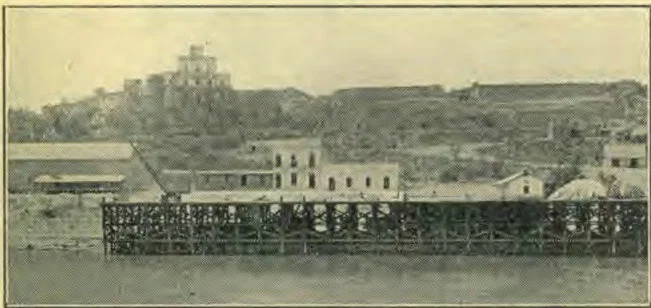
The Port of Diamante, Entre Rios. The City is over the Bluff to the Right.
In canvassing especially, one notices the inborn politeness of these people. They may have little or no interest in the paper or book presented, but rarely will one ever find, among the native Argentinians at least, a person who will say so. They may ask the canvasser to call again, or make some other excuse; but rarely does he receive anything but the most courteous treatment; in fact, he is received as a friend.
Of course we all know that after we have left some homes the people have laughed at our expense, and who knows what they said? but they at least treated us well to our faces, and any canvasser appreciates that.
If some one calls to make an inquiry or to ask some trifling favor, he is profuse in his apologies for having caused you so much trouble. I remember one case in particular which occurred shortly after we arrived here, five years ago. I asked one of our students to come over to see about a Sabbath school class she was to teach. I considered it a favor on her part to come over, and intended to tell her so at her departure; but before I had time to even suggest such a thing she strung out a long apology for having put me to so much inconvenience in taking my valuable time; thanked me for my most generous and kind attention, etc. That took all the wind out of my sails, and the fine little speech I had prepared was completely forgotten, as I mumbled some sort of answer.
Another strong characteristic of the native Argentinian is his consideration for the foreigner in learning the language. One cannot but wonder at their patience and long-suffering when they are forced continually to listen to foreigners butchering their beautiful language. Not by a word or look do they show their discomfort. One may have a fine idea and do his best to convey it to them through his poor Spanish: they nod their heads encouragingly and assure him they understand, when probably they have not the faintest idea of what he is getting at. They take the will for the deed, and would not discourage one by saying they did not get the point.
Very seldom one sees a native laugh at the mistakes of a foreigner. One may make a most ridiculous or disastrous mistake, and he sits as expressionless as a stone,—that is, if there are not some foreigners present to set a bad example. It takes the foreigners—North Americans, English, etc.—to notice and laugh at the mistakes of others. They, moreover, have the reputation of setting themselves up as critics and infallible authority on the Spanish language after a few months’ residence here.
I suppose one could write a book about the ridiculous mistakes in Spanish that are being continually made by our workers. One minister wanted to introduce his wife to a native, and presented her as his hermosa. That word in Spanish means beautiful, while the word he wanted to use was esposa, meaning wife. The woman in question happened to deserve the compliment, but the native never seemed to notice the mistake.
One of our workers once made quite a speech about the war in Europe, especially emphasizing some points about the Bulgarians, whom he mentioned many times, calling them Pulgas, which means fleas. He meant to say Bulgaros, of course. I do not know how intelligent an idea those hearers received from the discourse, but the speaker saw nothing in the expression of their faces to indicate that he had made a mistake, and so went calmly on. Afterward one of the students had courage enough to come up and ask him if he would please tell him what he had been talking about, that he did not quite get the connection. Small wonder!
I shall never forget one of my first blunders of that kind. Upon coming to the table at dinner time I remarked to the students seated around, “Pero, tengo un hombre!” meaning to say, “My, but I am hungry!” What I did say was, “My, but I have a man!” Nobody smiled even, although I noticed my mistake almost as soon as I had said it, and to hide my embarrassment laughed heartily at my blunder. But I did appreciate their kindness in not seeming to notice it. You know it is one thing to laugh at one’s own mistakes, and quite another when the laugh comes from “the other fellow.”
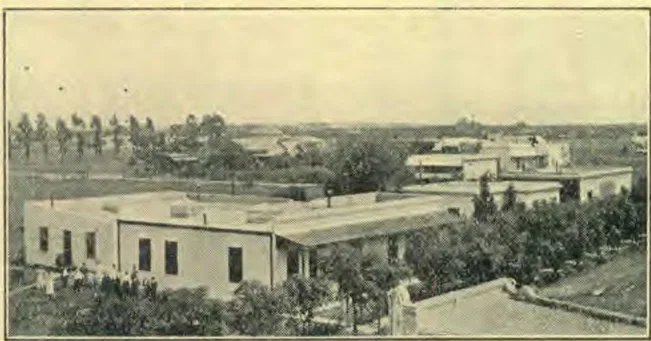
Seventh-day Adventist Headquarters, Florida, near Buenos Aires, South America.
North Americans boast of their civilization and progress, and with reason; but one thing is certain: as a nation they have no world-wide reputation for politeness and courtesy; and is it not barely possible that in this respect they may learn something from their less-favored neighbor to the south, down in the Neglected Continent?

What Can We Do to Solve the Foreign Problem?

SOME consideration is given on page eight as to what the foreign problem is, and to what constitute its special difficulties; now we shall take up the phase of how we can give the message to the strangers in our land. Where can we find the point of contact that will enable us to win their confidence?
The first thing is to learn something about the countries from which these people came, so as to be able to talk intelligently with them. If we can say something in appreciation of their native land, of the great men it has produced, of its influence on the world’s history, we shall have done much to win their confidence. What do you know about Poland, which has been called “The Knight of Europe”? Poles are often called Polacks, and other terms of contempt are used in speaking of them; they are considered as little above animals in intellect. Read some good books on Poland, and learn what the Poles have done for Europe; learn what kind of people they really are.
Then there are the Italians, rudely called Dagos. Do you know their wonderful history, their contributions to the arts and sciences? Their country is well worth study, for there are many fascinating episodes connected with its history.
The fact is, these people are not inferior in intellect to ourselves. The trouble with them is that in most cases they have been purposely kept in ignorance by the priests; their minds are undeveloped, but not deficient. Given the opportunity, they will show they are as capable as were their ancestors. Why not find out what foreigners live near you, and make a study of their history, as a first step to winning their souls?
One great need of these foreigners is a knowledge of sufficient English for at least ordinary intercourse. This will enable them to get better and more profitable employment in most cases, and to avoid being exploited by unscrupulous men. Classes for the study of English may be formed, and the foreigners invited to attend. These classes should be conducted by older church members, assisted by the young people. Such books as “Gospel Primer” could be used as reading books, and thus a knowledge of Bible truths be given while the language is being learned.
Classes could be formed to teach the mothers cooking, sewing, mending, nursing, and simple treatments. Tact will be needed in forming such classes, for generally foreigners are proud, and resent being considered beneath the native-born people. When they realize that a sincere interest is taken in them, they respond heartily, and appreciate the efforts that are made to improve their lot. Similar classes could be held for the unmarried young women who want especially to know “how to make their own clothes.” Classes might be formed to teach the boys carpentry.
These form helpful points of contact for uplifting the people, and gaining their confidence. One of our most effective means for giving them the message is the distribution of literature, and it is probably the best of all methods. While many are illiterate, others can read their own language, and anything in their mother tongue is welcome. Imagine yourself in the interior of China, not having seen an English publication for months, perhaps years, and then have some one offer you an English paper. You would give almost any reasonable price to get it. We have magazines in German, Danish-Norwegian, Swedish, Bohemian, French, Hungarian, Italian, Yiddish, Polish, and Rumanian, and a paper in Russian. We have tracts in almost all the leading languages, and books in a number of them. Bibles, too, should be circulated among these people. Many of them are hungry for the truth of God, as is shown by the following letter from a Russian:
“DEAR BRETHREN IN JESUS CHRIST: Though I am not acquainted with you personally nor have I ever seen you, my spirit witnesses that you are truly my brethren in the Lord. I received a few tracts and papers from you, through which I have concluded that you are the servants of God. And now I plead with you, Help me to understand the precious truths of the Bible which you know. In the past I have had no chance to come in contact with the Bible, but a few weeks ago I met in Berlin, New Hampshire, a Russian man who was a Russellite. He interested me in the Bible. The Bible was a new book to me. As we studied further, I found the Bible teaches that the seventh day of the week is ‘the Sabbath of the Lord thy God.’ But this man rejected the Sabbath. He said, ‘There are some seventh-day Sabbath keepers, but they are not right. They do not have the truth, because Christ has abolished that kind of Sabbath keeping.’ Since then I stopped believing what he said, and I tried to find some of those people who keep the Sabbath which I found in the Bible. Soon I left that place, and went to Portland, Maine, and to my great joy I found many seventh-day Sabbath keepers there, though they are not Russians but Americans.
“One sister, a missionary, got me some tracts in Russian which I read through, and accepted all the truth, and now I am keeping the Sabbath. This sister is also teaching me to read the Bible in English, for which I am more than glad. But how much happier I shall be if you will send me a Russian Bible. Please do not delay a single day. Send it at once. I will pay you whatever it costs. Recently I visited a Polish family, and talked with them about their salvation. They joyfully listened to what I said, but I found I was too uninformed to work for my God. So I repeat, My brethren, help me to understand this great truth. And especially please explain Dan. 9:24.”
Here is a letter from a sister who has a burden for the foreigners, and who works persistently for them:
“Recently the first Hungarian woman was baptized. She says she feels the blessing from our Lord in living the truth. She is always happy. Her husband came to the baptism, and from this time he is keeping the Sabbath strictly. He is laid off from his work. Our new sister Makra is faithful. Her friends became enemies to her. One Sabbath when she came home from church her door was broken open. Sister Makra and her husband came from the Catholic Church. The whole town is stirred since our new sister has been baptized. There are a few more souls seeking the truth.”
Undoubtedly the Lord has brought about this large immigration of foreigners to this country that, in a new environment, away from old associations and ties, they might be given the message. Will you not come to his help in carrying out this purpose?
EDITH M. GRAHAM.

An Old Indian Temple in Porto Rico

For several days a neighbor across the street had been trying to get me to make a trip with him back into the hills near Cayey to see what purported to be an old Indian temple. From his description of it I judged it would be very interesting, especially as there were near it some large natural caves.
At last the day was set for the journey, which was made on foot. Before the tropical sun had risen over the crown of hills which surround Cayey, we were well on our way.
After winding along a cart road for about two miles, we turned off into a bridle path, which in turn led us up a steep hill and down again into a little valley. Porto Rico is not a level country, except a little fringe on part of the coast line. The interior is rough, but productive, there being very little waste land on the island. After making another ascent, we reached a summit. The neighbor guide now informed me that we were near the caves.
During the trip my companion had incessantly talked of a man living near these caves, whom he claimed possessed supernatural powers. We soon were presented to this man, who was called the “prophet.” In his house, tapers were provided for exploring the caves. I had begun to get a little inkling that my neighbor was not so anxious for me to see the caves and the temple as he was to convince me of the occult powers of this “prophet.”
My suspicions proved to be well founded when a little later, after having finished the first cave, we entered “the old Indian temple.” This temple consists of a medium-sized chamber of natural limestone, with pillars, arches, divisions, and relics of a superstitious worship which, it is claimed, the Indians made use of at the time of the Spanish invasion. On entering this temple cave, the men all removed their hats and formed a circle about the “prophet” as the central figure.
There we were in the half light which flickered in through the spaces between the wide banana leaves that partly closed the entrance. All was perfectly quiet for a moment, when the “prophet” fell into a kind of spasm or trance which at first was a sort of muttering, but soon I got the run of what he was saying, which was in Spanish. The poor ignorant people thought these words to be a direct revelation from God, and therefore of great importance to them. The principal burden of his muttering seemed to be that there was a great necessity for the “stranger,” meaning myself, to become converted and realize the importance of his message.
Surrounded by evil angels, encompassed by Satan’s worshipers, in a foreign land, and alone in this company in the half darkness, I found myself trapped in the midst of a Spiritualist circle. Lifting my heart to God in prayer, I asked to be led by his Spirit, and to be given strength to help these poor superstitious people find their way to that peace and security which can come only by following a “Thus saith the Lord.” The warning against those that “peep” and “mutter” immediately came to my mind, as did also the infallible rule of Isa. 8:20: “To the law and to the testimony: if they speak not according to this word, it is because there is no light in them.”
Before I had finished this brief prayer the man was thrown to the ground, and after a short struggle, with twitching muscles, he came to his natural state again. I then asked permission to offer a prayer before we should leave. Standing with heads bowed, a humble prayer followed in which I asked the God of heaven to beat back the powers of darkness that surrounded us, and let in the light of heaven.
Many of the Porto Ricans having lost their faith in the Roman dogmas which have been taught them for centuries, are turning to Spiritualism. The people are now in a transitory stage, and seem to be ready to adopt almost anything which looks like progress. That they may learn of and accept the truth for this time, instead of taking up with something worse than they now have, is the endeavor of our small number of workers in Porto Rico. H. D. CASEBEER.
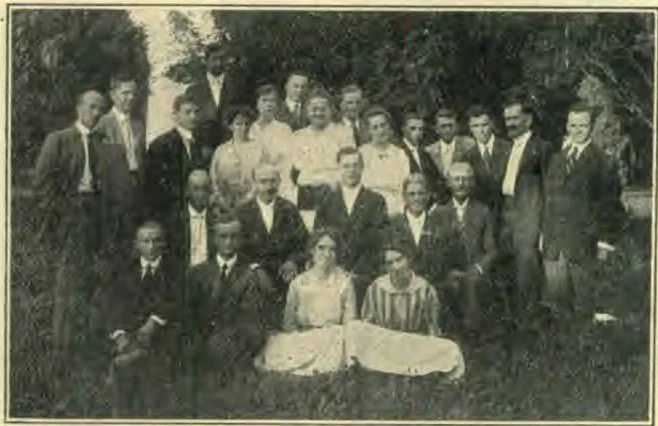
Delegates to the Missionary Volunteer Council Held at College View, Nebraska, from July 26 to August 1.

Another Milestone

IN the closing days of hot July there was held at College View, Nebraska, an important Missionary Volunteer Council, at which were present workers from the north, south, east, and west, representing all parts of Canada and the United States. The general and Union Missionary Volunteer secretaries, together with a few of the local conference workers, constituted the council, which met for the purpose of studying the needs of the young people, in order to be better prepared to help them to meet the problems which are confronting our boys and girls, and young men and women, in these days of peril.
From the first morning when we met for our opening devotional hour, each one present felt the absolute necessity for a renewed surrender to God, “a deeper consecration to meet a greater need.”
Our young people would have listened with keen interest had they been present at the sessions as the various topics were considered, and perhaps they would have found it difficult to refrain from adding a word of their own, when the discussions were at their height. An extensive list of topics received consideration. The prayer bands, weekly programs, Missionary Volunteer music and banners, and new plans for the Reading Course, and for the Standard of Attainment were some of the topics considered.
The Junior work, which so vitally concerns our boys and girls, received a large share of attention. The actions taken regarding it included plans for a much-needed Junior literature, for practical lines of work especially adapted to boys and girls, and for a better organization of our Junior societies. If all goes well, the Junior leaders will receive the assistance which they have so long desired in carrying forward the work for the children.
Elder Daniells addressed the council one morning during a brief stop at Union College, while passing through on his way to the Coast. He said in part:
“If I were allowed to say but one word here this morning, I would speak on the side of service. Activity is the thing that counts in these last hours of earth’s history. The all-important thing is to get our young people to do something for others. A thousand times more Christian help work ought to be done. This is a great sheet anchor to save our young people in the storms. Service for others—let us get that idea into the heart of every boy and girl in our ranks. God give us the seeing eye, the hearing ear, but above all, the willing heart.”
Yes, if we would be like Jesus we must serve, for “he lived to bless others.” May God help us to vitalize and spiritualize every part of our work, keeping ever before us the thought that after all the one great business of our lives is winning others to Jesus. “Individual work for individuals” is what really counts most for God.
When the council closed, all felt that another milestone on the way to the heavenly country had been passed—an important milestone showing unmistakably that we are nearing the journey’s end. As the workers separated to return to their various fields, it was with a clearer, brighter vision of the work which lies before us as Missionary Volunteers. Service is to be the keynote of our lives, willing, loving, consecrated service. ELLA IDEN.

Our Words

Do we realize what a blessing speech is? How would it seem to be unable to speak? Refrain from speaking, even for a short time, and see how many things you will want to say. Words express thoughts: “Out of the abundance of the heart the mouth speaketh.” Matt. 12:34. Our thoughts determine the character of our words. If the mind dwells continually upon trifling things, the conversation can have no depth, will edify no one. People speak of the things which concern them: children talk of their play, their toys, their pets; boys of their games; girls, too often, of their dress and the fashions; and men and women talk of the things in which they are interested. To be able to converse well is an art. How pleasant it is to meet with those whose conversation help us, those who are well read and who can instruct as well as entertain.
If our words of one day were written down and we could read them over at night, what would they reveal to us? Would there be unkind expressions, thoughtless, silly words? Or would they all be those which were a help to some one—words which we would have spoken if it had been the last day we should ever be allowed the privilege of speech?
Yet our words are written down, though we see not the angel scribe who is by our side silently writing every one. Many things would be left unsaid did we realize that “every idle word that men shall speak, they shall give account thereof in the day of judgment.” Matt. 12:36. The apostle James says: “If any man among you seemeth to be religious, and bridleth not his tongue, but deceiveth his own heart, this man’s religion is vain.” James 1:26. Then there must be power in true religion to enable us to speak aright. As words reveal what is in the heart, if the heart is renewed by the power of Christ, will not the words be different from what they were before conversion?
A witness on the stand gives his testimony in words. We are to be witnesses for Christ. Those who are saved are said to have overcome Satan by the blood of Christ and the word of their testimony. Our bodies are the temples of God, and the sacrifice we are to offer is “the fruit of our lips giving thanks to his name.” Heb. 13:15.
Unkind, cruel words should be left out of our vocabulary, as well as those which are idle and foolish. Cross words are often spoken to those we love the best. As the poet has aptly expressed it,
“We have careful thought for the stranger, And smiles for the sometime guest, But oft for our own the bitter tone, Though we love our own the best.”
Let us refrain from using slang phrases and extravagant expressions. We would not think of taking God’s name in vain if we really knew we were doing so, yet we often do it thoughtlessly. Is it not taking his name in vain to say we are serving him when we are not using his strength to gain the victory over wrong habits of speech?
“Death and life are in the power of the tongue.” Prov. 18:21. “A merry heart doeth good like a medicine.” Prov. 17:22. Then let us speak cheering, helpful words to those we meet day by day. Many times we are encouraged by the words of others. Perhaps we, too, can say something which will be a help to some one, as expressed in the song:
“Did you hear the loving word? Pass it on. Like the singing of a bird, Pass it on. Let its music live and grow, Let it cheer another’s woe; You have reaped what others sow, Pass it on.”
Let us never express discouragement; if we talk faith, we will have more of it. If we talked more about our future reward, it would seem more real to us. And if it seemed that we were soon to enjoy the beauties and pleasures of the heavenly home, would not more of our conversation be in regard to it? We can hardly refrain from talking of some anticipated pleasure. Then let us yield ourselves to God and receive abundant grace to enable us to overcome our wrong habits of speech, so that we may anticipate the pleasure of standing on Mount Zion among those of whom it is said: “In their mouth was found no guile: for they are without fault before the throne of God.”
MINNIE EMBREE PARKER.
Continue reading: Mission Notes