THE world was not greatly surprised to hear that the kingdom of Portugal was no more, and that a republic had been declared. The people could endure the strain no longer. The little state possessed less than 36,000 square miles, a population under 6,000,000, yet its public debt amounted to the vast sum of $800,000,000, or more than $130 for every man, woman, and child in the kingdom. The revenue last year fell short $27,000,000. Then there was the great burden of all the unproductive religious houses and orders. No wonder that events inspired the cartoon of a ragged peasant looking upon the bier of dead King Carlos and saying, "Well, the king is dead — but the poor are still poor." No wonder that now there are ill-considered and unwise outrages in driving out the Roman Catholic orders. But there will be more freedom and some relief from financial oppression.
No wonder that Spain trembles on the verge of a revolution. The seemingly strong hand of Canalejas holds it in check, and he declares he will prevent it if need be with his life; but let a weaker man come to power, or let him falter at the wrong time, and the revolution is assured.
We are also told that the Italian throne is tottering. If the republic in Portugal is a success, if Spain should follow, it is predicted that Italy would join the procession. And then where would revolution end? Greece, Austria-Hungary, and all Europe might become involved in the Socialistic maelstrom. The death of one man, or the mistake of another, may set all Europe aflame.
It is not in monarchies alone that the revolutionary spirit breeds. It is contagious, especially in the Latin races. Mr. Keir Hardie, member of Parliament, the British labor leader, declares in the New York "World" of October 17, that revolution is imminent in France. The great labor strike in that country is an index of the unrest that exists. The hours are long — 12 to 15 a day — and the wages inadequate; and Mr. Hardie tells us that attempt to conduct trains under military law might precipitate a revolutionary outbreak, and in such a case the workers "would find a sympathetic reflex in the army." And he well says: "There is neither an Old Guard nor a Swiss Guard to come to the rescue." I repeat, France at this moment trembles on the brink of a revolution."
Better times in all countries of earth generally means revival of business that helps the poor, the under strata of society, very little. The rich, the great trusts, are benefited. The great war burden grows apace, extravagance in living increases, extravagance in government expenditures follows the same trend; what wonder that Socialism and anarchy increase!
Who is responsible? First, the great money kings, the great trust magnates, who ought to use their powers for the good of humanity instead of for self. Secondly, the teachers of religion and morality, who turn from God's book, from the old standards, the old moralities, the Decalogue and the Sermon on the Mount, may see their own teaching bearing fruit in the laws which make for oppression and inequality, in the disregard of all law on the part of the uprising masses. Will conditions be bettered? Perhaps, at times, temporarily. God is doing a work in the earth. Angels are holding the winds till that work is done. Rev. 7: 1-3. Then Christ will come and the unrighteous kingdoms of this world will be swept away forever. Beyond the desolation lies the everlasting kingdom of Christ.
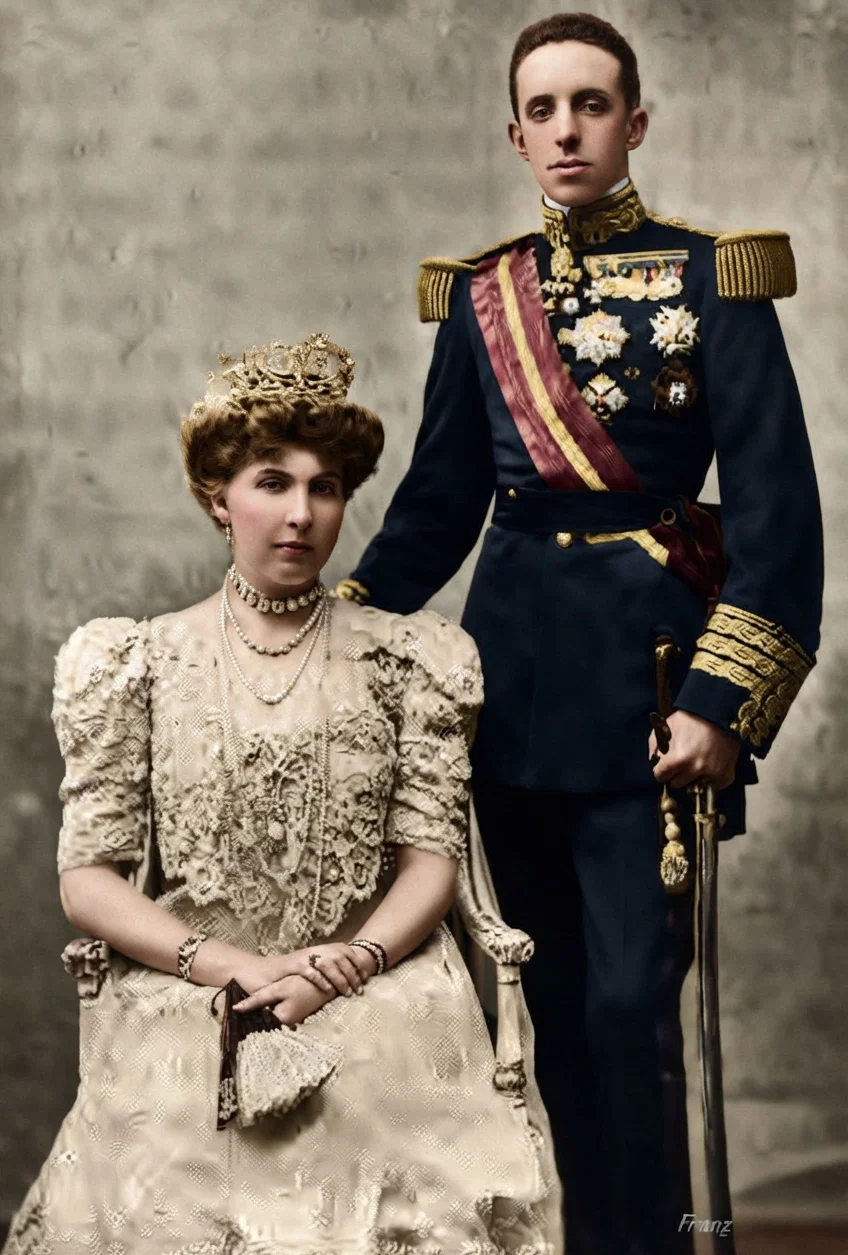
King Alfonso and Queen Victoria of Spain, whose throne is tottering
Manuel II as crowned king of Portugal after his father's death in 1908
Carlos I, the assassinated king of Portugal, father of Manuel II
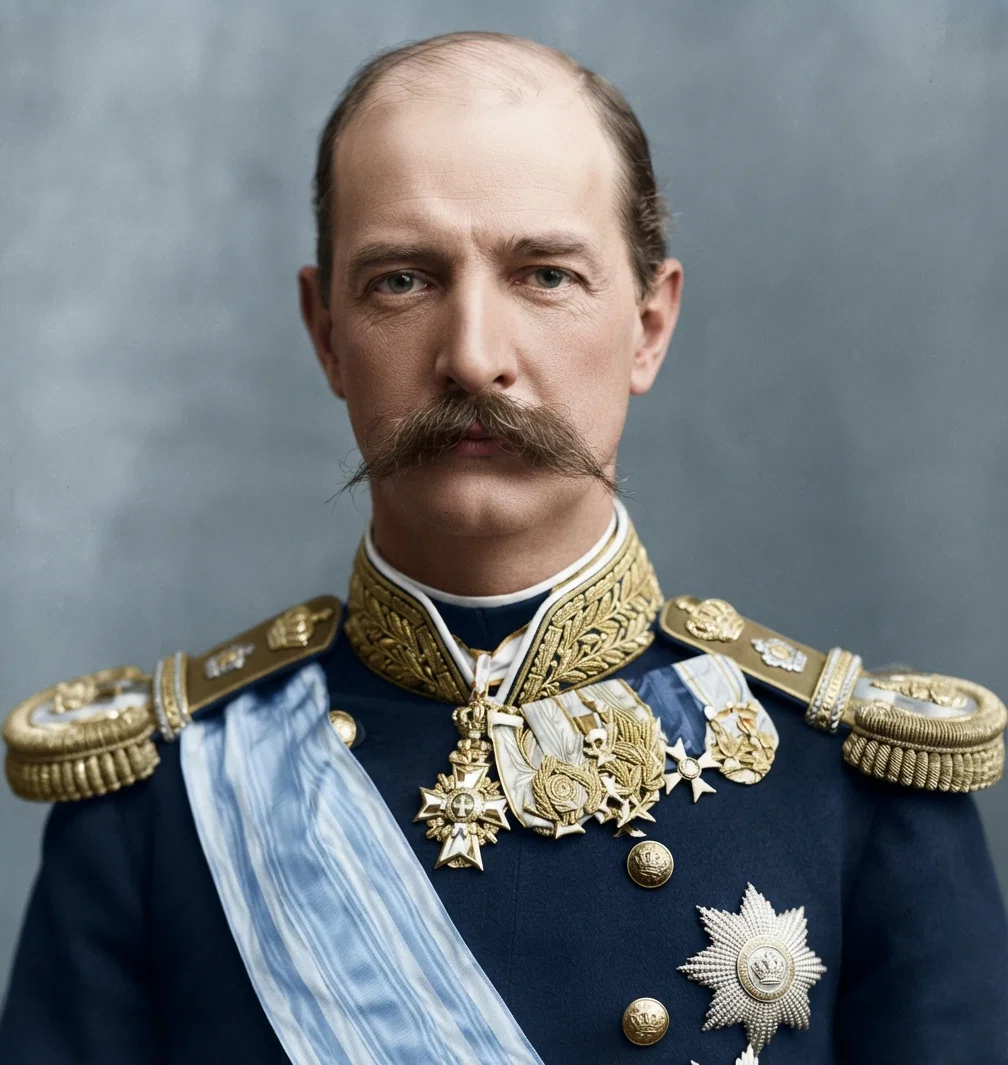
George I, king of Greece, son of Christian IX of Denmark, brother of King Haakon of Norway, and uncle to Czar Nicholas. Greece is but a faint shadow of her former greatness. The king is said to be preparing to leave.
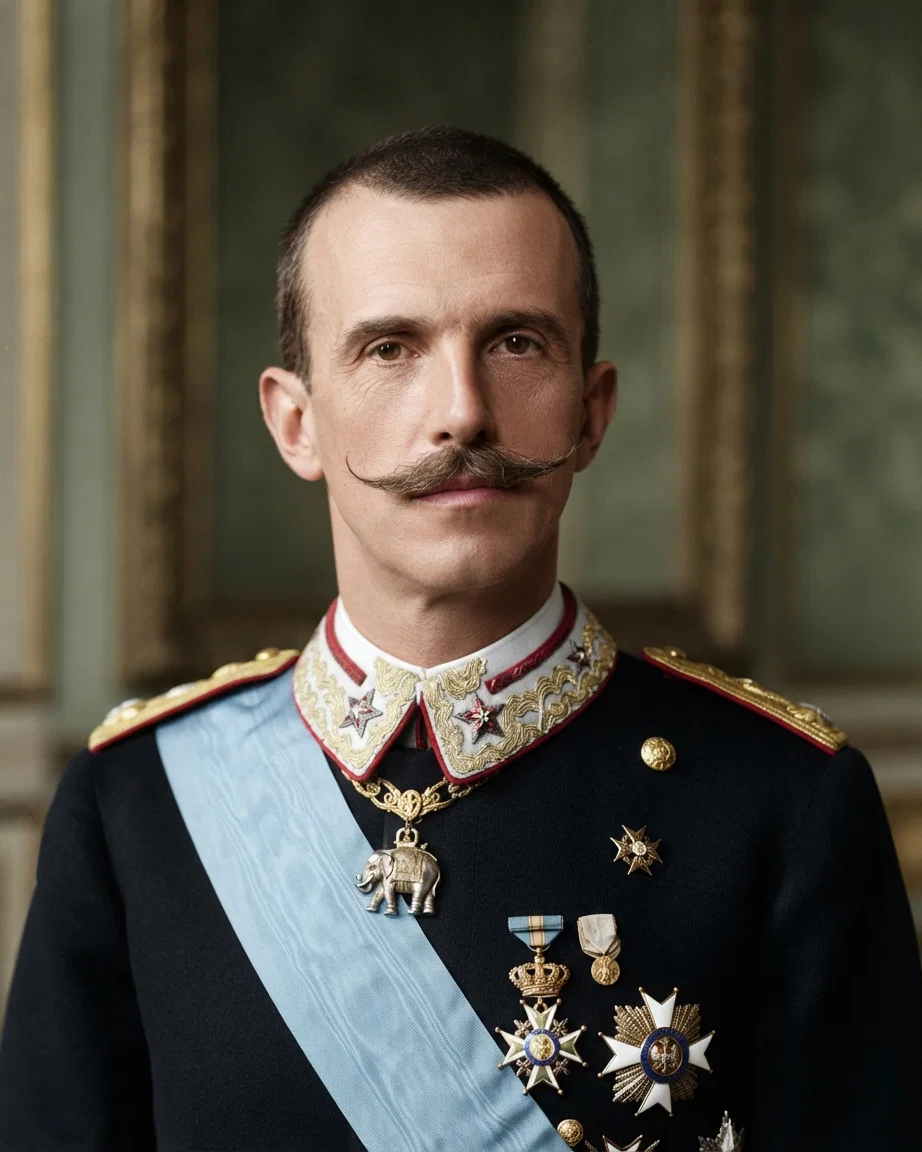
King Victor Emmanuel III of Italy, in whose dominion revolution is breeding
Our Constitution and Government
THE following editorial from the New York "World" sets forth in brief and admirable way the worth and importance of the American system in the safeguarding of the rights of the people,—a system which some are endeavoring to change:
"No Bonapartism Here
"Those who fret because every issue in this country is not settled by majority vote are at war with the American system. If the system is obnoxious to the people, it can be changed by due process. It should not be changed by clamor and usurpation.
"We have three great departments of government, coordinate and independent — the executive, the legislative, and the judicial. In its own sphere each is supreme, but each is a check upon the others.
"The thing that troubles some of our agitators now is the fact that the Supreme Court may, as they say, nullify an act of Congress. This is an exaggeration. The Supreme Court merely declares congressional usurpation. It is the Constitution that nullifies the act. Acts of Congress in violation of the Constitution are blank paper.
"The Constitution is the national balance-wheel. It sustains the Government at Washington, but just as powerfully it protects the states and the personal rights of the individual.
"Those who are accustomed to monarchy or despotism do not readily understand why the will of a national Congress may be set aside by a court. Let them consider also some other curiosities of American democracy:
"Presidents may be elected altho they do not receive a majority of the popular vote.
"States of small population, like Delaware and Nevada, have the same power in the Senate as New York or Pennsylvania.
"Exercising the treaty-making power, the President and Senate may, without consulting the people, enter into engagements which become the supreme law of the land.
"In time of war the powers of the President as commander-in-chief are almost dictatorial.
"The Senate can not originate a bill for the taxation of the people.
"The House of Representatives has nothing to say about appointments to office.
"The Supreme Court has no power in itself to enforce its judgments.
"The House may impeach, and, on conviction by the Senate, President, Cabinet officer, or judge may be removed from office as summarily as a disturber of the peace is ejected from a hotel or a theater.
"Strange as some of these things may appear to newcomers — and we have many of them — there is a reason in every case, and that reason is rooted11in order, security, and freedom. We have liberty. We do not have license. We are free to change our system — to establish kings, emperors, or dictators if we will; but unless in weakness and treachery we so elect, nobody else can impose those monsters upon us.
"In view of the millions new to our citizenship, how much better it would be if our agitators gave their attention to Americanism instead of to Bonapartism! Hope and growth lie in one direction; failure, despotism, and decay in the other."
Current Events and Curiosities
By Editor
As an experiment, one thousand Maxim silencers are being fitted to rifles for the use of the United States army. The rifles will then be smokeless, noiseless, and have a range of five miles.
The Anti-Saloon League of Maryland offers $1,000 in prizes for the best essays on the subject, "What it costs the people of Baltimore, morally, physically, mentally, financially, and industrially to secure the million dollars a year which the city now receives from the liquor traffic under the high license law." The first prize will be $500, and the next three best of $250, $150, and $100 respectively. The contest is open to any person anywhere except the salaried employees of the League. Essays must not exceed 5,000 words, must be typewritten, double spaced, ample margin, on one side of white paper, and the name and address of the writer given. Essays must be sent to Rev. J. F. Heisse, D.D., 801 American Building, Baltimore, Maryland.
One of the latest marvels of surgery is the successful transference of part of an eye from one living person to another. In New York recently the cornea of a woman's eye which she was forced to lose by an accident, was grafted onto the eyeball of a Chinaman. Later it was found necessary to reshape the pupil. In a Philadelphia hospital, the cornea of a young man's eye who was made blind by a flying piece of steel, was transferred to the eye of a woman who had been blind from infancy. After twenty days it was found that the woman could see for the first time in her life.
A baby weighing exactly thirty ounces was born to Mr. and Mrs. C. F. Seiler, St. Louis, Missouri. His head was the size of a silver dollar. The account says: "The high cost of living was of no importance to him, for he took his meals through a medicine dropper, and used a foot of cotton batting for a dressing-gown, while a hot-water bottle sufficed for a bed. The attending physician says the youngster will develop into a normal being."
The Marconi wireless station at Glace Bay, Nova Scotia, is now open for communication with Clifden, Ireland. The opening of the high-power station has brought an increase in the commercial business handled in this country, Canada, and Great Britain. The Glace Bay station covers 150 acres, and the fan-shaped aerial wires are 6,000 feet long and about 1,000 feet wide. These wires are supported by thirty masts, each 250 feet high. The instruments are of the most powerful make, having a communicating radius of 3,000 miles.
At the Belmont Park International Aviation Meet in New York several demonstrations were made of high altitude flying. J. Armstrong Drexel ascended 7,205 feet. Later his record was broken by Ralph Johnson, who ascended 7,303 feet. Walter Brookins in his baby Wright biplane rose to a height of 4,882 feet, when his motor abruptly stopped and he coasted back the entire distance to earth.
Five hundred delegates, coming from forty nations, assembled at the Sixth International Congress of Esperanto recently in Washington. Esperanto is said to be making considerable progress as a world language. At its last session the Maryland legislature passed a law permitting the study of the language in her public schools.
An experiment in an open-air public school for tuberculosis children is in operation at Mont Clair, New Jersey. During the winter the children will study under a large tent, and blocks of heated soapstone will be provided on extremely cold days. Hot milk and crackers will be served in the morning.
A startling statement by the health officer at Atlanta, Georgia, after investigating the result of one year's milk supply, is that eighty-two children have died from poisoned milk caused by unsanitary conditions.
The British Blue Book shows that when 1,700 saloons were closed in England there were 18,285 fewer cases of crime than the previous year with the saloons.
Three persons died in Orange, New Jersey, as the result of eating poisonous toadstools which they thought were mushrooms.
Engines of Destruction
As one reads almost weekly of the invention of some process, instrument, engine, for the destruction of human life, he can readily believe in the apocalyptic statement that the denizens of the bottomless pit are stirring the people to madness and war. General Sherman uttered a terse truth when he said, "War is hell;" and a modern poet, in describing a battle, has supplemented the old soldier's pronouncement:
"There are weapons formed by demons
belching forth their bolts of pain,"
by which is meant that the germ of the war fever, the incitement to ever greater engines of death, is demon-inspired. Here are some of the latest developments:
1. The Krupps of Germany have invented what is called "the bomb gun," which will fire a huge, brittle, hollow shell loaded with 160 pounds of chemicals so deadly that when the bomb explodes the poisonous gases engendered will destroy all life within a radius of 500 yards. Tried on animals the fumes killed them and colored them green.
2. The aeroplane shows tremendous possibility in spying out the enemy's position, and incidentally of dropping bombs.
3. To meet this danger new guns must be invented. The Japanese are experimenting with a bomb that will explode over or near the flying-machine, and kill all on board with deadly gases. Germany has invented an automobile gun for the purpose, which fires straight up into the air.
The French hope to devise a way of bringing down the aviator by a lightning-like discharge of electricity directed at the metal parts of his machine.
4. An announcement has been made that an automobile gun has been invented in the United States that will pour out 2,000,000 bullets an hour.
5. The effectiveness of a whole battery of horse artillery is contained in a new German invention that shoots 200 bullets a minute, and can be taken apart and carried by two men.
6. A new devilish submarine has been invented in France, with a great projecting horn like that of a swordfish. The object is to run this great horn into a ship, and break it off, upon which poisonous gases are released which suffocate those on board. Similarly, the United States is working upon a torpedo fish, which contains a gun that fires on striking the ship aimed at.
7. Now inventors are working on a "wireless" torpedo which can be controlled and directed without contact, by electricity, for six miles after its discharge.
8. Harbors are to be so thoroly mined that it will be impossible for the most powerful fleet to enter and not meet destruction. Invisible fortresses and guns are to defend our harbors, these fortresses mounting a dozen or more 12- or 14-inch guns, and mortars, sighted with deadly accuracy, the position of the ship being accurately marked on a chart in an underground room every fifteen seconds.
9. Among the sea-monsters are the ever increasing battle-ships. The British Admiralty has decided upon a battle-ship with gas engines of the internal explosion type, a ship which will surpass all others in speed and effectiveness.
This new type of battle-ship, already demonstrated in small craft, will add to the already fearful burden financially. Great Britain alone has invested nearly $850,000,000 in war-ships since 1900. Her ships the present year will cost her $183,914,980. A month ago she launched a new 26,300-ton battle-ship cruiser of 75,000 horse-power at a cost of $8,000,000, the Lion by name.
The gas engine ship will be of an altogether different type, less exposed, less vulnerable, more compact, more powerful. It will be able to focus all its guns on one center, and it can carry bigger guns than the present type. Germany is working on the same problem. One battle-ship of the new type, it is estimated, could successfully meet a fleet of six modern Dreadnoughts.
Still another type is suggested — the partially submersible ship, with only her guns above water, hard to find, harder to hit.
How it all demonstrates the truth of God's prophecy in the third chapter of Joel with reference to these times! How it demonstrates the prophecy of the demons of war predicted in Rev. 16: 14. Beyond wait Armageddon and the world's destruction.
No Text Provided
—★—
No Text Provided
—★—
Receiving Divine Power
A Danish inventor at Copenhagen has succeeded in lighting incandescent lamps by the wireless transmission of an electric current. A still greater accomplishment is that of German naval experts who have been experimenting with a "crewless war-ship" that can be started, stopped, and steered, and the guns of which can be fired, by wireless from shore. It is said that with unfailing accuracy the model boat has been operated within a radius of eighteen miles by the shore operator. Man has just conceived the possibilities of flashing wireless messages through space and of sending out electric power which instruments adjusted can receive and appropriate. But God from His great power-house of infinite energy has constantly been sending out great waves of life current which, when our hearts are adjusted to receive it, will illumine the heart and surcharge the soul with dynamic energy to chase away the darkness of despair and fight the forces of evil. In our little world out in the great ocean of space there are some hearts that will transmute and appropriate that divine energy sent out so freely from the heavenly dynamo, into practical Christian living. The great trouble lies in not adjusting the heart and directing the will to receive the power, and the great invisible waves of life and love and blessing sweep on and over us.
No Text Provided
—★—
The Isthmus of Panama
The Isthmus of Panama.—The fortifying of the Panama Canal is becoming one of the great questions. There is little doubt of the ability of the United States to fortify the canal effectively; but whether or not it has the right to do so according to the agreement with Great Britain, is a more involved question. The fortification is urged by President Taft, who has decided to visit Panama sometime this month. Nations of the world are watching to see what steps will be taken at the next session of Congress, for world politics are involved. Preparatory work has begun for the opening of the Government lands of the Canal Zone to settlement and cultivation. The Bible societies report a good sale of Bibles in the isthmus. One man, a West Indian, follows the zone pay-car and sells books on the street to Negro workmen. At other times in the month he visits the Negro quarters and outlying settlements and villages. A conservative estimate of the yearly sale of Bibles in this way is four thousand.
No Text Provided
—★—
Chapter XXXVI. On the Jericho Road
FROM time immemorial the road between Jerusalem and Jericho had been the haunt and hiding-place of fierce bands of thieves and robbers, who, tho routed and severely punished by Herod the Great, still, in the days of Herod Antipas, and even in much later years, carried on their nefarious traffic from time to time, making the fastnesses of the mountains and the caves of the rocks their hiding-places.
Here, stretched by the roadside in some lonely valley or by the side of some dark ravine, the horrified traveler often encountered the body of a man, stripped and wounded, the silent witness of a bloody tragedy.
On the day of which I write, not long after the events narrated in the preceding chapter, the afternoon sun threw long shadows across this rough, narrow highway. Possibly it was this fact that caused the young man who was hurrying along the road, to quicken his footsteps. The traveler was our friend Matthias, and his destination, Jericho. Now the wilderness of Judea, dark, lonely, dismal, lay just before him. His way led down a precipitous, narrow ravine, whose hoary rock and dark-mouthed cavern had been mute witnesses to many a deed of violence and blood.
Not only the lateness of the hour, but the fact that the robber Barabbas, with his band of outlaws, was reported to be in that immediate vicinity, tended to the quickening of the traveler's footsteps, as he hurried down the gorge.
He was just about congratulating himself upon the progress he was making, when, with a yell of triumph, a half dozen of the fiercest of the bandits of Barabbas were upon him.
Scarcely conscious of what had occurred on account of the suddenness and fierceness of the attack, Matthias found himself bruised and bleeding, bound hand and foot, stripped of his clothing, and entirely at the mercy of his captors.
"Ho, Ziba!" exclaimed one of the robbers, addressing his fellow, as he dragged Matthias to the very edge of the gorge, as tho he would hurl him downward, while he thrust a dim torch close against the pallid and blood-stained face, "Ho, Ziba, this fellow is verily a Jew, and I believe he is a follower of the Prophet of Nazareth, for I remember his countenance."
"Thou sayest truth, Rufus," replied another, "but for the moment I supposed him to be the man Judas of Kerioth, who beareth the purse of the company who follow the Nazarene. But he hath not the stature of Judas, neither hath he his years, and the purse which I had thought to find upon him, I find not. Now the raiment upon this fellow's back giveth us scant payment for our pains," he muttered.
Placing the bruised form with no gentle hand upon a horse, they took Matthias to the robber chieftain.
"Ho, Barabbas! we have brought unto thee a disciple of the Nazarene, and these be his garments,—scarce worth a farthing!" and the man dealt his victim a savage blow.
"Hold, Haman!" commanded the leader, interposing his huge frame between the wounded man and his assailant, "knowest thou nothing at all? If this man be indeed a follower of the Nazarene, why shall I not convince him that I, even I, Barabbas, the lawful son of a Jewish rabbi, am the Messiah who shall redeem my people Israel out of the hand of the Roman? Behold, fellow," he cried, bending over the bleeding form, "see; I will cover thee with mine abba, and thou shalt be my disciple; for behold, I do raise an army, and go against the Roman dogs who dwell at their ease in the inheritance of my fathers. If not, thy festering body shall rot by the roadside, and be meat for the birds of heaven. But see, I have secreted among the mountains of Judea more than threescore of the swiftest horses of Arabia,—even the Kochlani,—whose feet are like to the feet of the wild roe, and their riders but wait my bidding."
Matthias still lay at the feet of the robber, bound and bleeding. Perhaps it might save his life to acknowledge this robber as the Messiah; but his very soul revolted at the thought. Instantly before his mind rose a swift vision of a Man, gentle, unselfish, divine; a reliever of human distress; a healer of the blind, the deaf, the cripple, the maniac. He thought of poor Heber, his wandering brother, and wondered vaguely if the time would ever come when he, too, might feel the healing touch of the Master.
Before him stood the fierce bandit of the mountains, with his greed and his ambition for power, relieving no human distress, drying no tears, assuaging no grief, pompously setting up his claims to the Messiahship, because of his certainty that the time was fulfilled; the Other, that divine One at whose touch the loathsome body of the leper became like the flesh of a little child, and before whose godlike presence even the dusty doors of the chambers of death stood ajar. One by one the evidences of the Messiahship of this mighty One passed through his mind; and altho reflecting that his very life might depend upon his answer, Matthias exclaimed earnestly:
"Thou art a deceiver and a robber, O Barabbas; Jesus of Nazareth is the Messiah, the Son of the living God!"
All that awful night Matthias, son of Sylvanus, lay stark and bleeding, stretched upon the hard rock at the mouth of the cave. Kindly nature had pitied him, and had laid her fingers upon his throbbing brow, and closed his aching eyelids with forgetfulness, long before the sixth hour of the night; and this forgetfulness was so deep, so numbing, so overmastering, that it had almost been the forgetfulness of death.
But when the morning sun appeared above the mountains of Gilead beyond Jordan, the eyes of the wounded man opened feebly, and memory depicted once again the cruel scenes of the evening before.
Finding that they could secure nothing but his raiment, which was plain and inexpensive, and a few pence which he had bound in his girdle, Barabbas and his band had fled. Fearing the approach of the Romans, who for many years had kept up an aggressive warfare against the outlaws, they had again hidden themselves, only awaiting other opportunities of repeating the experiences of the evening before.
Matthias remembered hearing the last faint echo of their horses' hoofs as they hurried down the valley. An unspeakable sense of misery and helplessness oppressed him. The night dews had settled upon his unprotected and bleeding form, and the chill winds had stiffened his benumbed and aching body. If only some friendly traveler coming down from Jerusalem might pass that way! If help came quickly, it might not be too late to fan the spark of life once more into a flame. He was so young to perish alone upon the mountains! Life was sweet to him.
The thoughts of those who believe themselves very near death, fly rapidly.
He remembered the lonely cell of the Baptizer, and he mused long upon it. Every word which the prophet had spoken on that awful day when he had been butchered for the pleasure of the monster Herodias, came with fresh meaning into his mind. He of whom the mighty Nazarene had said, "There is none greater born of woman," had been murdered in cruelty and in horror, and no hand had been raised in his behalf. Matthias had often wondered over the awful mystery of the death of this man of God; but now, as he himself lies broken, bruised, and suffering, alone and helpless upon the mountains, a sense of peace and assurance steals over him at thought of this brave and uncomplaining man,—this beloved of the Almighty; and if this prophet was upheld and sustained even in death by the arm of everlasting strength, might not he also receive grace and courage? And as the sorely tired heart of the Baptizer doubted not the love of the Infinite, even tho He sent him no deliverance, still in meekness and faith he proclaimed this same Jesus to be the Anointed One, and met the king of terrors with calm peace and assurance. And even thus would he, Matthias.
Thinking thoughts like these, suddenly he heard the echo of a footfall hastening down the rocky pathway from Jerusalem. Hope sprang into his heart, for he loved life. Surely the unspoken prayer of his soul was about to be answered. Help was at hand.
There was a sharp curve in the roadway, around an overhanging rock, which reared its seamed face, carved by the storms of centuries, a hundred feet into the air. Matthias remembered that at this point the pathway divided,—one road leading around the other side of the ravine, the other directly past the mouth of the cave where he lay. Would the traveler, whose welcome footfalls have reached his eager ear, take this one? If not, he would not be seen, and must soon perish. His voice was too weak to cry out, and his parched and swollen tongue could frame no word.
Yes, he is coming around the curve, and is in full view. It is Jonathan the priest, the son of Annas. He is coming down from Jerusalem at the close of his eight days' service in the temple. With an exclamation of astonishment and a look of horror upon his face, the priest pauses for an instant, and stares at the bound and blood-stained body before him. But the look of horror quickly gives place to one of deep annoyance and disgust, as turning quickly upon his heel, he takes the road around the other side of the ravine, and disappears from sight.
Matthias struggles to call after him, but he is consumed by the agony of thirst, his parched lips refuse to articulate a word, and the sound of his voice dies away in a gurgling moan.
Another hour drags its slow length along. Already the hot rays of the unclouded sun scorch and torment him, and he longs for the damp dews and the chilling night winds which so lately afflicted him.
Suddenly a rider, also coming down from Jerusalem, appears as he rounds the curve by the rock. The face of this man is as familiar as was that of the other. The border of his raiment is broad and imposing; and the phylacteries which are carefully bound about his forehead and left arm, by their size and prominence, tell their ostentatious story of the piety of their long-faced wearer.
It is Shaphan, of the tribe of Levi, the rabbi of Nazareth. Matthias gazes upon him with dim, beseeching eyes. But there is nothing reassuring in the long, stern visage of the rabbi. No other emotion than that of disgust is written upon his countenance, as he, also, looks upon the wounded body and the marble face with its splotches of blood.
"Some heathen dog," he mutters, "who has been visited in wrath by Jehovah, on account of his sins. Why should I, a Levite, a minister of holy things, defile myself with uncleanness?"
The animal upon which he rides, halts at the word of quick command, while Shaphan instinctively gathers his rich robe closer about his lean form, lest he become polluted by a touch of the mangled body. There is but one way to avoid a closer contact, and that is to take the other path on the farther side of the ravine.
Another hour passes. The bare rocks glare white and defiant in the unpitying face of the sun.
Once again among the rocky hills, sounds the echo of approaching feet. But the ear of the man is too dull to take note of it, and the eye13too dim to see the massive form of the rapidly advancing rider. Already, high in the heavens, the circling vultures of the wilderness of Judea have spied with hungry eyes the helpless form among the rocks.
Meantime the rider has driven his animal close by the side of the prostrate figure, and quickly dismounted. With deft hand and sympathetic touch, he binds up the wounds and wipes the crimson splotches from the pallid face. From his own flask he pours a vivifying draft between the set teeth. Finding that the heart still beats faintly in the torn bosom, the stranger carefully lifts the senseless form and lays it upon his beast. Slowly and cautiously the animal is led down the valley and on toward the friendly inn situated some distance this side of Jericho.
Let us observe the stranger as he walks slowly by the side of the animal, while with firm but gentle hand he supports the senseless man. His gigantic frame would render him an object of notice anywhere. But there is something about the face,—the massive jaws, the overhanging brow, and the dark, piercing eye,—which in particular attracts our attention.
Where have we seen this man before? The misty years march by in quick review at the command of memory.
(To be continued)
Bibles
By Editor
Bibles.—Remember that we are headquarters for anything in the Bible line. We shall be pleased to send you our catalog of Bible selections on application. Pacific Press, Mountain View, Cal.
Large Ripe Olives for Sale
5 gallon lots, 60 cents per gallon; 25 gallon lots, 55 cents per gallon; 50 gallon lots, 45 cents per gallon. Satisfaction guaranteed. Order at once of A. E. Crist, Chico, California.
IN THREE DAYS
SAN FRANCISCO
Overland Limited
TAKES YOU
To Chicago
ACROSS GREAT SALT LAKE
AND
HIGH SIERRA BY DAYLIGHT
Luxurious High-class Equipment
Electric Lighted Throughout
Pullman Drawing-room
Stateroom
Vestibuled Sleeping-cars
Careful and Attentive Dining
Service
Parlor Observation-car with
Library and Cafe
Ladies' Reading-room
Gentlemen's Smoking-room
Daily News Bulletins
Latest Papers and Magazines
Southern Pacific
Special Book Notice
By Editor
We are in possession of a few copies of the original wide margin edition of that grand book "Desire of Ages" bound in full law sheep which sold at $5.00. While they last we offer them at $2.75 post-paid.
THE MAN OF VALOR
By Editor
The latest book from the press. By A. W. Spaulding. Equally interesting to young and old. Telling in a most pleasing way of the triumphs of Israel, under the leadership of Jonathan (The Man of Valor), through faith in the power of their God. A most inspiring book, and should be in every home. 247 pages. Price, 75 cents, post-paid. Address this office.