He shall think himself able to change times and laws.—Daniel 7:25.—Douay Bible
Papal Assumptions
The following extracts from Catholic works present some of the "great words" and "blasphemies" of this power, as foretold in the Scriptures:
Marcellus, referring to Pope Julius, in the Lateran General Council, called him "God on earth." (Deus in terris.)—Labbeus in his Concilia, Vol. 19, p. 731.
The Bull of Clement XI, dated at Madrid, March 18, 1718, refers to the Pope as "Most Holy Father."—Quoted by Anthony Gavin, formerly a priest at Saragossa, Spain, in the Great Red Dragon, p. 77.
"Prince of the World."—Labbeus Concilia, Vol. 19, p. 700. (Hoc est coram totius orbis principe.)
Pope Martin V, in the despatches which he sent to Constantinople, called himself "The Arbiter of Heaven and Lord of the Earth, the Successor of St. Peter, the Appointed of the Lord, the Master of the Universe, the Father of Kings, the Light of the World."—Giustiniani's Rome as It Is, p. 181. Quoted in Facts for the Times, edition of '93, pp. 48, 49.
"The Pope occupies the place, not of a mere man, but of the true God." (Papa vicem non puri hominis, sed veri Dei.)—Jacobatius, in his De Concilio, Vol. 1, p. 7.
"The Pope in the plenitude of his power, is above right. He can change the substantial nature of things, and of wrong make right." (Habet plenitudem potestantis, et supra jus est. Immutat substantialem rei naturam puta faciendo de illegitimo, legitimum.)—Canon Law of the Romish Church. Quoted by Gilbert, in the Corpus, Vol. 2, p. 103, and by Durand in Speculum, Vol. 1, p. 50; Edgar's Variations of Popery, p. 159, first American edition, 1849.
"The Pope is the Supreme Judge of the law of the land."
"He is the Vicegerent of Christ, King of Kings and Lord of Lords."
"The Pope, by virtue of his high dignity, is at the summit of both powers."—From the Civilta Cattolica, the official organ of Pope Pius IX, March 18, 1871. Quoted in Vatican Council, by Leonard Woolsey Bacon, American Tract Society edition, p. 229.
"The pontiff holds, as a mortal God, the place of Christ on earth, and can not be judged by a general council." (In Christi vicem gerit in terris, tanquam mortalis Deus; neque a concilio generali Pontifex judicari potest.)—Cardallus before the Council of Trent, as quoted by Labbeus, Vol. 20, pp. 571, 1177.
The "Dictatus Papae," Pope Gregory VII, Epistle 55, Book 2, among others, has the following propositions:
"Prop. 9.—All princes should kiss the feet of the Pope." "Prop. 18.—His judgment no man can reverse, but he can reverse all other judgments." "Prop. 19.—The Pope can be judged by no man." "Prop. 22.—The Roman Church never erred nor will she ever err."—Bower's History of the Popes, London edition, 1761; Vol. 3, p. 299. "The Pope can dispense with any law."—Notes on the Second Plenary Council of Baltimore, by Smith, Preface, p. 17. Quoted in Papacy and Civil Power, by Hon. R. W. Thompson, Sec'y. of Navy under Pres. Hayes' Administration, edition of 1876, Nelson & Phillips, p. 609.
"None may reopen the judgment of the Apostolic See, then whose authority there is no greater, nor can any lawfully review its judgment."—First Dogmatic Constitution on the Church of Christ, Chap. 3, Par. 4. Adopted by Vatican Council at Rome in 1871. Quoted in Vatican Council, by Bacon, p. 203, American Tract Society.
I.
I am the Lord thy God, thou
shalt not have strange
gods before me.
II.
Thou shalt not take the name
of the Lord thy God
in vain.
III.
Remember that thou keep holy
the Sabbath day.
IV.
Honor thy father and thy
mother.
V.
Thou shalt not kill.
VI.
Thou shalt not commit
adultery.
VII.
Thou shalt not steal.
VIII.
Thou shalt not bear false wit-
ness against thy neighbor.
IX.
Thou shalt not covet thy
neighbor's wife.
X.
Thou shalt not covet thy
neighbor's goods.
(See General Catholic Cate-
chism; Butler's Catholic
Catechism, etc.)
Papal Admissions
"The observance of Sunday
by Protestants is an homage
they pay, in spite of themselves,
to the authority of the [Cath-
olic] Church."—*Plain Talk
about the Protestantism of To-
day*, by Monseigneur Segur;
Thomas B. Noonan & Co.,
Boston, 1868, p. 213.
"You may read the Bible from
Genesis to Revelation, and you
will not find a single line au-
thorizing the sanctification of
Sunday. The Scriptures enforce
the religious observance of Sat-
urday, a day which we never
sanctify."—Faith of our Fathers,
by James Cardinal Gibbons, of
Baltimore; John Murphy & Co.,
Baltimore, 1888, p. 111.
"QUESTION.—Have you any
other way of proving that the
church has power to institute
festivals of precept?"
"ANSWER.—Had she not such
power, she could not have done
that in which all modern relig-
ionists agree with her; she could
not have substituted the observ-
ance of Sunday, the first day
of the week, for the observance
of Saturday, the seventh day, a
change for which she was no
Scriptural authority."—*Doctrin-
al Catechism*, by Rev. Stephen
Keenan, Catholic Publishing
House, New York, Second Amer-
ican Edition, p. 174. See also
p. 181.
"Sunday, as a day of the
week set apart for the obligatory
public worship of Almighty God,
is purely a creation of
the Catholic Church."—John
Gilmery Shea, in the *American
Catholic Quarterly Review*, of
January, 1883.
"QUESTION.—What warrant
have you for keeping the Sun-
day, preferable to the ancient
Sabbath which was the Satur-
day?"
"ANSWER.—We have for it
the authority of the Catholic
Church and the apostolical tra-
dition."
"QUESTION.—Does the Scrip-
ture anywhere command the
Sunday to be kept for the
Sabbath?
"ANSWER.—The Scripture
does not in particular
mention this change of the Sab-
bath. . . . So that truly,
the best authority we have for
this is the testimony and or-
dinance of the church."—*Cath-
olic Christian Instructed*, by the
Most Rev. Dr. Challoner; D. &
F. Sadlier & Co., New York,
1878, pp. 252, 253.
"The Catholic Church for over
one thousand years before the
existence of a Protestant, by
virtue of her divine mission,
changed the day from Saturday
to Sunday. . . . The Chris-
tian Sabbath is therefore to this
day the acknowledged offspring
of the Catholic Church as spouse
of the Holy Ghost, without a
word of remonstrance from the
Protestant world."—*The Catho-
lic Mirror* (Cardinal Gibbon's
official organ), Sept. 23, 1893.
"Reason and common sense demand the ac-
ceptance of one or other of these alternatives:
Either Protestantism and the keeping holy of
Saturday, or Catholicity and the keeping of
Sunday. Compromise is impossible."—Ibid.,
Dec. 23, 1894.
"The Bible commands you to keep the Sab-
bath day. Sunday is not the Sabbath day; no
man dare assert that it is; for the Bible says
as plainly as words can make it that the seventh
day is the Sabbath, i. e., Saturday; for we
know Sunday to be the first day of the week.
. . . I will give $1,000 to any man who
will prove by the Bible alone that Sunday is
the day we are bound to keep. . . . The
observation of Sunday is solely a law of the
Catholic Church. . . . The church changed
the Sabbath to Sunday, and all its world bows
down and worship upon that day, in silent
obedience to the mandates of the Catholic
Church."—"Father" Enright, of the College of
Redemptorist Fathers, Kansas City, Mo., in
Hartford (Mo.) Weekly Call, Feb. 22, 1884.
Copyrighted 1896, by Pacific Press Publishing Company.
The above is an exact copy of a chart we have printed on thin tough paper. Very convenient for mailing to friends or carrying in your Bible. Sent post-paid by the publishers of this paper at 50 cents per 100. Single copy 5 cents.
The Missionaries' Rest at Mokanshan
By F. E. Stafford
A Glimpse of the Interior
MOKANSHAN: How good the word sounds. To all missionaries in Shanghai and vicinity, it means a haven of rest. It means pure, fresh air, and cool mountain breezes, in contrast to the disease-laden atmosphere and terrible heat and suffocating humidity of the plains during the months of July and August. It is a feast for the eyes to behold the beautiful mountain scenery and delightfully graceful bamboo trees, after having been shut up for a year with the repulsive sights and sounds and nauseating smells incident to a Chinese city. It is a place where tense nerves relax, and tired bodies find rest and recuperation, an atmosphere which encourages quiet communion with God and nature.
There are two ways of reaching Mokanshan from Shanghai. One way is to go in a house-boat all the way to the foot of the mountains. This requires two days, and is a very convenient way to travel when it is desired to take much baggage, as the house-boat can store away any amount of luggage and provisions.
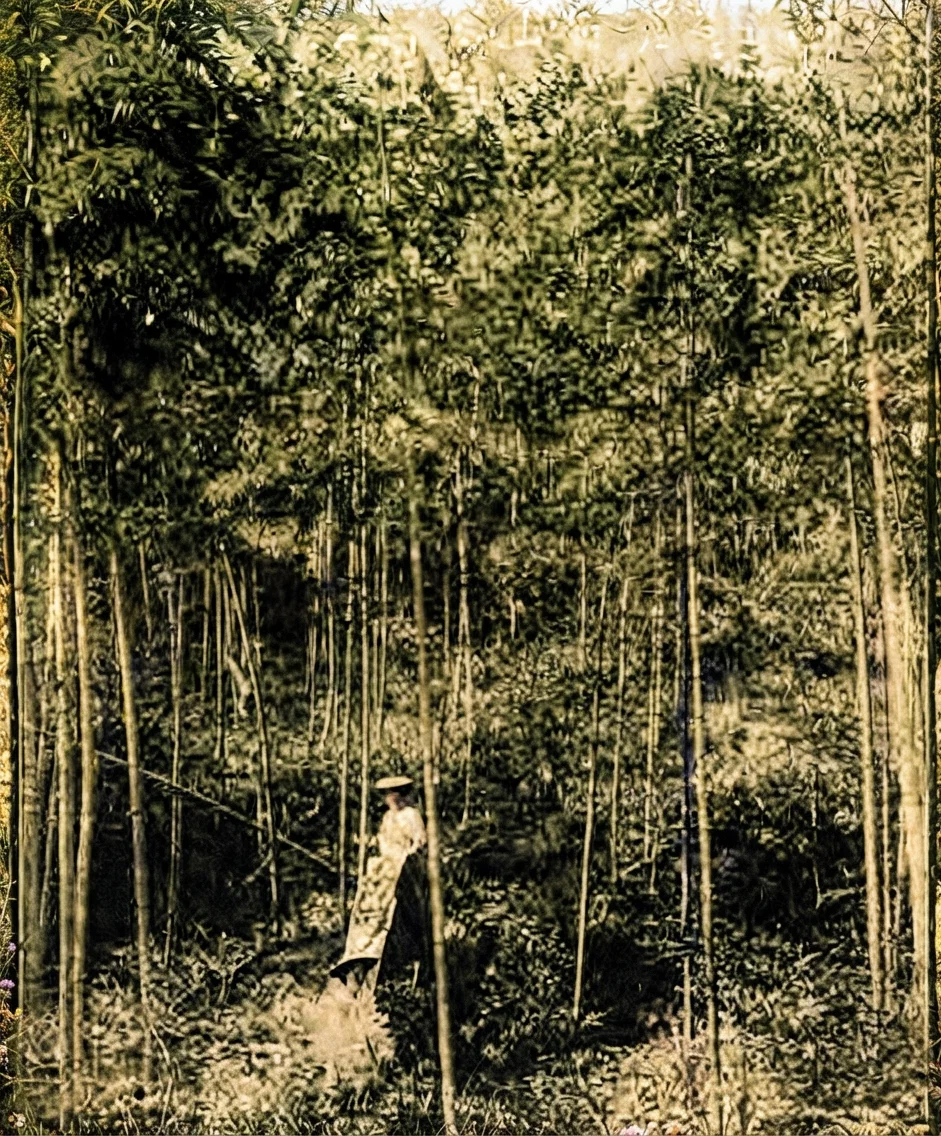
This gives a fine idea of a bamboo grove. Note the luxuriant growth of the foliage underfoot, and the sparkling effect of the sun shining through the tree tops. Beautiful wild flowers grow here in abundance.
The other way is to make the first part of the journey by rail. As we were fortunate enough to rent a furnished house on the mountains, and did not have to take much baggage, we chose the latter way.
Leaving Shanghai about noon, a half day's ride brought us to Hangchau, the "City of Heaven," with its picturesque surroundings and beautiful "West Lake."
This railway line has only been in operation one year, and is the only one in China which has American locomotives and coaches. We found the accommodations first-class in every respect, tho all the engineers, conductors, and brakemen are, of course, Chinese. Between each two opposite seats is a small stationary table; and as soon as we were seated, the Chinese porter came in and placed thereon a teapot of tea and four teacups. A few minutes later a coolie came in bearing a basket of steaming towels, which he handed out to every passenger to wash their face and hands. This luxury we decided to forego, not being sufficiently naturalized to enjoy washing with a second-hand towel.
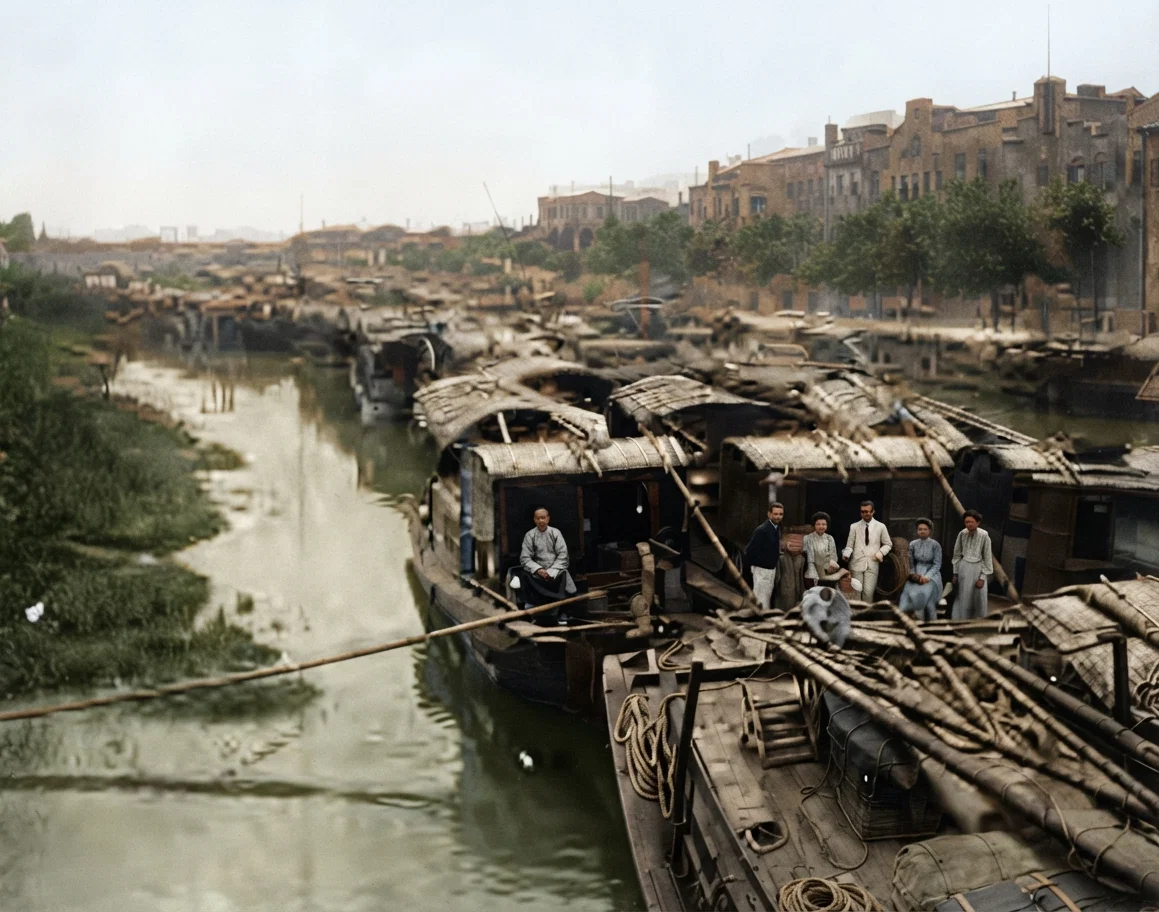
This is a picture of a string of house-boats on Loochow Creek in Shanghai. The launch steams along every day, and picks out those that are ready to go. The center boat shows a party ready to start for Mokanshan — Brother and Sister Westworth and Paul Westworth, Dr. and Mrs. Larsen, and Mrs. H. H. Winslow.
They have no dining-car attached, but serve meals on the individual tables by each seat. They will cook either Chinese or foreign style, and we found, they served a very good meal for one dollar Mexican, which is about forty cents United States money.
This ride is immensely interesting, as the train passes through a farming district, where we observed the primitive methods of agriculture, which are often very amusing.
The district through which we passed is one of China's greatest silk producing centers, and we saw miles and miles of flourishing mulberry-trees, the leaves of which form the food that sustains the cocoon during its silk producing period.
The vivid green foliage of these trees, intersected by hundreds of small square plots of rice, which is a brilliant yellow color when first sprouting, with an occasional field of red clover, or small orchard with pink and white blossoms, gives a kaleidoscope color effect which is very pleasant; while the native houses of mud with thatched roof of rice straw, the ancient pagodas and temples, the innumerable grave mounds mossy with age, and everywhere present the half-clad natives, men, women, and children, all working in the fields, or the women on their knees washing and pounding their clothes on the smooth stones by the side of the canals, and the men plowing their rice fields with the aid of a crooked-stick plow and the water-buffalo,—all combine to give a charm to the scene which makes it long to be remembered.
This is a chain paddle pump operated by foot-power. The main driving-shaft has a number of spindles, which form steps for the coolie to climb on, thus propelling the machine.
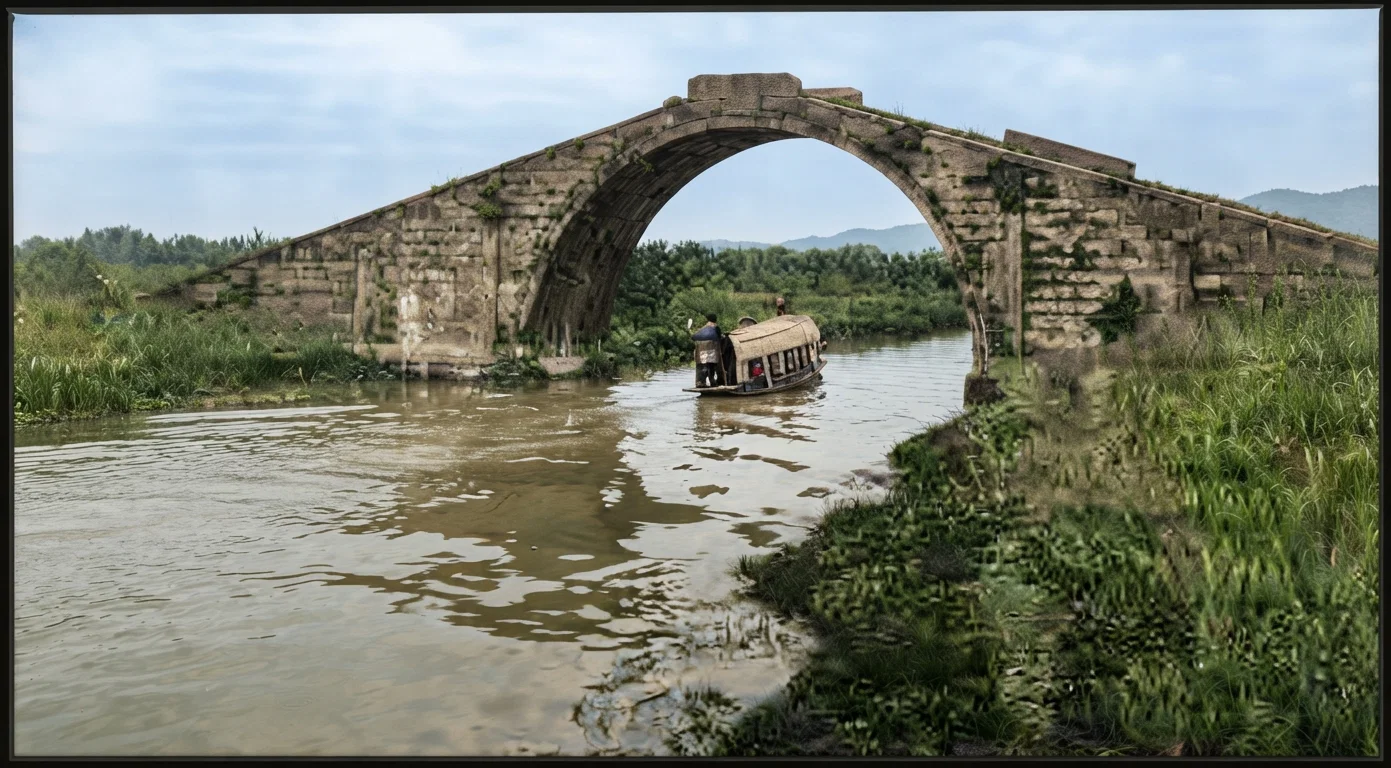
This is a sample of the numerous bridges we pass under. Wider canals have three arches built high in the center to allow high masted boats to sail under.
The country is densely populated, many walled cities being passed en route. At every station where we stopped, great crowds came down to the fence surrounding the station (They are not allowed on the platform without a ticket), and gazed with great curiosity on the "fire wagon," which is the literal translation for the Chinese name of a train.
Arriving at Hangchau we were besieged by the owners of various boats; and selecting a small boat-house, we transferred our baggage, and storing most of it under the floor, thus giving us more room to move about, we started on the next stage of our journey.
We were traveling on one of the innumerable canals which form a network all over the plain country of China; and while the trip on the train was interesting, we found the boat ride to be much more pleasant.
The boat is propelled by a scull, which also acts as a rudder in the hands of the experienced boat-man. In the case of large house-boats they are usually hitched to a steam launch, or pulled along with a tow-rope by coolies walking on the bank.
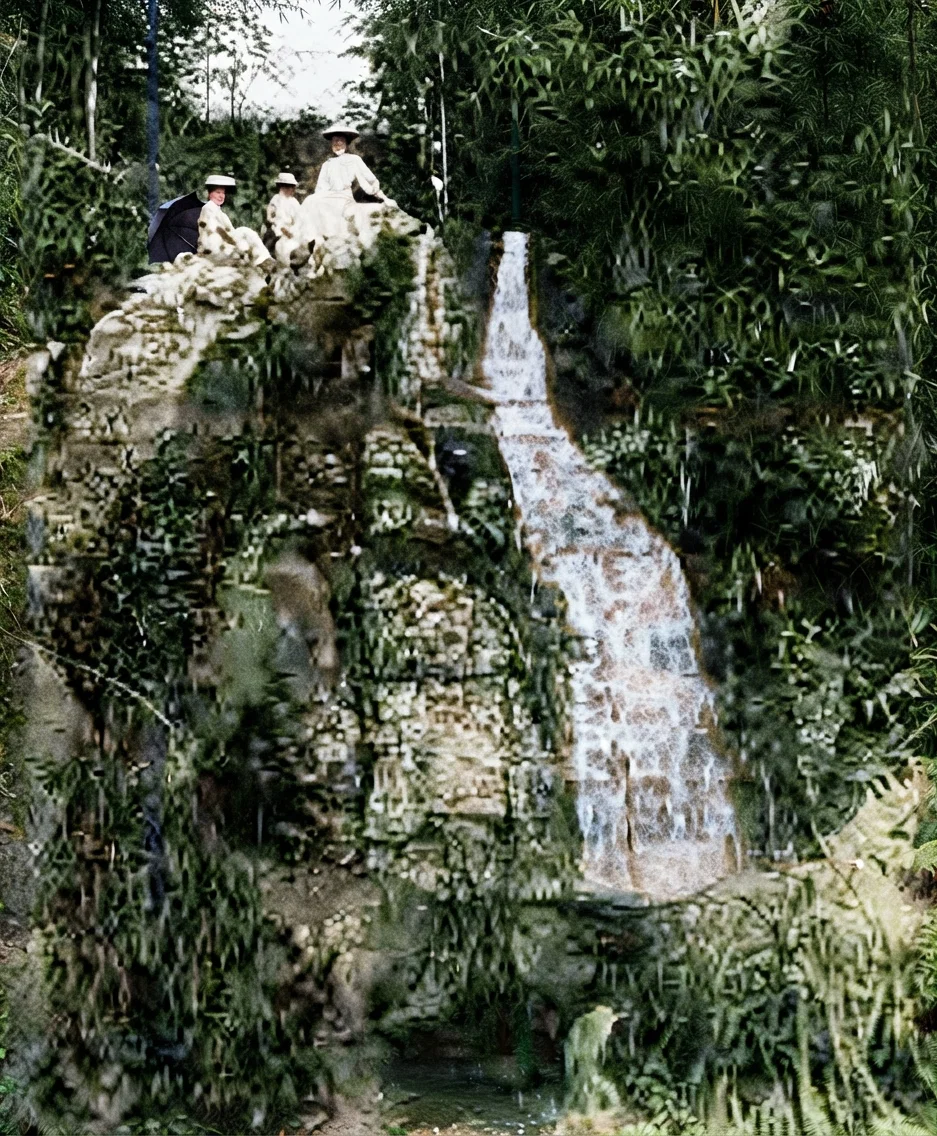
This is a view of the falls at Mokanshan — a poor view, and does not do the place justice.
We were soon attracted by a churning sound in the water, and noticed that on either bank could be seen the familiar chain and paddle pumps, which are the main reliance of the farmers for irrigation of their rice fields. Some are driven by the patient15buffalo, blindfolded, trudging round a never ending circle, while others are given the necessary impulse by men, women, or children, climbing the spindles arranged about the driving-shaft.
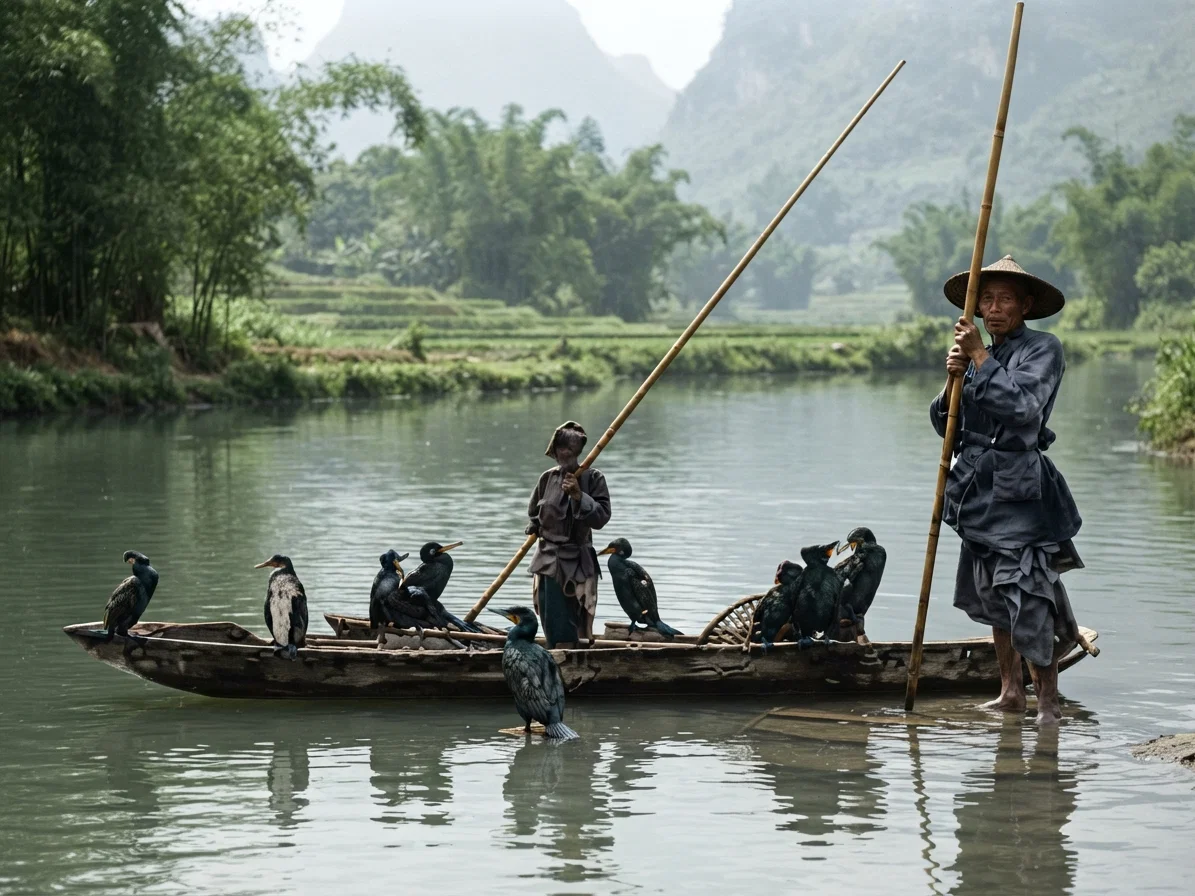
A fisherman with his flock of trained cormorants
Alternating with the pumps were huge stand dip-nets, so large in fact that it is quite a task for one man to operate the bamboo pole which lifts them, and it would seem that a few of them would clean up all the fish in the canals.
Occasionally we passed a small boat on which were a row of black fishing cormorants. These birds are about the size of a large chicken, and they stand on the edge of the boat, looking very wise, with their attention fixed on the water. Every little while one will dive, and come up with a fish in its mouth. The fish is promptly deposited in the bottom of the boat, and the bird is then ready for another dive.
Some of the most interesting sights on the canals are the arched bridges under which we pass. These arches, common all over China, circular in form, and with no prominent key-stone, are in many cases fine examples of the stone-mason's skill. They are a puzzle to all modern engineers who have seen them; and yet here they stand, large slabs of stone defying the laws of gravitation and balancing themselves in mid-air. Some of them have stood now for hundreds of years, and seem to be good for many more years.
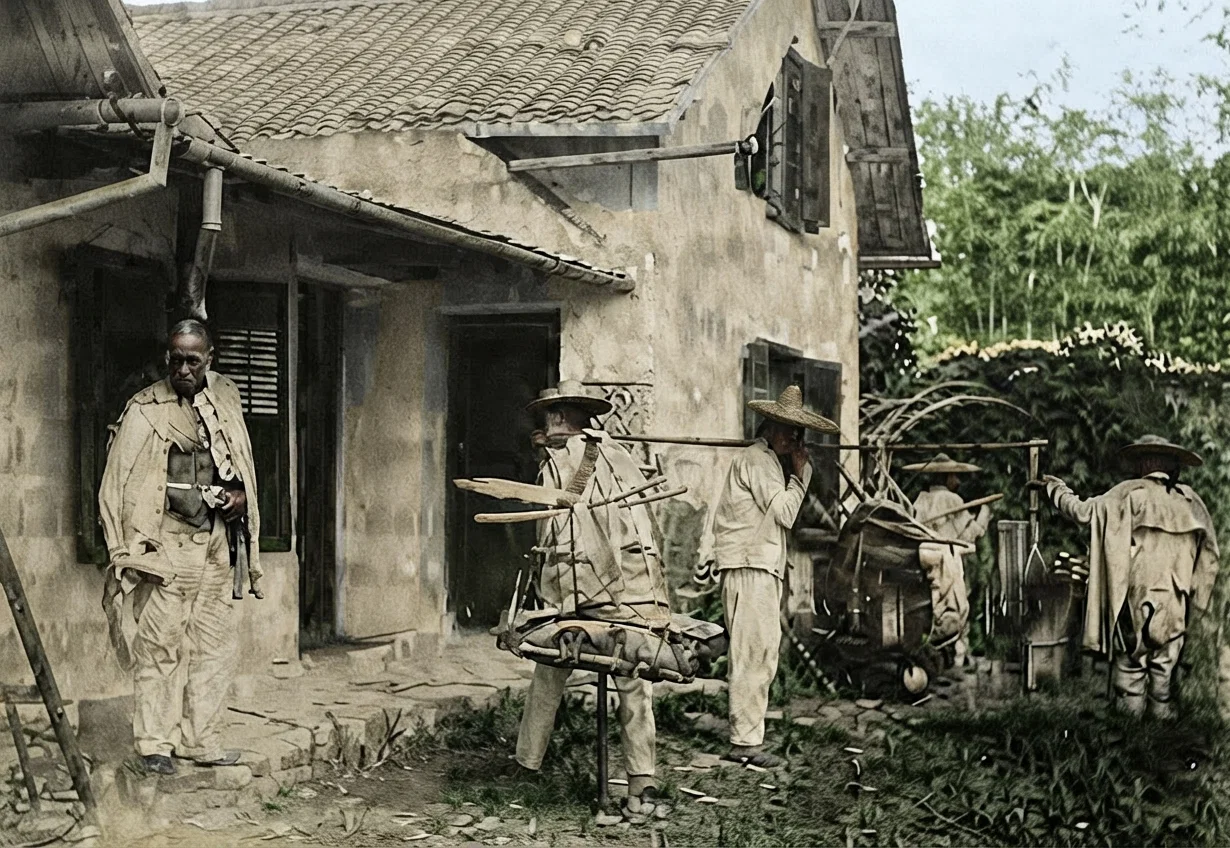
Coolies starting out with our baggage when we left the mountain. The poles they use are split bamboo, very strong and springy. This shows the house where Brother and Sister Roberts and ourselves lived this summer.
F. E. STAFFORD.
(Concluded next week)
A Book Bargain
By Editor
We have a few copies of the "Ladies' Guide" and "Man the Masterpiece." These are all perfect copies. To close them out the following post-paid prices will apply:
"Ladies' Guide"
Half-buffing binding, regular $3.75, now $1.90.
Library binding, regular $4.00, now $2.00.
"Man the Masterpiece"
Cloth binding, regular $3.50, now $1.75.
Library binding, regular $4.00, now $2.00.
APPROXIMATE CHRONOLOGY, OR THE TIME OF THE CRUCIFIXION
Places in condensed form a few facts, from Scripture, history, and astronomy, that will enable the reader to understand the exact time of the crucifixion and resurrection of Jesus, giving the year, the month, the day of the month, the time of the moon, the day of the week, and the day of the Jewish month. Price 25 cents. Address H. H. Perry, 67 19th St., San Diego, California.
Having read the "Time of the Crucifixion and Resurrection of Christ," we testify that to our minds it contains a clear and interesting statement of the facts in the case, fortified with good evidence for the positions taken.
J. N. Loughborough, J. O. Corliss, E. J. Hibbard.
Colds
Colds.—By G. H. Heald, M.D. A treatise on the causes, prevention, and cure of colds. White leatherette binding. 58 pages, 25c.
Address this office.
Life and Health
A PRACTICAL health journal, published with a view of meeting hygienic needs in every home; teaching how to care for the health and how to preserve life; prescribing simple home treatments to assist nature in throwing off diseases rather than adding more poison by using drugs or unnatural stimulants as remedies: teaching how to avoid disease as far as possible, how to manage in the home when sickness does come, and how to combat the disease by simple remedies which nature provides.
Send for sample copy and special rates to agents.
Price 10 cents per copy or $1.00 per year.
Address, LIFE & HEALTH, Takoma Park, D.C.
LIBERTY
By Editor
THE OFFICIAL ORGAN OF THE RELIGIOUS LIBERTY BUREAU
AN illustrated, 48-page, quarterly magazine, published as an exponent and advocate of true religious liberty; defending Christianity and the rights of conscience; upholding the Bible as the infallible word of God; recognizing the church and state as ordained of Heaven for specific and distinct purposes, but vigorously protesting against the alliance of the church with the state in the attempt to advance religion and to promote the state.
Price 25 cents per year. Liberal terms to agents.
Address, LIBERTY, Takoma Park, D. C.
SUBSCRIPTION RATES
By Editor
Three months ....................................................$0.50
Six months ............................................................. .90
One year (50 numbers) ............................................ 1.75
One new yearly subscription and one renewal, or two new yearly subscriptions, sent at one time, $3.00.
Two new yearly subscriptions and one renewal, or three new yearly subscriptions, sent at one time, $4.00.
Three new yearly subscriptions and one renewal, or four new yearly subscriptions, sent at one time, $5.00.
Sample copies sent on application.
Weekly and Monthly SIGNS one year, combined, $2.25.
DATE OF EXPIRATION
By C. H. Jones
The SIGNS wrapper bears date of last issue due on your subscription. Unless renewed in advance, paper stops with expiration date.
If herewith is an order-blank, you will know you have overlooked sending renewal. You will not wish to miss a single issue. Back numbers often can not be furnished.
C. H. Jones, Circulation Manager.
Our Cooperation Corner
By Editor
Constantly calls are coming to us from missionaries in distant lands (and in our own land) for clubs of "Signs" to use among English-speaking peoples in foreign fields; to be placed in public libraries; to be used in hospitals, in jails, in penitentiaries. We shall be glad always to receive donations to this fund from those who are disposed to help, and who are not so situated as to do local work.
WHAT DO THESE THINGS MEAN?
By Editor
This question is frequently asked by Christians, and non-believers, too, when they soberly consider the fact that all wealth is becoming concentrated in the hands of a few; when they note the rapidly increasing number of divorces; when they see other social questions becoming more complex; when they witness the destruction wrought by storms, floods, earthquakes, etc.; and when they see unmistakable evidences that Protestantism is on the decline and that Catholicism is gaining in strength and favor in America. These things mean much. They are way-marks pointing to the second coming of our Lord.
THE SIGNS OF THE TIMES MONTHLY
for November is Now Ready
This magazine is a watchman on the walls of Zion that keeps its readers informed on these very things. In addition it usually teaches healthful living and temperance, and also tells about those other things which make for the spiritual uplift of men and women.
This magazine of 48 illustrated pages and colored cover costs but $1.00 a year. The November and December, 1910, numbers are furnished free with all yearly subscriptions sent us before January 1, 1911, provided mention is made of this offer.
About 25,000 copies a month are sold by agents.
Other agents are wanted—those who wish to help their fellow men and earn a living at the same time. The cost of the magazine to such ones is but 5c. per copy for 5 to 40 copies, and 4c. per copy for 50 and upwards. They are sold at 10c. per copy, thus clearing a good margin of profit for the agent. It is an easy matter to sell from 10 to 50 or even more copies a day. If interested let us hear from you at once. Orders should come to us through your tract society.
SIGNS OF THE TIMES, Mountain View, California
ELO THE EAGLE
By Floyd Bralliar
AND OTHER STORIES
BY FLOYD BRALLIAR
THIS new animal book for young folks is receiving an eager welcome by all nature lovers. ELO THE EAGLE is the first of a series of ten interesting stories of animals, wild and otherwise; being, with one exception, the life histories of boyhood friends of the author. Many strange and laughable anecdotes are related by Mr. Bralliar, all of which are strictly true and vouched for by reliable witnesses.
The book is lavishly illustrated by special drawings, with a full-page half-tone design printed in Luxotype at the beginning of each chapter. Two hundred pages, printed on egg-shell paper, beautifully bound in red cloth. Price, post-paid, $1.00.
Easily sold by young people. Agents wanted.
Pacific Press Publishing Assn.
Mountain View, California
Portland, Ore. Calgary, Alberta Kansas City, Mo.
He Will Do It Anyway.
By Editor
A bright, breezy exchange puts it in this colloquial way: “Don’t waste time trying to punish sinners. The Lord will do that in time if you don’t butt in.” That is splendid advice. Sin is of the heart and motive, and no man can accurately weigh and measure the motives of the human. It is doubtful if the sinner himself can. “The heart is deceitful above all things, and desperately wicked: who can know it?” Jer. 17:9. The next verse declares that God knows it. He alone knows it. He will not have to try to punish sin; in His own good time He will visit punishment, and it will be supremely just. When that event occurs it may fall out that the worst sinners are those who have attempted to punish others. Whether man interferes or not, God will do His work.
“Not Military”
It is a strange thing to hear one remark that the boy scout movement is “not military.” Its very inception is military. Its aim is to train men for expected or possible war. A great many other things are brought in, but the movement is military; the very name is suggestive of war.
An Early North Pole Discovery
A record found in the Navy Department library states that Brother Nicholas, of Lynn, an Englishman, discovered the North Pole 550 years ago in the same manner as Dr. Cook and Captain Peary. The statement is from John Entinck’s “New Naval History, or Complete View of the British Marine,” published in 1757, and reads: “In the year 1360 it is recorded that a friar of Oxford called Nicholas De Linna of Lynn, being a good astronomer, went in company with others to the most northern island of the world, and there leaving his company together, he traveled alone and made drafts of all those northern parts with the indrawing seas, which at his return he presented to the king of England. It is added that he went to the North Pole by means of his skill in magic or the black art; but this magic or black art may possibly have been nothing more than a knowledge of the magnetical needle of a compass, found out sixty years before, tho not in common use until many years after.”
Contained in This Issue
General
PAGE
“Preach the Word”
3
A Contrast
4
The Revelation
5
The Master’s Coming—II. His Second
6
Advent a Literal, Personal, Visible Coming
Editorial
“Is Christ a Minister of Sin?”
9
Question Corner
Questions Nos. 3279 to 3285
2
The Outlook
Revolution in the Air
10
Our Constitution and Government
10
Engines of Destruction
11
The Story
Shiloh: the Man of Sorrows—Chapter
12
XXXVI. On the Jericho Road
Missions
The Missionaries’ Rest at Mokanshan
14
Poetry
Beautiful Hands
4
The True Life
7
Scriptures Confirm the Law of God
By Editor
Read page 8 of this number, and note how the Scriptures of both the Old and New Testaments confirm the law of God.
Snake Bites and Serpent Destruction in India
Over nineteen thousand persons have died as the result of snake bites in India during one year. The reptiles have caused more deaths than all the beasts of the jungles. But over seventy thousand serpents have been destroyed in return, bounties for their destruction amounting to $50,000.
Christians’ Regard for God’s Law
A citizen who honors his country and esteems the fundamental principle on which its government is based is not afraid to express his loyalty. He loves the law of the land. He delights in its reasonableness, in the safeguards it throws around human rights. He glories in the names of the loyal patriots who founded and have defended his country. Why should not the Christian so regard God's law? Why should he be ashamed to observe it? Why should he not rejoice in the long roster of loyal souls, of prophets, of apostles, of Jesus Christ, who were obedient to that law?
Catholic Control of America
Regarding Catholic control of America, Father Bernard Vaughan, an English Roman Catholic prelate, and a delegate to the Eucharistic Congress, says in part:
“From what I hear of conditions in the United States, the Catholics will soon control that country through force of numbers. The battle for the possession of the world, will soon be narrowed to the Roman Catholic Church. Protestantism is disappearing.”
Every Protestant and every American ought to be stirred by the confident words of this noted Catholic; and he should again consider the fundamental principles of civil and religious liberty which underlie the Constitution of our national Government, with the end in view of preventing the passage of any statute which would pave the way for a union of church and state.
A Fashion Fad.
A New York daily, in presenting the “fads of fashion” in picture form, shows a fashionably dressed woman seated upon a richly upholstered bed, intently studying a book for information. By the side of the bed is a table upon which are various medicines, glasses, bowls, spoons, etc. In the bed, propped up by great pillows, is a sick dog, a mere dog; underneath are the presumed words of the lady with reference to his dogship, “Baby’s Ill.” Pitiful, isn’t it? Within a stone’s throw of the dog worshiping mansion, real human babies may be dying for lack of bread or care.