"In such an hour as ye think not the Son of man cometh. Who then is a faithful and wise servant, whom his lord hath made ruler over his household, to give them meat in due season? Blessed is that servant, whom his lord when he cometh shall find so doing." Matt. 24: 44-46.
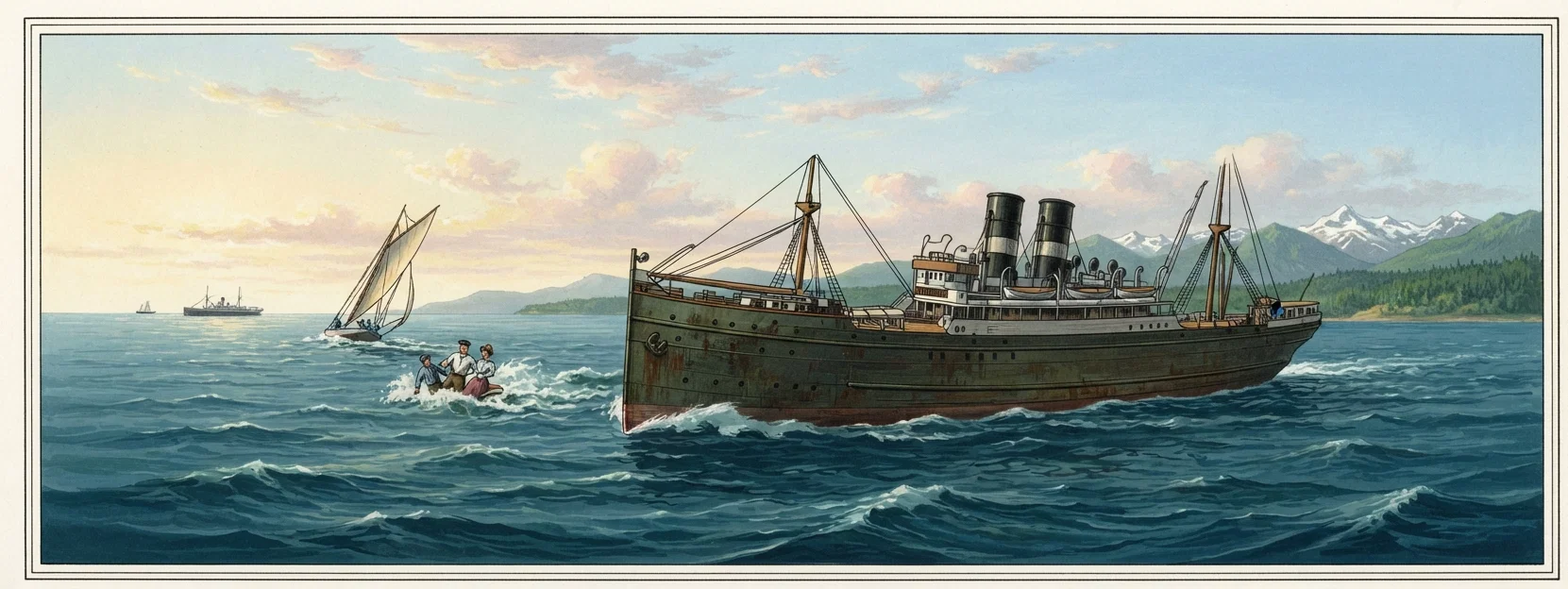
As I was on my way by ship to Seattle, Washington, an incident occurred which helped me to understand better, and made more impressive, the words of our Master at the head of this article.
It was a beautiful spring day, with no clouds, no wind. A calm was on the sea. The golden sunlight was flooding mountain and vale; and the green forests of fir, refreshed by the late rains, were smiling their thankfulness. Beautiful Puget Sound never appeared more lovely.
As our good ship Kulshan was plowing through the placid waters of the sound, we passed a small rowboat, in which a man and a woman seemingly were having a very happy time, fishing, talking, and laughing, all unmindful of the waves started by our ship. They were not watching, and were unprepared for the shock of the waves that struck with force and capsized their small craft. They were thrown into the water, but fortunately were rescued. Had they been watching, and ready to meet the waves in a proper way, they could have avoided a plunge into the cold sea, and danger of death by drowning. Likewise many of God's professed people go along their way carelessly, neglecting to watch and pray; and when some great wave of temptation strikes them, they are unprepared, and so go down. And this time, no one is able to save.
Lost While Asleep
If David had watched and prayed, and been seeking to save some one, instead of indolently sleeping in that pleasant evening-tide, he would not have been overcome by temptation, and that dark blot on his otherwise illustrious life would not have been made.
If Samson had watched and prayed, and kept the covenant of his God, instead of sleeping in the lap of Delilah, he would not have been defeated, and, with the loss of his eyes, made to grind in the prison house of his enemies. The battle was lost while he was sleeping.
O brother, watch and pray, lest you enter into temptation. You can be made strong, you can be "strengthened with all might, according to His glorious power," if you will pray, if you will seek the Lord with all your heart. But if you fail to do this, like Samson, you will awake some sad day to find that the Lord has departed from you.
If the disciples had watched and prayed with their Master in the garden, they would not all have forsaken Him when the mob came to take Him. If Peter had been less trustful of himself, and had sought the Lord earnestly in prayer, he would have been saved from his sad fall, and later his bitter tears of regret and shame.
The Lord lays special emphasis on the necessity for His church to watch and pray as the time of His second coming draws near. He says, "Watch ye therefore, and pray always, that ye may be accounted worthy to escape all these things that shall come to pass, and to stand before the Son of man." The "time of the end" to the world is a prayerless, gay, "merry-go-round," pleasure-loving time.
Through Enchanted Ground
John Bunyan, in his book "Pilgrim's Progress," represents Christian and Hopeful, just before they enter the Celestial City, as passing through the Enchanted Ground. The effect of the air and influence of the Enchanted Ground was to make them very drowsy. Indeed, they observed many fellow pilgrims who had come from the city of Destruction, and had passed all the dangers of the way, sleeping here, overcome by this miasma, the love of this world, all unmindful of the "eternal weight of glory" and joy of their Lord, that awaited them at the end of their way, and was so near.
It was only by earnest and persevering efforts, and helping each other by saying, "Let us not sleep, as do others," that they were successful in passing through this, the devil's last snare for Christians. Our Lord's words of warning to His remnant people are: "Take heed to yourselves, lest at any time your hearts be overcharged with surfeiting, and drunkenness, and cares of this life, and so that day come upon you unawares. For as a snare shall it come on all them that dwell on the face of the whole earth."
Preferred Suffering
In Paul's photograph of the last days, which days, he says, are "perilous," he pictures the people as "lovers of pleasures more than lovers of God." And these sinful pleasure lovers he says would have "a form of godliness," but would deny "the power thereof"; and from these the faithful, earnest pilgrims must turn away, and run with patience the race set before them, looking unto Jesus, "who for the joy that was set before Him endured the cross, despising the shame, and is set down at the right hand of the throne of God." Moses esteemed "the reproach of Christ greater riches than the treasures of Egypt." He chose "rather to suffer affliction with the people of God, than to enjoy the pleasures of sin for a season."
O brother, watch and pray, "lest coming suddenly He find you sleeping." If you would be among that glad company who shall lift up their heads when He shall appear in all His glory, and say, "Lo, this is our God; we have waited for Him, and He will save us," and if you would be presented without fault before the presence of His glory, you must remember the words of Christ in Rev. 16: 15: "Behold, I come as a thief. Blessed is he that watcheth, and keepeth his garments, lest he walk naked, and they see his shame."
"Watch and pray, nor leave our post of duty,
Till we hear the Bridegroom's voice.
Then, with Him the marriage feast partaking,
We shall evermore rejoice.
"Watch and pray, the Lord commandeth.
Watch and pray, 'twill not be long.
Soon He'll gather home His loved ones
To that happy vale of song."
Heaven's Only Attorney
By A. R. Bell
EVERY individual has a case pending at the bar of God. How important that we think often of the solemn scene of the Judgment! How important that we become thoroughly conversant with the great standard, or test of character, of that Judgment! That standard covers every relationship and duty between man and man, and between man and God.
The counsel of God calls us to perfect obedience; points us to a perfect law (Ps. 19: 7); shows us our Lord as a Saviour from sin (Matt. 1: 21); tells us, in plain language, that "sin is the transgression of the law" (1 John 3: 4); and calls us to the cleansing from sin — the transgression of the law — found only in the blood of Christ (1 John 1: 7). It points us to Christ as "leaving us an example, that ye should follow His steps" (1 Peter 2: 21); saying, "He that saith he abideth in Him ought himself also so to walk, even as He walked" (1 John 2: 6); giving us the example and walk of Jesus in His own words, "I have kept My Father's commandments, and abide in His love" (John 15: 10). It also points us to the final promise, where, revealing a people who shall stand without fault in the Judgment of God, and receive their reward, it says, "Blessed are they that do His commandments, that they may have right to the tree of life, and may enter in through the gates into the city." Rev. 22: 14.
A. R. BELL.
The Blessing of Good Deeds
"GOOD deeds are twice a blessing, benefiting both the giver and the receiver of the kindness. The consciousness of right-doing is one of the best medicines for diseased bodies and minds. When the mind is free and happy from a sense of duty well done and the satisfaction of giving happiness to others, the cheering, uplifting influence brings new life to the whole being."
Though Darkness May Encircle Me
By R. S. Owen
THOUGH darkness may encircle me,
I'll keep my eye on Calvary.
A Saviour I see bleeding there,
To whom I'll trust my constant care,
Till Zion's glorious hills I see,
And know Him there eternally.
R. S. OWEN.
Persecution and Spiritual Darkness
"A PERSON who persecutes another is bound by chains of darkness himself; and the axiom, 'Whoever is wrong, the persecutor cannot be right,' should be taught to every child that has come to the age of accountability."
Secret of a Life of Power
By Ellen G. White
The Physical Strength and the Spiritual Received Through Rest, Meditation, and Prayer
By the late ELLEN G. WHITE
THE Saviour's life on earth was a life of communion with nature and with God. In this communion, He revealed for us the secret of a life of power.
Jesus was an earnest, constant worker. Never lived there among men another so weighted with responsibilities. Never another carried so heavy a burden of the world's sorrow and sin. Never another toiled with such self-consuming zeal for the good of men. Yet His was a life of health. Physically as well as spiritually He was represented by the sacrificial lamb, "without blemish and without spot." In body as in soul, He was an example of what God designed all humanity to be through obedience to His laws.
The childhood of Jesus, spent in poverty, had been uncorrupted by the artificial habits of a corrupt age. Working at the carpenter's bench, bearing the burdens of home life, learning the lessons of obedience and toil, He found recreation amidst the scenes of nature, gathering knowledge as He sought to understand nature's mysteries. He studied the word of God; and His hours of greatest happiness were found when He could turn aside from the scene of His labors to go into the fields, to meditate in the quiet valleys, to hold communion with God on the mountain side or amid the trees of the forest. The early morning often found Him in some secluded place, meditating, searching the Scriptures, or in prayer. With the voice of singing He welcomed the morning light. With songs of thanksgiving He cheered His hours of labor, and brought heaven's gladness to the toil-worn and disheartened.
Lived an Outdoor Life
During His ministry, Jesus lived to a great degree an outdoor life. His journeys from place to place were made on foot, and much of His teaching was given in the open air. In training His disciples, He often withdrew from the confusion of the city to the quiet of the fields, as more in harmony with the lessons of simplicity, faith, and self-abnegation He desired to teach them. It was beneath the sheltering trees of the mountain side, but a little distance from the Sea of Galilee, that the twelve were called to the apostolate, and the Sermon on the Mount was given.
Christ loved to gather the people about Him under the blue heavens, on some grassy hillside, or on the beach beside the lake. Here, surrounded by the works of His own creation, He could turn their thoughts from the artificial to the natural. In the growth and development of nature were revealed the principles of His kingdom. As men should lift their eyes to the hills of God, and behold the wonderful works of His hand, they could learn precious lessons of divine truth. In future days, the lessons of the divine Teacher would thus be repeated to them by the things of nature. The mind would be uplifted, and the heart would find rest.
The disciples who were associated with Him in His work, Jesus often released for a season, that they might visit their homes and rest; but in vain were their efforts to draw Him away from His labors. All day He ministered to the throngs that came to Him; and at eventide, or in the early morning, He went away to the sanctuary of the mountains for communion with His Father.
Often His incessant labor, and the conflict with the enmity and false teaching of the rabbis, left Him so utterly wearied that His mother and brothers, and even His disciples, feared that His life would be sacrificed. But as He returned from the hours of prayer that closed the toilsome day, they marked the look of peace upon His face, the freshness and life and power that seemed to pervade His whole being. From hours spent alone with God, He came forth, morning by morning, to bring the light of heaven to men.
Rested in Prayer
It was just after the return from their first missionary tour that Jesus bade His disciples, Come apart, and rest a while. The disciples had returned, filled with the joy of their success as heralds of the gospel, when the tidings reached them of the death of John the Baptist at the hand of Herod. It was a bitter sorrow and disappointment. Jesus knew that in leaving the Baptist to die in prison, He had severely tested the disciples' faith. With pitying tenderness He looked upon their sorrowful, tear-stained faces. Tears were in His own eyes and voice as He said, "Come ye yourselves apart into a desert place, and rest a while."
Near Bethsaida, at the northern end of the Sea of Galilee, was a lonely region, beautiful with the fresh green of spring, that offered a welcome retreat to Jesus and His disciples. For this place they set out, going in their boat across the lake. Here they could rest, apart from the confusion of the multitude. Here the disciples could listen to the words of Christ, undisturbed by the retorts and accusations of the Pharisees. Here they hoped to enjoy a short season of fellowship in the society of their Lord.
Only a short time did Jesus have alone with His beloved ones; but how precious to them were those few moments! They talked together regarding the work of the gospel and the possibility of making their labor more effective in reaching the people. As Jesus opened to them the treasures of truth, they were vitalized by divine power, and inspired with hope and courage.
But soon He was again sought for by the multitude. Supposing that He had gone to His usual place of retirement, the people followed Him thither. His hope to gain even one hour of rest was frustrated. But in the depths of His pure, compassionate heart, the good Shepherd of the sheep had only love and pity for these restless, thirsting souls. All day He ministered to their needs, and at evening dismissed them to go to their homes and rest.
Sought Retirement and Unbroken Communion
In a life wholly devoted to the good of others, the Saviour found it necessary to turn aside from ceaseless activity and contact with human needs, to seek retirement and unbroken communion with His Father. As the throng that had followed Him depart, He goes into the mountains, and there, alone with God, pours out His soul in prayer for these suffering, sinful, needy ones.
When Jesus said to His disciples that the harvest was great, and the laborers were few, He did not urge upon them the necessity of ceaseless toil, but bade them, "Pray ye therefore the Lord of the harvest, that He will send forth laborers into His harvest." To His toil-worn workers to-day, as really as to His first disciples, He speaks these words of compassion, "Come ye yourselves apart . . . and rest a while."
All who are under the training of God need the quiet hour for communion with their own hearts, with nature, and with God. In them is to be revealed a life that is not in harmony with the world, its customs, or its practices; and they need to have a personal experience in obtaining a knowledge of the will of God. We must individually hear Him speaking to the heart. When every other voice is hushed, and in quietness we wait before Him, the silence of the soul makes more distinct the voice of God. He bids us, "Be still, and know that I am God." This is the effectual preparation for all labor for God. Amidst the hurrying throng and the strain of life's intense activities, he who is thus refreshed, will be surrounded with an atmosphere of light and peace. He will receive a new endowment of both physical and mental strength. His life will breathe out a fragrance, and will reveal a divine power that will reach men's hearts.
“With the voice of singing He welcomed the morning light.”
WILL ALL MANKIND CRY FOR PEACE?
THE "Federal Council of the Churches of Christ in America" is busying itself, perhaps more strongly than in any other way, in the various suggested efforts to secure international peace. The secretary of the "Federal Council," Dr. Charles S. Macfarland, has secured, through the German embassy at Washington, an authoritative copy of that paragraph in Chancellor von Bethmann-Hollweg's speech on November 9, in which he deals with the peace movement. Some of the words of the chancellor follow:
"When, at and after the end of the war, the world will become fully conscious of its horrifying destruction of life and property, then through the whole of mankind will ring a cry for peaceful arrangements and understandings which, as far as lies in human power, shall avoid the return of such a monstrous catastrophe. This cry will be so powerful and so justified that it must lead to some result. . . .
"The first condition for evolution of international relations by way of arbitration and peaceful compromise of conflicting interests should be that no more aggressive coalitions are formed in future. Germany will at all times be ready to enter a league for the purpose of restraining the disturbers of peace."
Secretary Macfarland also addressed a communication by wireless to Dr. Adolph Deissmann, the celebrated Orientalist of the University of Berlin, asking him for his opinion on this question of a league to enforce peace. Dr. Deissmann, in his reply to Secretary Macfarland, said, among other things:
"The question raised by Lord Bryce whether, after the close of this most destructive war, arrangements could be made by which peace-loving nations should pledge themselves to desist from any attack with arms, and submit all matters of dispute to a court of arbitration, is one of the great burning questions of the future, which concern not only a group of nations, but all mankind. Although history teaches us that the road leading to this goal is not easy, yet I venture to say that in our country, the idea of arbitration is gaining ground constantly."
On this question of a desire for a court of universal arbitration, Dr. Deissmann says that his words express his private opinion; "they are the voice of an individual in Germany." He proceeds then, however, to refer to Chancellor von Bethmann-Hollweg's speech in which he commits the German Empire to this policy of an international court and league of nations to enforce peace; and concerning that speech Dr. Deissmann says:
"The echo which this straightforward address, so full of strength and national dignity, has found in our press, confirms my impression that the idea of arbitration is constantly gaining ground in our country."
But most significant of all is the following paragraph from Dr. Deissmann's communication to the secretary of the Federal Council of Churches:
Study These Significant Utterances
"Of course, if attempts to form an international alliance for maintaining lasting conditions of peace are to be practically realized, the mental and spiritual atmosphere within the great powers must change. The gangrenous ulcer of hate which poisons international relations must be burned out, and the intellectual heads of nations, above all, the Christian leaders, must, under full recognition of the bona fides of their opponents, be ready to forgive one another's thoughts, as well as words and deeds, whereby they have hurt and wounded each other. Then they would be able to succeed in fully entering into the problem of reconstruction. In creating this atmosphere, which is prerequisite to every step towards a better mutual understanding, neutral Christians have a great mission. Without pharisaism, and by the proper attitude, which avoids everything that might pour oil into the flames of war, they should regard combatants as suffering brethren, nurse their wounds, and reconsider the attitude of their hearts and minds."
It must be apparent to every observer of current discussion, that there is a growing, feverish intensity to organize the world into a "league to enforce peace." Statesmen in all the nations are voicing the sentiment. Churchmen are working for this league with might and main; and Dr. Deissmann thinks that "above all, the Christian leaders" must enter into this work of establishing the proposed peace league. He considers that "neutral Christians have a great mission" in bringing the world up to the point where it will be free from war.
When They Say, "Peace and Safety"
On the face of it, these propositions seem good. It is not surprising that thousands upon thousands of the best men and women of the world are swayed by the impression that they should secure a league of nations which will forever put an end to the horrible butcheries that are now in progress in the Old World. But certainly, in the midst of all this feverish discussion, in these excitable times, there will be some who will think sufficiently beneath the surface to make the earnest inquiry. If the Christianity of the "Christian nations" of 1914 could not prevent the war, is there a sufficient change in the Christianity of these "Christian nations" of 1916 to form a league that will prevent the recurrence of such a catastrophe?
Paul, speaking of these very times in which we live, describes a great mass of people as uttering a chorus cry of "Peace and safety," who are to be visited by "sudden destruction." "There is no peace, saith my God, to the wicked." Isa. 57: 21.
Is it possible to take the wicked, selfish men of this wicked world, and form a league, or a combination, even though it be done in the name of Christianity, that will establish perpetual peace? Those who have been constant readers of the SIGNS OF THE TIMES will readily call to mind those remarkable prophecies in the second chapter of Isaiah and the fourth chapter of Micah which tell of the "many peoples" and the "many nations" who will, in the "last days," go forth to form these great leagues of peace.
Every Christian will devotedly labor for peace; but every careful student of the Bible must be impressed with the fact that there is no promise of lasting peace in this wicked world. On the other hand, we learn, from the divine Book, that the greatest persecuting despotism known to history will be found in the last days, in the name of the Christian religion, and ostensibly to secure perpetual peace.
The promises of the Bible hold forth the great prospect of the soon coming of Christ, when He will destroy all sin and wickedness, in order that He may bring in the reign of everlasting peace, in the eternity of bliss that He has promised to those who will accept and carefully follow the teaching of His divine word.
To Our Readers
By Editor
All reasonable effort will be made to preserve accuracy of statement, and to verify all authorities quoted.
Scripture quotations, when not from the Authorized Version, are taken from the American Standard Revised, unless otherwise stated.
Persons receiving copies of this paper without ordering them are not indebted to this office. Such papers are paid for by others.
Manuscripts should be addressed to the editor. Address all business and make all money orders, etc., payable to the SIGNS OF THE TIMES, Mountain View, California.
WILL DECEIVE THE ELECT
THE Lord Jesus Christ, speaking of the days just prior to His second coming, warned us that "there shall arise false Christs, and false prophets, and shall show great signs and wonders; insomuch that, if it were possible, they shall deceive the very elect." Matt. 24: 24.
The deceptions that are most alluring and most dangerous are those which claim to be based upon the Bible itself. We have a very cunning foe to deal with. He recognizes that it is popular in this day and age of the world to profess the name of Christ. Indeed, in many parts of the world now, it is far more popular to be a Christian than to make any other profession. The out-and-out opposer of Christianity has almost ceased. Hence Satan would come to us, as he did to our Master of old, in words of Scripture; and by distorting these scriptures in our mind, and taking them out of their proper setting, he would have us imbibe the delusion that we are following Christ when in reality we are following the great rebel leader.
But those who are following Christ in reality, know Him personally; and they know His word for themselves, so that they know when any one is speaking a doctrine that is contrary to that Word. "My sheep hear My voice." God's voice in this time is expressed to the world in His written word. We must know that Word for ourselves, and follow it, if we would avoid the great deceptions and delusions in this time.
A Royal Rest Day
By H. W. Cottrell
"And He said unto them, The Sabbath was made for man, and not man for the Sabbath: therefore the Son of man is Lord also of the Sabbath." Mark 2:27, 28.
Thus says our divine Lord. Nor did the circumstances under which the statement was made depreciate the truthfulness of His eternal word. Having all authority in heaven and on earth, He spoke as "never man spake." The Father said of Him, "This is My beloved Son; . . . hear ye Him." Matt. 17:5.
Man was not made because of the Sabbath, but the Sabbath was made because of and for man. Yet there are many men who do not believe the word of Christ, and will not worshipfully recognize His Sabbath day.
The Creator's Crowning Act
It was made for man. Who made it? "Who hath delivered us from the power of darkness, and hath translated us into the kingdom of His dear Son: in whom we have redemption through His blood, even the forgiveness of sins: who is the image of the invisible God, the first-born of every creature: for by Him were all things created, that are796in heaven, and that are in earth, visible and invisible, whether they be thrones, or dominions, or principalities, or powers: all things were created by Him, and for Him: and He is before all things, and by Him all things consist." Col. 1:13-17. Paul declares that Christ, the Son of God, created all things.
Being the originator of all things, He is surely the maker of the Sabbath. And being made by His rest, blessing, and sanctification, to be kept by man in honor and remembrance of Him, it is of necessity a Christian religious institution — the Christian Sabbath, the Lord's day.
It was truly the crowning act of God's creation. Men value a temporal structure only in proportion as they appreciate the skill of the architect and the workmanship of the builder. Thus only will men appreciate divine institutions. The architectural design of the Sabbath, the sacred and holy character of the specific day of the week as a sacred institution, was drawn, constructed, and eternally established by the divine Son of God, our Redeemer, in conjunction with "the Father of lights, with whom is no variableness, neither shadow of turning."
Finishing Creation at Calvary
"And to make all men see what is the fellowship of the mystery, which from the beginning of the world hath been hid in God, who created all things by Jesus Christ." Eph. 3:9. "For unto us a Child is born, unto us a Son is given: and the government shall be upon His shoulder: and His name shall be called Wonderful, Counselor, the mighty God, the everlasting Father, the Prince of peace." Isa. 9:6. "But unto the Son He saith, Thy throne, O God, is forever and ever: a scepter of righteousness is the scepter of Thy kingdom." Heb. 1:8.
When our Redeemer was here upon earth, clothed in human flesh, He rested on the very same day of the weekly cycle as in the beginning, when the world was framed. And He taught His followers thus to do; for we read, "And they returned, and prepared spices and ointments; and rested the Sabbath day according to the commandment." Luke 23:56. "I am the Lord, I change not."
The Lord's day, the Christian Sabbath, was the last day of the weekly cycle, when Christ was here, just as it had been from creation week. As all are aware, Saturday is the last day of the week; hence it is holy time, and will continue to be such through all eternity. Because of divinely described conditions in the world made new, we read: "For as the new heavens and the new earth, which I will make, shall remain before Me, saith the Lord, so shall . . . your name remain. And it shall come to pass, that . . . from one Sabbath to another, shall all flesh come to worship before Me, saith the Lord." Isa. 66:22, 23.
Could Worship in Flesh
So the seventh day of the week was the day upon which the Lord rested at the time of creation. Thus He constituted it His holy day, His Sabbath day, the Lord's day. The day of His rest followed the first six days of His toil. It was the seventh day. Gen. 2:2, 3. And from that first period of days, the seventh day of the weekly cycle — the birthday of the world — has, in uninterrupted similar successive cycles, announced to believers of every sect and to unbelievers of every type, that it is the holy of the Lord, a memorial of the God and Christ of creation and redemption.
At the time when He was clothed upon with flesh — born of flesh — it was said of Him, "For unto you is born this day in the city of David a Saviour, which is Christ the Lord." Luke 2:11. And as Christ the Lord, He taught His followers to regard sacredly the day of His rest, the seventh-day Sabbath; and they did it. Thus they worshiped. True Sabbath keeping is worship.