Your ShelfYour Projects

Signs of the Times, December 19, 1916

Are There Signs of His Coming?
Earlier text: Capsized on Life's Sea

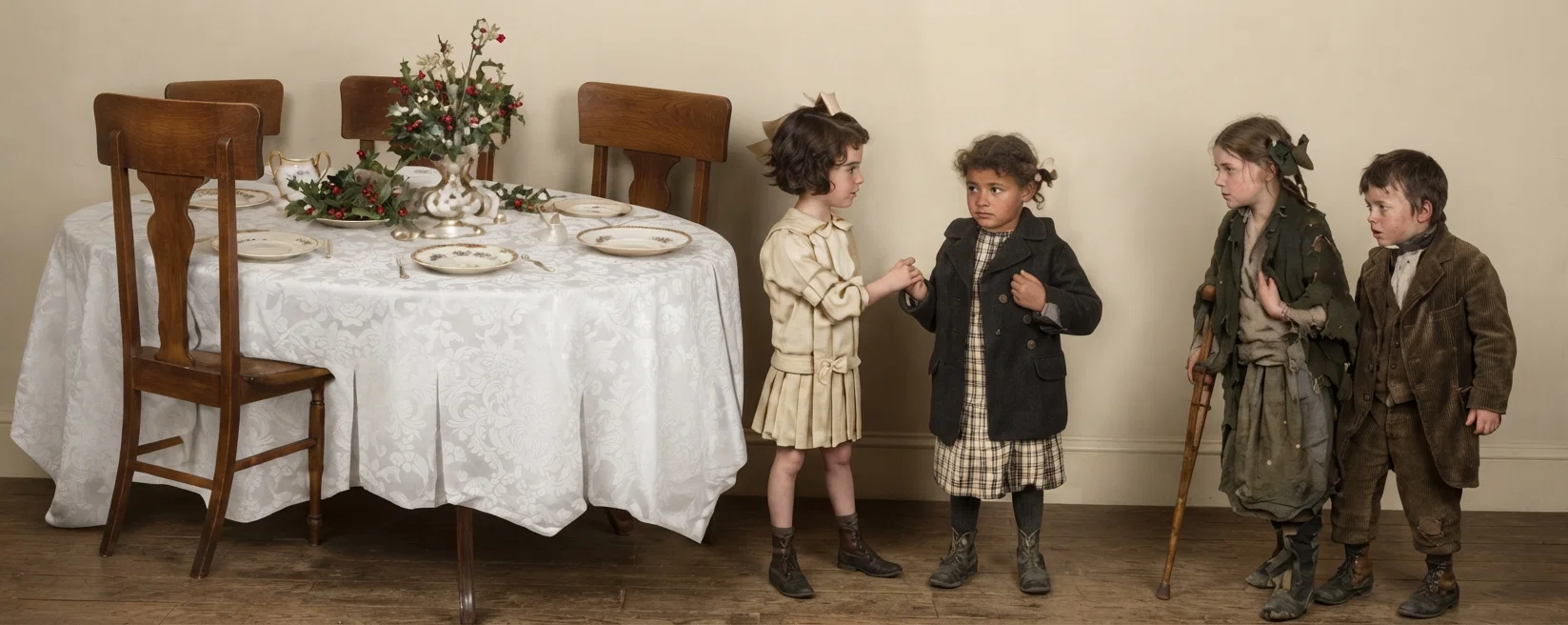
Mabel's Christmas Feast

By MARY ALICE HARE LOPER
COLD December had come, and the suburban winter scenes amid which Mabel Dodge dwelt were especially welcomed by her, to whom the fleecy drapery of nature's robes was a vivid reminder that Christmas joys and festivities were drawing near.
Mabel's mother believed implicitly in the blessed principles of the old-fashioned Bible, and it was her custom each week to choose some practical text for her little daughter to commit to memory.
Mr. and Mrs. Dodge had been accustomed to entertain lavishly at Christmas time, always taking care also to remember the poor; but this year, they had told Mabel that she might have just her own little company, whomever she might choose.
There remained but one text to be learned before Christmas week. The brisk breezes were swaying the naked boughs which in summer had spread an inviting shade about the large veranda. Mabel drew her little cane rocker in front of the cozy fireplace, and turned to her appointed task. She was somewhat puzzled as she read the words found in Luke 14: 13: "But when thou makest a feast, call the poor, the maimed, the lame, the blind." With a troubled expression on her usually bright face, she asked,
"What does it mean, mother?"
"What do you think it means, Mabel?"
"Well, does 'feast' mean a Christmas dinner?"
"I suppose it does," said her mother, without further comment; and seeing Mabel's perplexity, she promised to talk with her again about it at another time.
Mabel did not forget her task; and by the end of the week, she had learned the text perfectly. Her mother well knew that a struggle had been going on in the child's young heart, so she took occasion to explain further the meaning. She did not want Mabel to get the idea that it is not perfectly right to entertain our own special friends sometimes, but she desired her to know also the joy of giving happiness to those who have little of the sunshine of life.
Mabel had thought much about the coming Christmas, and how delighted she would be to have Katherine Swan and Elizabeth Bailey and Dorothy Smith take dinner with her; for she had been a guest at all their homes on various occasions.
"Well," said Mabel, "if I do as that text says, I suppose I can't have any good time on Christmas except just our tree on Christmas eve."
"Would my little Mabel like to entertain Jesus on Christmas day?"
"Oh, yes," said Mabel; "but He has gone to heaven, and I can't do that now."
"Let us see about it," said her mother. "We read in Matt. 25: 40, 'Inasmuch as ye have done it unto one of the least of these My brethren, ye have done it unto Me.' So if Mabel will invite to her Christmas dinner little lame Susan Snow and poor Bennie and Matie Brown, she will be doing just the same as if she should entertain Jesus Himself; that is, He counts it just the same."
"O mother, is that what it means — that we may entertain Jesus at our feast?"
"Yes," said her mother, "that is our privilege. The Bible always means just what it says. And would you like to try it on Christmas day?"
"Yes," said Mabel sweetly, "and I can have Katherine and Elizabeth and Dorothy some other time."
"Surely," said her mother, "you may have them any time you wish. But as they have so much to make them happy, I am sure you will never regret sharing your Christmas joys this year with those who have little to vary the monotony of a cheerless existence."
It was a bright morning, and the snow glistened like diamonds in the sunlight when Mabel set out upon her mission of love to invite her poor little acquaintances to her Christmas feast, as she had called it. As she tripped gayly along, a snatch of a little gospel song was ringing in her heart:
"Shout the glad news to each one you meet, Jesus loves even the waifs of the street."
She tapped softly at the widow Brown's door, and the poor woman opened it, half startled that any one should call. With a perplexed expression on her careworn face, she said:
"Come in, Miss Mabel. Is some one sick or dead, and is there washing or other work to be done?"
"Oh, no," said Mabel; "we are all quite well, thank you. I came to see if you would let Matie and Bennie come over to our house to dinner on Christmas day."
"The Lord bless you, dear; you are the first one that has ever given them such pleasure. But I fear they have nothing fit to wear on such an occasion as that."
"Oh, yes, they have," said Mabel sympathetically. "Please let them wear what they have on now; it is plenty good enough." And with a cheery good-by, away she went toward the humble cottage of poor Mrs. Snow.
She soon reached the place, and passed up the well beaten path, on either side of which the roses of springtime had long since faded. It was a tumble-down place, the home of a drunkard, who daily spent his earnings at the saloon, while his poor wife and little afflicted daughter were struggling with the woes of poverty.
In response to Mabel's soft tap, little lame Susie came hobbling on her crutches; and without waiting for Mabel's message, she said wearily: "My mamma is not at home. She has gone to wash for —"
"I didn't come to see your mother exactly," said Mabel. "I want to know if you can come over to our house on Christmas day."
"I don't know," said Susie, with a tone of deep sadness in her voice, "as I would be much help now in tending baby; for my foot is worse, and the doctor says I may never walk on it again."
"I don't want you for that, Susie dear," said Mabel sweetly. "I want you to be my company."
"Your company!" said Susie in astonishment.
"Yes, company," replied Mabel emphatically, "and eat at the first table with me and Matie and Bennie Brown."
"Oh, how delightful that will be!" said Susie. "I am sure mamma will let me go;" and while great tears of joy — such joy as she had never known before — fell softly down the pale cheeks, Mabel bade her a tender good-by, and hurried home with a heart overflowing with love for those less fortunate than herself, to tell her mother all about her morning experience.
How long the time seemed from Monday till Thursday, during which Mabel decided, with her mother's consent, to share her Christmas tree joys also with her poor little friends, by having the tree on Christmas day.
At last the day came, and Mabel's happiness knew no bounds. Tall chrysanthemums lit up the somber niches of the dining room, while in the library, amid gay festoons of evergreens and fragrant roses, stood the Christmas tree — the first tree of its kind in which the little guests of the day had ever had a share.
After the distribution of the gifts, every one being generously remembered, Mabel led the way to the dining room, where was laid a table such as her company had never before approached. Never were more delighted guests entertained at the hospitable Dodge home, than were present on this occasion. Mabel herself had never before seemed quite so happy, for on no former occasion had Jesus seemed quite so near. She was experiencing some of that inexpressible joy which comes as the result of ministering to the needs of others, and was realizing, as never before, that truly "it is more blessed to give than to receive."
The day was soon past; and the little feet that had never before pressed thornless flowers, turned to tread their familiar pathway. But it was not so dreary now. The shadows of life were spanned by the rainbow of love.
After Mabel's mother had tucked her away in her little bed that night, and the drowsy eyelids had closed in slumber, she thought she caught a faint murmur from the realm of dreams — "Inasmuch as ye have done it unto one of the least of these My brethren, ye have done it unto Me."

At the Last Bar

That there may remain no lingering doubt in the mind of any reader relative to the day—whether it be an indefinite period of time, or a twenty-four-hour day of our week, which circumnavigates the globe in a way similar to that of an aëroplane crossing the continent—we will again refer to the record of the apostle: "And they returned, . . . and rested the Sabbath day according to the commandment. Now upon the first day of the week, very early in the morning, they came unto the sepulcher." There can be no longer a candid question. When they had rested the Sabbath day, the next day is divinely stated to be the first day of the week. Sunday is the first day of the week; but the Christian Sabbath is now, as it was then, the day before the first day. That is, it is Saturday, the seventh day of the week.

Not in Heaven, but Asleep

By R. C. Porter
IN Eccl. 3: 18-21, we read: "I said in mine heart concerning the estate of the sons of men, that God might manifest them, and that they might see that they themselves are beasts. For that which befalleth the sons of men befalleth beasts; even one thing befalleth them: as the one dieth, so dieth the other; yea, they have all one breath; so that a man hath no preëminence above a beast: for all is vanity. All go unto one place; all are of the dust, and all turn to dust again. Who knoweth the spirit of man that goeth upward, and the spirit of the beast that goeth downward to the earth?" So far as man's ceasing to live after death is concerned, we have here the unqualified statement that there is nothing more in man that lives after death than there is in a beast. Were there no resurrection, man would remain eternally dead. "As the one dieth, so dieth the other; yea, they have all one breath; so that a man hath no preëminence above a beast," that is, in respect to death. One dies just the same as the other.
One is as much dead as the other, when death has passed upon them. This inspired writer knew nothing of such a thing as the living, conscious man going upward to God, and the spirit of the beast going down to the dust. He emphatically declares that so far as death is concerned, man has no preëminence above a beast. And further: "All go unto one place; all are of the dust, and all turn to dust again." Verse 20. In chapter 9, verses 4-6, the condition from death to the resurrection is stated: "For to him that is joined to all the living there is hope: for a living dog is better than a dead lion. For the living know that they shall die: but the dead know not anything, neither have they any more a reward; for the memory of them is forgotten. Also their love, and their hatred, and their envy, is now perished; neither have they any more a portion forever in anything that is done under the sun." There is no misunderstanding the teaching of Moses, Christ, the apostles, and the prophets, regarding man's condition between death and the resurrection.

Life's Only Certainty

"And where is now my hope? as for my hope, who shall see it?" Job 17: 15. "Oh that my words were now written! oh that they were printed in a book! that they were graven with an iron pen and lead in the rock forever! for I know that my Redeemer liveth, and that He shall stand at the latter day upon the earth: and though after my skin worms destroy this body, yet in my flesh shall I see God: whom I shall see for myself, and mine eyes shall behold, and not another; though my reins be consumed within me." Job 19: 23-27. He has informed us that all the days of his appointed time he would wait until his change came, and he says that it comes at the resurrection.
The psalmist David, speaking of the condition of man in death, says: "While I live will I praise the Lord: I will sing praises unto my God while I have any being. Put not your trust in princes, nor in the son of man, in whom there is no help. His breath goeth forth, he returneth to his earth; in that very day his thoughts perish." Ps. 146: 2-4. What was the hope of this sweet singer in Israel, that caused him to write such beautiful songs of praise to God? How could he write in so hopeful a strain, if his life was made cheerless by the gloomy prospects of the silence with which the grave claims every member of his race? Let him answer: "As for me, I will behold Thy face in righteousness: I shall be satisfied, when I awake, with Thy likeness." Ps. 17: 15.

Not in Heaven, but Asleep

(Continued from page 12)
Isaiah speaks of his hope thus: "He will swallow up death in victory; and the Lord God will wipe away tears from off all faces; and the rebuke of His people shall He take away from off all the earth: for the Lord hath spoken it. And it shall be said in that day, Lo, this is our God; we have waited for Him, and He will save us: this is the Lord; we have waited for Him, we will be glad and rejoice in His salvation." Isa. 25: 8, 9. "Thy dead men shall live, together with my dead body shall they arise. Awake and sing, ye that dwell in the dust: for thy dew is as the dew of herbs, and the earth shall cast out the dead." Isa. 26: 19. The hope of Moses and of all the prophets lay not in life during death, but in unconscious rest in death, and life beyond the resurrection at the second coming of Christ.
Hear the hope of the righteous as expressed by Jeremiah: "Thus saith the Lord; A voice was heard in Ramah, lamentation, and bitter weeping; Rachel weeping for her children refused to be comforted for her children, because they were not. Thus saith the Lord; Refrain thy voice from weeping, and thine eyes from tears: for thy work shall be rewarded, saith the Lord; and they shall come again from the land of the enemy. And there is hope in thine end, saith the Lord, that thy children shall come again to their own border." Jer. 31: 15-17. Mourners are not comforted with the assurance that their dead are now in heaven, but with the hope that they shall come again from the land of the enemy.

Stirring a Wilderness of Bones

The prophet Ezekiel says the Lord set him down in the midst of a valley full of dry bones. He was showing him the charnal house of Israel. "And He said unto me, Son of man, can these bones live? And I answered, O Lord God, Thou knowest. . . . Then said He unto me, Prophesy unto the wind, prophesy, son of man, and say to the wind, Thus saith the Lord God; Come from the four winds, O breath, and breathe upon these slain, that they may live. So I prophesied as He commanded me, and the breath came into them, and they lived, and stood up upon their feet, an exceeding great army. Then He said unto me, Son of man, these bones are the whole house of Israel; behold, they say, Our bones are dried, and our hope is lost: we are cut off from our parts."
Where does their hope center? "Therefore prophesy and say unto them, Thus saith the Lord God; Behold, O My people, I will open your graves, and cause you to come up out of your graves, and bring you into the land of Israel. And ye shall know that I am the Lord, when I have opened your graves, O My people, and brought you up out of your graves, and shall put My spirit in you, and ye shall live, and I shall place you in your own land: then shall ye know that I the Lord have spoken it, and performed it, saith the Lord." Ezek. 37: 3-14. Man lived in the beginning by the breath of life which was given to him by his Creator. The dead shall live again, by that same breath restored to them when they come from their graves.
The hope of the resurrection was the hope of Israel. If they had been alive already, and would live eternally without a resurrection, where would be the force of the Lord's promise in these scriptures?

After a Four-Day Sleep

The following beautiful words of the Lord express the hope of the prophet Hosea: "I will ransom them from the power of the grave; I will redeem them from death: O death, I will be thy plagues; O grave, I will be thy destruction: repentance shall be hid from Mine eyes." Hosea 13: 14.
This hope set before the disciples of the early church by Christ is expressed by Martha, the sister of Lazarus, in whose home the Master was a frequent guest. "Jesus saith unto her, Thy brother shall rise again. Martha said unto Him, I know that he shall rise again in the resurrection at the last day." John 11: 23, 24. Had the Master taught the disciples that a man was alive while dead? The only sense in which the Master taught that man should not die, was that by the resurrection, he would live again. "Jesus said unto her, I am the resurrection, and the life: he that believeth in Me, though he were dead, yet shall he live." Verse 25. The Master did not instruct Martha that the dead are alive, but that the dead shall live again. Lazarus was then raised from the dead in proof of this statement, and of Christ's power to give life to the dead. John 11.

Two Who Never Died

David is described as a man after God's own heart. If any went to heaven at death, except Enoch and Elijah, who were translated without seeing death, David was certainly among that number. But what do the Scriptures say of his place during death? "Men and brethren, let me freely speak unto you of the patriarch David, that he is both dead and buried, and his sepulcher is with us unto this day." Acts 2: 29. "For David is not ascended into the heavens." Verse 34, first clause.
In various scriptures, Paul calls death a sleep; and sound sleep is a condition of unconsciousness. W. H. Riley, M. D., member of the committee of one hundred leading American physicians, says: "We are not conscious of sleep. We only know we have been asleep by the sensation of awakening, and this may be very slight."
The dead in this condition of sleep, the Scriptures declare, "know not anything." They are conscious of no lapse of time. They shut their eyes in death. In what is to them a moment, they open the eyes at the resurrection, just as one closes his eyes at night in sleep, and opens them the next morning. It is all instantaneous to the sleeper. He has no knowledge whatever of the lapse of time during sound sleep.

The

Harp

on the

Willow

BY HAROLD MAYER
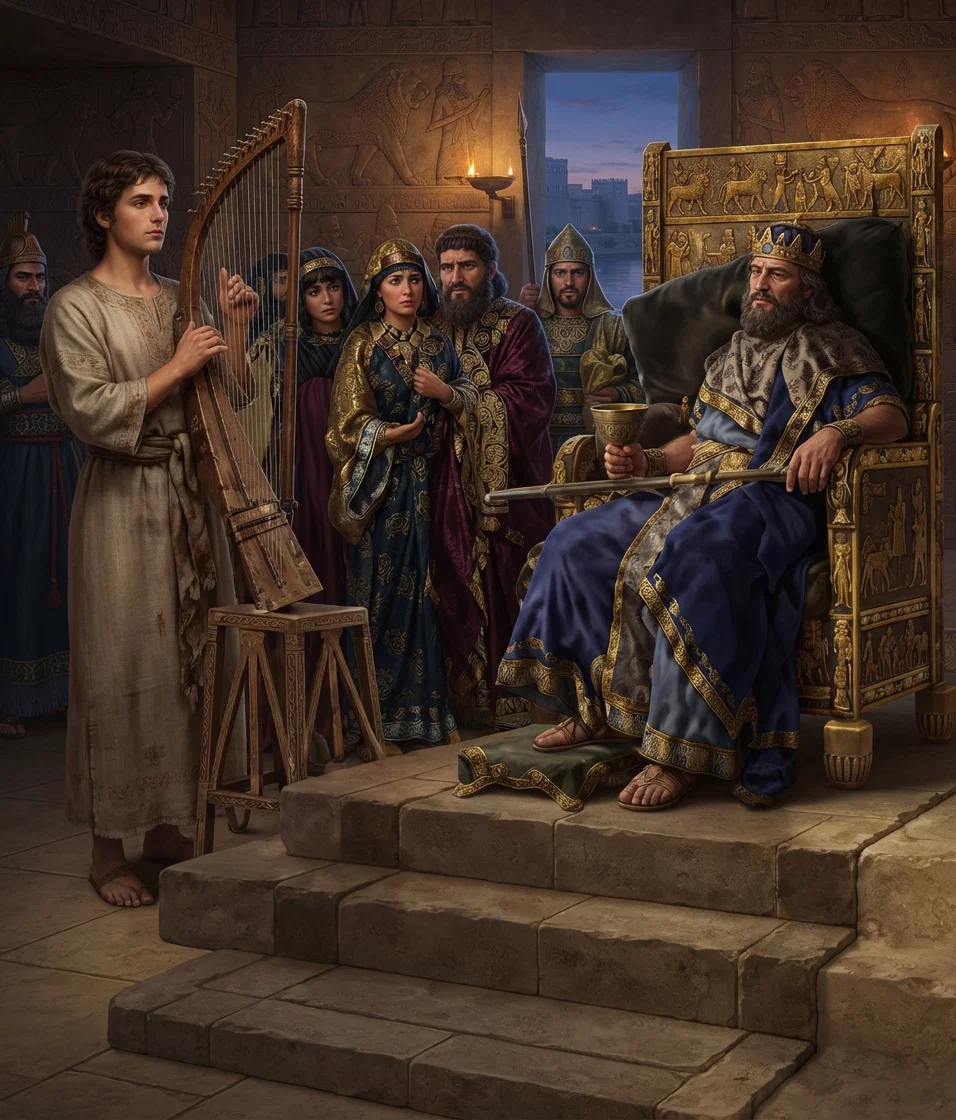
By the willows that bent o'er the edge of the river In Babel of old, a young captive wept sore. The harp that he held in his hand ceased to quiver The songs he had sung on his own native shore— The songs of the saints, that were holy and pure.
The hills and the woodland returned the glad laughter Of maiden and youth as they tripped on the green, To the notes of the flutes that were played—and all nature Herself seemed in tune with the holiday scene. The captive alone was depressed by the scene.
The king of that land had proclaimed an occasion Of revel and feasting throughout this broad realm When he came from his wars with the great Hebrew nation, Whose king, it was said, none on earth could o'erwhelm— Not even the gods could this monarch o'erwhelm.
He sat on his throne by the river. Around him Were gathered the small and the great of the land. As he told of the gold he had carried from Salem, He flourished a temple-marked cup in his hand— The impious king held the cup in his hand.
Having ended his story, he turned from the masses To speak a command to an officer near: "Go fetch us the Hebrew whose singing surpasses The notes of the gods. He shall sing for us here. The songs of his land shall he sing for us here."
The captive is brought to the king's august presence. His arm deftly sweeps o'er the resonant strings Of the harp that he holds in his hand, and the essence Is this of the heaven-born song that he sings— While the revels are hushed by the strain that he sings:
"There's a land that is fairer than springtime; and by it, This earth, with its joys, is a day at its best. There no enemy enters to break up the quiet. The exile of earth finds his rest, sweetest rest. Earth's wandering pilgrim finds rest, sweetest rest."
Then over the sin-hardened face of the ruler, A look of deep longing and tenderness crept, He listened a while to the song of the harper, Then bowed down his head in his hands, and he wept, And many another in sympathy wept.
It is thus runs the story. The song having ended, A soberness settled down over the throng Where before there was revel; and homeward they wended, All sadder, yet wiser, because of the song; And some were made better because of that song.
Ah, how often, amid the confusion of Babel, We go us aside by the river to weep! Allowing our harps in the breeze to swing idle, The songs of our home in our bosoms we keep— The dear songs of heav'n in our bosoms we keep.
If we'd take down the harps we have hung on the willow, And, striking a chord to men's hearts, if we'd sing Of our home of sweet rest, far beyond life's wild billow, Another's might melt, like the heart of the king. Some heart might be blessed by the song that we sing.

Holiness and God's Will

"THERE can be no sinless swerving from the standard of God's word. The first forms of holiness have yet to be learned by the one to whom God's will is not paramount."

Rum and the Starving Child

"RUM enters the house, and strikes the crust from the lips of the starving child."

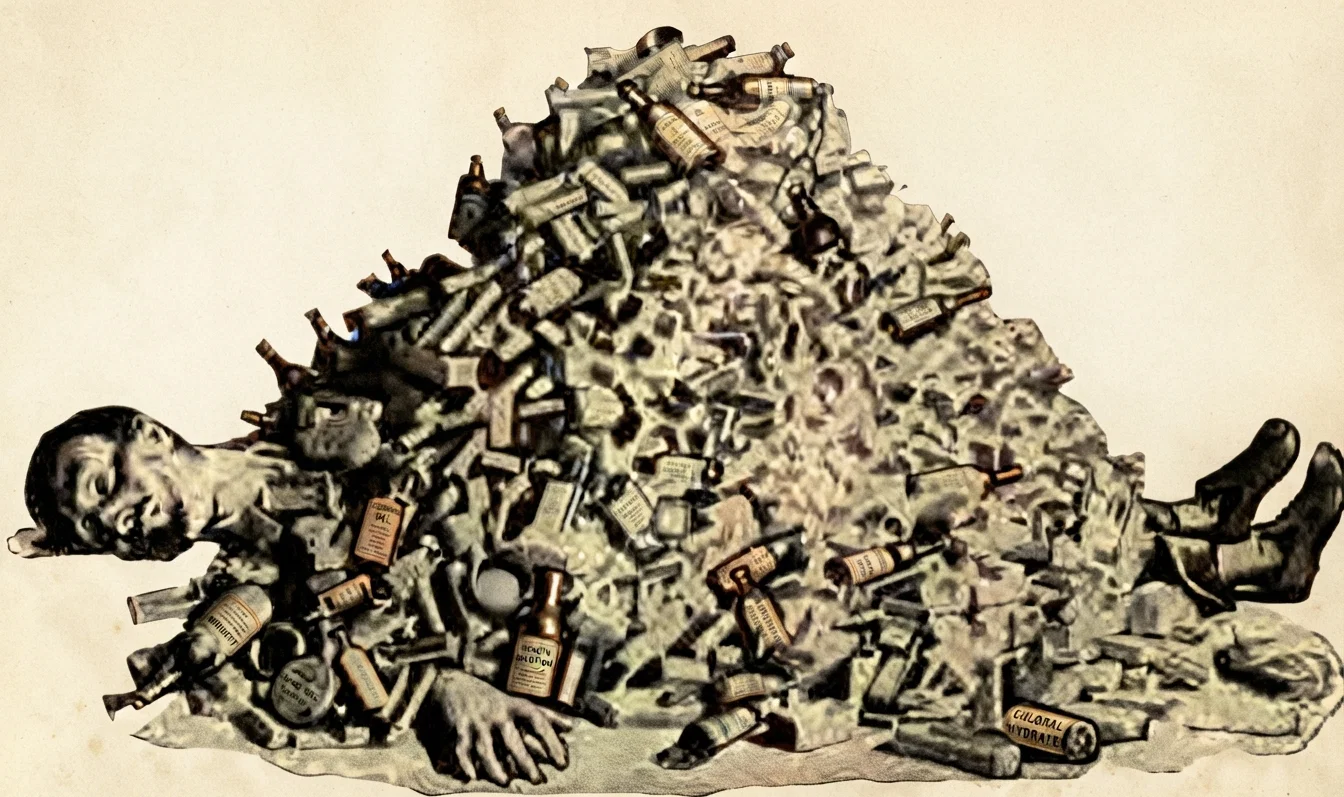
THE DOPE FIENDS

Those Already Made, and Those Who Are Still in the Making

By Daniel H. Kress, M. D.
THE campaign against the drug evil has again been revived by the New York State Anti-Drug League. Last year the league failed in securing legislation to stamp out the traffic in habit-forming drugs. Thousands of public-spirited men and women are back of the movement, determined to obtain what they failed to obtain last year.
In a special to the Washington Herald, September 18, it is said: "The dire need of such a law is emphasized by statements from leading criminologists, members of the bar, and heads of corrective institutions. In New York City alone, authorities agree, are more than one hundred thousand persons who are slaves to the drug evil.
"More than fifty per cent of the inmates of the state prisons owe their downfall, it is declared, to the use of habit-forming drugs. Of the men convicted of the most revolting crimes, more than eighty per cent used habit-forming drugs. Among the underworld, nine out of every ten men and women are drug addicts."

Dope Fiends Among the High-Ups

Drug addiction is not confined to the underworld. It is almost as common among the high-ups. It is also common among literary men and women. Scores of magazine stories, and most of the cheap novels and sensational books of fiction, are written by men and women who receive their inspiration from some habit-forming drug, as cocaine or heroin.
Cocaine is possibly the most dangerous of all drugs. There is no treatment known to science as yet that will cure the habit when once it is thoroughly established. It does not intoxicate like alcohol. It imparts a sense of strength, courage, and self-confidence, unlike any other drug. It imparts a flow of language and a sense of mental clearness as no other drug does. In this lies its fascination. Heroin and cocaine are the two most dangerous drugs we have to deal with in America. Whenever the use of alcoholic beverages is prohibited, men and women seem to resort more and more to the use of these drugs. In the South, among the Negroes, the traffic in these drugs is a constant menace. In England, it now has a strong hold among the soldiers. In America, there are probably more drug fiends in proportion to the population than in any other country in the world.
In speaking of drug addictions, we refer merely to such drugs as cocaine, heroin, and morphine. If these were the only habit-forming drugs consumed in America, it would be a serious enough problem; but there is one habit-forming drug, the use of which is now so common that we seem to ignore it entirely. It holds one hundred victims to every one held by the three others mentioned, and the injury resulting from its use is little short of that resulting from the use of the others. I refer to the inhalation of cigarette and tobacco smoke.

Tobacco and Degeneracy

Tobacco smoke inhalation, as practiced by the boys of America, is doing more to ruin America than opium smoking ever did in ruining China. In China, the smoking of opium was confined to adults almost wholly; while in America, the inhaling of tobacco smoke begins at an age when the brain is undeveloped. Boys who form this habit at the tender age of eleven or twelve years, the age when it is usually formed, are seriously injured. They become moral degenerates, as a rule.
There was a time when I thought this degeneracy was due to heredity, and that cigarette smoking was merely the outgrowth of it, or an evidence of degeneracy; but in dealing with these boys, I have been forced to the conclusion that heredity has not so much to do with it as I once thought it had. Just recently I had before me two boys, both twenty years of age. They both began to smoke at the age of twelve. The one was a waif picked up by two mission workers in one of our large cities. Nothing is known of his heredity. Naturally we would attribute his moral degeneracy to his heredity. The other is the son of a prominent man, both father and mother having a pedigree that is almost blameless. The father never smoked nor used intoxicants, and has always been temperate in his habits; yet this boy is just as much of a degenerate as is the other. Humanly speaking they are both hopeless moral degenerates. Nothing but the grace of God can ever help either of them. Such boys cannot be helped much unless they are placed under restraint for a prolonged period, under good moral and religious influences, and treated as we would treat any other drug addict.
We have hundreds of thousands of such boys in the United States. What will our future men be like, and what hope can there be of the future of the nation itself, if this evil is permitted to sweep in and ruin for life the best and most promising of our future men?

The Greatest Caffeine Users

No other country in the world consumes anywhere near the amount of caffeine per capita that we consume in America. One third of the coffee crop of the world comes to America. Over one hundred soft drinks containing caffeine are sold at our soda fountains. A few years ago, coca cola not merely contained caffeine, but in addition, it had in it traces of cocaine. What it now contains in addition to caffeine I do not know. There are a great many coca cola fiends in America. Most of these are nervous wrecks. The step from coca cola to heroin or cocaine is a short one.
Coffee is used freely in our homes by children. The drug caffeine produces nervousness, and creates a craving for other narcotics, and so leads to the use of cigarettes by boys and women, as well as by men; and later some of these victims are led to the use of heroin or cocaine. From coffee to coca cola, to the cigarette, to drink, and then to heroin and cocaine, are merely so many successive steps in the making of the dope fiend.
The boy who learns to drink tea or coffee at his mother's knee is on a fair way to become a dope fiend. In our fight against habit-forming drugs, it is well for mothers to remember this at least.

About Cocoa and Chocolate

In giving up tea and coffee, many take up with the use of cocoa and chocolate as beverages. While these products do not contain the same amount of caffeine as do coffee and tea, they do contain theobromine, a product identical with caffeine. Coffee contains 175 grains of caffeine to the pound; tea, 97 grains; and cocoa, 59 grains. There are many cocoa and chocolate addicts in the United States. All these beverages belong to the family of habit-forming drugs. Children should not be allowed to use cocoa, chocolate, and other beverages and products that tend to make them restless and nervous; for a nervous child naturally takes more readily to the cigarette, and to the use of other habit-forming drugs, than does the child that is in a normal condition.
The city of New York alone is estimated as having in it one hundred thousand victims of the heroin, cocaine, and opium habit. By all means, let us protect these poor, helpless victims, by laws which prohibit the sale of such drugs to them. But at the same time, let us remove the causes of this evil, by teaching our children, by precept and example, to abstain from the use of those things which create the craving for these drugs. While New York has one hundred thousand of the finished products, it has a great army of recruits back of them. The one hundred thousand dope fiends we are aiming to help are merely heading the procession. Marching behind them, ready to make up the ranks, are the dope fiends in the making. What is true of New York City is true of every city in the United States. We are fast becoming a nation of dope fiends.
Is there no remedy for the drug addict? Whenever possible, it is well to place such cases where they can have ideal moral surroundings, and where suitable treatments can be given. It is surprising, however, to notice what the gospel of Christ can accomplish for such cases. Again and again I have seen men and women freed from this slavery through a surrender of the will to God.
A few months ago, I was invited to a home. The head of the house, who was a confirmed morphine fiend, and had been for many years, wanted to see me, in the hope that he might get some medical aid in his efforts to obtain the mastery. He was certainly in a pitiable condition, and extremely nervous.

Saved from a Horrible Pit

I read to him the fortieth psalm: "I waited patiently for the Lord; and He inclined unto me, and heard my cry. He brought me up also out of an horrible pit, out of the miry clay, and set my feet upon a rock, and established my goings. And He hath put a new song in my mouth, even praise unto our God," etc. Some other helpful scriptures were read. He finally came to the point where he was willing to endure the suffering, and even die, if necessary, in his fight for the mastery.
After a season of prayer, I left. Three months later, I had the satisfaction of learning that the victory was complete, and that now he is a member of the church. He is singing the new song, "even praise unto our God." This is not the only case I have seen delivered without any outside help. The man at the Pool of Bethesda who had no one to aid him to reach the pool, and whose condition appeared hopeless, seemed to have been the special object of Jesus' compassion. We believe that Jesus is still searching for such to help them.

Leading Three Million to Liberty

MOSES was commissioned to lead three million people from Egyptian bondage to the land of freedom. The people whom he was to lead out had been reared in slavery under the very shadow of Egypt's numerous deities. Knowing this, Moses pleaded one particular excuse for not wishing to accept the commission. How was he to convince the people that the God by whose authority he was acting was different from the gods they already knew? So he said: "When I . . . say unto them, The God of your fathers hath sent me unto you; and they shall say to me, What is His name? what shall I say unto them?"
God replied: "Say unto the children of Israel, I Am hath sent me unto you." In other words, tell them that the Self-existent sent you. Make them understand that this is the name by which He was known to Abraham, Isaac, and Jacob, and that this is His name forevermore. Let them know that although He has been lost to their knowledge, He is alive forevermore, as the I Am to fulfill the promise made long ago to Abraham and his descendants. See Ex. 3: 10-15.
But the house of Israel was not easily persuaded, and Moses returned to tell the Lord that the name he had given the people of Israel had not moved them to obey. He said, "Neither hast Thou delivered Thy people at all." Ex. 5: 23. God replied: "Now shalt thou see what I will do to Pharaoh. . . . I am the Lord: and I appeared unto Abraham, unto Isaac, and unto Jacob, by the name of God Almighty, but by My name JEHOVAH was I not known to them." Ex. 6: 1-3.

The Patience That Won

What is the real difference between these names? The first one, El Shaddai, means power. Abraham believed in God's power to provide a city, although his faith viewed it afar off. See Heb. 11: 8-10. The promise to Abraham was not to be fulfilled in his day. He saw in it the coming of Christ, and was therefore willing to wait for its fulfillment, or until the time when the gentiles would be partakers with him through the gospel. Gal. 3: 14-16.
According to the best lexicographers, the other name, Jehovah, signifies performance. This is the rendering of it in Ps. 57: 2. So God really said to Moses, To you, My name shall be Performance in all things pertaining to this time; because I am self-existent, and therefore able to perform without hindrance; and the time for Israel's deliverance, promised to Abraham, has come. Hence when the Red Sea was to be crossed, the performance of God was seen in making a highway through it.
It is this wondrous name that brings to men the performance of things in their behalf. This, indeed, was the strength of David's courage. Hear him: "He restoreth my soul; He leadeth me in the paths of righteousness." And why?—"For His name's sake." Ps. 23: 3. So again in the apostle's teaching: "Whosoever shall call upon the name of the Lord shall be saved." Rom. 10: 13.

Claiming Royal Birth

Thus it may be seen that this name of Jehovah is really the essential of the gospel, which is "the power of God unto salvation." Rom. 1: 16. The Self-existent One must be among men to perform for them. And He actually clothed Himself in the likeness of sinful flesh, in order to reveal Himself to those who need His "performance" in their behalf. Appearing to men as the Son of man, He bestowed upon the apostles a rich blessing, because of their having openly acknowledged Him as the Son of man to be also the Son of God.
The Saviour Himself said, "When ye have lifted up the Son of man, then shall ye know that I am He." John 8: 28. This simply emphasizes Christ's statement that He was the same as the original I AM.
The apostle confirms this thought in saying that while Christ was in the flesh, He was accounted as the seed of David; yet the power of God declared Him to be the Son of Jehovah, by the very act of raising Him from the dead. See Rom. 1: 3, 4. When Christ was risen and ascended to heaven, He flashed back to earth the word that though He had been dead, He is now alive forevermore, and has the keys of death and the grave. See Rev. 1: 18. Thus God in all His attributes is shown in the Lord Jesus, and Jesus has revealed God as the I AM, the Self-existent, the One with infinite power to perform all His will.
Such a God, and such an intercessor as Jesus, encourage us, as children of His by redemption, to lay hold upon the promise of present help, and of a future eternal reward, if faithful. May we constantly realize that God is the ever present I AM.
Continue reading: The SIGNS of the Times