Your ShelfYour Projects

Review and Herald, Vol. 74, No. 51.

The Limit of God's Mercy

Review and Herald

Dec 21, 1897

Seventh-day Adventist Publishing Association · Battle Creek, Mich. · Dec 21, 1897

The Limit of God's Mercy.

MRS. E. G. WHITE.
“Because sentence against an evil work is not executed speedily, therefore the heart of the sons of men is fully set in them to do evil.”
The means which the Lord has employed in the gracious provision of his mercy, to soften and subdue the objects of his love, have, through the workings of Satan, encouraged the depraved and hardened hearts in perversity, resistance, and transgression. Even as far back as the days of David, this led him to exclaim, “It is time for thee, Lord, to work: for they have made void thy law.”
Because of the goodness and long-suffering of God, many have been led to consider and appreciate his mercy and loving-kindness, and this has led them to repentance. On the other hand, many have become more careless, and have abused his mercy. To their own loss and shame, they have followed the will of Satan, irrespective of the retribution that will surely come upon them for their disobedience and transgression. They will yet learn that God is jealous of his honor and his glory. He will not have his laws trifled with. Men cannot with impunity treat them with indifference and defiance.
If God had decided, in his councils in heaven, to visit the transgressors of his law with instant death, there would have resulted a much greater restriction of the inclination to do those things that are offensive to God. The very men who seem to be dead to entreaties and warnings sent in mercy by God, those who will not be deterred from their evil course of action, would be prudent to save their lives, even if they had no love for God. But the Lord's arrangement, made in council with his only begotten Son, was to leave men free moral agents to a certain length of probation. His eye would discern all their works, but he would compel no man's service. If the love displayed in his long-suffering and patience could not bring them to repentance and perfect surrender to the laws of his kingdom, then they must be left to choose whom they would serve. Their life must testify of their choice. If men love transgression, and choose to disregard his laws, after sufficient test and trial their case is forever decided. God cannot have such as members of his family in heaven. Their punishment will be in accordance with the character of their defiance and rebellion against God.
A vast reformation would be wrought in the world if the veil of the future could be lifted, and all could see that very soon there is to be a change in the attitude of God, in his dealings with the perversity of man; that there are limits to divine mercy and forbearance. There are those who, by their impenitence under the beams of light that have shone upon them, are very near the line where the forbearance of God is exhausted. In mind and heart they are saying, “The Lord delayeth his coming,” and they are eating and drinking with the drunken. But God declares of such that “sudden destruction cometh upon them,” “and they shall not escape.”
The present time, when great light is shining forth from the Word of God, making dark mysteries plain as day, is the day of mercy, of hope, of assurance, of joy, for all who will be benefited thereby, for all who will open their minds and hearts to the bright beams of the Sun of Righteousness. But there are those who will not come to the light, who despise the truth because it exposes error and transgression and sin; and as a result, boldness in transgression is becoming all-pervading.
The time is very near when men will reach the prescribed limits. They have now almost exceeded the bounds of the long-suffering of God, the limits of his grace, the limits of his mercy. The record of their works in the books of heaven is, “Thou art weighed in the balances, and art found wanting.”
The Lord will interfere to vindicate his own honor, to repress the swellings of unrighteousness and bold transgression. He will not be left without witness. The one-hour laborers will be brought in at the eleventh hour, and will consecrate their ability and their entrusted means to advance the Lord's work. While many have reduced the Word, the truth, the holy law of Jehovah, to a dead letter, and by their example testify that this law is a hard, rigorous burden; while they say, “We will lay off this yoke, we will be free, we will no longer remain in covenant relation with God, we will do as we please,” there will be men who have had very meager opportunities, who have walked in ways of error because they knew no better way, to whom beams of light will come. As the word of Christ came to Zacchaeus, “I must abide at thy house,” so the word will come to them; and those supposed to be hardened sinners will be found to have hearts as tender as a child's, because Christ has designed to notice them. Those will receive the reward for their faithfulness because they are true to principle, and shun not their duty to declare the whole counsel of God. When those who have had abundance of light throw off the restraint which the Word of God imposes, and make void his law, others will come in to fill their place and take their crown.
In all parts of the world there are diligent students of the Word of prophecy, who are obtaining light, and still greater light, from their study of the Scriptures. This is true of all nations, of all tribes, and of all peoples. Many will come from the grossest error, and will take the place of those who have had opportunities and privileges, and have not prized them. These have worked out their own salvation with fear and trembling, lest they should become deficient in doing the ways and will of God; while those who have had great light have, through the perversity of their own natural heart, turned away from Christ because displeased with his requirements. Even many supposed to be heathen will take the side of Christ, while those who become offended, as did the disciples in the synagogue at Capernaum, will go away, and walk no more with him.
From time to time the Lord has made known the manner of his working. He is mindful of what is passing upon the earth; and when a crisis has come, he has revealed himself, and has interposed to hinder the working out of Satan's plans. With nations, with families, and with individuals, he has often permitted matters to come to a crisis, that his interference might be marked. Then he has made known the fact that there is a God in Israel who will sustain and vindicate his people.
In Noah's day, men had disregarded the law of God until almost all remembrance of the Creator had passed away from the earth. Their wickedness reached so great a height, violence, crime, and every kind of sin became so intensely active, that the Lord brought a flood of water upon the earth. Yet mercy was mingled with judgment. Noah and his family were saved, but the wicked inhabitants of the world were swept away. In the destruction of Sodom and Gomorrah, also, when fire came down from heaven and destroyed those wicked cities, we see that the Lord will interfere for his people.
In these last days wicked men and professed Christians will harmonize in their hatred of the law of God. Then the crisis will come; then we shall see the class specified in Mal. 3: 13-15: “Your words have been stout against me, saith the Lord. Yet ye say, What have we spoken so much against thee? Ye have said, It is vain to serve God: and what profit is it that we have kept his ordinance, and that we have walked mournfully before the Lord of hosts? And now we call the proud happy; yea, they that work wickedness are set up; yea, they that tempt God are even delivered.” Here is a company of disaffected professed Christians, whose chief business is to murmur, and complain, and accuse God by accusing the children of God. They see nothing defective in themselves, but very much that is displeasing in others.
But while they are murmuring, and complaining, and falsely accusing, and doing Satan's work most zealously, another class is brought to our notice: “Then they that feared the Lord spake often one to another: and the Lord harkened, and heard it, and a book of remembrance was written before him for them that feared the Lord, and that thought upon his name. And they shall be mine, saith the Lord of hosts, in that day when I make up my jewels; and I will spare them, as a man spareth his own son that serveth him. Then shall ye return, and discern between the righteous and the wicked, between him that serveth God and him that serveth him not.”
In this time of prevailing iniquity, the Protestant churches that have rejected a “Thus saith the Lord,” will reach a strange pass. They will be converted to the world. In their separation from God, they will seek to make falsehood and apostasy from God the law of the nation. They will work upon the rulers of the land to make laws to restore the lost ascendency of the man of sin, who sits in the temple of God, showing himself that he is God. The Roman Catholic principles will be taken under the protection of the state. The protest of Bible truth will no longer be tolerated by those who have not made the law of God their rule of life.
And what effect will these attempts of men to make void the law of God have upon the righteous? Will they be intimidated by the almost universal scorn that is put upon the law of God? Will the true believers in the “Thus saith the Lord,” become wavering and ashamed because the whole world seems to despise his righteous law? Will they be carried away by the prevalence of evil?—No; to those who have consecrated themselves to God to serve him, the law of God becomes more precious when the contrast is shown between the obedient and the transgressor. In proportion as the attributes of Satan are developed in the despisers and transgressors of the law of God, to the faithful adherent the holy precepts will become more dear and valuable. It is the ones who have been faithful stewards of the grace of God, whose love for God's commandments grows with the contempt which all around would put upon them.
When the defiance of God's law is almost universal, when his people are pressed in affliction by their fellow men, God will interpose. Then will the voice be heard from the graves of martyrs, represented by the souls that John saw slain for the Word of God, and for the testimony of Jesus Christ, which they held,—then the prayer will ascend from every true child of God: “It is time for thee, Lord, to work: for they have made void thy law.” The fervent prayers of his people will be answered; for God loves to have his people seek him with all the heart, and depend upon him as their deliverer. He will be sought unto to do these things for his people, and he will arise as their protector and avenger. “Shall not God avenge his own elect, which cry day and night unto him?”

THE ABIDING ONE.

“He shall give you another Comforter, . . . that he may abide with you forever.”
Earth’s sweetest friendships hold a blight That bringeth anxious sorrow; The joy that fills the heart to-day, May sadness be to-morrow; The loved one welcomed by the heart, Ere set of sun may hence depart.
Yet there’s a fellowship most sweet,— The “love life” of the Spirit. Not needful that we hear the voice: Long distance cannot mar it. High mountains may between us rise; At his dear feet, more strong the ties.
His own their great heart-need revealed When he well-nigh was leaving; But, ah! the words that moment dropped Seemed to enhance their grieving. They needed but the touch of God To make them fully understood.
But wait the Holy Spirit’s day, The promised, glad outpouring; Are these the same weak, faltering ones, Made new with his restoring? O sweetest thought! this inner Guide Comes in his temple to abide!
No trial-blow can e’er be given To one who knows the Spirit, But what will be, in his dear hand, The power to lift and cheer it. Of every sorrow we must bear, The Spirit has his own large share.
So be the cloud or sunshine thine, Each keeps thy graces growing; The One who comes to dwell in thee, Will guard his own sure sowing. Till some glad day, in love’s sweet flow, He’ll tell us all we long to know.
— Carrie Merrall, in the King’s Messenger.

THE CENTER OF THE UNIVERSE.

L. A. REED.
(Jacksonville, Ill.)
Error and truth on any particular point cannot reside in the same mind at the same time. Error and truth are opposites: the one is entirely antagonistic to the other. A particular error retained in the mind keeps out of that mind the opposite truth. In astronomy for ages one radical truth was not generally apprehended. It was the truth that the earth is not the center of the universe. This idea, that the earth was the center, was the great mistake which for ages held men from any large advancement in astronomical science. All their investigations were colored by it; and tried by it, the whole universe of the visible heavens was woefully out of joint. The whole system of ancient astronomy was built upon a huge mistake.
“Men held, as a fact of absolutely unquestionable certainty, that this earth of ours—this small whirling globe, less than eight thousand miles in diameter—was a vast and immeasurable plain, extending to perhaps infinite distances, and firmly fixed upon immovable foundations. They held that around this great and motionless center moved the other heavenly bodies—a little sun, a little moon, and a few thousand tiny stars, all placed near, for the sole purpose of lighting and warming our mighty earth.”
“The one entirely accepted fact being that of our earth as the moveless center of all things, other matters had to fit in with that theory as best they might. The study of the skies was long hopelessly hampered by this one stupendous error. It is singular to glance through records of early astronomical notions, and see the variety of theories that arose, one following another, all designed to explain the things which were seen to happen, all hopelessly wrong, because of this one foundation mistake.
“The early Greeks at one time steadfastly believed the sun to be a torch, the stars to be candles, by turns lit and put out. One of their philosophers improved, later, upon the theory, by maintaining that the stars were a kind of meteors, an emanation from our earth,—a sort of ‘terrestrial effluvia.’
“Another explanation in vogue among them was that our earth floated in a boundless ocean; and that when the sun vanished at night, he was boated by Vulcan round the north pole, behind certain lofty mountains, which served to hide his radiance, and so he reached the other side in time for next morning’s due appearance.” “After a while it became evident to their minds that this explanation was hardly satisfactory. Then they conjectured that the earth, instead of floating on the waters of an ocean, was built upon enormous pillars, and that the sun really did go down at night underneath the earth, finding a passage among the said pillars, and coming up on the other side.”—“Radiant Suns,” pages 15, 16.
So men clung to the idea that the earth was the center of all things, tried everything by it, and tried to make everything harmonize with it. But truth cannot be harmonized with error; and so, holding error as their very foundation, progress toward the truth was frightfully slow.
Such a basal truth I had long believed must be in the Word, though I could not find it. The Word is a perfect guide for every age and every condition, and so this truth must be there. At last I have found this truth revealed in more than one place. The one most significant to me on this point is Job 26:14. From the rendering in our Authorized Version, we do not catch the idea at all. There is little wonder in this, however. God spoke the truth in the Hebrew language, and there it was; but when our translators attempted to state the same truth in the English language, they were either unable or afraid to give it the literal rendering. It could not mean just what it said; yet there it was all this time, waiting the mind that could take it in. Knowledge has advanced; men now see that it can be literally true.
I have special reference to the first clause of the verse, which reads, “Lo, these are parts of his ways.” I have found one other translation similar to this, with a note upon it: “Lo, these are parts of his ways; and what whisper-word is heard of him!” “The word rendered ‘parts’ signifies the ‘extremities of lines,’ mere points; but I know not of any good English word which I could substitute. The ‘whisper-word’ is the barest literal rendering, and it is too beautiful to be lost, as in the common version.”—Dr. Pye Smith.
From this authority we find that the word rendered “parts” means the “extremities of lines;” e. g., “the ends of lines,” or “the outlying points.” “Lo, these are the outlying points of his works.” And in harmony with this idea we have several other translations of good authority:—
“Lo, these are but the borders of his works; how faint a whisper we have heard of him!”—Noye’s Translation.
“Lo! these are only the outlying borders of his works. What a whisper of a word we hear of him!”—As quoted by Henry White Warren, D. D.
“Lo, these are but the outskirts of his ways: and how small a whisper do we hear of him!”—Revised Version.
All these translations help us to catch the load of meaning in the original, and their combined testimony shows that this verse is up with all the astronomical science of the present day,—yes, and infinitely ahead of it, daring to assert as certainty what astronomers regard as probable.
And when men have caught glimpses of these sublime truths, and have sought to express their awakened emotions, do you know that the Scriptures alone give them language adequately sufficient for their thoughts? It has taken the almighty power of God to make human language sufficient to express his infinite truths. Says an astronomer of no little note: “However vast the universe now appears, however numerous the worlds which may exist within its boundless range, the language of Scripture, and Scripture alone, is sufficiently comprehensive and sublime to express all the emotions which naturally arise in the mind when contemplating its structure. This shows not only the harmony which subsists between the discoveries of revelation and the discoveries of science, but also forms, by itself, a strong presumptive evidence that the records of the Bible are authentic and divine.”—Elijah H. Burritt, A. M.
“Lo, these are but the outskirts of his ways,” and the word “these” refers not alone to the earth, but also to the garnished heavens, as mentioned in the verses preceding. We may study the expanded heavens as we may, we may gather our facts so many as we can, we may get as large a conception of space as is possible; but, work and toil as we may to the extent of our abilities, we shall never get beyond this verse. It will never grow old. Human minds will never frame in better words the truth it contains. Human minds will never, either here or hereafter, find all the infinite depths of its meaning. It is an infinite truth.
It does not say, it is true, that the earth is not in the center of the universe; but it tells infinitely more than that; for though it does not say where the earth is not, it does define just where the earth is,—on the outskirts. If it is on the outskirts, it certainly cannot be in the center. And as the garnished heavens which we see, are also but “the outskirts” of His works, and as these are but a “faint whisper” of the word that was spoken (Ps. 33: 6, 9), then it must be an immense distance to that center, if there be any.
But why did men think that the earth was the center of the universe? What led them to this conclusion?—The apparent motion of the heavenly bodies was probably one great reason why they believed as they did. But there is a certain fitness, after all, in a self-centered man’s believing in an earth-centered universe. He who thinks himself a pope, a judge, or the mainstay and center of humanity, around whom all the rest of mankind must revolve, like planets and satellites, can easily frame a universe in which his earth shall be the one fixed, all-important center. Such an idea seems to him exactly right. But consider for a moment the conceit that resides in it. Since all on the earth must be, or ought to be, subservient to him, and since all things in the universe are subservient to the earth, it follows, logically, that all things in earth and heaven are subservient to him; that is, he is the center of the earth, and since the earth is the center of the universe, then he is the center of the center of the universe. Such nonsense! Yet it is the heathen rendering of, “All things are yours.”
But the self-subdued man is prepared to view all this far differently. He knows that there are others as important as he. He esteems them better even than himself. He has been taught “not to think of himself more highly than he ought to think.” He has learned that we are “every one members one of another.” He does not seek to lord it over God’s heritage, knowing that it is God’s heritage. To such a man it seems highly appropriate that this earth should be but a speck, the extremity of a line, in immensity; and that it is not nearly so important an affair in the machinery of the universe as the untamed intellect might contrive.
By these two views we are shown that the material is to be seen through the spiritual, being spiritually discerned. And, too, we see that the unregenerate man labors at a tremendous disadvantage in seeking to understand God’s works; and thus we realize something of the blessed import of the term “Christian education.” Last of all, we are more and more confirmed in our belief that the Word is an all-sufficient guide to man; and, furthermore, that the Word of God and the works of God are indissolubly connected,—the works testifying of the Word, for they are its manifestation; and the Word testifying of the works, for it made them.

GOD CALLING YET!

From the German.
God calling yet! shall I not hear? Earth's pleasures shall I still hold dear? Shall life's swift-passing years all fly, And still my soul in slumber lie?
God calling yet! shall I not rise? Can I his loving voice despise, And basely his kind care repay? He calls me still. Can I delay?
God calling yet! and shall he knock, And I my heart the closer lock? He still is waiting to receive; How shall I dare his Spirit grieve?
God calling yet! O, shall I give No heed, but still in bondage live? I wait, but he does not forsake; He calls me still; my heart, awake!
God calling yet! I cannot stay; My heart I yield without delay; Vain world, farewell! from thee I part; The voice of God has reached my heart.
— G. Tersteegen.

THE SOUND OF THE TRUMPET, THE ALARM OF WAR.

A. O. TAIT.
(Battle Creek, Mich.)
To get before the mind of the reader again the great fact that an intense spirit of war is to characterize the days just preceding the second coming of Christ, it will be well to quote one of the prophecies presented in the preceding article. It reads: “My bowels, my bowels! I am pained at my very heart; my heart maketh a noise in me; I cannot hold my peace, because thou hast heard, O my soul, the sound of the trumpet, the alarm of war.” Jer. 4:19. As stated in last week’s paper, the verses following this quotation from Jeremiah show very clearly that the prophet is viewing the scenes of the last days.
By permission of the “Scientific American.” The “Indiana,” a modern iron-clad, and one of the best and most powerful men-of-war of to-day.
There is nothing that more impressively marks the literal fulfilment of the prophecies concerning the warlike condition of the world in these last days, than a view of one of our modern war-ships. The marvel of the whole world is that this marine fighting-machine has been developed so suddenly. Prof. R. H. Thurston, of Cornell University, in the North American Review, December, 1897, speaking of the American navy, says that “this fleet—exemplifying the marvelous ingenuity of the American mechanic and inventor, the wonderful constructive skill of the marine engineer and naval architect, and the most extraordinary of all modern combinations of accurate design, with beautiful and exact construction, and demanding the highest skill of most thoroughly trained officers for its management, concentrating in minimum space maximum power, and uniting offensive and defensive power as does no other product of science and skill—is the outcome of but ten years of work on the part of our engineers, naval constructors, and ship-builders.” Note that these modern war-ships “unite offensive and defensive power as does no other product of science and skill;” and further, that this skill “is the outcome of but ten years of work.” Who would have believed, twenty-five years ago, that such results would be achieved so soon! But we are in the time of fulfilling prophecy, and should expect to see marvelous things produced by sudden developments.
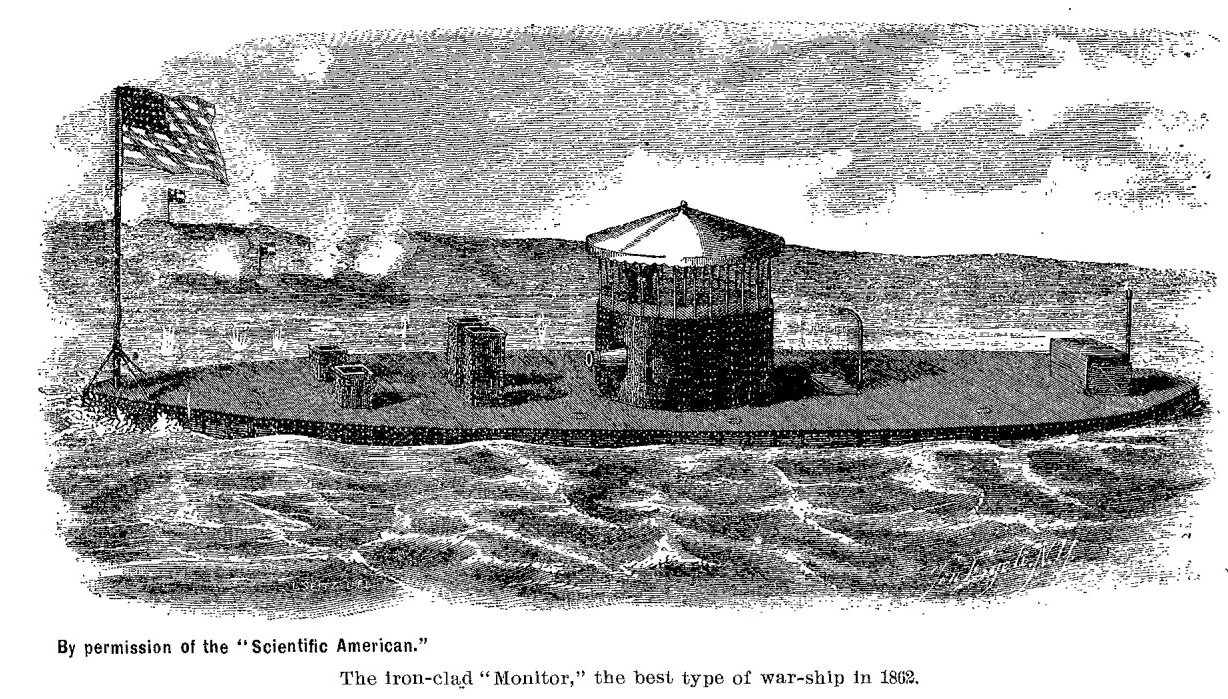
Perhaps the sudden developments in the terrible fighting qualities of the modern man-of-war can be more fully brought before the mind by contrast. The “Monitor,” represented on the following page, insignificant as it would appear to us now, steamed into Hampton Roads, March 9, 1862, just in time to defeat the “Merrimac,” and thereby keep her from destroying the Northern fleet. There is no telling what different turn the Civil War might have taken if the “Monitor” had not been invented and built just at the time she was.
“The ‘Monitor’ was a flat-bottomed vessel of about thirteen hundred tons’ displacement, armored on the sides and on the deck, which was only eighteen inches above the water. She carried a single revolving turret, mounting two eleven-inch smooth-bore, muzzle-loading guns, which could be fired only once in seven or eight minutes. The side armor was made up of five one-inch plates, tapering to three inches at the bottom, on twenty-three inches of backing. The deck was formed of two one-inch plates on six inches of wood. The turret was made up of eleven thicknesses of one-inch plate.” The “Merrimac,” against which the “Monitor” fought in that memorable battle, had her sides armored with four-inch plates, and over her deck a sloping roof was built with iron armor of about the same thickness. But this armor of the “Merrimac,” light as it may seem to us now, was sufficient to resist the shots of the “Monitor’s” guns throughout the whole day of their hard fight.
But turning from the “Monitor” and the “Merrimac,” both of which were the marvel of their time, and from the battle between them, the details of which are familiar to all, note the terrific power of the modern war-ship. The “Indiana,” represented in our illustration, is 348 feet long, 69 ft. 3 in. broad, and her displacement is 10,288 tons. She has four thirteen-inch guns, two in her revolving turret forward and two in her revolving turret aft; also eight eight-inch and four six-inch guns to complete her main battery. Her secondary battery consists of twenty six-pounder and six one-pounder “rapid-fire” guns, and four Gatling guns. All her guns are, of course, of the breech-loading type. Her steel armor is eighteen inches thick, and she cost $3,020,000. Mention should also be made of the frightfully destructive torpedoes with which all these men-of-war are provided, but it will be necessary to reserve a description of them for another article.
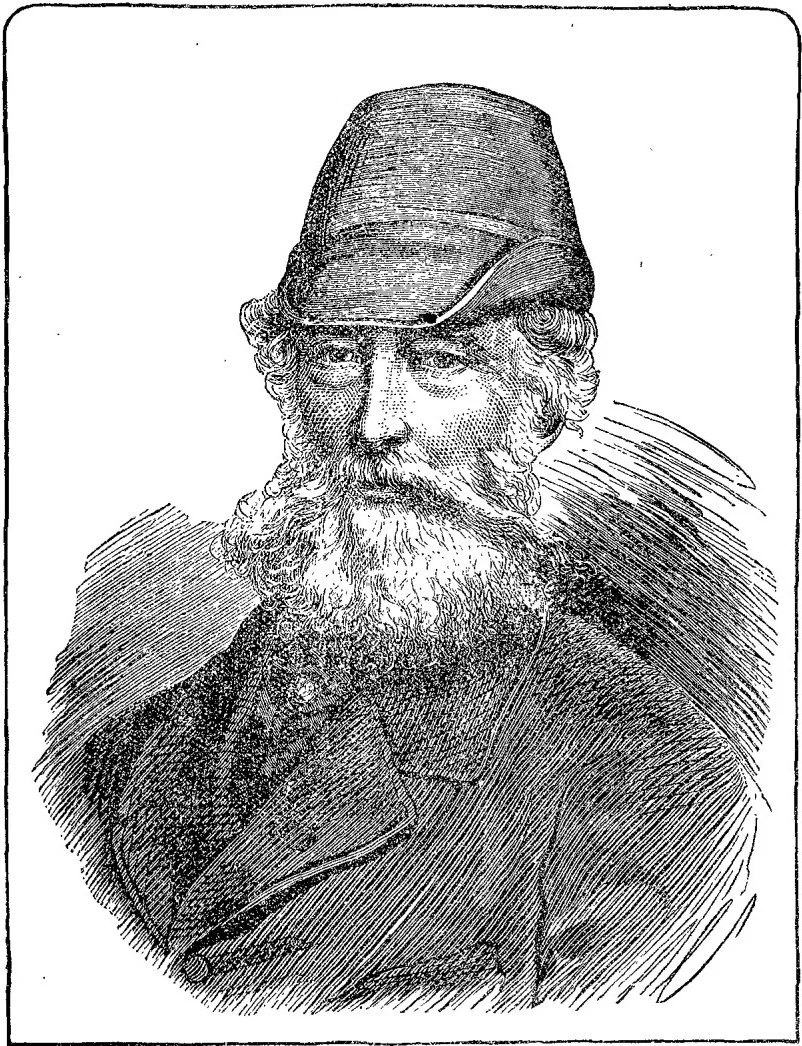
By permission of the "Scientific American." The late Alfred Krupp, of the great Krupp gun and iron works, Essen, Prussia. His works employ over 20,000 men, largely in making guns.
Each pair of her thirteen-inch guns can be fired every three minutes, and each pair of the eight-inch guns, once a minute. The six-inch guns can be fired twice a minute, and the six-pounders, twenty times a minute. In an engagement of only thirty minutes, she would discharge, with furiously murderous velocity, a total of 83,600 pounds, or something over forty tons, of steel projectiles. She would not deign to train one of her big guns on such a craft as the “Merrimac” or the “Monitor;” for a few minutes’ work from one or two of her smaller pieces would soon settle the fate of all such structures.
And the eleven-inch guns of thirty years ago that had to be loaded at the muzzle, and with their consequently short, stubby barrels, must not be confused with the eleven-inch guns of to-day. Then, a charge of from ten to sixteen pounds of powder was considered large, and a ball weighing from forty to one hundred and eighty pounds was the maximum. A few inches of iron armor was all that was needed to withstand the shots from such guns. But the modern breech-loading gun, as shown in last week’s paper, hurling, with all the force generated by the explosion of half a ton of powder, a steel shot weighing as much as a ton, is an altogether different weapon.
Men who are trained to war stand in awe of the frightful thought of bringing this modern fighting machinery into action. When we consider how suddenly it has appeared, and with what almost superhuman rapidity it is developing, who can doubt that the deadly weapons for the “battle of that great day” are now being hurriedly put in readiness for the final struggle? Are not the nations fulfilling the word, “Prepare war”? Joel 3:9.
Do you ever take the time to consider how the Spirit of God, through the Testimonies as well as the Bible, has been trying to awaken us to the situation about us to-day? With these fulfilling prophecies in mind, read the following:—
All heaven is represented to me as watching the unfolding of events. A crisis is to be revealed in the great and prolonged controversy in the government of God on earth. Something great and decisive is to take place, and that right early. If any delay, the character of God and his throne will be compromised. The armory of heaven is open; all the universe of God and its equipments are ready. One word has Justice to speak, and there will be terrific representations upon the earth, of the wrath of God. There will be voices, and thunderings, and lightnings, and earthquakes, and universal desolation. Every movement in the universe of heaven is to prepare the world for the great crisis.
Intensity is taking possession of every earthly element; and as a people who have had great light and wonderful knowledge, many of them are represented by the five sleeping virgins, with their lamps but no oil in their vessels,—cold, senseless, with a feeble, waning piety. While a new life is being diffused, and is springing up from beneath, and taking fast hold of all Satan’s agencies, preparatory to the last great conflict and struggle, a new light and life and power is descending from on high, and taking possession of God’s people who are not dead, as many now are, in trespasses and sins.—Special Testimony entitled, “An Appeal to our Ministers and Conference Committees,” pp. 38, 39.
The iron-clad “Monitor,” the best type of war-ship in 1862.
“Intensity is taking possession of every earthly element.” Do you see that it is really so? Are you, in company with “all heaven,” “watching the unfolding of events”? The rapidity with which the work is going on shows that the end cannot be far off. Are you ready for it? Are you seeking to lead others to a knowledge of what all these things mean? Above all, are you, by every word and act of your life, pointing them to the only refuge, the sympathizing and tender Saviour? “Arise ye, and depart; for this is not your rest: because it is polluted, it shall destroy you, even with a sore destruction.”
Continue reading: PREPARING FOR WAR