Your ShelfYour Projects

Review and Herald, Vol. 74, No. 51.

The Limit of God's Mercy
Earlier text: How to Be Patient

AMONG THE CHINESE IN HONOLULU.

On the 25th of March I received a telegram from the Foreign Mission Board, requesting that Mrs. Howell and myself “prepare immediately for Honolulu.” I was then engaged in teaching in Healdsburg College. Though loath to leave the work with which I had been intimately connected for three years; teachers whose association had come to be that of personal friends as well as of fellow laborers; students whose welfare I sought, and whose respect I enjoyed; and the place where some of the most trying, and yet the most profitable, experiences of my life were met with,—nevertheless some degree of acquaintance with the openings and needs of the work among the Chinese in Honolulu, together with a willingness to respond when the Lord calls, prompted me to offer my resignation to the college board, in order to accept this invitation to a foreign field. My resignation being immediately acted upon, I at once planned to leave on the first steamer, as the demand for help in Honolulu seemed very urgent. By rapid work I was able to leave Healdsburg on the 31st of March.
The evening before my departure, the teachers and students arranged a farewell meeting at the Home, of which I had been a member during my entire stay in Healdsburg. Constant association with the members of the Home family, in the capacity of one trying to be of service to them, had endeared to me the faces of those who gathered that evening to bid me, and those to follow me later, Godspeed in our future work, with some recognition of the past. The kindness and respect shown me then will not be forgotten. With much interest I shall watch the future development and work of those whom it was my lot to instruct in Healdsburg. I left that field, not with a satisfied feeling in regard to the work I had done there, but with some measure of consolation that I had done what I could, and praying that those who succeeded me might do much better.
I sailed from San Francisco, April 3, by the steamer “Mariposa.” Owing to my sudden disconnection with the school work in Healdsburg, and to some uncertainties about that in Honolulu, it was thought best for Mrs. Howell to remain in Healdsburg till the close of the school year. Accordingly, I came on alone, bringing only my trunk with me.
After an uneventful passage of seven days, I reached Honolulu on Sabbath morning, April 10. For the first time I was in a tropical land, to work for a strange people. After six months’ wearing labor in the school and Home at Healdsburg, I assumed the responsibilities of the Chinese school and Home in Honolulu, Tuesday, April 13.
At the General Conference in 1895, Brother and Sister H. H. Brand, who had had considerable experience in the Chinese work in Chicago, were asked to come to Honolulu to start the work here among that people. After two years’ arduous labor, they had won the respect and confidence of not only the boys whom they taught in their school, but also of the Chinese in highest official positions in the government, including the consul and vice-consul, and of the most intelligent merchants in the city. To say that these faithful servants worked against great odds during this time, is putting it very mildly. The missionaries of other denominations had already established a thriving boarding-school for Chinese boys, and did not feel at ease when this school began to draw boys of the best class in town. They frequently followed up those who had entered Brother Brand’s school, and in some cases compelled them to withdraw. Besides, Brother Brand’s experience in the Chinese work led him at times to take steps in conducting it here that were not always understood by those outside the Chinese themselves. But by patient perseverance, Brother and Sister Brand brought the work to where the Chinese requested him to open a boarding-school for their boys, stating that they wished them to be taught the English language, to be carried into the higher studies as fast as they were capable, and that they were willing that they should be taught the Bible just as it reads.
Accordingly, after careful searching, Brother Brand secured a place outside the business part of town, formerly the residence of a native chief named Nawahi (Nā-wā-hōe), and now known as “Nawahi Place.” A better location for this kind of work could not be found. The grounds are level, but of sufficient elevation to afford good drainage. They lie in the direct path of the northeast trade-winds, which blow here eight months in the year, and which reach us at this point by coming through Nuuanu Pali, a notable pass in the range of mountains skirting the eastern coast of Oahu Island. During the continuance of these trade-winds, the Pali is veiled in beautiful white clouds from the ocean just beyond. These bring to us almost daily showers, freshening and cleansing the atmosphere. As the wind and rain are about the only natural purifying agencies we have in this warm climate, our being thus favored is of no small importance.
In one corner of the grounds an artesian well furnishes an abundant supply of the best water obtainable in Honolulu. The city water is drawn from large reservoirs on elevated ground, in such a position that they catch the surface water when it rains; it is therefore impure.
We are located sufficiently far from the business part of the city to make our moral surroundings favorable, and yet are on the main street-car line, ten minutes’ ride from the center of town.
About the most unfavorable feature of our situation is that we are surrounded on four sides by rice-lots and sweet-potato patches, the only outlet being a driveway about three hundred feet long by thirty-six feet wide, leading to the street in front. Rice-lots have standing water in them constantly, except a short time before the grain ripens and during harvest. However, as this water is frequently changed or renewed, it does not become as foul as stagnant water usually does, though in this warm climate anything capable of souring sours very quickly.
By speaking of rice-lots and sweet-potato patches, I do not wish to convey the impression that we are out in the country; for we are near enough town to enjoy its facilities, though far enough out to escape its corruption. Adjoining our lot is the residence of the British consul; on the opposite side of the street is the government reform school; a little beyond is the Chinese hospital recently erected; and half a mile farther out are the Kamehameha (Kā-mā-hā-mā-hā) schools and the Bishop Museum, richly endowed from the royal estate. The property we occupy is a portion of the royal lands, and cannot be purchased. It is usually leased for terms of five years. The present lease is held by a Chinaman, and is sub-let to us. It expires in a little more than a year, when the Chinese friends of our school hope to renew it for five years or more.
The grounds lie in a rectangle one hundred and seventy-five by two hundred and fifteen feet in extent, about one hundred and fifty feet back from the street. The driveway is lined on both sides by eighteen stately royal palms and thirteen smaller ones. Alternating with these are oleander bushes from ten to fifteen feet high, some bearing red and some white blossoms. Near the main building, on each side of the entrance, is a banian-tree, whose branches measure about eighty-five feet from tip to tip, affording abundant shade for our boys to enjoy the open air. Still nearer the building are two Norfolk pines, imported from the Norfolk Islands, straight and slender, reaching thirty or forty feet skyward. In other parts of the grounds are six ponciana regias, two small magnolias, and one native plum-tree. Directly in front of the entrance is a small fish-pool encircled with foliage plants and ferns.
The buildings are very old and badly run down, though once, doubtless, the main one was a mansion. In their general plan they are well adapted to our purpose. The main building stands in the center of the grounds, and consists of a main part thirty by forty feet in size, with an “L” thirty-seven by fifteen feet. The former is used for our living-rooms, and the latter for schoolrooms. Three sides of the main part and one side of the L contain a veranda seven feet wide, which affords protection from the heat and rain. The L is divided into two schoolrooms of nearly equal size. If proper arrangements can be made, the Chinese wish to build a T to this L in such a manner as to secure good light and air for all the rooms.
The dormitory, which is about eighty by twenty-five feet, was formerly occupied by servants to the royal family, but is now in very poor condition. It will accommodate about forty boys, by close economy of space, with sleeping apartments, dining-room, and kitchen. It is divided into five large rooms of nearly equal size, and five smaller ones of uniform capacity. The estimate of forty boys is on the basis that six occupy each of the larger rooms, and four each of the smaller. At the present writing we have twenty-seven boys in the Home, so that we could accommodate thirteen more. But the recitation-rooms have nearly every seat occupied, day-scholars increasing the attendance to nearly fifty.
When I reached here in April, there were fourteen boarding-students, with sufficient day attendance to increase the number to thirty-two. As soon as I took charge of the school, Brother and Sister Brand, according to previous intention, began preparations to go to another island to start the Chinese work there. As they were anxious to open their new school as early in the season as possible, I sent for Mrs. Howell, by the first mail (two weeks after my arrival) to come immediately to my assistance; and as there was abundance of work for us all, I urged the board to send Mrs. Kinner also, as soon as she could be relieved from her work as preceptress and matron at Healdsburg College. They both arrived in Honolulu, May 25, and joined me in the work.
Brother and Sister Brand then went to Hilo (Hee-lō) on the Island of Hawaii, the largest of the group. Hilo is a growing town, and contains large numbers of Chinese. It is just now having a boom, through the coffee industry. There is every reason to believe that Brother and Sister Brand will do as faithful and successful work there as they did here, though there, as well as here, it cannot be built up in a day.
As to the class of boys in our school, they are all of good families, some of the very best. Among them are included the son, grandson, and nephew of the vice-consul; two nephews of the consul; two sons and two wards of a skilled Chinese architect; and sons of wealthy business men on another island. In aptness to learn, these boys will compare with any equal number of white boys I have ever seen; and when I say this, I mean that they make as rapid progress through their readers and the common branches, which they must study in a foreign tongue, as do English boys and girls in their mother tongue. This seems a very strong statement, but I have had experience with both. They are doing better work now than at any time since I have been here.
We have a regularly organized Sabbath-school, in which we use as a lesson-book, No. 1 in the series of Bible lessons prepared by Professor Bell for the young. We are using these with excellent success, as they are pleased to study the Bible in language they can readily comprehend. These lessons give good opportunity to teach the saving truths of the gospel. The Sabbath-school includes only the boarders. Sabbath afternoons I either instruct them from the Bible or take them out, and teach them lessons from nature.
Some of these boys show real comprehension of spiritual truth, and make application of it to their lives; but it is necessary for the Lord to work a miracle to convert the hearts of these, as well as of all other people. And why is not conversion a miracle? It has come to be a proverb that “you can convert a Chinaman’s head, but you cannot convert his heart; that he will acknowledge Christianity with his mind, but he is a Chinaman still.” But is this any less true of the most highly “civilized” person whose heart has been untouched by the power of divine love? It is true we cannot change the Chinaman’s heart; but if we patiently do our part, we expect to see some of this great nation in the kingdom of God; for God can change the heart.
We are not without evidence that God is working among these boys. Last Sabbath afternoon, after giving them the lesson of the “narrow way” and the “broad way,” from Matthew 7, I asked, “How many desire this eternal life that God has promised through believing on the name of Jesus?” Fully three fourths of those present raised their hands. In a recent letter from the vice-consul’s son, who has gone on a trip to China, soon to return to the school, he says: “God blessed me and helped me all the way. I am very grateful to God for his blessing. I think God upon the ocean just the same as on the land, like the fourth reading [commandment] say so. I tried to think what you were doing Sabbath.”
In the Home we have worship every morning, and at the beginning and close of Sabbath; and in the day-school we open every day with devotional services, beginning fifteen minutes earlier than the public schools, so as not to take time out of regular school hours. Nearly every boy owns a Bible, and all have a Sabbath-school book and the Little Friend and Instructor to read.
We are now just finishing the twelfth week of the present school term. Last term closed July 8, and this term began August 30, giving us about seven weeks to rearrange our rooms and work, and to prepare for the new term. About the first of October, Mrs. Kinner, while out riding with a friend, met with a serious accident, being run into from the rear by a carriage, and upset. This took her out of the schoolroom for a number of weeks, but she has now begun her work again. Miss Daisy Kerr, who has been attending Healdsburg College a number of years, kindly supplied her place during her illness.
We believe that the Lord has a people to raise up from these millions who are without hope “and without God in the world.” We are thankful for a part in carrying the message to this benighted and downtrodden people.
We have found many honest hearts and noble souls among them already, and are learning to love them and our work. We pray that God will give us greater strength and wisdom to do our duty faithfully; and we trust we have the prayers of all our brethren.
November 17. W. E. HOWELL.

NOVA SCOTIA.

NEW GLASGOW.—Since about the middle of September I have been doing what I could to help the believers here to a better understanding of the truths for this time, and a more thorough consecration to the Lord. I have been much blessed in this work, as have also the new Sabbath-keepers. A small Sabbath-school was organized at the beginning of the summer. This will continue its work in connection with the regular Sabbath services, which are to be held in a private house. While there has not been accomplished all that could have been hoped for in numbers, it gives me great joy to know that there are now four adults to hold up the light of truth in this town, where, a few months ago, there were none of like precious faith for many miles around. A few interested ones are reading, and I leave many warm friends. I have taken two orders for the REVIEW and one for the Sentinel, and have sold $12.41 worth of tracts and books.
I am now with Brother F. W. Morse at Amherst, where there seems to be an interest awakened from the sale of our books. We secured a hall, and began meetings November 28. Pray for us. H. J. FARMAN.
LUNENBURG COUNTY.—When I returned from the general meeting for this mission field last spring, the continued heavy rains made it very difficult to get around even among the scattered Sabbath-keepers. About the first of July the storms began to abate, and the weather for the four months following was pleasant.
As there has been no tent in this county this season, the difficulty of getting a place for meetings, together with the busy season of the year, stood in the way of doing anything successfully in that direction, so I proceeded to get some of our publications into circulation as a means of counteracting existing prejudice. I used such books as “Steps to Christ,” “Christ Our Saviour,” etc. When I began to deliver the books, I had some five hundred families to supply. The delivery was a complete success, and, including papers that I distributed, more than one hundred thousand pages of choice reading was put into the hands of these families. Aside from the financial help to me, I believe the way is prepared for a good work at some future time.
I am now at Amherst, assisting Elder Farman in conducting a series of meetings. This is a place of central importance, and the truth has not been preached here before. We ask the prayers of God’s people. F. W. MORSE.

UTAH

Provo.—Since last reporting the work at this place, some progress has been made. The church membership has increased from nineteen to thirty, and several are awaiting baptism. Our Sabbath-school numbers over forty. We are also conducting a church school here. This school opened September 14 with twelve students; but the enrolment has steadily increased until it is now over forty, with excellent prospects for more. The school is having a good effect on the public.
There is a desire on the part of the people of Provo to have a sanitarium conducted by Seventh-day Adventists, and some liberal offers have been made. This would be an excellent field for such an institution. Provo has a healthful climate, and is surrounded by large gold-, silver-, lead-, and coal-mines. There are none but Catholic hospitals in all this part of the West. These offers are the more remarkable when we remember that Provo is the headquarters for Mormon education. Their chief academy is situated here, and has an attendance of nearly one thousand.
This is a very needy field, and there is much room for missionary work, especially house-to-house work. May the Lord of the harvest raise up more laborers for Utah. We are of good courage in the Lord, and the work is onward. C. M. GARDNER, FLOYD BRALLIAR.

THE SOUTHERN FIELD.

Since the close of the camp-meeting season, I have visited several places in our district. September 15 I joined Elder Woodford at Blossburg, Ala., laboring with him two weeks for the company he brought into the message during the past winter and spring. All points of the truth had been presented, and the brethren and sisters were rejoicing in the light. The change in the life of some of them was almost marvelous. Paying tithes, practising health reform, taking our periodicals, and buying our good books seemed to be a pleasure to them. We organized a church of nineteen members, to which some additions have been made since. Their neat and comfortable house of worship, which was nearly completed and almost paid for, was also dedicated. The spirit of devotion to the work and the willingness to contribute to the cause are encouraging.
I next visited the Oakwood Industrial School, and found all hands busy on the farm, as it was vacation. The students were picking cotton, Brother Jacobs was preparing ground for sowing wheat, and Elder Shaw was refitting a small one-story cottage for Sister Andre’s schoolroom. The usual spirit of contentment and good cheer was apparent. A good foundation is being laid here for training workers for this special line of work. With needed improvements, which a few hundred dollars will provide, the institution will be fairly well equipped.
I next attended the opening exercises of Graysville Academy, and was made glad to see the good spirit manifested by both teachers and students. The institution is laboring under some disadvantages, but we hope soon to see these remedied. More land, a larger school Home, and better equipments for class and industrial work are among the needs. We trust our friends in the South will liberally contribute to this institution.
October 18 I joined Elders Owen and Drummond at Macon, Ga. These brethren, with Sister Hemming to assist in Bible work, had been holding meetings there during the summer. A small but interesting company has accepted the message. I spent two weeks with them, laboring as Paul did. Acts 20:20. Elder Drummond and Sister Hemming continue the work for a time, and we trust a good church will be established there.
After spending a few days with friends at Atlanta, I attended our good district meeting at Graysville, Tenn., which has been reported by others.
Elder Loughborough is now with us at Atlanta, and the church is enjoying a rich treat in listening to his interesting lessons on the rise and progress of the message to prepare for the soon-coming Saviour. A revival spirit is coming into the services. I am of good courage, and thankful for a part in the work.
N. W. ALLEN.

DAKOTA

THE FARGO INSTITUTE.—A general meeting for the Dakota Conference was held at Fargo, November 19–28. Nearly all the laborers of the Conference were in attendance, with a goodly number of our brethren and sisters. Elder Flaiz, of Minnesota, was with us during the latter part of the meeting. All the branches of work carried forward by this people were considered so far as time would permit. The health and temperance work received special attention, and advance steps were taken. The regular work was laid out for the winter, and so arranged that a minister and licentiate will go out together. It is expected that every church, company, and isolated Sabbath-keeper will be visited within the next two months, after which the laborers will go into new fields.
But the most encouraging feature of the meeting was that the power of God was present in a very marked manner from first to last. Every speaker received special help from God in the presentation of the Word, and the hearts of the people were ready to receive the light which God gave through his Word and Spirit.
One very interesting feature of the Bible study was a study of the first four commandments together with the sixth, taking them up one by one. As it was shown that the law not only condemns sin, but also presents to us perfect righteousness, and that in the law we see the character of God, of Christ, of angels, of the inhabitants of unfallen worlds, and the character we must bear before we can enter heaven, all present were made to say, “Thy commandments are exceeding broad.” Thanks be unto God, we can attain unto this perfect righteousness through our Lord Jesus Christ, if we abide in him.
The Fargo meeting will be regarded as a bright spot in the experience of the Dakota laborers, all of whom went out from this meeting full of hope and courage, and with a desire to do better work for the Master. We praise the Lord for his love and mercy.
J. W. WATT.

PENNSYLVANIA

SHESHEQUIN.—I came to this place, November 4, and began to give Bible readings. I held twenty-two readings, closing December 1. I think we can safely count three Sabbath-keepers where before there were none. Others are somewhat interested, though I thought best to stop giving readings for the present. The good Spirit of the Lord blessed in all our meetings. To him be all the praise. Milan Stedwell.

NEW YORK.

A NUMBER of months have passed since I last reported for the REVIEW, but I have not been idle, nor absent from the field. I left home on May 10 to join Elder J. B. Stow at Cattaraugus, in a tent effort for three weeks. Two accepted the truth at that place. I then started for the central part of the State, stopping at Olean to administer baptism, and holding a few services in the new church at Binghamton. Passing on to Delaware county, I was joined by Brother W. W. Wheeler and his wife in tent work at Sydney. We continued these meetings for nine weeks, when it became necessary for Brother Wheeler to go to California for his health. I then labored for nine weeks in Sydney Center, with a good interest. The Lord blessed the effort, and there are now twenty-four Sabbath-keepers in Delaware county. On my return I stopped at Binghamton for one week. Two decided to obey the truth there.
We expect to organize a church at Sydney soon. May the Lord keep the believers faithful. D. A. BALL.

MICHIGAN

EAST TAWAS.—October 22 I reached Wilmot, secured the use of a schoolhouse, and began services the same evening, continuing them until November 18. The attendance was not large at any time; but some became much interested, and two decided to walk in the way of God’s commandments. Elder Day joined me in the work on November 5, and rendered good service. He will remain in the vicinity further to develop the interest.
November 19 I went to Gilford, and attended a two days’ meeting. A goodly number of the brethren came in from surrounding churches, and the blessing of the Lord made us glad. At this meeting one took a decided stand to be a Christian, and two others asked an interest in the prayers of God’s people. To the Lord be all the praise.
To-day, by request of Elder Durland, I came to East Tawas to hold a series of meetings, but, so far, have learned very little about the interest. I hope to be so humble that the Lord may be able to use me to his glory.
November 22. O. SOULE.

BATTLE CREEK COLLEGE.

Our winter term opened December 7, with the largest attendance in the history of the College. The enrolment has reached five hundred and seventy-five, and the actual attendance is now five hundred and forty-one. This is the attendance at the College, and does not include the church school.
Both the Homes are nearly full, there being seventy-five in the ladies’ Home, and eighty four in the gentlemen’s Home. Only nine more gentlemen can be received in their dormitory.
Another interesting and encouraging feature is that seven have left the College the past term to engage in church-school teaching work, one in the ministry, and twelve in Christian Help work. Seven more will leave within two weeks as teachers.
The same spirit of earnestness in religious work which we have been reporting during the past month still continues.
HOMER R. SALISBURY.

MORE SUNDAY ARRESTS IN MANITOBA.

THE brethren of the Austin church, situated in Mc Gregor, have recently experienced some bitter persecution. A determined effort has been made to compel respect for the Sunday Sabbath. The Presbyterian minister and some of his members are at the bottom of this work.
Sunday, October 24, Brethren T. W. Hodgins and E. Martin, with James Falconer, who is not a professor of religion, were engaged in digging a well on the farm of Brother Hodgins. The location was so surrounded by trees and buildings that a person would have to come on the place in order to see any one at work. This was done. Three persons who pretended to be searching for some horses which had strayed, drove into the yard, and after chatting a short time, drove away. The next day, summonses were issued charging these three men with the crime of Sunday labor, and commanding them to appear on the 27th for trial. Two cases were tried that day; the other was postponed till the 28th.
The justice manifested a strong desire to convict, and would give our brethren no chance to defend their cases from the Bible standpoint. The trials were conducted in a very unfair manner throughout. The magistrate seemed much agitated, and trembled so he could hardly hold the paper while he read the charge.
(Continued on page 1 of Supplement.)

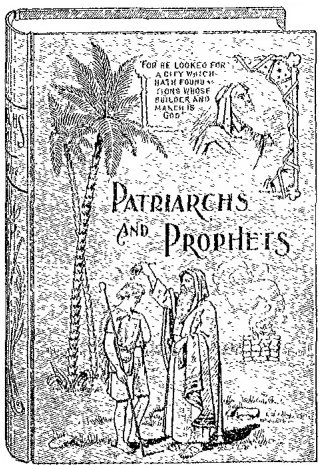
Patriarchs and Prophets;

OR, THE GREAT CONFLICT BETWEEN GOOD AND EVIL, AS ILLUSTRATED IN THE LIVES OF HOLY MEN OF OLD.
Beginning with the rebellion in heaven, the author shows why sin was permitted, why Satan was not destroyed, and why man was tested; gives a thrilling description of man's temptation and fall; and rehearses the plan of redemption devised for his salvation. This volume traces the great conflict between good and evil from its inception down through the centuries to the time of David's death, and shows God's wonderful love for mankind through his dealings with the race.
“Now all these things happened unto them for examples; and they are written for our admonition, upon whom the ends of the world are come.” Therefore this book is most timely now. If you simply glance it through you will see why it is so necessary and important that you should study it carefully.

PRICES.

Drab English cloth, emblematical design in jet and gold, marbled edges. $2.25
Light green English cloth, emblematical design in jet and gold, gold edges. 2.75
Library style, full sheep, combed marbled edges. 3.00
Full Turkey morocco, gold side and back, gold edges, extra finish. 4.50
Also issued in Danish, Swedish, German, and Dutch, at same prices.

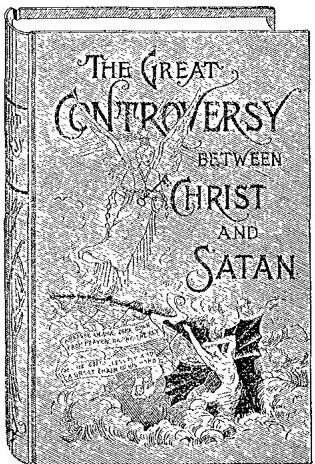
Great Controversy

Between Christ and Satan During the Christian Dispensation. A Companion Volume to “Patriarchs and Prophets.”
This volume presents the most wonderful and intensely interesting history that has ever been written of the great conflict between Christianity and the powers of darkness, as illustrated in the lives of Christian martyrs and reformers on the one hand, and wicked men and persecuting powers on the other. Beginning with our Lord’s great prophecy given while viewing Jerusalem from the Mount of Olives, this book graphically, and in an intensely interesting manner, outlines the history of the whole dispensation down to the time when “sin and sinners are no more; God’s entire universe is clean; and the great controversy is forever ended.”
If you have not read the chapters on the “Agency of Evil Spirits,” “The Snares of Satan,” “Spiritualism,” “The Character and Aims of the Papacy,” “The Impending Conflict—Its Cause,” “The Scriptures a Safeguard,” “The Final Warning,” and “The Time of Trouble,” you should read them at once, and study them again and again. The intensely real, and vividly clear description that is given of the times upon which we are entering, cannot fail to stir the mind and soul to the very depths. The salvation of yourself and others that God designs to reach through you hinges upon your properly understanding the themes and heeding the instruction presented, especially in the closing chapters of this book. The work is illustrated, and contains 700 pages.

PRICES.

Cloth, marbled edges, $2.25; Cloth, gilt edges, $2.75; Library, marbled edges, $3.00; Half morocco, gilt edges, $3.50; Full morocco, gilt edges, $4.50.
Also issued in Danish, Swedish, German, and French, at same prices.

THOUGHTS FROM THE MOUNT OF BLESSING.

By MRS. E. G. WHITE.
A graphic presentation of the Sermon on the Mount, written in the chaste, yet eloquent language characteristic of this author. The reader quickly finds himself transported to the mountainside, where, with the vast multitude, he listens to wonderful lessons, fraught with tender pity and divine love, from the lips of Him who spake as never man spake.
An excellent companion volume to, “Steps to Christ,” by the same author.
“Thoughts from the Mount of Blessing” contains 15 original half-tone illustrations, printed on enameled paper.
Bound in Cloth, Embossed in Gold, 209 pages, - - - $ .75
“ “ 1-2 Calf, Marbled Edges, “ “ - - 1.00

EARLY WRITINGS

....OF....
Mrs. E. G. White.
A COMPILATION AND REPRINT OF THE FIRST-PUBLISHED WORKS BY THE AUTHOR.
As a Seventh-day Adventist you cannot afford to miss reading this book, containing, as it does, a full and complete account of Mrs. White’s first visions and experiences. A careful and unprejudiced perusal of “Early Writings” will lead the seeker after truth to rejoice in these words: “And it shall come to pass in the last days, saith God, I will pour out of my Spirit upon all flesh; and your sons and your daughters shall prophesy, and your young men shall see visions, and your old men shall dream dreams.” Joel 2:28.
Bound in Fine Cloth, 154 pages, — 75 cents.

Testimonies for the Church.

... BY ... MRS. E. G. WHITE.
NUMBERS 1-33 are bound in Five Volumes of about 700 pages each, each volume containing a complete index of subjects. Volume I contains a brief sketch of the early life and Christian experience of the writer of the Testimonies. This sketch of her early experiences, together with the story of her triumphs of faith, is among the most valuable matter from her pen. It should be read and studied often. But while these first paragraphs of Volume I are worthy of special note, great stress should be placed upon the fact that every Seventh-day Adventist should be a constant student of every part of all these volumes of the Testimonies. They are a special message from God to the church, and any one who is troubled with doubts concerning them, will find the evidence of the divine source of these writings in the books themselves. Whatever else you fail to read you should not neglect these volumes in connection with your study of the Bible.
Bound in Muslin, per volume, - - - - - $1.00 " " Library, " " - - - - - 1.50 Complete Set of Five Volumes, Bound in Cloth, - 5.00 " " " " " Library, - 7.50

Books that Every Seventh-Day Adventist Should Read this Fall and Winter.

Both the Young and the Old Should Carefully Study Them.

Do not pass this matter by lightly. You cannot keep up with the rapidly advancing work amid the perils of these times unless you are a careful and faithful reader of our literature. How many of these books do you already have? How many have you read? Plan for a course of systematic daily reading of these books. Send for the ones you do not have. Begin your study at once.

RISE AND PROGRESS OF SEVENTH-DAY ADVENTISTS.

BY ELDER J. N. LOUGHBOROUGH.
Commencing with the early experiences of the Advent movement of ’43 and ’44, the writer—who has been actively engaged in proclaiming the doctrine since ’49, and is therefore able to say, “I speak the things which I have seen and heard”—here presents a graphic account of the struggles and difficulties through which the pioneers were safely carried by their unwavering faith in God, and their unfaltering loyalty to the cause they had espoused.
Due attention has been given to those agencies which, in the providence of God, have aided in building up and preserving the work represented by this people, until now we see the earth encircled with the message proclaimed by the missionary, and heralded by numerous publications in a multitude of languages.
No one can read this book without having his faith in the message very much strengthened. The book will interest your children, and give them confidence in our work. The book contains 392 pages, interspersed with numerous cuts, besides 20 full-page illustrations; is printed on fine calendered paper, and bound in cloth, silk finished; prices: plain edges, $1.25, gilt edges, $1.50.

TWO WONDERFUL BOOKS

BY MRS. E. G. WHITE.

A Beautiful, Self-Pronouncing S. S. Teachers' Bible,

Containing the Complete Oxford Helps, a Full Series of New Maps, etc., given away with the YOUTH'S INSTRUCTOR, to either old or new subscribers, for only $2.50. Imperial Seal binding. Regular price of Bible alone, $4. All proper names are divided into syllables, and every vowel is marked. Offer limited. Send for full descriptive circular.
Continue reading: Publishers' Department