THE United States Government operates a flag factory in the New York Navy Yard, where more than four hundred varieties are turned out, partly by machinery and partly by hand. The mechanical equipment includes a machine that cuts out stars for the Star-Spangled Banner. This flag factory is described as follows in the Scientific American:
“It is operated by a master flag maker with a corps of assistants, and the flags made are not only to supply ships, but army posts and government buildings on the Atlantic coast. A small factory in the Mare Island Navy Yard supplies the flags needed on the Pacific.
“Flag making as the government does it, calls for a prodigious amount of work. More than four hundred distinctive kinds of flags are made. Many of them involve patient labor. The sewing-room at the New York Navy Yard presents an interesting and patriotic spectacle. Here, in a great blaze of color, many skilled machine sewers and needlewomen stitch at the flags of the world.
“The first operation in making a flag is to cut out the flag from measurements arranged on chalk lines and metal markers on the floor. The first basting is usually done on the floor also, as large stripes and like pieces can be more conveniently stitched in this way. The final sewing on ordinary flags is done on machines. In recent years flag making has become highly specialized. At the present time each woman is kept working on the part that she makes best. Some excel in ‘trimming’ stars, others in striping, and some in a complicated emblem on a foreign flag.
“The many thousands of stars used on Old Glory each year are cut out by a cutting machine which manages the eight different sizes needed. The stars on the reverse are simply pieces of cloth basted to the blue field. An operator using a ‘zigzag’ machine stitches around the edge of the star which has been cut out by a machine; this makes a star pattern on the piece of cloth basted on the reverse, and the excess material is cut with scissors by a ‘trimmer.’ These vary in dimensions from fourteen inches in diameter down to two inches.
“Of all the flags of the United States the President’s flag entails the most labor. To make it requires all of one woman’s time for a full month. This flag, consisting of a blue ground with the coat of arms of the United States in the center, is hand-sewed, and it takes days of patient stitching to secure in place the life-sized eagle with its great wings outstretched. The flag is made in two sizes, ten by fourteen feet and three by five feet.”—Young People’s Weekly.
A Channel Tunnel
THE revival of plans for a tunnel under the English Channel brings out the interesting and little-known fact that a substantial beginning on the tunnel was made a generation ago. In 1874 a French company sank a shaft at Sangatte, and drove a gallery a mile and a half under the channel toward England. In 1881 an English railway company sank a one-hundred-and-sixty-foot shaft near Dover, and drove a seven-foot tunnel more than a mile under the channel toward France. Then the cautious statesmen interfered and stopped work. Both tunnels remain virtually intact. Engineers have found that at a depth under the channel ranging from eighty to two hundred feet is a stratum of gray chalk that is the easiest possible material to cut through.—Youth's Companion.
Newfangled Schools
THEY taught him how to hemstitch and they taught him how to sing,
And how to make a basket out of variegated string,
And how to fold a paper so he wouldn’t hurt his thumb.
They taught a lot to Bertie, but he
couldn’t
do a
sum.
They taught him how to mold the head of Hercules in clay,
And how to tell the diff’rence ’twixt the bluebird and the jay.
And how to sketch a horsie in a little picture frame,
But, strangely, they forgot to teach him
how to
spell his
name.
Now, Bertie’s pa was cranky, and he went one day to find
What ’twas they did that made his son so backward in the mind.
“I don’t want Bertie wrecked,” he cried, his temper far from cool.
“I want him educated!” so he
took him
out of
school.
—Selected.
Polly Pry’s Foreigners
By Florence Boyce Davis
“I’d like to see some foreigners,” sighed little Polly Pry,
“A whole shipload of immigrants go slowly walking by;
With funny kerchiefs on their heads and garments quaint and queer,—
I’d like to see them standing round right in my garden here!”
“Oh, fie upon you, Polly Pry!” said Aunt Matilda Mott;
“To wish a lot of foreigners into your garden plot!
If you will look about, my dear, I’ll show you full a score
Already at your very feet while you’ve been wanting more.
Now here are Tiger Lilies, they are natives of Japan,
And gay as any little Jap who ever waved a fan;
Your Pansies—a resemblance you certainly must see
To Uncle Johnny-jump-up, who came from Germany.
A Turk first brought your Tulip into Europe long ago;
The forebears of your Zinnias all lived in Mexico;
Siberia claims the Scilla that you planted on your lawn;
Your Sweet Peas are from Sicily and far-away Ceylon.
And there’s your Calla Lily with a kerchief on her head—
She holds the Cape of Good Hope as her native garden bed;
The tall and stately Golden Band is purely Japanese;
Your Bluebells came from Europe, and your Hyacinths from Greece.
Your June Pinks used to blossom on Russia’s distant hills;
About the Mediterranean first grew your Daffodils;
Sweet William roamed from China to the Pyrenees, ’tis said,
Before he ever settled in your grandma’s garden bed.”
“Who ever thought that foreigners,” laughed little Polly Pry,
“Were looking at me every day as I went walking by!
The next time I am wishing, dear Aunt Matilda Mott,
I’ll wish a few Americans into my garden plot.”
—Florence Boyce Davis, in St. Nicholas.
The Happy Bee
By M. G. Kains
There was a happy B, as any one could C,
Who never heaved a sigh of any siiii.
He would fly among the pppp,
The nectar there to cccc,
And gather pollen on his little thiiii.
With neither haw nor G, he’d fly away to T,
And there the honey he’d begin to uuuu.
Living always at his eeee,
With no one who would tttt,
He never had to mind his pppp and qqqq.
— M. G. Kains, in St. Nicholas.
For the Finding-Out Club
Part I
WHERE are the red corpuscles of the blood formed? What is their work?
2. Of what two actions is every muscle capable?
3. What effect does tight clothing have upon the spine and chest?
4. Who discovered the circulation of the blood?
5. Into what three divisions is the skeleton divided?
6. How many bones in the human leg?
7. How many cranial nerves in the human body?
INEZ MORTENSON.
Part II
1. Why does oil poured on the waters calm the sea?
2. How do the fishers of Japan use the cormorant in their work?
18. The first city of the Bible was Enoch, built by Cain. Gen. 4:17.
19. Musical instruments are first mentioned in Gen. 4:21.
20. The father of musicians, or father of the fine arts, was Jubal. Gen. 4:21.
21. The father of the nomads and of commerce was Jabal. Gen. 4:20.
22. The first worker in metals, or the father of the useful arts, was Tubalcain. Gen. 4:22.
23. Rebekah, according to the Bible record, wore the first bridal veil. Gen. 24:64, 65.
24. Saul was the first person mentioned in the Bible that committed suicide. 1 Sam. 31:4.
25. In Gen. 23:3-18 is recorded the first instance of the purchase of land.
26. The first monument to the memory of the dead was erected by Jacob at Rachel’s grave. Gen. 35:20.
27. The first mention of a library is made in Ezra 6:1.
28. The first wall of water was built by the Lord across the Red Sea. Ex. 14:15-31.
29. The daughters of Zelophehad—Mahlah, Noah, Hoglah, Milcah, and Tirzah—were the first women to demand their rights. Num. 27:1-4.
Answers to Questions in “Instructor” of August 21
1. OUR Secretary of State signs his name simply “Lansing” in sending messages to foreign powers, for the purpose of saving expense on cablegrams, and because it is a diplomatic custom.
2. An ultimatum is the final conditions or terms offered by either of the parties in a diplomatic negotiation. The rejection of these terms by either party usually ends in the breaking of diplomatic relations or in active hostilities.
3. The majority of the people of Switzerland speak the French language. Forty-five per cent of the people of Belgium speak the Flemish language, forty-one per cent Walloon (a French dialect), and eleven per cent both languages.
4. Russia, Portugal, and San Marino are the other republics in Europe besides France and Switzerland.
5. In the present meaning of the term a “hyphenated American” is one who has sympathies abroad, especially with the central powers or their allies.
6. Brand Whitlock was the United States minister to Belgium when the European war broke out in 1914. Bethmann Hollweg was until recently the chancellor of the German Empire. Poincaré is president of France. Asquith is ex-premier of England. Grey was minister of foreign affairs in the Asquith cabinet. Earl Kitchener, of Khartum, was appointed secretary of state for war in Great Britain in 1914, and his exceptional organizing ability won him rank among the foremost men in England. He was drowned while on his way to Russia, June 5, 1916, when the cruiser “Hampshire” was sunk off the Orkney Islands.
7. Riga is a seaport of Russia, the capital of the government of Livonia. During the war it has frequently been mentioned in dispatches from the Russian battle front as the objective of numerous attacks by the central powers. It recently passed into the hands of the Germans.
Bagdad is the capital of the province of Bagdad in Asiatic Turkey. On March 12 of the present year it passed from Turkish rule into the hands of the British.
Warsaw is the capital of Russian Poland. It fell into the hands of the German army under Prince Leopold of Bavaria Aug. 5, 1915.
Monastir is in Serbia. It fell into the hands of the Bulgarian forces on Dec. 2, 1916.
The Marne is a river in France. In the Valley of the Marne was fought the Battle of the Marne, a victory for the French under Joffre, which thwarted the German attempt to reach Paris.
Louvain is a city in Belgium, the seat of a famous Catholic university which has been closed since the war.
Hartlepool is a seaport in Durham, England. It is frequently mentioned in connection with air raids as a point of attack by the invading planes.
8. Persona non grata is a term applied to a representative of a foreign government not acceptable to the government to which he is sent.
Soixante-quinze is the French expression for seventy-five.
Boche, a word which has come into use among the Allies since the beginning of the war, referring to the Germans.
Piou-piou is a French colloquial word for foot soldier.10
Tommy Atkins is a British soldier.
Cossack refers to Russian cavalry.
Hussar refers to the light cavalry of Hungary.
9. Italia irredenta means unredeemed Italy, referring to provinces in Austria inhabited by Italians.
10. A censor is an official empowered to examine written or printed matter, and forbid publication or circulation of objectionable matter.
A minister is a diplomatic agent of the second or third class, sent from one country to another.
A consul is a person appointed by a government to reside in some foreign country, to care for the commercial interests of the citizens of his government, and to protect its seamen.
A chargé d’affaires is a temporary substitute for an ambassador.
An envoy extraordinary is a minister plenipotentiary accredited to a foreign government by the chief executive, sent for the purpose of gathering special facts, information, and data.
Train the Memory to Alertness
“I HAVE been introduced to that minister three times within a few weeks, and yet he does not recognize me when we meet,” said a woman who had but recently accepted the truth for this time. This was a real hurt to her. She could not know how many persons the minister meets each week and how difficult a task it is to keep each one in mind. However, the minister who remembers faces and names has a very great advantage over one who does not.
It is conceded by the best hotel men that a memory for names and faces is one of the most valuable assets of successful hotel men. If this qualification is invaluable from a commercial viewpoint, it is much more valuable as an asset of successful ministry. Why should a winner of souls excuse himself for his failure to remember people by saying he has little ability to remember names and faces? He can acquire the ability. He should do so. God will help him to do it.
James A. Farrell, president of the United States Steel Corporation, in which are 270,000 employees, more than the population of St. Paul, Louisville, Denver, or Atlanta, is called “the living gazetteer of the world,” “a talking atlas,” “commercial wizard,” and other equally suggestive names. It has been said that his knowledge of the world is so great that the cartoonist could fittingly substitute the globe for his head. His knowledge of ship building, of national and international tariffs and custom duties, of steel making, and of his concern’s manufacturing and selling business is almost incomprehensible, and positively uncanny. This remarkable memory has not been developed without effort. It has been gained, says Mr. Farrell, “by close observation, lively imagination, and indomitable industry and perseverance.” These three things will produce acceptable results for all other persons.
The following incident related in a recent number of the American Magazine gives another striking example of a man’s success in acquiring a good memory by studied effort:
“Five men were riding westward on a fast train last summer. After trade talk had slumped and politics had been worn bare, they turned to a discussion of John L. Horgan and his marvelous memory for names and faces.
“‘When I put up at the Hotel Sinton in Cincinnati five years ago,’ said one of the party, a New England jeweler, ‘Horgan was room clerk there, and a fellow was telling me—’
‘What some one was telling you doesn’t matter,’ broke in a second member of the group.
‘But—’
‘Wait a minute,’ interrupted the skeptic. ‘You say you stopped at the Sinton five years ago?’
‘Yes.’
‘For how long?’
‘One night.’
‘Well, I’ll bet you twenty-five dollars that when we walk into the Statler at Cleveland today Horgan won’t recognize you.’
‘Taken!’
“As the five men came into the lobby of the hotel a few hours later, Assistant-Manager Horgan was standing near the room clerk’s desk. The jeweler walked toward him. With a quick smile, Horgan stepped forward and held out his hand.
‘How do you do, Mr. Imhoff?’ he said cordially. ‘Glad to see you again.’
“John L. Horgan has an appearance almost boyish; one would never suspect him of sheltering a directory and photograph gallery back of his smiling face and alert, genial eyes. Yet there are one hundred thousand persons whom Horgan can call by name when he sees them. This is his own estimate, and he thinks it conservative.
“If you happen to be standing in the lobby of the hotel at Cleveland when Horgan meets a guest for the first time, you may see his eyes focus for a second on the stranger’s face, and then catch up his dress, build, and appearance in a quick glance. As the guest walks away, the hotel man will look at him again. Henceforth he is added to the Horgan collection.
“Horgan’s memory is a natural gift trained to the limit of proficiency. When he began his hotel experience, fifteen years ago, a boy of seventeen, he soon realized that a memory for names and faces was one of the most valuable assets a hotel man could possess. In the five years between 1907 and 1912, while he was room clerk at two Cincinnati hotels, Horgan collected the names and permanent addresses of fifty thousand persons, each one of whom he could recognize. Frequently he would run over sections of this list, making sure that each name called up the image of the man to whom it belonged. Today Horgan’s memory is practically automatic; it needs no first aids to efficiency.
“In preparing for a convention a few weeks ago, Horgan made out from advance lists four hundred and sixty-two cards, each bearing the name and room number of one of the expected guests. Shortly afterward it was decided that the machinery of the hotel organization would be spared needless wear and tear if the room reservation cards were distributed on the train to one hundred and twenty-seven men who were coming from Chicago.
“The four hundred and sixty-two cards had been jumbled up without the slightest regard for geography. Horgan ran hurriedly through them, tossing into a pile at one side the names which he remembered as belonging to men in the Western delegation. He glanced through the pile again, cast out six, and left the one hundred and twenty-seven cards for the Chicago party without a single mistake.
“How does he do it? On a recent Sunday afternoon in Cleveland I set out to answer that question.
“‘Attention comes first,’ Horgan told me. ‘When you meet a man, look squarely into his face for a11second and forget everything else in the world. Etch his features into your brain: you can do it if you will keep practicing.
“‘It isn’t enough to catch a name so that you can pronounce it. You must learn to see it. You must visualize it so that it appears in your brain as clearly as if it were printed on paper before your eyes. A trained memory is packed full of double exposures—to use a photographer’s term. The name will bring up a vision of the man; the man, a vision of the name.
“‘I believe that any one who will keep at it can learn this trick of photographing a name. If a person’s memory is faulty, let him shut his eyes for a moment after leaving a man he has just met, and trace the man’s name letter by letter in his mind until he can see it all clearly. A name treated in this fashion won’t leave one’s mind right away.
“‘Self-consciousness blocks good memory. The man who is not sure of himself, who is wondering what he is going to say, who is afraid he may do something awkward, who fears he is not well dressed, or who prides himself on being unusually well dressed, is not likely to be able to give that moment of undivided attention that is necessary to stamp a man’s image on his brain.’
“‘Is it sufficient to remember a man’s face?’ I asked.
“‘Oh, indeed not,’ laughed Horgan. ‘I suppose there are five hundred sets of people in my mind, each set made up of persons who look pretty much alike as far as their features are concerned. One man may hold his head a little differently, or speak in a lower tone, or act a little more aggressively, or have a ruddier complexion, or show some peculiarity about the way he holds his shoulders. You should catch a side view of a man and another view as he walks away.’
“Horgan admitted that his own memory has its off moments.
“‘Sometimes when I get very tired it plays tricks on me,’ he explained. ‘Then I try to get away until I am rested up. To remember best, one must be feeling fit and fresh. Almost every one has a clearer memory in the morning than at night. As a general rule, the better a man’s health the better his memory.’
“‘Tell me some devices for developing memory,’ I said.
“‘Any test which trains your mind really to see things at a quick glance will help a lot,’ returned Horgan. ‘One of the best tests I know is to stand in front of the show window of a store and glance quickly at all the articles in the window, and then turn away and see how many you can remember. Practice will make any one pretty adept at this.
“‘Look at the passengers opposite you in a street car. Then shut your eyes and try to visualize each one of them. Glance at the advertising placards over their heads. Close your eyes and see how many you can remember. All these things will help you in remembering a man’s features from a quick glance; it would be impolite and usually impossible to stand and stare in a man’s face for three or four minutes.
“‘Meet all the people you can. Watch them. Keep lists of their names. Sit down at night and check up the people you have met that day; see how clearly you can call up the image of each.’
“‘Anything else?’ I asked.
“‘Just a bit of common-sense advice. Don’t try to remember people whom you aren’t likely to meet again. I never try to remember foreigners. One needs all one’s brain cells for people who may cross one’s path in the future.’”
The minister, the teacher, the leader of young people, may not be able to accomplish the mental feats of the two men mentioned; but every one may do much toward creating for himself a memory that will yield him rich returns in spiritual or social work. If for commercial reasons alone one will take the pains to train one’s memory, why should not Christian workers be even more solicitous to do the same, and more energetic in attaining the goal? Soul-winning demands and deserves the best of every talent and power.
Sticks: A Children's Game of Goals
Sticks
THE children form two bands. Two trees about sixty feet apart are goals. Ten sticks are piled loosely under each tree and a goal keeper guards them. He may not touch the sticks, but may tag any one who does. A line is drawn between goals, and any one tagged on the wrong side of the line must join the enemy. The members of each band try to steal sticks one at a time from the other goal to add to their own pile. The side securing all the sticks wins.—Selected.
Behold a Bird's Nest: Verses on Craftsmanship
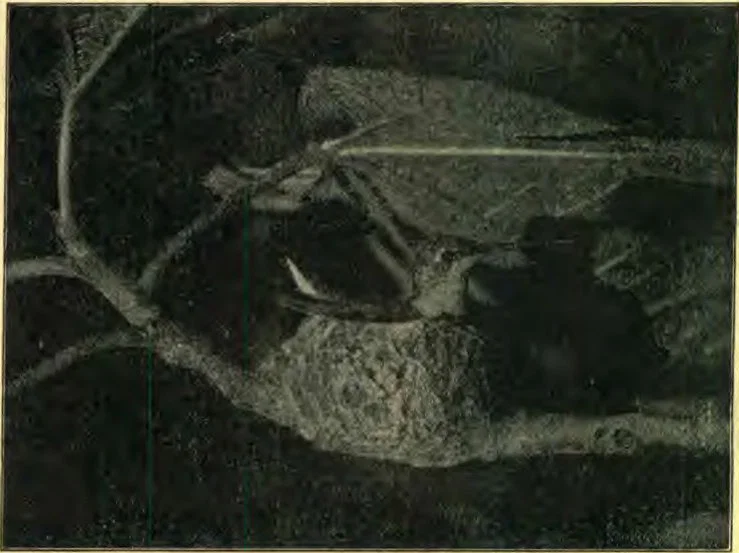
“BEHOLD a bird’s nest.
Mark it well within, without.
No tool had he that wrought,
No knife to cut,
No nail to fix,
No bodkin to insert;
His little beak was all. And yet how neatly finished.
What nice hand, with
Every implement and
Means of art, with
Years and years of practice,
Could compass such another?”
To Think Upon
OUR friends are our ideals.—J. R. Miller.
MANY strand on the rock of Almost.—S. V. Cole.
“BE slow in choosing a friend; slower in changing.”
To the dawdler, school examinations are “vexaminations.”
“A FRIEND?—The first person who comes in when all the world steps out.”
“WE fail, not because our qualities are ordinary, but because we let them remain so.”
A BORE is some one who talks of himself when you want to talk of yourself.—S. V. Cole.
“SELF-INDULGENCE is suicide. Sparing yourself means wasting yourself. He that saveth his life shall lose it.”