The Youth’s Instructor, Vol. 53, No. 27.

Good Angels
Earlier text: Good Angels

News from New Zealand

REPORTS from some of the New Zealand Young People’s Societies have been sent in to the secretary of the Sabbath-school Department. While these were designed especially for the General Conference, we are glad to give the readers of the INSTRUCTOR extracts from them. They show that the work and spirit of our Young People’s Societies across the waters are the same as in the home land.
Besides the usual lines of missionary work, lessons have been given in reading and writing to an Assyrian young man. Some members have engaged in ship missionary work, some have visited sick children, carrying them flowers. The Societies have studied the lessons on the Life of Paul, the Field Studies, the parables of Jesus, and the main points of our faith. The following summary is of interest:—
Name of society AUCKLAND NAPIER PETONE WELLINGTON
Number of members 34 12 10 6
Missionary letters written 30
Missionary letters received 3 35
Missionary visits 20 3
Bible readings or cottage meetings 30
Subscriptions taken for periodicals 4,530
Papers sold 1,495 29 3
Papers mailed or given away 200 99 7
Books sold 6 4
Pages of tracts sold 1,055
Pages of tracts given away 6,000
Persons supplied with food 32
Articles of clothing given away 7
Offerings for home mission work £2 7s 6d 14s 11d £3 3s 2d
Offerings for foreign mission work 16s 3½d

Say It

WHEN you've got a thing to say, Say it! Don't take half a day. When your tale's got little in it, Crowd the whole thing in a minute! Life is short — a fleeting vapor — Don't you fill an eight-page paper With a tale which at a pinch Could be cornered in an inch! Boil it down until it simmers; Polish it until it glimmers. When you've got a thing to say, Say it! Don't take half a day. — Selected.

When Rachel Came Home

Rachel was coming home! It was the gladness to which Rachel's mother rose in the morning, the joy which woke her again and again in the sweet, still June nights, the music to which all her days were set—Rachel was coming home! Why, it was almost two years since she had seen Rachel; the long journey to the East was too expensive to be contrived more than once. Father had planned, when Rachel went away to school three years before, that he and mother should go to see her graduated, and bring her home in triumph, but so many things had gone wrong—the poor crops, and Bessie's sickness, and Ned's sprained ankle, and all. Father had taken it hard that they couldn't go, but mother, after the first disappointment, had turned her face happily toward the waiting joy. After all, it wasn't Rachel at school that she wanted; it was her old daughter back in the old places. Of course through the years she had had the others, Ned and Lottie and Bess, but Ned was a boy, and Lottie and Bess only children. It was Rachel who was “daughter,” old enough to understand and help and companion the unspoken ways of a woman's heart. Why, there were times when it seemed to mother that she had been famishing just for a glimpse of Rachel's face, for the sound of her steady voice. Those were the times when she shut herself away in the empty room, and Lottie drew Bess softly past the door because mother was “thinking about Rachel.” But for the past month when mother went into Rachel's room, it was not to “think,” but to work there—to clean every inch of the woodwork over and over, to put down new matting and hang fresh curtains, to care for the mignonette in the box outside the window sill, to do things and undo them and do them over, for sheer delight in the doing. For Rachel was coming home—to stay!
The golden June days slipped away one by one. In a week Rachel would be home—in three days—to-morrow—to-day. Then indeed the house bubbled with excitement: mother was preparing a feast that rivaled Thanksgiving day—was it not the great thanksgiving day of her heart? And everybody had to help. Lottie wanted to make some cookies to show Rachel that she knew how to cook, and Bess begged to be allowed to pull molasses candy; grandma was not a whit less excited, and insisted upon making the custard pie, because there was a “knack” about it that nobody else knew as well as she. There was the whole house to decorate with flowers, too, and finally, when father and Ned had driven off to the station, there was just time for the others to do a hundred “last things” and get dressed before Rachel arrived. Everybody was tired out between the day's work and excitement, but nobody realized it. They are poor lives indeed that do not know a few such days of joyous spending.
And after all, there was time to spare. The children, forbidden to leave the yard, kept running to the gate to look; grandma tried to knit, but dropped so many stitches that she gave it up; as for mother, she did not pretend to do anything but watch. Then at last the carriage came, with Ned waving his cap, and the children, who, forgetful of commands, had rushed out of the gate, running beside it, and Rachel—mother turned suddenly white. Could that tall, stylish young lady be Rachel? Then she was seized in a pair of strong young arms, and Rachel's clear eyes were looking down into hers, and Rachel's voice, with an odd little note of excitement in it, was crying, “Mother, mother dear!” And Rachel had come home!
Of course the evening was a wonderful one after that. Rachel was hungry after her journey, and ate enough to satisfy even mother—almost! And when supper was over, nothing would do but she must put an apron over her pretty traveling dress and help with the dishes, “just to make sure,” she said, “that she was at home.” And then she had to be taken all over the house and out to the barn to see every single new thing that had been acquired since she left; and finally the whole family settled down on the piazza in the moonlight, and Rachel told them about school and commencement, and her classmates, and a thousand things of the strange, far-away world in which she had been living. Once mother leaned over and touched Rachel's hair.
“Is it coming down?” Rachel asked, laughingly.
But mother shook her head. “It looks real pretty,” she said. “It was just—you'll think it's foolish of me, I know, but hearing you tell about all those places and people made it seem sort of unreal, and I wanted to be sure you were here.”
“Oh, I'm here,” Rachel returned. “Just you wait till you see all the things I'm going to do!”
“I don't want you should do things,” mother answered. “I guess I am not going to have you get all worn out with housework.”
But Rachel laughed again. “What do you suppose I've been studying for, if not to help?” she asked. “I'm not going to let you make me out a parlor ornament, mother.”
“I guess you'd be an ornament anywhere you went,” mother returned, fondly.
That night after the house had settled down to darkness and silence, mother lay wide awake, her thoughts traveling far down the happy future. Rachel never from a child had been one to sit with idle hands, but that didn't mean, her mother resolved, that she should ever do any of the hard work. She fancied Rachel keeping the rooms dainty and pretty,—Rachel always had a knack for fixing things about the house,—she imagined the two of them having long, happy talks over the afternoon sewing, and the family gathering about the organ to sing in the evenings. They had missed the singing so since Rachel had been away. And Rachel would be such a help in entertaining company—somebody young and educated. And there were the children, too, and Ned; it would be so much to them to have Rachel home. Mother looked solemnly out into the June night. How could she ever, all her life, begin to thank God for giving her Rachel?
The lovely June night slowly passed; toward morning, at last, mother fell asleep. She woke later with a start of dismay. Seven o'clock, and she was not up; and Rachel's first morning home, too! She dressed hastily, with nervous fingers that stumbled over every task, and hurried down to the kitchen. To her surprise the fire was bright and breakfast on the stove, and quick, firm steps sounded in the dining-room. Mother hurried after them; her face was flushed and her voice tremulous. “I'm real ashamed,” she declared. “I don't know when I've overslept that way before. I guess maybe 'twas because I couldn't seem to get to sleep for thinking about your being really home at last. I 'most got up and went to your room, only I was afraid of waking you.”
“Which would have been a very foolish thing to do,” Rachel answered as she kissed her good morning,—“to get up, I mean. If people could only put away every thought when they are ready for sleep, there wouldn't be half so many nerves in the world. Really, when you stop to think about it, it's even more foolish to stay awake over happy things than over unhappy ones. There might be a shadow of excuse in trying to make plans, but there isn't any in getting excited over things that are all right.”
“I suppose there isn't,” mother replied, “but I couldn't seem to help it, someway. You see I've been looking forward to it so long.”
“And now it's come true,” Rachel assured her. “Oh, a great deal more is coming true than you've any idea of. I've come home to help, mother; you wait and see.”
“I don't know when you haven't helped,” mother protested.
“Maybe I tried to, but I didn't know how before; now I know. But we'll have plenty of time to talk everything over. I suppose breakfast comes first, doesn't it? I've cooked some new breakfast food that I brought home with me. We analyzed it in the laboratory, and found it had far more nutriment than any other kind on the market. And I made some corn bread; it's in the oven now. I didn't know what you had planned, but corn bread is always sensible.”
A troubled expression crossed mother's face. “I was going to make waffles,” she said, “seeing it was your first morning home. I guess the children will sort of expect them, too; we always have them for celebrations; they were talking about it yesterday. It won't take me any time to beat up a few.”
“Indeed, you're not going to,” Rachel asserted, cheerfully. “My real celebration is in being home, not in eating. As for the children, corn bread is a great deal better for them.” “Well,” mother agreed reluctantly.
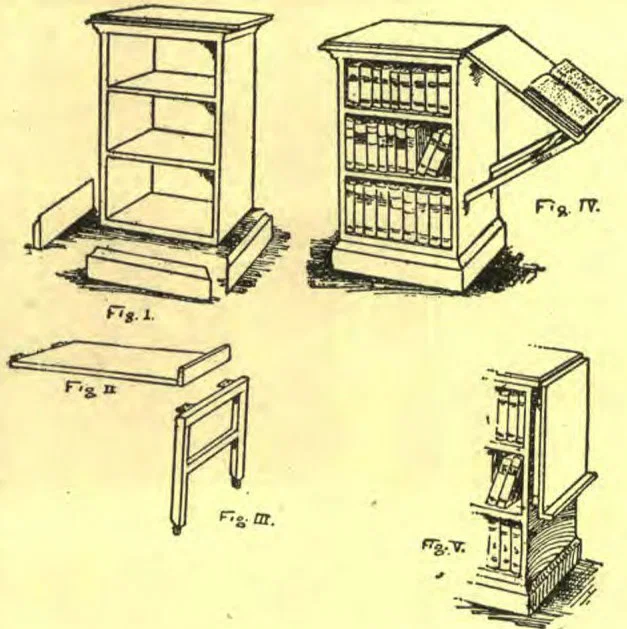
Fig. I. Fig. IV. Fig. II Fig. III. Fig. V.
She longed to make the waffles, but after all, she thought, brightening, what difference did it make? As Rachel said, the real celebration was in having her home. It was lovely to have Rachel feel like that. Mother turned away briskly, all the old joy in her voice. “I'll just see to grandma's oatmeal,” she said, “and then we'll be ready. It's a new kind that takes only five minutes.” But Rachel's cheerful voice again restrained her. “You won't need the oatmeal this morning, mother. Grandma will have the breakfast food.” Mother stood still, her face full of distress. “Oh, I guess we'll have to cook a little oatmeal, Rachel; grandma doesn't like breakfast foods; she says she's too old to learn how, and that they don't have any more taste than so much bran.” “Oh, she'll like this kind; you see if she doesn't,” said Rachel. “I guess now everything's ready. Oh, the coffee? I'm going to see if I can't coax father out of coffee drinking. But I suppose we can't do it all at once. There, now we are ready, aren't we, and I can ring the bell? Oh, I forgot the flowers, but I can get them while you are putting things on.” She ran out in the yard and began cutting the roses. As she came in with her bright face and her handful of dewy blossoms, her mother thought that she was like a rose herself. After all, what did anything matter, so long as they were all together and well and strong? Yet somehow the breakfast was not quite a success. Opinions were softened out of deference to Rachel, yet even the children clamored for waffles, and Ned, though good-humoredly eating it, declared the new breakfast food tasted like sawdust. Grandma, after a single taste, pushed away her saucer. Rachel laughed and chatted, and pretended not to notice, and afterward told her mother that she wasn't a bit discouraged. “I'll bring them around yet; you see,” she declared.—Mabel Nelson Thurston, in Young People's Weekly.
(Continued)

The Little Children in Japan

THE little children in Japan Are fearfully polite; They always thank their bread and milk Before they take a bite, And say, “You make us most content, O honorable nourishment!”
The little children in Japan Don’t think of being rude. “O noble, dear mama,” they say, “We trust we don’t intrude,” Instead of rushing into where All day their mother combs her hair.
The little children in Japan Wear mittens on their feet; They have no proper hats to go A-walking on the street; And wooden stilts for overshoes They don’t object at all to use.
The little children in Japan With toys of paper play, And carry paper parasols To keep the rain away; And when you go to see, you’ll find It’s paper walls they live behind.
The little children in Japan, They haven’t any store Of beds and chairs and parlor things, And so upon the floor They sit, and sip their tea, and smile, And then they go to sleep awhile. — The Child’s Hour.

A Visit to Aunt Ida’s

WALLACE was counting the days before the tenth of June. It was his birthday, and something very nice was going to happen on that day. He and mama were going to make a long visit to Aunt Ida’s, who had returned from Japan a few months before.
Aunt Ida was a missionary, and she had come home to rest and get well and strong again, so that she could go back to Japan and teach the little boys and girls who live there about Jesus.
Before she came home, she had written to Wallace, and sent him a Japanese newspaper. He had placed it beside one of our own papers, and thought a great deal about the difference between them. He was anxious to see Aunt Ida, and hear about the people who read such strange newspapers.
The tenth came at last, and late in the afternoon they arrived at grandma’s, where Aunt Ida was staying. She was very glad to see Wallace, who was a tiny baby when she went to Japan. She had not forgotten that it was his birthday, so she sat down beside him, and told him how the birthdays of the Japanese children are celebrated. She said: “A Japanese baby is counted one year old the very day it is born, then on New-year’s day it has another birthday, and is said to be two years old. On account of this way of reckoning, January 1 is a sort of national birthday which lasts two weeks. Besides this, in Japan little girls have a special birthday, which is celebrated on March 3, while that of the boys is celebrated on May 5, so you see that all children in Japan have two birthdays instead of one. I presume American children would not object to that.”
“The special birthday for girls is observed with all sorts and sizes of dolls, indicating the nature of their future lives and the duties which will devolve upon them in the care of their children. On the special birthday of the boys the air is filled with hollow paper fishes, which are attached to tall poles. They represent fishes swimming against the stream, which is the way the parents and friends of the boys have of saying that they hope they may be successful in stemming the current of life. All the cakes and candies on that day are fish shaped, that the lesson may be more firmly fixed in their minds.”
“Aunt Ida, do the children play games as we do?” asked Wallace.
“Yes, they play ball, prisoners’ base, hopscotch, and puss-in-boots. They also have bows and arrows and tops, while they excel in flying kites. The mothers believe in idols, and teach the children to do so. If a little Jap is sick, his mother takes him to the nearest image of Binzuree, and if the child has the stomach-ache, she rubs the stomach of the image; if he has the earache, she rubs Binzuree’s ear, and expects the child to be cured. One image which they have, consisting of three little monkeys, is designed to teach them a useful lesson. One monkey has his hands over his eyes, another covers his mouth, while the other stops his ears with his fingers; this teaches that they should ‘see no evil, hear no evil, speak no evil.’”
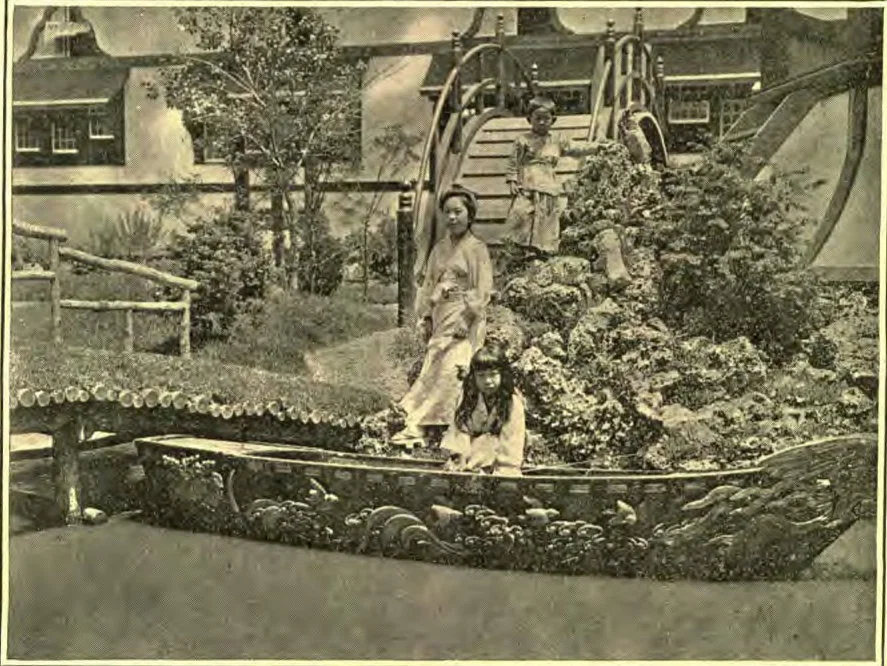
JAPANESE VISITORS AT THE ST. LOUIS FAIR
Aunt Ida went into another room and brought out a Japanese stocking, which she handed to Wallace.
“Why, Aunt Ida, it looks more like a mitten with a long wrist.”
“It does resemble our mitten,” she replied, “for they have a separate place for the great toe, as mittens do for the thumb. The sole of the stocking is padded with several thicknesses of cotton, and when their rooms are matted, they wear nothing else on their feet. When walking in other places, they wear sandals, which are held in place by a thong, which passes between the great toe and the second one.”
“They are fond of beautiful things, and the men as well as the women use their needles very skilfully. They paint beautifully, and make lovely jars and vases.”
Aunt Ida told Wallace all about the raising of tea and rice, and then went into another room and brought out an armful of pictures of scenery in Japan, of the people and children, and of the many curious and pretty things which they make.—Mrs. Lucinda Fenner, in S. S. Times.

The Selfish Cannot Be Sanctified

“THE selfish can not be sanctified.”

A Unique Desk and Bookcase

The beginning of this is a grocery box or a shoe box, of such size and shape that, when placed on end, it will be thirty inches in height, fifteen inches wide, and twelve or fourteen inches deep. An extra top is screwed or nailed to the top of the box, projecting beyond the box about two inches at sides, front, and rear, a little “finish” being tacked about the box beneath the projecting edge of the top. A “finish” three inches in width is also tacked about the base of the box, thus raising it about two inches from the floor. Two shelves are now to be placed within the box, making accommodations for three rows of books. This construction is all to be seen in Fig. I.
Now to make a reading or writing desk, construct a shelf like that shown in Fig. II, just as wide as the top that was added to the box, and hinge it to this top, as shown in Fig. IV. If it is desired that this added shelf shall be level with the bookcase top, the legs, which are shown in Fig III (which are to be hinged beneath the outer edge of the shelf), should be made as high as the bookcase. The shelf can then be used as a table, or the legs can be inclined inward until they rest in the angle made by the box and the floor, which will give an inclined reading desk similar to that shown in Fig. IV.
But if it is desired that the shelf and legs be capable of folding up out of the way, in the manner shown in Fig. V, the legs must be made a little shorter than the length of the shelf, when they will fold up within the space between the dropped shelf and the side of the bookcase. In this case the lower ends of the legs are fitted to enter two holes in the side of the bookcase, as suggested.
Instead of three shelves for books, one shelf can be fitted up with two drawers if desired, where pen, ink, paper, and pencils can be kept, thus giving still greater convenience to the device.
When the carpenter work has been finished, the whole can be given a stain of some attractive color, following this with an oil finish, well rubbed in.—Webb Donnell, in Y. P. Weekly.

INTERMEDIATE LESSON

III—The Parable of the Sower

(July 15)
LESSON SCRIPTURE: Matt. 13: 1-23.
MEMORY VERSE: “But he that received seed into the good ground is he that heareth the word, and understandeth it.” Matt. 13: 23.
“The same day went Jesus out of the house, and sat by the seaside. And great multitudes were gathered together unto him, so that he went into a ship, and sat; and the whole multitude stood on the shore. And he spake many things unto them in parables, saying, Behold, a sower went forth to sow; and when he sowed, some seeds fell by the wayside, and the fowls came and devoured them up: some fell upon stony places, where they had not much earth: and forthwith they sprung up, because they had no deepness of earth: and when the sun was up, they were scorched; and because they had no root, they withered away. And some fell among thorns; and the thorns sprung up, and choked them: but other fell into good ground, and brought forth fruit, some an hundredfold, some sixtyfold, some thirtyfold. Who hath ears to hear, let him hear.”
“And the disciples came, and said unto him, Why speakest thou unto them in parables? He answered and said unto them, Because it is given unto you to know the mysteries of the kingdom of heaven, but to them it is not given. For whosoever hath, to him shall be given, and he shall have more abundance: but whosoever hath not, from him shall be taken away even that he hath. Therefore speak I to them in parables: because they seeing see not; and hearing they hear not; neither do they understand. And in them is fulfilled the prophecy of Esaias, which saith, By hearing ye shall hear, and shall not understand; and seeing ye shall see, and shall not perceive: for this people’s heart is waxed gross, and their ears are dull of hearing, and their eyes they have closed; lest at any time they should see with their eyes, and hear with their ears, and should understand with their heart, and should be converted, and I should heal them. But blessed are your eyes, for they see: and your ears, for they hear. For verily I say unto you, That many prophets and righteous men have desired to see those things which ye see, and have not seen them; and to hear those things which ye hear, and have not heard them.”
“Hear ye therefore the parable of the sower. When any one heareth the word of the kingdom, and understandeth it not, then cometh the wicked one, and catcheth away that which was sown in his heart. This is he which received seed by the wayside. But he that received the seed into stony places, the same is he that heareth the word, and anon with joy receiveth it; yet hath he not root in himself, but dureth for a while: for when tribulation or persecution ariseth because of the word, by and by he is offended. He also that received seed among the thorns is he that heareth the word; and the care of this world, and the deceitfulness of riches, choke the word, and he becometh unfruitful. But he that received seed into the good ground is he that heareth the word, and understandeth it; which also beareth fruit, and bringeth forth, some an hundredfold, some sixty, some thirty.”

Questions

1. To what place did Jesus go one day? Who came out to hear his words? How did he teach them? Verse 3. What is a parable?
2. Upon what familiar sight did he base the parable given in this lesson? What became of the seed that fell by the wayside? What of that which fell in stony places? How was the seed choked that fell among thorns? How great was the yield of that which fell in good ground?
3. When Jesus had spoken this parable, what did he say to the people? What question did his disciples ask?
4. What did Jesus tell them it was given to them to know? What wonderful opportunity did they have to become acquainted with the principles of heaven? What is given to all who make a good use of the gifts that the Lord lends to them? What will be done to all who do not improve these gifts?
5. What reason did Jesus give for choosing the parable to teach those who came to hear him? What had Isaiah written about this people? Why were they in this sad condition? What lesson may we draw from their experience?
6. What blessing did Jesus pronounce upon his disciples at this time? Could all have had the same blessing? Why were so many without a knowledge of the truth for that time?
7. What did Jesus now explain to his disciples? To what are the careless hearers compared? What becomes of the good seed sown in their hearts?
8. How do the “stony ground” hearers receive the word? What do they lack? When they are tested by persecution, how do they fail?
9. Describe those who receive seed among thorns. How is the good seed sown in their hearts hindered from bringing forth fruit? What is done by those who receive the seed in good ground? How great is the increase? What is the object of all seed sowing? How may those who hear the word of life bring forth fruit for the kingdom of heaven?

Answer to Aquarium Puzzle

  1. A sphere .................... Globefish
  2. A heavenly body .................... Sunfish
  3. A heavenly body .................... Moonfish
  4. A shaft of light .................... Ray-fish
  5. Something often worn in winter Skate fish
  6. A beautiful insect ............ Butterfly-fish
  7. A weapon .................... Swordfish
  8. Part of a shoe .................... Sole-fish
  9. A carpenter’s tool .................... Sawfish
  10. A sovereign .................... Kingfish
  11. A dog .................... Houndfish
  12. A part of the ear .................... Drumfish
  13. A ferocious animal ............ Wolf-fish
  14. An implement used by blacksmiths .................... Bellows-fish
  15. A bowman .................... Archer-fish
  16. A guide .................... Pilot-fish
  17. Master of a trading vessel .... Skipperfish
  18. A machine for destroying ships .................... Torpedo fish
RALPH EDWARDS.
The editor promised to give the name of the one who sent in the first list of answers to the aquarium puzzle. Master Edwards’ letter was the first to arrive, and he had a correct list of answers. Miss Lela Warner sent in the second list. Other lists soon followed. The names are here given: Bennie Smith, Fern Wilcox, Bessie Woodruff, Tesla Nicola, Vada Welch, Gale Ruiter, Helen L. Butler, and Otelia Starr.

Walking With Wise Men

“HE that walketh with wise men shall be wise.”

Bring Ye All the Tithes Into God's Store-House

“BRING ye all the tithes into God's store-house.”

The Beauty of Character in God's Sight

THE choicest productions of human skill possess no beauty that can bear comparison with the beauty of character which in His sight is of “great price.”

III—The Sabbath and the Tithe

(July 15)
MEMORY VERSE: “Blessed are they that do his commandments, that they may have right to the tree of life, and may enter in through the gates into the city.” Rev. 22:14.

Questions

1. In the beginning, what part of time did God set apart for religious purposes? Gen. 2:3.
2. What name was given to this definite seventh day? Ex. 20:10.
3. How was man to use this day? Ex. 20:8-11.
4. Of what is the Sabbath still a test? Eze. 20:20.
5. What special term is applied to the Lord’s Sabbath? Isa. 58:13.
6. What similar term is applied to the tithe? Lev. 27:30; note 1.
7. When man uses the Sabbath for secular purposes, of what law does he become a transgressor? Ex. 20:8-11.
8. Of what is he guilty who uses his tithe for any other purpose than that which the Lord has directed? Mal. 3:8.
9. On what two points will the remnant church be especially tested? Note 2; Isa. 58:1, 12, 13; Mal. 3:7, 8.

Notes with Reference to the Sabbath

It is God’s people who are to be warned. Isa. 58:1.
They are to build up the foundations of many generations.
It is not a new path, but the repairing of an old one.
They have been trampling the Sabbath.
They are encouraged to call the Sabbath a delight, holy of the Lord, honorable.
This describes an actual condition in the church to-day.

Notes with Reference to the Tithe

The message is to those who are to witness the coming of the Lord. Mal. 3:1.
God’s people are urged to return to him.
One thing that has kept them from him is the sin of robbery.
This has been in tithes and offerings.
This also describes an actual condition in the church to-day.
10. What promise is made to those who heed the warning and observe the Sabbath? Isa. 56:1, 2.
11. What promise is made to those who bring all the tithes into the storehouse? Mal. 3:10-12.
12. What promise reaches all who turn to the Lord and keep his commandments? Rev. 22:14.

Notes

1. Note the similar claim the Lord lays to the Sabbath and the tithe. “The seventh day is the Sabbath of the Lord thy God.” “All the tithe is the Lord’s.” Both are “holy” unto the Lord. Lev. 27:30; Ex. 20:10; Isa. 58:13.
The Sabbath and the tithe are both a test of man’s loyalty to his Maker. The first makes known our Creator and God. The second is a means of constant acknowledgment that we receive all earthly blessings from his hands. To disregard the claims of either is a violation of the holy law of God.
2. A careful study of the context shows that these scriptures have a special application in the last days. While Sabbath-breaking and withholding the tithe have always been wrong, the Lord will test the world upon these questions before the end of his work for the world.

No Need of an Empty Treasury

MR. A. T. PIERSON in speaking of Christians says: “Our superfluities and luxuries absolutely unnecessary, save as made so by a luxurious and extravagant taste, reach an aggregate which is at the lowest estimate four billion dollars. If only one tenth of these was sacrificed, we should have four million dollars at once for the Lord’s work! Our comforts and conveniences aggregate as much more. If we should give one twentieth of them to the Lord, we should have an aggregate of two hundred million dollars more; a total of six hundred million dollars. And yet we have not supposed our self-sacrifice to touch our necessities, but even these, according to John Howard’s maxim, should yield no small percentage in view of the extremities of the poor and lost.”

Lessons of Star, Flower, and Leaf

(Concluded)
THOUGH to-day in the field and to-morrow cast into the oven, the grass is as skilfully constructed as the palm-tree, which is destined to endure for centuries. The root of the grass is more fibrous and tenacious in proportion to its size than that of any other plant. Sometimes the more it is cut and hacked, the faster it spreads. The stem is hollow, combining lightness with strength; for it can readily be shown that an iron or steel tube of moderate thickness, like a piece of gas-pipe, or of bicycle-tubing, is much stiffer than a solid rod of the same weight per foot. Further strength is gained by the mysterious electrotype coat of flint, which gives the smooth, glossy surface of the stem. The leaves are as remarkably adapted to their work and circumstances. “They are spear-shaped, and strongly ribbed with threads of flinty fiber, thus forming wedges admirably fitted for forcing their way with least resistance through the soil; they are long, narrow, alternate, and sheath the stem for quite a distance, in order to present as small a surface and give as light a hold as possible to the winds; they are destitute of branches, so as to qualify them for growing together in masses without suffering for want of air and light—the whole stem being fleshy and covered with spiracles or air-holes. And last of all, the flower of the grass is a perfect miracle of design. It is produced from the upper sheath, which encloses it altogether when young; it is disposed in simple or branching heads, each head consisting of two or more chaffy scales inserted the one above the other. From each of these scales three slender white threads hang out, crowned with yellow, dusty knobs, playing freely about in every breeze. These little threads, or stamens, are of the most vital importance; for without them the ears of corn would not fill with the nutritious grain.”
The rapid maturing and death of the grass flower is phenomenal. James refers to this habit when he says: “Let the brother of low degree rejoice in that he is exalted; but the rich man in that he is made low; because as the flower of the grass he shall pass away.” When the pollen dust is about ripe, the white threads, or filaments, of the stamens begin to grow suddenly, increasing their length several times in ten minutes. The anthers then discharge the pollen, and the flower perishes, all requiring not more than twenty minutes. “As the flower of the grass he shall pass away.”
If God so clothes the grass of the field, adapting every part of its structure to its need, he will much more clothe his children, fitting each for his work and place in life.
Mr. McMillan in his excellent book “Bible Teachings in Nature” speaks so beautifully of the grass that I can not forbear quoting further from it: “Wherever the conditions of vegetation exist—from the icy plains of Spitsbergen to the volcanic scoria of the antarctic islands; from the sunny seashore to the dreary Alpine snow-line—there, in some form or other, it is sure to be found, struggling with adverse circumstances, maintaining the dominion of life over dead matter, incorporating in its frail tissues the forces of nature, preserving the atmosphere in a state of purity by feeding upon its noxious vapors, fringing the limits of eternal barrenness with beauty, often the only softening touch of tenderness beneath the scowling heavens. It attains its maximum of richness and growth in temperate regions, where the need for it is greatest. As we go northward, it becomes short in stem and narrow in leaf, and forms a continuous closely matted sward of verdure; as we go southward, its stem becomes tall and its leaves broad, and it grows in isolated tufts, generally in swampy places or on river banks. It forms pastoral landscapes under the weeping skies of Europe; it forms bamboo forests and cane-breaks under the glowing skies of the tropics. It ministers to the food of man in mild climates; it ministers to the luxuries of man in hot climates. It may, however, be said to cover with a uniform green mantle the whole surface of the globe. And this mantle is not only ornamental, but eminently useful. It protects the roots of trees and flowers from the scorching effects of the summer’s sun and the blight of the winter’s frost. By the decomposition of its tissues, when it has fulfilled the purposes of its existence, it forms a layer of vegetable mold for the reception and nourishment of higher tribes of plants. When it grows upon the barren sands of the seashore, its long, creeping, matted roots bind down the particles which would otherwise be carried off by the waves; and thus it forms the best bulwark against the encroachments of the ocean. It can lift up its tiny spears against the crested billows, and say with prevailing power: ‘Hitherto shall ye come, and no farther.’ When it flourishes on the mountainside, it performs a similar service to the loose soil, which the action of the elements has disintegrated from the rock; it binds it together by its roots and leaves, and thus prevents it from sliding down in the form of land-slips—whose effects in Alpine valleys are frequently most destructive. And as it is the earth’s first blessing, so it is her last legacy to man. The body that it fed when living, it reverently covers when dead with a garment richer than the robe of a king.”
Well is it for man to understand what God doth speak out loudly through his works, and well is it for him to render grateful praise to the Maker of all, even to him who said: “Let the earth bring forth grass.”

Hindu Gods and the Population of India

The people of India number about three hundred million; but their gods number three hundred thirty million.

Missionary Workers Among Vast Populations in China and India

WHAT are fourteen missionaries in China among three hundred eighty million souls? What are twenty-nine workers in India among 297,638,040 persons?

Periodical Publications Issued in the United States Last Year

ACCORDING to the latest authoritative information there were issued in the United States last year 22,312 publications. This includes weekly, monthly, and quarterly periodicals as well as daily newspapers.

British and Foreign Bible Society Marks a Century

THE British and Foreign Bible Society, which is about to complete a century of work, has issued one hundred eighty million Bibles, which are now printed in four hundred different languages and dialects.

Languages of Scripture Distribution Across Empires

THE diversity of tongues to be found in one country is often a matter of surprise. Last year the Bible Society sold the Scriptures in fifty-three languages in the Russian empire, in twenty-eight in Burma, in thirty in south Malaysia, and in fifty-three in the Egyptian agency.
Continue reading: Our Saviour's Watch-Care Over Individuals