AT sundry stages in earth's history, God has given definite messages through His ministers, all of which were well calculated to arouse moral sensibility, and institute an era of moral reform. Each of these various messages has been a definite, unmistakable call to the people to separate themselves from some general overspreading evil, which threatened the existence of God's rule among men.
Beginning with the days of Noah, we learn that the world had then become so corrupt that every production of men's thoughts was toward evil. Gen. 6:5. The world was, in fact, so nearly sunken in evil that the days were numbered when it must go down, and its corruption be purged. One family alone was found that had not succumbed to the universal depravity. To the head of this house the Lord gave commission to build an ark for the saving of himself and house. Gen. 6:13, 14; Heb. 11:7.
Through this man, during the 120 years in which the ark was preparing for the reception and salvation of those who believed God, the Holy Spirit proclaimed to the antediluvians the one special, definite message of a coming flood. 1 Peter 3:18-20.
Coming down a little farther in the stream of time, we find, situated in the borders of the "pleasant land," which had already been assigned by the promise of God to a peculiar people, the "cities of the plain" given over to fornication and other terrible sins. Gen. 18:20; Jude 7. The time of their extinction had come, and yet, in the mercy of God, He would not destroy them without first sending a message of warning, by which they might escape impending doom. Lot, the nephew of Abraham, heeded the warning and used all the time of probation given the inhabitants of that and the cities of the plain, in warning others of their destruction. The message was definite and clear, one just suited to the needs of the people and the times, as God's special messages always are.
It was just the same in the days of Elijah. All Israel had departed from the true service of God, and were following in the ways of the sun-god Baal. 1 Kings 18:17-22. Baal's 450 prophets had so confused the people's minds that, altho they seemed desirous to be right, they were quite wedded to that which was contrary to God's commandments. The burden was therefore laid upon one lone, the faithful, man to proclaim a definite message of reform,—one which would, if heeded, radically change the customs and worship of the people. The time had come for this distinct message, in order that Israel might be saved from utter extinction as a part of God's inheritance.
The First Advent.
Just before Christ appeared upon earth as the Messiah, the professed people of God had again become corrupt. So far had they descended, indeed, that simony stalked abroad in daylight. Even the high-priesthood was put upon the market like meat in the shambles, and sold to the highest bidder. The moral sensibilities of men had become so blunted that they even descended below the dumb animals in failing to acknowledge the gifts of a benefactor; for while an ox always knows his owner, and the dull ass distinguishes his master's crib from all others, Israel did not know or consider that the Lord had nourished and brought them up. Isa. 1:2-4.
At such a juncture it was necessary for the most potent remedy to be applied in order to rescue God's people from the terrible depths to which they had descended. At this time God came in the flesh, revealing Himself to the human race that His people especially might reform, and be brought into conformity to His will. It matters not that His own rejected Him, and gave Him over to be crucified; that but proves that the time was ripe for a moral reform to be wrought through just such a definite message as was given by the Son of God,—a message, indeed, which contravened the traditional religious teaching of that time.
True, that message did not turn all the professed people of God into the way of reform; but it did establish an apparently small beginning, which was designed, like leaven, to permeate all ranks, and call out from the masses those who would hold aloft the standard of righteousness to the glory of God.
The Growth of Apostasy.
But the enemy of all good has persistently opposed the growth of grace in the human heart, and has assiduously worked to stop its progress. This has not been altogether by standing off and using strong language against the requirements of God, but in bringing into the sacred assembly of the people—the church—such measures as would oppose the progress of true Christianity. This is really what is meant by the warning of the apostle when he said that the man of sin would so oppose and exalt himself above all that is called God as to sit in the temple of God (the human heart or conscience, and the aggregate of such hearts, the church, 1 Cor. 3:16), and there reign as God. 2 Thess. 2:4.
Beginning with the so-called conversion of the Emperor Constantine in the early part of the fourth century, the way was opened for the full development of just such a work. Acknowledging Christianity in words, but refusing to leave Paganism behind, he laid the foundation for Papacy, which in the sixth century was clothed with power to correct heretics, even to their extermination. For more than a thousand years it pursued the humble followers of Christ with relentless hatred. The Word of God shared the same fate as the innocent worshiper in the sentences of pope, council, prelate, and religious magistrate, and the auto da fé, the fagot, and the flame, were called to the work of their destruction.
Voices in the Darkness.
Thus things went on until it seemed impossible for them to be worse. In the sixteenth century the notoriously depraved Leo X. was occupying the papal chair. Indulgences for sin were freely hawked about the streets, while the Bible and its adherents were hunted to death. At this very juncture the stentorian notes of reform began to sound forth from the lips of an Augustine monk, Luther by name. Thousands rallied to the support of the message so clearly sounded at that time, and the great Reformation began.
Step by step it moved on, calling to its ranks, as necessity demanded, such men as Calvin, and the Wesleys, with their co-workers, each one adding measures of reform to the swelling tide. All these did noble work in their day, but Satan has stood strongly against the tide of reform, lest it should bring the professed church of Christ up to the high standard which He left for His disciples to follow. Divisions exist in the professed church of Christ. Her creeds are as numerous as her costly towers. Confusion—Babylon—exists, which can only be annihilated by the unity of the faith of Jesus Christ in that work which in the beginning brought order out of confusion, cosmos out of chaos. But faith in the Word is weakened by "higher criticism" and infidelity in the churches. The religious establishments have, therefore, as a result, become worldly, wealthy, and popular, with a growing tendency to dominate religious beliefs and practices. They have accordingly solicited the aid of the civil power in their behalf, exactly as did the Papacy in its development to a persecuting power, and so the tide of true reform to a higher life in the nominal church has been stayed, and a rapid decline has become noticeable.
The Message Needed.
The only remedy for this is another definite message, which shall, as God's messages have ever done, demand a separation of His people from every unclean thing. 2 Cor. 6:15-18. This message must be such as to separate men from every earthly support, in order that their faith may be wholly in the power of God. This will call forth such a reform in men as to present a positive contrast between the practice of their lives and the lives of those who reject the message.
Besides this, the time has come for the gathering together of a people who shall be translated at the soon coming of Christ. 1 Thess. 4:15-17. The signs of that coming are nearly all fulfilled. The sun and moon have been darkened (1780); the predicted meteoric shower occurred in 1833 (Rev. 6:13); wars are on every hand; the sea and the waves roar, to the destruction of their traffic, and men's hearts are everywhere troubled regarding what is to come on the earth (Luke 21:25-27). The time has surely come, therefore, for a ripening message which shall prepare men for translation, so that when the Lord comes, He may receive as His own those in whose mouth is no guile, and who are without fault before the throne of God. Rev. 14:5.
IS SINFUL MAN IMMORTAL?
By A. O. Tait
(The first of a series of four Bible Readings.)
What is the wages of sin?
God gives the answer: "For the wages of sin is death; but the gift of God is eternal life through Jesus Christ our Lord." Rom. 6:23. Then sinful man has only death for his portion.
2. Who only can have eternal life?
"Verily, verily, I say unto you, He that heareth My Word, and believeth on Him that sent Me, hath everlasting life, and shall not come into condemnation; but is passed from death unto life." John 5:24. Hearing Christ's Word, and believing on the divine Father, causes the sinful man to pass from death to life.
3. Where is immortality or eternal life to be found?
"And this is the record, that God hath given to us eternal life, and this life is in His Son. He that hath the Son hath life; and he that hath not the Son of God hath not life." 1 John 5:11, 12. Eternal life is a free gift to all who will receive it, but the sinful man who refuses this gift shall not see life.
4. Then, since sinful man does not possess life beyond this mortal existence, can he be in possession of an immortal soul?
"Which in His times He shall show, who is the blessed and only Potentate, the King of kings, and Lord of lords; who only hath immortality, dwelling in the light which no man can approach unto; whom no man hath seen, nor can see; to whom be honor and power everlasting." 1 Tim. 6:15, 16. This text plainly says that the King of kings and Lord of lords,—even the Saviour Himself,—is the only one who "hath immortality." Other texts considered in this study show that He bestows this immortality upon those alone who will accept it as a gift in exchange for their worthless sins.
5. What is the effect upon the sinful man to teach him that he has an immortal soul that lives beyond the grave, whether he repents or not?
"Because with lies ye have made the heart of the righteous sad, whom I have not made sad; and strengthened the hands of the wicked, that he should not return from his wicked way, by promising him life." Eze. 13:22. Then it is not only a falsehood to tell the wicked that they have any hope of life while rejecting Christ, but it hardens them against turning from their wicked way.
6. It is true that the wicked man has a soul, but will it not die unless saved from the sinful condition?
"Let him know, that he which converteth the sinner from the error of his way shall save a soul from death, and shall hide a multitude of sins." James 5:20. Then the conversion of the sinner saves his "soul" from death. Thus do the Scriptures make it perfectly plain that in Christ and His pardon is the only way of life. O, that every sinful man may sense the enormity of the doom that hangs over him, and turn to the only Source of pardon.
A. O. TAIT.
[This will be followed in our next special issue, November 16, by a reading on "Man's Condition in Death."]
WEALTH and WAGE.
By William N. Glenn
IN THE BEGINNING.
BY WILLIAM N. GLENN.
It was the all-wise, all-seeing God who gave man his start in the beginning. God endowed him with capital, and gave him directions how to proceed. Whatever arrangement was made then was unquestionably "very good."
Man's capital was the ground, the earth, the soil, and he was to cultivate it himself. Had he remained obedient to his Creator and Adviser, his work never would have been otherwise than a delight. Everything would have grown with the planting, and nothing would have existed that was not good for food or pleasant to the eye. Under the original arrangement all the man had to do was to care for that which grew. In the garden which God planted as a sample, the man had only "to dress it and to keep it."
After the man transgressed the commandment of God, conditions were very much changed, but the principle remained the same. A curse came upon the ground, so that noxious plants grew spontaneously and persistently, and the soil had to be cultivated sedulously in order to induce it to bring forth the products that were necessary for food. The man's capital was still the God-given ground, and the labor was within himself; only he was obliged to put forth much greater effort in his labor than under former conditions. "In the sweat of thy face shalt thou eat bread," was the divine decree, indicating the increased amount of physical labor that would be required in procuring a livelihood. This was to continue as long as the man should live. There was no intimation that in course of time others should do his work for him, and he should appropriate the fruits of their labor to himself.
It was a wise provision that man was to labor hard enough to cause perspiration; for, because of sin, the products of the earth would be naturally of an inferior quality. There would be more or less of unhealthful effects from their use, which, in a measure, would be carried off by copious perspiration. Physical work, in the absence of the tree of life from which man was debarred, would prove a partial antidote for the ills that would come as a result of sin. Therefore physical work would be a life-long necessity, and an accumulation of goods would not be essential. Men would provide for their children, and if children should honor their parents according to the commandment, they would reciprocate in the care of old age.
Then the divine ideal was every man in a home of his own, with sufficient ground to produce the necessaries of life with his own labor. Thus capital and labor always would have been combined in the individual, under one proprietorship. Under such an arrangement all would be equally independent, for every family would produce its own requirements from the earth. Even in our own comparatively new country, as late as the first half of the past century, such manner of life was not uncommon. And the industrious, frugal, and therefore thrifty people, under those conditions, were better provided for, were more honest, contented, and happy than are the masses of to-day, most of whom are dependent on others for the privilege of working for whatever their masters choose to give them.
And this dependent condition obtains while vast areas of land are lying idle.
If men could be induced to return to the plan devised by their Creator in the beginning, much of the prevalent crime and human suffering would be averted. The Gospel of Jesus Christ is calling men to conversion, that they may have a part in the inheritance of the new earth, "wherein dwelleth righteousness," and wherein will be a restoration of Edenic conditions. Then capital and labor will once more be combined in the individual, and the selfish oppressions of sinful conditions will be unknown forever.
GOD'S MESSAGE FOR THIS TIME.
By M. C. Wilcox
BY M. C. WILCOX.
GOD is One. Normally, His universe is one, bound together by the life which is in Him. The myriad suns and countless spheres are all of one, as truly as the members of a man's body are one. If one suffer, all partake of that suffering.
God's everlasting purpose is to "gather together in one all things in Christ, both which are in the heavens and which are on earth" (Eph. 1:9, 10), and to hold them as one by the bonds of His all-sufficient life and all-comprehending law throughout all eternity.
An Unthwartable Purpose.
Sin has seemed to thwart the Perfect Purpose. Where we look for union, we find division. When we seek strength and stability, we find weakness and wavering. We look for gladness of heart, and find grief of soul. We hope for righteousness and integrity, and lo, sin and decay. We long for manifestations of love, but see strife and hatred and envy. The earth, established to feed and to nourish, brings forth, in response to the blood poured by brutal hatred upon her bosom, thorns and thistles. And the culmination of all the misery is manifested and felt in the great restless, throbbing, longing heart of humanity.
But God's purpose is one still; and "He doeth according to His will in the army of heaven, and among the inhabitants of earth; and none can stay His hand." Dan. 4:35. He has sworn by His own existence that His good pleasure in Christ Jesus shall be completely met in an eternity of oneness and love. Isa. 45:17, 18.
But "we see not yet all things put under Him." We know, the most optimistic of us, that the universe is not normal.
Let it be the purpose of the articles which shall follow under this heading to set forth briefly, definitely, comprehensively, that which earnest hearts in both church and world are day and night longing for—the all-comprehending, all-efficient, and all-sufficient remedy for this time.
Nor do we arrogate to ourselves superior wisdom in thus doing. We have no wisdom, save what God by the Spirit freely bestows upon all; we have no source of knowledge, save the Holy Scriptures, which are able to make all "wise unto salvation through faith that is in Christ Jesus."
The world and the divided church have messages and messengers many, as numerous and varied as their costly heavenward-pointing towers. They are certainly not all true, yet all may be false. What and where is the true? What message has God, ringing with the true metal of heaven, bearing God's hall mark of truth, to lead the world and church from the wilderness of human creed and tradition, from the quagmire of infidelity and unfaith, to the clear highway of right and righteousness, to the solid ground of verity and faith.
The great sick world and divided, sore-wounded church are longing for a healing remedy which will take from the saturated systems the poison of the panaceas of human compounding, and bring the healing life of heaven into the soul. For among the worst of earth's ills are the panaceas of man's devising. Their forms are many, their base, in the last analysis, is ever the same—self-salvation.
How the world has hoped and hoped to despair; how it has struggled and wrestled in the hopeless struggle; and how, even in the advancement which has been made, it has failed to recognize the true source of the uplift.
Is there a message, definite, clear, strong? Is there a balm in Gilead, a physician, a healer for the dying ones?
In all other ages of the past God has had messages, definite and clear, remedies, specific and all-potent.
When the world was worthy of destruction at the time of the Deluge, God sent the definite message of warning, of righteousness, of healing, through His righteous servant Noah, and provided the refuge from destruction in the Heaven-preserved Ark of Salvation; and He would have provided a thousand fleets of arks, if it had been necessary, for those who believed the message.
Very clearly came God's warning through Lot to wicked Sodom, while Abraham prayed for the city.
Clear, definite, and strong came God's repeated warnings to Jerusalem and Samaria and their kings, and to all the nations and cities of the past. Betimes and all-sufficient has been the remedy and its proclamation to all who would believe and receive.
Definite, strong, and clear, rang out the message of John the forerunner of Jesus in the Judean wilderness, typical of the greater spiritual desert in which Judea was famishing and dying; and those who believed and accepted justified God, "being baptized with the baptism of John," while the Pharisees and scribes "rejected the counsel of God against themselves, being not baptized of him." Luke 7:29, 30.
When the darkness of the Dark Ages was upon church and world, and the very sun of truth seemed sinking into the oblivion of everlasting night, God struck the bondage of superstition from a monk of Germany, a scholar in England, a soldier in Switzerland, and to the church and the world again rang out the saving message of God's truth in Jesus Christ.
In This Our Day.
Not the less God has a message for this time, and as clear, as definite, and as strong, as any in the past; a remedy He has, not less specific and potent.
That message, it will be seen, includes God's everlasting purpose in Christ Jesus; the everlasting Gospel, fitted to meet the definite need for this time, a present, living truth, demanding living, active, progressive faith.
These definite messages for the healings of the divisions of Christendom and meeting the world's great need, will be considered in our next.
THE IMPORTANCE OF THE LIVING PRESENT.
[From "The Present Crisis," by James Russell Lowell.]
ONCE to every man and nation comes the moment to decide,
In the strife of Truth with Falsehood, for the good or evil side,
Some great cause, God's new Messiah, offering each the bloom
or blight,
Parts the goats upon the left hand, and the sheep upon the right,
And the choice goes on forever 'twixt that darkness and that
light.
Backward look across the ages, and the beacon moments see,
That, like peaks of some sunk continent, jut through Oblivion's
sea;
Not an ear in court or market for the low foreboding cry
Of those crises, God's stern winnowers, from whose feet earth's
chaff must fly;
Never shows the choice momentous till the judgment hath
passed by.
Careless seems the great Avenger; history's pages but record
One death grapple in the darkness 'twixt old systems and the
Word;
Truth forever on the scaffold, Wrong forever on the throne,—
Yet that scaffold sways the future, and behind the dim unknown
Standeth God within the shadow, keeping watch above His own.
Then to side with Truth is noble when we share her wretched
crust,
Ere her cause bring fame and profit and 'tis prosperous to be
just;
Then it is the brave man chooses, while the coward stands aside,
Doubting, in his abject spirit, till his Lord is crucified,
And the multitude make virtue of the faith they had denied.
HEBER, THE FIRST-BORN
By Hart Hall
A Story of Israel's Deliverance.
BY HART HALL.
CHAPTER I.
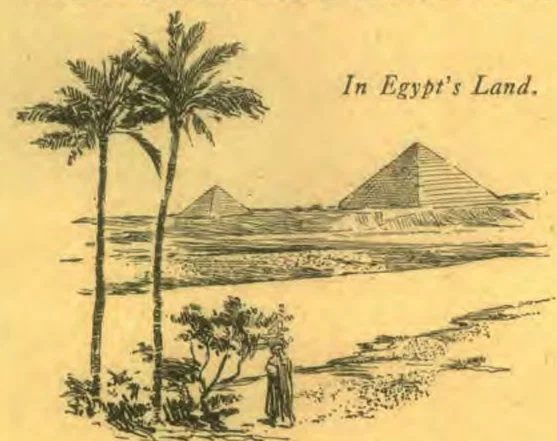
OVER the broad, blue expanse of the great River Nile, the warm, tropical sun shed its blistering rays one day, about the time of the month Ethanim, nearly four thousand years ago. As the great burning disk rose higher and higher, the Coptic fishermen, in their high-prowed skiffs, were compelled to abandon their work for the day, paddling away through the sluggish waters for the shore, discernible beyond the tall, reed-like papyrus that lined the natural borders of the stream. In the distance beyond lay green vineyards, orchards laden with blossoms, and fields of waving grain in their lighter shades, creating a perspective which had for its bas-relief the dark stone wall of Egypt's capital city.
To the eyes of two of the many pedestrians on the king's highway who were approaching the city, the walls looked high and formidable, the watchtowers jutting higher regularly along the top. The huge arched gate stood wide, and on either side, stolid and brown, were the guards, clad in the simple armor of the times,—helmet and mail, with the battle-ax for a weapon.
On through the city's busy mart the two travelers continued, through the gates that opened into the king's grounds, on through the outer court, and up the broad granite steps into the palace. One of the twain gazed eagerly and familiarly at the beautiful surroundings, the magnificent gold-mounted furniture, the rich paintings, the statuary, the great pillars with their quaint inscriptions that towered to the domes. These things he looked upon as friends of by-gone days, when as a lad he roamed at will among them. As a man here he dwelt, heir apparent to the throne, receiving the obeisance of princes, honored by the greatest of the land. But he esteemed 'the reproach of Christ greater riches than all the treasures of Egypt;' 'choosing rather to suffer affliction with the people of God, than to enjoy the pleasures of sin for a season.' So he left it all, and now, returning after many years as ambassador and prophet of the King of kings, he is hated and despised.
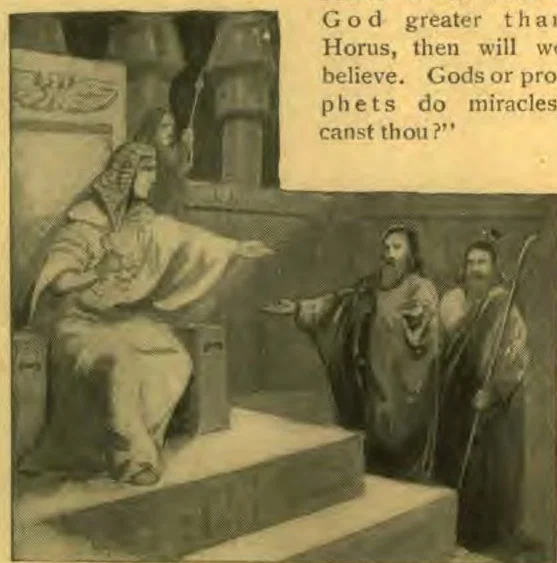
The beautiful objects held not their steps for a moment, but, passing on, ignoring the liveried doorkeepers who would have stayed them, they soon stood in the throne room of the greatest monarch of that time. The king was seated under a gorgeous canopy, among soft cushions and rich tapestries. Princes stood in attendance, and on either side were officers of state, scholars, priests, and musicians. At the foot of the throne stood the royal guards, gaunt and lithe, their spears beside them. Behind the monarch were winged effigies of Truth and Justice, and a great inscription above the throne represented a hawk-headed figure leading a lion and a sphinx.
As the two simply-clad Hebrews—for such they were—stood before the king, all other business was suspended in amazement. Solemnly and with uplifted hand, one spoke, demanding, on the warrant of the Most High God, the release of His people. The message was short and simple, but impressive; when he ceased speaking an ominous silence reigned, naught was heard but the wafting to and fro of the fans. Courtiers waited breathless and expectant, the guards were alert, ready for the signal to act, but none came.
Pharaoh's eyes glittered angrily, and sneeringly he reiterated, 'Let my people go.' Show yourselves to be from a God greater than Horus, then will we believe. Gods or prophets do miracles, canst thou?'
The men stepped back a pace, and one cast his rod to the floor. Hardly had it touched the marble pavement e'er it became a great hissing serpent of the most dreaded species in the land; writhing angrily into a coil, it lashed its venomous fangs to and fro. The attendants fell back instinctively, 'The fiery serpent!' they exclaimed in terror. Pharaoh gasped in wonder.
'That is magic of a truth,' he declared; 'but may not the magicians do also with their enchantments? Let us see. Call the magicians,' he cried. Soon they appeared before him, and, in response to his inquiry, they cast their rods to the floor, and to all appearances they became serpents as they fell. But the serpent of the Hebrews recognized a common foe, and, flinging itself upon them, devoured them all. Then the Hebrew advanced upon the reptile, and as he grasped it fearlessly it became a rod again in his hand.
The scene was ended; but Pharaoh was unmoved and unconvinced. The ruler recognized in the two men a superior magic than that possessed by his magicians, but nothing more. The interesting scene had abated his anger, but he despised the messengers, and reviled their God.
'The wise men and the sorcerers do as ye do, wherefore say ye then, 'Let us worship the Lord in the wilderness;' get ye hence, Moses and Aaron, I wot ye are enemies to the land.'
Without a word farther the men withdrew.
CHAPTER II.
The Egyptian king was a god. He was deified and invoked by all the divine appellations and epithets. He was not merely like the gods, but was one of them. He was the mighty Horus, the good god, the master. Therefore to appear unbidden before him was punishable with death. The offense of the Hebrew prophets was great, and would have met its punishment, but a greater King was keeping His servants, and Pharaoh dared not harm them.
For fear of a possible uprising among the slaves that served at the palace of this king, Menephthah I., they were kept, when through their day's duties, in the prison or dungeon; and the heavy stone doors closed behind many of Israel's choicest young men selected for their skill, wisdom, and strength. Lying on their mats or beds they recounted the scenes of the day and the tales of new afflictions laid upon their people in Goshen; they talked of their loved ones at home, and with gladdening hearts they dwelt upon the words that the prophet had spoken, that God had visited His people, and the day of deliverance was near.
Then they listened again to the wonderful story of the miracle told by one of the king's messengers, Heber by name, who in waiting at the court had beheld the scene himself. Vividly he described the wonder, his voice low-pitched in excitement. But finally one interrupted, 'Tell us, Heber lad, what manner of men are the prophets?'
'Did I not tell thee? They are both tall and strong, their hair and beards are black like the raven's wing. Tho alike yet are they different in many ways. Aaron is the speaker and a bold one is he; Moses is slow of speech, and his tongue hath a Midianitish sound.'
The voices of the lads grew low and drowsy. In spite of excitement, tired nature asserted itself, and at last they were locked in slumber.
When the gray of dawn began to creep through the narrow stone-walled passages, the bolts and chains rattled as they were loosened, the doors creaked heavily as they swung back, and the keeper looked in upon the slaves. 'Up, ye sons of Israel,' he exclaimed, 'the king goeth early to the river to worship. Hasten then to thy labors.'
'Anathpherah, my goodly keeper, sawest thou the prophets yesterday?' inquires Heber. 'Yea,' responded the keeper, 'I beheld them as they left, in the outer court, and, by the great Ra, methinks I beheld in one, behind his beard, the crown prince that fled many years ago. A goodly king, it seemeth me, he should have been. Twice spared he my head when the king was wroth with me. Come, my lads, the day breaketh.'
The sun was not yet two hands high when the king with his courtiers and attendants left the city in grand procession headed for the river to worship.
The king was borne under a canopy of purple. A score of priests, carrying censers and the statues of the gods, with trumpeters in the van, led the procession.
Fan-bearers stood on the right and left, and high officers of state bore the weapons and insignia of the king. Behind followed the body-guard, soldiers and priests, then the white bull, Apis, led by his attendants and nurses.
Following these were all the wise men, astrolo-15gers, and magicians, for none of the royal house might omit devotions to the great river, which was worshiped as the symbol of the god of productiveness by high and low alike.
For, about the time of the summer solstice, the sun looked straight down upon the mountains of Abyssinia, setting free the weight of snow and ice, and as it melted it tumbled in yellow cascades over precipices, and rippled down in brooks and streamlets, and bubbled up in springs, all joining to swell the Nile until it overflowed its banks throughout the length of Egypt, watering and enriching with its deposits thousands of acres that otherwise would have been sterile. All that Egypt ever has been it owes to the annual inundation.
As the cortège reached the place of ceremonies, two men suddenly appeared before the king.
They were Moses and Aaron.
The monarch paled with anger at the interruption again repeated, but before he could speak the hand of the prophet Moses was raised in warning, and solemnly the message from Jehovah fell on the haughty king's ears.