Your ShelfYour Projects

Signs of the Times, Vol. 30, No. 43.

WHY YOU WILL WANT TO READ
Earlier text: THE DEMAND FOR A DEFINITE MESSAGE

MUSIC IN THE HOME.

BY MRS. L. D. AVERY-STUTTLE.
IF there is music in the heart, there is quite likely to be music upon the lips.
It is rare indeed to find a man or woman, and rarer yet to find a child, who does not love music. It is an inborn passion of the soul. How perfectly it expresses the myriad emotions of the human heart. Are we happy? What so expressive of our joy? “Is any merry? let him sing psalms.”
Are we sad? what so perfectly expressive of our sorrow?
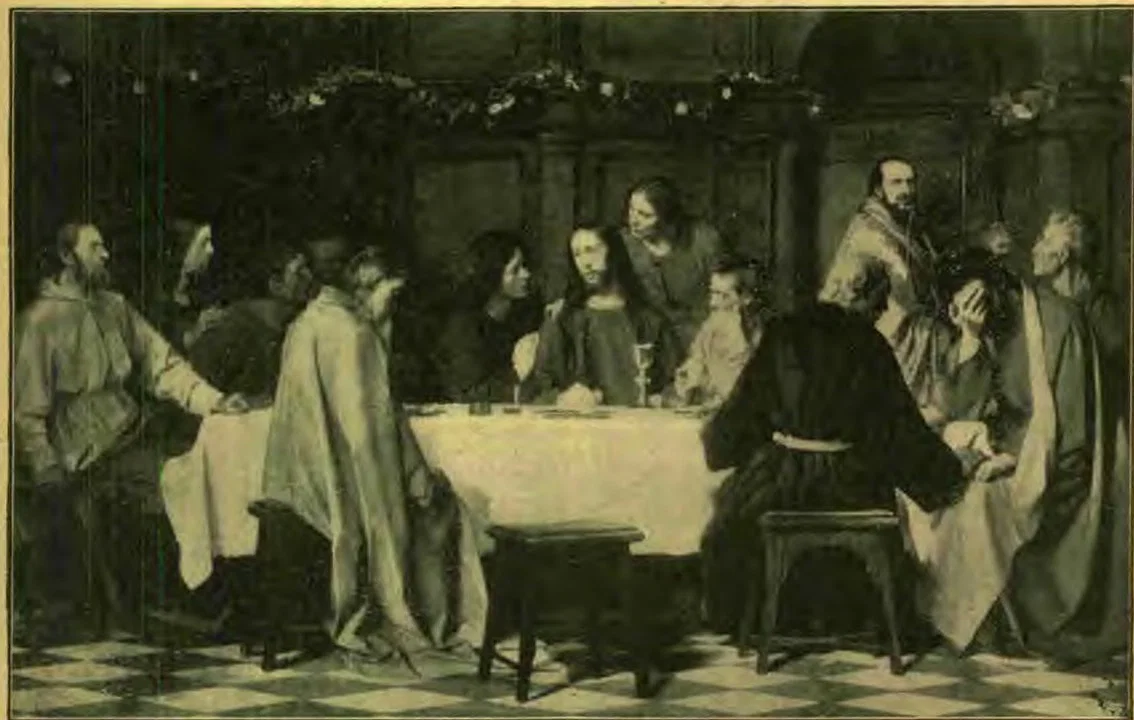
Go with me to the large upper room where the disciples met for the last supper with their beloved Master. The table is spread. The bread and the sop are ready. The sad, prophetic words have been spoken: “One of you shall betray Me.” One after another asks the heart-breaking question, “Master, is it I?” Even the youthful face of the beloved John is lifted in horror-stricken wonder from the breast of the Man of Sorrows with the same tearful question. At last the murderous hand receives the sop, and the false one steps out into the night to commit the black deed of everlasting infamy, and to write his traitor name on the records of time and eternity in crimson characters of shame. Then, upon the still night air is borne the notes of that sad, sad hymn. All join in singing it. Peter the impetuous, Thomas the doubting, John the beloved,—all but the traitor. He could sit quietly by, and eat of the Passover Supper, but he could not stay to join in that solemn hymn which was the last they would sing with the Man of Sorrows.
When that mighty hero of the Reformation, the humble monk, who appeared before the Diet of Worms with shaven crown and bare feet, was assailed by the darts of Satan, he would say to his bosom friend, Melancthon, “Philip, come; let us sing the forty-sixth psalm.” And, under the inspiring influence of that song, they went courageously to do battle with the enemy, in the name of the Lord of hosts.
O, there is strength, there is inspiration, in music!
“Well, what about music in our homes? Now, I have a daughter who loves music, and she was so determined to have a piano that I bought one for her. I don't know that I am sorry, for she was getting to be pretty wild and reckless; now her mother and I never have any trouble with her. She has just dropped all her wild associates, and seems to care for nothing but music.”
There is no instrument made by the hand of man which can equal the human voice. Yet I think all will agree that there is a certain kind of artificial training which ruins the simple and natural beauty of the voice—a sort of operatic affectation. I have known sweet voices to be ruined by this, and the tender, bird-like tones, a gift from the hand of the kind Creator, spoiled by a foolish vanity, until they were anything but pleasant.
Ah, what so beautiful as the soft and tender lullaby from the mother's lips, which calms and soothes the sleeping infant at her breast? All the famous operas in the world can not be compared to it. The wonderful strains of a Patti may be forgotten. The songs of the greatest singers of earth whom kings applaud, and over whom princes rave, may be forgotten as the years roll on and the hair becomes white and the form bent; but the songs mother used to sing to us as the sun was sinking out of sight behind the old barn, while she held us closely in her dear arms, and
swung back and forth in the old rocking chair, will never be forgotten while life lasts; and even over in that happy land, where voices never become cracked and shrill with age, methinks we shall ask mother to sing again the old lullabies of yore.
There is something wondrously soothing in good music. You remember how the dulcet tones of the sweet singer of Israel charmed away the evil spirit from the impetuous king.
But if music is used as an agency for good, so Satan, recognizing its power, has harnessed it to his car also, and used its alluring and persuasive, yea, almost compelling, force to draw his victims into the net. A few evenings ago my way down-town led me past a number of saloons—those dens of death. But from the beautiful and brilliantly-lighted interiors floated the witching and subtle strains of music.
O music! sweet and heaven-born tho thou art, thou hast been prostituted by the prince of evil, and made to serve his fiendish purposes. But we will not surrender thee to the forces of evil. We will employ thy beautiful voices and thy rapturous melody as instruments of praise to our King. Aye,
through the ceaseless cycles of eternity, that matchless choir around the dazzling throne shall chant their “Holy, holy, holy, Lord God Almighty!” and the countless suns and systems and blazing worlds shall keep harmonious time to the rhythmic music of the spheres.
Well, then; since we expect to enjoy music in heaven, why not enjoy it upon earth? Since, in our heavenly homes, we shall hear, as did the seer of Patmos, every creature in heaven and in earth and such as are in the sea, singing praises to Jehovah, why not begin to sing His praises in our earthly homes?
Why not?
This will be followed in our next Special by an article by the same writer, entitled, “The Sanctity of Marriage.”

VOICES OF THE ADVENT.

I BELIEVE He is yonder getting His guest-chamber ready, and the moment it is ready, those clouds shall roll away, and He shall come, and we shall be caught up together to meet the Lord in the air. So there may be some in this audience who may never taste death.—Dwight L. Moody.
THE Scriptures teach the church to look to the coming of the Lord as the day of her completeness and triumph. It will be our Jubilee year.—Rev. John Hall, D.D.
I WOULD as soon relinquish all hope of salvation and of heaven and immortality, as give up the expectation of seeing the Saviour in person on earth, just as His disciples last saw Him near Bethany. Surrender the second advent of the Messiah?—Never! It is THE one sublime event.—Rev. G. W. Bosworth, D.D.
LET it be constantly borne in mind in the investigation of the whole subject, that, according to divine arrangement, the advent precedes the millennium, and the beginning of the millennium rapidly succeeds the end of this age, and the terrific judgments that accompany and succeed the advent.—Dr. J. T. Barclay.
IN the Scriptures, the constant note, the continually-occurring exhortation, is, to be prepared for the Lord's coming.—Dean Henry Alford.

WHEN JESUS COMES.

Some people seem surprised at the eagerness which Adventists display for the return of the Lord Jesus Christ to this earth. But why should they not be eager for His return, when that return means—
  • Reunion for the parted;
  • Health for the sick;
  • Land for the landless;
  • Habitations for the homeless;
  • Plenty for the destitute;
  • Bread for the hungry;
  • Water for the thirsty;
  • Sight for the blind;
  • Hearing for the deaf,
  • Speech for the dumb;
  • Youth for the aged;
  • Liberty for the captives;
  • Riches for the poor;
  • "Beauty for ashes;"
  • Immortality for mortality,
  • Life for the dead;
  • "The oil of joy for mourning;"
  • Peace for the troubled;
  • Rest for the weary;
  • Gladness for the sorrowing;
  • Songs for the sighing;
  • Society for the friendless;
  • Perfect bodies for the crippled;
  • Crowns for crosses;
  • Light for darkness;
  • Strength for weakness;
  • Harmony for discord;
"With an eternal inheritance in the kingdom of God for all His ransomed people"?

CHURCH and STATE

THE IDEAL CHURCH AND IDEAL STATE.

BY C. M. SNOW.
AN ideal institution of any kind is an institution that is doing just the work that it was planned to do. Christ is the ideal Saviour, because He is able to “save to the uttermost all that come unto God by Him.” There is no flaw in Him, no weakness in His plan of redemption, no turning aside of His powers and energies to a work outside of that which it pleased the Father to place in His hands.
Likewise any institution inaugurated by Him will be an ideal institution as long as its time and its energies and its talents are given to the accomplishment of the purpose for which it was conceived and established—and not any longer.
Just so it is with any institution of this world; and any person holding any official position or any position of trust is an ideal official only so long as his most faithful endeavors are conscientiously put forth to carry out the trust imposed in him. It is the confusion of interests always that brings in heartless or dilatory work, and that leads to dishonest and shameful practises.

The Ideal Church.

Jesus Christ has established an institution in the world which will continue until He comes to gather His faithful to Himself; it is that company of the faithful, who, at His coming, will constitute the ideal church. They must stand in the most trying time the world has ever seen; but they will stand, and stand not only upon the promises of God, but upon the commands of God—the law of God—as well.
Speaking of that church—the ideal church—our Lord, through the prophet John, says, “Here is the patience of the saints, they that keep the commandments of God, and the faith of Jesus.” Rev. 14:12.
Concerning other characteristics of the ideal church the Word says, in speaking of Christ’s work for it: “That He might present the church to Himself a glorious church, not having spot or wrinkle or any such thing; but that it should be holy and without blemish.” Eph. 5:27. One of the petitions in Christ’s last recorded prayer was, “that they may all be one;” and concerning the place which His followers were to occupy in this world Christ declares in that prayer: “They are not of the world, even as I am not of the world.” John 17:16. Therefore the ideal church will not be mixed up in the politics of the world. It will not be turned aside from its work for any cause whatever.
Again: the ideal church must be a missionary church. It must obey the command, “Go ye into all the world, and preach the Gospel to every creature.” There has never been a time in the history of the world when the church could plead that it had accomplished its purpose in forwarding the interests of Christ’s kingdom, and could now unite with the state in helping to straighten out the affairs of the kingdoms of this world. The church has on its hands the greatest enterprise in all the world. The ideal church will bend all its energies to the accomplishment of that purpose.
In the world, but not of it; married to Christ; not united in any way to the state; fully absorbed in God’s work alone; loyal to God in all circumstances; obedient to all His commandments; and, because obedient, having the gift of prophecy in its midst—these are some of the characteristics of the ideal church.

The Ideal State.

The state is a legitimate institution. Being such, it has a field distinctly its own. Anarchy is as much opposed to God’s purpose as it is to the governments against which it aims its poisoned arrows.
The purpose of the ideal state is to safeguard individual rights. It must sit as a judge upon the cases of those who wantonly invade rights, destroy property, or chastity, or reputation, or take life. Did it not do this, here could be no excuse for its existence, and no guarantee of safety to person, life, or property.
Because men will not respect the rights of others, the state uses force to compel them to refrain from invading those rights.
The state can not compel men to cease being covetous, or to cease hating other men; but it can, through fear of punishment, to a great extent, compel them to refrain from taking the possessions of another, or allowing hate to manifest itself in murder. The ideal state can not punish for evil thoughts, but it can punish the evil thinker for carrying his evil thoughts into practise, and thus can and does to a great extent control and hold in check the flood of evil deeds that otherwise would flow unchecked in tremendous volume. In other words, it does not demand righteousness, but civility.
The ideal state can demand of man no religious duty or service; for the state is not a deity. It can not demand that such duty or service be performed toward the God of heaven; for the God of heaven Himself has placed before men every necessary requirement, made His service voluntary, not compulsory, and has delegated to no power nor institution on earth the authority to enforce any of those requirements upon any soul. The right of choice is a sacred right which even Divinity will not invade. The ideal state, therefore, can not invade it.

Can the Two Join?

Christ recognized the fact that the church and the state must stand each in its own sphere. “Render therefore unto Cæsar [government] the things that are Cæsar’s; and unto God the things that are God’s.” Matt. 22:21.
The policeman is not the man to carry the Gospel message. He has no commission so to do. The minister of the Gospel has no business with the policeman’s club or pistol or the warrior’s sword or rifle. God has given him no commission to carry on that work. These stand for the state, not the church. The only weapon the Christian may carry is the sword of the Spirit. To teach, and to convict men of sin and convert them to Christ, through the operation of the Holy Spirit—this is the business of the ideal church. To protect the person, property, and liberties of the individual—this is the business of the ideal state. Unite them, and you have a combination that has not been authorized of God, and can not but invade the rights of men in both domains. He who flees from civil punishments to the protection of a legalized creed has made himself a hypocrite and shut the door of heaven in his own face. And that is what every national religion—every union of church and state—has taught men to do. In the words of U. S. Grant, “Keep the church and state forever separate.”
[Three articles will follow this, in subsequent numbers. The next is entitled, “Creed Power and State Aid.”]

The King of Glory

There is a King of glory, Erelong on earth to rise, Sung in prophetic story, Descending from the skies; The Babe of Bethlehem, 'tis He; It is the Man of Calvary— Not crowned with thorns, and gory, But crowned with glory now! Not crowned with thorns to-day, Not mocked and led away, But crowned with everlasting glory now! —Anon.

Come, Lord Jesus

THE sum of all human longings, all Christian hope, all divine promise [is] in the cry, Come, Lord Jesus.—Prof. John Peter Lange.

The Sunday-School

LESSON 7.—NOVEMBER 13.—JEHOASH REPAIRS THE TEMPLE.
Lesson Scripture, 2 Kings 12:1-15, A. R. V.
(1) "In the seventh year of Jehu began Jehoash to reign; and he reigned forty years in Jerusalem: and his mother's name was Zibiah of Beer-sheba. (2) And Jehoash did that which was right in the eyes of Jehovah all his days wherein Jehoiada the priest instructed him. (3) Howbeit the high places were not taken away; the people still sacrificed and burnt incense in the high places.
(4) "And Jehoash said to the priests, All the money of the hallowed things that is brought into the house of Jehovah, in current money, the money of the persons for whom each man is rated, and all the money that it cometh into any man's heart to bring into the house of Jehovah, (5) let the priests take it to them, every man from his acquaintance; and they shall repair the breaches of the house, wheresoever any breach shall be found. (6) But it was so, that in the three and twentieth year of King Jehoash the priests had not repaired the breaches of the house. (7) Then King Jehoash called for Jehoiada the priest, and for the other priests, and said unto them, Why repair ye not the breaches of the house? now therefore take no more money from your acquaintance, but deliver it for the breaches of the house. (8) And the priests consented that they should take no more money from the people, neither repair the breaches of the house.
(9) "But Jehoiada the priest took a chest, and bored a hole in the lid of it, and set it beside the altar, on the right side as one cometh into the house of Jehovah: and the priests that kept the threshold put therein all the money that was brought into the house of Jehovah. (10) And it was so, when they saw that there was much money in the chest, that the king's scribe and the high priest came up, and they put up in bags and counted the money that was found in the house of Jehovah. (11) And they gave the money that was weighed out into the hands of them that did the work, that had the oversight of the house of Jehovah: and they paid it out to the carpenters and the builders, that wrought upon the house of Jehovah, (12) and to the masons and the hewers of stone, and for buying timber and hewn stone to repair the breaches of the house of Jehovah, and for all that was laid out for the house to repair it. (13) But there were not made for the house of Jehovah cups of silver, snuffers, basins, trumpets, any vessels of gold, or vessels of silver, of the money that was brought into the house of Jehovah; (14) for they gave that to them that did the work, and repaired therewith the house of Jehovah. (15) Moreover they reckoned not with the men, into whose hand they delivered the money to give to them that did the work; for they dealt faithfully."
Golden Text.—"We will not forsake the house of our God." Neh. 10:39.

SUGGESTIVE QUESTIONS.

(1) In what year of Jehu, king of Israel, did Jehoash begin to reign in Jerusalem? How long did he reign? Who was his mother? Verse 1. (2) What is said of his conduct? Verse 2. (3) What is said of the conduct of the people? Verse 3. (4) What permission was given by the king to the priests regarding their support? Verses 4, 5. Note 1. (5) But what did they long neglect? Verse 6. (6) For whom did the king at last call? What reproof did he administer? And what command did he give? Verse 7. Note 2. (7) How did the priests receive the king's reproof and his orders for the future? Verse 8. Note 3. (8) What plan did Jehoiada then adopt for raising money? Verse 9. (9) As money accumulated in the chest, who took charge of it? Verse 10. (10) What was then done with the money? Verses 11, 12. (11) What things were not made at first? Verse 13. Note 4. (12) What received first and earnest attention? Verse 14. (13) What marked confidence was manifested toward the men who had charge of the work? Verse 15. Note 5.

NOTES.

1. Altho Jehoash (also called Joash) was faithful under the instruction of Jehoiada the high priest, he was too young, at the age of seven years, to do much aggressive work throughout the country, and for a time the inclination of the people to indulge in the exciting worship of Baal was not materially curbed. Therefore the priests of Jehovah were not properly provided for. So they were permitted to procure for themselves sustenance as indicated in verses 4 and 5.
2. The king's reproof of the priests indicates that, through the permission before granted to collect money for their support, they had been so liberally supplied that they ought to have devoted some of the means thus acquired to keeping the temple in repair. For twenty-three years at least, and evidently for a number of years before Jehoash's reign, there had been no repairs made in the house of the Lord. The king was now thirty years old—recognized as a mature man—and in a position to wield more commanding influence than before.
3. The priests consented to the plan, and decided not to personally collect any more money from the people, but to rely for their support on that which should come to them in the regularly prescribed way. The expression, "neither repair the breaches of the house," is a little obscure; it evidently implies that they would receive no more money that ought to be devoted to that purpose. The Common Version strengthens that idea. And what follows shows that the money donated for that purpose, together with the work, was put into other hands.
4. "But there were not made . . . vessels," etc.—There is an apparent contradiction between this verse and 2 Chron. 24:14, which says, "And when they had made an end, they brought the rest of the money before the king and Jehoiada, whereof were made vessels for the house of Jehovah," etc. The thought, then, in the lesson text is, that these vessels were not made until the work for which the money was specially designed had been finished. The money was not diverted from its original purpose until that purpose was fully accomplished.
5. The fidelity of the king's reign up to this time had inspired the people with a spirit of confidence and of faithfulness to the extent that the men entrusted with this work could be depended upon. If such a work were given to men in these days without their being required to account for the details, or even the aggregate of expense, there would not be much, if anything, left to apply to other purposes. The men of the very best reputation to-day, if employed on any public work, must be bound by specific contract, and bonds of other responsible parties, and be required to give itemized accounts of expenses, etc., in order to insure a faithful work and honest expenditure of the people's money. And even all these precautions often fail to protect the public. Yet we are told that "the world is growing better." But the Word of the Lord and the experiences of the public are all against the popular claim.

How to Care for Lamps

The dealer who sells lamp-chimneys to last, is either a shrewd or an honest man. MACBETH. How to take care of lamps, including the getting of right-shape chimneys, is in my Index; sent free. MACBETH, Pittsburgh.
MACBETH.
How to take care of lamps, including the getting of right-shape chimneys, is in my Index; sent free. MACBETH, Pittsburgh.

TOURIST CARS EAST

VIA

S. P. LINES

Personally Conducted Quickest Time Cheapest Rates
Your choice of a dozen routes
Through cars to— Portland Omaha St. Paul St. Louis Memphis Houston Atlanta Los Angeles Denver Minneapolis Louisville El Paso New Orleans Washington, D. C. Salt Lake City Kansas City Chicago Cincinnati San Antonio Montgomery
Remember these cars run through to above named cities without a change from Oakland or San Francisco. Our fast limited trains in connection with the above mentioned service. . . .

G. T. FORSYTH

Div. Pass. Agent 12 San Pablo Ave., Oakland, Cal. PHONE MAIN 543

OLIVOILINE

Is the Hygienic Cooking Oil of To-day A Pure Vegetable Shortening. No Animal Fat. No Taste and No Chemicals.
Like Olive Oil, and Keeps In Any Climate
Price, F. O. B., Cash with order 5 gal. can, $3.50; 10 gal. can (75 lbs.), $6.75. Write for circulars on Bbl. and ½-Bbl. lots. (Refined Cotton Seed Oil, 10 Gallons, $5.50) Address O. C. GODSMARK
2005 Magazine St. LOUISVILLE, KY

THE NORTH-WESTERN LINE RUSSIA-JAPAN ATLAS.

Send ten cents in stamps to R. R. Ritchie, No. 617 Market Street, San Francisco, for Russo-Japanese War Atlas, issued by the Chicago & North-Western Railway, three fine colored maps each 14 × 20, bound in convenient form for reference. The Eastern Situation shown in detail with tables showing relative military and naval strength and financial resources of Russia and Japan.

THE AMERICAN STANDARD

Revised

Bible

"The most excellent translation of the Holy Scriptures ever published in the English tongue."—The Interior. Besides publishing the American Standard Revised Bible in a large variety of sizes and bindings, we also publish about 400 styles of the King James Version.
Complete Catalogue sent on request.
"The Standard translation of the Bible for the English speaking world.—Sunday-School Times. Published in over 70 styles, prices 35c. to $12. Teachers' Edition, $2.25 to $10. New Testament alone, 15c. to $2.50. Sold by all booksellers.

Thomas Nelson & Sons, Publishers

37 East 18th Street, New York

SIGNS OF THE TIMES

PUBLISHED WEEKLY
BY THE PACIFIC PRESS PUBLISHING CO.,
Villa Street, . . . . . . . . Mountain View, California.
(Application made for entry as second-class matter at Mountain View, Cal.)
H. H. HALL, . . . . . . BUSINESS MANAGER.
Terms of Subscription.
Per Year, post-paid . . . . . . . . . . . . . . . . . . . . . . . . . . . . . . . . . . $1 50
Six Months, 75 cts. Three Months, 40 cts.
To Foreign Countries, per year, $1.75.
SPECIAL TERMS.
1. One new yearly subscription and one renewal, or two new yearly subscriptions, sent at one time, $2.50.
2. Two new yearly subscriptions and one renewal, or three new yearly subscriptions, sent at one time, $3.25.
3. Three new yearly subscriptions and one renewal, or four new yearly subscriptions, sent at one time, $4.00.
Sample copies sent on application.

FOOTBALL FREE!

BOYS, send to us for 20 packages of Bluine which you can easily sell at ten cents each. Return us the $2.00 received, and we will at once send free, post-paid, a Regulation-size Rugby Football, consisting of a tested bladder made of the best rubber, and a strongly sewed leather cover. It is warranted to stand rough work. Send your address. We trust you with the bluine. Satisfaction guaranteed. We also give other athletic goods.
(The Old Reliable Firm)
BLUINE MANUFACTURING COMPANY 16 Mill Street, Concord Junction, Mass.

To Our Readers

To Our Readers.—We do not ask the public to read any one of the articles in this paper because of the greatness or the prominence of its author. We do not ask a soul to purchase the paper for any other reason save for the truth it contains. We know the writers of these articles as able, devoted servants of God, who believe in the mission of Christ Jesus our Lord and are anxious to see it accomplished. But each and all, even as the writer of this note, ask for no recognition because of name or position, past or present. This number of the SIGNS OF THE TIMES, and the numbers to follow, deal with great, vital, and important questions, questions made prominent in the Word of God, and which all must decide for eternal wo or weal. We therefore entreat our readers to weigh these matters as they are herein set forth in the balances of God's truth. Read them in the light of His Word. Consider them as we would wish to do if we stood literally and visibly at the bar of God. Let men be nothing only as they are used of God; let God and His truth be everything. Our work is to present them to you; and as we have been "allowed of God to be put in trust with the Gospel, even so we speak; not as pleasing men, but God, which trieth our hearts."

Bible Inspiration

Bible Inspiration.—On another page is an article which clearly presents the fact that the Bible is inspired. That article does not say how; finite man can not understand the processes of the Infinite God. But from the texts used (2 Tim. 3:16; 2 Sam. 23:2; 1 Cor. 2:13), we would naturally understand that the words were breathed of God, not, of course, the words of man's translation, but the original words. But the objection is raised, "Why, then did not all the prophets speak in the same style?" And the answer is simple: Because they were different men. God is limited in speaking to men by man's capacity to understand. John 16:12. God is limited also in imparting instruction through men because of man's limitations. Heb. 6:12. The wise Master always used the best instrument He had, that would be used, and He used that instrument to the fullest capacity of the instrument. He must, therefore, have used words which the instrument knew. He inbreathed the words familiar to the man He used, but He expressed thoughts by the words which the speaker or writer did not understand. Dan. 12:8; 1 Pet. 1:10, 11. Yet the words used expressed the truth. To illustrate: Here is a master musician. He plays equally well on a piano, organ, violin, harp, cornet, oboe, guitar, drum, etc. Each instrument according to its limitations expresses the truth and harmony of music, but all are not equally sweet or melodious. The sound of the bagpipe can not be reproduced by the soft guitar, nor can the drum produce the tones of the violin. The voice of the cornet does not sound like that of the piano; yet all are perfect in their sphere, and each by the power and skill of the master expresses correct music within its limitations. Each instrument has its admirers in the vast throng which listen, while other instruments are criticized. The music was the master's, and the tone, the instrument's. So God has chosen men, rough, crude, old, young, learned, unlearned; and through them He has spoken as best He could. The words were their own, chosen by Him. His, the quality; theirs, the tone. They spoke out of their own vocabulary, but God chose the words. His words were therefore on the tongue of His servants, selected by the Holy Spirit, not by man's wisdom.

Notice of the Special Numbers

Read the extended notice of our special numbers on second page of cover; and please act quickly.

Value of Our Four Specials

<h3>Value of Our Four Specials.—</h3>In an ordinary book which sells from a dollar to a dollar and a quarter there are all the way from 80,000 to 140,000 words, some less, a few perhaps more. One of the latest to come to our table has 96,000. But our four special SIGNS will contain, besides the covers, from 140,000 to 150,000 words, good, live, religious matter. And these four papers sell at retail for only 20 cents! Where can you get so much truth for so small a price? How could you get so much before your neighbor at so small a sum? Who would not be willing to buy a set if they were properly presented?

Give These Specials Wide Circulation

Faced continuously by almost insurmountable obstacles, this paper has been gotten out. The almost entire extent of our library now unpacked and in use consists of our Bible, our concordance, our dictionary. We have been hungry for time which we could not use on account of other difficulties, and when we could use it to advantage we have had so little of it. Artists have been at a distance; noise and confusion, hustle and commotion, incident to the finishing of the building and moving in, are a part of every hour's experience for the last two months. In view of this we trust our readers may overlook some, at least, of the many defects. But the papers contain precious, vital, soul-saving truth; and as bearers of Gospel truth we send them forth and ask our friends to give these specials the widest possible circulation.

Help the Infidels

Help the Infidels.—Not a few who are infidels are such because of the perversion of truth. Many of these who can be helped to see the truth in its beauty, will turn from infidelity. To help such the Life Boat publishers issue a special number for infidels and skeptics this month. Among the writers are Geo. I. Butler, editor of the Southern Watchman, once an infidel. Mrs. E. G. White, S. N. Haskell, W. S. Sadler, and others, will speak of the mighty truths of the Word of God, and the power of the Gospel to save men. If you want to help us in the good work, send the names and addresses of infidels whom you know, and a two-cent stamp for each, and the publishers will mail to each address a marked copy of this issue; or order at two cents a copy, and distribute yourself. Pray for this work. Address, Life Boat, Hinsdale, Ill.

THE SAINTS' WELCOME.

"And it shall be said in that day, Lo, this is our God; We have waited for Him, And He will save us; This is Jehovah; We have waited for Him, We will be glad and rejoice in His salvation."

THE MASTER'S PROMISE.

"Let not your heart be troubled; Ye believe in God, Believe also in Me. In My Father's house are many mansions; If it were not so, I would have told you. I go to prepare a place for you. And if I go and prepare a place for you, I will come again, And receive you unto Myself, That where I am There ye may be also."

The Body as God’s Temple

Man's body, every man's body, is the temple of God de jure, or by right. It was created so to be. But man of free will chose not so to have it; and God's presence went forth and the enemy came, whose temple the man's body became de facto, and so it ever is with the natural, carnal man. All that Heaven can do is being done to win that temple back to allegiance to God. But God does not call that temple His where Satan or the flesh rules. He does not call that law His which man has perverted. He does not call that life His which man has prostituted to selfish ends and perverted to dying. But, O soul, the heart of Infinite Love longs that you shall yield your all to Him that your body may become His temple in right and in fact.

Who Putteth Our Soul in Life

" Who Putteth Our Soul in Life."—Thus reads a clause of Ps. 66: 9 in the Revised Versions, so also the marginal Hebrew of our common version. It implies that naturally our soul is not in life, but in death, in dying. And so it is; for "the carnal mind is enmity against God," and to be carnally minded is death. It is out in the great sea of death, drifting to everlasting oblivion; but if the soul is yielded to God, He reacheth down His great, strong, mighty hand and "putteth our soul in life," baptizes it into the Holy Spirit. It is for us to choose—carnality, sin, and death; or Christ, righteousness, and life.
Continue reading: Manner of Christ’s Coming