Why do you condemn pork when God says it is good to eat, if received with thanks and after asking God's blessing upon it?
We do not believe in the eating of pork because—
1. God has classed it with unclean animals, and tells us that it is unclean and an abomination. Leviticus 11, Deuteronomy 14. We know no reason why it is not unclean still. We believe that heavenly wisdom made the classification that it did because of the very nature of the beasts themselves, and we know no evidence to show that the nature of the beasts has changed.
2. Medical science is against the use of pork as food. It is one of the first things forbidden in sickness, and one of the last things permitted. The very word from which "scrofula" comes is the very same word from which "sow," the female swine, comes.
3. The text in question no more authorizes the use of swine's flesh as food than it does that of toads, scorpions, bedbugs, or any other creeping, crawling, filthy thing. The subject under consideration is not the subject of food at all. It is that we should beware of a class of people that depart from the faith of God's Word, that give heed to seducing spirits and doctrines of demons, that are led by the doctrines of men who speak lies, whose conscience is seared. This class forbids to marry and command to abstain from food. The word "meats" simply means food, nothing more nor less, and applies to vegetable food just as much as animal food. The kind of food that these teachers command their dupes to abstain from is that which God commands to receive with thanksgiving by them which know the truth.
4. The Word of God is true, and that Word teaches the distinction between the clean and the unclean which we have set forth in the beginning of this note, and the creature, or anything created, not necessarily animal, is good if it be received with thanksgiving, for it is sanctified through the Word of God. The Word of God is that which sets it apart, and the Word of God has made very clear6and distinct what things are good for His children and what are not. The class against which the apostle warns us would make their rules and regulations the standard of conduct, and God has left His children free to walk in the liberty of His great, boundless Word.
1811.—The Gospel of the Kingdom.
1. Has the ordinary preaching of the present day any resemblance to the preaching of the Gospel of the kingdom as predicted by our Saviour in Matt. 24:14? (2) How far do you understand this Gospel of the kingdom has been preached? (3) As Christians, what may we next expect in view of that message?
1. Much of the preaching of the present day has no relation to the Gospel at all. It is based on higher criticism and traditions of men. Much of the preaching also is real Gospel preaching without specific reference to the coming kingdom; yet much of this true preaching rings out with the truth that Christ will come, and that the Gospel is to prepare men for that coming.
2. We do not know how far the Gospel of the kingdom has been preached. In the message of 1840 to 1844, it is said that the message of Christ's coming was preached in every mission station on the face of the globe. There are many missionaries preaching it now, and it could be preached in a very short time if hearts were alive to its meaning.
3. When that time has come that the Gospel of the kingdom of the Lord Jesus Christ is proclaimed in all nations as a witness, then cometh the end.
1812.—Prerogatives of Religious Bodies.
"Congress shall make no law respecting an establishment of religion, or prohibiting the free exercise thereof. On this ground why should a Unitarian representative, that church or denomination have been denied joining with other representatives at the Federation of Churches at New York? Is not the Unitarian Church a Protestant church and entitled to its beliefs, seeing that all men do not, and can not, believe alike?"
Every human society has a perfect right to shut from its deliberations and fellowship whomsoever it will, if the civil rights of those so shut out are not infringed upon. This is also true of any number of such societies which may form an alliance. The Church Federation was such an alliance, and Unitarians were excluded on the ground that they were unevangelical. Jesus Christ to them is only a man, not a divine-human Saviour. The Constitution has no bearing on the subject whatsoever. Doubtless the Federation was inconsistent because there are many in the other churches who hold to Unitarian ideas; yet they have the right to exclude Unitarians.
1813.—Adam and Repentance.
Does the Bible teach that the first man Adam, for his disobedience, was repentant, and that he was faithful and obedient to the commands of God to his life's end?
The Bible says nothing directly upon this point. It has been inferred that he was repentant.
1814.—Proper Precautions.
Does it show a lack of faith for Adventists or Christians to build storm caves?
It is not a lack of faith to do anything that common prudence deems advisable unless absolute duty calls us from it. It is no more lack of faith, so far as we can see, to build a storm house or cave, than to build any house, or to carry an umbrella, or to wear an overcoat or storm shoes.
1815.—Carcass and Eagles.
Matt. 24:28. What is the carcass and who are the eagles?
The carcass is the incorrigibly wicked; the eagles, or vultures, are the plagues or judgments of God that seize those unrepentant when probation closes. Compare with Luke 17:26-37.
The ROYAL LAW
By F. C. Gilbert
BY F. C. GILBERT.
(A Hebrew Christian.)
I. THE ORIGIN OF GOD'S LAW.
THE law of Jehovah, like the character of God, has never been properly understood since the day it was first violated. Ever since Lucifer allowed thoughts to enter his mind which were contrary to the express wish of his Creator, till the present time, the divine law of the Lord has been misrepresented, misunderstood, maligned, and lightly esteemed. The great purpose of Satan in doing this is to blind the minds of people to the real issue involved in the law; for as long as the law of God is not understood, so long will the true character of God be misrepresented. This has been the one studied plan of Satan; and during the last six millenniums his master mind has been spent in devising and planning methods whereby this end might be reached.
In nearly every age of the world's history, a great battle has been waged religiously, and every time, almost invariably, it has been over the question of the divine law of God. In this present time we frequently hear it said that the law is old, Jewish, abrogated, null, laid aside, non-essential, not needed for this age, etc. It may be well, therefore, at the beginning of this series of articles to pause a while and ascertain what is meant by God's law, and what is its origin.
The word "law" in the Bible has several different terms in the original Hebrew. These are chiefly, chog, statute; mishpat, judgment; doth, statement; davar, word; torah, law. But when considering the thought of God's law, the word torah is almost invariably used. This word is really the standard word for the law of the Lord. Ps. 19:7; verse 8, in Leeser's translation.
What Is God's Law?
That God has a law which He clearly declares to be His law, is many times repeated in the Scriptures. For instance: "Harken unto Me, ye that know righteousness, the people in whose heart is My law." Isa. 51:7. "But this shall be the covenant that I will make with the house of Israel: After those days, saith the Lord, I will put My law in their inward parts, and write it in their hearts." Jer. 31:33. "I delight to do Thy will, O my God; yea, Thy law is within my heart." Ps. 40:8. "But his delight is in the law of the Lord; and in His law doth he meditate day and night." Ps. 1:2. "O how love I Thy law! it is my meditation all the day." Ps. 119:97.
We may now well inquire, What is this law which God calls His? "And the Lord said unto Moses, Come up to Me into the mount, and be there; and I will give thee tables of stone, and a law, and commandments which I have written." "And He gave unto Moses, when He had made an end of communing with him upon Mount Sinai, two tables of testimony, tables of stone, written with the finger of God." "And Moses turned, and went down from the mount, and the two tables of the testimony were in his hand; the tables were written on both their sides. . . . And the tables were the work of God, and the writing was the writing of God, graven upon the tables." "And He wrote upon the tables the words of the covenant, the Ten Commandments." "And the Lord spake unto you out of the midst of the fire; ye heard the voice of the words, but saw no similitude; only ye heard a voice." "Did ever people hear the voice of God speaking out of the midst of the fire, as thou hast heard, and live?" "And He declared unto you His covenant, which He commanded you to perform, even Ten Commandments; and He wrote them upon two tables of stone." "These words the Lord spake unto all your assembly in the mount out of the midst of the fire, of the cloud, and of the thick darkness, with a great voice; and He added no more. And He wrote them in two tables of stone, and delivered them unto me." Ex. 24:12; 31:18; 32:15, 16; 34:28; Deut. 4:12, 33, 13; 5:22.
The word "add" in the Hebrew is, literally, to increase, to continue, to go on. The thought is that when the Lord finished giving the Ten Commandments, He said no more; he stopped right there, and did not go on any farther. This the reader will see very clearly by reading Ex. 20:19; Deut. 5:28, 29; 18:15-17.
It is thus clearly evident that the law which the Lord says is His law was that which He wrote upon the two tables of stone, otherwise known as the Decalogue, the Ten Commandments. The ten words, the ten expressions, the ten thoughts, the ten statements (for this is what the Hebrew words A' se-res Ha-dev-roi, the Ten Commandments, mean) are the Scripture testimony of God's law. While all the Bible is God's Word, while scores, hundreds, even thousands of other expressions and laws were given by the Lord, the TEN COMMANDMENTS are emphatically known as the law of Jehovah.
Where Did It Originate?
This, therefore, being true, where did these words originate? When were they given? To whom were they given? When were they first known? How extensively were they known? It is said nowadays, that they were first given to the Jews through Moses, and hence are known as the law to the Jews. But from the Word of God we learn that this law was known and violated long before there were any Jews or Israelites. We read in Luke 10:18 the words of Jesus: "I beheld Satan as lightning fall from heaven." In Rev. 12:7-9 we read: "And there was war in heaven; Michael and His angels fought against the dragon; and the dragon fought and his angels, and prevailed not; neither was their place found any more in heaven. And the great dragon was cast out, that old serpent, called the Devil, and Satan, which deceiveth the whole world."
From these scriptures we learn that not only was Satan cast out of heaven, but his angels were cast out with him. What was the cause of their fall from heaven? is the question that may be asked. We read the answer as follows: "For if God spared not the angels that sinned." "Thou art the anointed cherub that covereth; and I have set thee so; thou wast upon the holy mountain of God; thou hast walked up and down in the midst of the stones of fire. Thou wast perfect in thy ways from the day that thou wast created, till iniquity was found in thee. By the multitude of thy merchandise they have filled the midst of thee with violence, and thou hast sinned." 2 Peter 2:4; Eze. 28:14-16. "He that committeth sin is of the devil; for the devil sinneth from the beginning." 1 John 3:8.
What Is Sin?
It was sin, therefore, that caused Satan and the millions of angels to fall from their high estate in heaven. See Jude 6. But what is sin? The Bible tells us it "is the transgression of the law" which says, "thou shalt not kill," "thou shalt not steal," "thou shalt not commit adultery." 1 John 3:4; James 2:10, 11; Rom. 7:7. It is therefore plain that God's law is known to the angels, and the angelic hosts are governed by that moral law in heaven, as the inhabitants of earth are governed by that same law. Ps. 103:19-21. This the Scriptures plainly declare: "Bless the Lord, ye His angels, that excel in strength, that do His commandments, harkening unto the voice of His word." Ps. 103:20. And the Saviour, in the Lord's Prayer, teaches us to pray that God's will may be done in earth, even as it is in heaven. Matt. 6:10. God tells us that His will is His law. Ps. 40:8. We thus see why it is that David makes the following statement: "Forever, O Lord, Thy word is settled in heaven." Ps. 119:89. The Hebrew rendering of the text is, literally, "Unto all eternity, Thy word is planted in the heavens." And the term "word" in this text is the identical word that is used in Ex. 34:28 and Deut. 4:13 for commandment.
Thus God's law originated in heaven. God first planted it there. It was made known to the universe, to the angels, to all God's created intelligences. Satan made the first attack on that law. He succeeded in securing sympathizers; the result was an open revolt against God's law, and millions of angels fell. But God planted His law in heaven. It is still there at the present time; and to all eternity it will be; for heaven and earth will pass away, but neither a jot nor tittle of that law can fail or be altered. Matt. 5:18; Luke 16:17. Thank God for the eternal stability of Jehovah's law.
South Lancaster, Mass.
GOD'S PART.
By Samuel Rutherford
God hath a thousand keys to open a thousand doors for the deliverance of His own when he has come to the greatest extremity. Let us be faithful and care for our own part, which is to do and suffer for Him, and lay God's part on Himself and leave it there; duties are ours, events are the Lord's. When your faith goeth to meddle with events, and to hold a court (if I may so speak) upon God's Providence, and beginneth to say, "How wilt Thou do this or that?" we lose ground, we have nothing to do there; it is our part to let the Almighty exercise His own office and steer His own helm.—Samuel Rutherford.
THE KEYS OF THE KINGDOM OF HEAVEN.
By W. A. Spicer
[W. A. Spicer, in Present Truth.]
WHAT did Christ mean when He said, "I will give unto thee the keys of the kingdom of heaven"? We well know the priestly interpretation, by which a certain class of men assume the power to open or to shut heaven to the sinner.
There was just such a priestly caste in Christ's day. He pronounced the wo upon the scribes and Pharisees: "Because ye shut the kingdom of heaven against men; for ye enter not in yourselves, neither suffer ye them that are entering in to enter." Matt. 23:13.
How did they shut the kingdom of heaven against men? Luke's report of this same wo tells us: "Wo unto you, lawyers! for ye took away the key of knowledge; ye entered not in yourselves, and them that were entering in ye hindered." Luke 11:52.
Of what knowledge, then, had they taken away the key?—The knowledge of the kingdom of heaven.
What gives us the knowledge of that kingdom?—The Word of God, the Scriptures, received by faith.
How had the priests and doctors of the law taken away the key from the people, seeing that they had the Scriptures in every synagogue? Christ told them: "Ye have made void the Word of God because of your tradition." "Why do ye also transgress the commandment of God because of your tradition?" Matt. 15:3.
The Word of God has been covered by the traditions of men, by church customs of human invention. Christ swept these aside and gave the people again the simple Word of God, the Holy Scriptures, the keys of the kingdom of heaven.
Thank God we have the key! It is the Word of the living God, with no admixture of human tradition. Use this key! There are treasures of truth for this day, and God entrusts every soul with the key to all that heaven has to give now, and the same key is the way into the eternal kingdom to come. Yes, this blessed Word of God supplies the key to every problem of the soul.
Is it a question as to where we stand in the world's history?—"There shall be signs." Luke 21:25. "Ye, brethren, are not in darkness, that that day should overtake you as a thief." 1 Thess. 5:4.
What is the work for Christians in these times when the spirit of war is filling all the nations? In Rev. 14:6-14 is the key to the situation, the message that all Christians ought to be giving in all the earth.
Has God an answer for the spirit of lawlessness in these last days?—It is indicated in the prophecies of God's Word, showing that to meet latter-day lawlessness, the Gospel worker in these times will be lifting up the standard of the commandments of God, and the faith of Jesus, and calling upon the people to turn from tradition to the plain Word of God. Rev. 12:17; 14:12; Isa. 56:1, 2; 58:12-14.
The Pharisees thought Christ was bringing in new ideas, and that they themselves were standing for the old. It was exactly the reverse. They stood for the traditions and the commandments of men that had covered over the Word of God. Christ swept these all aside and stood for the Word and the commandments of God. He thus gave the keys of the kingdom of heaven to His followers, and His Word to us to-day is to take the same key and enter in. What a treasure of truth His holy Word unlocks to the one who will but use the key!
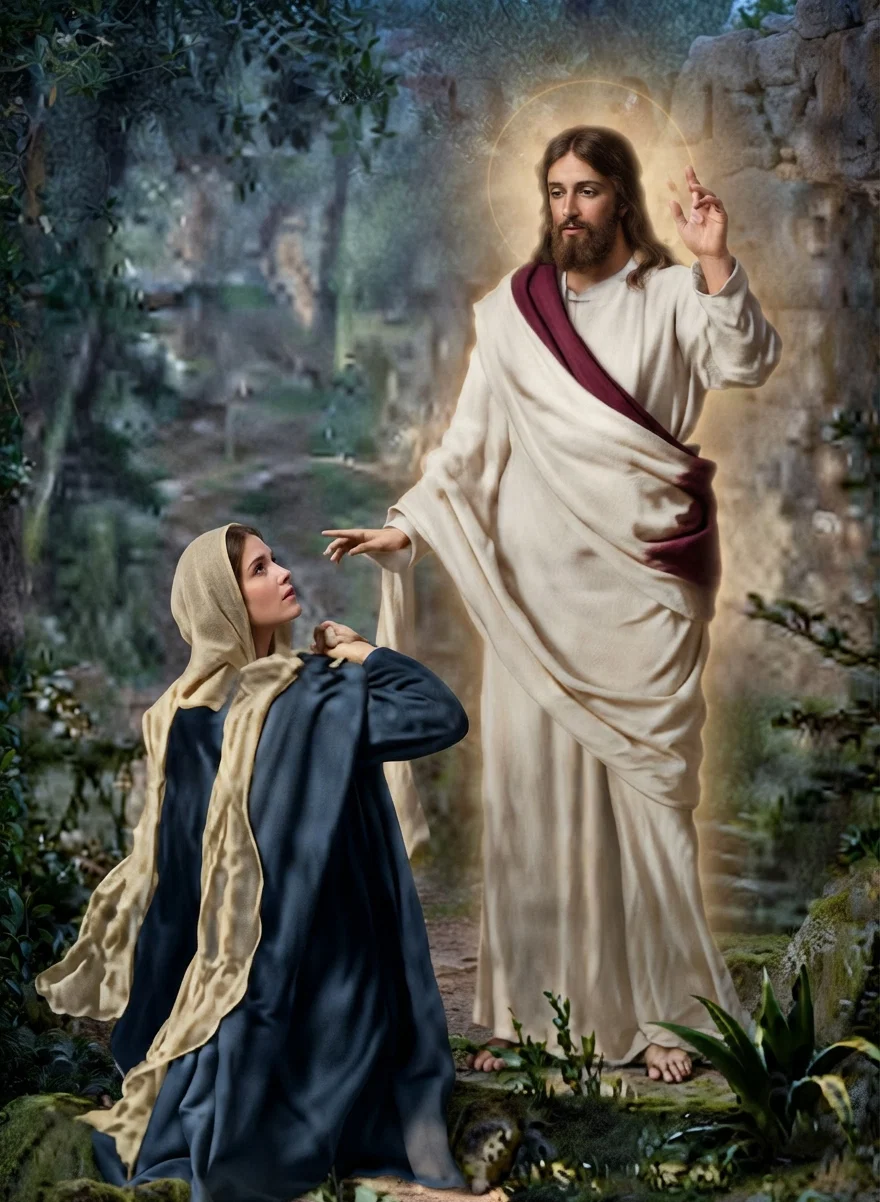
"WHY WEEPEST THOU?"
By Frances E. Bolton
MARY, the Magdalene, had scarcely slept
Or eaten, since that dreadful day
When she had seen Christ crucified. She'd wept
Until it seemed her tears would never stay;
For she had broken with her box of bloom
The Alabaster of her love's perfume.
How could they hate Him? Heaven's Lamb and Dove!
The Godlike Image of unfaltering love!
Before the night passed, she was at the tomb,
And Lo! 'twas open! empty! and behold,
As she stooped down, she saw amid its gloom
Two shining ones in robes of snow and gold.
But not this vision had her purpose moved
Where was the form of Him she most had loved?
Dazed in her sorrow, gently asked they now,
"Woman, whom seekest here? Why weepest thou?"
She turned herself away from all this sight
Of heavenly ones, and stood with tears aflow,
And some One moved beside her e'er 'twas light
And asked again, "Woman, why weepest thou?"
"Touch Me Not."
"O Sir," she cried, "If you have taken Him,
Tell me where you have laid Him." Sight was dim.
She knew not that the Christ delayed to go
Back to the throne till He had 'suaged her wo.
"Mary!" Ah! tender accents of the voice she knew!
Her heart leaped, and her very being thrilled.
A flash of radiance round about Him grew,
And sorrow's doubt was now forever stilled.
"Rabboni, [Master]!" "Touch Me not," He said;
"I have not yet ascended from the dead."
"But go, tell My disciples, bowed 'neath rod,
I go unto our Father and our God."
O, tenderness of Christ, to wait His flight,
Till He had dried a woman's tear-dimmed sight!
And sent a message to His sorrowing own,
Before He sought the Father's heavenly throne,
To see His sacrifice accepted, even
For all the human race in highest heaven!
And O, glad Mary, knowing not she slept—
So swift her feet, or that she'd ever wept!
FRANCES E. BOLTON.
COLOSSIANS.
By F. D. Starr
COLOSSE was a city in Asia Minor, but a few miles distant from Laodicea, and not far removed from the rest of the seven churches to whom John had messages as recorded in Revelation 2, 3, tho Colosse itself was not favored with one of these messages from the Seer of Patmos, personally directed to it.
This epistle written from the prison in Rome, about A.D. 62, contains excellent instruction for believers in all ages. The exaltation of Christ, as being not only our Redeemer, but also the One by whom all things were brought into existence and by whom they are still kept in order, is brought to our minds in the first part of this letter, "For by Him were all things created, that are in heaven, and that are in earth, visible and invisible, whether they be thrones, or dominions, or principalities or powers; all things were created by Him, and for Him; and He is before all things, and by Him all things consist." "All things were made by Him; and without Him was not anything made that was made." John 1:3. In Heb. 1:2 we are informed that God, the Father, made the worlds by the Son.
Christ being the One who created the world and all things connected with it, He is, of course, the One who rested from the work of Creation. This is the reason why He is Lord of the Sabbath. The same Being who created all things must unquestionably be the One who rested on the Sabbath from the six days' work of Creation. So the seventh day, the original Sabbath, must be the Sabbath that Christ made and upon which He rested, and is indeed the Christian Sabbath. It is the only Sabbath that He observed while He was here as a man among us. What an honor to observe the very Sabbath that Christ instituted at Creation.
In Col. 1:25 we have a very clear explanation of the term fulfil as applied to moral obligation. The verse reads thus: "Whereo I am made a minister, according to the dispensation of God which is given to me for you, to fulfil the Word of God." The marginal reading is, "fully to preach the Word of God." This is also Mr. Wesley's rendering. To fulfil the Word, then, is to fully preach the Word. In Matt. 5:17, Jesus says He came to fulfil the law, not to destroy it. By this He meant that He had come fully to preach the law as well as to observe it. "Bear ye one another's burdens, and so fulfil the law of Christ." Gal. 6:2. Christ's law is, of course, to be fulfilled by observing it. No question about that. "If ye fulfil the royal law according to the Scripture, Thou shalt love thy neighbor as thyself, ye do well." James 2:8. We would not do well to abolish this law,—the golden rule,—but we do well to practise it. "Thus it becometh us to fulfil all righteousness." Matt. 3:15. It does not become us to abolish all righteousness, but it does become us to perform all righteousness. "All thy commandments are righteousness." Ps. 119:172. No one need be in any doubt as to what is meant by the instruction of our Saviour as to fulfilling the law; it is to be fulfilled just as moral precepts are always fulfilled—by keeping them.
In Col. 2:14 we are clearly informed what it8was that was blotted out by the death of Christ. It was the "handwriting of ordinances." In Heb. 9:10 we learn what class of ordinances these were, "Meats and drinks, and divers washings, and carnal ordinances, imposed on them until the time of reformation."
Carnal ordinances! Was there anything carnal about the Ten Commandments?—By no means. "For we know that the law is spiritual; but I am carnal, sold under sin." The law is spiritual. There is nothing in the Decalogue about feast days, sacrifices, priesthood, circumcision, or anything of that nature. These carnal commandments were made void by the death of Christ, when the veil of the temple was rent in twain from top to bottom, but the precepts of the moral law are of eternal obligation. The same distinction is to be observed in the statement of Col. 2:16, 17, where we are told not to let any man judge us in respect of an holy day, or of the new moon, or of the sabbath days; which are a shadow of things to come, but the body is of Christ. The sabbaths here mentioned were the shadowy sabbaths connected with the typical feast days of the ceremonial law.
Most excellent instruction to husbands, wives, parents, children, servants, masters, and all in every condition of life is found in chapters three and four. What a delightful condition of society we would have if this instruction were followed.
We find from Col. 4:16 that Paul had written an epistle to the neighboring church at Laodicea, and that he directs that the Colossians and the Laodiceans exchange epistles and so both get the benefit of both letters. The letter to the Laodiceans has not been preserved to us, but we may be very thankful that the letter to the Colossians is ours to study. If we only had the one to the Laodiceans how eagerly we would study that also. So it seems to us. Let us be even more diligent in studying the one we have, the epistle to the Colossians. It is not that which we do not have, but what we do have that should interest us most.
F. D. STARR.
Covetousness, the Sin of Humanity
Other forms of selfishness are partial in their operation, being either confined to a party, or, at most, to an order of character; but covetousness is the sin of humanity: it is the name of a disease which knows no distinction of class or party—the epidemic malady of our race. —Harris.
OUR GREAT TREASURE-HOUSE
By Ellen G. White
BY MRS. E. G. WHITE
VI. THE MYSTERIES OF THE BIBLE.
The mysteries of the Bible, so far from being an argument against it, are amongst the strongest evidences of its divine inspiration. If it contained no account of God but that which we could comprehend; if His greatness and majesty could be grasped by human minds, then the Bible would not, as now, bear the unmistakable evidences of divinity. The greatness of its themes should inspire faith in it as the Word of God.
The Bible unfolds truth with a simplicity and an adaptation to the needs and longings of the human heart, that has astonished and charmed the most highly cultivated minds, while to the humble and uncultured, it also makes plain the way of life. "The wayfaring men, tho fools, shall not err therein." No child need mistake the path. Not one trembling seeker need fail of walking in pure and holy light. Yet the most simply-stated truths lay hold upon themes elevated, far-reaching, infinitely beyond the power of human comprehension,—mysteries that are the hiding of His glory,—mysteries that overpower the mind in its research, while they inspire the sincere seeker for truth with reverence and faith. The more we search the Bible, the deeper is our conviction that it is the Word of the living God, and human reason bows before the majesty of divine wisdom.
Ever Unfolding.
God intends that to the earnest seeker the truths of His Word shall be ever unfolding. While "the secret things belong unto the Lord our God," "those things that are revealed belong unto us and to our children." The idea that certain portions of the Bible can not be understood has led to neglect of some of its most important truths. The fact needs to be emphasized, and often repeated, that the mysteries of the Bible are not such because God has sought to conceal truth, but because our own weakness or ignorance makes us incapable of comprehending or appropriating truth. The limitation is not in its purpose, but in our capacity. Of those very portions of Scripture so often passed by as impossible to be understood, God desires us to understand as much as our minds are capable of receiving. "All Scripture is given by inspiration of God," that we may be "thoroughly furnished unto all good works."
It is impossible for any human mind to exhaust one truth or promise of the Bible. One catches the glory from one point of view, another from another point; yet we can discern only gleamings. The full radiance is beyond our vision. As we contemplate the great things of God's Word, we look into a fountain that broadens and deepens beneath our gaze. Its breadth and depth pass our knowledge. As we gaze, the vision widens; stretched out before us, we behold a boundless, shoreless sea. Such study has vivifying power. The mind and heart acquire new strength, new life.
Food for the Soul.
This experience is the highest evidence of the divine authorship of the Bible. We receive God's Word as food for the soul, through the same evidence by which we receive bread as food for the body. Bread supplies the need of our nature; we know by experience that it produces blood, bone, and brain. Apply the same test to the Bible; when its principles have actually become the elements of character, what has been the result? what changes have been made in the life?—"Old things are passed away; behold, all things are become new." In its power, men and women have broken the chains of sinful habit. They have renounced selfishness. The profane have become reverent, the drunken sober, the profligate pure. Souls that have borne the likeness of Satan, have been transformed into the image of God. The change is itself the miracle of miracles. A change wrought by the Word, it is one of the deepest mysteries of the Word. We can not understand it; we can only believe, that, as declared by the Scriptures, it is "Christ in you, the hope of glory."
A knowledge of this mystery furnishes a key to every other. It opens to the soul the treasures of the universe, the possibilities of infinite development.
And this development is gained through the constant unfolding to us of the character of God—the glory and mystery of the written Word. If it were possible for us to attain to a full understanding of God and His truth, there would be for us no further discovery of truth, no greater knowledge, no further development. God would cease to be supreme, and man would cease to advance. Thank God, it is not so. Since God is infinite, and in Him are all the treasures of wisdom, we may to all eternity be ever searching, ever learning, yet never exhaust the riches of His wisdom, His goodness, or His power.
THE TWO WAYS.
By J. L. Shuler
THE government of heaven is not arbitrary. Man was made an intelligent being, with the power of choice between good and evil. He was given the privilege of obedience to the eternal principles of righteousness, with eternal life, or of disobedience and death. This power of choice is given to every one, "Thus saith the Lord, Behold, I set before you the way of life, and the way of death." Jer. 21:8. "I have set before you this day life and good, and death and evil." Deut. 30:15.
The Way of Life.
"In the way of righteousness is life; and in the pathway thereof there is no death." Prov. 12:28. "Righteousness keepeth him that is upright in the way." Prov. 13:6. "He is in the way of life that keepeth instruction." Prov. 10:17; 16:17. In these scriptures the fact is clearly stated that those who walk in the way of righteousness or right doing are traveling the way of life. And the apostle Paul says that "with the heart man believeth unto righteousness." Rom. 10:10. If we would travel the way of life, we must first believe the Gospel of Jesus Christ and accept Him as our Saviour. Without Christ we are doomed to death, for all have sinned, and "sin bringeth forth death." But Christ became our Substitute, and paid the death penalty of sin in our behalf. "Christ died for our sins according to the Scriptures." 1 Cor. 15:3. "Who His own self bare our sins in His body on the tree, that we, being dead to sins, should live unto righteousness." 1 Peter 2:24. And now, by accepting Him as our Saviour, we escape the penalty of sin and we are given life eternal. Christ says, "I am come that they might have life, and that they might have it more abundantly." "He that believeth on Me hath everlasting life." Christ gives eternal life to every one who accepts Him. There is no other way to obtain eternal life. "Neither is there salvation in any other; for there is none other name under heaven given among men, whereby we must be saved." Acts 4:12.
Now notice the results of following each way:
"Behold, I set before you this day a blessing and a curse; a blessing, if ye obey the commandments of the Lord; . . . and a curse if ye will not obey the commandments of the Lord." Deut. 11:26-28. "If ye be willing and obedient, ye shall eat the good of the land; but if ye refuse and rebel, ye shall be devoured with the sword; for the mouth of the Lord hath spoken it." Isa. 1:19, 20. "Say ye to the righteous, that it shall be well with him; for they shall eat the fruit of their doings. Wo unto the wicked! it shall be ill with him; for the reward of his hands shall be given him." Isa. 3:10, 11.9"If they obey and serve Him, they shall spend their days in prosperity, and their years in pleasures. But if they obey not, they shall perish by the sword, and they shall die without knowledge." Job 36:11, 12.
"He that believeth on the Son hath everlasting life; and he that believeth not the Son shall not see life; but the wrath of God abideth on him." John 3:36.
"The righteousness of the upright shall deliver them;" "but the wicked shall fall by his own wickedness." Prov. 11:5, 6.
"Righteousness tendeth to life;" but "he that pursueth evil pursueth it to his own death." Prov. 11:19.
In these scriptures it is clearly stated what results will follow from traveling one or the other of these two ways. Reader, carefully consider these results, and then choose the best way. Why not choose to walk in "the good way," which will secure for you a life of endless joy? As you consider the blessings that accrue from following the way of life, are you not convinced that "this is the way," and that wisdom says, "walk ye in it?" Isa. 30:21.
"Ye shall walk in all the ways which the Lord your God hath commanded you, that ye may live, and that it may be well with you." Deut. 5:33; 8:6. "What doth the Lord thy God require of thee, but to fear the Lord thy God, to walk in all His ways, and to love Him, and to serve the Lord thy God with all thy heart and with all thy soul?" Deut. 10:12; Jer. 7:23.
May we incline our hearts unto Him, to walk in all His ways. J. L. SHULER.