The Youth’s Instructor, Vol. 65, No. 11.

Notes on the Junior Assignment and Health Tips
Earlier text: White Slavery Dangers

The Bible Year

Senior Assignment

March 18: Judges 11, 12. Jephthah; Ibzan; Elon; Abdon.
March 19: Judges 13 to 16. Samson.
March 20: Judges 17 to 19. Micah.
March 21: Judges 20, 21. The desolation of Benjamin.
March 22: Ruth.
March 23: 1 Samuel 1 to 3. The child in the temple.
March 24: 1 Samuel 4 to 6. The ark—captured and returned.
For notes on this assignment, see the Review for March 15.

Junior Assignment

March 18: Judges 6. Gideon called to deliver Israel.
March 19: Judges 7; 8: 22, 23. A little army and a great victory.
March 20: Judges 13, 14. A strong man who was weak.
March 21: Judges 16: 4-31. Samson's latter days and death.
March 22: Ruth 1, 2. A loving daughter.
March 23: Ruth 3, 4. The marriage of Ruth.
March 24: 1 Samuel 1. “Lent . . . to the Lord.”

The Conqueror Who Would Not be King

There are three stories in this week’s reading which are very interesting to every boy and girl. Suppose you read these stories and try to tell them to some one. A few notes will be given to help you.
Try to picture the serious condition of the Israelites. These Midianites from the desert were not making a regular conquest, it would seem, but were making life and property unsafe by continuous raids upon the land, similar to what was often done to white settlers by the Indians, in the early days of the United States and Canada. The people might sow their seed, but were never sure of the harvest. Where do we first see Gideon? Why was he there?
How did the Lord test this young farmer, to show whether he was a worthy leader? Judges 6: 25-32. That was almost a harder job than fighting the Midianites, for it meant making his own family and friends his enemies. But people who are willing to risk their lives in doing what needs to be done are about the only people that God can really use. Missionary Volunteers need to remember this.
Why didn’t the Lord want too many to go into the fight? Judges 7: 2. How were the cowards sifted out? How was the number further reduced? Can you tell why the men who lapped the water from one hand were more dependable than those who got down on their knees to drink?
What a strange attack! It was made at night when the enemies were sound asleep. Imagine the fright of the Midianites when suddenly those torches flared up and those three hundred trumpets began to sound. “When the war cry woke the echoes in the still night air, the Midianites awoke to find themselves apparently in the presence of a mighty army. For every brandished torch their terror-stricken imagination pictured a whole company of soldiers. One look was enough. As one man they turned and fled.”
And now comes the hardest thing of all—the refusal to be king. How many of us would refuse to accept some high office? It seems that Gideon’s question was not, “What would I like to have or do?” but, “What is God’s will?” And after all isn’t that the difference between a Christian and one who is not?

Strong but Wrong

“Just feel my muscle,” says John, as he boasts of his strength. I think it is all right for a boy to be proud of his physical strength, and to think so much of it that he won’t injure it by cigarettes or any other body-destroying habit. I think the Lord is pleased with the strong muscles and healthy vigor of young people, for he says, “The glory of young men is their strength.” Prov. 20: 29.
While the story of Samson is very interesting, it is really a very sad story. The Lord’s people were oppressed by the Philistines, and it was his purpose to begin to deliver the Israelites from their oppression, by the hands of Samson. But, in spite of the Lord’s blessing upon him, he did not have a very high idea of proper conduct. He cared more, it would seem, for his own selfish pleasure, and used his great strength selfishly. How different from Gideon!
Samson was a Nazarite; that is, one especially consecrated to God. (This word has no connection at all with Nazareth.) The law of the Nazarites is found in Num. 6: 1-21. They were, (1) to abstain from wine, (2) not to cut their hair, and (3) to avoid all ceremonial uncleanness.
But Samson was not true to his vows, and his great physical weakness after his hair was cut is a good illustration of our moral and spiritual weakness when we disobey the Lord.

A Young Woman Who Was Unselfish

The beautiful story of Ruth has charmed the hearts of old and young ever since it was written. Be sure to look up Moab on the map, and see where it was that Elimelech moved to with his family. They were really in a foreign country, for the Moabites were not Israelites; nor did they worship the true God. But these young women that the sons of Elimelech and Naomi married must have learned to worship the true God. They may have accepted the truth before they were married; and Ruth, anyway, held out faithful, didn’t she?
What sorrow must have been Naomi’s. Her husband and her sons had died; and now she decided to return to the land of her people. She seemed to think that her daughters-in-law would prefer to stay with their own people. But no; Ruth was determined to go with her and to worship only the true God, even though it meant leaving her kinsfolk behind. How touching are her words of determination and consecration: “Intreat me not to leave thee; or to return from following after thee: for whither thou goest, I will go: . . . thy people shall be my people, and thy God my God.”
How she was so true and faithful to her husband’s mother and how the Lord greatly blessed her is brought out in the story. They were poor, for Ruth went gleaning after the reapers. There she was recognized by Boaz as an exceptional woman. Neither misfortune nor poverty can hide real beauty of character.
Boaz loved Ruth and wanted to make her his wife, but in that country it was a custom that the nearest relative to a man should buy his land and marry his widow, and there was another of nearer kin than Boaz. This man said he could not perform the part of a kinsman, so Ruth became the wife of Boaz, and a good home and comfort came to Ruth and Naomi.
Do you know that this faithful Moabitess girl became an ancestress of Jesus? The son of Boaz and Ruth was Obed, the grandfather of King David.
All this happened at Bethlehem, the city of David, where Jesus was born. And isn’t it wonderful to think that Jesus, when a boy, read and appreciated this beautiful story? And when he left to go back to heaven, he told his people to take the gospel to all the people everywhere who do not know the true God, for many more he knew would, like Ruth, become true worshipers. That is why we are Christians, for our forefathers were heathen at one time. And that is why we give our money and ourselves to send the gospel to the heathen. M. E. K.

Missionary Volunteer Society Programs for Week Ending March 24

The programs for this date, with notes, illustrations, and other helpful material, will be found in the Church Officers’ Gazette for March.

XII — Paul’s Further Ministry

(March 24)
LESSON SCRIPTURE: Acts 21:1-17.
MEMORY VERSE: “God forbid that I should glory, save in the cross of our Lord Jesus Christ.” Gal. 6:14.

Questions

  1. At what three places did Paul stop after leaving Miletus? Acts 21:1. Note 1.
  2. What transfer did they make at Patara? Verse 2.
  3. What large island did they see on the left? In what country did they land? At what seaport? Why did they stop in this city? Verse 3. Note 2.
  4. Whom did they find in Tyre? How long did Paul and his companions stay there? What did these disciples say to Paul? What authority did they have for such advice? Verse 4.
  5. Who went with the missionaries to the ship when they left? What was done before they parted? Verse 5. Note 3.
  6. To what places did each company go after they separated? Verse 6.
  7. At what city did Paul next land? How long did he stay? Verse 7. Note 4.
  8. To what port did Paul’s company then come? In whose house were they entertained? Who was this Philip? Verse 8. Note 5.
  9. How many daughters had Philip? What gift of the Holy Spirit was given them? Verse 9.
  10. How long did the missionaries remain in Cæsarea? Who visited them from Judea? Verse 10.
  11. What did Agabus do and say? Verse 11.
  12. What did all beseech Paul not to do? Verse 12. Note 6.
  13. What question did Paul ask them? For what did he say he was ready? Verse 13.
  14. What memorable words did Paul write which showed the spirit in which he worked? Gal. 6:14.
  15. Why did the brethren stop entreating him? What did they say? Acts 21:14. Note 7.
  16. From Cæsarea where did Paul’s company go? Who went with them? How was a home provided for them in Jerusalem? Verses 15, 16. Note 8.
  17. How were they received by the brethren there? Verse 17.

Questions for Diligent Students

  1. Trace on the map Paul’s journey from Miletus to Cæsarea.
  2. What characteristics of Paul do you find in this lesson?
  3. What other women than Philip’s four daughters do we find in the Bible to have had the gift of prophecy?

Golden Chains and the Love of Money

“It was the custom of the Phenicians, when executing prisoners of rank who had committed crimes against the state, to fasten the culprit with golden chains to a stake. Then one of the royal elephants, trained for the work of execution, was led out. The enormous beast would place a foot upon the malefactor and slowly crush him to death.”
“The love of money is a golden chain that is holding hundreds of persons to the things of this world. Unless they break away, nothing can save them from being crushed by it.”

Wild Oats

UNCULTIVATED and untrained, the wild oat, springing up in the midst of a mass of thorns and poisonous weeds to fight its way nearer the sun, is not infrequently overwhelmed by the superior array of the enemy. Their healthy branches crowd in around the tender-leaved plant, and the precious rays of the sun, needed for growth, are kept back. Gradually the presumptuous little oat begins to wither and pale. Its death needs no prediction.
“Oh, let him alone,” exclaims a father; “he is just sowing his wild oats!”
“Just sowing!” He speaks as if this sowing must come in the life of every person. If one sows and comes back to the right path, all right; if not,—well, “it just couldn’t be helped.”
A man once made his son drive a nail in a post every time he committed a certain wrong act. The post fairly bristled with nails for a few weeks. Soon, however, as he began to overcome, the boy started to pull them out. Finally all the nails were out.
“Very good, my son,” praised his happy father, looking at the post from which all the nails had been removed.
“Yes,” admitted the boy, “but the holes are still there.”
Professor James, a psychologist of world-wide fame, writes in one of his books:—
“Could the young but realize how soon they will become mere walking bundles of habits, they would give more heed to their conduct while in the plastic state. We are spinning our own fates, good or evil, and never to be undone. Every smallest stroke of virtue or of vice leaves its never so little scar. The drunken Rip Van Winkle, in Jefferson’s play, excuses himself for every fresh dereliction by saying, ‘I won’t count this time!’ Well, he may not count it, and a kind Heaven may not count it; but it is being counted none the less. Down among his nerve cells and fibers the molecules are counting it, registering and storing it up to be used against him when the next temptation comes. Nothing we ever do is, in strict scientific literalness, wiped out.”
The boy was right; the holes could not be taken out of the post. As this is true, just so is the fact a thousand times more true that impressions left by these “wild-oat” periods can never be erased. More accurate than any man-made machine is this God-made machine which registers and stores up for future use every act, deed, and emotion, whether good or bad.
No parent will speak indifferently of this subject if the essence of what Professor James wrote is understood. Instead, he will become more vigilant in behalf of the child.
Serious consideration should be given to the eliminating of the “wild-oat” period, for figuratively speaking, it is placing a sailboat on the sea without a sailor on board to direct it. Thousands never survive this wild streak, for the allurements drag them on and on until it is too late to turn back.
Playing with fire is dangerous, and some philosopher has said, “Never!”
LOUIS GLANVILLE STEVENS.

“Take My Hand”

“TAKE my hand,” says little grandchild, As she presses to my side; And I clasp quite close her fingers, That no ill may her betide.
Then her voice, late full of tremor, Takes on firmer, stronger sound, As she, guided by her grandpa, Safely treads uneven ground.
Is there not in this a lesson That each child of God may know, As he safely walks with Jesus, While his faith and love e’er grow?
Take my hand, O blessed Master, Hold it ever firm and fast, That my steps may never falter Till I find my home at last.
C. P. BOLLMAN.

Pet Flying Squirrels

A FRIEND of mine found four young flying squirrels in a flicker’s nest. He put them into a box full of cotton, and fed them warm milk with a medicine dropper.
The second night he heard a curious noise in the room where they were. Turning on the light, he found the mother squirrel by the box. She had come in through the half-open window. He stood perfectly still, and watched her. She gave a little whimpering noise, and immediately from out of the box popped one of the baby squirrels. When he saw his mother, he lay flat down on his back and reached up his little paws; and, as she stood over him, he clasped them around her, and immediately my friend saw one of his pet squirrels disappearing up the wall toward the open space in the window. He ran out to stop them; but, as he reached the door, he saw the mother squirrel, with her baby clasped tightly around her, scurry up the nearest tree and from the very top skim through the air in a long diagonal flight, which brought her to the foot of the next tree. Before he could reach her she was up that one and flying to another. In a minute she was out of sight.
He went back, thinking that anyway he had three other squirrels left. When he looked into the box, however, he found it empty. The mother squirrel had already rescued the first three of her family before he came, and the one he saw going off with her was the last of the litter.—Christian Endeavor World.
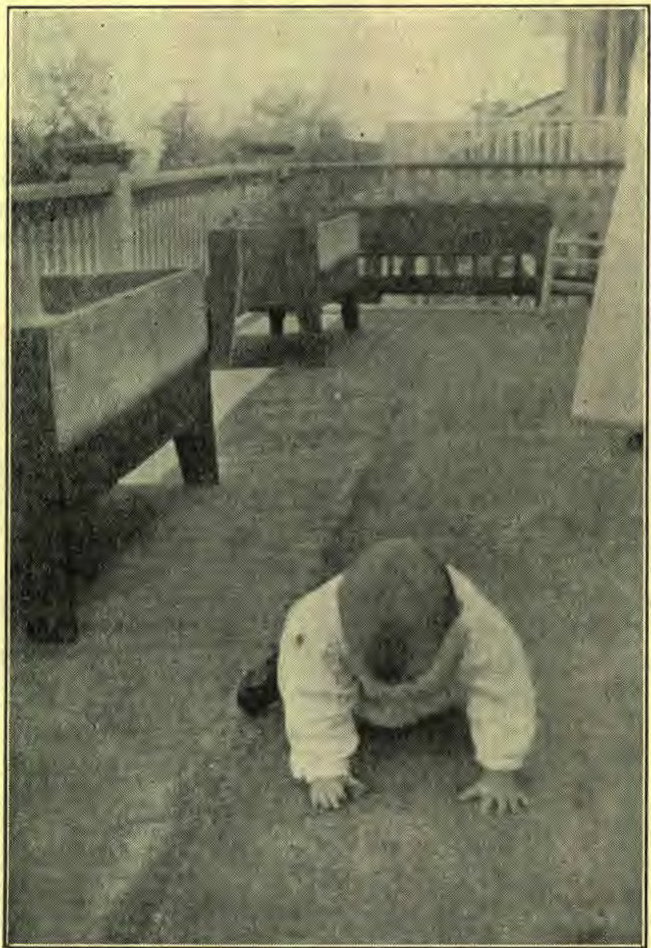
A MARYLAND CREEPER
A MARYLAND CREEPER

You have reached the end of this edition.

The Youth’s Instructor · Mar 13, 1917