The Youth’s Instructor, Vol. 65, No. 11.

Notes on the Junior Assignment and Health Tips

The Youth’s Instructor

Mar 13, 1917

Review and Herald Publishing Assn. · Takoma Park Station, Washington, D. C. · Mar 13, 1917

Notes on the Junior Assignment and Health Tips

Are you reading the notes on the Junior assignment? If you overlook these, you miss helpful and interesting reading.
Ringworm is caused by a vegetable parasite which attacks the skin through some small abrasion. Some cases are much more stubborn than others, hence need what may be called more vigorous treatment. Applying carbenzol oil and washing with carbenzol soap is an effective treatment. Ringworm of the scalp is usually the hardest form to cure.
What makes happy marriages is not great gifts or great sacrifices. It is not even necessarily great love; for great love is often exacting and harsh. It is just the habit of saying tender and kindly words, of giving at the right moment and in the right way the praise and the affection that make difficulties disappear and that turn rough and barren places into smooth and smiling ones.
The United States government has undertaken, through the Federal Farm Loan Bureau, to finance the long-time needs of the farmer. The Federal Farm Loan Act, when fully in operation, will make it possible for any farmer complying with its provisions, anywhere in the United States, at any time, to borrow any sum, from one hundred dollars to ten thousand, for any term of years from five to forty, at reasonable rates of interest, up to half the value of his land plus one fifth of the value of the permanent insured improvements upon it. This is the greatest job of lending on real estate ever undertaken in the history of the world.
The mosquitoes that live along the shores of Lake Nyassa, in Africa, are so numerous and so large that even the proud New Jersey singer is put to shame every time it thinks of its relative of the Eastern Hemisphere, especially when it realizes that there the native considers its race an asset instead of a pestiferous liability. The natives eat them, relish them, welcome everything concerning them, except the sting. Hunters go forth to the marshes with large bags on their shoulders, into which they toss handfuls of mosquitoes. These are then pressed into cakes an inch thick and six inches in diameter. Kungo the cakes are called, and one of them will bring many beads and potatoes in the open market.
Mr. Howard J. Shannon, in an article in the Scientific Monthly, entitled “Insect Migrations as Related to Those of Birds,” maintains that many insects as well as birds make annual migrations southward in the autumn, following well-defined routes that correspond to those taken by the birds of the same regions. The insects include certain North American species of Diptera, butterflies and dragon flies. Mr. Shannon believes that there may be a return migration in the spring, but he is not sure whether such migrants are the same individuals that flew south in the fall or a new generation, bred in the southern winter quarters. Some idea of the magnitude of the migrations may be gathered from the statements of the author in regard to the monarch butterflies (Danaus archippus), which “in mingled myriads move forward in swarms, forming a veritable crimson cloud miles in width, and streaming backward for equal distances, casting below them as they go perceptible shadows.”
The most convenient method for sterilizing tooth-brushes is with that most common household germicide, table salt. After the gums and teeth have been properly brushed, sufficient salt is placed in a glass of warm water to make a saline solution. This is used as a mouth wash. The brush is then to be cleaned as well as possible by holding it under the hot-water tap. Salt is then sprinkled on the brush, and it is hung up to dry. The salt permeates to the center of the tufts of bristles, and sterilizes as well as toughens them.
There is a fortunate Pekingese that inhabits a brown-stone house in West Seventy-eighth Street, New York City. It has a reception-room richly upholstered and adorned with rare Chinese hangings. The dog eats out of gold dishes and has two attendants. Its jeweled collar cost $1,000, and the leash is a gold chain. The owner is, of course, a man with money. This summer he told the reporters he was going to tear down the house next door to have a playground for the little pet.
Taking it all around, 1916 was the best business year the United States ever experienced; yet there were seventeen thousand business failures. Compared with twenty-two thousand the year before, this is encouraging; but practically one out of a hundred of all concerns in business failed, and, year in and year out, through good times and bad times, the proportion of failures never varies very far from one per cent.

An Interesting Experience

ABOUT two years ago a young man, a Belgian Catholic, became interested in the truth, and later in one of our cottage meetings expressed his intention to keep the Sabbath. He had much to learn, and as he knew nothing of the Bible, and was a high-spirited worldling when he started to attend our meetings, I feared he did not have Christian experience enough to stand the trials that were before him. But he was firm in his decision. He worked as grain inspector at an elevator under people of his former faith, but was soon thrown out of employment. For about three months he had only a day's work now and then. One day while visiting me, I told him that I could not understand why he did not get work, for God always keeps his promise (Matt. 6: 25-33) when we devotedly seek first the kingdom of God and do what we can to get work. He saw afterward that God was giving him and his family a lesson in economy. They reached the extremity of one loaf of bread and a few potatoes. While we had prayer I remember his saying, “O Lord, you are testing us very hard, but I will be true to the truth!” He got his old job back, and has kept it since, and they are getting along better than before he began to keep the Sabbath. Last winter, when work at the elevator closed, he did iron work; this winter he is canvassing, and took eighty-five dollars’ worth of orders the first week.— C. Edwardson.

The Lilt of a Laugh

I’ve toiled with the men the world has blessed, As I’ve toiled with the men who failed; I’ve toiled with the men who strove with zest, And I’ve toiled with the men who wailed. And this is the tale my soul would tell As it drifts o’er the harbor bar: The sound of a sigh doesn’t carry well, But the lilt of a laugh rings far.
The men who were near the grumbler’s side, Oh, they heard not a word he said; The sound of a song rang far and wide, And they hearkened to that instead. Its tones were sweet as the tales they tell Of the rise of the Christmas star. The sound of a sigh doesn’t carry well, But the lilt of a laugh rings far.
If you would be heard at all, my lad, Keep a laugh in your heart and throat; For those who are deaf to accents sad Are alert to the cheerful note. Keep hold of the cord of laughter’s bell, Keep aloof from the moans that mar; The sound of a sigh doesn’t carry well, But the lilt of a laugh rings far. —Selected.

The Little Boy in Bavaria

Laughter

THERE are two kinds of everything, and there are two kinds of laughter. I met a little boy in Moby Lane; he was an acknowledged son of A. Neil Lyons; he spoke with discriminating disapproval of a woman he met in a railway carriage, saying:—
“What’s the matter wif her? I laughed at her free times an’ she didn’t laugh back.” He meant the smiling kind of laughter.
It is the other laughter I have in mind—the kind that asserts a superiority to others. After my talks with the boy in Bavaria, I tried to think out a philosophy of laughter. I didn’t get very far. I know, as Lord Chesterfield knew, that sitting down where there is no chair produces more laughter than the wittiest remark you can make. When that happens, you laugh—you have let yourself be surprised by some apparent negligence in the laws of nature, at some apparent break in the cosmic mechanism, of which the Other Fellow is the victim. You do not laugh when you yourself sit down where there is no chair. Laughter is always aimed at a person or a thing; you smile with people and you laugh at them.
Mothers do not laugh; they smile.

The Little Boy in Bavaria

There was a street near my hotel in Munich, in ante-bellum days, where I used to walk and take the air. It was there I met the little boy in Bavaria. The first time I saw him he was a wet-eyed boy sitting on a stone ledge. I walked past him; then I turned back and said, “Good morning.” He was very polite. He bowed and said to me, “Good morning, sir.” I requested him not to call me sir, but doctor.
“Are you a doctor?” he asked, suspiciously.
“Certainly; I am a tear doctor,” I replied. It was the next day, or perhaps the day after, we agreed he should call me “Old Doctor Philo,” though I wasn’t keen on the adjective. However, I became his Old Doctor Philo, and we met nearly every day and discussed affairs in general, and I learned many things. One day we were walking near his house when he said abruptly—after emitting a long breath: “Well, I must go in and see my father.”
“Good,” I said, “so I will leave you here.”
“Oh, please,” said the little boy in Bavaria, “come with me, for I must go in and see my father.”
One of the dirty trinity was tugging at him, and it was not sentimentality; it was fear.
“Oh, please,” and he put his arm up round my waist, and led me into the house. He was a very young boy, slim and gentle, tall for his age, with a white face and serious eyes. I did not know his father then, though all the world knows him, for he is a very famous man, many times a doctor, omnifarian doctus, a scientist and scholar. That day—I see him as though in a picture—he sat in a big chair with a tall back, beside a little round table littered with books and papers. He was a long, thin man, with a studious face and a partly bald head; what hair he had was gray and yellow, and that was the color of his thick, straggling mustache; he was dressed in gray clothes, and his long legs—ending in gray slippers—stuck out straight before him. We entered the room softly, the boy in Bavaria pressing close to my side, with one arm round my waist. The learned man half turned his head, and eyed us over the back of the chair. What he said was: “Ah! I suppose this is your ‘Old Doctor Philo.’”
And with that, out of the gray-and-yellow man there came a blast of laughter, so merry, so hard and gay, so cold and hostile to humanity, that the boy in Bavaria wilted up against me in sheer physical chill.
Then I understood.
I understood why a boy sat wet-eyed on a stone ledge in Bavaria; I understood why he said: “Oh, please, I must go in and see my father.” That scientist, that portent of a man, had a sense of humor, which is an awful thing for a man of science to have. He laughed because childhood was not identically like his manhood; he laughed at childhood’s amusing ignorance of the cosmic system—its hopeful way of sitting down where there is no chair; and, laughing, he was gloriously aware that he was wiser than the childhood at which he laughed.
Have you ever been laughed at by a scientist?
Then you know the fierce, deep, and blighting power of laughter.
It is all very well to laugh and have the world laugh with you, as in the famous song, if you and the world are not laughing at the Other Fellow—at his tragic endeavors to sit down where there is no chair.
Gayety of heart is charming; the joy of life that bubbles over is wholesome; but they have nothing to do with the laughter aimed at men and things. There is bitter cruelty in laughing at men, and to laugh at cosmic mechanism is sheer idiocy. Wherefore have a care of your laughter: if you are laughing because you are alive, it is all right; but if you are laughing because the Other Fellow has fallen on his nose, it is all wrong. There was once a man named Zeuxis; they showed him a portrait of an old woman—the poor old face fatigued by the years, the dim, watery eyes, the toothless mouth,—all the scantness and tremor of age were pictured there; and Zeuxis, looking at the portrait, laughed himself to death—and the world was better, cleaner, richer for his going. His was the bad kind of laughter. I have no words fierce enough to blast it with. The man who would laugh in an old woman’s home, would find something to laugh at in the nursery—and that is falling into the abyss of cynicism.
More and more, as I go through life, I try to wean myself from laughing at the Other Fellow—even when he is fat.
Even when—like the little boy in Bavaria—he is sentimental.
It is a lesson I learned from listening at nursery doors.—“Take It from Me,” by Vance Thompson.

The Many-Sided Paul

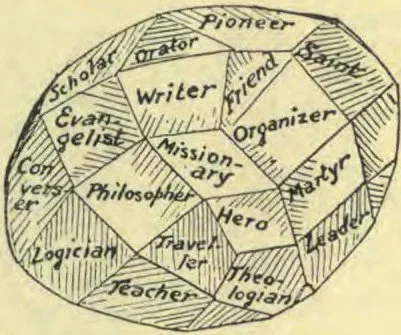
The apostle Paul is recognized as one of the greatest of foreign missionaries, and it is not difficult to understand the reason for this. He was first genuinely converted, entirely changed in thought, desires, and works. “One minute a cruel Roman, heartless as concerned a human life. The next moment a kind Christian heart full for all suffering.” This was Paul, because on the Damascus plain he beheld Jesus, the real Jesus, with all the love of his great heart revealed in his countenance. This vision broke Saul’s stubborn will, and the picture burned into his soul on that day by heaven’s glory, never dimmed. He then comprehended the awful havoc his own evil work had wrought. Humiliated, enlightened, and converted, he started out on his remarkable career. His life was like a jewel of many facets, each face revealing new beauties. He was a “scholar, orator, pioneer, saint, converser, evangelist, writer, singer, friend, organizer, strategist, missionary, philosopher, traveler, teacher, theologian, leader, hero, logician, martyr.”

Paul’s Sincerity

While the apostle was many-sided, he was not two-faced. He hated everything that savored of insincerity or deception. He once openly rebuked Peter because he ate and drank with the Gentiles until some Jews from Jerusalem came up to Antioch, then fearing their trouble-making propensities, he refrained from intimate association with his Gentile brethren. Even Barnabas was influenced for the wrong by Peter’s example, so Paul frowned upon such a questionable course. Paul himself could say after long service, “Our exhortation was not of deceit, nor of uncleanness, nor in guile.” In his preaching he did not try to please men, but God. He used not flattering words. This is an age of flattery; men everywhere endeavor by such means to gain favor and unmerited success, but Paul’s method of gaining favor was by better means. “Ye know,” he says, “how we exhorted and comforted and charged every one of you, as a father doth his children.” “We were gentle among you, even as a nurse cherisheth her children.”

Courtesy and Thoughtfulness

The apostle’s love and thoughtfulness for others was a more substantial as well as a more honorable way of gaining influence than that of flattery. His courtesy and thoughtfulness are manifest throughout his epistles. In but one of the fourteen Pauline letters does the author fail to send some word of greeting to some one, or to speak kindly of some of his coworkers. Even when writing that didactic letter to the Hebrews, he thought to speak of the release of Timothy from prison. In the letter to the Colossians he says of Epaphras, who was from Colosse, “I bear him record, that he hath a great zeal for you.” This thoughtfulness could not fail to attract the people to him and to his message.
His great-hearted, fatherly spirit is further shown in his dealing with Onesimus, a runaway slave, who belonged to Philemon of Colosse. Paul had met Onesimus in Colosse, and had brought his master into the truth. Later Onesimus, having robbed Philemon and escaped to Rome, heard again in Rome the truth from the lips of the aged apostle, and was converted. This change having taken place, the only thing for him to do was to return to his master and acknowledge his sins. Paul sent a letter by Onesimus to Philemon, urging him to deal as a brother with his former slave, and if he felt to hold him responsible for what he had taken from him, Paul would pay the sum with his own hand. Do you wonder that multitudes have been taken captive by the wonderful spirit of the great apostle to the Gentiles?

Integrity and Hardness

With Paul “right was right, wrong was wrong; no compromise.” This is illustrated by the apostle’s almost frantic endeavors to prevent the Lystrans from sacrificing to him and his coworker as to gods. How easy for them to have argued, “We do not want to be worshiped; but if we make these people angry, we cannot hope to convert them. They are only heathen; why not keep still until we have opportunity to teach them the right?” This was not Paul’s way. Perhaps his dread of this particular wrong was increased by the serious judgment quickly inflicted upon Herod for accepting homage due only to God.
The apostle had no liking for the faint-hearted. We cannot think he was a coward even by nature, and if he had been, the grace of Christ would have dissipated it on the Damascus plain. He was a hardened soldier of Jesus Christ, and he disliked faint-heartedness so ardently that when John Mark returned home on account of homesickness, the apostle absolutely refused to allow him to accompany him on his next journey. By precept and example Paul showed that a Christian cannot “go to heaven on flowery beds of ease,” but “that all who will live godly in Christ Jesus shall suffer persecution;” for, according to the apostle, it is given unto us not only to believe in Christ, but to suffer with him; and to suffer must be regarded as great a privilege as to believe. Paul himself so thoroughly believed this that even after being beaten, scourged, stoned, shipwrecked, robbed, and having suffered weariness, pain, hunger, thirst, cold, and nakedness, he could say: “I take pleasure in infirmities, in reproaches, in necessities, in persecution, in distresses for Christ’s sake.” If one’s pleasures do not come from this source, it may be they are not of the right kind.
If it seems hard to believe that Paul could really take pleasure in reproaches and distresses, we must remember that doubtless each new trial brought him great joy because it lifted him nearer to the heart of Jesus. What cared Paul for heathen beatings and persecutions so long as he felt the Saviour’s arm tighten about him?
The apostle learned later that while youth sometimes shrinks from hardships as did John Mark, that many will not take the hand completely from the plow, but will in time gain renewed courage, turn about, and march on to victory. In subsequent ministry Paul said that John Mark had been very profitable to him. It takes a large-hearted, Christian man so fully to reinstate in favor a young man who has blundered.
Fearlessness is also characteristic of this Christian knight. Even when he could not talk about Jesus, he would sing about him, and the prisoners heard him. Yet once he was tempted by fear,—fear that the people of Corinth would not receive his testimony. Jesus said to him, “Be not afraid, but speak, and hold not thy peace: for I am with thee, and no man shall set on thee to hurt thee: for I have much people in this city.” This no doubt so aroused and shamed the apostle that never again do we read of his faltering or wavering, even in the face of death.
We do not read of any one’s pointing to the apostle as an excuse for backsliding; but there have been many who have been encouraged to endure hardness as a soldier of Jesus Christ by his unswerving fidelity to right and truth. Mr. Ridgeway, a prominent Sunday school worker and writer of today, says that when a young man he was saturated with disbelief in Christianity, but that he never failed to admire the manliness, gentleness, courage, energy, and grit of that “little Jew Paul.” Finally he thought, “Here is Paul at odds with his family, cut dead by his lifelong friends, sacrificing his living, enduring poverty, suffering all hardships, assuming trying responsibilities,—yes, beloved, that is what knocked old Mr. Unbelief on the head for me as I came out of college a chesty young B. S. Knowitall.”

Tactfulness and Readiness

Paul in his ministry was tactful. A missionary set a large iron dog in his garden. The heathen natives stopped to look at it. Some spoke to it, or went near and touched it, but the dog did not move. They asked what it was for. The missionary said it was his watchdog. Then they laughed, for they knew that an iron dog could not see, hear, nor bark at any one. The missionary said, “My iron dog can watch me just as well as your stone gods can watch you, for they cannot see, hear, nor help you.” Then the heathen learned how foolish it was to fear an idol, or to pray to a god of stone, silver, or gold.
So Paul as tactfully revealed the true God to the Athenians by his reference to the altar bearing the inscription, “To the unknown God.” This evidence of the blindness of the people of Athens greatly stirred the apostle’s soul; and to him, to be stirred meant to speak. Were this true of all, truth would sooner get a foothold in the hearts of men.
It is one thing to be stirred, and another to act. All of us have felt the Spirit of God inciting us to action, but many of us have failed to do the thing for which the Spirit of God sought to arouse us. This is one of the almost innumerable lessons that Paul’s life should send home to us with great force,—the lesson of acting at the opportune moment.
“Standing by the railroad,” says one, “I watched the postmaster as he hung out the bag to be caught by the mail express soon to pass. A few minutes after and the train came thundering round the curve. The mail agent looked out of his car, and then, thrusting out an iron arm attached to the side of it, snatched the bag, and the train sped on its way. So God is hanging out opportunities along the pathway of our lives. If we are alert and watchful, we may appropriate them for the glory of God and the advancing of his kingdom. If we are careless and indifferent, we pass them by, and they are lost to us forever, as we make but one trip on this line.”

Expression of Appreciation

Even hard, embittered human hearts have ofttimes been subdued by some simple expression of appreciation of the manhood still afire in the depraved one. Appreciation of another’s worth is among the rarest gems of character. We should not be just were we to fail to accord this spirit to the apostle Paul. No other Bible writer gives evidence of its possession in so marked a degree as does Paul. Hear him say: “Greet Priscilla and Aquila my helpers in Christ Jesus: who have for my life laid down their own necks;” “Greet Mary, who bestowed much labor on us;” together with many other expressions of a similar character. The apostle revealed no small jealousies in his work.
What more shall we say? Only this, that Paul regarded himself first and always as a servant of Jesus Christ. As professed servants, then, of the same Master, let us earnestly endeavor to exemplify in our own lives his magnificent character and work.

Alpha Centauri, Our Nearest Star

If you could ride from the earth to Alpha Centauri on a train going at the rate of a mile a minute, you would reach your destination in forty-eight million years. At the rate sound travels, if a song were to be sung on Alpha Centauri, it would be three million eight hundred thousand years before we could hear it. This neighbor of ours is thirty-five trillion miles away. A spider’s thread from a cocoon reaching to it would weigh five hundred tons.
Our earth in its revolutions on its own axis and its trip around the sun and outward into space makes a journey of nine hundred and eighty-four million miles a year; but the old clock never varies; there is never a jar or tremor, and we are back again on the hundredth of a second. Do you know it would have cost me one billion five hundred million dollars if I had had to pay my way so far at the rate of two cents a mile during my journey of seventy-five years?
To ride from the earth to Alpha Centauri would cost seven hundred billion dollars.—American Magazine.

Conscience as Knowing With God

“CONSCIENCE” means “knowing with” God.

THE FIRST SERMON AT THE TENT

Donald and His Friends Become Greatly Interested

CARLYLE B. HAYNES
THE FIRST SERMON AT THE TENT
Donald and His Friends Become Greatly Interested
THE FIRST SERMON AT THE TENT Donald and His Friends Become Greatly Interested
When the tent master turned on the lights in the big tent on Sunday night, he found a row of boys on the front seats. They did not propose to miss the pictures which had been promised. The most interested one among them was Donald Hunter.
By half past seven there were about seven hundred persons in the big tent, and among them were Donald’s father, mother, and sister. They were seated in the middle of the tent. New songbooks were passed out, and the people joined heartily in singing old-time favorites. This song service was conducted by Brother Harris, who was a singer as well as a preacher.
After fifteen minutes’ singing, Brother Harris opened the meeting with a short prayer. He then announced the subjects for the following evenings of that week, saying that meetings would be held every night except Saturday night. He expressed a hope that many would find it possible to attend the services, that they might all together study the teachings of the Bible. He announced also that at the close of each address there would be a question-and-answer service, requesting the people to bring in such questions as had been a source of perplexity to them.
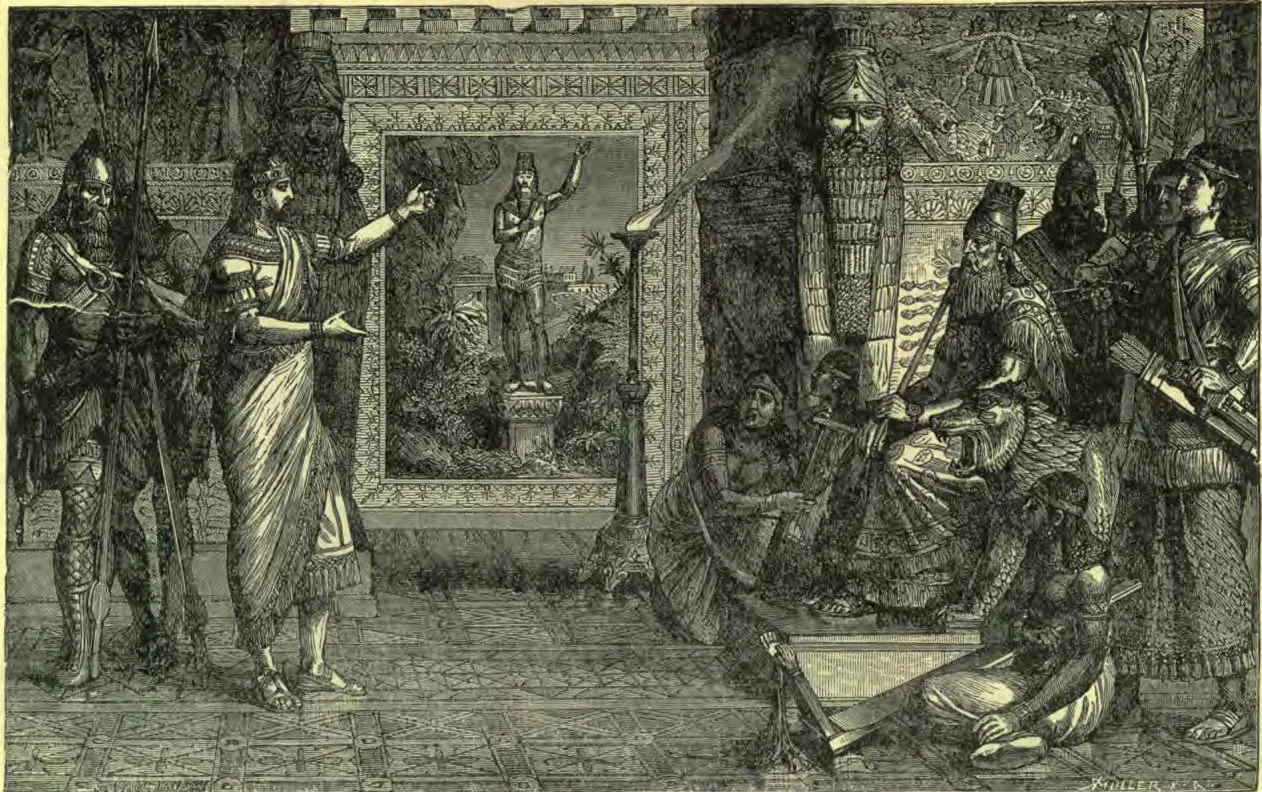
In beginning his sermon that evening, Brother Harris read a part of the second chapter of Daniel. He then told the story of the captivity of Daniel and his three companions. He described the city of Babylon where King Nebuchadnezzar lived, and told of the wonderful hanging gardens which the king had built, gardens which rose, terrace after terrace, to the height of the great walls that surrounded the city.
“One day,” he said, “the king was out walking on these terraces, and he could see over the length and breadth of the great city which he had built. A feeling of pride came into his heart as he looked over his possessions. And then he began to wonder what would become of this great kingdom of his after he died, who would be king, and whether any other kingdom would ever be able to overthrow Babylon. As he went to his palace and retired that night these were the thoughts which were on his mind.”
“That night God gave him a dream which answered the questions that he had been turning over in his mind. But when he awoke the next morning he could not remember the dream, though he was deeply impressed that there was something in it which was very important. He called in the wise men of the kingdom, the astrologers, the soothsayers, the magicians, the Chaldeans, and the sorcerers. These people were the same as those today whom we call fortune tellers, palm readers, and Spiritualistic mediums. The king told them his trouble, and asked them to tell him the dream and what it meant; but they could not do it. The king was very angry, because they had professed to be able to do so much, and were now found to do so little.”
“So the king commanded to kill them all. As Daniel and his three companions were accounted among the wise men, the officers sought them to slay them. Daniel had known nothing of these facts until the soldiers came to kill him, and when he was made acquainted with the circumstances he asked for time, promising that he would tell the king both what his dream was and what it meant.”
“The next morning he was brought in before the king, and told him his dream. We will now see on the screen what the king saw in his dream.”
Suddenly the great crowd was plunged into darkness. Then the hiss of the stereopticon light was heard, and a picture was thrown on the screen.
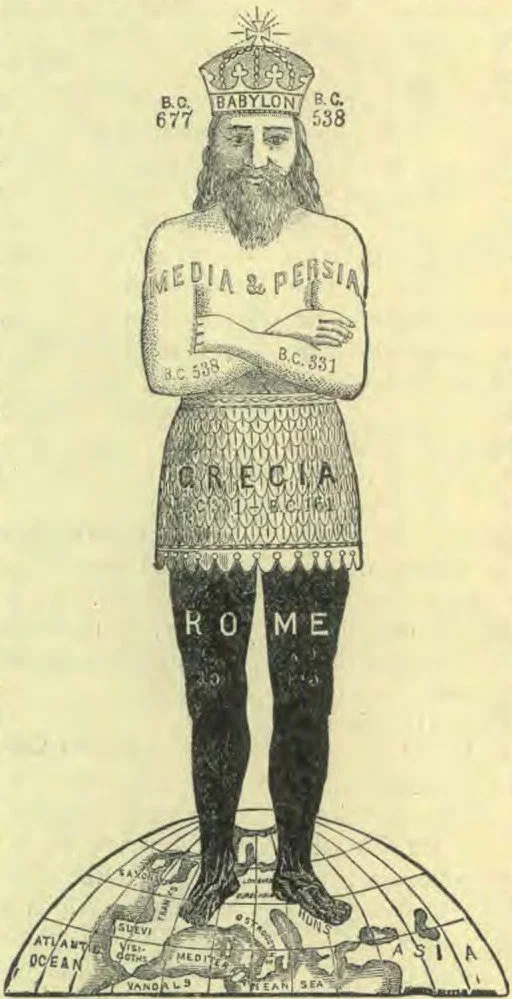
“This is what the king saw,” said Brother Harris, as he pointed to the picture. “He saw this great image. It had a head of gold, its breast and arms were of silver, its waist and thighs of brass, its legs were of iron, and its feet and toes were part of iron and part of clay. Then Daniel told the king that this image represented the course of the history of the world from his day down to the very end of time. Babylon, Daniel said, was shown on the image by the head of gold. This, however, was to be followed by another kingdom, shown by the breast and arms of silver, which would overthrow Babylon and take its place. Then another kingdom, a third, would come, which would be succeeded by a fourth kingdom, represented on the image by the legs of iron. This fourth kingdom would be divided into ten kingdoms, shown by the ten toes on the image, some of which kingdoms were to be strong and some weak, represented by the mixture of iron and clay.”
DANIEL INTERPRETS THE DREAM
“Then the king saw a great stone cut out of a near-by mountain, which struck the image on its feet, as you see in this next picture. The stone ground all the image to pieces, while the wind caught up the dust into which the image was ground and blew it all away, so that not so much as a particle remained. Then the stone grew and became a great mountain, until it took the place of all other kingdoms and filled the whole earth.”
The lights were then turned on, and Brother Harris began to explain the fulfilment of this wonderful prophecy. He said:—
“The head of gold meant Babylon. After Nebuchadnezzar’s death this was overthrown by Medo-Persia, which is represented by the arms of silver. Medo-Persia, in turn, was overthrown by Greece, under Alexander the Great. Greece is symbolized by the waist of brass. Then Rome overthrew Greece, and is represented by the legs of iron. After this, Rome was divided into just ten kingdoms, as shown by the ten toes. These ten kingdoms were the Alamanni, the Franks, the Suevi, the Burgundians, the Vandals, the Anglo-Saxons, the Heruli, the Ostrogoths, the Visigoths, and the Lombards. Do you boys on the front seat think you can remember that?”
Brother Harris looked down at the boys with a smile. Donald Hunter was sure he could not remember such strange names, but he made up his mind he would get that list of kingdoms from Brother Harris and study it. Then the speaker continued:—
“I will tell you what some of these kingdoms are now called, and that will help you remember. The Alamanni, Germany; the Franks, France; Suevi, Portugal; Burgundians, Switzerland; Anglo-Saxons, England; Visigoths, Spain; and the Lombards, Italy. Three of these kingdoms have been destroyed, the Vandals, the Heruli, and the Ostrogoths.”
“So you see that God has brought us in this prophecy down through all the history of the past to the present kingdoms of Europe. And now God, through Daniel, makes a wonderful prediction regarding these kingdoms of Europe. He says, ‘They shall not cleave one to another.’
“And, true to this prediction, these kingdoms have never again been welded into a great empire as they once were under Rome. Nor will they ever be again, for God’s word is against it. Men have arisen in different nations and at different times who have tried to do what God said should never be done, but they have all failed. Charlemagne tried to unite the nations into one again, but he did not succeed. Charles V of Spain tried it, and he failed. Louis XIV of France tried, and he failed. All the wisdom and shrewdness of Napoleon Bonaparte, all his ingenuity and knowledge of military tactics, and all the strength of his mighty army were not sufficient to break the power of these few words of Scripture, and Napoleon’s great dream of world empire came to an end at Waterloo. God says, ‘The Scripture cannot be broken.’ Seven short words spoken by God twenty-five hundred years ago have proved stronger than all the legions of the world’s mightiest generals. Surely, these words are the words of God, who knows the end from the beginning, and not, as infidels tell us, the words of uninspired men.
“And then this wonderful prophecy closes by saying, ‘In the days of these kings shall the God of heaven set up a kingdom, which shall never be destroyed.’ This means that before very long the long-looked-for kingdom of God is to be established in this world. ‘In the days of these kings,’ this is to take place, and ‘these kings’ refers to the modern nations of Europe. In our days, before these boys here live out the natural span of their lives, Christ will come, and his kingdom will come to take the place of all the kingdoms of the earth. This will not be done by the conversion of these kingdoms, but by their destruction; for the great stone, which represented the kingdom of God, broke the image, with all its parts, to pieces and ground it to powder. Thus we must look for the destruction of the nations.
“And, now that we know these things, our supreme duty as Christian people is to make ready for these great events which are coming on the earth, and especially prepare ourselves to meet Christ in peace, for many here in this tent tonight will live to see him come.”
As Brother Harris closed his sermon with this earnest statement, Donald Hunter felt a strange thrill of fear, mingled with very deep interest, run through him. Jesus coming again! Coming before he died! He had never been told that before. Why had they not told him? It certainly must be true, for Brother Harris had made the Bible very clear about it. He went home that night a very thoughtful boy, and he decided that he must attend every meeting at the tent, so that he might know what to do to get ready for Jesus’ coming. He felt sure Brother Harris would say more about it.
Continue reading: White Slavery Dangers