A PROOF of the resurrection of the dead is that God counts Abraham as among the living. Christ does not give this as proof of the immortality of the soul, but as positive proof of a resurrection. In answering the Sadducees, who did not believe in the resurrection, Jesus said: "Now that the dead are raised, even Moses showed at the bush, when he calleth the Lord the God of Abraham, and the God of Isaac, and the God of Jacob. For He is not a God of the dead, but of the living; for all live unto Him." Luke 20:37, 38. Abraham has the promise of being heir of the world (Rom. 14:3); but he died without receiving the promise, as shown in the eleventh chapter of Hebrews; and he will not receive it until his heirs (the children of faith) receive it with him. He can not be made perfect without "us" (verses 39, 40), and that will not be until the coming of the Lord and the resurrection of the righteous dead. See 1 Thess. 4:13-18. Abraham died, and "the dead know not anything;" but the lives of the righteous are "hid with Christ in God," and when He "who is our life, shall appear, then shall ye also appear with Him in glory." "This mortal must put on immortality," says Paul (1 Cor. 15:53). Then he adds, "When this corruptible shall have put on incorruption, and this mortal shall have put on immortality, then shall be brought to pass the saying that is written, Death is swallowed up in victory." So, in order that God may fulfil His promise to Abraham, He must raise Him from the dead. And it is because God has the resurrection in purpose, that He reckons Abraham as living. So Jesus gives the fact of God's having made a promise to a man who died without receiving the promise, as proof, not of inherent immortality, but of a resurrection from the dead.
A Question of Divorce
By Editor
1661.—A Question of Divorce.
A husband and wife are legally separated by divorce, tho not from Scriptural cause. The husband seeks reconciliation with the wife, but is unsuccessful. She marries another. Afterward he marries, and his wife bears him children. Later he is troubled as to whether his last marriage is right, and asks what course to pursue. There are many such cases.
What shall the husband do?—There is, to our mind, only one thing for him to do, and that is to live a faithful, godly life with his present wife and the mother of his children. The legal divorce and the action of the first wife in marrying left him free to marry as a Christian; let him so abide.
Will you please explain the difference in the records as given in 2 Samuel 24 and 1 Chronicles 21, as, for instance, the numbers of the armies and, also, the amounts paid by David to Ornan for his threshing-floor.
2 Sam. 24:9 gives of Israel able to bear arms 800,000 men; of Judah, 500,000, a total of 1,300,000. 1 Chron. 21:5 gives of Israel 1,100,000; of Judah, 470,000, a total of 1,570,000, a difference of 270,000 men. It has been suggested that the writer of Chronicles included the regular army (see chapter 27:1-15), a little less at the time, while the writer of Samuel did not. If this is not the true supposition, there is no doubt a mistake somewhere in the part of the transcription of the numbers in one or the other places.
As to the price paid, it is suggested that the 600 gold shekels of 1 Chron. 21:25 should read six gold shekels, worth at that time about fifty silver. Another explanation is that the sum of fifty silver shekels was paid for the threshing-floor and the oxen (2 Sam. 24:24), while the 600 gold shekels was for the price of "the place," the whole top of Mount Moriah, on which the threshing-floor was, and where the temple was afterward built.
One's religion ought to be that which would give him confidence, strength, rest, in times of trouble, and the fullest fruition at last. These of which the prophet speaks are those who have been trusting in lies, who have been counting death a friend, who looked for a good time, who thought they had within themselves power over death and the grave, instead of trusting in Christ, the foundation stone, the tried stone, the precious corner-stone. See verses 14-16. Verse 17 declares that God's judgments of the last days (Rev. 16:17-21) will reveal all this, and show the utter weakness of their refuge of lies. Their time of peace was a dream, their covenant with death is annulled, and the supposed friend becomes an enemy, a scourge, that cuts down and destroys day and night. The bed of lies on which they had hoped to repose, is now too short for comfort, and their false covering gives them no protection. Verse 21 brings to view God's "strange work," when just wrath will be finally meted out upon all; and verse 22 is His plea to the wicked to turn from the destruction sure to come.
THE SEPARATION BILL IN FRANCE.
By M. Jean Vuilleumier
BY M. JEAN VUILLEUMIER.
THE separation bill now under discussion before the French Chamber, must be especially interesting to the readers of the SIGNS, from the fact that it related almost entirely to the matter of religious liberty.
Article 1 declares that "the state does not adopt nor support any form of religious worship," and that "the public establishments of religion now in existence"—which means the Catholic, Protestant, and Hebrew—"are abolished, as are also all expenses from the public treasury applied to the support of these forms of worship."
M. Briand, reporter of the bill, stated that the condition of things contemplated in it "is the only one which safeguards the rights of everybody, whereas the maintenance of an official religion is like throwing the gauntlet in the face of reason and common sense."
Article 8 says that the ministers of the denominations now supported by the state shall receive a life-pension equivalent to one-half or two-thirds, as the case may be, of their present salary.
Article 9 says that all cathedrals, churches, chapels, synagogs, seminaries, and parsonages belonging to the state shall be allowed for use, free of charge, for two years to the churches which are now using them. After this, said edifices and buildings shall be rented for terms of no less than ten years, at a price not exceeding one-tenth of the annual income of such church organizations as shall desire them.
Article 15 says that the cash property of the various churches shall not exceed a sum five times equal to the amount annually spent for their current expenses, with the exception of sums raised for the construction, purchase or repair of necessary church buildings or furniture. This is aimed at the proverbial custom of the Catholic Church to accumulate funds, an example of which is the billion of francs owned by the religious orders in France.
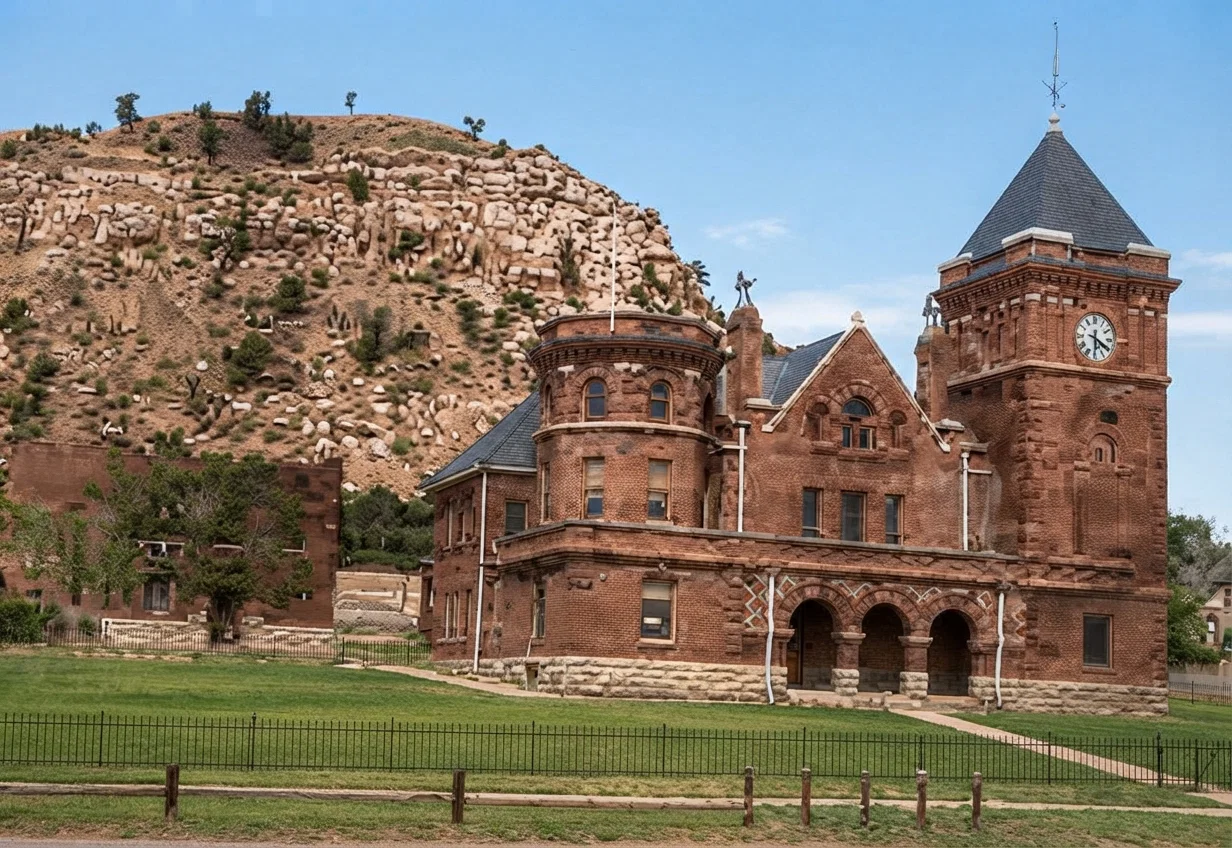
Court-house and Jail, Raton, N. M., where Mr. E. K. Cassell is incarcerated for "Sabbath desecration."
Article 18 says that meetings for regular worship can be opened at any time, provided due notice of the fact shall be given to the proper authorities.
Article 23 pronounces a fine of 16 to 200 francs, and an imprisonment of six days to two months, against "those who by means of threats or violence," "shall cause any one to attend or refrain from attending religious worship, or cause him to support or refrain from supporting religious worship, or cause him to celebrate certain feasts or to observe certain rest days, and, as a consequence, to open or close his shops or stores and to perform or quit certain jobs."
Above article is certainly one of the most remarkable guarantees offered to religious liberty that were ever enacted by any state. It is quite similar to Article 15 of the Belgian Constitution of 1830, which says:
"No one can be compelled to contribute in any way whatsoever to the rites and ceremonies of any religious worship, nor to observe its days of rest."
The French law is more explicit than the Belgian. Not only does it protect man in his observing or not observing of religious rest days against state interference, but also against threats or violence on the part of individuals.
This article of the French bill carries to its farthest logical conclusions the principles of liberty of conscience, as applied to the matter of religious rest-days.
Article 24 enacts the same penalties for those who shall in any way disturb or trouble religious meetings.
Article 26 threatens a fine of 500 to 3,000 francs, and an imprisonment of a month to one year, against the ministers of any religious denomination who shall outrage a public official or influence the votes of any citizen.
Article 27 pronounces from three months to two years' imprisonment against any minister who shall deliver a discourse or allow any printed matter to be distributed in any place of public worship, the plain meaning of which shall be to oppose the execution of laws, or to cause citizens to take up arms against one another.
The last two articles are evidently directed against any possible interference of the Catholic clergy in political matters, thus endeavoring to protect this law against clerical reaction.
An era of complete protection against papal oppression seems ready to open before France with the enactment of this law. May we not hope that this new era shall be improved, by those who know the pure Gospel, in scattering its blessed seed on this very needy soil? Alas! most of the 600,000 French Protestants are even now so weak spiritually that they consider the $320,000 which they expect to lose annually, as too dear a price to pay for untrammeled liberty to perform their God-given mission in behalf of their own countrymen! Where shall the true apostolic, self-denying messengers come from? God knows. May there be no delay.
SUNDAY LAW IN NEW MEXICO.
By Editor
An Illustration of How It Works.
IN our issue of April 26, we published an account of the arrest of Brother E. K. Cassell, at Raton, N. M., on a charge of violating the Sunday law. We present here a letter from Brother H. M. J. Richards, of Loveland, Colo., together with some photographic illustrations, regarding Brother Cassell's incarceration, which will certainly be of interest, as well as instruction, to our readers:
Numbered with criminals for obeying God's Sabbath law in preference to man's.
LOVELAND, COLO., April 21, 1905.
EDITOR SIGNS OF THE TIMES: I enclose some photos showing Brother E. K. Cassell in the county jail of Colfax County, N. M., for laboring on the first day of the week, after having faithfully observed the seventh day; also a photo of the court-house and prison, with its connecting passage-way overhead. The prison proper, a dark, forbidding room, with stone floor, and iron-barred windows, and steel-barred cages, is the back portion of the square building to the left. The front part of the square building is where the jailer lives. The jailer is also sheriff.
The picture of Brother Cassell behind the bars is taken at the door of the prison. This is how I saw him when I reached there, after his incarceration. I talked with him there for some time, until the jailer returned from town, when he opened the door and let Brother Cassell come out into his parlor and talk with me.
There are just ten bars to the opening in the door, altho they do not all show in the photo. How much better to be kept behind ten iron bars for keeping the law of God, than to be kept in ward in the prison-house of sin and condemnation by the ten "words" of God! This man, altho behind iron bars, was the Lord's free man, and was rejoicing in the privilege of being counted worthy to "suffer for His name."
The citizens asked me what ought to be done. I said, "Brother Cassell can not pay the costs, for that would acknowledge the principle and invite further persecution. For the same reason we (the church) can not do it. But if you, as citizens, who are not Seventh-day Adventists, pay it, that will repudiate the thing." Within a few hours the money was raised, and his release secured. His time, aside from the twenty-eight days for costs, was about expired, so the sheriff kindly let him out a little over one day before the actual fifteen days had elapsed.
It was my privilege to stay two nights on the floor in the court-room with Brother Cassell, and the next day, the day of his release Thursday the 13th inst., to accompany him from the prison to his home, there to rejoice with him and his wife over the providential deliverance wrought before our eyes.
The city authorities, including the mayor, said Brother Cassell's imprisonment was unjust. We expect no more trouble until the next District Court meets in September. Pray for the victory of the truth and liberty of worship in New Mexico.
Your brother in the work,
H. M. J. RICHARDS.
THE PROGRESS OF THE SUNDAY CAUSE.
By Editor
SUNDAY observance in Canada was the subject of an article by Rev. John P. Gerrie, of Stratford, Ont., that recently appeared in a leading religious periodical published in the United States. We give the article place in order that our readers may be fully posted regarding a subject that is coming to the front the world over, showing the growing determination everywhere to supersede the "perpetual covenant" (Ex. 31:15-17) that God has established between Himself and His people, and to set up a man-made substitute. It is a movement that must be met in all lands by those who "keep the commandments of God and the faith of Jesus." The article is as follows:
The decision of the Privy Council of London, England, that the Ontario Lord's Day Act is unconstitutional turns renewed attention to the question of Sunday observance in Canada. For some time the matter has been pending, and the chief difference now is that the Province goes back to the law before confederation. This means that Sunday excursions and the running of electric cars will be allowed until further legislation may be secured, which will be with greater difficulty now that Dominion authorities must be dealt with. The more composite character of the House of Commons does not betoken the agreement on a question of this kind which might be expected from a provincial Legislature. The well-nigh unsuccessful, yet persistent, efforts of the Hon. John Charlton in Parliament gives further support to the conclusion. Measure after measure was introduced for a period of about ten years, but the reception has discouraged like effort during recent years.
And yet the Canadian Sunday is proverbial, and for good reasons. There is a general cessation of work throughout the Dominion. Agriculture, commerce, and almost every form of industry rests for this day. The Sunday newspaper is practically unknown, tho repeated attempts have been made in Montreal and Toronto to secure for it a foothold. It is true that there is a Toronto paper, which issues a Sunday edition, but this publication appears on Saturday and is not offered for sale on Sunday except, perhaps, on certain railway trains, and these trains are also greatly limited on that day, especially for passenger service. The street-car companies, too, have had great difficulty in obtaining a Sunday franchise. The question was submitted three times to the electors in Toronto. An adverse vote of 3,936 in 1892 was reduced to 1,003 in 1893, and changed to a favorable vote of 321 in 1897. Since then Sunday cars have been continuous, tho on a more limited scale than on other days. The result in Toronto has made no appreciable difference elsewhere, as there are many cities without the Sunday service. Nor have the evils generally feared from the innovation come upon Toronto, as the city, apart from the street-cars, maintains its usually quiet and orderly appearance.
The reasons for the observance of the day are varied, but the chiefest of all is an undoubted Sunday sentiment. Large sections of Canada have been settled chiefly by the Scotch, who brought with them their ancestral reverence for the day. A like attitude has been maintained by English and Irish settlers, while the accessions from other European countries have been too slow and meager to make any other influence in the land. Happily, too, there has been no vigorous Puritanical observance to cause any rebound on the part of succeeding generations. Credit, too, must be given to the churches, labor organizations, and other agencies for their continued efforts to retain the day as one of rest and privilege. Every year sees emphatic resolutions by the different denominations in their annual gatherings, while a common week day and Sunday are especially designated for services in the interests of the day. These services promise to become more general and will yet be producing larger results.
In this connection may be noted especially the work of the Lord's Day Alliance. This institution has grown until every province is regularly organized, while hundreds of branches are scattered up and down the land. At first one field secretary was engaged, but it was found necessary to appoint an associate secretary, and now both men are finding more work than they can reasonably undertake. The purposes of the alliance are set forth in the Ontario constitution as follows:
"The Alliance believes that the Lord's Day is a divine institution, and that the only sure foundation upon which the enjoyment of its benefits can rest is a strong conviction on the part of the people of its sacred character.
"It shall be the object of the Alliance, therefore, to preserve the Lord's Day in its integrity, and to secure to the whole community the right to its full enjoyments:
"(1) By informing the public mind concerning the dangers by which the Lord's Day is threatened, and arousing the public conscience to a sense of the paramount importance of its preservation in the interests alike of the domestic, the industrial, the national, and the religious, life of the people;
"(2) By uniting in a strong and effective organization the friends of the Lord's Day throughout the province;
"(3) By endeavoring to secure the faithful and impartial enforcement of laws intended for the preservation of the day of rest;
"(4) By endeavoring to secure such improved legislation as may be found necessary for the complete protection of the Lord's Day as a day of rest and opportunity for worship."
Exception may be taken to some of the terms and phraseology of this constitution, and possibly to some of the methods pursued, yet the Alliance has done a great service in maintaining the present rest and quiet of the Sunday. Their suits have, as a rule, been successful, tho here and there they have met with disappointment. A good work has been done in circulating literature and in arousing public interest on the great need of maintaining a day of rest.
Will the present Canadian Sunday continue? Many good people are apprehensive that it will not. They see encroachments on every side, and it must be admitted that there is not the old-time reverence for the day. The large in-coming tide of non-English-speaking people adds to the complexity of the situation. Many of these, as the Doukhobors, are scrupulous in their observance of the day, but many are not. It is unlikely, however, that the latter will be able to introduce in any degree the "Continental Sunday." Deterring influences will meet them in their new home, and if present conditions prevail the result will be more apparent on the rising generation than on the present settlers. The responsibility for the day as it is, therefore, rests, in large measure, on the people who have brought Canada thus far on her way, and there is reason to believe that the sturdy intelligence of the children of the pioneers will prove equal to their need.
There will, however, be a changing position in the arguments for the maintenance of the day. Many people uphold its sanctity, and contend that to take up any form of work, except that of necessity, is a violation of specific divine commandments. By a largely-increasing number of people these conclusions are no longer accepted. They find instead a strong and unassailable position in the broad humanitarian aspects of the day. They see it to be divine because of its humane and benign influences, and gratefully accept it in lieu of the Sabbath set apart for the Jew. Exponents of both views see the need of a well-observed Sunday for this formative and growing land. From the material, the moral, and the spiritual aspects, the arguments for a day of rest and privilege are alike conclusive, and may Canada ever retain her Sunday as one of the great bulwarks for a young nation's growth and prosperity.
The defenders of Sunday legislation often attempt to justify it by citing the fact that public holidays are set aside and established by law. The difficulty with the argument is that the two things are not parallel. But if Decoration or Memorial Day were a religious observance and institution, they would have a parallel case in a law that has recently been enacted by the Legislature of Nebraska. This measure "prohibits all manner of sports on Memorial Day," and is intended to prevent "the seizure of the holiday by youths and the unthinking for athletic sports and other diversions." In other words, it is a law to compel the observance of Memorial Day. But the parallel with Sunday legislation is not complete, for the reason that Decoration Day is not a religious institution and observance, but is a civic institution and observance, and therefore may be regulated by the civil law. But even here coercion may not be proper. Commenting on this measure, the Toledo Times says:
We regret very much to see this effort merely to seek to legislate an evil out of the human heart. This is not the right way to go at the matter. Until those who break the beautiful purpose of Decoration Day can be brought to see what they are doing, it is idle to attempt to coerce them to do what they ought to do voluntarily and gladly. The inevitable result of such a law will be to arouse a defiant antagonism against the day. There are many who will resent an effort to curtail what they consider a legitimate privilege of theirs. The law has utterly failed to protect Sunday, and it will utterly fail to protect Decoration Day. Such legislation, sumptuary or restrictive, not only generally fails wholly of its regulative purpose, but teaches people that laws may be violated with impunity, and is, therefore, stimulative of anarchy.
And if coercion and enforcement is not the right way to "go at the matter" with respect to a civic observance, how much less is it the right way to enforce a religious observance?
Chamber of Deputies, Paris, the scene of many heated debates over the separation of Church and State.
A Christian behind the Bars for Obedience to God's Word. See Preceding Page.
War and Labor Unrest
By Editor
The third Russian squadron has now passed through the Malacca Strait, and has joined, or will soon effect a junction with, the second Pacific fleet, under Admiral Rodjestvenski. This makes a powerful fleet so far as numbers and men are concerned, and the Japanese seem to be reluctant to give them a general engagement. It seems certain, however, that serious developments may be looked for soon in the China Sea. The hopes of Russia are centered in the great fleet now nearing Japanese waters. There have been a few minor engagements on land within the past few days. The Japanese are said to be moving both wings of their army, as if to precipitate a general engagement.
The great strike of teamsters in Chicago is still on at the present writing. Both sides are claiming gains to their ranks, and there is little prospect of an immediate settlement. There has been much rioting in connection with the strike, many have been maimed or injured, and there is still a possibility that the state troops may be called out. The police have been openly accused of favoring the strikers, refusing to arrest them for actual assaults on non-union men, and being quick to arrest non-union men who have retaliated for abuse and injuries.
It is reported that on May 1 nearly one hundred persons were either killed or injured in Warsaw, Poland. Russian troops fired into crowds of demonstrators, and the latter retaliated with firearms, bombs, and other missiles. The temper of the people has been raised to a high pitch by the wanton brutality of the troops, who continued firing volleys into the retreating, shrieking multitude. Many of the killed and wounded were shot in the back.
England must begin at once the work of removing many of the great guns of her war-vessels, and replacing them with others. It is reported that the large wire-wound guns with which many of the ships have been provided have proved unsatisfactory, and that many of them are already useless, simply from the practise firing they have had.
Europe is still agitated over the question of Germany's attitude toward the Moroccan question. Germany fears that France desires to declare a protectorate over Morocco, and Germany asserts that the Kaiser will resist such a move even to the point of war.
It has been discovered that women connected with high officials of Russia are members of the terrorist societies that are threatening the lives of officials in that country.
A TEACHER SENT FROM GOD.
By Mrs. E. G. White
BY MRS. E. G. WHITE.
AT the time of Christ's first advent darkness had covered the earth, and gross darkness the people. Truth looked down from heaven, and nowhere could discern the reflection of her image. Spiritual darkness had settled down over the religious world, and this darkness was almost universal and complete.
The scribes and Pharisees professed to explain the Scriptures, but they explained them in accordance with their own ideas and traditions. Their customs and maxims became more and more exacting. In its spiritual sense, the sacred Word became to the people as a sealed book, closed to their comprehension.
All things proclaimed the urgent necessity on the earth of a Teacher sent from God,—a Teacher in whom divinity and humanity would be united. It was essential that Christ should appear in human form, and stand at the head of the human race, to uplift fallen human beings. Thus only could God be revealed to the world.
Christ volunteered to lay aside His royal robe and kingly crown, and come to this earth to show to human beings what they may be in co-operation with God. He came to shine amidst the darkness, to dispel the darkness by the brightness of His presence.
When in the fulness of time the Son of the infinite God came forth from the bosom of the Father to this world, He came in the garb of humanity, clothing His divinity with humanity. The Father and the Son in consultation decided that Christ must come to the world as a babe, and live the life that human beings must live from childhood to manhood, bearing the trials that they must bear, and at the same time living a sinless life, that men might see in Him an example of what they can become, and that He might know by experience how to help them in their struggles with sin. He was tried as man is tried, tempted as man is tempted. The life that He lived in this world, men can live, through His power and under His instruction.
From the beginning God had spoken through Christ, laying the foundation of the Gospel in the Jewish economy of types and shadows. Before the coming of Christ this economy was unfinished. The ceremonies of the unfinished economy pointed to the reality. God would not leave the plan incomplete. He would work out to its end the plan for the redemption of the race. By sending His Son into the world, He would carry out to its fulfilment the plan ordained in heaven before the world was made.
The apostle Peter declared: "Moses truly said unto the fathers, A prophet shall the Lord your God raise up unto you of your brethren, like unto me; him shall ye hear in all things whatsoever he shall say unto you. And it shall come to pass, that every soul which will not hear that prophet, shall be destroyed from among the people. Yea," Peter continues, "and all the prophets from Samuel and those that follow after, as many as have spoken, have likewise foretold of these days."
Patriarchs and prophets have predicted the coming of a distinguished Teacher, whose words were to be clothed with invincible power and authority. He was to preach the Gospel to the poor, and proclaim the acceptable year of the Lord. He was to set judgment in the earth; the isles were to wait for His law; the Gentiles were to come to His light, and kings to the brightness of His rising. He was "the Messenger of the covenant," and "the Sun of Righteousness."
The Jewish teachers, claiming to give instruction in the things of God, turned minds to things that eclipsed the revelation of God. They gave the things of earth the first consideration and the greatest thought. God beheld in these teachers an ignorance that is death to true godliness. Under the education they gave, virtue and purity grew feeble, and self-sufficiency and pride ruled the life.
Those who loved God and who realized the danger that lay in the struggle for wealth and power, longed for Heaven's enlightenment. They longed for a message direct from the heavenly courts. The heavenly inspiration was begotten, and men began to feel after God, if haply they might find Him.
And "when the fulness of time was come, God sent forth His Son, . . . to redeem them which are under the law, that we might receive the adoption of sons."
Wonder, O heavens, and be astonished, O earth. The heavenly Teacher had come. Who was He?—No less a being than the Son of God Himself. He appeared as God, and at the same time as the Elder Brother of the human race. "The word was made flesh, and dwelt among us." Christ must come as a human being. Had He come in the glory that He had with the Father, men could not have lived in His presence.
Nearly two thousand years ago a voice of mysterious import was heard in heaven, from the throne of the Highest, "Lo, I come." "Sacrifice and offering Thou wouldst not, but a body hast Thou prepared Me. . . . Lo, I come, . . . to do Thy will, O God." In these words is announced the purpose that had been hidden from eternal ages. Christ was about to visit our world, and become incarnate.
Who is this that thus announced His purpose of visiting a guilty world?
We ask Isaiah, and he answers, "Unto us a Child is born, unto us a Son is given; and the government shall be upon His shoulder; and His name shall be called, Wonderful, Counsellor, The mighty God, The everlasting Father, The Prince of Peace."
We ask John, the beloved disciple, and he replies: "In the beginning was the Word, and the Word was with God, and the Word was God. . . . All things were made by Him; and without Him was not anything made that was made. . . . And the Word was made flesh, and dwelt among us, . . . full of grace and truth."
We ask Him, "Who art Thou?" and the answer comes, "Before Abraham was, I AM." "I and My Father are one." "As the Father raiseth up the dead, and quickeneth them; even so the Son quickeneth whom He will. For the Father judgeth no man, but hath committed all judgment unto the Son."
We ask Paul, and he breaks forth into words of adoring transport: "Without controversy great is the mystery of godliness. God was manifest in the flesh, justified in the Spirit, seen of angels, preached unto the Gentiles, believed on in the world, received up into glory."
"In whom we have redemption through His blood, even the forgiveness of sins; who is the image of the invisible God, the firstborn of every creature; for by Him were all things created, that are in heaven, and that are in earth, visible and invisible, whether they be thrones, or dominions, or principalities or powers; all things were created by Him, and for Him, and He is before all things, and by Him all things consist."
"Worthy is the Lamb that hath been slain to receive power, and riches, and wisdom, and might, and honor, and glory, and blessing. And every created thing which is in heaven, and on the earth, and under the earth, and in the sea, and all things that are in them, heard I saying, Unto Him that sitteth on the throne, and unto the Lamb, be the blessing, and the honor, and the glory, and the dominion, forever and ever."