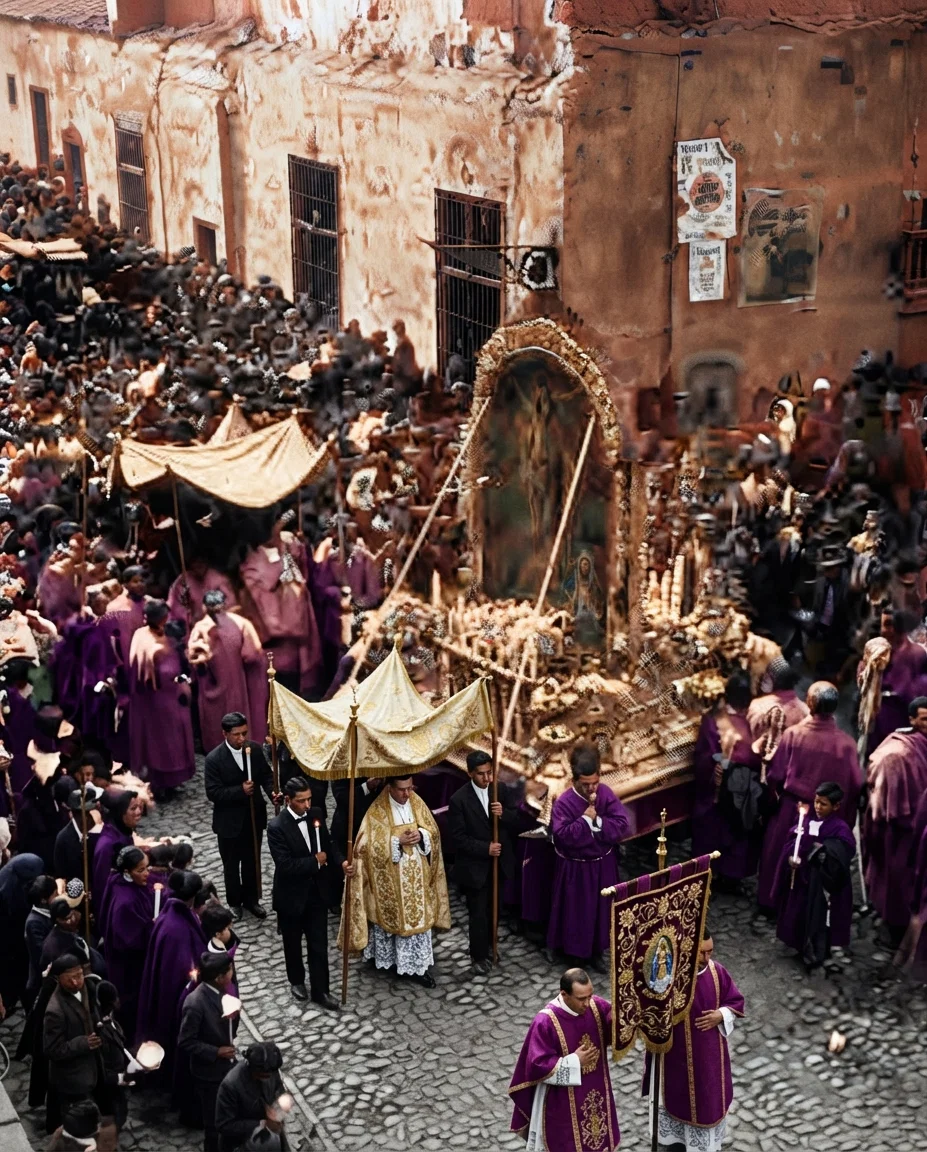
ON the morning of Oct. 18, 1904, as I was on my way to the post-office in Lima, Peru, on entering the Plaza de Armas, or great square in the center of the city, I noticed thousands of people emerging from one of the streets. I looked down the street from which they came, and, as far as I could see, the street was crowded with people, who surged to and fro like the waves of the sea. I stopped in the plaza to see what the great demonstration meant.
In the fore part of the procession were several priests, carrying a banner. Then, in the midst of the crowd were about five hundred women, dressed in purple, each carrying a lighted candle, and singing as they passed. Then followed hundreds of women with censers, in which they were burning incense, such a cloud of which arose that it made breathing difficult. Hundreds of men and boys and girls were carrying lighted candles, as tho to lighten some one through the darkness.
On they passed, until I saw the center of display, which was a life-sized picture of Christ hanging upon the cross, painted on canvass, on the back of which was a painting of the Virgin Mary carrying the Babe in her arms. Ten candles were burning before either image, while the deck of the platform which sustained it was strewn with flowers. Many silver medals were hung on either side, by persons who had been miraculously healed, all of which made it so heavy that the twelve men who bore it were required to rest every few yards.
As the "Lord of Miracles" passed by, every head was bared, with the exception of mine, which made me so conspicuous as to call forth mutterings from the crowd against the "cursed foreigner" who would not honor the "Lord of Miracles." Next came the priest, dressed in his gorgeous sacerdotal robes, with six men carrying a canopy over him to shield his delicate person from the scorching rays of a tropical sun. Then followed the band, to whose slow, measured strains of music all were marching.
The throng stopped before the great cathedral in front of the plaza, and made way for the "Lord of Miracles" to pass inside, where the priest said mass for the dead. They came out again, and, with slow, steady tread, moved on to the next church, where the same ceremony was repeated, and so on, until all the churches in the city were visited.
In the meantime, I hurried to the house for my camera, and hastened to a street where I knew they would pass. Seeing a balcony upstairs which would be a favorable spot from which to get the picture; I ascended the stairs, and asked permission of the lady to take a picture of the procession, which was most willingly granted. As the family seemed to be very intelligent, I asked the meaning of such a demonstration. They said, "O, you are a stranger in the city." Assuring them that I was, they said, "That is the 'Lord of Miracles.' That Lord has performed some wonderful miracles."
"O, yes," I said, "and why do they carry him around in that way?" "O, that is to avert the great calamities," they said. They then related to me the terrible earthquake of Oct. 28, 1746, to Feb. 17, 1747, in which Lima was destroyed, and Callao, the port seven miles distant, was wiped out of existence by a mighty tidal-wave that swept in over the land.
Annual Catholic Procession in Lima, bearing the "Lord of Miracles" from church to church to protect the city from earthquakes.
At half-past ten o'clock on Friday evening, October 28, as the people were holding a solemn festival in one of the churches, there came such a mighty movement of the earth that nearly every building in both cities was shaken to the ground, burying the inhabitants beneath them. This was immediately followed by the sea withdrawing, leaving the harbor dry. But suddenly it returned, carrying ships and shipping with it, and depositing them far back into the city. Of the twenty-three ships anchored in the bay, nineteen were either sunk or carried back into the city, where they were dashed to pieces. Not a single wall in the city was left standing. Again the sea withdrew, as if to gather more strength, and, returning with greater fury, swept in across the country, and threatened the city of Lima, which is situated seven miles from the coast. A mighty mountain rose out of the sea, called, to-day, the Island of San Lorenzo.
Of the 8,400 inhabitants of the city, but twenty-one were left to tell the sad tale. Terrible was the consternation in Lima—parents looking for their children, and children for their parents; brothers seeking their sisters, and sisters their brothers; many running here and there in search of a priest to whom they could confess their sins, and receive absolution. Language fails to describe the horrors which befell those two cities, neither can the most vivid imagination form a picture of the scene. In twenty-four hours two hundred distinct and mighty shocks were felt. The inhabitants of Lima were gathered in the plaza, expecting that each moment would end their miserable existence. During the days which followed, there fell a rain of such a peculiar character that it burned the grass in the fields, many people dying from sickness caused by it.
But why continue describing a scene so terrible? Suffice it to say that in the 112 days that the earthquake lasted, the earth was shaken 430 times. Thousands of people died afterward, as a result of an epidemic caused by the thousands of bodies lying unburied.
Some time after this terrible earthquake, according to the tradition, some negro candy-sellers were, at the close of the day, counting up their profits. They had stopped by a white wall, and, using a piece of coal for a pencil, were making their figures on the wall, when suddenly the Lord appeared, pictured on the wall as He had been crucified. Frightened almost out of their senses, they fled to the priests, to whom they made known the wonderful apparition which they had seen. The priests then went to the place, and confirmed the story of the negroes.
By some means, tradition continues, the Lord communicated His will that a convent be built in that place. The church of the convent was built, enclosing the wall, which was left standing, on which the image can still be seen. A painting of the apparition was then made on canvass, and is kept in the church with the original. But each year, on the 18th of October—two days before the anniversary of the great earthquake—it is taken out, and for two days is carried through the streets of Lima, visiting all the churches in the city. Again, on the 28th and 29th of October, the anniversary of the terrible catastrophe, the same procession is witnessed in Callao, the port of Lima.
They believe that thus the cities will be spared the repetition of the awful destruction. That piece of painting has the credit of performing other miracles besides averting the earthquake, as, for example, if any one is seriously ill, he promises the "Lord of Miracles" that, if restored to health, on the great anniversary he will help to bear him in the great procession. In case he recovers, he attributes his healing to that image. He is, therefore, one of the carriers.
Thus, in this twentieth century, the people are held in ignorance and superstition by the darkening influence of Rome, while the missionaries who seek to enlighten them are persecuted, and forbidden to hold public meetings, under pain of imprisonment. The public burning of Bibles is not a thing of the past in Peru, but is practised to-day, whenever the people can be sufficiently stirred up to do it. And they would burn the missionaries, too, if they dared.
OUR HERO MISSIONARIES.
By Marianne Farningham
THEY have journeyed far on a stormy tide
To the friendless shore and the strange hillside,
Where the wild winds sigh and the darkness creeps;
For their hearts are sad with a world that weeps,
And theirs is a love that never sleeps.
Where the stress is great and the battle long
They strengthen their faith with psalm and song;
And if for guerdon they have defeat,
The hymns of their angels are ever sweet,
And they take their rest at the Master's feet.
God is the source of their secret strength.
They trust in Him, and they see at length
That morn is breaking after the night,
And the harvest fields are gold and white,
While shines around them God's fadeless light.
But who shall follow where they have led?
Who live and labor and love instead?
O, hearts of youth, earth waits for you;
Be strong and brave, be firm and true,
Faithfully promise, and nobly do!
—Marianne Farningham.
GOD'S WAY IN THE MISSION FIELDS.
WE are too apt to assume that the rate at which we travel and erect buildings and make fortunes must have its counterpart in the work of missions, and hence the impatience for immediate results. 'Architects and builders adjust their work to the temper of the day, but the Eternal Workman heeds not the varying moods and fashions of His creatures, but in spite of the demand for rapid production is at this hour as slow and sure in His work as at any past time in His history.' Does the sun shine any different from what it did in Adam's day? Do the trees of the forest grow any faster than in Solomon's time? Do the tides ebb and flow with more rapidity than when Alexander beheld them on the shores of India?
When the church realizes that the evangelization of the whole world is the task committed to her, and enters upon this work with the consecrated zeal and unflinching energy which characterized the early church, then will the day of India's redemption be hastened, and it will be found that the success which has hitherto been attained is only the first-fruits of the harvest that is in store for us. Yes, the harvest time is coming—such a harvest as has not yet been dreamed of—when the Lord Himself 'shall see of the travail of His soul, and shall be satisfied.'—Selected.
[And yet the Word teaches that there will come a time when the Lord's work will go with a power and a rapidity that we have not expected. With a short work and a swift work will the Gospel message close.]
OUR WORK AND WORKERS.
By Editor
A CAMP-MEETING at Woonsocket, S. D., is appointed for June 8-18.
THERE will be a general camp-meeting in Des Moines, Iowa, June 8-18.
THE Indiana Reporter notes the baptism of seven candidates at Medaryville, Ind., by Brother B. Hagle.
AT Estella, I. T., April 8, nine candidates were baptized by Brother F. H. Conway, as a result of six weeks' labor.
THE address of Brother E. W. Webster is now Cheraw, S. C. He desires his correspondents to take notice of the change.
IN the East Caribbean Conference there were 114 persons baptized in the year 1904. The annual offerings were doubled over the previous year.
THE baptism of two Spanish-speaking people in Arizona is reported by Brother Marcial Serna. They are the father and mother of eight children.
ANOTHER worker has fallen at her post in a foreign field. From the interior of China we have the sad news of the death of Dr. Maude Miller, March 14, of tropical dysentery.
WE have received word that Brother George W. Reaser has been elected president of Southern California Conference the ensuing year. We are not advised as to other officers.
A LETTER from Brother R. S. Donnell notes the addition of ten members to the church in Memphis, Tenn., April 8. He expects to engage in tent labor near that city in a short time.
AT the last quarterly-meeting of the church at Alto, Texas, two members were added to the church, making fifteen during the year. Brother D. U. Hale was present at the meeting.
THE annual session of the Western Oregon Conference will be held in connection with the camp-meeting at Portland, June 8-18. A ten-days' workers' meeting will precede the regular meeting.
IN the Workers' Bulletin, Brother C. W. Hollingsworth reports the organization of a Sabbath-school with fourteen members at Sutherland, Iowa. This school is a branch of the Sioux Rapids missionary society.
THE report of Southern California Conference for the last nine months shows an increase of about two hundred members. The conference has voted to pay the salary of one of its laborers in a foreign field until the field becomes self-supporting.
REPORTING to the Southwestern Union Record, Brother A. E. Field notes the addition of five members to the church at Merritt, O. T., and the baptism of three candidates at Mayfield. At the latter place a church of fifteen members was organized.
AT the quarterly-meeting of the church at Streator, Ill., held April 8 and 9, five candidates were baptized by Brother E. A. Curtis. The brethren have decided to build a house of worship, 54 x 36 feet dimensions, with a basement story for a school-room.
A NOTE in the Southwestern Union Record states that a series of meetings is being held in the new meeting house recently erected by the colored brethren of Cleburne, Texas. The meetings are conducted by Brethren S. S. Ryles and Thomas Defreze.
MEETINGS were held in Ottumwa, Iowa, April 16-18, by Brethren L. F. Starr and C. A. Washburn, during which a church of fifteen members was organized. These had been brought to a knowledge of the truth mainly through the labors of Sister Margaret Young.
AT the recent annual meeting of Arizona Conference, Brother C. E. Knight was re-elected president; Mrs. M. T. Poston, secretary, and the Arizona Sanitarium, treasurer. The executive board are: C. E. Knight, J. E. Bond, M. Serna, H. A. Dow, and a member to be supplied.
ON a recent journey by rail, to Denison, Texas, Sister Watts stopped over at Fort Worth, and sold about three hundred copies of the SIGNS OF THE TIMES. She says, "The Lord blessed in selling all papers. I don't believe I ever saw as marked evidence that the Lord was doing the work."
IF you have not done so already, don't delay any longer in ordering the Review, that you may have full reports of the General Conference proceedings. Three months, containing these reports in addition to the regular matter, 50 cents. But it is better to order for six months, at 75 cents, or a year for $1.50. Address 222 N. Capitol Street, Washington, D. C.
TUESDAY evening, the 2d inst., the editor of the SIGNS started on his journey to Washington, D. C., to attend the session of the General Conference. He expected to make a short stop at Chicago, and again at Battle Creek. Other delegates from this conference and from this publishing house, are J. N. Loughborough, W. C. White, A. S. Kellogg, J. O. Corliss, H. H. Hall, and E. R. Palmer.
An appeal comes to California from Brother H. H. Dexter, now laboring in Southern France, for donations to purchase a tent for that needy field. The sum of $200 is wanted for the purpose, and donations to the cause may be sent to W. A. Spicer, 222 N. Capitol Street, Washington, D. C. In a letter to the Recorder, Brother Dexter reminds us that while California has an average of one worker to 35,714 souls, in France there is one to 6,000,000.
ABOUT two months ago a girls' school was opened in Canton, China, with thirty-eight applications for admission. Others have applied since. As some copies of Our Little Friend were being torn apart in order to go around, a little girl said to the teacher, "Won't you please write a letter, and ask the children of America to send us more papers?" If those who have Bible picture-cards to spare will send them to Miss Lucile Thompson, Mauston, Wis., she will forward them by Brother Anderson.
A REPORT in the North Dakota Worker, from Brother George Wagner, states that he was recently privileged to meet a group of Russians, to the west of Anamoose. "Tho he is able to carry on a common conversation in their native language, he found it rather difficult to proclaim to them the Gospel in Russian. But he succeeded in securing a good interpreter, who, a Russian himself, also speaks German, and is a firm believer in the message. All essential points of our faith were presented quite fully, and, as the result, four of these precious souls and two Germans were accepted as members. They, with about thirty more Russians, had been Baptists, and had begun to observe the Sabbath prior to Brother Wagner's coming. He says there is every reason to believe that many of those who have not yet identified themselves with us, will do so after continued labors."
IN the South African Missionary, Brother W. S. Hyatt says: "Again and again have we considered the advisability of opening a mission in Kafirland, but we have never felt sure that the time had come till we met at the conference in East London. As Brethren Tarr, Shone, and Moko told us of the interest among this people, all were agreed that something should be done, and delay no longer. During the past year the truth has been gaining a strong foothold in the location at East London, and several intelligent natives have accepted the message. At the time of our camp-meeting the brethren held open-air services each evening at the location, and they reported some wonderful meetings. Our missionaries from up country enjoyed this work very much. Several of these natives who are keeping the Sabbath speak English, Dutch, and Kafir, and have some education. Three or four have been local preachers, and, now that they have received the truth, they are anxious to be fitted to go to their people with the message." It was recommended that the surplus Sabbath-school donations for the present year be devoted to this work, and, as there are twenty-five schools in South Africa, that will afford a nucleus.
INFLUENCE OF THE CHRISTIAN FAMILY IN INDIA.
IN not a few Hindu families as many as fifty souls are dependent on the earnings of a single member. I happened to be present at a railway station sometime ago when a Hindu friend of mine, a government official, was moving his family from one town to another to which he had been transferred, and he had actually to charter two compartments, at a cost of thirty tickets, to move his numerous family, consisting of wife and children, uncles and aunts, grandparents and grandchildren, and other relations, any one of whom would curse him and his posterity to their latest day if he failed in his duty to them as members of a family of which he was the constituted head. But this system will pass away. Already a bill has been introduced into the legislature, called the "Gains of Learning Bill," by an orthodox Hindu, whereby an educated man can claim exclusive right to ownership of all properties acquired by him through his education. The bill has met with great opposition, as it is a serious blow to the joint family system, and what will be its fate we can not predict; but it is interesting, as showing the tendency of the times.
But greater than any other influence—and this is what I want especially to emphasize—that is being brought against the Hindu-family system is the Christian home that is being reproduced in India. All over the land, in the cities and towns and villages, are ideal homes being founded by native converts. Marrying at suitable age, the wife educated as well as the husband, the young people go to their own home, and the children, as they appear, are nurtured in Christian truth, while the voice of family prayer and sweet Christian hymns of praise show that God the Father and His eternal Son are honored beneath the roof. We can appreciate the remark made by a Telugu mother whose son had become a Christian: "My Christian son's home is heaven, and I would never wish to see a better heaven; but my Hindu son's home is a dunghill—yea, hell itself!" Not that every Christian family erects the family altar, nor that every Christian home is what it should be, but every year shows the number of such homes increasing, and shedding their fragrance, not only on the inmates of the family, but also on the heathen neighbors around. The influence of this new factor in the life of India can not be overestimated. And what with the rapid advance of female education among the native Christian community, have we not the most sanguine hope that this result will, in an increasing measure, be realized?—Missionary Review.
WANTED FOR MISSIONARY WORK.
By Editor
(Always prepay postage.)
SECOND-HAND papers—any of our denominational issues. Address Mrs. S. Kortson, Iowa City, Iowa.
LATE SIGNS, and tracts on "The Coming of the Lord" and "The Seal of God and the Mark of the Beast." Address Mrs. Hester Garner, Seward, Neb.
PERSONS wishing to send only Seventh-day Adventist literature to hospitals, jails, and interested persons direct, and save remailing here, may obtain some addresses in this needy field, where we have not even a single minister or regular canvasser, by writing to Joseph Clark, Ceballos, Cuba. Postage on letters and papers same as in states.
Education in the Home
By Mrs. L. D. Avery-Stuttle
EDUCATION IN THE HOME. No. 1.
BY MRS. L. D. AVERY-STUTTLE.
NESTLING among the hills, amid a thrifty orchard of apples and peaches and plums, just outside the little village of D——, lived Brother and Sister Hartman and their family. An old-fashioned home, you would pronounce it at once, even before you noticed the quaint well with its lofty sweep, and the broad veranda, over which climbed a wild grape-vine. Yes, it was an old-fashioned home, and old-fashioned people lived in it, from dear old grandma, with her neat, white-lace cap, to little Beth, with her sweet baby face. All the members of the household were very old-fashioned.
Now, do not imagine for a moment that they wore ridiculous clothes, or that the children were ignorant and ill-mannered, or the house shabbily furnished and unpleasant,—nothing of the kind.
I'll tell you why I call them old-fashioned: It is because they believe in an old-fashioned Book. They believe in it all,—from cover to cover,—many wise men, and much "higher criticism" to the contrary, notwithstanding.
The children are taught to revere it, and to follow its wonderful teachings. Every day a portion of this much-beloved Book is read, and fervent prayer ascends to the great Author, for grace to understand and obey His sacred Guide-book.
One day Brother and Sister Hartman had an earnest conversation together. The children were growing up: Elsie was almost sixteen; John was fourteen; Mattie was twelve; and little Beth was seven. It seemed to them that something especial must be done to instill into the hearts of their children a love for the truths that they themselves believed and held precious. To be sure, they had always taught the children to believe in the Bible, and they were all members of the little Sabbath-school, yet the parents were not satisfied.
"I'll tell you, mother," began Brother Hartman, "I'd like to send the children to church-school, and I know you would,—but that's impossible, with none nearer than fifty miles."
"That's so, father; but they must not miss a good education, they must go to school somewhere. But I do believe we can counteract, in a great degree, the evil they may learn there, if we teach them the reasons for our faith and hope right here at home. Of course, you and I could never teach them grammar and arithmetic, they can learn that at the village school, and they must,—for neither you nor I had many advantages when we were young."
"That's so, mother; but while we may be a little shabby in grammar and physiology, we need not feel so bad about that; but there is no excuse for us to be ignorant concerning the great truths which we love, or to neglect to teach them to our children."
"Yes, and we must not depend wholly on what the Sabbath-school teacher can do one hour each week. How can our children love that which they know nothing about?"
"I have felt for some time that we were not giving even the attention to the Sabbath-school lesson that we ought to. What do you say to having a Bible study with the children at least twice every week?"
"Why, I think it a grand plan; and we will see what the children will say about it to-night, when they come home from school."
At last 4 o'clock came, and the old house again resounded with childish voices.
"O mother!" began Elsie, "The teacher said to-day that only a part of the Bible was inspired, and—"
"Yes," interrupted John, "and she didn't take the trouble to tell a fellow which part was all right and which wasn't."
"She said it was foolishness to believe the story about Jonah and the whale," said Mattie.
"Yes," added Elsie, "and she teaches the class in geology that the world wasn't made in six days, at all,—that it took many millions of years—and, O mother! she doesn't believe the Bible account of the creation of Adam and Eve."
"Well, children," said grandma, "I suppose you don't belong to the class in geology, do you?"
"O, no, grandma, I just happened to hear it while the class was reciting."
"How would you like the idea, my children," said their mother, "of having a little Bible class two or three evenings in every week? Your father and I have been talking it over, and, if you all agree, we will choose our subject, and begin Friday evening. You shall all 'take turns' in answering the questions, and reading the verses, if you want to, and we will see how interesting we can make it, and how much we can learn."
"O, that would be lovely!" said Elsie. "I would like it ever so much, wouldn't you, John?"
"Yes, only sometimes some of the boys come in to see me, and then what could we do?"
"Why, invite them to join our society," said grandma.
"O, O!" cried Beth, delightedly, "If grandma's going to help us, we're just sure of having such a good time."
And so it was decided that the next Friday evening the home studies were to begin.
ONE MOTHER'S WAY.
THEY were like all other healthy, wide-awake boys, and so the playthings were scattered about in their fun, and left for somebody else to pick up.
There was no patient elder sister to help, nor was there a maid of all work to set the house in order. Mother's busy hands did everything.
At last the mother called a council, and, in due form, presented her plea, What shall be done to make the boys remember to put their playthings away?
"I s'pose," said one, rather ruefully, "you could put 'em away so we couldn't get 'em."
"That's a fine thought," said the mother, as if she hadn't been hinting that way. "Suppose we do it. I'll have a guard house, and put the things I find out of place into it for twenty-four hours, or till bailed out."
"What's bailed out?" asked the boys. Then came an explanation of the court process, and the boys understood they would have to do some extra work to "bail out" the playthings, altho they were very sure they would never forget any more.
Mother was fair, and her cry of "anything for the guard house?" often sent flying feet back to put things in place. But the boys were fair, too, and, while they often forgot, and their toys disappeared, there was no ill nature nor rebellion, and they did many a bit of work for "bail."—Christian Work.
SOME SMALL, SWEET WAY
“THERE’S never a rose in all the world
But makes some green spray sweeter,
There’s never a wind in all the sky
But makes some bird wing fleeter,
There’s never a star but brings to heaven
Some silver radiance tender,
And never a rosy cloud but helps
To crown the sunset splendor;
No robin but may thrill some heart,
His dawn light gladness voicing;
God gives us all some small sweet way
To set the world rejoicing.”
THE LIGHTS IN OUR HOMES.
By Sara H. Henton
BY SARA H. HENTON.
I FEAR we do not think enough of the happiness and blessings that accrue from the meeting of the family around the evening lamp.
The lights in our homes are very important factors. Our health and eyesight depend quite a good deal upon them, as the lamp is our main dependence to read or sew by. We home-keepers should see to it that they have skilful treatment and intelligent care. A good light is a constant pleasure in a home, but an unsteady, flickering, dim lamp soon affects the eyes and injures them, resulting in oculist's bills and headaches. The things necessary for cleaning lamps are a small brush, plenty of clean cloths (cheese-cloth is the best to use), a bottle of alcohol, and a hot suds of rain water. Add enough pearline to the water to make a good cleaning suds, and wash the tubes, founts, and all parts of the lamp in this suds. Fill the bowl of the lamp daily with high-grade oil, such as head-light oil, as cheap oils are dangerous. Tissue paper will polish the chimney beautifully. A good lamp well-kept is a benediction in a home.
Georgetown, Ky.
GENTLENESS IN THE HOME.
THERE is a small per cent. of people who have constitutionally an amiable and gentle make-up, and in whose souls' grace seems to work with comparative ease;—but the majority of us need to be mightily subdued, and transformed, both by grace and by discipline, to give us that patient, compassionate, and gentle type of religious life, which is most needed in the home. There is no place on earth where gentleness of spirit is more needed than in the home, and perhaps most people who are convicted for a deeper experience, get their conviction from a conscious lack of home religion. The requisite kindness and patience for home life can not be obtained simply by specific blessings, tho they are essential, but it must come by a deliberate and prayerful study of kindness of spirit. Those we love most are entitled to the best exhibition of our religion.—Selected.
EVERYBODY'S BUSINESS.
A WEALTHY man in St. Louis was asked to aid in a series of temperance meetings, but he scornfully refused. Being pressed, he said, "Gentlemen, it is not my business."
A few days later, his wife and two daughters were coming home on the lightning express. In his carriage, with liveried attendants, he rode to the depot, thinking of his business, and planning for the morrow. Hark! Did some one say "Accident"? There are twenty-five railroads centering in St. Louis. If there had been an accident, it was not likely to have occurred on that road. Yet it troubles him. It is his business now. The horses are stopped on the instant, and on inquiry he finds that the accident has occurred twenty-five miles out on that road. He telegraphs to the superintendent:
"I will give $500 for an engine."
The answer flashes back, "No."
"I will give you $1,000 for an engine!"
"A train with surgeons and nurses has already gone forward, and we have no other."
With white face and anxious brow, the man paced the station to and fro. In a half-hour, perhaps, which seemed to him a half-century, the train arrived. He hurried toward it, and in the tender found the mangled bodies and lifeless forms of his wife and one of his daughters. In the car following lay the other daughter, with her dainty ribs crushed in, and her precious life oozing slowly away. Whisky which was drunk fifty miles away by a railroad employee was the cause of the catastrophe. Who dare say of this tremendous question, "It is not my business"? — Selected.