Both Are Divinely Ordained — Each Has a Distinct Sphere — To Attempt to Unite Them Means Disaster to Both
By W. A. GOSMER
BOTH church and state exist in the order of God; for "the powers that be are ordained of God." Rom. 13:1. For the promotion of man's highest spiritual good, the church was ordained; for his temporal welfare, the state. Because of the entrance of sin, and the existing order of things, both institutions are indispensable as relates to society and the eternal interests of mankind.
Wherever the civil state is found, whether among Christians or among pagans, it is invariably the ordinance of God. The civil magistrate among all nations is denominated in Scripture a "minister of God." The inspired apostle spoke of the pagan, persecutive world-power of Rome as the "ordinance of God." That the church is a divine institution is beyond argument. Therefore both church and state are institutions divinely appointed.
But notwithstanding the fact that both exist by God's appointment, each has a different mission.
THE SPHERE OF THE CHURCH
The church occupies a peculiar sphere of its own. It deals with things spiritual, with things divine, and has to do only with man's eternal welfare. Consequently it does not concern itself with those matters which come within the purview of civil government, only in so far as relates to obedience thereto. The church is directly concerned with the souls of men. It has to do with God's kingdom, which is not of this world. It has to do with His righteousness, which is the righteousness of faith, which no civil government can bestow. In fact, the only reason the church can give for its existence is that it has in view, as its ultimate object, the redemption of mankind, and the bringing in of an entirely different order of things in a world to come that shall be free from sin.
THE FIELD OF THE STATE
As, on the one hand, the church has to do with things entirely divine, so, on the other, the state occupies itself with things wholly civil. The mission of the latter is specifically the protection of society. No earthly government can be man's sponsor in spiritual matters, because every man, individually, must "give account of himself to God." In the great Judgment-day, not governments, but individuals, are called to account. Hence no man is amenable to civil powers so far as relates to his religious belief or practise.
CAN NOT SAFELY UNITE
Two institutions, therefore, so widely different in their spheres of action, each having a mission peculiarly and distinctively its own, can not be profitably or even safely united. One is spiritual, the other carnal. One deals solely with this world; the other, with the world to come. One occupies itself with the guardianship of men's souls; the other, with the protection of their bodies and goods.
Imagine, if possible, the state administering the ordinance of baptism, celebrating the Lord's Supper, or instructing men in regard to matters pertaining to another world. Think also of the church invading the realm of the state by putting to death criminals, levying taxes, or going to war. It would be difficult to conceive of greater incongruity. Such a wrong policy on the part of either, must inevitably prove disastrous to both. The nature, the genius, and the office of each, being so widely different from the nature, the genius, and the office of the other, would not possibly admit of interchange or union. In fact, the state could not administer the affairs of the church, and the latter would lose its spiritual nature in administering the affairs of the state.
DISTINCTION DIVINELY RECOGNIZED
In recognition of the foregoing principles, the Scriptures forbid such a union. Jesus said, "My kingdom is not of this world." To Peter, who resorted for defense to carnal weapons, He said, "Put up thy sword into the sheath." To the crafty Jews He said, "Render to Cæsar the things that are Cæsar's, and to God the things that are God's." Thus He distinguished clearly between affairs of state, and things pertaining to His kingdom.
Plain, however, as these principles appear, there have in all ages been those who have endeavored to unite the civil and the religious. The utter folly and disaster of such a course may be most clearly seen in the history of the Dark Ages. During the world's midnight, the church and the state clasped hands, the church being in the ascendancy. The civil power became the agent in the hands of the church to punish men for non-compliance with certain forms of religion. In this unholy union, the church lost sight of the only true source of her power, and sought in its stead the mere power of men.
Of the terrible results of this union, not even the casual student of history is ignorant. Resort was had to the rack, the dungeon, and the stake, to bring the minds and the consciences of men into subjection, with the outcome that millions of honest, God-fearing men and women were cruelly put to death for the crime of "heresy," which meant only to differ from the established order as prescribed by the church.
THE TERRIBLE RESULTS
Thus it has been amply demonstrated that a union of the civil and the ecclesiastical is one of the greatest evils that can come upon the world. Viewed in the light of God's word, and from the view-point of human experience, it must be evident that for the good of the church, for the welfare of society, and for the best interests of the state, the civil and the spiritual powers should be forever kept separate.
Sought to Unite All Europe, Asia, and Africa
By Jean Vuilleumier
A Great Dream of World-Wide Empire — It Seemed on the Verge of Fulfilment — Crushing Defeats Shatter the Dream
The Prophecy Stands a Mighty Gibraltar Monument
By JEAN VUILLEUMIER
THIS is the third and concluding study of Mr. Vuilleumier on the prophecy of the second chapter of the book of Daniel. In the previous articles, he has presented what the prophet foresaw. He has shown that the four great world empires of Babylon, Medo-Persia, Greece, and Rome were seen in the prophet's vision. The prophet furthermore saw that when Rome should arise, she would be the last of the world-wide kingdoms. She was to be broken into numerous smaller kingdoms, and these were to continue until Christ should come in person to overthrow all and establish His everlasting reign. Many mighty men have conspired and worked to unite Europe into one world-embracing empire. This article devotes itself to one of these colossal attempts — the one made by Napoleon Bonaparte. Without question, Satan has exerted all his rebellious powers to overthrow God's prophetic utterance; but for fourteen centuries and more, the divided state of Europe has stood as a mighty monument to God's foreknowledge.
Next week Mr. Vuilleumier will have the first of the two articles on the prophecy of the seventh chapter of Daniel.
THE most conspicuous and memorable example of the world empire dream is found in the history of Napoleon. He came as near reaching the goal of this ambition as could well be desired.
THE GIGANTIC PROJECTS OF NAPOLEON
"In the gigantic projects of Napoleon, Moscow was to be only one station. He planned to take up again, in colossal proportions, his expedition to India frustrated after Aboukir. A secret agent sent to all the countries between the Red Sea and the Indus, was seeking to unite all the Arab chiefs for a common undertaking against English India; Persia had been sounded and won; once beaten, the czar would furnish auxiliaries, and a Russian and French army would have left Tiflis, carrying along the nomads of those regions, rushing them as far as the shores of the Ganges!" — Duruy, "History of France," volume 2, page 62.
THE FINEST ARMY
Europe seemed to be at his feet. Five of his own brothers and sisters were sitting on thrones created or usurped by him. The reestablishment of the Roman Empire seemed an accomplished fact, when the whole structure came to naught under the second coalition.
In vain had Napoleon set on foot the finest and most disciplined army he had ever led. A divine fiat followed him, and turned every motion of his into a failure. Disaster followed upon disaster,— first the conflagration of Moscow, then the frightful retreat from Russia, and the crossing of the Beresina,— the most heartrending scenes in the history of war. Then comes the battle of Leipsic, which winds up in an irreparable defeat; France is invaded by the allies; Paris is blockaded, and a provisional government demands the abdication of Napoleon, who retires to the island of Elba as a private citizen.
ALL EUROPE RISES AGAINST HIM
But he is not satisfied with this experiment. He decides to try again the favor of his "star." He enters France, and a delirious army soon surrounds him. In order to crush the "French Attila," as his enemies call him, forces two and three times more numerous than his own army — 300,000 or 400,000 against less than 100,000 — hasten from all corners of Europe. A single battle must now decide the fate of the world, and settle once for all this question of sewing together the fragments of the old Roman Empire.
Napoleon is confident that once more he can defeat his enemies, in spite of numbers. According to his habit, he surprises them by the swiftness of his motions, and reaches Waterloo, in Belgium, before they expect him. The whole campaign lasted four days; but the battle, properly speaking, raged for ten hours.
CHARGED THE IRON DUKE ELEVEN TIMES
It was a giants' fray. Napoleon exhausted all the resources of his military genius. Twice the French came within reach of victory. Michel Ney, thinking he saw the allies beating a retreat, threw his whole cavalry against the English squares. Eleven times the charge was given, and eleven times they were repulsed. Wellington, in command of the English, unmindful of his terrible losses, remained motionless at his post, deserving the title of the "iron duke."
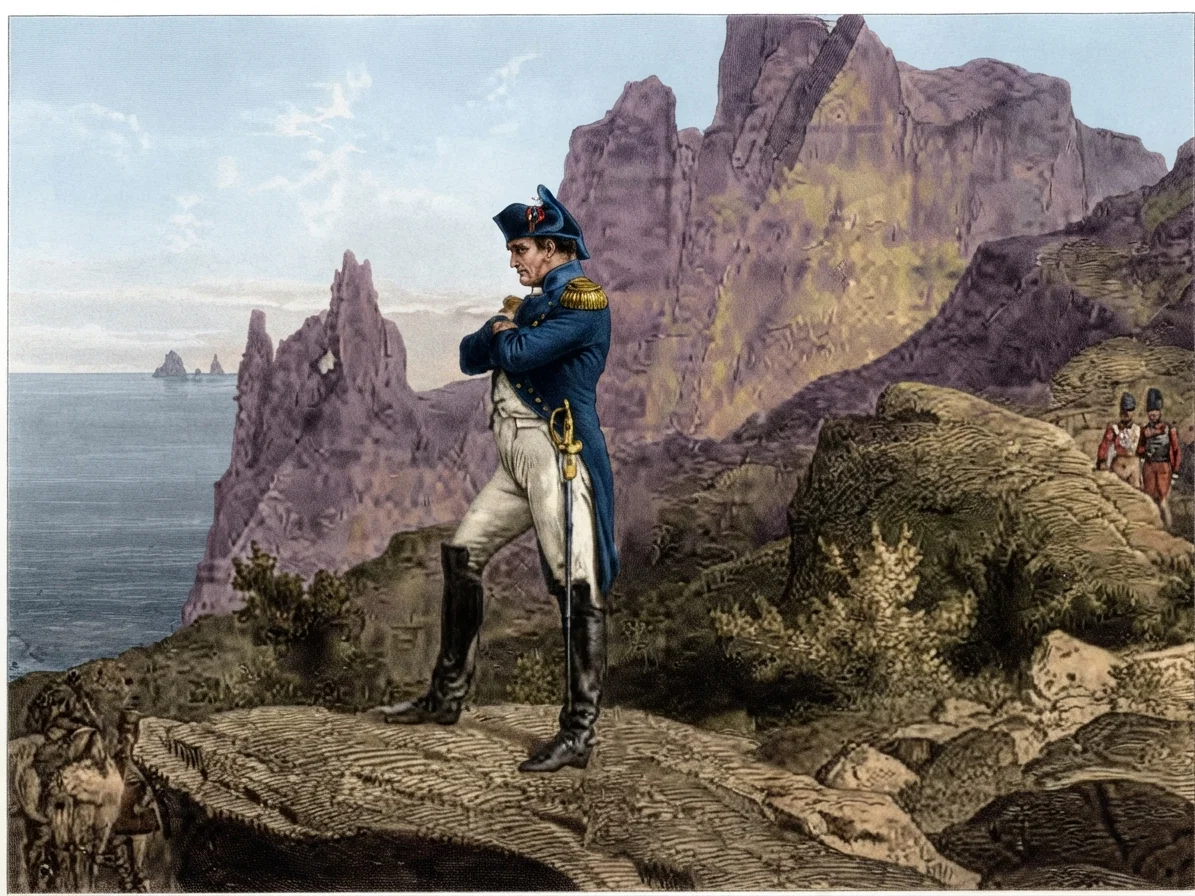
From Ridpath's "History of the World" NAPOLEON, WITH HIS DREAMS OF WORLD EMPIRE, BANISHED TO THE ISLAND OF ST. HELENA
But all was in vain. Unforeseen difficulties and reverses foiled the strategy of the emperor and the heroism of his soldiers. At eight o'clock at night, he exhausted his last resource by launching his reserve. The French army, reduced to one half, surrounded and crushed on two sides, whirled upon itself into a confused and horrible melee. Again France was invaded, its territory reduced, and it had to pay an enormous war indemnity.
AN UNRIVALED GENERAL, BUT SENT TO ST. HELENA
Rejected by his own countrymen, Napoleon — who had entered victoriously twice into Vienna, into Rome, Berlin, Madrid, and Moscow — saw himself forced, "like Themistocles, to ask England, as the mightiest, the most constant, and the most generous of his enemies, to give him a place at her fireside." But this request was not granted. He was treated as a prisoner of war, and carried in mid-ocean to the island of St. Helena.
After five years of captivity, he died at the age of fifty-two. One of the greatest generals the world ever produced, if not the greatest, a worthy successor of Cyrus, Alexander, and Caesar, he had seen his gigantic dreams vanish into smoke, and had madly dashed his head against a rock of adamant. The prophetic word written twenty-five centuries before had said, "They shall not cleave one to another."
Since Napoleon's failure, nothing has materially changed the aspect of Europe. The kings are there yet, waiting, as they have been for fourteen hundred years, for the next great change in the program of nations, for the last act in the human drama marked by prophecy:
"And in the days of those kings shall the God of heaven set up a kingdom which shall never be destroyed, nor shall the sovereignty thereof be left to another people; but it shall break in pieces and consume all these kingdoms, and it shall stand forever. Forasmuch as thou sawest that a stone was cut out of the mountain without hands, and that it brake in pieces the iron, the brass, the clay, the silver, and the gold; the great God hath made known to the king what shall come to pass hereafter: and the dream is certain, and the interpretation thereof sure."
TWO THOUSAND YEARS OF FULFILMENTS
Over two thousand years of striking fulfilments ought to be a sufficient warrant of the truthfulness of this final prediction, which contains a definite answer — and O, how consoling! — to the question of Nebuchadnezzar of so long ago, and which the present generation is repeating with breathless anxiety:375"What shall come to pass hereafter?" "What is this world coming to?"
THE STONE CUT OUT WITHOUT HANDS
The stone "cut out without hands," which strikes the image and dashes it to pieces, is Jesus Christ, the Saviour of the world, and the King of kings. David says of Him that He shall break the nations "with a rod of iron," and "dash them in pieces like a potter's vessel." Ps. 2:9. And the revelator saw in vision that when "the kingdom of the world is become the kingdom of our Lord, and of His Christ," who is to "reign forever and ever," then "there was a great earthquake, such as was not since there were men upon the earth," so that "the cities of the nations fell," "and every island fled away, and the mountains were not found." Rev. 11:15; 16:18-20.
A NEW EARTH IS OFFERED
But to His people, to the church of all ages, is offered in possession "new heavens and a new earth, wherein dwelleth righteousness." 2 Peter 3:13. "They shall inherit the earth," said Jesus of the meek, in His Sermon on the Mount. Matt. 5:5. And many years before, Isaiah described the "singing," the "gladness," and the "everlasting joy" of the "ransomed of Jehovah," when they see the desert "blossom as the rose," and "the glory of Lebanon" and "the excellency of Carmel and Sharon" adorn the earth made new. He tells us that "the wolf shall dwell with the lamb, and the leopard shall lie down with the kid"; "their young ones shall lie down together; and the lion shall eat straw like the ox."
BLIND AND DEAF TO SEE AND HEAR
But this is not all. "Then the eyes of the blind shall be opened, and the ears of the deaf shall be unstopped. Then shall the lame man leap as a hart, and the tongue of the dumb shall sing." "They shall not hurt nor destroy in all My holy mountain, saith Jehovah." Isa. 11:6, 7; 35:1-9; 65:17-25.
This is what the world is coming to. History in hand, we can, with Daniel, and even better than he, exclaim that "the dream is certain, and the interpretation thereof sure."
No longer doubt then, dear reader, seeing that God has given you such powerful reasons to believe. Accept with joy the good news herein proclaimed, thank God for such a beautiful prospect, and enlist without delay under the banner of the King of righteousness, who is also the Prince of peace and the Friend of sinners, the One who says to all, "Come unto Me, . . . and I will give you rest."
President Wilson and Patriotism
By S. B. HORTON
The Principles upon Which Our Government Must Stand — Americans Can Not Hold Allegiance to a Foreign Power
By S. B. HORTON
AT the unveiling of the Barry statue in Washington recently, the president of the United States delivered an address on the subject of patriotism which was quite apropos. The Barry statue had its inception in 1902, when at a meeting of the Robert Emmet Club, of Georgetown, a plan was inaugurated to induce the general government to erect a statue in honor of Captain John Barry, who was the first commissioned officer in the American navy.
A MILITARY MASS
The circumstance of his being an Irishman and a Roman Catholic was seized upon by the Roman hierarchy to bring the church into prominence. The church had devised a military mass to be conducted on the monument grounds on the Sunday morning following the unveiling ceremonies, to which the president and other national officials were invited.
PATRIOTISM DEFINED
In his speech, the president seemed to touch the vital element in patriotism. Said he:
"Patriotism is, in my mind, not merely a sentiment. There is a certain effervescence, I suppose, which ought to be permitted to those who allow their hearts to speak in the celebration of the glory and majesty of their country, but the country can have no glory and no majesty unless there be a deep principle and conviction back of the enthusiasm. Patriotism is a principle, not a mere sentiment.
"No man can be a true patriot who does not feel himself shot through and through with a deep ardor for what his country stands for, what its existence means, what its purpose is declared to be in its history and in its policy. I recall those solemn lines of the poet Tennyson in which he tries to give voice to his conception of what it is that stirs within a nation: 'Some sense of duty, something of a faith, some reverence for the laws ourselves have made, some patient force to change them when we will, some civil manhood firm against the crowd; steadfastness, clearness of purpose, courage, persistency, and that uprightness which comes from the clear thinking of men who wish to serve not themselves but their fellow men.'
"What does the United States stand for, then, that our hearts should be stirred by the memory of the men who set her Constitution up? John Barry fought, like every other man in the Revolution, in order that America might be free to make her own life without interruption or disturbance from any other quarter. You can sum the whole thing up in that, that America had a right to her own self-determined life; and what are our corollaries from that? . . .
VITAL TOPICS ARE BEFORE US TO-DAY
"There are just as vital things stirring now that concern the existence of the nation as were stirring then, and every man who worthily stands in this presence should examine himself and see whether he has the full conception of what it means that America shall live her own life.
"Washington saw it when he wrote his farewell address. It was not merely because of passing and transient circumstances that Washington said that we must keep free from entangling alliances. It was because he saw that no country had yet set its face in the same direction in which America had set her face. We can not form alliances with those who are not going our way; and in our might and majesty and in the certainty of our own purpose we need not, and we should not, form alliances with any nation in the world.
"Those who are right, those who study their consciences in determining their policies, those who hold their honor higher than their advantage, do not need alliances. You need alliances when you are not strong. And you are weak only when you are not true to yourself. You are weak only when you are in the wrong. You are weak only when you are afraid to do the right. You are weak only when you doubt your cause and the majesty of a nation's might asserted.
HIS HEART CROSSED THE ATLANTIC
"There is another corollary. John Barry was an Irishman, but his heart crossed the Atlantic with him. He did not leave it in Ireland. And the test of all of us — for all of us had our origin on the other side of the sea — is whether we will assist in enabling America to live her separate and independent life, retaining our ancient affections, but determining everything that we do by the interests that exist on this side of the sea.
"Some Americans need hyphens in their names, because only part of them has come over. But when the whole man has come over, heart and thought and all, the hyphen drops of its own weight out of his name. This man was not an Irish-American; he was an Irishman who became an American. I venture to say if he voted, he voted with regard to the questions as they looked on this side of the water, and not on the other side; and that is my infallible test of a genuine American, — that when he votes, or when he acts, or when he fights, his heart and his thought are nowhere but in the center of the emotions and the purposes and the policies of the United States.
BROUGHT BY THE MAGNET OF FREEDOM
"This man illustrates for me all the splendid strength which we brought into this country by the magnet of freedom. Men have been drawn to this country by the same things that have made them love this country — by the opportunity to live their own lives and to think their own thoughts and to let their whole natures expand with the expansion of this free and mighty nation. We have brought out of the stocks of all the world all the best impulses, and have appropriated them and Americanized them and translated them into the glory and majesty of this great country.
STAND FOR HUMAN FREEDOM
"When we go out from this presence, we ought to take this idea with us — that we, too, are devoted to the purpose of enabling America to live her own life, to be the justest, the most progressive, the most honorable, the most enlightened nation in the world. Any man that touches our honor is our enemy. Any man who stands in the way of8that kind of progress which makes for human freedom can not call himself our friend. Any man who does not feel behind him the whole push and rush and compulsion that filled men's hearts in the time of the Revolution is no American. No man who thinks first of himself and afterward of this country can call himself an American. America must be enriched by us. We must not live upon her; she must live by means of us."
Commenting upon the speech, the Washington Herald said editorially:
"Every American should read the address of President Wilson at the unveiling of the Barry statue yesterday. A great many will be better Americans if they give it careful study. The address ought to and probably will take its place as the best and clearest definition in American literature of genuine patriotism. First of all, it should be printed in the school-books, that the principles which it proclaims may be learned early by those who later in life must be depended upon to maintain the nation's honor and traditions."
It may be said to the credit of the president's good taste and judgment, that he did not attend the mass held on the monument grounds.
IF THESE SHOULD PREVAIL
It must be concluded that if the principles connected with patriotism so suggestively presented by the president would govern our legislators and executives; moreover, if these principles were heeded by those who would use the government for propagating religious doctrines and observances which in their very nature mean a departure from the original idea of the founders of this government,—then there would be no need of fear as to the future integrity of the United States government as an ideal system. There would be no need to fear the church power that is becoming more and more assertive and determined for an alliance with and a control of the state.
The Great Mystery of Christianity
By Calvin P. Bollman
We May Not Be Able to Explain It—Neither Can We Explain Life and Many Other Processes
By CALVIN P. BOLLMAN
CHRISTIANITY is not a code, but a life—the life of Christ in the heart of the believer. "I am crucified with Christ," says the apostle; "nevertheless I live; yet not I, but Christ liveth in me: and the life which I now live in the flesh I live by the faith of the Son of God, who loved me, and gave Himself for me." Gal. 2:20.
The mystery of the incarnation began when, in the person of Jesus of Nazareth, "divinity was clothed with humanity." It will be finished when the last redeemed human being stands perfect before God in His everlasting kingdom; for then the redeemed race will have been made partakers of the divine nature through the union of the human with the divine in the person of the Son of God.
It was not for Himself, but for us, that the Son of God met and conquered sin in human flesh. It was not for Himself, but for us, that He endured temptation in the wilderness, and that throughout His earthly ministry He was tempted in all points "like as we are, yet without sin."
His life here is far more than an example. It is even more than a demonstration of what human weakness united with divine strength can accomplish. It is the triumph of renewed humanity over the enemy of all righteousness. This victory is in Christ, and He gives it to as many as are in Him. Of her who was "highly favored" of the Lord, of whom it was said, "Blessed art thou among women," the angel declared, "She shall bring forth a Son, and thou shalt call His name Jesus: for He shall save His people from their sins." Matt. 1:21.
"Whosoever committeth sin transgresseth also the law: for sin is the transgression of the law." 1 John 3:4. To save from sin, therefore, is not merely to interpose between the sinner and the penalty for sin, but to save from the sin itself, that is, from the transgression, from sinning. This is plainly stated in Rom. 8:3, 4: "For what the law could not do, in that it was weak through the flesh, God sending His own Son in the likeness of sinful flesh, and for sin, condemned sin in the flesh: that the righteousness of the law might be fulfilled in us, who walk not after the flesh, but after the Spirit."
Coupled with His stern rebuke to the Laodiceans (Rev. 3:14-22), the Saviour gives this precious encouragement: "As many as I love, I rebuke and chasten: be zealous therefore, and repent. Behold, I stand at the door, and knock: if any man hear My voice, and open the door, I will come in to him, and will sup with him, and he with Me. To him that overcometh will I grant to sit with Me in My throne, even as I also overcame, and am set down with My Father in His throne."
If it be asked how man can overcome, how this victory is brought to the human subject, we answer, By faith. "For whatsoever is born of God overcometh the world; and this is the victory that overcometh the world, even our faith." 1 John 5:4. It is by faith we are justified. Says the apostle, "Being justified by faith, we have peace with God through our Lord Jesus Christ." Rom. 5:1. It is by faith in Christ that we are made partakers of the divine nature. By Him, says the apostle, "are given unto us exceeding great and precious promises: that by these ye might be partakers of the divine nature, having escaped the corruption that is in the world through lust." 2 Peter 1:4.
If it be asked how all this is accomplished, we reply that we can not tell. The Saviour Himself did not attempt to explain the new birth and the subsequent spiritual growth to Nicodemus. There are few things, even in the physical world, that we understand. We know that certain results follow certain causes; but why, we can not tell. It is related that when a German scientist once said to Thomas A. Edison, "The day is almost here when we can explain all the processes of nature," Mr. Edison replied by moving his little finger, and saying, "Explain to me why my finger moves in obedience to the will of my brain, and I will believe what you have just said."
The new spiritual life begotten in the human heart by the divine Spirit when the will is surrendered to God, is no more mysterious than is the giving of life to inanimate clay in the beginning of earth's history. We do not know, possibly we never shall know, how God could speak matter into existence; how He could give life to lifeless things; how He formed man of the dust of the ground, and then breathed into his nostrils the breath of life, and man became a living soul. We know that we exist. Reason tells us that back of us there must be a Creator. Revelation tells us that there was and is a Creator.
That revelation fills a real want in our natures. It satisfies a longing in the human soul. It tells us also of a Saviour from sin, of a means of freedom from the galling, degrading bondage of Satan. The soul bound in sin cries out for liberty. God gives that liberty through Jesus Christ. The need is just as imperative and the supply is just as real as is the demand for the food God has placed within our reach. We appropriate and are nourished by the one. Why not appropriate and be saved by the other?
The truth is that we are in a world—yea, in a universe—of mystery. So far as the ultimate is concerned, we know nothing, excepting what God has revealed; but this we may know by experience,—that there is power in the Lord Jesus Christ to save not only from sin, but from sinning. And this is "the mystery which hath been hid from ages and from generations, but now is made manifest to His saints: to whom God would make known what is the riches of the glory of this mystery among the Gentiles; which is Christ in you, the hope of glory." Col. 1:26, 27.
The Benefits of Judicious Labor
"Judicious labor is a healthful tonic for the human race. It makes the feeble strong, the poor rich, the wretched happy. Satan lies in ambush, ready to destroy those whose leisure gives him opportunity to approach them under some attractive disguise. He is never more successful than when he comes to men in their idle hours."