The New Hebrides — Their Extent — Their Formation — Climatic Conditions — Vegetation
By C. H. PARKER
ELDER Parker has been for a considerable time a missionary in the New Hebrides Islands. Hence what he tells us in these paragraphs is from his own experience and observation. This week he tells about the islands themselves. Next week he will tell more about the people and their customs.
When the Master said, "This gospel of the kingdom shall be preached in all the world for a witness unto all nations," He knew of the faithful men that would be raised up whose all-consuming passion would be to put the Bible into the hands of each person on earth, and in that person's native tongue. He knew of the faithful men and women who would come from all the evangelical churches, burdened with an indescribable desire to carry the gospel of the great Book to "every creature" in all the world. He saw them sailing the seas, exploring continents, facing dangers and privations and hardships of every kind, and all that they might tell the glad story, and enter into the joy of seeing others rejoice in the new-found pleasures of the "blessed hope." He saw all this seed sowing followed by the great and final message proclaiming His soon coming.
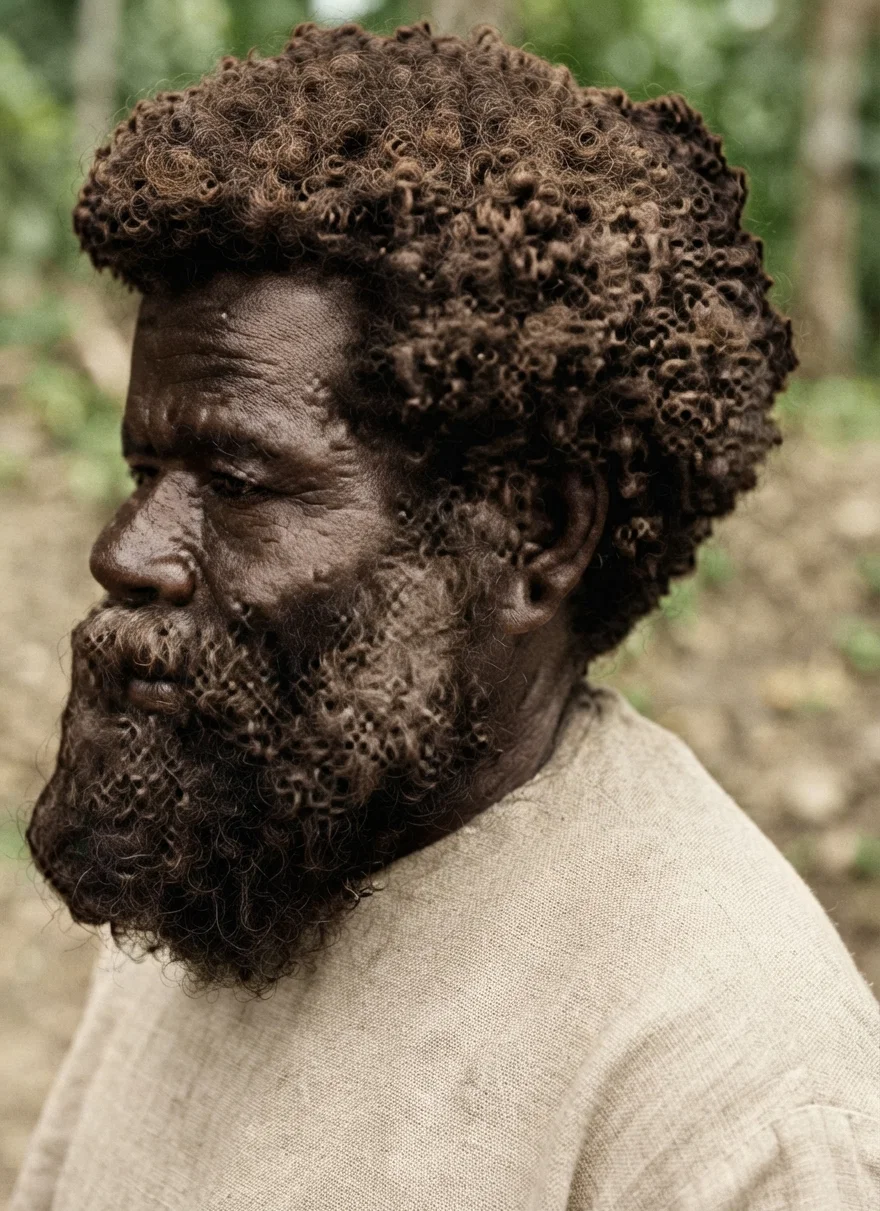
FIRST NATIVE PASTOR IN THE NEW HEBRIDES
How sublime is the thought of being a part of such a great plan of the Infinite One! What a miracle it is that men can be led by divine grace to give up all that this world holds dear, and devote themselves to the labors, to the afflictions and the dangers, incident to fulfilling the divine plan! But when one understands what it really means, how can he refuse to enlist?
THE New Hebrides consist of a group of islands somewhat more than thirty in number. Two of these are about two hundred miles in circumference. They are Santo, which is sixty-five by twenty-five miles, and Malekula, sixty by twenty-eight. The Hebrides group extends four hundred miles in a northwesterly and south-easterly direction. With the exception of the Fijis and New Zealand, no group in the South Seas can compare with them in extent and resources.
The names of the principal islands of the group, proceeding from the south in a north-westerly direction, are Aneiteum, Futuna, Aniwa, Tanna, Erromanga (Martyr's Island, for here is where the Rev. John Williams, Mr. Harris, and the two Gordons were massacred), Efate, or Sandwich Island, Hinchinbrook, Montague, or Nguna, Three Hills, Shepherd Islands (five in number), Panin Islands (two in number), Epi, Ambrym, or Chinambrym, Pentecost, Aurora (which disappeared, but has put in appearance again), Lepers' Island, Bartholomews, Malicolo, or Malekula, and Espiritu Santo,—the last two the largest in the group. They are about two hundred miles from New Caledonia on the south-west, and about one thousand five hundred miles from Australia.
The group was first visited in 1606, by Quiros, the Spanish navigator, who discovered some of the northern islands, especially Espiritu Santo; but he imagined that they formed part of the great southern continent, which he called Tierra Australis del Espiritu Santo. They were again visited in 1768, by Bougainville, who did little more than land on one of them, but ascertained that they were not a continent, but a number of islands, which he called the Great Cyclades.
It was reserved, however, for the great English navigator, Cook, to explore the group thoroughly. On his second voyage, in the year 1774, he sailed twice through them, discovering all the southern islands, and examining the northern more carefully than had been done previously. He gave the name New Hebrides to the group, from observing a striking resemblance of some of them to the old Hebrides off Scotland. Scottish missionaries still declare that the contour of some of these islands strongly reminds them of the mountains of the Skye.
VOLCANIC ACTIVITY
Most of the islands of the New Hebrides are of volcanic origin. Some of them bear traces of recent igneous action. On Aneiteum there are appearances of extinct volcanoes, and the natives point out a spot where a volcano existed in a state of action until a recent period. Their tradition is that their gods had compassion on the inhabitants, and drove the fire away underground to Tanna. The extinction of the one may have been coincident in time with the breaking out of the other, and the superstition may have arisen in this way.
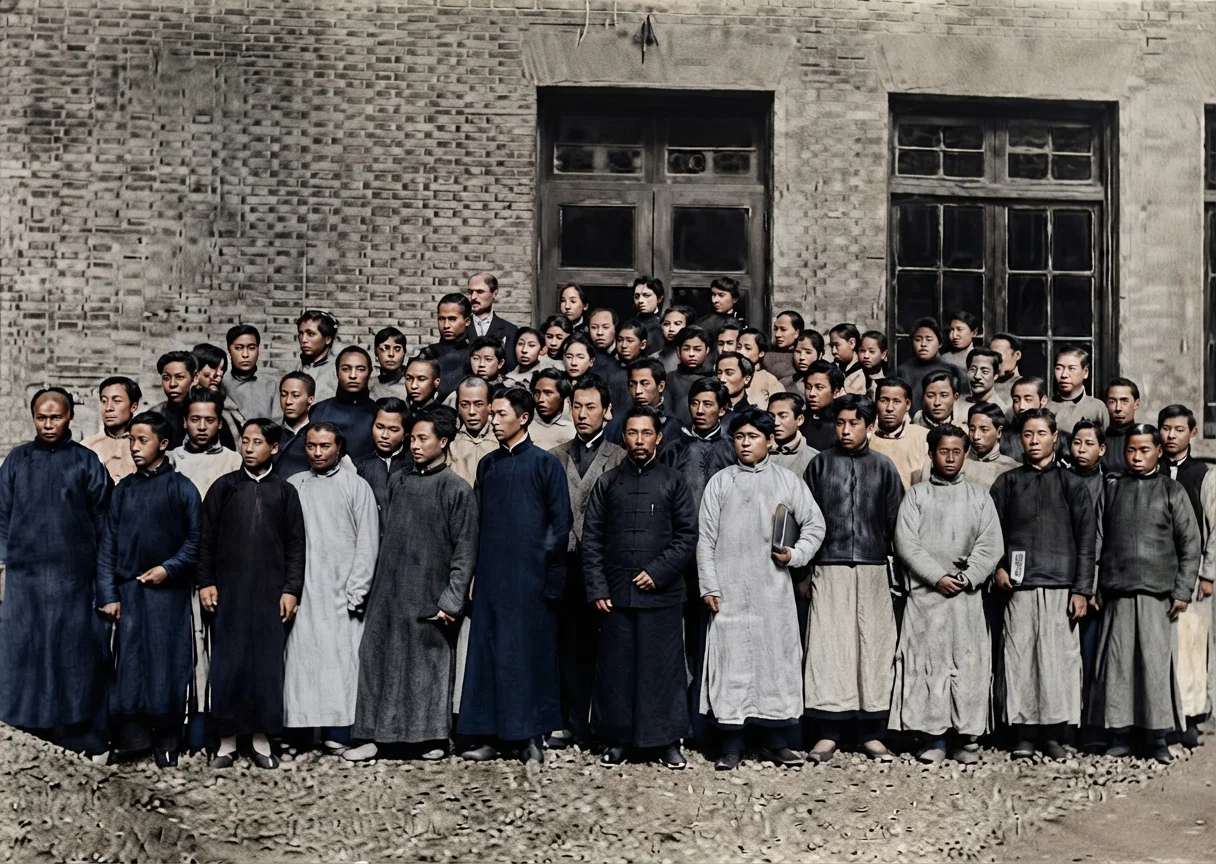
GROUP OF STUDENTS ATTENDING CHINA MISSION TRAINING-SCHOOL, SHANGHAI
Three volcanoes are known to be in operation in the group — one on Tanna, one on Ambrym, and the third on Lopevi, a small island close to Paama in the north. On the first of these, and probably on the others,
there are hot springs, which the natives utilize to boil their food. On Tongoa, one of the Shepherd Islands, in some places the ground is so hot that the natives cook their food by burying it for a short time in the earth.
In 1881 a volcano broke out in the sea off Trator's Head, on Erromanga. These points are all nearly in a line from about northwest to southeast, and nearly in the general course of the group; while much in the same line to the north, active volcanoes and hot springs are found in the Banks Islands, which may be considered the extension of the New Hebrides in that direction.
But Aniwa, and some smaller islands of the group, and the Loyalty Islands, the next group to the southward, are of coral formation, and every form of coral abounds in them all. In many places, bands of coral mark the several upheavals that have taken place, but they are not so generally encircled by barrier reefs as the islands of some other groups.
Slight earthquakes are experienced, and occasionally more severe. Last December the Ambrym volcano burst out into a furious eruption. Half of the island was devastated; many of the natives licked up by the lava or cooked in the water, and the Presbyterian hospital, which was under the skilful management of Dr. Bowie, was blown up into the air by a crater forming under it. The inmates had sufficient warning to escape. A boiling mass of waters has taken the place of the well-planned and well-kept buildings of that institution.
The soil of volcanic islands is generally fertile, and this is the case with the New Hebrides. From what has been already said, it will appear that they are either mountainous or hilly.
CLIMATIC CONDITIONS
The climate may be described as perpetual summer. In the southern islands, the thermometer rarely registers above ninety-five degrees Fahrenheit, or below sixty-three degrees, the mean temperature being about eighty degrees. The heat is sometimes intense; but the agreeable trade-winds, which rise and fall with the sun, serve to moderate its severity. In the daytime, the weather is seldom comfortably cool at any season; but the night air is damp and chilly, and to expose oneself to it between sunset and sunrise is imprudent. In the northern islands, the heat is greater, ranging from seventy to one hundred degrees, the mean temperature being about eighty-five degrees.13
THE WET AND THE DRY SEASON
In these islands, the wet and the dry season take the place of the summer and the winter of temperate climates, only that in the southern hemisphere, the greatest heat is from December to April. That is also the rainy season, and rain falls in quantities unknown in temperate climates, sometimes continuing for weeks at a time. The streams are swollen and the low ground submerged, and traveling is difficult or impracticable.
Thunder and lightning are at that season matters of daily occurrence. The hygrometer indicates an atmosphere thoroughly saturated with moisture. Vegetation grows with a rapidity scarcely conceivable by those unacquainted with the tropics. That season is also very tempestuous, the destructive hurricanes peculiar to these latitudes always taking place at that time.
From April to December is the dry season. Rain seldom falls in quantities, but showers are frequent. The weather then is more agreeable, and the atmosphere more healthy. Vegetation does not grow so rapidly as in the wet season; and toward the close, the foliage loses slightly its verdant hue, and assumes somewhat of the autumnal appearance.
THE PREVAILING DISEASE
Malaria is the prevailing disease, and the persistent attacks of the malaria mosquito keep one's system impregnated with this disease. No one is immune. Quinin seems to be the only asylum, but it soon shatters the system, black-water fever often occurring from overdosing.
The natives are afflicted with sores, which become very virulent, and eat large holes to the bone, which in turn becomes affected. The filth in which the people live only aggravates these sores, and draws a cloud of bottle flies, as well as the smaller varieties, to cover them. Large numbers of the islanders are infected with skin diseases, which cover their bodies.
The Editor
By Editor
EDITOR.
Educational Progress in the Chinese Mission
By A. C. Selmon
Some Results of the First Year's Work
THE group of Chinese young men and women shown in the accompanying photograph are the first to enjoy the blessings of our new school buildings. We have sixty-one in attendance at present. The majority of them have been in the work in the capacity of evangelists or colporteurs.
Some of them will not have the opportunity of being here in the school more than this present year. The demand from the field is so urgent that we must do the best we can for them in the shortest possible time, and then send them out into the great harvest-field; for there are mission schools to be taught, and there is evangelical work to be done. If we had two hundred in school, there would be places for them all in the field.
We have had a very successful school year thus far. A good spirit is manifested on all sides; and we can see that most of the students have made progress not only in their various lines of study, but in their Christian experience as well.
One young man and his wife are here from Manchuria. He is full of enthusiasm, and will make a most efficient helper for the brethren who will go to Manchuria this fall to open the work there. We regret he can not stay for another year or two in training.
The photograph tells its own story of the intelligent class of young men and women that are embracing this message. And they have a strong purpose in their hearts to join in pushing the work to its completion.
These are some of the fruits that not only encourage our hearts here, but that we know must encourage the hearts of the self-sacrificing brethren and sisters in the home land who are sustaining us in these outlying fields.
A. C. SELMON.
Thoughts from the Mount of Blessing
The thirteen chapters of this favorite little volume are truly "steps" which lead to a close companionship with Him who "has linked Himself with the children of men by ties that are never to be broken." These chapters are:
"God's Love for Man," "The Sinner's Need of Christ," "Repentance," "Confession," "Consecration," "Faith and Acceptance," "The Test of Discipleship," "Growing Up into Christ," "The Work and the Life," "A Knowledge of God," "The Privilege of Prayer," "What to Do with Doubt," and "Rejoicing in the Lord."
Beautiful cloth, gilt edge, presentation edition, $1.00. Published in 23 different languages.
Thoughts from the Mount of Blessing
With this beautiful little work, the reader in imagination is taken back to the scene of the mountain side, amid the throng who listened eagerly to Christ's wonderful sermon commonly known as "The Beatitudes." Point by point the wisdom there uttered in simple parable form is presented, and practical spiritual lessons are suggested. Its general chapters are: "On the Mountain Side," "The Beatitudes," "The Spirituality of the Law," "The True Motive in Service," "The Lord's Prayer," and "Not Judging but Doing." Each of these chapters contains thoughts to brighten the way, and lead the reader to a deeper realization of the blessings of real Christian service. Fully illustrated, rich cloth binding, price 75 cents.
The Advance Guard of Missions
The stories of the Mayhews, the Wesleys, Christian Frederick Schwartz, William Carey, the Judsons, and scores of other faithful men and women who pioneered in mission work, as given here, form one of the most thrilling missionary books ever published. It is more than a book of biographical sketches. It pulsates with the spirit that led those men and women out into the needy fields beyond, and kept them there in self-sacrificing work. Each sketch is illustrated, and is filled with incidents that instruct and inspire. 27 chapters, 247 pages. Handsome cloth binding, marbled edges, price $1.50.
Prices 10% higher in Canada.
Address your tract society, or
PACIFIC PRESS PUBLISHING ASSN.
MOUNTAIN VIEW, CALIFORNIA
Portland, Oregon
Kansas City, Mo.
Calgary, Alberta, Canada
The July "Signs Magazine"
By Editor
Is one you will enjoy reading. It contains articles on the following subjects:
"A Quick Work in This Generation—Providential Agencies at the Present Time—What It All Means."—W. A. Spicer.
"The Spirit of Kindness Is the Spirit of God's Kingdom—Evidences of God's Fatherhood—How Nature Reveals the Character of Its Creator—Jesus Christ the Example of Perfect Manhood."—R. C. Porter.
"The World-Wide Gospel Message—The Real Purpose of Linking the World Together by Telegraph, Telephone, Railroads, Steamships, Newspapers, Books, Various Means of Communication—Increase of Knowledge as a Sign of the Times."—I. H. Evans.
"The Final Battle—The War That Closes the History of the World—Why It Is Restrained—When It Will Come."—J. O. Corliss.
"The Passing of Simplicity—Another Sign of the Times in the Changes That Are Taking Place in Human Life—The Past and the Present in a Light That Points a Lesson."—Frank S. Weston.
"God's Eternal Purpose in Christ—A Study of the Great Contest over Man's Soul—Who Is the Real Saviour of the World, Christ or the Virgin Mary?—Who Is the Mediator Between Man and God?"—T. E. Bowen.
"The Drug-Endangered Nation—Increase of the Drug Traffic—Cocain a Menace."—Milton Charles Wilcox.
"A Work of Reform—Why Is there So Much Agitation over the Sabbath Question?—A Clear, Logical Answer—Providential Means of Sabbath Reform."—Mrs. E. G. White.
"Literary Aspects of Evolution—Some Poetic and Prose Selections from Evolutionary Literature—Some Clumsy, Some Stupid, Some Blasphemous—Contrasted with the Treasures of Wisdom and Knowledge in the Sacred Word."—George McCready Price.
"Putting on Immortality—Who Shall Have Immortal Life—When Immortality Will Be Given—The Mighty Change That Will Take Place."—William Covert.
"The Eastern Question—It Is Still a Question—Some Index-Fingers, Every One of Which Points Toward Russia—Prospects of Another Uprising in the Near Future."
"Our Canadian Letter—Will there Be Catholic and Protestant Political Parties in Canada?—Some Eventful Agitations Relative to Church and State."—Jean Vuilleumier.
"Nuggets of Gold"—"Christianity and Social Problems."
If you wish to read these good articles, you must get the July Signs Magazine. It is worth your money, and you can well afford a few copies for your neighbors.
5 copies for . . . . . . . . . . . . . . $ .25
10 copies for . . . . . . . . . . . . . . .50
20 copies for . . . . . . . . . . . . . . 1.00
50 copies for . . . . . . . . . . . . . . 2.00
Cooperation Corner
By Editor
THE opportunity is offered to help some one not so fortunate as ourselves. Many calls—in fact, a continual stream—are received at the office, for copies of the SIGNS for those who can not afford to pay for them. They, as well as we, desire to study these important subjects, but are not able to supply themselves with papers.
We call your attention to this from time to time, and many of our readers gladly contribute to our Cooperation Corner Fund. Here is a letter just received:
"Enclosed find $2.00 for Cooperation Corner. Please use anywhere most needed, from a SIGNS OF THE TIMES reader and one who believes and is interested in the message."
This good offering is much appreciated, and in behalf of the beneficiary, we acknowledge the gift.
Remittances should be sent to the SIGNS OF THE TIMES, Cooperation Corner.
Graduation Day Gifts
BOOKS are divided into two classes, said Ruskin, "books of the hour, and books for eternity." Among our beautiful gift books that furnish lasting inspiration and constant spiritual help for young people are the following:
Steps to Christ
Our Natural Defenses Against Disease
By David Paulson, M. D.
The Healing Power Implanted Within the Body—How to Be Germ-Proof—Digestive Disinfectants
WHEN an epidemic of grippe is raging in a neighborhood, why does not every one take the disease? And why do some die, while others recover? Why is it that some who are careful about their health are semi-invalids, while others who are careless have good health? In the providence of God, extensive medical research now enables us to furnish at least partial answer to each of these interesting questions.
THE REMARKABLE MYSTERY OF HEALTH
Nothing else seems so remarkable to me as the mystery of health and healing, except the amazing miracle of salvation. I knew a man who was a born thief. He was an expert pickpocket at the age of ten years. Finally he became the best known and most dreaded safe breaker in the United States.
Yet after he had served time in seven different state prisons, he "happened" to drop into a little mission in Chicago, and something "happened" to him that night. Then he began work washing windows at a dollar a day, and was ever after that an honest man. During the years that followed, he earned the complete confidence and respect of leading business men in Chicago, and was used of God for the saving of hundreds of souls.
THE LANGUID EYE TO FLASH WITH ANIMATION
Such a change is the most remarkable thing I know of. But to see the glow of health return to a face marked for the tomb, to see the languid eye again flash with animation and new life, is almost as inspiring. This is a sight that fills my soul with a peculiar holy awe, even after all these years of medical experience.
Thirty centuries ago the inspired psalmist said that the same God who forgave iniquities healed all diseases. Ps. 103:3. Disease was formerly considered to be something that could be driven out of a man as we drive a cat out of a room. The heathen tried to dislodge it by burning the patient with hot irons, while the doctors in civilized lands attempted to do the same by administering nauseating medicines.
IN SPITE OF THE OLD-TIME DOCTOR
We are gradually learning that the disease symptoms are in reality the efforts of the body to repair itself. Hence when the old-fashioned doctor gave medicines merely to smother the symptoms, he was working squarely against the patient’s interests. If the patient recovered, it was often in spite of the doctor and his medicines.
We now know that the healing power is within the patient, and not in the doctor’s bottle or in the nurse’s applications, and that it is the business of the scientific physician and the attendants to cooperate intelligently with and direct these healing activities, which they may hinder but which they never can create. The farmer can cultivate corn, but he can not grow corn.
A perfectly healthy body is the best protection against disease germs. We are naturally endowed with a certain amount of vitality, or natural resistance, or "something" that wards off disease. The ancients used to call it "the power in nature that cures." This mysterious something came from God, and it can not be put up in bottles nor sold over the counter.
Rockefeller’s son will probably inherit so much money when his father dies that he will be unable to spend it in one lifetime. And some men naturally inherit so much of this vital resistance that they can not squander it all during their lifetime; while others inherit so little that they always have to live from hand to mouth, so to speak, and are constantly running the risk of contracting disease.
AN AUTOMATIC AIR STERILIZER
There is something bitter in every orange rind. It is put there by nature to discourage the parasites from burrowing into the orange. Likewise God has put "something" into every healthy person that renders him unattractive to germs. Before we contract any acute disease, we must generally spend weeks, months, or even years battering down one bodily defense after another, until it becomes just as easy for the germs to waylay us as it finally was for the Japanese to enter Port Arthur.
Walking down the crowded thoroughfare of a large city on any windy day, every breath we inhale contains pneumonia germs, perhaps grippe germs, and more than likely tubercular bacilli. But when a healthy person exhales this air, it has been sterilized. The microbes have been destroyed.
A DISINFECTANT KILLS THE GERMS
The healthy mucus in the nose, throat, and bronchial tubes of the lungs contains a disinfectant that kills these germs. Before we contract any respiratory disease, we must have lowered the vital resistance of the body; for only healthy blood can make healthy mucus.
When suffering of colds, bronchitis, or other respiratory disease, it is not enough to inhale medicated steam to kill the germs. We must reform—in other words, repent, for there is such a thing as physical repentance.
The man who drinks liquor must reform. The tobacco user must cease that filthy habit. Those who are eating abominable stuff, or even good food at irregular hours, must cease to do evil, and learn to do well. There is too much physical repentance that is scarcely skin deep, and that is why so many of our fellow men do not live out half their days.
A DIGESTIVE DISINFECTANT
Some years ago a French investigator fed a dog a piece of rotten meat. An hour later he killed the dog, opened its stomach, and found that the gastric juice had disinfected the rotten meat.
If the human stomach were not to a certain extent similarly endowed, there would be many more cases of ptomain poisoning. The gastric juice, as well as the other digestive juices, protects us against disease.
The mucous membrane of the intestines has a similar power to destroy poisons. It is a well-known fact that a very small quantity of rattlesnake poison introduced through the skin directly into the blood may cause death, while a considerable quantity may be swallowed with safety. The same is true of other poisons. This explains why it is possible for some people year after year to eat with comparative safety unwholesome and wretched foods that happen to tickle their perverted appetite.
AN IMPORTANT RENOVATING PLANT
The great mission of the liver, besides making bile, is to stand between us and destruction. Practically all the digested food products pass through the liver before they are permitted to enter the general blood stream. It holds back, changes, and destroys poisons, and thus for years prevents well-earned pains, aches, and untimely death.
THE LIVER DESTROYED THE POISON
An experimenter injected nicotin, the poison of tobacco, into the vein entering the liver, and he found that nearly half of it was destroyed in passing through that organ.
There are some men who have inherited an almost unlimited liver capacity for destroying poisons. This permits them to use tobacco year after year without any apparent15serious consequences. But they are simply presuming on nature, without knowing when the liver and other bodily defenses will give way and overwhelm the system with toxins. It is a terrible price to pay for a little temporary unearned felicity.
SUGGESTIONS TO TOBACCO USERS
The use of tobacco does no one any good. It is certain to do some harm, and it may do a vast amount of unconscious harm. I advise every tobacco user to ask the Lord to deliver him from this wretched bondage. For a few days, live exclusively on a fruit diet, eating it in abundance three or four times a day. Drink a large amount of water. If convenient, take one or two sweat baths. It is surprising how easily freedom from the habit is secured.
Experiments have been made on dogs, connecting the blood-vessel that goes to the liver directly with the one that leaves it. It was found then that if the dog was fed on meat, he would sicken and die in a few days; but when fed on bread and milk, he could live satisfactorily for months. This experiment gives us a hint as to how highly essential for our welfare the liver is when eating freely of flesh foods.
The liver is also overtaxed when fried foods are eaten, and when compelled to destroy pepper and other fiery spices; and above all things, when it has to contend constantly with poisonous alcoholic liquors.
"THE reason some men can not make both ends meet is because they are too busily making one end drunk."
The Right Master
Translated from the "Sendebud" by B. M. Shull
IN a little country village stood an organ. No one knew how it had sounded when, new and beautiful, it came from the hands of its builder; but for a long time all were agreed that the old organ was worn out and worthless, and that as soon as the congregation were able, they would buy a new one. No one thought for a moment that possibly the fault might be with the old organist and not with the instrument. There was no one in the whole village who understood music, not even the minister.
Now it came to pass that the old organist died. A few weeks later, a sober-looking man, with a thoughtful countenance, came to the village. He went to the parsonage, and asked for a position as organist, or to be permitted at least to try the old organ.
This request was cheerfully granted, and a time was set for the trial. The audience came with few or no expectations — for did they not know the old, worn-out organ! No hand could possibly coax beautiful sounds out of it.
But listen! What is that? Lightly the fingers of the artist touched the keys of the instrument, and in a moment the old organ trembled with pure ecstasy.
The air was filled with soft, melodious tones. It was a music more rapturous than any they had hitherto heard. Then the tones swelled mightily. They seemed like the howling of a storm and the roaring of the waves. Grief struggled with joy, but joy triumphed — even the exalted, heavenly joy of the Christian — and jubilant yet quieting sounded the playing of the master in the well-known hymn, "Jesus, Thou joy of loving hearts." Many eyes were wet. Now the instrument was silent.
The sober player came slowly down. He went directly to the minister, and asked, "Are you satisfied with my playing?"
"O, it was glorious!" the minister replied, "Who could have thought that there was such a wealth of music in the old organ! But I believe it was only waiting for the touch of the master."
The true Master! What joy to know that He knows the instrument, and that that which is considered worthless and despised by the world, receives its worth by His touch!
A GOOD HOME FOR SALE
By M. C. Wilcox
ON account of change of work, I desire to sell my property in best part of Mountain View, California, consisting of an acre of land, nine-room house, bathroom, lavatories, toilets, large closets, sleeping porches, fireplace, good basement, solar water heater; a neat shingled bungalow of three rooms, bath, and toilet; a good well and tank house, with complete power pumping plant, water piped to all parts of the acre; a garage, chicken house and yard; two magnificent live oak shade-trees in right place, with palm and other trees; a good family orchard, just well in bearing, of more than thirty trees — apple, almond, cherry, fig, nectarine, orange, peach, plum, prune, quince, walnut, small fruits, grapes and berries, with plenty of land for garden. Fifteen minutes’ walk, five minutes’ ride, from station where fourteen trains stop each way, daily; six miles from Stanford University; good schools in town, including S. D. A. school of ten grades; town dry and growing. A good place for small sanitarium. Address M. C. Wilcox, Mountain View, California.