REV. DR. READ, senior pastor of the First Baptist Church, in a prelude to his sermon last evening, expressed his opinion in regard to the proposed Sunday-closing laws. He said: "Are they according to the Bible? One of the great movements of this day is that which passes under the name of 'Good Citizenship.' The great Endeavor Convention to be held this week at San Francisco will devote one whole day to a discussion of ways and means for promoting 'good citizenship.' Every true Christian and patriot should do all in his power to promote so worthy an object as this. But under the sacred name and the tender associations of this movement for good citizenship, it is proposed to commit these enthusiastic young Christians to the side issue of 'Sunday-closing laws.' Against this I desire to lift my voice in vigorous protest and solemn warning.
"First, this movement is contrary to the plain teachings of the Bible. In Luke 20:25 our Lord said, 'Render therefore unto Cæsar the things which be Cæsar's, and unto God the things which be God's.' This divine law is our warrant for a complete separation of Church and State. Jesus himself would not allow the sword to be used in his defense.
"Religious duties should be enforced only by religious motives and moral means. The observance of the Lord's day is a religious duty, and hence should not be enforced by civil penalties. All that the State should be asked to do for Christians in anything pertaining to religion is to afford them protection in the exercise of their natural and inalienable rights.
"And it is self-evident that in this respect all persons have equal rights. The Jew has as good a right to worship on the seventh-day Sabbath as the Christian has to worship on the first day, the Christian sabbath, and any civil statute which imposes any disability upon the Jew or upon any Sabbatarian is obviously wrong.
"It is claimed by the advocates of this movement of Sunday laws that it is wholly as a rest day, and not as a religious day, that they ask the State to require the observance of the Lord's day. But I ask these men if they would consent to have the State pass a law requiring all business to be suspended on Wednesday instead of Sunday? Having conscientiously observed the first day, the Lord's day, would they be willing to lay aside their business for another day and so forego all the profits of their business for one-sixth part of their secular time? But this is precisely what they propose to compel every conscientious Jew and Seventh-day Adventist and Seventh-day Baptist to do. Thus this proposed law interferes not only with religious obligation, but also with one's duty to support his family by honest toil. When the citizen shall rest, how he shall rest, or where, is a question with which the State has nothing to do, any more than it has with the ways and times of his activity. If the State may prescribe when the citizen shall rest and how long, on the ground that such rest promotes health and morality, then it should go farther and prescribe what church he shall attend and what forms of religious worship he shall observe.
"Again, this proposed Sunday-closing law is in direct conflict with the first amendment to the Constitution9of the United States, which guarantees religious liberty to all citizens.
"And yet again this proposed law is in direct opposition to all our Baptist principles and our splendid history in the past. From the beginning we have been the champions of freedom, and we shall be to the end. During the last two years in our own beloved land, under the Stars and Stripes of our beautiful flag, there have been more than one hundred cases of relentless persecution in Tennessee and Maryland. Godly men have been fined, put in prison, and even in the chain-gang with the worst of criminals—all, and only, because they did not observe the first day of the week as their day of rest and worship.
"And, last, I believe that all such efforts to promote religion and morality are not merely failures, but are worse, they are criminal blunders, inasmuch as they do most certainly exasperate and disgust many citizens who are not Christians, and turn them away from the churches, and from the Bible, and make it very much more difficult to bring them under the influence of our holy religion. Moreover, such a resort to force in efforts to secure the proper observance of the Lord's day is a virtual confession of the inadequacy of moral motives and moral suasion. And let it be known that any observance of the Lord's day which is not the free choice of the soul itself is not pleasing to God and will not receive his blessing.
"As Christians let us be faithful in testimony for the truth and for duty, and live right lives, and then leave every man with his God and his own conscience; let us ask protection and only protection from the State, rendering to Cæsar the things which be Cæsar's and to God the things which be God's."—Los Angeles Times, July 5, 1897.
Closing Saloons, etc.—In discussing the question, "What shall the Christian Endeavor Convention expect of us?" the Rev. H. H. Russell, of Washington, in a union meeting in San Francisco, June 29, said: "In the line of hospitality let me suggest that in cleaning up the streets and making ready the city an effort be made to close the grocery stores, business places, and saloons on convention Sunday, the 11th of July. These eastern people are not accustomed to seeing such places open on the sabbath. Don't you think, in deference to them, then, these places should be closed?" Evidently Mr. Russell is not acquainted with eastern cities. We have seen as much Sunday drunkenness, Sunday labor, and Sunday selling in eastern cities as in California. Now and then there is a little season of zeal in enforcing Sunday laws in the east, but the laws are generally honored in the breach. We shall hear more and more of these lower motives which Mr. Russell presents laid before Californians. Do it out of deference to the Endeavorers, out of deference to visitors, out of deference to churches! It is a purely politic plea, having no principle in it, unworthy of religion. If Sunday had back of it the Word of God, we should hear no such plea. The saloon is no worse on Sunday than on Monday, and drunkenness is no worse one day than another. As to groceries, if it is right to vend them on Monday, it is to vend them on Sunday. Let it be understood that God has made sacred only one day—the seventh—but seventh-day Sabbath sacredness is in no way dependent on civil law or deference to human opinion. It can not be enforced by the one or observed out of deference to the other. It is wholly a matter between God and the human agent.
BILLY'S LUCK.
By Sydney Dayre
A Story for Boys.
BY SYDNEY DAYRE.
"I DON'T have any luck at all," said Billy sorrowfully to himself as he slowly walked toward his wretched home as night was closing in. "Only two errands to run to-day—one for ten cents and one for five cents."
"Got a horseshoe over your door?" asked one of his friends, a bootblack, to whom he had spoken.
"No. What good will that do?"
"Lots of good. Don't you know that there's luck in a horseshoe? Thought everybody knew that. Ever since I've had one over my door I've had all the work I could do. I just set out that time to try if there was anything in it, and I've had luck all the time."
"I know where there's a horseshoe," said Billy. "Found one in the street one day and chucked it under a board sidewalk."
"Get it out, then," said Jake. "I'll come round and help you get it top of the board over your door."
Jake was as good as his word and better, for he came bringing another horseshoe.
"Two are better than one," he declared.
"Miss Parsons says there's no such thing as luck," said Billy's sister, Hetty, as she heard what was going on.
"Well, we'll see," said Jake. "We'll watch now if Billy doesn't get up on his luck."
Billy brought out a wooden chair, on which he, with Jake's help, piled two or three boxes. On these Jake climbed up to reach the small ledge which projected over the door of the tenement house in which Billy's mother had two rooms on the ground floor.
"There!" said Jake as he set the two horseshoes carefully on end. "They're fixed all right."
"I can't see them," said Billy.
"Of course you can't. This shelf is in the way, unless you climb up there."
Billy did, and satisfied himself that they were so well placed as to make sure of good luck.
During the next few days he did his very best in the way of looking out for errands. Sometimes he thought he was doing better, but on the whole he began to feel that the horseshoes were not justifying the hopes based on them.10
"Say," said Sam, a boy who lived in the room above Billy's, "let's us two go into partnership."
"What at?" said Billy.
"Selling papers."
"It's pretty hard work," objected Billy, who, to tell the truth, owed much of his ill-fortune to his laziness.
"You've got to work if you expect to get along," said the wise Sam. "Come on. We'll put in together and begin."
"O, I can't!" said Billy. "I've got to give all I get to mother every day."
Sam stood for a few minutes in thought.
"Say," he said, "I've got fifteen cents to begin on. That'll get six papers, and I'll divide with you, and when we get them sold, you can pay me back. Let's try our luck."
The partnership began and proved as successful as could have been hoped. Fired by the conviction that good luck must attend him, Billy worked as he had never worked before. Sometimes in going home for the evening he would strain his eyes when at the proper distance to get a view above the ledge at the horseshoes, which were so well proving their claim to be the bestowers of good-fortune. But it would be too dark for him to get a fair view of them; and in the morning he was always too much in a hurry as he started to work to remember to look back at them as he intended.
As the summer went on, some scarlet runners courageously made their way up the sides of the door. Some one had given a few seeds to Billy. He had rejoiced as the shoots first showed their dainty heads, and had so carefully watered them as they grew that in spite of the heat and dust they kept on until they met on the ledge above.
"Covering the horseshoes all up," said Billy, one day observing it with pleasure as he came near home. "But that won't spoil the luck at all."
The luck kept on. It was so delightful to Billy to bring his daily earnings to his mother, such happiness to see the glow of surprise and pleasure in her eyes, and to find comforts multiplying in the poor home, that Billy never thought of relaxing his efforts or going back to the old lounging days of looking for errands.
"Yes'm, it's a fine vine."
Billy had come home late one afternoon to find Miss Parsons, one of the teachers in the mission school near, making a visit to Hetty. She was a great friend of Hetty's, and Billy had often met her. He was pleased at her admiration of the scarlet blossoms.
"Billy planted them," said Hetty, who had a great admiration for her brother and his doings. "And it was Billy that bought that nice chair you're sitting in, ma'am, bought it for mother."
"That's nice," said Miss Parsons, warmly. "Billy must be doing well these days."
"Yes'm," said Hetty, with a beaming smile at Billy.
"It's all along of them horseshoes up there," said Billy, pointing above his head.
Hetty winked and shook her head at him in token that such things were not to be said before Miss Parsons, but Billy wilfully kept on.
"There's two of them up there. Jake Pratt says a horseshoe over your door always brings good luck. He and I put them up, and I've had the best kind of luck ever since. Hetty will tell you so," with a defiant smile divided between Hetty and Miss Parsons.
Miss Parsons returned the smile in full measure.
"I'm glad you have been so prospered, Billy," with a nod of sober confidence. "But are you sure the horseshoes had anything to do with it?"
"Sure as shooting," said Billy positively.
"I like," said Miss Parsons, "to look a little higher than the top of your door, Billy, to see where your blessings come from. There is a great white throne—not far from us, but kept from our sight just now. The Lord of heaven and earth is there, looking down in tenderest love and compassion on his children. All their blessings come from him. Even when he sends trouble and sorrow we know it must be in some way best, because he knows better than we can ever know what is best for us. He cares for us and will some day bring us to his own home. His loving compassion is over the very smallest and weakest of us. You believe all this, don't you, Billy?"
"Yes'm, I do."
"Then I don't quite like you to seem to be putting a horseshoe in his place—to be thinking the good comes from it."
"Ph-e-e-e-w!" Billy gave a long whistle. "I never, never thought of that before."
Miss Parsons was not in the habit of giving long lessons, so she went away, leaving Billy in deep thought.
"I believe it was the horseshoes," said a forlorn-looking little fellow who had drawn near. "I haven't got any horseshoes, and I haven't ever had any luck."
"Say, Tippy, I'll give them to you if you think they'll do you any good," said Billy. "No, you needn't bring out a chair, Hetty. I can get them from Sam's window."
He ran through a passage and up the stairs which led to Sam's room.
"I want to get the horseshoes," he explained to Sam as he entered the room.
"What horseshoes?"
"Those over our door."
"Were those yours?" Sam opened his eyes wide. "I didn't know they were. I took them ever so long ago. Put them with some old iron I had and sold them. Got that way the fifteen cents you and I went into business with."
Billy gave another whistle.
"Sam," he said solemnly after a pause, not able quite to give up his superstitious fancy all at once, "do you think our good luck could have been—just a little, you know—'cause of them horseshoes going into the money?"
"Well," said Sam, "not knowing much about horseshoes for luck, I can't say. But I think our good luck came of our setting in and working so hard. That's the only kind of luck that ever came to me."—Advance.
THAT the use of tobacco in some form is one of the most common causes of amaurosis, a form of blindness in which the nerve of sight is affected, is now generally recognized by medical authors, and by those who make a specialty of the treatment of disorders of the eye. Several cases of this form of blindness have come under the author's observation, and medical literature abounds in reports of these cases.
The following list of symptoms of tobacco-blindness every smoker would do well to commit to memory and think of every time he lights a pipe or cigar:—
Sudden or gradual impairment of vision; a blurring of objects; ability to see better in twilight than in full daylight; difficulty in distinguishing colors, especially red and green; after a time, partial, or complete and permanent loss of vision. In cases in which the disease has existed for a short time, and has not advanced to its worst stages, recovery takes place with great rapidity when the use of tobacco in all forms is wholly discontinued. In other cases, however, the impairment of vision which follows the long-continued poisoning of the nervous system with nicotine is permanent, not yielding to any known method of treatment. Probably the most frequent of all causes of this form of blindness are tobacco and alcohol, the effects of which are so nearly identical in these cases as to defy distinction.
The symptoms named as indicative of the approach or presence of tobacco-blindness, are all significant of the universal mischief in the vital economy of which the poison of tobacco is productive. The blurring of sight, dilated pupil, and ability to see better after twilight than in full daylight, are all evidences of paralysis. The little muscle which contracts the pupil is paralyzed by the nicotine, and allows the pupil to dilate. This lets in too much light, and confuses the images formed on the retina. This is why the person sees better after twilight.
The little muscles of the heart are in the same condition as those of the eye. The same is true of the muscles of the stomach. It is this paralyzing influence upon the muscles that does much of the mischief attributable to tobacco.
Another symptom connected with the eye, which the confirmed smoker may often notice, is the long retention of bright images in the eye. If a person looks at a bright object, as a window when the sun is shining out-of-doors, and then closes the eyes, or looks at a blank wall or a sheet of white paper, he will still see the form of the window, the sash bars, the glass, etc., for a few seconds. If the eyes are in a healthy condition, the image disappears very quickly, but when the nerves of the eye have been partially paralyzed by the use of tobacco, these images will sometimes remain for several minutes.
Ear Disease from Tobacco-using.
Tobacco-users are sometimes afflicted by a peculiar form of ear disease, the chief symptom of which is sudden loud or shrill sounds in the ears. These sounds are sometimes due to an enormous exaggeration of slight sounds, as a chirping of a cricket, the ringing of a bell, or some similar source of sound, but generally the sound is wholly subjective, that is, originates entirely in the ear, and is due to the diseased condition of the auditory nerves resulting from the use of tobacco.
These facts have been widely known for years, and yet they seem to have little influence with the users of the weed. So great is the fascination of this most unclean and injurious habit, most persons who have been long addicted to its use continue to indulge notwithstanding the clearest evidence that they are being seriously injured thereby.
The effect of the long-continued use of the narcotic is to paralyze the will and to weaken the judgment, so that considerations which would influence a man in the full, healthy command of his intellectual powers have but little weight with an old devotee of the pipe or the quid. Knowing full well the consequences, he will deliberately sit down to smoke or chew his favorite brand of the poisonous stuff as complacently as he would seat himself to partake of a meal of wholesome food.
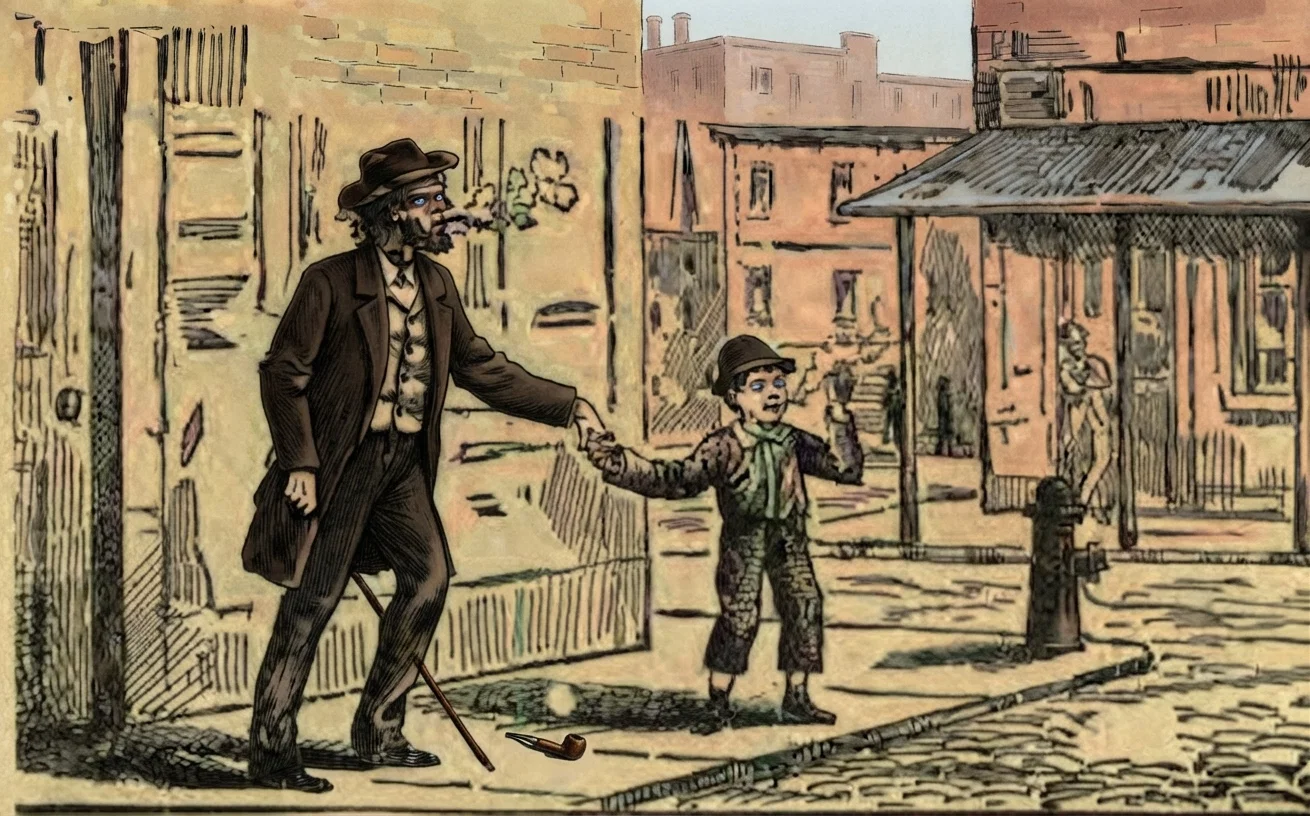
This indifference to consequences which is noticeable among the users of narcotics as a class, is well illustrated at the head of this article. A man who has become blind from the use of tobacco is still smoking the old pipe which has destroyed his invaluable eyesight, and is led about the streets by a small boy, who, instead of taking warning by the fate of the older transgressor, is following in his footsteps to the same unhappy end by the aid of a penny cigarette. Each of these poor tobacco slaves would undoubtedly endorse the sentiment of the tobacco-loving poet who wrote:—
"For thy sake, tobacco, I
Would do anything but die."
Thousands go farther, and for the sake of the gratification of a depraved appetite knowingly and willingly sacrifice half a score or more of the best years of their lives.
J. H. KELLOGG, M.D.
CLERICAL-POLITICAL RECIPROCITY.
By W. N. G.
WE have no inclination to discuss the merits of the proposition of Mr. Lubin, of Sacramento, Cal., to equalize the system of protective tariff in vogue in our country by an export bounty on agricultural products. Such is not the province of a journal devoted to warning the world in regard to the coming of the Lord and the necessity of a preparation for the final judgment of all the earth. True, the inequalities and injustice of which he complains are no doubt the cause of much suffering, but the proposed remedy is a political question upon which the wisest students of political economy are pretty well divided in opinion.
That which is deplorable in this connection is to see the effort that is being made, with an apparently growing success, to enlist the ministers of the Gospel in the controversy. They have been urged into the fray on the pretext that it is their duty on all occasions to contend for justice and equity, and many of them are biting at this plausible bait, and making it a pretext for espousing and advocating a human political remedy. That they are allowing themselves to be led by one who has an inadequate conception of the ministerial calling (whatever the merits of his political proposition), is clearly shown from the following expression in his "addenda" to their memorial to Congress:—
"Those who would narrow the public function of the clergyman to the Bible and exclude them from this work can have but a narrow conception of the Bible and know little or nothing of this work."
But the minister of Christ is a minister of the Word, which is comprehended in the Bible. Our Saviour, in reporting his work to the Father, simply said, "I have given them thy word." John 17:14. He positively declined to act as an arbiter in the temporal affairs of men, altho an earnest appeal was made to him, implying gross injustice. "And one of the company said unto him, Master, speak to my brother, that he divide the inheritance with me. And he said, unto him, Man, who made me a judge or a divider over you?" Luke 12:13, 14. The apostle Paul was a learned man, but he said, "I determined not to know anything among you, save Jesus Christ, and him crucified." 1 Cor. 2:2. There was probably as much or more inequality and injustice in Corinth as there is in any part of the United States; yet Paul knew but one remedy for sin of whatever character, and that was Jesus Christ, and him crucified. His admonition to Timothy was to "preach the Word."
To talk of narrowing the function of the clergyman, or any other man, to the Bible shows a very narrow idea of the Word of God. When men shall become in their lives as broad as the Bible, there will be no more need for warfare against inequity and injustice. But Mr. Lubin has succeeded in convincing fifty-two ministers of Philadelphia and vicinity (thirty-four of whom are Baptists!) that the Bible is too narrow for their public functions, and that they should, as far as their influence goes, become dividers of the inheritance of the people of the United States,—a function which the Master positively ignored. And he thus expresses his hope of a large accession to the ranks:—
"Champions for this cause are now beginning to rise up in every section, and victory must surely come as soon as the clergyman everywhere throughout our land will espouse this cause from their pulpits."
We have become accustomed to seeing the clergymen endeavoring to enlist the support of politicians in furthering the cause of religion by religious legislation, but a general appeal to the clergymen on the part of politicians to support political measures is a more recent feature of the illicit connection of the church with the world in the last days, so clearly foretold in the Scriptures. Of course this latter feature is the complement of the former, and is the opening wedge to a general reciprocity between the clergy and the politicians. As the idea of "National Reform" by means of "Christian Citizenship"—the purification of politics by the interference of the church, and the reformation of the church by civil law—progresses, and becomes more and more engrafted on the public mind, the more we will see of the practical working of this new idea of clerical-political reciprocity of endeavor. W. N. G.
The Penalty of Sin
It is a common thing for Christian people to make strenuous endeavor, on the plea of mercy, in behalf of murderers sentenced to death, in order that life imprisonment may be substituted for the death penalty. Yet a majority of these same Christians will demur against the doctrine that death is the penalty of sin, claiming that it is not adequate punishment, and insisting that everlasting life imprisonment is the greater and more appropriate penalty. This inconsistency is the result of ignoring the plain teaching of the Scriptures: "The wages of sin is death; but the gift of God is eternal life through Jesus Christ our Lord." Rom. 6:23.
NOT FORGETFUL.
By Fannie Bolton
DOUBT says, "'Tis vain, O, all in vain!"
Sorrowful heart, regretful,
Yet of all thy labor, of all thy pain,
Thy Father is not forgetful.
To thy "work of faith," when all is dark,
When storm-clouds o'er thee gather,
He setteth His seal, He maketh His mark,
Compassionate as a Father.
Thy "patience of hope," when thou lookest up
For a ray of heaven's splendor,
When He biddeth thee drink of a bitter cup,
He noteth with pity tender.
Thy "labor of love" compassionate
That from faith and patience groweth,
Ministering even to those who hate,
Thy Father of loving knoweth.
You are His own little, faltering child,
He is your tender Lover,—
More than a mother, gentle and mild,
Your Saviour and Elder Brother.
Dear unto Him is your humble toil
As a child's work is to a mother.
You'll have your crown in a little while
From the hand of your Saviour-lover.
FANNIE BOLTON.
Want of Thought and Want of Heart
By Thomas Hood
THE wounds I might have healed,
The human sorrow and smart!
And yet it never was in my soul
To play so ill a part;
But evil is wrought by want of thought
As well as want of heart!
—Thomas Hood.
TONGATABU.
By Edwin S. Butz
The Friendly Islands consist of three principal groups, as follows: Tonga, in the south; Hapai, in the middle; and Vauvau, in the north, besides some less important groups, numbering in all about 100 islands, located between parallels 18° and 20° south latitude and meridians 173° and 176° west longitude, with a population of 20,438, all under the Tongan Government.
Nukualofa, on Tongatabu, the only inhabited island of the Tongan group, is the capital. As seen in the photograph, the village fringes the shore, while stately coconut palms form a beautiful background, but which do not appear in the picture. The cupola in the picture is on the king's palace, a wooden building surrounded by a neatly kept yard, inclosed by a wall seen in front. The spires are on the "King's Church," which is also a frame structure, well finished in modern style.
The eighteenth day of May was a day of special importance to the village of Nukualofa, and to the Tongan people generally, because on this day Parliament, the legislative body, convened and was formally opened by his majesty King George II., at whose opening address the Europeans and Americans had the privilege of being present by special invitation.
The Parliament consists of thirty-one nobles who inherit their position, subject to election by Parliament, and thirty-one representatives chosen by the people just before each session, which meets once in three years. Their term of office expires with the last meeting of the session.
There is here a government college for the sons of chiefs, in which the common branches, the English language, and some of the elementary sciences, are taught. Connected with the college is an orchestra, entirely of natives, which rivals the average orchestras of leading nations where opportunities and advantages in music are much greater.
The Wesleyans also have a college here well equipped, which admits both sexes. There is a Catholic school also, for both native and English children. Less than two years ago the Seventh-day Adventist missionaries started an English school, which gradually has grown in influence and increased in numbers. Recently the king determined to have all the children taught English, so the government erected a new schoolhouse and procured a teacher, thus adding another to the list of English teaching schools.
NUKUALOFA, TONGATABU, FRIENDLY ISLANDS.
The average Tongan child has a bright mind and learns very rapidly when his enthusiasm is aroused. We have been informed that nearly all the Tongans read their own language. They have schools in the different villages where the children are taught. They all live in villages.
All the South Sea islanders I have seen are fond of music, and the Tongans are no exception. Many of the natives I have heard, however, have a high, shrill voice, which strikes the ear as strained, with a rasping effect, lacking real resonance and melody. But not so with the Tongan voice. They simply open the mouth slightly, and, without any seeming effort on their part, volumes of music pour forth in cheerful sweetness. The deep, mellow bass bursts forth in swelling waves, then reverberates in echoes so soft and sweet, and bursts again in glad surprise, rivaling the noted bass of the "Old Tennesseeans."
Religiously the Tongans are divided between Wesleyan, Roman Catholic, and Free Church, a local organization modeled after the Wesleyan. Almost all the people attend church regularly, being members of the different churches, and seem to enjoy religious exercises and love the Bible. It is not an uncommon sight to see them reading the Bible on entering their fale (cabin), and frequently they will ask you to read and pray with them. One feels to rejoice in what Christianity has done for these people, when comparing this with their former condition.
At Hihifo, the west end of the island, are some large spreading trees, on which may be seen hanging, with heads downward, and moving their wings as if fanning themselves, thousands of flying foxes, a large species of bat. These creatures were once an object of worship, and the "great chief" of Hihifo feeds them at these trees, nor suffers them to be disturbed. The old chief has gone to his rest years ago, but the flying foxes still spend their days on the same trees, and fly off at night in search of food, returning with the dawn. They remain a testimony to the depth of darkness and superstition to which the "image of God" may be prostituted: "Because that, when they knew God, they glorified him not as God, neither
were thankful; but became vain in their imaginations, and their foolish heart was darkened." They "changed the glory of the uncorruptible God into an image," "the truth of God into a lie, and worshiped and served the creature more than the Creator." Altho they have turned from such gross idolatry, the great need so apparent in the islands—and not the islands only, but everywhere—is the vitalizing power of the Spirit of God, which works in men "both to will and to do of his good-pleasure." What is needed is not more profession, but more possession of the "power of God" working to his glory; for failure to glorify God and cherish thankfulness always leads to darkness and only darkness, whether in the tutored or untutored, and the darkness is in proportion to the light rejected. Also with darkness comes the inability to perceive one's true condition; so while spurning the gross forms of idolatry he may worship at another shrine equally fatal, congratulating himself that he is "not as other men are." There is a German adage something like this, "Good is the greatest detriment to the best." Having gone a few steps in the right direction, man is12so apt to admire himself for what has been accomplished, and become satisfied with his condition.
Rather than press toward the mark placed by God, he sets his own mark, which the force of gravity carries down with the beholder. There must be the power from above to lift men up or they will inevitably gravitate downward. "Walk while ye have the light."
EDWIN S. BUTZ.
Tonga, Friendly Islands.
SUNSHINE.
By G. T. Wilson
As SUNSHINE floods the earth and sky,
And gladdens Nature's face,
So may the Sun of Righteousness
Light us with truth and grace.
The Sun of Holiness appears
With healing in His wings;
And fogs of doubt, and clouds of fears,
Fly from the light He brings.
The icebergs melt beneath His rays,
And streams of mercy flow;
The earth of self no more delays
The fruits of love to grow.
G. T. WILSON.
Launceston, Tasmania.