"THE SUPREMACY OF PETER; OR, DID CHRIST ESTABLISH A PRIMACY IN THE CHURCH?" By Moses Eastman Kellogg. Illustrated, neatly bound in cloth, 290 pages; price, $1.00. Review and Herald Publishing Company, Battle Creek, Mich.
This modest little volume aims to set before the reader in smaller compass than the great church historians, and with less elaborate discussion than by theologians in general of certain Scripture passages, the following points: (1) No human primacy was established by Christ or recognized in the apostolic writings; (2) how the primacy grew up in the church; (3) the power and position attained by that primacy in the temporal reign of the popes; (4) the loss of the temporal power; (5) church government as revealed in the New Testament. There are twenty-four chapters and twenty-five illustrations. The book presents in brief before the reader what he might fail to get in many volumes. On a more careful perusal we shall probably refer to it again.
"THE SEPARATED NATION." By H. L. Hastings. No. 19 Anti-Infidel Library. Bound in manila covers, 224 pages; price, 20 cents. This is a discussion of that remarkable people, the Jews, their vitality, fecundity, longevity, the superior character of their social life, their educational characteristics, their finance and statesmanship, their sources of power, their history, their law, their hope, their relation to God, their present condition, the coming of the Messiah, and Jewish enfranchisement in America. Tho all may not agree with the implied answers to the author's questions, they will be interested in perusing the little booklet. It contains much information, and is worthy of circulation. H. L. Hastings, 47 Cornhill, Boston, Mass.
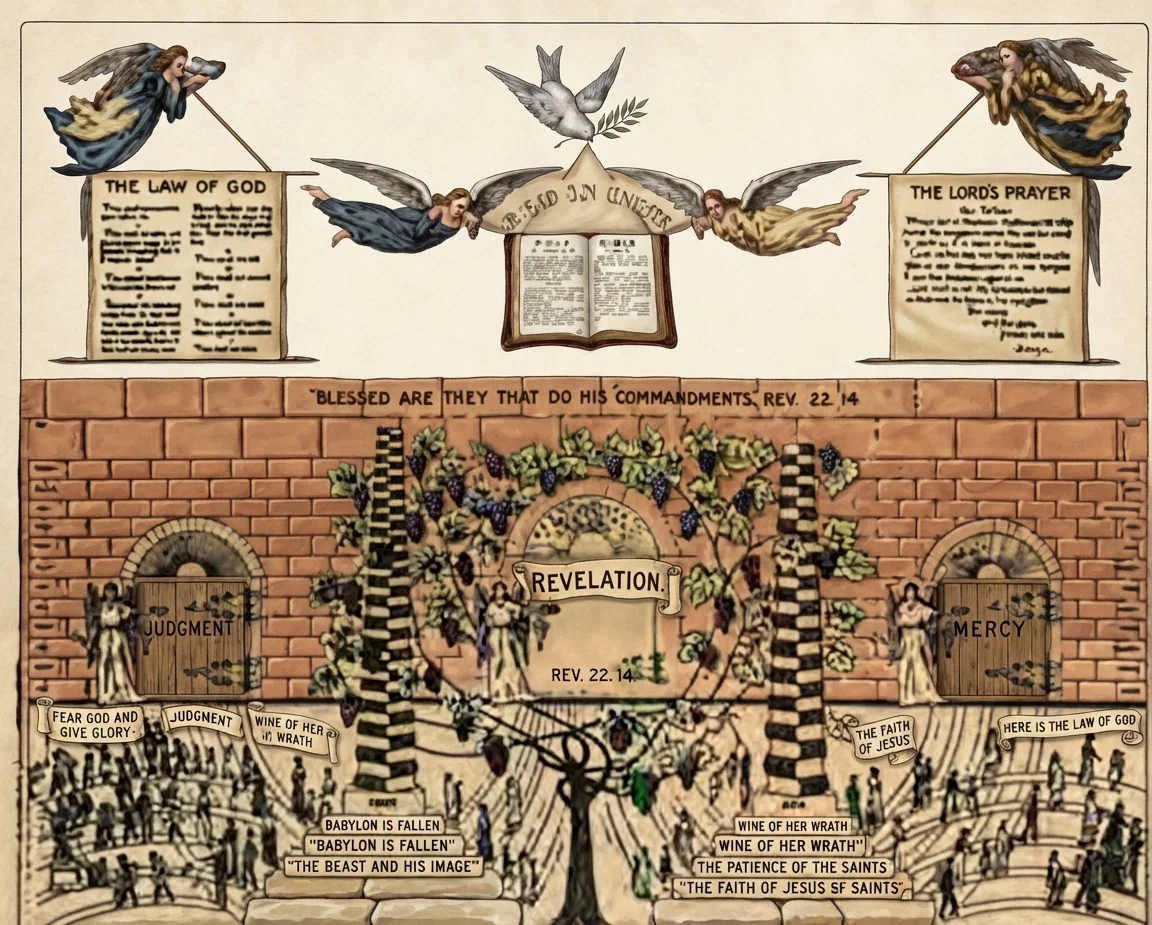
"Historic and Prophetic Diagram of the World." Printed in seven colors, containing twenty-two colored engravings specially prepared for this chart; 5 1/2 feet by 3 feet 10 inches. J. E. Woodward, publisher, 4327 Evans Avenue, Chicago, Ill. Cloth, convenient for folding, $3.75; tough paper, cloth-bound edges, with rollers top and bottom, $3.00; the same with cloth back and rollers, $3.75.
Were we to criticise the above, our great criticism would be that it contained too much. But as an aid to Bible study it is an immense help. It presents in diagram and illustration the past, future, and present, some of the great symbolic prophecies of Daniel, the origin of Sunday, religious persecution, the sanctuary, the plan of salvation, the millennium, and several other important subjects. We cheerfully indorse it as a valuable aid to Bible study.
The above cut is an illustration of 'The Two Ways,' a diagram or chart, designed by W. H. Wild (published by Wild & Hilliard, 67 Kendall Street, Battle Creek, Mich.), to illustrate the way of life and the way of death, and to show God's love for erring man. It is lithographed in twelve colors, and printed on fine white enameled manila paper; size, including margin, 23x30 inches; price by mail, postpaid, 75 cents, including key. It presents an interesting study, and would be helpful in giving instruction to children, which they would much better remember. Illustrated circulars may be obtained from the publishers. Agents are wanted.
The Cosmopolitan Magazine, published by John Brisben Walker, Irvington-on-the-Hudson, New York, sent to India Mr. Julian Hawthorne, as a special commissioner, to investigate the famine and plague in that country. British officials in India were not anxious to have Mr. Hawthorne risk his life by a close inspection of the horrors of plague and famine, but he is a typical American, and having undertaken to see the real conditions, was deterred by no dangers. Eight and a half millions of people have already perished, and the reading of Mr. Hawthorne's description will open the eyes of the world to a condition of affairs that is almost inconceivable in this year of jubilee. The first installment is found in the July Cosmopolitan, and the information it gives is well worth more than the price of the magazine, 10 cents a number, $1.00 a year. For sale by all news-dealers.
McClure's Magazine (S. S. McClure Co., 141-155 East Twenty-fifth Street, New York) holds its own well, and is superior to many of the higher-priced ones. The July number has, among other interesting articles, "The Smallest Republic in the World," governed by boys for two or three months in the year from the tenement districts of New York, and "Andrew Jackson at Home," by his granddaughter, illustrated by "Life Portraits" of Jackson at 48, 52, 61, 63, 68, and 78 years of age, ten in all. Price of magazine, 10 cents; a year, $1.00. For sale by all news-dealers.
WE have received the following from the American Sabbath Tract Society, Plainfield, N. J.: "The Catholicization of Protestantism on the Sabbath Question, or, Sunday-Observance Non-Protestant," by Abram Herbert Lewis, D.D., a pamphlet of 60 pages and 11 chapters, presenting trenchant truths for Protestants to ponder; "Pro and Con, the Sabbath Question in a Nutshell," 4 pp.; "The Sabbath and Spiritual Christianity," 16 pp.; and "The Authority of the Sabbath and the Authority of the Bible Inseparable," 16 pp. These may be obtained by writing to the above address. Price not stated.
"Proceedings of the General Theological Library" for the year ending April 26, 1897, with a sketch of its History, Rules, a List of its Officers, Founders, Patrons, Members, etc. 53 Mount Vernon Street, Boston, Mass. This worthy institution must prove a great help to all the religious students round and about Boston.
"God-Ordained Spiritualism Is Not God-Prohibited Serpent-ism, Commonly Called Modern Spiritualism," a pamphlet of 12 pages, by Orlando C. Brown, Columbus, O. The matter is addressed to the Progressive Spiritualist and Liberal Society, of Columbus, O., whose claim is that Spiritualists believe the Bible, and that "the Bible begins and ends with Spiritualism." The author, Mr. Brown, conclusively shows from the Bible, it seems to us, that man's hope of continuance in life is harmony with God, and the only hope of immortality is the resurrection; while, on the other hand, the doctrine of inherent immortality is based upon Satan's story to Eve, "Thou shalt not surely die."
OUR WORK AND WORKERS.
By Editor
THE camp-meeting of Virginia Conference will be held at Charlottesville, August 12-22.
ELDER A. J. OSBORNE reports the addition of four members to the church at Sebastopol, Cal., since the State camp-meeting. They were baptized at Forestville.
ELDER L. P. JACOBSON reports that nine Finnish people have been added to the San Francisco church within the last four months. Others of this "warm-hearted people" are deeply interested in the truth.
THE Christian help workers in this city find many needy persons and families, and they also report a corresponding disposition on the part of the people to assist those to whom their attention is called. As our workers become known to the people, voluntary offers of assistance come to them. Brother A. Brorsen reported at a recent missionary meeting that a baker had sought him out to place 300 loaves of bread at his disposal.
WE have received an elaborate calendar of Keene Industrial Academy, situated at Keene, Texas. It contains a full account of the institution, its courses of instruction, home life, and general purposes, together with illustrations showing the Academy Hall, the Assembly Hall, and the Home. The next term begins October 27. Elder C. McReynolds is president of the board of managers, and Prof. C. C. Lewis is secretary. Professor Lewis is also principal of the school. The other instructors are August Kunz, A. M., Charles H. Hodges, B. S., Mrs. Flora H. Williams, Miss Pear Blocher, B. S. D., Miss Hattie E. White, Mrs. Mary E. Reisinger, Homer E. Giddings, Mrs. Lida Moore.
A CORRESPONDENT of the American Sentinel relates that Thomas Furman, one of our brethren, was recently fined $5.00 and costs, or ten days' imprisonment, for having two loads of wood hauled to his house at Barton, Fla., on Sunday. The charge was "disturbing the peace." The persons "disturbed" were in a church near by making a table on which to take the communion. Two other wagons went by about the same time, but they did not disturb the complainants—presumably because they were not driven by persons who observe the seventh day as the Sabbath. It was evidently the fact that the defendant keeps the Sabbath of the fourth commandment that disturbed the complainants, rather than the wood-hauling on Sunday. "The carnal mind is enmity against God; for it is not subject to the law of God, neither indeed can be." Rom. 8:7.
DR. A. S. CARMICHAEL writes from the mission in Matabeleland, May 15, to friends in Iowa, and we take the following from his letter as it appears in the Workers' Bulletin:-
"Last week Brethren Tripp, Anderson, Burton, and myself made a trip to the Druillard farm (a farm that was donated to the mission by Brother Druillard), about fifteen miles northwest from here. We found on it a number of deserted native villages, but not a living soul was to be seen. The surrounding country was quite level. At some distance we found a family living in their field of grain to watch it, and on our way back we passed several other families living in the same way. But very little grain was growing. Their principal crop consisted of armijodas, a species of melon. They dry them in the sun, and then cook them. They also dry the seeds, and grind them for meal. There was a remarkable scarcity of grain, and the natives will evidently be in a starving condition the coming year. There were not many children among them, and they have likely perished from hunger. Whole villages have perished in this way, not one of the inhabitants escaping. Our crops are short this year, as we had no plow during the cropping season. All we planted had to be put in with hoe, and then the season was a dry one. Near my house is a wet piece of land, and from this we are securing quite an abundant supply of vegetables, such as squash, tomatoes, lettuce, and ground cherries or cape gooseberries. In a few days we will have roasting ears. On such land we can have a succession of crops all the year round."
Publications on the Sabbath
THE LORD'S DAY, THE TEST OF THE AGES
Presents in the briefest, simplest manner a part of the Bible evidence concerning both sides of the Sabbath question. The subject is treated in a new and interesting way. Fully illustrated with diagrams and original illustrations. 128 pages, paper covers, just out, price 15 cents.
ABIDING SABBATH AND LORD'S DAY
A pointed review of two of the best recent productions for the defense of the Sunday sabbath. The best arguments in support of Sunday are undoubtedly presented in this book. 173 pages, paper covers. Price 20 cents.
CHANGE OF THE SABBATH
A brief treatise answering the question so often asked, "Who Changed the Sabbath?" 218 pages, paper covers. Price 20 cents.
NATURE AND OBLIGATION OF THE SABBATH OF THE FOURTH COMMANDMENT
A candid and thoroughly scriptural treatise on this important question. 96 pages, paper covers. Price 10 cents.
THE SABBATH AND THE LAW
This work covers the Sabbath institution from Eden created to Eden restored, and its arguments are clear and forcible and convincing. 192 pages, paper covers. Price 20 cents.
THE HISTORY OF THE SABBATH
An exhaustive treatise on the Sabbath question, in which every passage in the Bible which has any connection with the Sabbath, either in the Old or New Testament, is examined at length. It is a veritable mine of information, both Biblical and Historical, on this subject. Three volumes, paper covers. Price $1.00 per set.
.. Send for Catalogue containing Price List of other .. Publications on this Subject.
Pacific Press Publishing Co. Oakland, Cal. N. Y. City, Mo. N. Y.
17 "And now, brethren, I wot that in ignorance ye did it, as 18 did also your rulers. But the things which God foreshewed by the mouth of all the prophets, that his Christ should suffer, 19 he thus fulfilled. Repent ye therefore, and turn again, that your sins may be blotted out, that so there may come seasons 20 of refreshing from the presence of the Lord; and that he may send the Christ who hath been appointed for you, even Jesus; 21 whom the heaven must receive until the times of restoration of 22 all things, whereof God spake by the mouth of his holy prophets which have been since the world began. Moses indeed said, A prophet shall the Lord God raise up unto you from among your brethren, like unto me; to him shall ye hearken in 23 all things whatsoever he shall speak unto you. And it shall be, that every soul, which shall not hearken to that prophet, 24 shall be utterly destroyed from among the people. Yea and all the prophets from Samuel and them that followed after, as 25 many as have spoken, they also told of these days. Ye are the sons of the prophets, and of the covenant which God made with your fathers, saying unto Abraham, And in thy seed shall 26 all the families of the earth be blessed. Unto you first God, having raised up his Servant, sent him to bless you, in turning away every one of you from your iniquities.
"And as they spake unto the people, the priests and the captain of the temple and the Sadducees came upon them, being 2 sore troubled because they taught the people, and proclaimed 3 in Jesus the resurrection from the dead. And they laid hands 4 on them, and put them in ward unto the morrow: for it was now eventide. But many of them that heard the word believed; and the number of the men came to be about five thousand.
5 "And it came to pass on the morrow, that their rulers and 6 elders and scribes were gathered together in Jerusalem; and 7 Annas the high priest was there, and Caiaphas, and John, and 8 Alexander, and as many as were of the kindred of the high 9 priest. And when they had set them in the midst, they inquired, By what power, or in what name, have ye done this? 10 Then Peter, filled with the Holy Ghost, said unto them, Ye 11 rulers of the people, and elders, if we this day are examined 12 concerning a good deed done to an impotent man, by what 13 means this man is made whole; be it known unto you all, and to all the people of Israel, that in the name of Jesus Christ of Nazareth, whom ye crucified, whom God raised from the dead, even in him doth this man stand here before you whole. He is the stone which was set at nought of you the builders, which was made the head of the corner. And in none other is there salvation; for neither is there any other name under heaven, that is given among men, wherein we must be saved."
QUESTIONS.
Relate the story of the healing of the lame man at the gate of the temple.
By what means was he healed?
Yet what had the people who saw this miracle done to Jesus?
How could they have done such a deed?
What had been fulfilled by their action? How many prophets tell about the suffering of Christ?
What exhortation did Peter give the people? Why should they repent and be converted? What will follow the cleansing from sin?
And what will follow the "times of refreshing from the presence of the Lord"?
Until what time must Jesus remain in heaven before he comes again? Who has spoken of the "restitution of all things"? How extensively has God spoken of this?
What had Moses said? What did he say of the Prophet whom God should raise up?
What will become of those who will not hear him?
Have any other prophets besides Moses spoken of these things? How many?
Having reminded the people of what the prophets had said, what direct statement did he make to them? In what words was that covenant contained? To how many were the blessings of the covenant promised?
Through whom does the blessing come? What is the blessing which Jesus is sent to bestow?
As Peter and John spoke these words, who came upon them?
What troubled those priests and rulers? What had Peter and John been teaching the people?
What did the priests and the chief men do to them?
Nevertheless, what was the result of their teaching that day?
Who gathered together the next day? and what did they do?
What did they ask the apostles?
Who answered? In what condition was he when he spoke? With what words did he begin his reply?
By what means did he say that the impotent man stood before them whole that day? How many did he desire should know this? What charge did he bring against the judges?
What did he say of Jesus, whom they had rejected?
What can be found only in him? Why is this?
Additional Questions and Suggestions.
What caused the rulers and the people to crucify Jesus? Compare verse 17 with 1 Cor. 2:8. Did their ignorance make them guiltless? Need they have been ignorant?
What is it that leads to the seasons of refreshing from the presence of the Lord? See verse 19 in Revised Version. With what does God refresh his people? See Isa. 44:3, 4.
Who is Christ declared to be like? What important feature is specified in which Christ was like Moses? Heb. 3:1, 2. Could any man have a higher recommendation than is thus given to Moses? Of what are those guilty who reject or disparage Moses and his words? What did Jesus say about this?
In what words is the covenant that God made with Abraham expressed? When God said, "In thy Seed shall all the kindreds of the earth be blessed," what was he doing? See Gal. 3:8. What, then, is the covenant with Abraham?
The Sunday School
International Series.
LESSON V.—SUNDAY, AUGUST 1, 1897.
PAUL'S MINISTRY IN CORINTH.
NOTE.—It is suggested that the first three chapters of 1 Corinthians be read in connection with the study of this lesson. The lesson section includes Acts 18:1-22. Verses 8-11 should be memorized. Review, by aid of the map, Paul's second missionary journey from Antioch to Corinth. In the three first chapters of 1 Corinthians considerable light will be thrown upon Paul's life and work while among them. It is also suggested that the scholars be drilled upon the principal events of Paul's stay in Corinth. "Events at Corinth: Paul preaches to Jews and Gentiles; finds some congenial friends; works at his trade for his own support; his helpers, Silas and Timothy, come to him from Macedonia; the Philippians send him, by them, a loving contribution for his support; he writes two letters to the Thessalonians; he has a comforting vision and message from Jesus; in A.D. 57 they receive two letters from Paul; later still, A.D. 58, according to Farrar, Paul wrote from Corinth the epistles to the Galatians and to the Romans."—Peloubet.
"AFTER these things he departed from Athens, and came to Corinth. And he found a certain Jew named Aquila, a man of Pontus by race, lately come from Italy, with his wife Priscilla, because Claudius had commanded all the Jews to depart from Rome; and he came unto them; and because he was of the same trade, he abode with them, and they wrought; for by their trade they were tent-makers. And he reasoned in the synagog every Sabbath, and persuaded Jews and Greeks.
"But when Silas and Timothy came down from Macedonia, Paul was constrained by the Word, testifying to the Jews that Jesus was the Christ. And when they opposed themselves, and blasphemed, he shook out his raiment, and said unto them, Your blood be upon your own heads; I am clean; from henceforth I will go unto the Gentiles. And he departed thence, and went into the house of a certain man named Titus Justus, one that worshiped God, whose house joined hard to the synagog. And Crispus, the ruler of the synagog, believed in the Lord with all his house; and many of the Corinthians hearing believed, and were baptized. And the Lord said unto Paul in the night by a vision, Be not afraid, but speak, and hold not thy peace; for I am with thee, and no man shall set on thee to harm thee; for I have much people in this city. And he dwelt there a year and six months, teaching the Word of God among them."
Golden Text.—"Other foundation can no man lay than that is laid, which is Jesus Christ." 1 Cor. 3:11.
SUGGESTIVE QUESTIONS.
(1) After the events of our previous lesson, where did Paul go? Verse 1. Note 1. (2) Whom did he find at Corinth? (3) Why were they at that place? Verse 2. (4) What influenced Paul to take up his abode with them? Verse 3. (5) How did Paul busy himself when he was not preaching? (6) What was their occupation? Note 2. (7) On what days did Paul preach and where? Verse 4. (8) To whom did he preach? (9) Who joined Paul at this place? Verse 5. (10) What change took place in Paul's work at this time? Note 3. (11) How was his testimony received? Verse 6. (12) In view of this what did he do? (13) Where did he place the responsibility for the loss of their souls? (14) What did he say of himself? (15) Where would he prosecute his work while he remained in Corinth? (16) On leaving the synagog, where did Paul go? Verse 7. (17) What is said of this man? (18) What of the location of his house? Note 4. (19) What prominent Jew believed on Christ as the result of Paul's teaching? Verse 8. (20) What position did he hold? (21) Who else at this place accepted of the Gospel message? (22) What visitation did Paul have at this time? Verse 9. (23) What was the message to him? (24) Why need Paul have no fear? (25) What reason does the Lord give for specially protecting Paul at this place? Verses 9 and 10. Note 5. (26) How long did Paul continue in this place? Verse 11. Note 6.
NOTES.
1. Came to Corinth.—From the long stay which Paul made at this place and the experiences which he had in going to, and attempting to go to, other places, it would seem that this was the destination which the Lord had in view for him. In starting on this journey he was forbidden to preach in Asia, and was prevented from going into Bithynia, but was directed to go over into Macedonia. His stay here was not long, after accomplishing a certain work; and for one reason or another he did not stop long in any of the places he visited until he reached Corinth. This city was said to contain 400,000 inhabitants, and was very cosmopolitan. It was thus a strategic center for the spread of the Gospel. It was also a very wicked city.
2. They were tent-makers.—This was not a highly esteemed trade, but rather the opposite. The tents which they made were used by shepherds, travelers, and by Roman soldiers. This occupation is carried on quite extensively in eastern countries at the present day. A portion of the business part of Constantinople is now devoted to this industry. The rabbinical laws required the Jewish parent to teach his son a useful trade, and whoever did not so do was considered as bringing his child up for a robber. Jesus was a carpenter. How appropriate for him who was to perfect "God's building" (1 Cor. 3:9), who was to build "his stories [mansions] in the heaven" (Amos 9:6), the Architect of that city "whose builder and maker is God" (Heb. 11:10), in short, for the great Master Builder who is preparing mansions for his people—how appropriate, how full of meaning, is the labor which he performed as a man!
3. Constrained by the word.—Completely held by it, impelled, urged on. Even with the knowledge that he was doing the work of God, and that God was with him, the reinforcements from Macedonia, with the cheering news which they brought, were a source of great encouragement to Paul. Being relieved from anxiety in regard to them and the work which he had left behind, a new impetus was given to his preaching.
4. Titus Justus.—Paul's departure was not from the city but from the synagog, and the close proximity of the house into which he entered to continue his work made it a standing invitation to the Jews to come and hear. The Gentiles would also go to this place of meeting, for Titus Justus was not a Jew, but a Gentile proselyte.
5. For I am with thee.—A reiteration of his promise in the great commission, "Lo, I am with you allway, even unto the end of the world." Paul had no doubt been weighed down by the opposition which he met at this place, and the mutterings of the Jews against him.
6. A year and six months.—It will be noted that this lesson incidentally gives a good idea of Paul's regard for the Sabbath. In the first place he found Jews—those who observed the Sabbath, the seventh day, with whom to associate in his work. He labored six days, preaching "every Sabbath" to both "Jews and Greeks." As long as he could he did this in the synagog, afterward in the house of Justus, and he kept this up for one year and six months. Here were then seventy-eight Sabbaths observed by the apostle, who labored, as intimated by the record, on all first days. And his course in this respect was not even questioned.
PUBLICATIONS ON THE
SECOND COMING OF CHRIST
MATTHEW 24, OR THE SECOND COMING OF CHRIST.
An exposition of the twenty-fourth chapter of Matthew's Gospel. 96 pages, paper covers. Price 10 cents.
SUN OF RIGHTEOUSNESS. A brief resumé of the advents of Christ and the prophecies which cluster around these events. Two diagrams assist in the study. 80 pages, paper covers. Price 10 cents.
CHRIST OUR ADVOCATE. Showing the work that Christ accomplishes in the Sanctuary in Heaven, before his second coming. 112 pages, paper covers. Price 10 cents.
SURE WORD OF PROPHECY. A consideration of the important prophecies of the book of Daniel, the last chapter of which brings us to the "time of the end," just previous to Christ's second coming. 96 pages, paper covers. Price 10 cents.
Send for complete catalogue with description and price list of other publications on this and kindred topics.
PACIFIC PRESS PUBLISHING CO.Oakland, Cal.Kansas City, Mo.N. Y. City, N. Y.
News and Notes
FOREIGN.
—Within two weeks three Catholic churches in the Lake St. John district, Quebec, have been struck by lightning and destroyed.
—The Minister of Railways and Canals of Canada has refused to open the canals to traffic on Sunday, except under extraordinary circumstances.
—By a strike of engineers in London a movement has been set on foot which will result in throwing 25,000 men out of employment throughout the United Kingdom.
—A band of Greek raiders met defeat at the hands of a column of Turks near the village of Metzovo. It is stated that 120 of the Greeks were killed and 80 taken prisoners.
—Recent fires in the suburbs of Cairo, Egypt, have left over 4,000 persons homeless, destroyed property to the amount of $450,000, and resulted in the death of over 100 persons.
—A despatch from Danes Island, via Stockholm, states that on June 28 Professor Andree's balloon was filled and in readiness to leave on its voyage across the North Pole on July 1.
—The British bark Overdate collided with a steamer near the mouth of the Ganges, and sank almost immediately. All of the crew except the captain, pilot, and one seaman were drowned.
—Rev. John G. Patton, D.D., has presented to the Victorian General Assembly $60,000, the entire proceeds of his book entitled "Life in the Hebrides." This gift will be used for evangelical purposes.
—An Australian inventor has perfected an electrical device which will instantaneously locate the position of a vessel in the vicinity of forts, and direct the aiming of the guns within the fort at the same time.
—A despatch from Roumania states that in consequence of a recent flood in Moldavia, on the left bank of the Danube, 20,000 persons are homeless. It is also estimated that no fewer than 100 persons have been drowned.
—In August of this year a congress of Jews from all parts of the world will meet in Munich to discuss questions of peculiar interest to that people, chief among which will be the question of founding a Jewish state in Palestine.
—It is reported that the tribes south of Khartoum are in open revolt against the Khalifa. This dissension among the tribes of the upper Nile will make the advance of the Anglo-Egyptian expedition much easier than it would otherwise be.
—Special despatches from Bombay say that from 600 to 1,000 native rioters were killed by the militia during the recent rioting in the vicinity of Calcutta, and that 8,000 laborers from the Hoogley River are marching to reënforce the rioters.
—The eruption of Mayou volcano, in the Philippine Islands, which has been inactive since 1617, was attended by great loss of lives as well as destruction of property. The village of Librug was greatly damaged, and 120 persons perished.
—A report from South Africa states that the natives of Chasaland are in open revolt, and that the outbreak is assuming alarming proportions. The governor of Mozambique is personally in command of the column sent to suppress the revolt.
—Japan has filed another protest with the Hawaiian Government and the State Department of the United States against the annexation of the Hawaiian Republic to the United States until the present complications between Japan and Hawaii have been settled.
—The rebellion in Brazil still maintains formidable proportions. Three attacks were recently made by the government troops upon the followers of Conselheiro, but without success. In the three battles the troops lost 1,000 men. The estimated loss of the rebels is placed at a still higher figure.
—A fierce battle is reported to have taken place between the Cubans and Spaniards in Matanzas Province on June 26. The Spaniards lost between 60 and 70 killed and wounded according to their own report. The Cubans' loss is not known, but they succeeded in beating off their assailants.
—A report from Athens dated July 5 states that the Turks have captured the village of Kalabaka, in North Thessaly, after a desperate battle with the inhabitants. The Turks burned the village after pillaging it and massacring or carrying off the inhabitants who refused to flee to the mountains.
—The king of the Mosquito Coast, to whom the government of Nicaragua was to pay an annual allowance of $5,000, has been deprived of this pension, in consequence of which he has sought the protection of the British Government. It is feared that this will reopen the Anglo-Nicaraguan controversy of 1894.
—The Simplon tunnel, which is being bored under the Alps, will be twelve and a quarter miles long, or three miles longer than any other under these mountains. The temperature reaches 122 degrees, and cold air and atomized water have to be forced into the tunnel in order to keep the temperature low enough to enable the men to work.
—A cablegram from Sancti Spiritus states that General Gomez is in danger of being surrounded by the Spaniards, and six Cuban bands are hurrying to the assistance of their commander-in-chief.
—Two presidents of South American republics have written to the inventor of a kind of cloth that has been proved bullet-proof, asking for samples of the fabric and blanks for self-measurement.
—Terrible floods have been reported from the south of France, and the losses are proving much greater than at first estimated. It is said that hardly a village in that section of France has escaped damage, and that the number of persons drowned is fully 300. It is estimated that 200,000,000 francs would hardly cover the damage to property in the flooded regions.
—Russia has sent a circular note to the powers suggesting that steps be taken to expedite the conclusion of peace between Greece and Turkey. This is taken to mean that if Turkey does not yield to the rectification of the frontier decided upon by the representatives of the powers, she will be coerced into doing so. The Turkish Government has also issued a note to its representatives, making a defense of the position which it has taken, and declining to consider any frontier line in Thessaly north of the River Penios. Many think that the sultan has decided to test the alleged concert of the powers. His officers are rapidly strengthening their positions in Thessaly, massing troops in Dhomoko, fortifying Velestino, and entrenching themselves more firmly.
DOMESTIC.
—Father Hewitt, founder of the order known as the Paulists, died at his home in New York on July 3.
—On July 6 nine persons were instantly killed and five seriously injured by the explosion of a threshing boiler on the farm of W. A. Allen, at Hartsville, Tennessee.
—The Bannock Indian scare has quieted down, and no serious trouble is anticipated. The number of Indians off the reservation is much less than was at first reported.
—Lake Ann, Michigan, a village of nearly 1,000 inhabitants, was practically destroyed by fire on the afternoon of July 3. The property loss is estimated at about $100,000.
—A cyclone and cloudburst visited northwestern Minnesota on July 4, killing nine persons and destroying a considerable amount of property. The loss is estimated at $750,000.
—The past week has been one of intense heat throughout most of the central and eastern States, and has been attended by scores of deaths and hundreds of prostrations.
—On the night of June 30 Montana's anti-gambling law went into force. All games were shut down at 12 o'clock P.M., and all mechanical devices for gambling purposes were stored away.
—Two United States war-ships are now on their way to Morocco to enforce a demand made by U. S. Consul Burke for the punishment of a Moor who brutally assaulted an American citizen at Tangier.
—A Washington despatch states that the Navy Department is expecting to take steps for the increase of the Pacific Coast squadron by building more vessels on the coast. These will consist of battle-ships and torpedo-boats.
—Prof. David Starr Jordan, of Stanford University, California, started on July 3 for Alaskan waters, to make further studies of the fur seals and brand the young males. It is estimated that about 50,000 seal puppies will be branded this season.
—The Christian Endeavorers, during their stop at Salt Lake City, held services in the Mormon Tabernacle. This is said to be the first time that the Tabernacle has ever been thrown open for religious services by any other body than its founders.
—The Dingley Tariff Bill passed the Senate July 7, after a discussion lasting six weeks and one day, during which time it has received 874 amendments. The final vote stood 38 to 28. A conference with the House is the next step to be taken before the bill becomes a law.
—President McKinley sent to Congress on July 8 a special message recommending legislation providing for a commission to adjust the currency questions of the country. The message asks for a commission of nine to consider the matter and report at the next session of Congress.
—The growth of the American States is causing considerable alarm among the diplomats of the Old World, and this alarm is openly expressed, especially in the official organs of the German Empire. Prince Bismarck's paper, the Nachrichten, gives considerable space to the matter, and Emperor William has voiced his fears in a public speech.
—While a fourth-of-July balloon ascension was being made at Blair Park, Oakland, Cal., on July 3, Bertram Hill, a lad of six years, caught hold of the sand rope and was carried up with the balloon. When about 1,000 feet from the earth, the child's strength gave out, and he dropped headlong to the ground, and was killed. On the same day two aeronauts lost their lives at Eureka, Cal., in attempting to make an ascent while a strong wind was blowing.
—The boys in the reform school located at Whittier, California, have risen in open mutiny against the officers of that institution. Arming themselves with knives, clubs, and pieces of their iron bedsteads, they attacked the officers sent to quell the disturbance, and citizens of the place had to be called in to assist in keeping the rioters within the building.
—A gigantic strike of coal miners is now on throughout the eastern and middle States, and it is estimated by the president of the Miners' Union that when the strike reaches its full height, 250,000 men will be out. The low rate of wages paid the miners during the last year has placed them in pitiable circumstances, and the leaders of the strike claim that this will be to the miners the strike of their life.
—The International Convention of Christian Endeavorers opened in San Francisco, Cal., July 7, with a very large attendance. A careful estimate places the number of visitors at 20,000, the great bulk of whom are delegates from various Christian Endeavor Societies throughout the world. On the evening of the opening many of the visiting pastors conducted services in the churches around the bay.
—The Senate Committee on Foreign Relations reported a resolution on July 7 authorizing President McKinley to take such measures as he might deem necessary to obtain indemnity from the Spanish Government for injuries done to certain naturalized American citizens by the Spanish authorities of Santiago de Cuba. The resolution authorizes the President "to employ such means and to exercise such power as may be necessary" to obtain the desired end.
Apples of Gold Library
By Editor
THIS little quarterly publication, especially designed as an auxiliary medium of conveying the truth in letter-writing, has, we believe, accomplished much good in this line. It can be enclosed in a No. 6 envelope without folding, and without additional postage, being only a leaflet of from four to sixteen pages. We recommend it as a very effective means of spreading the truth.
Thirty-six numbers of this library have already been issued, embracing a varied field of topics, from which one may choose according to what will be best adapted to each case. Among the latest issues we might mention the following:—
Scripture Answers to Worldly Objections
Seventh-Day Adventists and Their Work
The Hope Set Before Us
The True Church
Subscription price: 5 copies one year, 25 cents; 12 copies one year, 50 cents. Special price in quantities.