THE outbreak of robbery and lawlessness of late in Chicago has aroused the newspapers and people of that city to the great need for better protection of lives and property. Several mass-meetings have been held to urge better police protection, city officials have planned a vigilance committee as an aid to the police, and an anti-crime federation has been formed, and has been growing rapidly. Mayor Harrison and the police magistrates come in for severe criticism in the press, while the police force is regarded as inadequate.
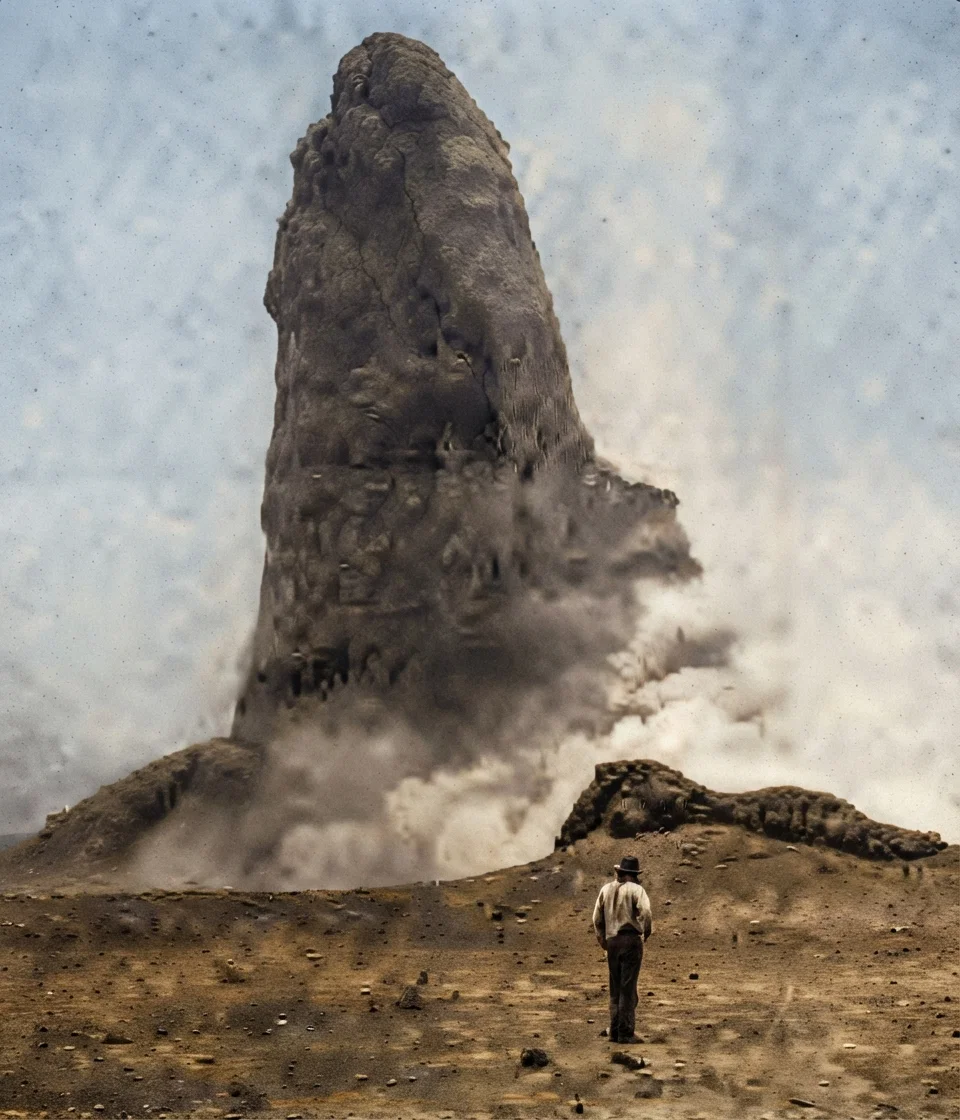
Courtesy of the Scientific American. A Cone Pushed Up from the Interior of Mount Pelee.
The news columns of the Chicago papers are full of items about the criminal situation. In the month from September 27 to October 27 there were 394 burglaries and holdups and only 88 arrests. In the last six months seventeen police magistrates have had before them 226 persons charged with carrying concealed weapons. Of these 121 were discharged and on 105 only a slight fine was imposed. There are now more than 1,000 cases awaiting trial with only four trial judges in the criminal court to dispose of them. During the four days of December 6-9 inclusive, fully 20 persons were held up and robbed, and in one instance a lawyer was shot while running away from his assailants. He died the next day. In the majority of cases the bandits have been young men, but in one case two young girls imitated the highwaymen by robbing two young women in the street. Saloons have been "held up" and patrons robbed. Other places of business have been visited and proprietors and patrons forced at the muzzle of a revolver to deliver up their money. One attempt was made to "hold up" a street-car, and two men were beaten into unconsciousness and then robbed.
Mayor Harrison and chief of Police O’Neill attribute these criminal outbreaks to the wide publicity given to the operations of the car-barn bandits, and to the carrying of concealed weapons. They claim that efficiency of the department has been weakened because of the labor strikes, and that 700 policemen are now doing strike duty. A "flying squadron" of police has been organized to round up these highwaymen, besides all-around thugs and undesirable saloon loungers. The mayor has issued orders to the police to use every possible means to stop the carrying of concealed weapons. As a result, the police are now busy "running in" vagrants and criminals. At one time the "flying squadron" visited a number of lodging-houses and saloons and searched about 1,500 persons, but no concealed weapons were found.
"It is time a strong check was put on the habit of carrying pistols," says the Chicago Journal. It adds: "It is ridiculous to suppose that personal safety requires an ordinary person to go about armed. Even with the prevalence of highwaymen in the city, a revolver is of little use to its possessor, and its dangers are far greater than its benefits." The Chicago Tribune declares that "the inefficiency of the police is great, but the laxity of the police magistrates is even more serious. Even in the higher courts ridiculously small penalties are often imposed." The News of the same city says similarly:—
Not only are robberies increasing in number in Chicago, but the highwaymen are more bold and more desperate than formerly. There has been a marked and significant change in the character of these crimes during recent years. Formerly the footpad rarely resorted to violence save as a means of avoiding arrest. To-day the robber’s weapon is used to injure, maim, and kill. Having robbed, he is likely to beat his unresisting victim into insensibility. In short, he is a murderer as well as a robber. The responsibility for many of the failures to enforce law and administer justice is not hard to place. It is the "political pull" that protects the dive-keeper and it is the same villainous influence that hampers the administration of justice and secures light sentences and bridewell pardons. . . . Crime is but the natural result of tolerating abuses that breed crime.
GOVERNMENT WEAKNESS.
By Editor
THAT this great republic is not all-powerful even in its own jurisdiction, is shown when a single county can hinder the operation of a Federal treaty with a foreign country. There is threatened a general uprising in Tuolumne County, Cal., to drive out all the Chinese residents. The ore sorters of a large mine have already been driven out, and are not allowed to return. This is in violation of the treaty with China, and Secretary of State Hay has notified Governor Pardee that the Chinese must be protected. But the governor can only protect them by calling out the militia, and he can not do this until notified by the county authorities that they are unable to give the desired protection, or until it is shown that they are not trying to do so. As the Tribune of this city says, "The national government is without the constitutional power to keep its agreements in the face of popular objection in a community, as has been repeatedly shown. When mobs have violated our treaty engagements the government can only pay an indemnity, as it did in the Rock Springs, Col., massacre and the lynching of Italians in New Orleans. It can pay, but not protect."
The recognized principles of State and local government deprive the national government of exercising police control excepting over government property and employees. "Therefore," continues the Tribune, "when popular sentiment in a particular locality is in opposition to the rights conferred on foreigners by treaty, the government is without the necessary authority to make good its engagements. It can not protect the Chinese in Tuolumne County; it can only indemnify them for loss or injury."9All of which goes to demonstrate that man can not make a perfect government. He may patch and
amend and revolutionize, and politically "Christianize," and prosecute and persecute, and go to the extent of human wisdom in political science, but not until He who is perfect shall have established His throne, will there ever be a perfect government on earth. "We, according to His promise, look for new heavens and a new earth, wherein dwelleth righteousness;" then everything will be perfect.
Trust Matters
Trust Matters.—A report comes from England to the effect that capitalists are planning to purchase and consolidate all the mines which produce the "ball clay" used in the production of certain kinds of earthenware. There have been a number of actions recently in the courts of Texas against various trusts. Among these have been actions against certain railroad and express companies because of collusion to monopolize the express business of that State and prevent other companies from doing business there. The attorney-general asks that the charters of these companies be revoked. The blast-furnace operators have decided to curtail the production of iron twenty-five per cent. This is for the purpose of keeping up the price of the product. A loss of about $5,000,000 is reported from Wall Street, due to the failure of the United States Realty and Construction Company. The failure of the company was due to the fact that the public would not buy the securities offered. The public's shyness was too strong a test for the watered stock. There seems to have been a setting back in the number of the great trusts with headquarters at New York. The great steel trust has been compelled to cut down its dividend; and the value of its stock, both common and preferred, has suffered reduction. A plan is on foot for the merging of seven large sugar corporations in Hawaii into one concern that will control the sugar business there. German bankers, backed by a very strong combination of capital, are planning to give battle to the Standard Oil trust of America. The latter concern's control of 80 per cent of the German oil trade has long been a source of irritation to the Germans. The Germans have secured extensive wells and refineries in Rumania and Galicia, and the Standard Oil Company has secured similar facilities in Russia. The utter collapse of the great shipbuilding trust at New York, together with the disclosure of the unlawful methods of its management, has done much to enlighten the public on trust affairs in general. To this may be due the present lull in trust formation; but this has in no way quenched the desire of heaping up treasure.
The Panama Affair
The Panama Affair.—Colombia's agent continues in Washington awaiting the reply of the State Department to the brief of Colombia's case presented by him last week. In case the reply is unfavorable (and it is said to be certain that it will be), he will at once take his leave and the Colombian minister at Washington will also depart. The American minister in Colombia is already on his way to this country. Affairs on the isthmus are quiet, and it is reported that Colombia's attitude is less defiant; that she has received no encouragement from any European country, all of whom desire that the United States build the canal. Panama's agent in this country announces that Panama will assume her proportion of the foreign debt of Colombia. Other countries had intimated that they would expect Panama to do this. Elections have been held in Panama, but the results have not yet been made known. Six hundred marines left Philadelphia on December 28 for the isthmus on the cruiser Dixie to re-enforce the marines already there. The cruiser New York left San Francisco on December 27 for Panama, and is to be followed at once by the gunboat Bennington, and several torpedo-boat destroyers. Large quantities of supplies are also being sent to the isthmus for the use of those now there and those being sent there.
The Sea of Azof is said to be rapidly disappearing, leaving wharves and shipping high and dry.
British army authorities report marked deterioration in the physical condition of the men they have been for some time receiving as recruits for the army. The commander of the forces in South Africa states that the majority sent out are physically immature and of a low standard of intelligence. Professor Cask, a leading authority on public health, declares that this is due to juvenile cigarette-smoking. The professor gives the following formidable list of symptoms produced by that baneful habit: chronic hoarseness, lack of appetite, dyspepsia, pallor from impaired blood formation, rapid and intermittent pulse, pain in the region of the heart, difficulty in breathing, and disinclination to partake of healthy, athletic exercise. To these he adds headache, mental weariness, slowness of thought causing muddled ideas, defects of memory, impatience and irritability. He suggests that the government prohibit the smoking of cigarets by persons under sixteen years of age. But with all that is being said against the use of tobacco, more is being used than ever before. With every year the noxious habit is fastening itself more firmly upon the race, which seems to be losing its power to resist the deeper it goes into the indulgence, and children are born with the habit already acquired.
Railroading in the United States is about as dangerous as campaigning with the army in time of war. The last quarterly bulletin of the Interstate Commerce Commission shows that during the year which ended June 30, 1903, 3,554 passengers and employees were killed outright on the railroads of the United States and that 45,977 were injured. There were 735 more killed than in the previous year, and 6,177 more injured—casualties enough for a small-sized war. There have been several frightful railroad accidents in the United States during the past week. Nine persons were killed outright in a train wreck at Godfrey, Kansas, on December 21, and 32 were injured, of whom it is expected that five will die. Sixty-five persons were killed in a terrible wreck which occurred at Laurel Run, Pa., on December 23, and 30 others were injured. A passenger train, the Pittsburg Limited, ran into a pile of lumber which had fallen on the track from a freight train. Twenty-one persons were killed and 38 injured in a railroad wreck near East Paris, Mich., on December 26. Four of the injured died later, and still others are believed to be fatally hurt.
New South Wales reports an abnormal increase in insanity. The proportion of insane to the whole population is now one to every 299 persons. There is said to be urgent need for additions to the existing hospitals and for the erection of new institutions. Lunacy is steadily increasing both in Britain and America, and this is true also of other highly civilized countries. Cancer also is increasing rapidly. The English registrar-general reports that deaths from the disease have increased from 242 males and 519 females a year, per 1,000,000 of population in 1861-70 to 672 males and 977 females at the present time. In other words, the mortality from the disease has more than doubled in a period of a little over thirty years.
A new storage battery has been invented by Thomas Edison, and has successfully passed through tests. Its superiority over other storage batteries lies in the elimination of weight, the new battery weighing only a fraction of what the old-style storage batteries did. A great future is predicted for it in automobile and locomotive propulsion.
The Vatican proposes to make an attempt to shake off civil control in the election of popes hereafter. An article was recently printed in the Vatican organ, which is thought to have been written by the present pope, stating that the changed political conditions render unbearable the veto “which in the past the church prudently tolerated.”
Rev. Shirley W. Baker, one of the most conspicuous figures in the religious history of Tonga, is dead. In 1890 he was deported by the British government, because of strife between church and civil authorities, and was forbidden to return for two years. He returned to, and died in, Tonga.
Turkey has apologized for its treatment of United States consul Davis, at Alexandretta, and has surrendered the naturalized American, who was being held prisoner by the Turkish authorities. It was the imprisonment of this Americanized Armenian that caused the trouble.
The railroads of the United States have added to their mileage of tracks during the past year a total of 5,723 miles of new road, making the total mileage of the railroads of the United States at the present time 209,855 miles.
More than a ton of letters have been received at the New York Post-office during the holidays, addressed to Santa Claus. About half this amount was received at that office last year addressed to the same individual.
Louis Godard, of New York, an aeronaut who has made a balloon of peculiar construction, plans to start for Europe in May of next year, at which time the winds will be most favorable for such an undertaking.
The Dreyfus case will be reopened, and the condemned and exiled captain of the French army will be given a hearing before a civil tribunal.
NOT A GOOD SIGN OF THE TIMES.
THE Tribune prints the following despatch from Rome which, if correct, is a portentous affair:—
The visit of Ambassador Storer here and his conference with several cardinals and the pope is now learned to have been for the purpose of representing to the Holy See how indispensable is the nomination of Archbishop Ireland as cardinal, after so many promises and after all the Church has obtained through his influence.
Mr. Storer left the Vatican pleased, and it is said that he is almost sure that Archbishop Ireland this time will succeed. Vatican circles, however, are skeptical, and the opinion prevails that, altho the most discussed candidates are Archbishops Ireland and Ryan, the pope will choose an outsider, who is likely to be Archbishop Farley. This belief is based on the feeling that if one American see must be honored by the conferment of the purple, New York deserves it most, because it has the largest Catholic population.
When our ambassadors get to running after the pope and his cardinals to represent to the Holy See how indispensable is the nomination of Archbishop Ireland as cardinal, after all the Church has obtained through his influence, it appears as tho a political party is paying its debts to the archbishop.—N. Y. Christian Advocate, Dec. 17, 1903.
A SPREADING LAWLESSNESS.
No MATTER what the cause may be, no one will dispute the fact that the country is viciously beset just now by too strenuous lawlessness. Not only is Chicago at the wits' end of her authorities and people to know how to deal with aggressive criminalism, but Boston is scarcely less beset with burglarious operations, and with assaults upon people on her streets, which proceed from the snatching of women's purses to deadly assaults upon men. To other and lesser cities the era of crime rampant has spread, until the news of each day includes murderous assaults by burglars, or the robbing of people or houses with a daring recklessness most disturbing. The times are not hard enough, so far as financial conditions go, to give ample explanation and accounting for all this. Do people realize that these evil conditions have gone to such a pass in Boston, that Police Commissioner Emmons has advised women to carry pistols and use them, in case of attack on the streets? Recognizing what can not be blinked, and addressing women "who are careless with their pocket-books, and who fling their valuables about and leave them in all sorts of tempting places," the Boston Globe advises:—
Yet things being as they are, the best we can do is to utter a word of caution to the careless. The woods are full of criminals just now. It would greatly aid the police and shopkeepers if the women would be more watchful of the loopholes where thieves usually break through and steal.
These are days full of trouble for the police everywhere, for they are under fire in all the cities, and in Boston especially. This winter is opening with an amount of criminality in our cities far beyond the ordinary in the boldness, wantonness and extent of its operations. How shall society adequately deal with this misdirection of strenuous effort?—Springfield Republican.
In the Orient.
The powers are said to be still endeavoring to prevent war between Russia and Japan, and Russia also seems anxious to preserve the peace if she can do it without yielding to the demands of the Japanese. Some of the week's reports have stated that Russia might yield rather than precipitate war, but there seems little evidence to show that this is the case. Despatches from Japan state that there is much activity in both naval and army circles. Ships are being made ready for war, and railroads are being prepared to transport large numbers of troops on short notice. One correspondent states that Japan is in a much better condition for war than is generally known. Japan has asked Russia to reconsider her answer to Japan's demands, and it is felt that on the attitude which Russia takes toward this request hangs the question of peace or war. While Japan is buying more war-ships, the Russians are settling up Manchuria. In Peking a gloomy view of the situation is taken, and the Chinese are doing what they can to prepare troops for service. Japan is preparing to send a body of troops to Korea, but it is stated that this is with the consent of Russia, and for the purpose of quelling disorder. Many are predicting war between Japan and Russia in the spring. Japan has established a press censorship, which is looked upon by many as an ominous sign.
THE FLASH OF THE SWORD.
By T. R. Williamson
[Contributed to the SIGNS by the late T. R. Williamson. One of the last poems written by him.]
SURE the flash of the sword is a poor, false gleam,
Even when 'tis the scourge of a foe.
Tho millions have thought it a trustworthy beam,
And have cheered at its luster; 'tis but a wild dream
To think joy from its fury can grow.
War's flames, leaping up, gild the clouds with their fire.
But they ruin the roof-trees below.
In the roar and the rush of their surges of ire
Lust's lewd demons reel through the soft, bloody mire
That encircles the doorways, aglow.
And the high swell of music, the flap of the flags,
With the glint of the weapons that play,
Call the crowds of the earth where war beckons and brags,
Peace men are named cowards, no war-hero lags
When sent into the flame of the fray.
There's a time soon to be, let's thank God, you and I,
When the kingdom of glory shall come;
Ne'er a hate-storm shall darken that earth or that sky,
In that kingdom of peace, in the glad by-and-by,
In my fadeless and sorrowless home.
HOW MUCH?
By Sallie Campbell
"YESTERDAY was mother’s birthday," remarked Billy Stone, as he walked proudly by the side of Miss Fowler, his Sunday-school teacher. "We gave her presents."
"How nice! I suppose you love her very much, don’t you?"
"Lots."
"Well, Billy, my man," said Miss Fowler, stopping a minute at the corner where she was to turn off, "don’t forget our lesson last Sunday. You know what the Bible tells us about how true love shows itself."
Yes, Billy knew. He walked on thinking of it, and presently his round face grew very sober.
"Yesterday we told mother that we gave her the presents with our love. To-day is only a day off, and I wouldn’t get up in time for breakfast. I was late at school; I made the twins mad, and I sneaked out of the back door so as not to have to go for the mail. I can’t see how anybody by looking at the way I’ve acted could tell that I liked my mother at all."
It was beginning to rain when Billy reached home. He and the twins, who had been playing in the yard, all went into the shelter of the kitchen together.
Mrs. Stone, at work in the next room, looked out of the window with a sigh. She had so much to do, and there was so liable to be trouble when the children must stay indoors.
Billy thought of this, too.
The twins were hanging their caps up with a scuffle.
"I say, Robin," asked Billy abruptly, "how much do you love mother this afternoon?"
Robin turned around and stared at him. What a queer question! It was not a bit like a boy.
"Why?" he giggled. "Do you want to write poetry about it?"
"Poetry!" snuffed Billy. "I want to know how much—just plain how much. That isn’t poetry, is it?"
"That’s arithmetic," said Dora.
Dora was the oldest of them all. She was bolstered up in a big chair by the fire; she had been ill for a fortnight.
"How much?" repeated Robin. "How can you tell how much you love a person?"
"In plenty of ways," said Billy, wisely. "I’ll tell you one right now. I love mother a boxful."
With that he picked up the kindling-box and marched out into the shed.
A light broke upon the twins.
"O-ho!" cried Harry, "that’s what you mean, is it? Well, I love her a pailful," seizing the water-bucket and starting for the pump.
"I love her a scuttleful," said Robin; and he plunged down the cellar steps after coal.
Dora looked at the clock. She had looked at it five minutes before and had said to herself:—
"I do believe that my darling mother is going to forget the medicine this time. I shall not remind her, that is one thing certain, sure!"
"But I guess," she said now, reaching for the bottle with a wry face, "I guess at least I can love her a spoonful."
There was a shout of laughter.
Mrs. Stone heard and glanced anxiously toward the door.
"I hope that there is no mischief on foot. I’m in such a hurry to get this sewing done."
Kitty Stone had roused herself from her book in the old-fashioned window-seat to listen to Billy and the rest. So far, she said nothing. But, when the kindling-box was full, and the pail, and the scuttle, and the medicine-bottle was a little less full, the covers of Kitty’s book went together with a snap.
"Don’t you think," she said, "that all of us together, if we hurried, could love mother this whole roomful before she came in and caught us? I’ll clean the stove out and blacken it."
They worked like beavers. The last tin was hung on its nail, and the last chair set back to the wall, when Mrs. Stone’s step was heard coming rapidly down the hall.
"Dora, child, your medicine!" she said.
"Yes’m," said Dora demurely; "I took it for pure love—to you, not to it."
Her mother looked around the tidy room, and when she saw how spick and span it was, and when she saw the ring of smiling faces, she kissed them every one, and her own was just as bright as the brightest.
"There’s no other mother in the country," said Mrs. Stone, "that has such children as mine!"
"There now, do you see?" said Billy to Robin. "Can’t you tell how much you love a person! It feels nice, doesn’t it?"—Sallie Campbell.
TRY IT JUST FOR ONE DAY.
By Laura Bethell
It is your thoughts that are working out in your character, in your destiny, and in the character and destiny of others. Yet you go on thinking soul-and-body-destroying thoughts and wonder why things go wrong.
This is not a sermon, only a serious thought which we might together follow for a few moments. You know the good Book says, "As a man thinketh . . . so is he." Would you like to have all your thoughts for any one day of your life written out and brought for your reading? Yet not one of these has failed to write itself on your character, on your physical being, on your destiny.
You are a person of average good qualities, but you are human, and in the course of the day some thought of impatience, vanity, spite, or other selfishness comes up for expression. You entertain it, express it. What are some of its certain fruits? Trace them to the selfhood, then to your actions, then to the actions of others. It would astonish you to see how awry is your point of view in every consideration with which you have to deal. It would alarm you to trace its effects out to the secretions of the various organs of your body, to the character of life-blood your veins carry. It would startle you to know that at your door lies the responsibility in part for the ill thought and ill conduct of every brother who has been reached by your selfishness.
But to go back. Suppose the thought of impatience, vanity, spite, or other selfishness when it rises receives no recognition, is rebuffed, as it deserves. What then? Does it persist? Maybe, but if the will (and, thank God, He has given us free will, has put that stamp of His Fatherhood upon us) stands firm for the right, the evil thought drops away from the mind as if it had not been, and the would-be vacuum is filled with the rush of life that is ever flowing upward, and our day is a perfect peace, the glory shines 'round about, and every one near feels the warmth and glow of it—the inspiration to rise to higher levels. Is it worth while to guard the every thought? Try it just for one day—Laura Bethell.
HIS LAST SHOT.
By Alphonse de Lamartine
[Translated from Lamartine.]
A harmless, happy roebuck bounded joyously over the wild thyme on the verge of the wood. Now and then I could see him above the heather, pricking his ears, butting in play, warming his dewy flanks in the rising sun, and browsing on the young shoots, in his innocent revel of solitude and safety.
I am a sportsman's son and spent my boyhood with my father's gamekeepers. I had never thought about the brutal instinct that leads man to find amusement in slaughter, and to destroy without necessity, justice, pity, or right, animals who might equally claim to hunt and slay him if they were as ruthless, well-armed and savage in their pleasure as he is in his. My dog was on the alert, my gun pointed, the deer right ahead. I did feel a certain hesitation and remorse at cutting short such a life—such joy and innocence in a creature that had never harmed me, and that delighted in the same sunshine, the same dew, the same morning freshness, that I did; created by the same Providence, perhaps endowed in a different degree with the same thought and sensibility, perhaps bound in the same ties of affection and relationship—looking for his brother, waiting for his mother, his mate, his little one. But Nature's recoil from murder was overborne by the mechanical instinct of habit. I fired. The roebuck fell, his shoulder broken by the shot, and his blood reddening the turf on which he vainly struggled in his agony.
When the smoke dispersed I approached, pale, and shuddering at my misdeed. The poor, lovely creature was not dead. It looked at me, its head sunk on the grass, its eyes swimming in tears. Never shall I forget that look, to which amazement, suffering, and untimely death seemed to give a human depth of feeling quite as intelligible as words—for the eye has its language, and most of all when about to close forever. That look said distinctly, with a heart-rending reproach for my wanton cruelty, "What are you? I do not know you; I never offended you. Perhaps I should have loved you. Why have you struck me with death? Why have you snatched from me my share of sky and breeze, of light, and joy, and life? What will become of my mother, my mate, my fawn, waiting for me in the brake, to see only these torn tufts of hair, and these drops of blood on the heather? Is there not up above an avenger for me and a judge for you?"
This is literally what the eyes of the wounded deer seemed to say. I understood and reproached myself as if it had spoken with a voice. "Put an end to me now," it seemed to say, too, by the grief in its eyes and the helpless shiver in its limbs. I would have given anything to undo what I had done. Alas! the most merciful close to my pitiless work was to shoot my poor victim once more, and so put it out of its misery. Then I flung the gun away, and in truth shed tears of which I am not ashamed. My dog knew something of my meaning; he did not stir, but laid beside me sad and abashed, as if he mourned with me, and the victim of this cruel, wanton sacrifice.
I abandoned forever the brutal pleasure of murder, the sportsman's savage despotism which, without need, right, or pity, takes away the life that he can not restore. I swore to myself never again to cut short, in my caprice, an hour of sunshine enjoyed by these denizens of the woods, and by the birds of heaven, who taste, like us, the transient ecstasy of light, and the more or less vague consciousness of existence under the same sky as ourselves.
KISHINEFF AS A CITY.
A CORRESPONDENT of the New York Times has written the following interesting article concerning that Russian city in which so many Jews were done to death a few months ago:—
So great has been the interest of the public in the recent massacre in Kishineff that little or no attention has been given to the physical characteristics of the place. And yet there are men over in the east side who have lived in Kishineff and say that in many ways it is quite unlike any other city in the world. One of these men, who was in Kishineff not a great while ago, and who took sufficient interest in it to learn much of its history, told recently of some of its most remarkable features. Judging from the way he spoke of it, Kishineff is not at all a bad place to live in—that is for any one but . . . Jew.
Altogether the most attractive part of the city, according to the description of the former inhabitants, are the wonderful gardens in the suburbs. These gardens occupy 12,000 acres which is about 19 square miles. The fertility is not excelled anywhere, and it is said to be a rare occurrence for a crop of anything to fail. The chief product of these acres are fruits and that kind of vegetables which in America is associated with the word "trucking." Immense quantities of wines come from the vineyards of the gardens of Kishineff. And many of the expensive foreign cigarets smoked by people here in New York are made of tobacco that was raised in these same fields.
But for all things which the Bessarabian capital is noted, said the informant, with a reminiscent smacking of the lips, the plums are the most deserving. They are dried and exported, going to Odessa or some Mediterranean port, and are famous all over southeastern Europe.
"For many months of the year," he continued, "the climate of Kishineff is just about like that of Southern California is said to be, but we had some pretty cold weather, tho it didn't last long. The coldest month has an average temperature of about twenty and thirty degrees Fahrenheit, and in the hottest month it is never over seventy-five degrees."
The formation of the city is very striking and unusual. The old, or lower town is on the banks of the river Byk, a tributary of the Dniester, and the new, or high town, is on high crags, rising in some places to nearly 500 feet above the level of the river.
It is doubtful if any town in Russia, the nation of fairs, has more of them than Kishineff. Twice a week they occur, and the yearly returns from them amount to something like $1,500,000. Trade is exceedingly active and with every year it becomes more important, Kishineff being the center of the Bessarabian commerce in tallow, grain, and countless other articles. Tho the recent outrages perpetrated there inevitably create the impression that Kishineff is in a very primitive stage of civilization, such is far from true. Whatever may be the character of many inhabitants, and however villainous and cruel they may have proved themselves, their city is very rich in some things that are usually considered adjuncts of civilization.
For instance, the schools are said to be very good, and there are several theaters, magnificent Turkish baths, large markets, especially for cattle and corn, and eighteen or twenty churches. The river Byk, winding in and out among the hills and crossed by several bridges, with the fertile fields lying in the low part of the town, presents a picture, the travelers say, far from unpleasant. The population is something between 110,000 and 120,000, and is growing steadily. The railroad from Odessa to Jassy, in Rumania, passes through Kishineff, which is only about 120 miles northwest of the former city. Kishineff is the seat of the Archbishopric of Bessarabia and has an ecclesiastical seminary with nearly 1,000 students, besides a college and several secondary schools. Steam flour mills, candle and soap works, distilleries, tobacco factories—all these are in the interesting city. The streets, however, it is said, are mostly unpaved, and the buildings are plain.
Although it is a matter of history, several hundred years old now, the way in which the immediate vicinity of Kishineff has been the home of so many different peoples is particularly interesting in view of the late race troubles. Far back, almost before history began, the Cymri and Scythians lived there. They were ousted by the Roman Emperor Trajan. In the third century, A. D., came the Goths, recently become Christians; later the Huns, then the Ayars and Bulgarians, then Salvonians, then the Bessi, from whom the name Bessarabia is taken. And so it went on, one nation coming and ousting the other. Even now there are two gypsy villages in which about 9,000 gypsies live.
All these names are only part of those of the nations that came, and now it would take an ethnologist endowed with supernatural powers to determine the genealogy of the people of Kishineff.