"Modern Practical Theology." A manual of homiletics, liturgics, poimenics, archagics, pedagogy, sociology, and the English Bible. By Ferdinand S. Schenck, D. D. Funk & Wagnalls, Publishers, New York and London. Cloth, 5x7 in. 320 pp. Price, $1.00 net.
This book deals with the practical work of the ministry in the preparation and delivery of sermons; in the conduct of public worship; in the shepherding of the flock entrusted to his care; in organizing the aggressive force of his charge; in teaching and teaching others to teach. A chapter on Sociology deals with the social life of mankind, especially the social life of the Bible and its relation to the establishment of the kingdom of God. The closing chapter deals with the study of the English Bible, book by book, bringing out many helpful suggestions, in spite of the author's seeming inclination toward the evolution theory, which he touches very lightly. The minister will find in this book much that will be of benefit, especially in the matter of sermon preparation and analytical Bible study. The chapters on Liturgics and Pedagogy seem written especially for ministers of the Reformed (Dutch) Church. The book would have been of more real worth in advancing true religious living had the author taken an uncompromising stand against tobacco, wine, and the questionable pastimes in which too many church members indulge.
"Faces Toward the Light." By Sylvanus Stall, D.D. Cloth, gilt top, 310 pp. $1.00 net. The Vir Publishing Company, Philadelphia and London.
This book is designed for devotional reading. Its chapters are short and pointed, and are interspersed with many short paragraphs of a helpful religious nature. The book is well written, the style is good, and it will be found of assistance by religious workers in suggesting themes for spiritual talks. However, the book is not free from the unscriptural dogma of natural immortality, tho references to this are generally merely incidental. The book is not helped, either, by the author's digression in the attempt to teach that feet-washing was not given to the church as an ordinance. The digression is not necessary to the purpose of the book, and the scriptural evidence is on the other side of the question.
"Experiences of a Pioneer Evangelist of the Northwest." By Elder W. B. Hill. Published by the author.
This book of 344 pages is an interesting story of a man, who, seeking the light, was led from the occupations of the world to become a minister of God in the truth for this time. It gives very many interesting experiences, and teaches much truth. Several of its incidents are aptly illustrated by line sketches. We would tell our readers where to obtain the book and its price, but we find no address given in the book, tho we presume College View, Neb., might reach the author.
"George Washington Jones"—A Christmas Gift that Went Begging. By Ruth McEnery Stuart. Cloth, illustrated. 147 pp. Price $1.00. Published by Henry Altemus Company, Philadelphia, Pa.
This is a sweet and touching little story of Southern life, told in a graphic and interesting way.
"Early Conversion." By Rev. E. Payson Hammond. 232 pages. Paper covers. Price, 25 cents. J. S. Ogilvie Publishing Company, 57 Rose Street, New York.
This book has been specially written for ministers and Gospel workers of all kinds, and has in it also many things which will interest children and youth. Mr. Hammond believes in child conversion because he has demonstrated it. You may not always believe in his methods or agree with his theology, but you will believe, on reading the book, that he knows how to reach the children and bring them to Jesus. It is full of suggestive helpfulness.
Devotional Songs
You pay five times too much for lamp-chimneys.
Buy good ones.
MACBETH.
If you use a wrong chimney, you lose a good deal of both light and comfort, and waste a dollar or two a year a lamp on chimneys.
Do you want the Index? Write me.
MACBETH, Pittsburgh.
LADIES: Send 10c for a Needle Package containing five papers of needles of Nos. 5, 6, 7, 3 to 9 and 5 to 10. Also an assortment of Darning Needles. The needles in this package would cost 30 cents if bought separately.
WM. CRAIG MERCHANDISE COMPANY
CHESANING, MICH.
— JUST ISSUED! —
# Devotional Songs
EDITED BY THREE FAMOUS COMPOSERS AND COMPILERS
W. H. DOANE, MUS. Doc.
WM. J. KIRKPATRICK AND HUBERT P. MAIN
It contains a larger variety of songs than any other hymn book of its kind ever published.
256 pages. Full Cloth Bound, 276 hymns.
$25 per 100; 30 cts. per copy, postpaid.
A returnable copy for examination will be sent on request.
THE BIGLOW & MAIN CO., New York—Chicago.
"IT TAKES TWO."
A lad of seventeen was telling an older friend, recently, of an experience he had had that day. As the apprentice of a carpenter, he had been sent to a saloon to take the measures for a new counter. It was very cold weather, and he arrived with his teeth fairly chattering in his head, for his coat was thin. The saloon-keeper immediately mixed a hot drink and pushed it over the counter to him. "It'll cost you nothing," he said; "drink it down and you'll soon stop shivering, my boy."
"He meant it kindly, too, and didn't think any harm," said the apprentice, as he told the story. "That's what made it harder to push it back, and I didn't want it."
"It must have been a big temptation," said the friend. "That saloon-keeper might have started you on the road to ruin."
"Well," said the lad frankly, "I'd rather have had it than some other kinds. You see, it takes two to make a temptation. There's no saloon-keeper and no cold weather can make me drink when I don't want to. The temptation I'm afraid of is the one that I'm ready for before it comes, by hankering after it. I don't take much credit to myself for refusing that drink; and, if I had taken it, why, I wouldn't have put all the blame on the saloon-keeper, as some folks do. It takes two, every time, to make a successful temptation."
It was an honest way to look at the question. Temptation is not all a matter of outward happening, but also of inner readiness. No outsider can be responsible for our sins as we are responsible. "He tempted me" only explains one side of the temptation. The other side—the personal side—we must answer for, and no excuse will save us. "It takes two," and one of the two is always our own responsible self.—Selected.
THE MANY KINDS OF PROJECTILES WE USE.
By John F. Meigs
We have now armor-piercing projectiles, deck-piercing projectiles, semi-armor-piercing projectiles, common forged and cast-steel projectiles, cast-iron projectiles, shrapnel, and so on, in endless variety. As the work the gun, whether ashore or afloat, will have to do can be clearly predicted, it would appear as tho one, or at most two, kinds of projectiles were enough. These two would naturally have, the one a high penetrative power, and the other a large capacity for internal charge, giving great destructive power when the shell is burst. No one who has not examined carefully the effect of bursting a shell in a closed space can have an idea of its destructiveness. A small 6-pounder shell, of about 2¼-inch diameter, containing 3 or 4 ounces of powder, burst in an ordinary room, and, breaking into 20 or 30 fragments, would probably destroy everything in the room.—John F. Meigs, in the Iron and Steel Number of the Scientific American.
MISSIONS
By Maidie E. Barnitz
OUR PRESENT HELP.
TIRED out with centuries of care,
And sordid strife for gain,
The weary world seeks for its rest,
And would forget its pain.
Looks through the year's long reach to find
Its Lord, Redeemer, King,
To pause before a manger stall,
Where lies the weakest thing.
O mighty nations in your power
Which would your prestige keep!
Stand back awhile! Reverse your laws!
Here lies a child asleep!
Hush all the hurry and the noise,
By which ambition lives,
And learn to know life's larger part,
The King-like power which gives.
Then through each altering phase of all,
Take it what form it may,
Where weakness reaches hands for aid
The Christ still comes to-day.
Berkeley, Cal. Maidie E. Barnitz.
THE ISLAND OF JAMAICA.
By F. I. Richardson
SELDOM does a weary seasick voyager meet with a more beautiful sight than that which greets his eyes on approaching the evergreen isle of Jamaica. Its surface is literally covered with mountains, gorges, and valleys. Peak rises above peak, until, in the Blue Mountains, an elevation of 7,360 feet is attained. These hills, altho composed largely of limestone rock, are covered with verdure to their very summits. Sea-shells and coral are found in many places, even on the mountain tops, indicating that the land was once covered with water.
When Christopher Columbus and his small band of bold adventurers discovered this spot, May 3, 1494, they found it occupied by Indians, living in peace and plenty; but not much longer were they permitted to enjoy their quiet manner of life; for no sooner did Columbus return to Spain and report his wonderful find, than many decided to try their fortunes in the new Dorado.
Upon the arrival of the Spaniards, the Indians arose in arms to repel the invaders. But the natives were cunningly deluded by fair promises; the wily foe won over their unsuspecting natures. However, the Spaniards were no sooner able to execute their bloody designs, than they began a terrible slaughter of the simple-minded people. In a few years no less than 60,000 had been put to death. Erelong the very name of Indian was rooted out, and none left to bear witness to the existence of that once flourishing race. Previous to this, Jamaica had been the most densely inhabited of all the Antilles.
While engaged in this war of extermination, the Spaniards made several temporary settlements in Western Jamaica. At length they decided on Saint Jago de la Vega (now Spanish Town), and there founded a fine city. The savannas (fields) which to-day are so barren and useless, were then the richest and most highly cultivated portions of the island, yielding all manner of necessaries. Here, with nature lavishing upon them her almost boundless store, they could say with the rich man of old: "Soul, thou hast much goods laid up for many years; take thine ease, eat, drink, and be merry." But, like him, they were not left long in the enjoyment of their ill-gotten and blood-stained treasure.
The usurper became the usurped. From the time Sir Anthony Shirley (1596) made his attack upon Jamaica, and plundered and burned Saint Jago, until its final occupation by the English, May 11, 1655, many and sanguinary were the struggles that took place. Among the silent witnesses of those troublous times are the cannon now serving as "bumpers," on the street-corners in different parts of the island.
The English were not slow in occupying their newly-acquired possession. Like the Spaniards they employed slaves in the cultivation of the soil. In 1734, the Maroons (as the slaves left by the Spaniards were called), who had taken refuge in the mountains, and whose numbers had been swelled by the accession of runaway slaves formerly owned by the English, until they were several thousands strong, began to give trouble, whether justly or not, we can not say. Led by the notorious Nanny, the renowned Maroon leader, they made their headquarters on one of the naturally fortified ridges, and the regular troops were unable to cope with them. It is said that bloodhounds were imported from the United States, and let loose upon them, before they were brought into subjection. Altho they suffered defeat then, many of them are to-day gaining a glorious victory in the progress Christianity is making in their midst.
Some of the horrors of the old slave days are being revealed to this generation. In the museum at Kingston hangs an iron cage that enclosed the skeleton of a person who had evidently been placed in it alive, and had suffered death by torture and starvation. It was made with hinges, to fit any sized body, and the sharp iron spikes in the bottom were for the victims to stand upon. It was discovered near Kingston a few years ago, after a heavy rain-storm had washed out the road where it lay buried. Other instruments of torture have been found.
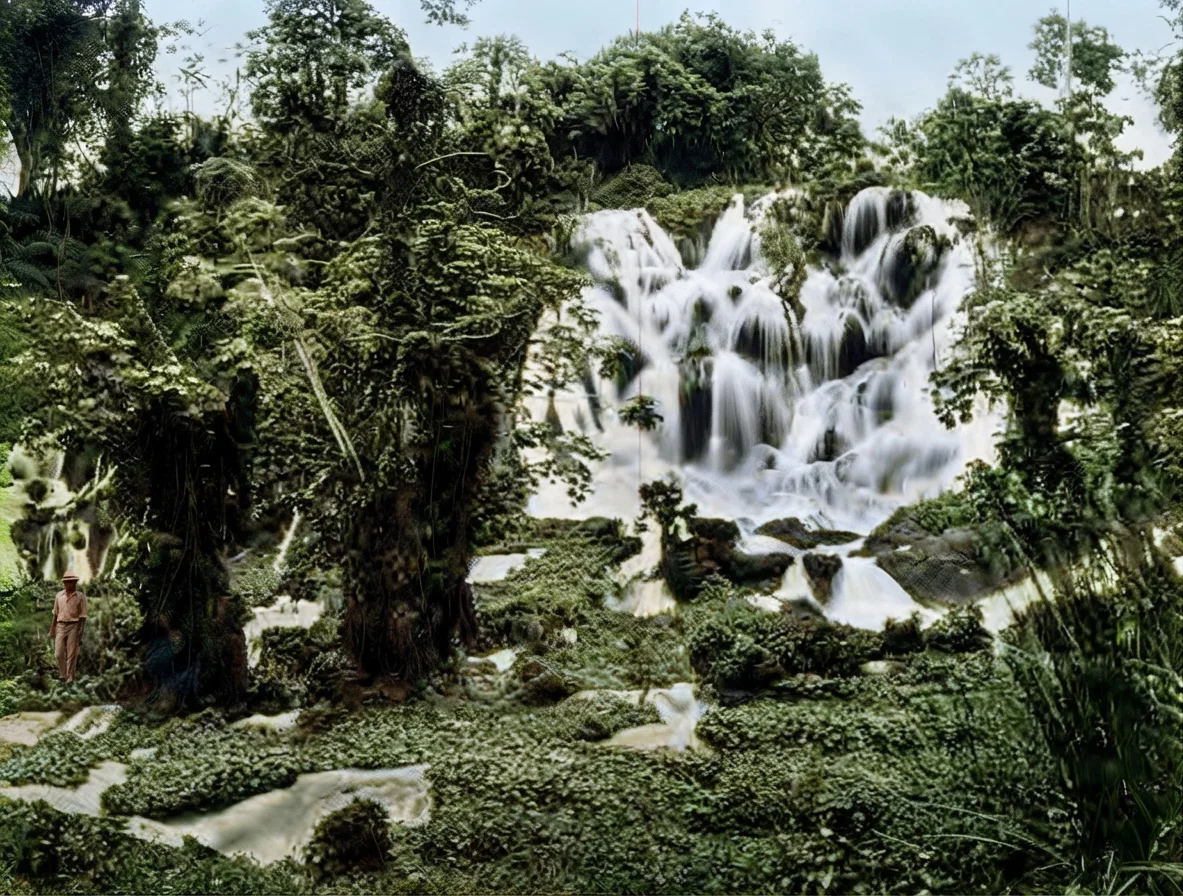
A Typical Jamaican Waterfall.
August 1, 1834, slavery was abolished, and four years later absolute freedom was conferred upon the whole population. Altho more than sixty years have gone by, yet the effects of slavery are still seen in the low morals of that people. But through the blessings and influence of the Gospel many are learning a better way, and walking in it. Missionaries find here a wide field of usefulness.
January 17, 1692, occurred one of the most violent earthquakes that was ever felt. All the houses on the island were thrown down; mountains were split, and whole plantations were moved out of place. Port Royal suffered the greatest damage; at that time it was a city of several thousand inhabitants. It was reputed to be the richest spot on earth. For many years it had been the rendezvous of pirates who had been very successful in their depredations, and had brought thither their ill-gotten gains. The people of the island are supposed to have welcomed and protected these marauders because of the wealth they brought. In two minutes nine-tenths of the city had gone down, and with it immense treasure, and 3,000 human beings.
"I have seen the wicked in great power, and spreading himself like a green bay tree. Yet he passed away, and, lo, he was not; yea, I sought him, but he could not be found. Mark the perfect man, and behold the upright, for the end of that man is peace. But the transgressors shall be destroyed together; the end of the wicked shall be cut off." Ps. 37: 35-38. At the present time, the tops of the buildings in the doomed city may be seen in the depths of the clear water, ever bringing to mind the sad fate of those wicked men.
The inhabitants that escaped left the place and built Kingston, which is to-day the metropolis and capital, with a population of 50,000. The houses are usually but one story high, on account of the hurricanes and earthquakes. It is said to be the hottest place in the island. Here the mean temperature is about 78°. The thermometer registers lower in the hills and mountains until an average of only 56° is found. As Jamaica is situated between 17° 48' and 18° 32' north latitude, of course winter is unknown. There is one perpetual summer, and the temperature in any given place scarcely varies 20° the year 'round, thus making a very desirable climate.
According to the census of 1891, the population of Jamaica was 639,491. Of this number 14,692 were whites; 121,955 colored; 488,624 black; 10,110 East Indians; 481 Chinese; and the nationality of 3,623 was not stated. The estimated number of inhabitants in 1902 was 750,000.
The government has constructed good roads around the island, and in several places in the interior. A railway 125 miles in length connects Kingston with Montego Bay. It is a wonderful specimen of engineering skill. Three-fourths of the distance this railroad forms almost one continual wind and twist through mountain gorges, or skirts mountain sides, or plunges through them. It is impossible to picture the beauty of the scenery along this route; to be appreciated, it must be seen. Branch lines run to Ewarton and Port Antonio; so13that nearly all parts of this otherwise almost inaccessible island are made accessible.
The extreme length of Jamaica is 144 miles; its greatest width is 49 miles; and its least width (from Kingston to Annotto Bay) is 21 1/2 miles. Its aboriginal name was Xaymasa, a word supposed to imply an overflowing abundance of rivers. This meaning would not be inappropriate, for in many parts of the island springs and rivers are numerous.
Because of its central position among the West Indian islands, and owing to the fact that it lies in the direct route between Europe, the United States, and the Isthmus of Panama, Jamaica offers great advantages for trade, commerce and missionary work.
PROGRESS IN MATABELELAND.
By W. S. Hyatt
[In the South African Missionary for October we find an interesting report of a visit to Matabeleland by Brother W. S. Hyatt, from which we take the following.]
At Somabula we had a very interesting baptismal service. Eight of the older boys desired to follow their Lord and be buried with Him. We gave them special instruction to fit them for the occasion. But I wish to say that the boys who have been at these missions for several years have a good knowledge of the plan of salvation, and can readily turn to texts in various parts of the Bible. A large number of people gathered at the mission on Sabbath morning. After Sabbath-school we went to the river, and had our meeting under a large tree. Elder Armitage, Brother C. H. Sparrow, and myself, each gave them a short address, explaining the Gospel plan and what baptism meant; for they had never seen such a thing before. Then each of the boys bore a testimony to what the Lord had done for him. Hearts were touched, and tears flowed from many eyes. The baptism followed, and it was pronounced by all to be a precious experience.
We had noticed that the boys felt the need of a Christian name. Often in the study of Acts they found the expression, "whose surname was," etc. They desired such a name. So after we had placed several names before them, we allowed them to choose a Christian name, and at the same time retain their own names. I will give their names, that you may see how well the choice was made: Harry Sibagobe, Joseph Mamo, William Mzeleti, Willis Mehlo, James Samdede, Byron Selomba, Fred Mazalwaedwa, Frank Kama. They were first called by their new names at the time of their baptism, and a thankful lot of boys they were, too.
I must mention two young men who heard that the teacher at Solusi taught the boys not to drink beer or smoke. They tried to find the mission, but, after wandering about for several days, came to Somabula. When they had been there a week, they, like Philip, went and found three others of their number and brought them to the mission. These all came from the Melsetter District, a section of country on the eastern border of Rhodesia.
God has certainly blessed the efforts to teach these boys. When they came to the mission in February they did not know a letter, but in six months they could read their native Bible and write a fair hand. Besides this they could read considerable English. Now they are reading in the English Bible. Surely God is in this work. At both missions the classes in English are doing well.
As we had a desire to know the openings for mission work, Brother Sparrow, Brother Armitage, and I took a three weeks drive through the country. On our trip we found natives who knew absolutely nothing about God or Christ, having never heard about them. We tried to tell them about the love of God, but they would shake their heads and say: "He may love you white men, but He does not love us black men." We had two of our young men from the mission with us, and they told the people what God had done for them. At this the natives were silent, as here were two of their own kind of people, speaking their own language, telling them about God and His Son Jesus.
OUR WORK AND WORKERS.
By Editor
A CANVASSERS' institute will be held in Armstrong, Mo., January 22 to February 1.
A SABBATH-SCHOOL of sixteen members was organized at Ten Mile Creek, Wis.
THE brethren at Hampton, Iowa, are erecting a house of worship, with a school annex.
A THREE-MONTHS' school for canvassers is to be held in Minneapolis, Minn., commencing January 5.
A CHURCH of eighteen members has been organized at Broken Bow, Neb., by Brother L. E. Johnson.
THE brethren of Keene, Texas, have entered heartily upon the work of building a house of worship.
THE Minnesota Conference Committee have ordered the special SIGNS sent to the 525 editors of that State.
THE baptism of three candidates at Minneapolis, by Brother J. F. Pogue, is noted in the last issue of the Minnesota Worker.
A REPORT in the Kansas Worker, from Brother D. H. Oberholtzer, mentions the baptism of fifteen persons at Thayer, November 29.
IN the Canadian Union Messenger, Brother G. B. Thompson reports the organization of a church of twelve members at Lindsay, Ont.
THE annual session of West Michigan Conference will be held at Charlotte, commencing on the 8th inst., and continuing until the 13th.
THE dedication of a new house of worship near Pulaski, N. Y., is reported in the Indicator, by Brother S. H. Lane, president of the conference.
THE new house of worship erected by the church at Eau Claire, Wis., was dedicated December 6. Brethren Wm. Covert (president of the conference), T. B. Snow, and J. B. Scott were present.
THE Life Line Mission, located at 416 East Locust Street, Des Moines, Iowa, was formally dedicated on the 3d ult. An appreciation of the new enterprise was shown in a full house on this initial occasion.
AS BEFORE noted, a training school for workers will be conducted at College View, Neb., from the 7th inst. to March 3. The course this year will take the form of a Biblical institute for ministers, licentiates, Bible workers, city workers, canvassers, and church officers, with a corps of experienced instructors.
A COMPANY of Bible-working sisters in Leavenworth, Kansas, report that four of their readers have recently accepted the Sabbath of the Lord. Also that the church school recently established there is prospering. One mother had taken her daughter from the Catholic school to send her to the church school, and was well pleased with the change.
FROM letters received by Brother C. McReynolds, president of Kansas Conference, he notes in the Worker these recent accessions to the churches: Fort Scott, 7; Columbus, 4; Newton, 15; Great Bend, 7; German church at Herington, 4; Wichita, 3; Miltonvale, 5; Salina, 2; Ozawke, 2. He also notes "a great awakening as a result of the SIGNS work."
THE Central Advance says: "The Kansas Conference expects to open up a sanitarium at the Santa Fe hospital at Ottawa. Elder McReynolds, president of the Conference, has been assured by one of the managers that they can have the building free of rent for five or ten years, provided they will keep it in repair. The building at present is in excellent condition."
BROTHER R. D. QUINN, who recently went to Australia, writes to the Bivouac: "We came to Maryborough [Queensland], a city of about 11,600 people, several weeks ago and laid siege to it with all the workers we have in this conference. We secured from the government a fine location in the center of the city, erected a large eighty-foot tent, and begun work. The first evening there were about two hundred and fifty people out to hear us."
THE publishers of the Life Boat give notice that the price has been raised to 35 cents. Dr. Paulson says, "We are carrying on so many charitable enterprises with the paper that we deem this advisable." They are also making a valuable offer in connection with it; that is, a copy of J. Hudson Taylor's "Retrospect" for four new subscribers. This a book of experiences of the noted missionary in the interior of China, giving a glimpse of what God is willing to do for those who push into that benighted country with the light of "present truth." We are glad to learn that some workers for that paper found that they could also sell the special SIGNS without interfering with their regular Life Boat work. There is a field for both papers, and logically their fields cover the same ground. Many husbandmen have found a rotation of crops quite profitable, and it ought to work well in planting various phases of the truth.
THE WORK FOR CHILDREN IN CHINA.
A LADY missionary in China, whose special work is among the children, writes: "There is no work that will yield such large and lasting results as the one among little children, and none that will have so far-reaching an effect upon the future of China. We who are on the field realize this as we see how reluctantly the men and women relinquish the old customs and beliefs. One of the native teachers in the boys' college, who has been an earnest Christian for years, says that at times he still has desperate struggles against the superstition of his early training, and that in spite of himself the old impressions and fears rise up and haunt him. A few days ago a baby girl was born in the Pierce Street Hospital, in Foochow. The mother, like many another mother in China, had no love in her heart for her child because it was a girl, and before the little thing was a day old sold her for ten cents. My kindergarten in Foochow has an enrolment of forty-five boys and girls from two to seven years of age. They are merry little folks, and are fond of singing the songs I have translated for them, and their voices are sweet. Our work for them and among them is wielding a powerful influence for good."—Christian Work.
WANTED FOR MISSIONARY WORK.
(Always prepay postage.)
CLEAN, old copies of our papers. Address, Henry Tonjes, 21 Morton Street, New York City, N. Y.
Any of our periodicals. Address, Grover Jenkins, Linden, O. T.
SIGNS, Good Health, tracts, etc. Address Chas. T. Volz, Marble Hill, Jefferson County, Ind.
CLEAN copies of any of our publications, for rack work. Address S. H. Smith, 350 Minor Avenue, San Jose, Cal.
INFORMATION WANTED.
Mrs. Ed. Garland, of 218 18th St., Santa Ana, Cal., desires her husband to know that she is sick and greatly in need of his help. He is a blacksmith by trade and is supposed to be in some Pacific Coast City. She would be glad to have our readers living in these cities inquire for him at such shops as he might be employed, and let her know of his whereabouts.
STORIES OF MISSIONS.
By Editor
THE first articles of a series on "Missions in the South Sea Islands" appears in the Youth's Instructor of Nov. 17.
These stories of Missions by Miss Estella Houser, will tell of our missionary efforts in the islands of the sea, beginning with the first cruise of the missionary brig "Pitcairn."
Brief sketches of the experience of such leading island missionaries as Williams, Patteson, Chalmers and Paton will be given in the opening articles.
Miss Houser's "Story of the Matabele Mission" which appeared in the Instructor, was most cordially received, and we trust that thousands of new readers will have the privilege of reading these new true stories of our missions.
By sending 75 cents now every new subscriber gets the remaining issues of 1903 and all of 1904. Order through your State Tract Society, or send direct to the Youth's Instructor, 222 North Capitol St., Washington, D. C.
MISSIONARY TRAINING SCHOOL OF CORRESPONDENCE.
By Editor
This School of Correspondence has been called into existence to meet the needs of the hour. There are in almost every community people, who, if circumstances were different, would be glad to enter one of our schools to prepare for active missionary work. They know that the Lord has a place for them and a work for them to do. Some are prevented from attending school by home duties, others are detained for financial reasons. Nevertheless, these would make just as good workers as those who become resident students in our various schools.
If men working for worldly advantage will put forth such an effort, should Christians be satisfied when they do less? The long winter evenings may profitably be devoted by many Christian families to a study of the Word of God. In many of our homes neighbors may gather to study God's truth. The course of instruction offered in the Bible by the Missionary Training School of Correspondence will enable parents to work side by side with their children. It will make it possible for Christian fathers and mothers to study with their neighbors. It is an opportunity which none can afford to miss.
You should at least read the circulars issued by the Missionary Training School of Correspondence and see for yourself what you may do by studying in your own home.
Address, Missionary Training School of Correspondence, Berrien Springs, Michigan.
FOR THE HOLIDAYS.
By Editor
ON December 24, 25, 26, 31, January 1, and 2, the following rates in effect via North Shore Railroad good for return until January 4th. Camp Taylor, Pt. Reyes, etc., $1.00; Marshalls, Tomales, etc., $1.50; Occidental, Camp Meeker, Monte Rio, Mesa Grande $2.00; Duncans Mills, Watsons, Cazadero $2.50.
Through trains daily at 8:00 A.M., also special through trains at 3:15 P.M. Saturdays, and at 5:15 P.M. December 24th and 31st. For complete holiday time-table inquire at ticket office, 626 Market Street.
I Can Sell Your Real Estate
By W. M. Ostrander
I Can Sell Your
# Real Estate
no matter where it is
or what it is worth.
Send description, state price
and learn my wonderfully
successful plan.
W. M. OSTRANDER
379 North American Building, PHILADELPHIA