As a Christian submits to the solemn rite of baptism, the three highest powers in the universe,—the Father, the Son, and the Holy Spirit,—place their approval on his act, pledging themselves to exert their power in his behalf as he strives to honor God. He is buried in the likeness of Christ’s death, and is raised in the likeness of His resurrection. The Saviour went down into the grave, but He rose from the dead, proclaiming over the rent sepulcher, “I am the Resurrection and the Life.”
The three great powers of heaven pledge themselves to furnish the Christian with all the assistance he requires. The Spirit changes the heart of stone to the heart of flesh. And by partaking of the Word of God, Christians obtain an experience that is after the divine similitude. When Christ abides in the heart by faith, the Christian is the temple of God. Christ does not abide in the heart of the sinner, but in the heart of him who is susceptible to the influences of heaven.
The light that shines forth from the life of the true Christian testifies to his union with Christ. Self is hidden from view, and Christ is revealed. Heaven recognizes the fulfilment of the promise, “I will make a man more precious than fine gold, even a man than the golden wedge of Ophir.” “Now are we the sons of God, and it doth not yet appear what we shall be; but we know that, when He shall appear, we shall be like Him; for we shall see Him as He is.” Then those whose lives have been hidden with Christ, those who on this earth have fought the good fight of faith, will shine forth with the Redeemer’s glory in the kingdom of God.
My brother, my sister, God’s purpose for you is that you shall live a life that will make others better,—a life which will show that Christ is formed within, the hope of glory. It is His purpose that you shall be able to say with the apostle Paul, “I live; yet not I, but Christ liveth in me.” In perfect content, resting in the love of Christ, trusting the Redeemer and Life-giver to work out for you the salvation of your soul, you will know, as you draw nearer and still nearer to Him, what it means to endure the seeing of Him who is invisible. God desires us to rest content in His love. The contentment that Christ bestows is a gift worth infinitely more than gold and silver and precious stones.
Love the right because it is right, and analyze your feelings, your impressions, in the light of the Word of God. Misdirected ambition will lead you into sorrow as surely as you yield to it. Cherish an ambition that will bring glory to God because it is sanctified by the Holy Spirit. Consecrate every power of your being to the accomplishment of a holy work. Make every effort, in and through the grace of Christ, to reach the high standard set before you. You can be perfect in your sphere, even as God is perfect in His sphere. Has not Christ declared, “Be ye therefore perfect, even as your Father which is in heaven is perfect”?
Our lives are pure only when we are under the control of God, and happy only when we hold communion with Him. The luster possessed by those who have gained the richest experience is but the reflection of the light of the Sun of Righteousness. He who lives nearest to Jesus shines the brightest. And let us thank God that the Master has His hidden ones whose value may not be recognized by the world, but whose names are written in the Lamb’s book of life. The Lord knoweth them that are His. “They shall be mine, saith the Lord of hosts, in that day when I make up My jewels; and I will spare them, as a man spareth his own son that serveth him.”
“Behold, the day cometh, that shall burn as an oven; and all the proud, yea, and all that do wickedly, shall be stubble; and the day that cometh shall burn them up, saith the Lord of hosts, that it shall leave them neither root nor branch. But unto you that fear My name shall the Sun of Righteousness arise with healing in His wings.”
I am so glad that we have a God who understands,—a God who will reward every man according as his work shall be.
I long to see Christians who are harmonious in all their parts. It is so sad to see those whose lives are a jumble of opposites. Christians must be Christlike. The life of a true, lovable Christian is the most powerful argument that can be produced in favor of the Gospel.
“YE OUGHT TO BE TEACHERS.”
By H. A. St. John
BY H. A. ST. JOHN.
“For when for the time ye ought to be teachers, ye have need that one teach you again which be the first principles of the oracles of God; and are become such as have need of milk, and not of strong meat.” Heb. 5:12.
ALL true Christians are teachers. They must teach or backslide, and need themselves to be taught again which be the first principles of the oracles of God. A Christian is a follower of Christ. Now Christ was the greatest teacher that ever appeared among men. By precept, and by example, in word and in deed, He was always going about among men teaching. In Him the Word, the truth, was made flesh, and dwelt among men, ever teaching them the way of the Lord more perfectly. He taught His disciples how to pray, how to give alms, how to fast, how to bring forth much fruit, how to continue patiently in well-doing, sowing beside all waters. He taught in the temple, in synagogs, in private dwellings, in the wilderness, on the stormy deep, on the mountainside, and at riverside, and wayside, and seaside. He hung His beautiful lessons on the visible things surrounding every-day life, that they might be the better remembered when the great Teacher was gone. His enemies were grieved that He taught in the temple; indeed, they had no sympathy with His teaching anywhere; for He did not teach as the scribes, but with authority divine.
All who follow closely in the footsteps of Jesus, will necessarily be teachers. By precept and example they will ever be pointing the way to life everlasting. Every missionary campaign will be a campaign of teaching. By a godly life, by verbal lessons, by printed page, in every way possible they will reveal the everlasting Gospel, the good news of the coming Kingdom, that all who so will may become subjects thereof, and have an abundant entrance therein, when the day of triumph shall come.
Every one of us may be taught of God. He has given abundant provision whereby we may be guided into all truth. As we teach others what the Lord has taught us, we ourselves will be more and more enlightened in the things of God. As we impart to others, our own stock of knowledge will be increased. If we do not teach, we will gradually, altho almost imperceptibly, lose what we have. As our interest in, and love for, the truth wanes and fades, our knowledge of the same will also diminish, and the time will come when we need to be instructed again, even in the first principles of the oracles of God—old babes, who have need of milk instead of strong meat.
And what joy, what bliss, it is to teach the story of unseen things above, of Jesus and His love, to interested and receptive minds. Some such good soil, all ready for the good seed, awaits every sower, every teacher, everywhere. If we have the ardent desire, the Lord will give us the opportunity. “Delight thyself also in the Lord; and He shall give thee the desires of thine heart.” Ps. 37:4.
The gift of teaching ought to be far more generally possessed and used by the church of Christ than it is. Many ought to be teachers that are not, simply because they have neglected the gift that is in them, that was given them of God. Reader, if you are neglecting this gift, begin to-day. If you must begin with a child, begin at once, lest the gift be taken from you. Your mind will be illuminated, your pathway brightened, when you begin to help others.
Sometimes the pulpit is instructed by the pew. Apollos was eloquent, and mighty in the Scriptures, but the pew, represented by Aquila and Priscilla, expounded unto him the way of God more perfectly. This may frequently occur, that he that is taught in the Word can communicate unto him that teacheth, in all good things.
Anciently the Lord chose the tribe of Levi for the first-born of all Israel. Hence the Levites were priests and teachers, going into the cities, villages, and homes of all the tribes, teaching. All the members of the church of Christ now are the first-born, hence they are all a royal priesthood, all teachers. When will the remnant church of Christ arise to their blood-bought privilege of enlightening the whole earth with the everlasting Gospel of the soon-coming kingdom, teaching all men, everywhere, to observe all things that the Lord has commanded us, thus learning how to live here, physically, mentally, and spiritually, that they may live hereafter happily, gloriously, and eternally.
MIND.
1. Mind your tongue! Don't let it speak hasty, cruel, unkind, or wicked words.
2. Mind your eyes! Don't permit them to look on wicked books, pictures, or objects.
3. Mind your ears! Don't allow them to listen to wicked speeches, songs, or words.
4. Mind your hands! Don't let them steal, or fight, or write any evil words.
5. Mind your feet! Don't let them walk in the steps of the wicked.
6. Mind your heart! Don't let the love of sin grow in it. Don't give it to Satan, but ask Jesus to make it His throne.—Selected.
SEARCH THE SCRIPTURES
ZECHARIAH.
By F. D. Starr
WE see by comparing the first verse of this book with the first verse of the previous book, that Haggai and Zechariah prophesied in the same year. They lived and labored in the days of Darius, king of Persia. Their work was to encourage the people in rebuilding the temple.
The spirit of the entire book under consideration may be seen in chapter 1, verse 13: "And the Lord answered the angel that talked with me with good words and comfortable words." This is the most correct statement that could be made concerning the nature of the contents of this book, and those who neglect the perusal and study of the book, lose much of the comfort and consolation that the Lord designed they should have.
The Holy Spirit is designated, by Him who has sent it into the world, as the Comforter. The inspired books having been written under the direction of this Spirit, they are themselves messages of comfort to the people of God. Only a very few of these expressions of comfort can be considered here, but the searcher will find many more of them as he reads the book.
Two forces are brought to view in the last of chapter one, the one to scatter the people of God, the other to resist this scattering power, and exert a gathering influence. What is our influence? Is it to scatter or to gather? Our Saviour has said, "He that gathereth not with Me scattereth abroad." Matt. 12:30.
Chapter three gives an incident in the great controversy between Christ and Satan. As has already been noticed, Joshua in Hebrew and Jesus in Greek are the same name. The Septuagint version of Zech. 3:1 reads: "And the Lord showed me Jesus the high priest standing before the angel of the Lord, and the devil stood on his right hand to resist him." It is true there was then a high priest by that name, as we see from Hag. 1:1; and so this prophecy, like so many others, had a local application at that time, while having reference to the work of the Lord in a more extensive and important manner. Jude gives us a glimpse of this controversy when he tells of the dispute between Michael and the devil. Jude 9. It is past human conception that the Son of the infinite God, He who is now our High Priest, Jesus, should so humble Himself as to take our nature, submit to all our environments, and be clothed, as it were, in the habiliments of finite man, but these He bore not long; He was granted a change of raiment. He has put off the common garments and is now clothed in priestly robes with the fair mitre upon His head. Soon He will have another change of raiment, when He shall put off the sacerdotal attire, and come in glory with a vesture on which is written, "KING OF KINGS, AND LORD OF LORDS." Rev. 19:16.
Think Not Evil.
This exhortation is given in Zech. 7:10, "Let none of you imagine evil against his brother in your heart." The Septuagint reads: "Let none of you remember in his heart the injury of his brother." What an excellent Christian virtue is here held before us—forgetting the injuries others may have done to us. But is it possible for us to forget? Sometimes people say, "I can forgive, but I can not forget." But that is not going far enough. The Lord says forget. And is that possible? He who gives command can give us power to perform. Listen to the testimony of the patriarch Joseph, "God hath made me forget all my toil, and all my father's house." The same power that will bring all things to our remembrance that the Lord has said to us (John 14:26) will also give us the power to forget. It has been said that it is a sin to forget, and so it is when it pertains to matters of duty that we ought to remember. But may it not as truly be said that it is a sin to remember when it comes to matters that ought to be forgotten? The fact is that so often the remembrance of those things that should pass from our minds causes us to forget the things we ought to remember, by crowding them from our memories. Let us train our memories by divine help so that we can forget the things that are behind. Phil. 3:13.
One of the gracious promises to Jerusalem is found in Zech. 8:5: "And the streets of the city shall be full of boys and girls playing in the streets thereof." A street education is counted a great misfortune, but it is evident from this text that the trouble is not in the street itself, but in the associations found there. With inhabitants such as would be found in holy Jerusalem, there would be no more contamination for the children in the streets of the same than in any other part of the city.
The treatment that our Lord received when "He came unto His own, and His own received Him not," is shown in Zech. 13:6: "And one shall say unto Him, What are these wounds in Thine hands? Then He shall answer, Those with which I was wounded in the house of My friends." That this refers to the experience of our Saviour, is shown by verse seven, from which a quotation is made by our Lord as applying to Himself. This is found in Matt. 26:31.
Thus in this book, as in all other parts of the Old Testament, we are constantly finding passages that refer to Christ and His work. Surely the ancient Scriptures contain much that points the student to the world's Redeemer, Christ in the Old Testament. Chapter 14 contains perhaps some of the most difficult portions of Holy Writ to understand, but remembering that many of these predictions have a double fulfilment, applicable in part to the events of ancient times, and in part to matters of the present dispensation, and to the future, the meaning of these utterances will be more readily seen. The grand culmination of all predictions is seen in verse five, "The Lord my God shall come, and all the saints with Thee." For that event may we all be prepared, so that we can say at that time, "Lo, this is our God; we have waited for Him, and He will save us." Isa. 25:9.
THE BIBLE AND WAR.
By J. L. Shuler
BY J. L. SHULER.
NEARLY all Biblical students recognize the fact that the outcome of the Russo-Japanese War was foretold in the Bible. But while the sure word of prophecy pointed out the defeat of Russia in this present war, it also points out another great war which will soon take place. This war will involve all nations, and they are all unconsciously preparing for this great struggle.
But there is another feature of our times which is not to be passed by unnoticed. Many people are already beginning to say that this present war will be the last great war, and that we are now assured of peace for a long time to come. Now in connection with this thought let us read the following from the prophecy of Isaiah: "And it shall come to pass in the last days . . . many people shall go and say, Come ye, let us go up to the mountain of the Lord, to the house of the God of Jacob; . . . And He shall judge among the nations, and shall rebuke many people; and they shall beat their swords into plowshares, and their spears into pruning-hooks; nation shall not lift up sword against nation, neither shall they learn war any more." Isa. 2:2-4; Micah 4:1-3.
The prophet distinctly says that in the last days "many people" shall say that nation shall not lift up sword against nation, and there will be no more war. Are the people fulfilling this prophecy? How about the world's peace conference called in 1899? And what should we say of all the peace conferences the nations are still calling? How about the $1,500,000 that a certain rich man offered for the express purpose of building a peace palace? People say there will be no more war, for all disputes will be settled by arbitration. Such things as these indeed fulfil the prophecy, and it of itself is a sign that we are in the last days.
Now, after reading what the people are to say, let us read what God Himself says will take place among the nations: "Prepare war, wake up the mighty men, let all the men of war draw near; let them come up. Beat your plowshares into swords, and your pruning-hooks into spears, let the weak say, I am11strong." Joel 3:9, 10. "And ye shall hear of wars and rumors of wars." Matt. 24:6.
Are the nations preparing for war as the prophet Joel said they would?—"There never was a time when so much ingenuity, wealth, and skill were employed in the invention and construction of appliances for war."—Gen. N. A. Miles.
About seventy-five per cent. of all revenues of all countries is expended in warlike preparations. Workingmen are taxed to the last extremity to support large standing armies. Among all nations the cry is, "Let us have a large army and a strong navy." The United States spent $100,000,000 for the improvement of the navy last year. Congress appropriated $200,000,000 for the coming year. This is just double the appropriation of last year. The war-ships of the world, placed one to the mile, would cover a line from New York to Liverpool. The combined armies of the world in 1869 amounted to about 6,000,000 men. In the next twenty-three years this increased to almost 21,000,000; and in the next six years another addition of 5,500,000 was made. A further significant fact is that 2,434,000 of these were added in one year, 1897 to 1898. How true the words of the prophet: "Prepare war" and "let all the men of war draw near." The prophet Jeremiah saw all these war preparations and was pained at his very heart because he knew of the great destruction they would bring. Jer. 4:19-21.
The prophet Joel says the heathen are to be awakened. Joel 3:12. Look, for instance, at the heathen nation of Japan. Sixty years ago Japan was asleep. She refused to carry on any commerce with other nations, and they had none of the modern inventions and improvements. Thirty years ago Japan was unknown as a world-power. But to-day we behold that she has been awakened, and she is now one of the foremost of the world's great powers, and has carried on a very successful war with the mighty nation of Russia. Thus the heathen are being awakened. This is a sure indication that the end of the world is near (Joel 3:14), and this anger among the nations is another sign that God is about to pour out His wrath upon the world (Rev. 11:18.).
Among the nations there is distress, perplexity and anxiety because of the various international questions which are constantly arising. Men's hearts fail them for fear as they view the conditions that exist. This, according to the prophecy, shows that the end is near, and that the next great event will be the appearance of the Son of Man "coming in a cloud with power and great glory." Luke 21:25-27.
Yet with all this preparation for war, all the mutterings and threatenings, a semblance of peace in general continues; for another prophecy says that the winds of strife must be held till the servants of God are sealed. Rev. 7:1-3.
Those who are crying peace now are crying "peace, when there is no peace" (Jer. 6:14), because God says directly the opposite. "Evil men and seducers shall wax worse and worse, deceiving and being deceived." "Sudden destruction cometh upon them, . . . and they shall not escape." 2 Tim. 3:13; 1 Thess. 5:3.
If the men who are at the head of the different governments in the world understood these prophecies they would see that peace congresses would not bring peace. And, then, how illogical to prepare for war and at the same time be crying "Peace, peace." But God, foreknowing the future as the past, foreknowing what the people would say and do, has told us plainly in His Word. To question the fulfilment of prophecy is to question God's foreknowledge. What they are doing in these days fits exactly what God declared they would do.
By these war preparations all nations are getting ready to be gathered together to the battle of that great day of God Almighty—that of Armageddon. Rev. 16:14-16. Then there will be a time of trouble such as never was since there was a nation. Dan. 12:1. Evil will go forth from nation to nation, and the nations will rush like the rushing of many waters, but God will rebuke them. Jer. 25:32; Isa. 17:13. When the nations gather on that occasion, God will open the armory of heaven, and bring forth the weapons of His indignation. Jer. 50:25. These weapons will be the treasures of hail, which he has reserved against the time of trouble, against the day of battle and war. Job 38:22, 23. Each hailstone will be the weight of a talent, about fifty-seven pounds. Rev. 16:21. "A noise shall come even to the ends of the earth, for the Lord hath a controversy with the nations, He will plead with all flesh; He will give them that are wicked to the sword. . . . And the slain of the Lord shall be at that day from one end of the earth, even to the other end of the earth." Jer. 25:31-33. How are we going to stand in that great day? May we so live now that we may "be accounted worthy to escape all these things and to stand before the Son of Man." "Now is the accepted time; behold, now is the day of salvation." "To-day if you will hear His voice, harden not your heart." "Seek ye the Lord while He may be found; call ye upon Him while He is near." Now is the time to prepare to meet our God, so that when He comes we can say: "Lo, this is our God; we have waited for Him, and He will save us; this is the Lord, we will be glad and rejoice in His salvation."
"We are living, we are dwelling,
In a grand and awful time,
In an age on ages telling,
To be living is sublime.
Hark! the waking up of nations,
Gog and Magog to the fray;
Hark! What soundeth! Is creation
Groaning for her latter day?"
Farmington, Ill.
THE DAY TO COME.
By Frances E. Bolton
BY FRANCES E. BOLTON.
WE hear men speak of better days,
As days long past and fled,
As tho no room were here for praise,
And love itself were dead;
But every day is sent from heaven,
And every day is blest;
To every mortal heart is given
The chance to be the best.
What! are these last days worse than those
That once were swept by flood?
Or worse than when time reeked with woes,
And dripped with martyrs' blood?
The chance to be most blest is here,
This is a glorious time,
The soul may rise without a fear,
And face a life sublime.
O, rather, let us hold a light
To win men up the way,
Than point them ever to the blight
That sweeps across our day.
Instead of gloomy, iron face,
Let's show to men the glory
That waits a godlike, noble race,
And lights the way before thee.
If times are dark, the sequel's fair;
No night was ever given,
But God had kept a morning rare
To spread its wings from heaven.
"The morning cometh," saith the seer,
He pointed first to light,
"The morning cometh," have no fear,
Tho "also comes the night."
Be ready for the morning time,
Be ready for the dawn,
Rouse up from slumber, fresh and fair,
And with thy garment on.
For O the morning time is near,
A dawn of endless day,
And ever and forevermore
Earth's shadows flee away.
Error Mixed with Truth
By Rev. N. Day
ERROR is never so harmful as when it is mixed with the truth. Bold, defiant error, undisguised, may be easily met and refuted, but when it comes in the guise of a friend, professing to advocate a righteous cause, it is not so easily detected, but gains an advantage it could gain in no other way.—Rev. N. Day.
Character Revealed in Appearance
“ALL corporeal things are spirit born; love and kindness are embryotic beauty, and the most lovely appearances from most lovely feelings spring, while hideous appearances have their origin in hateful tempers, affections, and dispositions. Inspiration has it right, “God beautifies the meek with salvation,” and as all truth and its consequences is reversible, Satan makes the proud ugly through sin. Therefore our permanent, eternal appearances in beauty or blight will be fully expressive of our true character and earthly habits. The saints shall actually look like the Christ whose love controlled them and whom they felt and acted like here, and sinners shall look like Satan whose spirit they obey and whom they feel and acted like in time.”
GOD’S PROVISION FOR THE SUPPORT OF THE MINISTRY.
1. What commission did Christ give to His followers?
“All authority hath been given unto Me in heaven and on earth. Go ye therefore, and make disciples of all the nations, baptizing them into the name of the Father and of the Son and of the Holy Spirit; teaching them to observe all things whatsoever I commanded you; and lo, I am with you always, even unto the end of the world.” Matt. 28:18-20.
2. What title is given to one thus commissioned?
In Mal. 2:7 he is called God’s “messenger;” in 2 Cor. 8:23 these servants of God are called “messengers of the churches;” and in Eph. 3:7 the title “minister” is used.
3. What great work is given into the hands of these ambassadors?
“But all things are of God, who reconciled us to Himself through Christ, and gave unto us the ministry of reconciliation; to wit, that God was in Christ reconciling the world unto Himself, not reckoning unto them their trespasses, and having committed unto us the work of reconciliation. We are ambassadors therefore on behalf of Christ, as tho God were entreating by us; we beseech you on behalf of Christ, be ye reconciled to God.” 2 Cor. 5:18-20.
4. How much of their time must be devoted to this work?
“And the twelve called the multitude of the disciples unto them, and said, It is not fit that we should forsake the Word of God, and serve tables. Look ye out therefore, brethren, from among you seven men of good report, full of the Spirit and of wisdom, whom we may appoint over this business.” Acts 6:2-4.
5. What solemn responsibility rests upon them?
“Obey them that have the rule over you, and submit to them; for they watch in behalf of your souls, as they that shall give account.” Heb. 13:17.
6. What arrangement has been made for the temporal needs of these ambassadors?
“Know ye not that they that minister about sacred things eat of the things of the temple, and they that wait upon the altar have their portion with the altar? Even so did the Lord ordain that they that proclaim the Gospel should live of the Gospel.” 1 Cor. 9:13, 14.
7. What prayer is the Christian to pray concerning the work of God?
“And He said unto them, The harvest indeed is plenteous, but the laborers are few; pray ye therefore the Lord of the harvest, that He send forth laborers into His harvest.” Luke 10:2.
8. How can he assist in answering that prayer?
“Bring ye the whole tithe into the storehouse, that there may be food in My house, and prove Me now herewith, saith Jehovah of hosts, if I will not open you the windows of heaven, and pour you out a blessing, that there shall not be room enough to receive it.” Mal. 3:10.
9. In the day of God what will they do who have withheld their means from God’s work?
“And men shall go into the caves of the rocks, and into the holes of the earth, from before the terror of Jehovah, and from the glory of His majesty, when He ariseth to shake mightily the earth. In that day men shall cast away their idols of silver, and their idols of gold, which have been made for them to worship, to the moles and to the bats; to go into the caverns of the rocks, and into the clefts of the ragged rocks, from before the terror of Jehovah, and from the glory of His majesty, when He ariseth to shake mightily the earth.” Isa. 2:19-21.
BAPTISM AT ROME.
By Chas. T. Everson
LATE one night, after I had retired, a gentleman who wished to speak with me was announced. I arose, dressed, and entered the parlor to find there a gentleman of tall stature, broad shoulders, a strong personality, and a highly intellectual face
He stated his case in a few words. He was professor of Latin and Greek in the highest college in Rome. He is one of the best Latin scholars in Rome, which is saying much when we remember that we are at the headquarters of the Latin Church; but he had no hope of eternal life, and from what he knew of this world he believed the next would be very beautiful. "Now pastor," he said, "if you can give me the assurance of being saved in God's everlasting kingdom, I shall be eternally grateful to you. That is all I ask, and is the only reason for which I am here." Then he added, "I wish to put myself in your hands as a child of five years to be taught what I must do."
A man so humble, I thought to myself, surely can get help from the Lord. I appointed a day for him to come and study with me. He wanted to come every day, but at the time I could not teach him so often.
He had learned of me through a young officer who had studied with me, and who had been so greatly struck by the message that when he found his friend, the professor, seeking in vain for light, he told him that he would bring him to a person whom he might embrace with open arms, for he was a man who knew the Bible. He told him that I taught the prophecies.
"Well," said the professor, "I want to see him if there is any help for me." I assured him that I could eliminate the Church of Rome from the list of the possible true churches in two studies. This pleased him very much, as he saw we had something definite to offer him. With Daniel the second and seventh chapters, I succeeded in showing him that the Catholic Church is not the true church.
He continued his studies and went forward day by day; his countenance began to brighten until he told me, "I could peacefully go, now, if God called me from this life; whereas before I was afraid." One day he asked me what he must do to unite with our body. I told him that he must be baptized. He said that he was ready. Then I told him that we do not use tobacco nor liquor in our church, and in a few simple words I explained to him the reason. He smiled and said, "How true that is; and to think I have lived so long before finding it out! I have a cigar in my pocket which I shall throw away when I get downstairs."
At our next study he did not appear; but at the one following he told me that he had been sick from the effects of stopping the tobacco and wine. He had been a great smoker, but he persevered, and to-day he said, "I worked four and a half hours without interruption; whereas when I was smoking I could work only three hours at a time."
He had, of course, the question of the Sabbath to meet, as his college held sessions on Sabbath. He presented the matter to the president, who said he would not refuse him, but, as it was a question of every Sabbath, he would have to present the matter to the faculty for their decision, and in the meantime he himself would teach the professor's classes on the Sabbath.
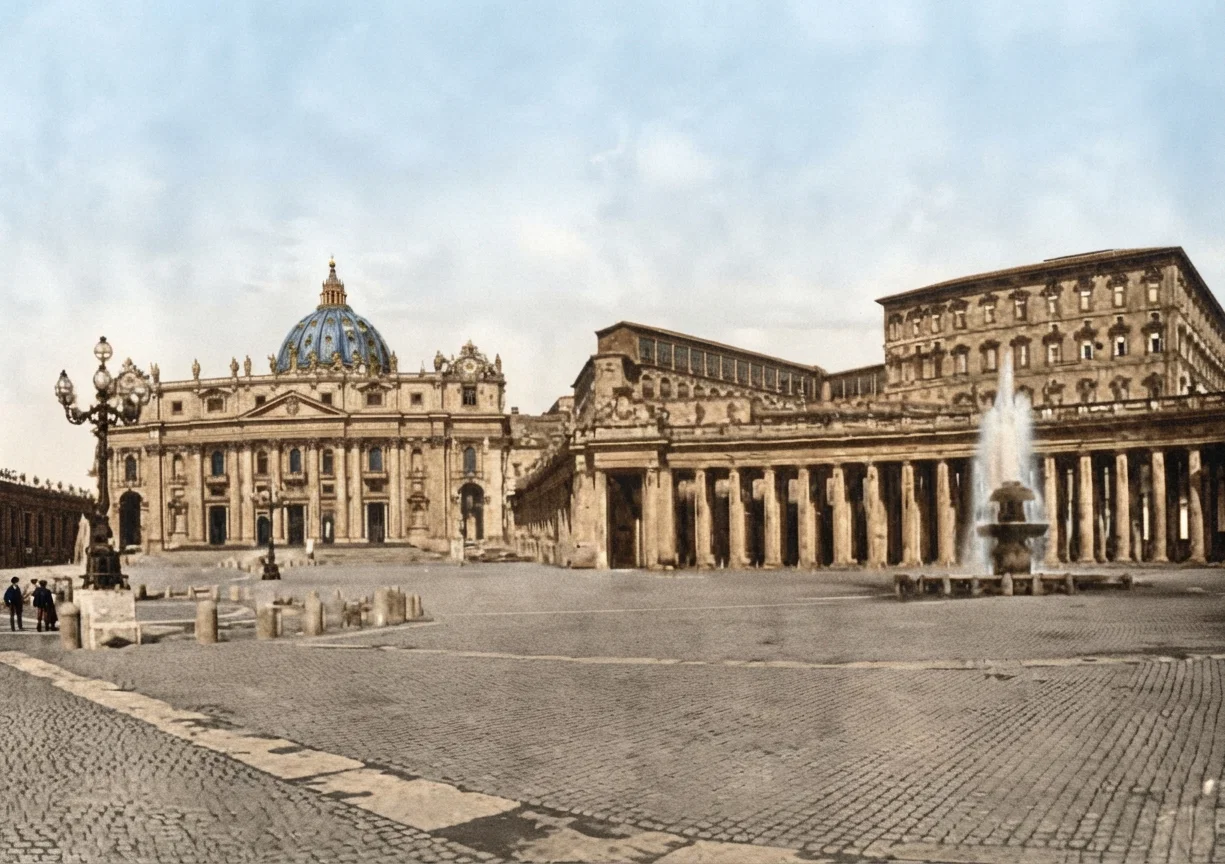
St. Peter's and the Vatican.
The professor was born of parents strongly Catholic, and was educated for the priesthood. He rose step by step until he became professor of theology in one of the large Catholic seminaries. While there, doubt began to rise about a number of the Catholic doctrines, especially that of transubstantiation. He studied out for Himself that Christ was the Word, and that by eating the Word we eat Christ, and not by eating the host. He communicated his views to the head of the seminary, who became very angry, and said that the Catholic Church never changes, for it is founded on God who never changes.
He left his position. The church authorities tried hard to get him back, and wished to call him before the Board of the Inquisition and make him recant.
He refused, for if he had complied he would have been imprisoned in some old monastery.
Knowing no other religion than the Catholic he became an infidel, but while in Florence he began to consider the world about him, and after reading a little tract he decided that there must certainly be a God. So he came to Rome for the express purpose of studying what other denominations taught.
He secured a position as professor, and in the meantime studied different churches. He studied three churches, but still he was hopeless and full of doubt. The Baptists offered to baptize him, but he said he was not convinced and therefore would not be baptized. He told me that one of the strong reasons that decided him against them was because he did not see Christ in the members.
Then he came to us. We did not need to urge, but he himself asked for the privilege of uniting with us. Every one of us has seen the great change that has come over him. His countenance now is bright and bespeaks the joy and peace of heaven. Even the Baptist pastor, whom he has since visited, said that he had never seen so great a change in a man.
During the time that our brother was studying with me he was called upon by what purported to be a committee of citizens, but whom he found to be a committee of dignitaries of the Church of Rome, who wished to speak with him. They offered him a position as editor of one of the large Catholic reviews. But he answered that altho in the past he worked along those lines, now he did not believe in them. They replied that he should not let that stand in his way, as they offered him a great position with a large salary. He replied that he would never sell himself, and so closed the matter. I pray that God may make him a power for the Message in this dark land.
CHAS. T. EVERSON.
BURDENS THAT ARE LIGHT.
WHEN Jesus said to His followers, "My burden is light," He uttered one of the most beautiful truths in connection with His Gospel. He did not say that Christianity laid no requirements upon us, that it was all receiving. He admitted that the Christian would have burdens to bear, but He declared that these burdens are light.
Perhaps many of us are thinking now of the experiences of the early Christians, some of whom were present when Christ spoke these words. Perhaps we look back over the history of the persecution and suffering which makes up so much of the story of the early church, or we recall the trials of some nineteenth century Christians, and we wonder whether these things can be accounted light. If so, what burdens are heavy?
The answer to this question is suggested by a story told of Dr. MacGregor, who met, in the Scotch city which is his home, a little girl staggering under the weight of a plump baby.
"Baby's heavy, isn't he, dear?" said the doctor, smiling down upon the pretty pair.
"No, sir," said the little girl, stoutly. "He isn't heavy; he's my brother."
To her childish mind, love's burden could not be heavy. And this is the secret of the light burdens which Christ gives us to bear. If the heart is full of love, all burdens are lightened.
We must all bear burdens, and he is to be pitied who bears them alone. But if we come close to the heart of Christ, and let His Spirit possess us, we shall find that His Word is true, and that His burdens are light.—Selected.
WALKING WITH GOD.
WALKING with God in sorrow's dark hour,
Calm and serene in His infinite power,
Walking with Him, I am free from all dread,
Filled with His Spirit, O! softly I tread.
Walking with God, O! fellowship sweet,
Thus to know God, and in Him be complete;
Walking with Him whom the world can not know,
O! it is sweet through life thus to go.
Walking with God in sorrow's dark hour,
Soothed and sustained by His infinite power;
O! it is sweet to my soul thus to live,
Filled with a peace which the world can not give.
Walking with God, O! may my life be
Such that my Lord can walk always with me;
Walking with Him, I shall know, day by day,
That He is my Father, and leads all the way.
—Selected.