Your ShelfYour Projects

Signs of the Times, Vol. 31, No. 33.

GOD'S GREAT GIFT
Earlier text: LIVING FOR CHRIST

LESSON 9.—AUGUST 27.—JEREMIAH IN THE DUNGEON

The Sabbath-school lessons have been discontinued. The Lesson Quarterly may be obtained, containing three months' lessons and notes, for five cents. Address, Pacific Press, Mountain View, Cal. The Sunday-school lessons will continue.
INTERNATIONAL SERIES THE SUNDAY SCHOOL

LESSON 9.—AUGUST 27.—JEREMIAH IN THE DUNGEON.

Lesson Scripture, Jer. 38:1-13, A. R. V.
(1) "And Shephatiah the son of Mattan, and Gedaliah the son of Pashhur, and Jucal the son of Shelemiah, and Pashhur the son of Malchijah, heard the words that Jeremiah spake unto all the people saying, (2) Thus saith Jehovah, He that abideth in this city shall die by the sword, by the famine, and by the pestilence; but he that goeth forth to the Chaldeans shall live, and his life shall be unto him for a prey, and he shall live. (3) Thus saith Jehovah, This city shall surely be given into the hand of the army of the king of Babylon, and he shall take it. (4) Then the princes said unto the king, Let this man, we pray thee, be put to death; forasmuch as he weakeneth the hands of the men of war that remain in this city, and the hands of all the people, in speaking such words unto them; for this man seeketh not the welfare of this people, but the hurt. (5) And Zedekiah the king said, Behold, he is in your hand; for the king is not he that can do anything against you. (6) Then took they Jeremiah, and cast him into the dungeon of Malchijah the king's son, that was in the court of the guard, and they let down Jeremiah with cords. And in the dungeon there was no water, but mire; and Jeremiah sank in the mire.
(7) "Now when Ebed-melech the Ethiopian, a eunuch, who was in the king's house, heard that they had put Jeremiah in the dungeon (the king then sitting in the gate of Benjamin), (8) Ebed-melech went forth out of the king's house, and spake to the king, saying, (9) My lord the king, these men have done evil in all that they have done to Jeremiah the prophet, whom they have cast into the dungeon; and he is like to die in the place where he is, because of the famine; for there is no more bread in the city. (10) Then the king commanded Ebed-melech the Ethiopian, saying, Take from hence thirty men with thee, and take up Jeremiah the prophet out of the dungeon, before he die. (11) So Ebed-melech took the men with him, and went into the house of the king under the treasury, and took thence rags and worn-out garments, and let them down by cords into the dungeon to Jeremiah. (12) And Ebed-melech the Ethiopian said unto Jeremiah, Put now these rags and worn-out garments under thine armholes under the cords. And Jeremiah did so. (13) So they drew up Jeremiah with the cords, and took him up out of the dungeon; and Jeremiah remained in the court of the guard."
Golden Text.—"Blessed are they which are persecuted for righteousness' sake; for theirs is the kingdom of heaven." Matt. 5:10.

SUGGESTIVE QUESTIONS.

(1) What princes heard Jeremiah as he spoke to the people? Verse 1. Note 1. (2) What word of Jehovah did the prophet utter? Verse 2. (3) What did he say concerning the city? Verse 3. Note 2. (4) On hearing the prophet's words, what appeal did the princes make to the king? What was the particular objection to the prophet's words? Verse 4. Note 3. (5) What concession did the king make to this appeal? Verse 5. Note 4. (6) What then was done with Jeremiah? What was the condition of the pit in which the prophet was placed? Verse 6. Note 5. (7) What house servant of the king is mentioned in this connection? Where was the king stationed at this time? Verse 7. (8) When Ebed-melech heard what had been done to Jeremiah, to whom did he speak about it? Verse 8. (9) What did he say of the act of the princes? What did he fear would be the result? Verse 9. Note 6. (10) Then what order did the king give? Verse 10. (11) What preparation did the servant make for relieving the prophet? Verse 11. (12) What did he say to Jeremiah as he let down the cords and rags? Verse 12. Note 7. (13) How, then, was Jeremiah taken out? Where was he then permitted to stay? Verse 13. Note 8.

NOTES.

1. Jeremiah had prophesied during the reigns of Josiah and Jehoiakim. Jer. 1:1-3. Through him many warnings and exhortations had been given to Judah by the Lord. Through him, also, all the nations around had been enjoined to submit themselves to Nebuchadnezzar, king of Babylon. See chapter 27. But King Zedekiah and his officers rejected Jeremiah's predictions that Jerusalem would fall into the hands of Babylon, and they were encouraged by other prophets who opposed Jeremiah. See chapter 28. Zedekiah depended upon help from the king of Egypt, but Jeremiah told him that this would fail. When he attempted to go to Anathoth, near Jerusalem, which was his home (chapter 32:6-15), he was arrested, charged with trying to join the Chaldeans, and cast into prison. Chapter 37:12-15. But he continued to utter his predictions against the city.
2. The certainty that Jerusalem and her people would fall into the hands of the Babylonians did not rest entirely upon Jeremiah's word. The prophecy of Isaiah (2 Kings 20:16-19; Isa. 39:5-8) foretold the event to Hezekiah a hundred years prior to the events mentioned in this lesson.
3. The appeal of the princes to the king to have Jeremiah put to death is evidence that he could not be silenced by any other means. It was no doubt true that his words had the effect upon many of the soldiers to weaken confidence in the cause for which they were fighting. The last resort of men opposing the truth is the death of those who persistently advocate it.
4. Zedekiah showed the weak, vacillating spirit manifested by Pontius Pilate. He would not order Jeremiah put to death, but he gave the princes power to do as they pleased.
5. The princes did not dare to kill Jeremiah directly, but they put him into a position where they expected he would soon expire. The dungeon is supposed to have been a filthy cistern, which had not been cleansed for a long time, and from which the water had all been drawn during the siege. In Palestine the cisterns were filled by rain-water from the roofs of the houses and from courtyards, by means of surface gutters, and thus a great amount of impurity would accumulate in time.
6. Ebed-melech, the foreigner, an Ethiopian servant, like the good Samaritan, manifested a humanitarian spirit that the professed Israel of God had lost. He recognized Jeremiah as a prophet, while the princes and the people were accusing him of falsehood and treason.
7. The great depth of the miry dungeon is indicated by the act of Ebed-melech's in sending rags down to the prophet to place under his arms, that he might not be sorely chafed by the rope while being pulled up. This thoughtfulness of the negro servant further shows his tenderness of heart in addition to the courage of conviction manifested in his protest to the king against the cruelty of the princes.
8. It is worthy of additional note, that Jeremiah still held to the message that God had given him. He did not falter nor retract. But the cowardly king did not dare to act upon God's Word, because he feared the Jews. This he privately admitted to the prophet. Read the remainder of the chapter. Notwithstanding Jeremiah's assurance that all who would yield to the king of Babylon should be spared, the king feared the people more than he believed God. And so prevalent has been this man-fearing spirit in all ages that Christ was constrained to make it a matter of special admonition: "Fear not them which kill the body, but are not able to kill the soul; but rather fear Him which is able to destroy both soul and body in hell." Matt. 10:28. Zedekiah's sad fate (Jer. 39:1-8) illustrates the wisdom of heeding the Word of God.

OUR WORK AND WORKERS.

At the forty-sixth Street church, Chicago, July 15, fifteen candidates were baptized.
THE annual session of Arkansas Conference will be held in connection with the camp-meeting at Bentonville, August 17-27.
JULY 17, four persons were baptized by Brother V. B. Watts, at Tahlequah, I. T. Two others accepted the Sabbath of the Lord.
OUR work—the proclamation of the "Gospel of the kingdom." Matt. 24:14. Our workers—"they that keep the commandments of God, and the faith of Jesus." Rev. 14:12.
THE Hawaiian field is to be again supplied with an ordained minister. Brother C. D. M. Williams and wife recently sailed for Honolulu from San Francisco, under the auspices of Pacific Union Conference.
IN order to close out the edition of the anti-tobacco booklet, "Save the Boys," the publisher will sell them at 60 cents per 100. Do not order less than fifty at this price. Address "Save the Boys," 118 W. Minnehaha Boulevard, Minneapolis, Minn.
THE recent district camp-meeting at Arcata, Humboldt County, Cal., is reported to have been a profitable occasion, with a good outside interest. Brother W. T. Knox, president of the conference, and Brethren J. O. Corliss and J. H. Behrens of the committee, were present. Nine candidates were baptized, and others deferred baptism until after the meeting.
WRITING to the Gleaner of the camp-meetings at Goodrich and Towner, N. D., Brother J. G. Walker says that the attendance at the Goodrich meeting exceeded five hundred, and that of the Towner meetings was over one hundred. The number baptized at both meetings was forty-two. One brother and sister had been keeping the Sabbath about seven years, tho remaining in the Methodist Church. Our brethren had no knowledge of them until they appeared at the Towner meetings. They had been convinced through our literature. None but God knows how many others there are who are likewise faithful.

WANTED FOR MISSIONARY WORK.

(Always prepay postage.)
CLEAN copies of 1905 SIGNS, Watchman, and Instructor. Address J. M. C. Johnson, 1625 Twelfth Avenue, Seattle, Wash.
ANY of our publications suitable for missionary work. Address Herbert Crippen, Alamogordo, N. M., Box 320.

Camp-Meeting Notice.

The Sonoma District camp-meeting will be held in Cloverdale, sixteen miles from Healdsburg, on the Northwestern Railroad, August 17-28.
We hope all our brethren who can possibly attend, whether of this district or elsewhere, will make it a point to be there. Ample provision will be made for all, but be sure to bring bedding, as we cannot furnish bedding for every one.
Send orders for tents at once, if you want them ready when you come. Bring checks for baggage to the camp-ground, and give them to no one but the baggage man, and you will have no trouble about getting your trunks or other baggage.
GEO. W. MILLS, A. L. LINGLE, Camp-meeting Committee.
Cool washing for hot weather

EDUCATION IN THE HOME. NO. 14.

BY MRS. L. D. AVERY-STUTTLE.
"NOW to sum up;" began Brother Hartman: "We find a certain power which the prophet Daniel declares shall arise, which shall arrogate to itself wonderful power,—a power which shall 'speak great, swelling words against the Most High,' and even go so far in its blasphemous assumption as to tamper with His holy law,—for to do this is the most daring form of blasphemy. We then trace the history of the nations down the stream of time, and find that just such a power has arisen; the inspired description fits the case exactly. The law has been changed,—the Sabbath of Jehovah has been dragged from the honorable position accorded it by its divine Author, and a counterfeit Sabbath been forced into its place. Finding that the inspired description of the culprit exactly fits the apostate church of Rome, we have had the courage to lay the crime to her charge."
"Yes," responded Sister Hartman, "and she acknowledges the charge boldly and even boastingly."
"And so we are doubly certain that the crime lies at her door," declared Brother Hartman; "and the question remains for us each to decide, after having once been enlightened: Shall we heed and obey the lying words of the man of sin? or shall we yield obedience to Him who has said: 'If ye love Me, keep My commandments;' and, 'To obey is better than sacrifice'?"
"It may be that some one is wondering how the resurrection of Christ is commemorated, if not by making a Sabbath of the resurrection day," ventured Elsie.
"That's just exactly what I was wondering," said Walter Grey, fixing his dark, questioning eyes upon the speaker.
"And I, too," declared Mrs. Wilber.
"I wonder if John has any ideas that will help us out," suggested his father.
"I believe he has," declared Mattie, who had great respect for her brother's opinions; "John always has ideas."
"Well," said John, with a wise shake of his head, "it seems strange that the resurrection should be kept in memory by resting on any day,—seems inappropriate like."
"Yes," chimed in Walter Grey, "and it does seem too bad to forget all about the rest day that God ordained at creation—even if Sunday is a sacred day, seems as if the seventh day ought to have some honor yet."
"Well said, my lad," said Brother Hartman. "But let us see what the Word of God says about commemorating the death, burial, and resurrection of our divine Redeemer. We are not left without a memorial, I assure you, my children, and one which bears upon it the stamp of divinity. We first find that the death of our Lord is kept in mind by partaking of the bread and wine at communion."
"Have you scripture to prove this, Mr. Hartman?" inquired Mr. Jones.
"Certainly; Beth, will you read 1 Cor. 11:26—grandma will find the place for you."
" 'For as often as ye eat this bread, and drink this cup, ye do show the Lord's death till He come.' "
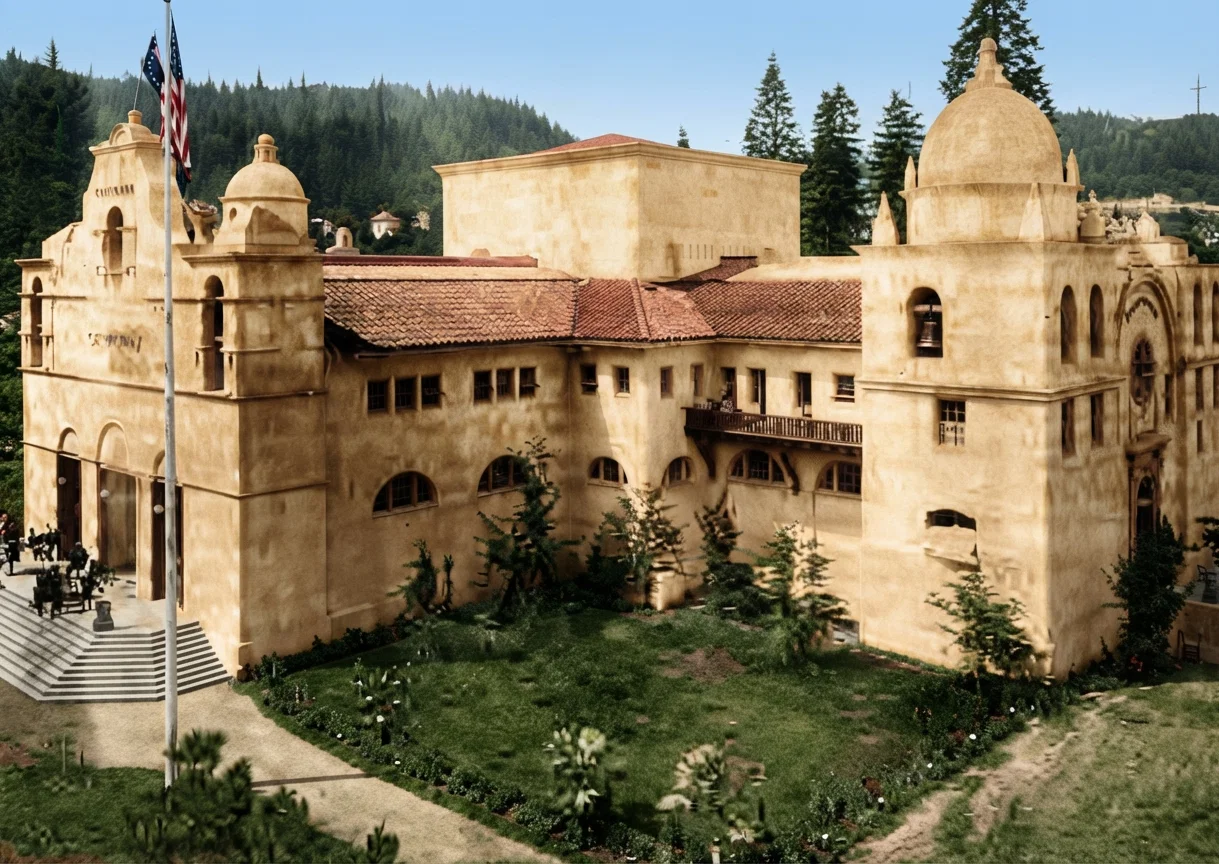
California Building at Lewis and Clark Exposition, Portland, Oregon.
"But I would like to read," said Mrs. Wilber, "of a divinely appointed memorial of the resurrection of Christ, if there is any such thing other than the observance of Sunday."
Sister Hartman hastily turned to the sixth chapter of Romans, and handed the book to Mattie who read the fourth and fifth verses slowly and thoughtfully, while Josie looked over her shoulder.
" 'Therefore we are buried with Him by baptism into death; that like as Christ was raised up from the dead by the glory of the Father, even so we also should walk in newness of life. For if we have been planted together in the likeness of His death, we shall be also in the likeness of His resurrection.' "
"It seems plain to my mind," said Brother Hartman, "that this scripture teaches us that even as Christ died on the cross, we are also to die to sin; and as He was buried in Joseph's new tomb, we also should be buried beneath the watery grave in baptism (not by sprinkling, which is no burial), and that as Christ was raised from the dead, even so we are raised from the watery grave of baptism, that we may henceforth walk in newness of life, having thus publicly acknowledged our faith in a buried and risen Lord. This seems to me wonderfully appropriate and beautiful. How could it please the Lord to give us a day of rest to commemorate the most wonderful work in all the plan of redemption? Can a day of REST be an appropriate reminder of a day of most intense activity, both among the heavenly hosts and amid the church of Christ on earth?"
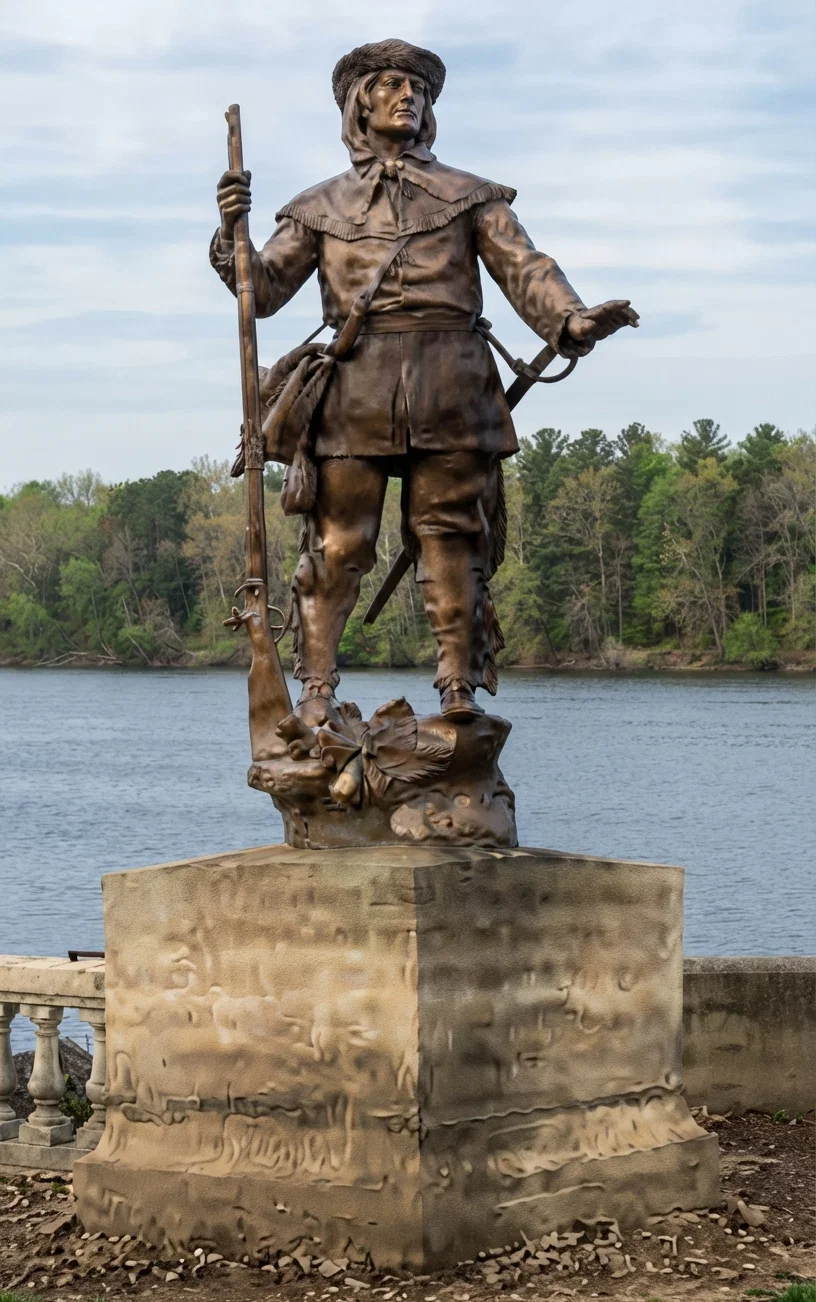
Capt. Meriwether Lewis, born 1774, died 1809.
"Well, wife," said Mr. Jones, "I, for one, must acknowledge that this appears to me exceedingly reasonable,—I never thought there was so much to the subject."
"I think there is another text in Col. 2:12," said grandma, "which seems to prove conclusively that instead of our being commanded to observe the resurrection day as a Sabbath, the ordinance of baptism was given to us, that we might, by properly observing this ceremony, prove before the world our faith in a risen Redeemer."
Elsie had turned to the text, before grandma had done speaking:—"Why, grandma, I never noticed that text before, really, father, it's a good one; I will read it:
" 'Buried with Him in baptism, wherein also ye are risen with Him through the faith of the operation of God, who hath raised Him from the dead.' "
"I think I can see in this text," said Walter Grey, "a very close connection between baptism and the resurrection of Christ."
Mrs. Wilber said nothing; but Grandma Hartman believed she could see in her eyes the dawning of a new light.
(To be continued.)

COME INTO THE SUNLIGHT.

BY ELIZA H. MORTON.
WHY sit in the deepening shadows When the heavens are aglow for thee? There's warmth in the brilliant sunshine And a promise of things to be; Each ray in its gorgeous brightness, As it lingers about thy feet, Is a chord in a perfect anthem, Is a melody most sweet.
That song is the song of nature, And thy heart may be catching the tune Of winds, and of rippling streamlets, Of the birds and sounds of June.
O, come where the star-flowers blossom, Where the pinks and the roses grow, O, come where, with faith and courage, You can look on the vale below.
O, come where the sun is beaming, Till the earth with its light is o'erspread, O, come where the angels linger, And the glory of God is shed.
North Deering, Me.

AT THE LEWIS AND CLARK EXPOSITION.

THE purchase of Alaska from Russia was looked upon by many, at the time of the purchase, as a bad bargain for the United States. The first thought that comes into the mind of people generally, when Alaska is mentioned, is the thought of ice, frost, snow, and blizzards. But Alaska has been a surprise, even to her purchasers. Wonderful and valuable things are being brought out of those bleak regions.
Among the interesting exhibits that Alaska furnishes for the Portland Fair is the ivory obtained from whales and walruses, which has a market value of a dollar a pound. There are some specimens of ivory which came from prehistoric animals, and are presumed to be about 6,000 years old. This ivory is found on many creeks, in many cases partly buried in the frozen earth, and comes sometimes in pieces ten or twelve feet long. The ancient ivory is found all the way from Dawson to Nome. In some cases it is partially decomposed, but in general it is hard and firm, and is nearly as valuable as the new ivory.
Skagway has en route a remarkable collection of vegetables and wild flowers of the kind which most people are not accustomed to associate with Alaska. Rampart, one of the newer camps, where hydraulic mining is being carried on most successfully, has shipped one of the finest collections of minerals. From Tanana will come an unusually interesting timber exhibit. Tanana has almost unlimited timber resources, which, as yet, are undeveloped. Important among these is a prolific growth of wonderfully fine birch, which grows in that far northern land to a diameter of from twelve to eighteen inches, and is of perfect grain. When Alaska's exhibits are all in place at the Fair, there will be a wealth of fur exhibits; for that country abounds in fur-bearing animals. Alaska also has her educational displays, with portraits of teachers and students, and pictures of school buildings, which tend to dispel the impression that Alaska is entirely wild and rough. There are samples of some marble which one day will be a principal product of this land of gold.
Case after case of ores and nuggets convince the editor that, regarding the mineral wealth of Alaska, the half even yet has not been told, while the large variety of ores, including copper, tin, zinc, and iron, impresses one with the versatility of the mineral resources. There are also a number of glass jars filled with crude oil, which tell of another great possibility as yet but meagerly investigated.
One of the most interesting exhibits at the Exposition is furnished by the national government. It illustrates the work now being carried on by the Agricultural Department for securing a definite knowledge of the soil and agricultural possibilities of every square mile of the United States. This work will take eighteen years, and will cost at least $6,000,000. When the work of the Bureau of Soils has been completed, it will be possible for a man intending to purchase a farm to write to the Department of Agriculture, and secure from that department a detailed map of the section in which his farm is located, together with a description of the section. Then, by looking up his intended purchase on the map, and consulting the descriptive booklet, he can determine to a nicety its value. The map will show by different colors the nature of the soil, while the descriptive booklet will tell its value, which has been determined by examination of the soil, study of the railroad facilities, and examination of the markets and other qualifying conditions. The soil maps and booklets will enable many farmers, who have been only partially successful, to learn wherein they have failed by trying to raise crops unadapted to the nature of their lands, and will instruct them as to what crops are best suited to their farms. It will instruct them, also, as to the best methods of cultivating soils of different kinds.
The Soils Division was established as a separate bureau of the Department of Agriculture on July 1, 1901, and since that time its force has been increased more than twelvefold. Up to Dec. 31, 1904, the Bureau has mapped 88,855 square miles, in small patches scattered over the whole United States, and it is estimated that eighteen years more will be required to complete the work.
The investigation of the soils is conducted in this wise: Selecting some town in the area to be surveyed, the party goes out in the fields, and takes frequent borings. They examine the material carefully, noting the texture, whether sand, silt, or clay, the changes which take place at varying depths, the presence of gravel, the drainage conditions, and the character of the crops or native vegetation. Moving forward in its work, if the party finds that the material changes, either in the surface soil or in the subsoil, sufficiently to influence plant growth, the character of this change is noted, and the boundary lines between the two types are traced out. Separate samples of the soil and subsoil are sent in to the Bureau's laboratories, where painstaking examination of them is made.
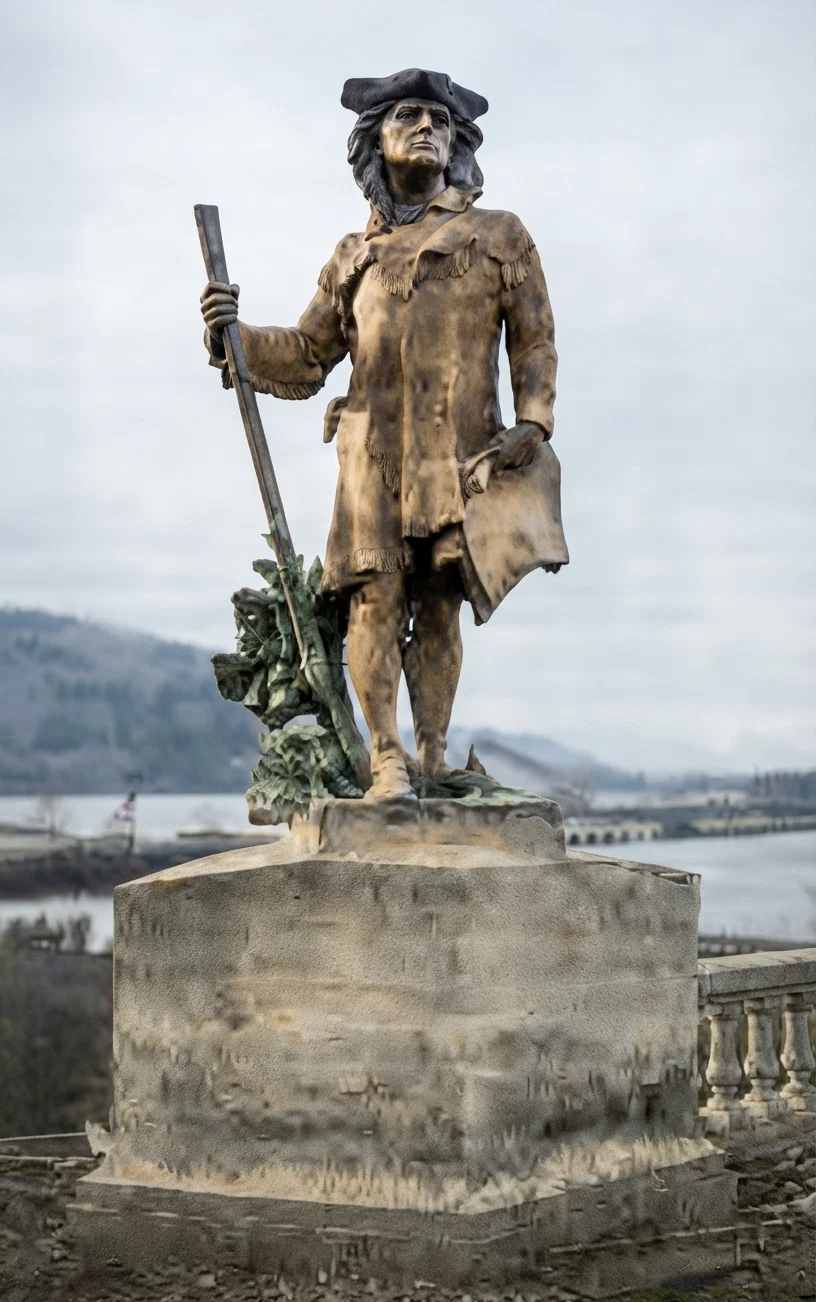
Capt. William Clark, born 1770, died 1838.
At the Lewis and Clark Exposition, the manner in which the work is carried out is shown in an interesting way by means of maps and models. The exhibit has attracted a great deal of interest among farmers in the Pacific Northwest and those from the East who have come to the Fair.
In the United States Government Building at the Lewis and Clark Fair there is a model which shows, in a clear and interesting way, how land at present worthless, on account of the alkali salts which it contains, may be made extremely valuable by the removal of these salts, which, in many cases, were brought in by over-irrigating the land. The plan adopted, as most practical, is one whereby a drainage system, preferably by means of tile drains, is used. The alkali area is flooded by irrigation methods, and then drained, so that the alkali salts are washed out of the land. For the purpose of demonstrating the efficiency of this method, the Bureau of Soils is under-draining and flooding tracts of land near Salt Lake City, Utah; North Yakima, Wash.; Fresno, Cal.; Tempe, Ariz.; and Billings, Mont. At Salt Lake City and Fresno the experiments have already proved so successful that good crops were grown on the formerly worthless lands during the season of 1904.

SUNSET MAGAZINE

DESCRIBES

California

Not only California, but all the great West, is truthfully described in the beautifully illustrated pages of this virile Western monthly. Its fine half-tones make you SEE the country, while its descriptive and industrial articles TELL YOU EXACTLY what is to be found there. It is

"Opportunity"

in visible form, for it shows the wonderful chances for success now open in the new West for wide-awake people.
If your news dealer doesn't carry SUNSET, send us his name and address and write for sample copy.
HOME OFFICE: 431 California St. San Francisco, California.

THE NORTHWESTERN LINE

RUSSIA-JAPAN ATLAS.

Send ten cents in stamps to R. R. Ritchie, No. 617 Market Street, San Francisco, for Russo-Japanese War Atlas, issued by the Chicago & Northwestern Railway, three fine colored maps each 14x20, bound in convenient form for reference. The Eastern Situation shown in detail with tables showing relative military and naval strength and financial resources of Russia and Japan.

For Rent

FOR RENT.—At St. Helena, Cal. Near the Sanitarium and Food Factory,—Two Suites of Rooms, with or without furniture.
Address Mrs. W. C. White, Sanitarium, Cal.

WANTED.

A CHRISTIAN housekeeper. Have two small children; a seven-roomed house supplied with water and gas. Street-car passes the door. Address, with references, Merton Everett Jones, Reynoldsville, Pa., Box 265.

GENERAL AGENTS WANTED.

To REPRESENT the E-Z Washing Tablets. Either sex local agents. Terms free. Sample for sufficient for one month's washing for ten cents, stamps or silver. An honest article that any one can sell. Address,
Alfred Mallett, Elkridge, Baltimore, Md.

FOR SALE AT A BARGAIN.

New, modern one story six-room cottage, with half or full acre of land; one block from Fernando College, Fernando, Cal. Several naval orange trees in bearing. Other fruits. Palm and other ornamental trees. An abundance of flowers at all seasons of the year. Good mountain water. It is safe to say, Fernando College offers unusually reasonable terms along educational lines. For price and full particulars address, S. Thurston, Toluca, Cal.

WANTED AT ONCE.

Two or three consecrated Seventh-day Adventist young ladies to wait table in Vegetarian Café. Address, S. J. Lashier, 105 Sixth St., Portland, Ore.

Abiding Spirit

ABIDING SPIRIT.—By the late Mrs. S. M. I. Henry. The object of this book is to show the necessity of having the help of the Holy Spirit in the performance of the common and every-day duties of life. Plain, cloth . . . . . . . 40c. Gilt edges . . . . . . . . . . . . . . . . . . . . . . . . . . . . . . 75c.
Address PUBLISHERS OF THIS PAPER

How Much Better It Would Be!

General Miles has said: "The contrast between war and peace is illustrated by the fact that what has been expended on the Philippines would have put water upon every quarter section of arable land in our country where it is required; it would have built for the farmers a splendid system of good roads, or for commerce two ship canals across the isthmus." And the National Daily Review remarks: "This item of foreign outlay, coupled with the fact that the $96,000,000 spent every year on our navy, would give three years' schooling to each one of our 6,000,000 illiterates over ten years old, gives peace an economic value." There are now said to be 2,000,000 children under sixteen years of age compelled to join the ranks of the breadwinners. The increase of child labor for the past twenty years of the last century was 100 per cent., double that of the increase of the population. Better spend more money for education and less for war.

Money and Social Standing

"Society" doesn't care much how a man gets money, so he has it and knows how to add to the general enjoyment. It is said of the man who has just been forced from the management of the Equitable Life Insurance Society because of illegal business methods, that he "is having the time of his life socially, being invited everywhere."

It is True; Apply It.

The Herald of Gospel Liberty says editorially:
Brethren, when you discriminate among the principles of the New Testament, and suppress emphasis on some doctrines that God and His Son seemed to consider important, and say that they need not be defended, you are unwise, even from the worldly standpoint.
Now, brother editor, why not put this in practise? Why not make emphatic as did our Lord and His apostles the inviolability of the Law and the Sabbath; and the importance of Christ's second coming? Surely these are made emphatic and important. If this were done by the Herald, its antinomianism would be obliterated.

OUR FORTHCOMING SPECIALS.

THE SIGNS OF THE TIMES is set for the purpose of giving the last Gospel message of Revelation 14 to the world. And it gives it week by week, number by number. Yet that message is so broad, so comprehensive, that it is impossible to scarcely more than touch it in one issue. In fact, it takes an entire volume of the paper to develop that great message at all adequately.
Yet there are many who wish it presented in its various phases briefly. To do this, we propose to issue, beginning with the first week in October, four "Special Message" numbers, as follows:
  1. The Sure Word of Prophecy and Christ's Coming.
  2. The Sanctuary, The Gospel in Type and Antitype.
  3. The Law, the Gospel, and the Sabbath,—"The Whole Duty of Man."
  4. The Church Triumphant.
The above titles express only a part of that which each number will contain. Here is a suggestive list of the main articles so far as developed:

I. PROPHECY AND CHRIST'S COMING.

  1. Object of Prophecy.
  2. Prophecy May Be Understood.
  3. Importance of Prophecy.
  4. Alphabet of Symbolic Prophecy, Daniel 2.
  5. God's View of the Nations, Daniel 7.
  6. Christ Will Come Again. How? When?
  7. What His Coming Means.
  8. Christ Our Life.
  9. The Only Power That Can Save, Acts 4: 12.

II. THE SANCTUARY,—THE GOSPEL IN TYPE AND ANTITYPE.

  1. The Gospel in Type.
  2. The Sanctuary and Its Lessons.
  3. The Priesthood in Type and Antitype.
  4. The Day of Atonement and the Judgment.
  5. The Wonderful Book—The Seven Seals.
  6. The Closing Work of Our High Priest.
  7. The Great Apostate Powers, Revelation 12 and 13.
  8. Signs in the Heavens.
  9. A Message of Preparation.

III. THE LAW, THE GOSPEL, AND THE SABBATH,—"THE WHOLE DUTY OF MAN."

  1. The Eternal Law, The Everlasting Gospel.
  2. The Bible Sabbath.
  3. The First Day of the Week.
  4. The Broken Hedge, Sabbath Changed in the Church.
  5. Babylon—Its Character.
  6. Principles of Babylon in Succeeding Ages.
  7. The Reformation and America.
  8. Encroachments on Freedom—Beast, Image, Mark.
  9. Great Field of Prophecy.
  10. Signs in the Earth.

IV. THE CHURCH TRIUMPHANT.

  1. A Spirit-Filled Church.
  2. Requisite Conditions to.
  3. Spiritual Gifts.
  4. The Apostasy.
  5. The Great Center of Sanctuary Service.
  6. The Seal of God—Sabbath Restored.
  7. God's Last Great Protest.
  8. A Church Restored, and Triumphant.
Besides these our Home department will be full of precious instruction. There will be Bible-Readings, poems, music, if there is room, many illustrations. Each number will have a specially-prepared front-page cover-design, attractive and appropriate to that issue.
This series ought to have a circulation, at the least calculation, of half a million. More about it in the future.

The Sabbath—the Sunday—the Greek.

In last week's issue there were two articles on the Sabbath question, one in our editorial department, and the other in the general articles, entitled, "The First Day of the Week." The latter presents the testimony of modern scholars as to the correct translation of the Greek original of "the first day of the week." We hope that it may be read. We wish, however, to present briefly other evidence as to the correct rendering of the Greek by the term "first day of the week." We have before us the commentaries of Clarke, Olshausen, Scott, Alford, Barnes, and others. These men, all first-day observers, made a word-by-word study of the Scriptures, some of them in the original; but never once do they intimate that any other rendering than the common one is admissible. In other words, they do not question "the first day of the week." The translators of the King James Version were all observers of the first day and scholars; but there was union in the rendering given in our common version. The English Revisers, all first-day observers and all eminent scholars, came to the same conclusion. The American Revisers, with a more careful and critical study of years longer, with every honest inducement for them to furnish support for Sunday observance if the original held it, could not do otherwise than render mian sabbatōn by the term "first day of the week." There are many others. It may be safely said that all the scholarship is on that side; and that is the Bible side.
Continue reading: Sunday Laws and Persecution