In our study of the land animals we now come to those with which we all are more or less familiar. Listen! Do you hear that gnawing sound in the granary? Yes; that is a familiar sound; it is a mouse which is biting off small pieces of wood, not to satisfy its hunger, but rather that it may get into some wheat- or corn-bin, where it can find an abundance for itself and family. Sometimes mice make the opening into the bin in such a place that nearly all the grain runs out. Although the mouse makes the farmer a great deal of trouble, it asserts its right to have a life of happiness and freedom, as well as other creatures that God has made. But in spite of this thousands of these creatures are killed every year by the curious little device, the mouse-trap. Will a cry of mercy ever be raised for these little innocent creatures as well as for the birds?
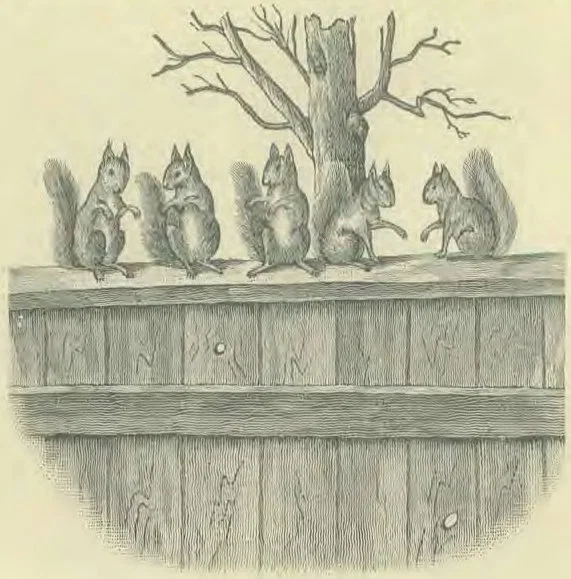
SQUIRRELS.
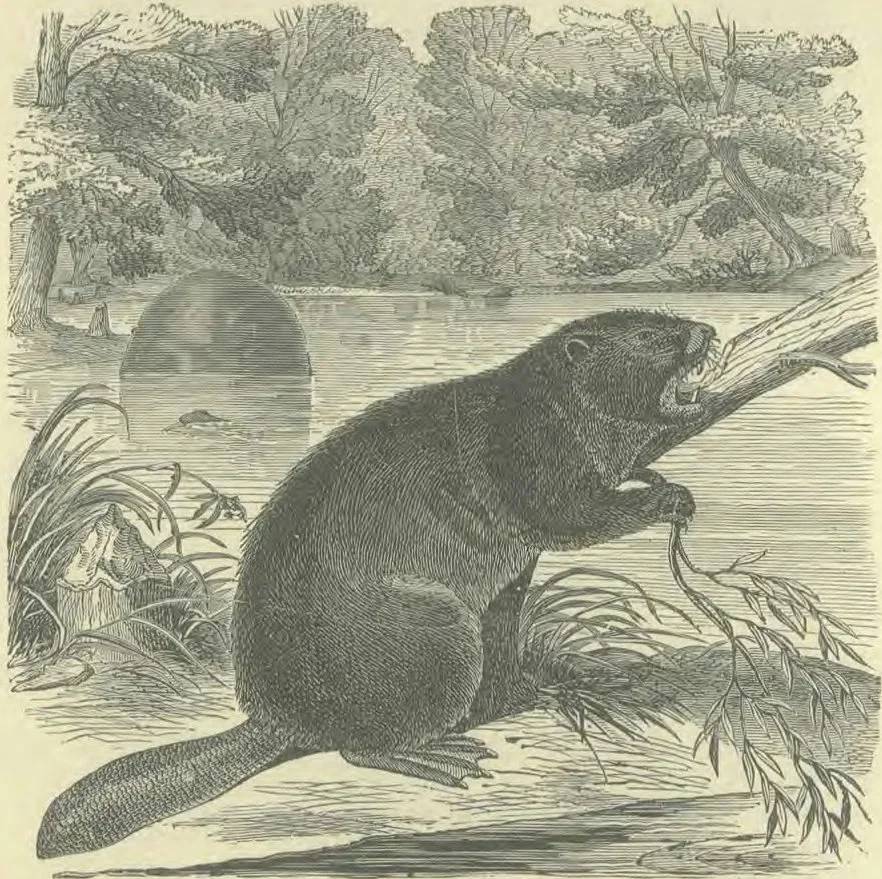
THE BEAVER.
The Gnawing Animals are numerous, and are to be found everywhere, even on board the ships that navigate the seas. Mice, rats, squirrels, beavers, rabbits, and hares are the most important ones, and I shall have a few words to say about each; but before I describe them, I want to speak of their teeth, which enable them to gnaw so readily, and on account of which they receive their class name, Gnawing Animals. You will remember that our last study was about a class of animals that had no teeth, or if any, they were few and poorly developed. It is not so with the Gnawing Animals; for they have very long, sharp teeth, which are well fitted for their work. You have often seen the squirrel sitting on its hind legs, holding a nut between its fore paws. What is it going to do with that hard nut? In a few moments it makes a hole in the nut large enough so that it can extract the rich meat within.227
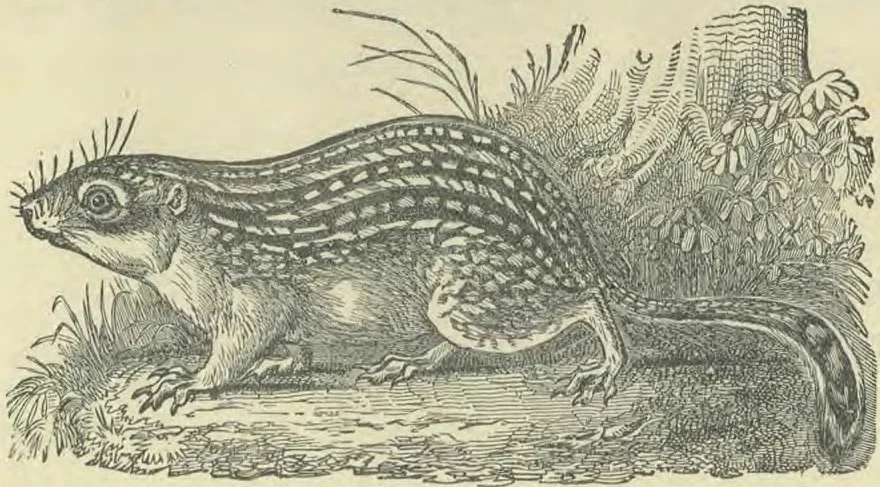
The majority of the Gnawing Animals live upon grains and nuts. Among these may be mentioned the mouse, rat, squirrel, and gopher; but others, such as the rabbit, hare, and beaver, live upon roots and the bark of trees. The teeth of the beaver are not only made to aid in eating, but they are also the tools with which it fells the trees to build the dam. You see that its teeth are an ax, with which it slowly but surely cuts down large trees.
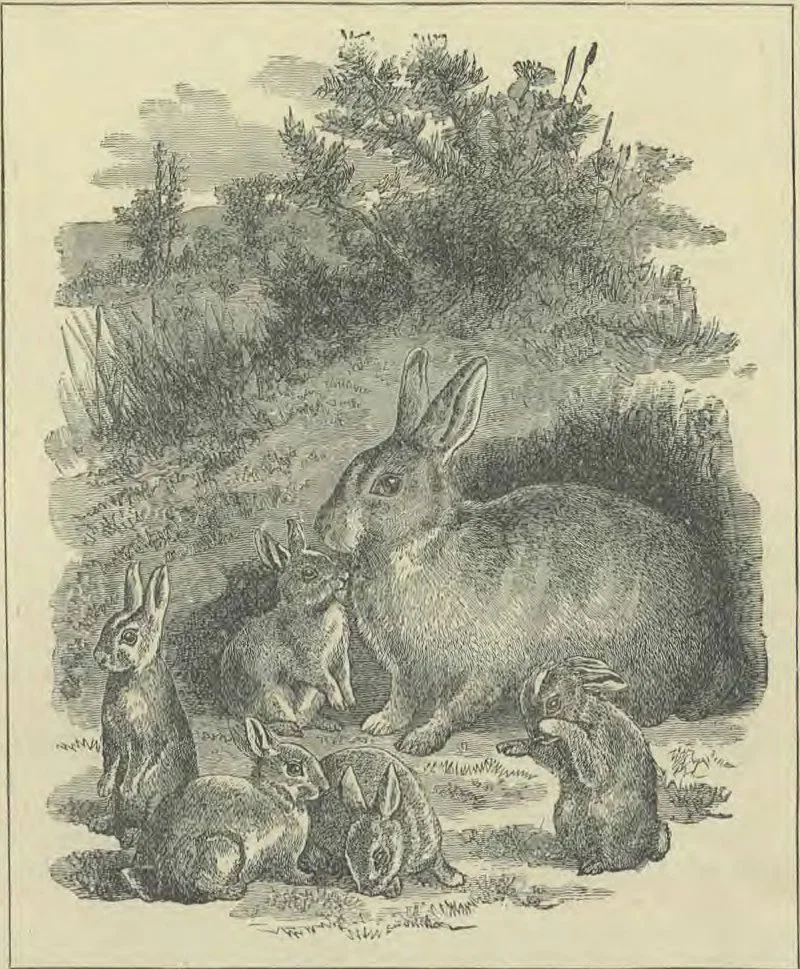
The rabbit does not use its sharp teeth in the summer so much as in the winter. In the winter it lives upon the bark of trees, while in the summer it feeds upon grass and leaves. It is an innocent and harmless animal, possessing no spirit to quarrel and fight. It has long ears, which enable it to hear very acutely. It usually builds its nest under ground, making it out of leaves, grass, and fur from its own body.
The squirrels are a lively family of animals, living mostly in the trees, where they build their nests out of leaves and sticks.
THE RABBIT.
GROUND SQUIRREL.
Squirrels and rabbits are often tamed, and become nice pets.
Many chapters could be written about each one of these gnawing animals, but I must leave you to observe and study the ways and habits of these animals during the summer. M. E. CADY.
The True Success of Life
THE success of life,—the only success in the true sense,—lies in the quality of living day by day, and not exclusively in achievements, and still less in acquirement of possessions. We can live in aspirations, in good will, in generosity, in love, amid the most limited, narrow, and trying circumstances.— Selected.
Truth Will Rise Again
TRUTH, though trampled in the dust, will rise again.
“THE POWERS OF THE AIR.”
By Ruth Gardener
As the children were ushered into Aunt Ruth’s own room for their evening talk, they saw on the table three mysterious-looking glass jars, and other strange-looking vessels with crooked necks and downward-bent tubes, or pipes.
Mama was given the honored seat; for she, too, was anxious to hear Aunt Ruth’s talk on the powers of the air.
Walter was into the mystery; for he had been auntie’s assistant, all the afternoon, in preparing for the evening lesson. Aunt Ruth was only an amateur chemist, and her equipments only such simple apparatus as would illustrate the elementary laws of natural science.
She smiled at the eager expectation and wonderment portrayed on the sweet young faces before her. The thought of opening “the eyes of their understanding” to the mysteries of God’s natural world was an inspiration to her loving heart, and she began to talk in a simple, easy manner.
“We are to learn something of the nature and powers of the atmosphere in which we live, and also something about the water so necessary to our life and comfort. Let us see just how much you already understand about the air and its uses. Edith, what color is the air?”
“Why, auntie, it has no color. We can not see it,” said Edith, with some surprise.
“If we can not see it, it is —?”
“Invisible,” supplied Walter.
“Yes. Harold, what does it taste like?”
“I can’t taste anything, auntie.”
“Then it is tasteless, or insipid. Here are two things, then, that we understand about the air. If we can not see it nor taste it, how can we know the presence of air?”
“We can see what it does,” declared Harold, confidently.
“What can you see that it does?” asked Aunt Ruth, to which the children replied, in turn.
“It rustles the leaves of the trees.”
“It blows out the light when we go in a draft.”
“It whirls my pin-wheel.”
“It takes the kites away up in the sky, and whirls the dust and dead leaves around.”
“Good,” said Aunt Ruth. “Can you feel the presence of the air?”
“Yes, when the wind blows,” answered Harold.
“Yes; and you can feel the soft, billowy pressure of the air at any time by waving your hands through it.”
Suiting the action to the word, the children felt the air with their fan-like hands.
“Now, children, you must know that, although the air is invisible, it is a real, tangible substance, yet it is composed of gaseous atoms so minute that millions of them could be crowded into a thimble. These atoms are constantly rolling on one another, which they can do with the greatest of ease, so that the air is constantly in motion. You can notice this very plainly if you will watch a ray of sunshine pouring through a knot-hole in the barn, and see the dust atoms float in the constantly moving air. You can not make a motion so slight but it produces little waves, currents, and eddies in the billowy, elastic substance of the air, which will affect every particle of it in the room.”
“Is the air elastic, like rubber?” asked Harold.
“Yes; it is much more elastic than anything you can think of. Here is a small glass cylinder—a tiny air pump, with a graded register. It is like your pop-gun, Harold, with the nozzle closed up. Do you see this piston, like the plunger of a common pump, half way down in the cylinder? I have fastened the valve in this plunger, so that the air can not escape through it when I push downward on the piston, as it does in the pump-plunger. You see the air below is a prisoner. Now, Walter, please use this handle, or piston-rod, and push down on the piston, and let us see if we can squeeze, or compress the imprisoned air in the pump.”
Walter exerted his strength until the piston descended in the cylinder a full inch. A ripple of satisfaction passed from lip to lip, and Aunt Ruth said: “You see, dear children, that the air is highly elastic, and can be compressed. It is by compressed air that you shoot the wad from your pop-gun, Harold; and it is by the same means the great explosive shells are forced from the cannon-bore, and are hurled for miles into the enemy’s camp. Now, Walter, pull on the piston-rod, and we will see if air will stretch. Ah, that was easy,” as it slipped back to its normal position. Then, with a long, steady pull he brought the piston up in the cylinder an inch above the normal, but it took all his strength to hold it. Aunt Ruth continued: “Now that the air is stretched to fill so much more room in the cylinder, it must be much more thin and rare, must it not? We have learned229by this experiment that air can be compressed, or condensed, and also expanded, or rarefied.”
“There are other things to learn about the condensation and expansion of air. I have here a small, deep copper can, filled only with air, and I have tied a web of thin rubber over the top, so that the air can not escape. Now let us see what a little heat will do for the imprisoned air within.”
The children watched with intense interest as Aunt Ruth lighted a small alcohol lamp, and held the vessel, by its long handle, over the blaze. Gradually the heated air swelled the thin rubber covering until it seemed as if it would burst. At last, by a puncture from Aunt Ruth’s needle, it escaped with a sharp hiss, and the rubber bubble collapsed. This called forth enthusiastic applause from the children, while Aunt Ruth tied another rubber on the top of the vessel, and told Walter to put it out where it would get the benefit of the freezing air. In the morning the rubber top was sunken and hollowed inward.
“Well,” continued Aunt Ruth, at last, “we have learned several things about the nature of air. Walter, will you recapitulate, and let us see how far we have gone?”
“Air,” said Walter, “is a very elastic gaseous substance, invisible, tasteless, capable of compression and rarefaction by the application of force, and of shrinkage, or contraction, and of expansion, by the action of heat and cold.”
“Excellent,” said Aunt Ruth, much pleased. “You have learned something of the power of compressed air. Now we will test the weight of the air at its normal, or natural, density. Here is a large air-pump. Place your hand over the mouth of the jar, Edith, while I pump the air out of the jar under your hand. You will then be able to judge of the weight of the air pressing down on the top of your hand.”
Edith placed her hand on the mouth of the air-pump, and Aunt Ruth gently pumped one stroke.
“O Aunt Ruth, stop, please! It will crush my hand,” cried Edith, in alarm.
Walter, who was determined to test the weight of air, bore three strokes manfully, though it seemed as if the great pressure would crush his hand into the jar.
“There, Walter, you have tested that sufficiently. What does this prove to you?”
“Aunt, is that really the weight of the air that bears down with such power on my hand? It seems as if something below was drawing my hand into the jar by suction.”
“Suction, Walter, is the removal of the air-pressure on one side of an object. You can not feel the weight of the air; for it presses you on all sides alike; but when you remove that equal pressure from one side of your hand, you realize its power on the other side.”
“And does the air press upward as well as downward?” asked Edith.
“Yes, Edith, and horizontally as well as vertically. In fact, its elastic pressure is in every direction equally. This we can prove by inverting the air-pump. You will see that the pressure is the same. It is tritely said that ‘nature abhors a vacuum;’ and when a void is created by pumping out the air, nature rushes to the rescue, trying to fill up the vacuum, hence the powerful pressure of the atmosphere at that point. This elastic, expansive pressure of the equi-buoyant air is estimated by scientists to be fourteen pounds to the square inch of surface, and God has made this pressure necessary to the preservation of our animal organism. I once heard of a scientific experimenter who cruelly placed a living mouse in a powerful air-pump, to watch the dissolution of its little body as the atmospheric pressure was removed. It literally fell to pieces. Cruel as this experiment was, it proves our dependence on atmospheric pressure for our very existence. But I think we must postpone our further investigation of this subject until to-morrow evening, at seven o’clock. RUTH GARDENER.”
WHY NOT SIMILAR ACTION EVERYWHERE?
It is cabled from Egypt that the government has decided to prohibit the sale of alcoholic liquors in the Sudan. Everywhere, and under all circumstances, rum is a curse. There is no element in human depravity that it does not stimulate. Nevertheless, the government of Egypt would do well to prohibit hashish. When we visited the only lunatic asylum in all Egypt, we found two wards entirely filled with hashish patients. A congress of European nations is to be held to discuss the liquor trade in West Africa. The use of liquor by the African negro is death. It is stated that the blacks have lately mastered the secrets of the moonshine still, and readily convert bananas into a fair imitation of applejack. As Christian nations took alcohol to Africa, they ought to do what they can to suppress its ravages. So far as that question is concerned, the Mohammedans present a contrast decidedly favorable to themselves when brought into contact with Christianity.—New York Christian Advocate.
HABIT OF THOUGHT.
By M.
How many young people ever think that it is possible to acquire good and bad habits of mind and thought? Yet it is not only possible but inevitable. It is impossible to live, and breathe, and move, and think without forming habits. There are proper and improper habits of breathing, correct and incorrect habits of walking, and of posture in sitting and standing, wise and unwise ways of eating, and drinking, and sleeping. In every occupation in life and in every situation we are confronted with the possibility of doing everything in a wrong way, and of becoming so fixed in the wrong habit that we at length become unable to do it right. This is just as true of the action of the mind as of the muscles, of the brain as of the stomach. But if all the physical organs of the body are given over to the dominance of bad habits, how can one expect the mind to be free? Indeed, it is certain in such a case that the mind will be under complete thraldom. So to have correct habits of thought one must begin with proper bodily habits. No one is a free man who is enslaved to any bad habit of body or mind. The only power that will enable any one to escape from this universal slavery that threatens every man is the gospel of Jesus Christ. Thus from the mental and physical point of view, no less than from the moral and spiritual, we find the truths of religion to be the foundation upon which life must be built.
M.
CREED AS AN AIM.
As the world grows older, creeds, dogmas, formulas, and catechisms have less and less power to control the actions of men. In this many good people see cause for serious alarm. The marvelous increase of knowledge and its wider dissemination among the masses have resulted in fastening the conviction in the minds of intelligent people generally that most creeds are man-made, and have neither divine authority nor sanction. The unfortunate thing about the general letting-down of confidence in the creeds is that many, while abandoning their one-time faith in them, also relinquish their belief in the fundamental and truly divine principles of religion. The young especially, through their inexperience and proneness to trust wholly to their own strength and supposed wisdom, are in grave danger of making this sad mistake. To them these words of the apostle Paul should appeal with special force: “Prove all things; hold fast that which is good.”
But no one, either young or old, is in a position to obey this admonition if he has subscribed to, and thereby hedged himself about by, some iron-clad creed, dogma, or formula, religious, political, social, scientific, or otherwise. He who has taken a fixed position that the world is flat is not capable of fairly weighing the different arguments that go to prove its rotundity; he can not “prove all things” relating to this subject. No more can he comply with this wise and beneficent rule in religious affairs, who incloses himself within an impenetrable wall of creed, it matters not how venerable nor how musty with the dank dust of ages that creed may be. He who has yielded himself unreservedly to the doctrine of predestination,—and allows himself to contemplate this tenet to the exclusion of all else, is in no position fully and fairly to consider any reasons that may be deduced from the Bible in proof of the belief in “free grace.” He who subscribes to the dogma that any churchly organization or any officials thereof have any authority whatever to withhold him from freely and fully investigating any question of religious belief, has dungeoned himself so completely that it is henceforth impossible for him to do as the apostle enjoins: “Prove all things.”
No true man will ever consent to be placed in a position, either by ecclesiastical or political decree, where he can not ever and always have the windows of his soul temple “open toward Jerusalem,” the glorious citadel of eternal truth. Whoever allows any dogma or formula of belief, whether it be religious, social, political, or of whatever nature, to intervene so as to intercept his vision of truth, is thus making creed his aim, hence the false deity to which he pays supreme homage and worship.
It is blind adherence to some set statement or system of belief and practise that makes possible the wide-spread evils, arrant abuses, and even high crimes, that often disgrace the annals of both church and state.
Not infrequently do we hear stump speakers and after-dinner orators, with more fervor than sense, propose this sentiment: “Our country right or wrong, our country.” So also do those high231in ecclesiastical circles, by actions, if not by word of mouth, sometimes declare, “Our church right or wrong, our church.” By so doing, the latter dishonor the cause of true religion and its divine author, as the former dishonor their country, and true patriotism as well.
The best, most enlightened, and, it may be said, the most reverential, scholarship of our day holds, and with the best of evidence, that not one of the apostles of Jesus had anything whatever to do with, and in fact knew nothing about, the so-called “Apostles’ Creed.” This document was devised several centuries after they were all dead, when church dignitaries, conscious of their own barrenness of the spiritual power so abundantly manifested in the early church, devised ingenious dogmas and creeds, with which, if possible, to hold the allegiance of the people.
The truth regarding creeds in the early church is, as Sir John Lubbock has well observed: “Collect from the Bible all that Christ thought necessary for his disciples, and how little dogma there is.” How beautifully simple, yet how all-complete, is the creed of Christ: “By this shall all men know that ye are my disciples, if ye have love one to another.” Again, speaking through his disciple James, Jesus defined true religion thus: “Pure religion and undefiled . . . is this, To visit the fatherless and widows in their affliction, and to keep himself unspotted from the world.” What need of creeds have they who make this divinely inspired sentiment of the prophet Micah their own, both in faith and practise: “And what doth the Lord require of thee, but to do justly, and to love mercy, and to walk humbly with thy God?”
The supreme need of the hour is this: less trust in creeds and isms and a return to the artless simplicity of the gospel of Jesus. Very truly has Dean Stanley observed: “The error of Christendom has far more usually been that it has not thought of Him [Christ] half enough; that it has put aside the mind of Christ, and taken in place thereof the mind of Augustine, Aquinas, Calvin,—great in their way; but not the mind of him of whom we read in Matthew, Mark, Luke, and John.”
VINE-COVERED WALLS.
By M.
THERE is a prevalent notion that ivy and similar climbing plants that cling to the wall by rootlets make the walls which they cover damp. This is an erroneous belief. The reverse is the fact. Quantities of water are evaporated daily from the extensive leaf surface of these vines. This is in some degree drawn from the soil about the foundations where the roots run, but to a large extent also from the walls themselves, through the little clinging rootlets, which penetrate every crevice. Besides, the leafy covering acts as a thatch to shed the rains and mists and snows from the walls, and protect them also from the direct beating of the storms. This is proved to be true by the practical demonstration of the condition of many of the old European ivy-covered ruins, in which the joints have been found so perfect and the mortar so hard and dry that it was only with much difficulty that they could be torn down.
Climbing vines, if properly cared for, add greatly to the appearance of a house; and upon a stone or brick house there is no reason why they should not be permitted to grow and spread, both for their beauty and their protection. Care should be taken, however, that the vines do not obstruct any gutters or conduits, and by causing them to overflow upon the walls produce dampness. Only a little pruning and training are needed.
The beauty of the spring-time, with all its growing things, will soon be here,—and not the least of these is the vine on the wall. M.
BLESSED ARE THEY.
By M.
How easy it is to see that the apostle John loved Jesus! He takes such a joyful satisfaction in referring continually to the personal presence of the Saviour with himself and his fellow disciples. In the first chapter of his Gospel he says: “And the Word was made flesh, and dwelt among us (and we beheld his glory, the glory as of the only begotten of the Father), full of grace and truth.” In the first chapter of his first epistle he reiterates and amplifies the same thought with an added stress of feeling, born of years of meditation and experience, filled with a loving recurrence to the memories of his personal human association and fellowship with Jesus. With what joyful assurance he says, “We have seen with our eyes.” “We have looked upon, and our hands have handled” “the Word of Life.” “The life was manifested, and we have seen it.” “That which we have seen and heard declare we unto you.” This is “the message which we have heard of him, and declare unto you.” To all those who read and hear these glad words of John is addressed that promise which Christ incorporated in his gentle rebuke to Thomas, “Blessed are they that have not seen, and yet have believed.” M.
HOMES FOR OUR FEATHERED FRIENDS.
By W. K. Loughborough
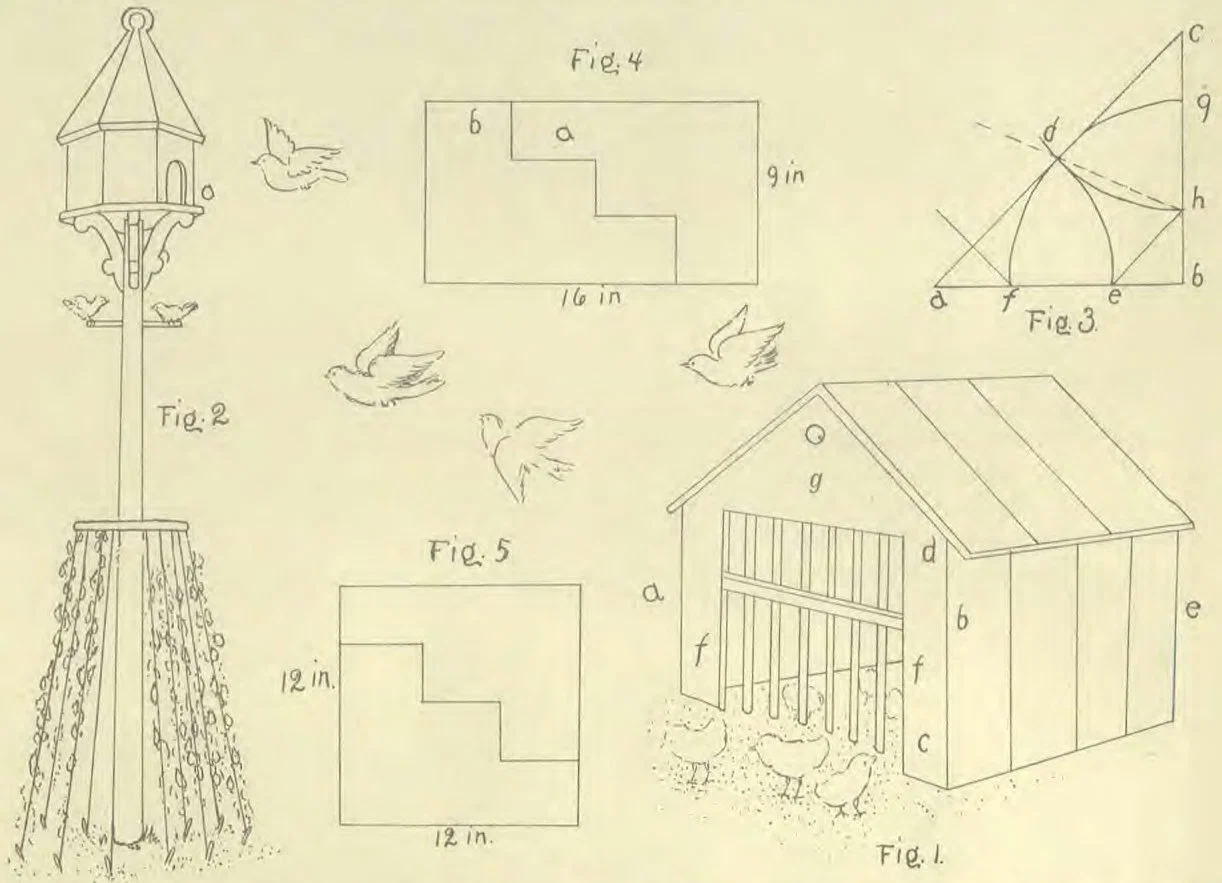
Well, boys, in our illustrations this week you will see a dove-cote and a chicken-coop. It is well to provide suitable homes for our feathered friends. The coop illustrated by Fig. 1 makes a comfortable abode for the chicks. In this coop is no floor. The measurements are: from a to b twenty-four inches; from b to e, across the sides, twenty-four inches; and from c to d twelve inches. The roof is what we call a half-pitch roof; that is, it is just as much higher in the center above the sides as one half the width, or twelve inches. The sideboards on the front, marked f, should be two inches and a half wide. Put a board across the top, as seen at g, and bore four holes in it for ventilation. In the back side of the coop make four similar holes, and put in a door about seven inches wide and eight inches high, through which the hen may be let in and out.
Across the opening in front, and about five inches below the board marked g, put a stick seven eighths of an inch by one and three-fourths inches. Bore six holes three fourths of an inch in diameter in this stick, and put in six round sticks, letting them run down to within an inch of the ground. This will make a neat coop.
In Fig. 2 you will see a dove-cote. I love to have some place for the birds; for they are great favorites of mine. I never shot one in my life. I have often thought what a happy day it will be when, with the curse removed, we shall hear the little immortal songsters warble their praises in the new earth.
To make the dove-cote here shown, you will need a pole sixteen feet long, and three or four inches in diameter at the lower end. If you will burn the lower end of the pole in a fire so that it will be a coal on the outside where it goes into the ground, it will last a good deal longer. I have some three-by-four-inch scantling posts that I served in this way, and set them out for grapevine trellises twenty-three years ago, and they are good yet. Shave your pole smooth, and nail on to the top of it a board about two inches larger than the cote will be. Saw out some brackets, and put under the board. About half-way up233the pole bore two holes, and put two round sticks through, as shown. Nail a nice barrel hoop on to the ends of these, drive some little stakes into the ground, and run some strings up to the hoop, for morning glories.
The floor of the house is octagonal. Fig. 3 shows a simple way of laying out an octagon of whatever size you may wish. Make the lines a b c of equal lengths and a right angle. Draw a line from a to c. Set one point of your compasses at a, and the other on the line a c at d. Then strike the circle down to e. Put the compass point at c, and strike down to h. A line from h to e will give you one section of the octagon.
For the sides get out eight boards six inches wide and about nine inches high. In one board cut a hole about four inches wide and six inches high, for an entrance (see a, Fig. 2). The edges of the boards should be beveled. Set your bevel on the line e h d (see Fig. 3) to get the right bevel. Nail the sides to the octagon bottom. You will need to put two screws through this bottom, to hold it to the board nailed on top of the post, as you could not nail the house on after it was made.
For the roof get out eight pieces about ten inches long and six inches and a half wide at the lower end. Taper them to a point, and nail them on, as shown in Fig. 2. These boards will need to be made narrower on the under side, to let them come together tight upon the upper side. Put a ball upon the top, and the cote will be complete when it is nicely painted. In Figs. 4 and 5 you have an answer to the last puzzle given you. The board twelve by twelve inches and the other nine by sixteen inches each contains one hundred and forty-four square inches. Cut the plank as marked in Fig. 4, and place a over b; you will then have Fig. 5. W. K. Loughborough.