Your ShelfYour Projects

The Youth’s Instructor, Vol. 47, No. 12.

We Have Made It Easy
Earlier text: THE GNAWING ANIMALS

SERPENTINE AND OTHER WALKS.

The class is marched down the center of the room in twos, then one each way. As they come round to the center, instead of turning to come down to the teacher, they pass on around the room, “weaving” in and out by clasping hands in this way: the ones who lead the lines, clasp right hands first; then they pass on to the next person, clasping left hands. The third persons clasp right hands; the fourth, left hands; and so on until the last person is reached, when the lines will have crossed each other. They can then march around the room until they meet, and the same exercise may again be taken. It is necessary to take short steps, and have plenty of room between the pupils. The special benefit to be derived from this exercise is chiefly in the alertness necessary to keep the line intact, and to act on the moment the individual part required. It is not easy to have this done accurately without considerable practise. When the teacher wishes to abandon this exercise, as the lines meet, she orders, “Down the center, two abreast!” or “Down the center, single file!”
For “statuary walk,” class should be in single file; music, very slow march. Class take position with right foot forward and body inclined well forward, but trunk erect, left hand on hip, right hand as shown in the accompanying cut—this on count “one—and.” On next count, order, “two—and;” the body is erect, with hands at side. These orders should be given very slowly that there may be time for the body to be poised like statuary, allowing the exercise of muscular control to be manifest. It will be noticed that those who do not have this control, will “wabble” about, unable to hold the body in the attitude described. This movement should be taken with the right foot forward, and right arm poised overhead, for several steps, or until the class has marched around the room once or twice. Then order, “Change hands and feet! one—and—two—and!” etc. Then the exercise is the same, except the change of left foot forward, and left hand poised over head, and right hand on hip. The third order for the statuary march is, “Right foot forward! Both hands up!” as in the illustration. Care should be taken to be easy in these movements, avoiding strain or stiffness, and to pay attention to the time. The teacher can assist the pupils in keeping time, by sharp spats of the hands, accenting each count. After marching with the right foot forward, change is made to the left, position of hands the same. The teacher should insist upon perfect symmetry of line in this class work, as, when properly taken, this exercise is not only a beautiful one, but is beneficial in many ways.
The “clasp-hand march” is a simple figure, but may be introduced by way of variety and also because of some beneficial movements in its execution. Class marches around the room in twos. On reaching the “rear center” of the room (room diagram will explain this term), the order is given, “Down the center, two abreast!” On reaching the teacher, she orders, “One each way!” As class marches around to “rear center” again, instead of coming close together in twos, the lines turn, on the order, “Down center! clasp hands! pull!” and come down the room about five feet apart, or allowing space enough in which to clasp hands and pull apart as they march down the center of the room. Care should be taken to keep the lines straight, and each should pull hard, but not enough to break the symmetry of the lines. On reaching the teacher, she orders, “Hands drop! One each way! march close to rear!” Each line turns back, marching close to the pupils in line, the leader of the left line turning to the left, and the leader of the right line turning to the right, both lines marching back, and meeting at “rear center.” They now clasp hands and pull apart, marching down the center again. Instead of marching back as before, the order is, “One each way, diagonally to rear!” The leader of the right line turns sharply to the right, with the eye on the corner of the room, diagonally opposite; and the leader of the left line turns to the left, marching diagonally to the rear, each leader then turning about, facing each other, marching on until meeting, when the leaders clasp hands, as follows (the others doing likewise as they meet in couples): the leader of the left line, with the right hand clasps the left hand of the leader of the right line, holding their hands straight up as far as possible, while the other hands are clasped loosely in front. Thus they march down the center of the room, as the order is given, “Down center, together! clasp hands! upward thrust!” The figure can be repeated if desired. Then order, “Single file! fall in!”
MRS. M. D. McKEE.

Overcoming the World and Its Anxiety

OVERCOMING the world implies overcoming a state of worldly anxiety. Worldly men are almost incessantly in a fever of anxiety lest their worldly schemes should fail. But the man who gets above the world gets above this state of ceaseless and corroding anxiety.—Charles G. Finney.

WATCHFULNESS

“BEHOLD, I come quickly” are words plain and clear; This message will comfort and strengthen and cheer. Be watchful, be prayerful, be honest and true, Be faithful in doing what He’s told you to do. C. F. Ladd.

GOOD FRUITS.

CHEERFULNESS, pleasantness, a bright and sunny temper,—these are some of the richest fruits of true religion. If our Christianity is worth anything at all, if it has any potent influence over our lives, if it is anything else but the feeble sentimentalism of a selfish and artificial piety, then it will make us “pleasant.” It will brighten our spirits, sweeten our manners, and tame our tempers. Almost the first indication of the new life is the desire to smooth over trivial but ugly difficulties, to promote a general feeling of kindness and simplicity, and thus to rob life of its dulness and bitterness and monotony. . . . And there is a certain kind of Christian effort which no committee can do, no organization can accomplish, no code of rules can help—it requires human touch. It can only be done by a smile, a welcome, a hand-shake.—Frederick A. Atkins.

MAKING HOME PEACEFUL.

XVI.

With the coming of the sultry days of summer, it was evident to James Beardsley that his father was surely failing. No one else seemed to have either the time or the inclination to note the trembling step, and the pale, worn face of the old man. When, indeed, he mentioned one morning that “father looked as if he had had a poor night of it,” Grandmother Sharpe remarked quickly that she hadn’t rested either, and she guessed other folks felt about as well as she did. It really seemed as if the poor old woman was cultivating the weeds in the garden of her heart, with more and greater success every day. Ah, how true it is that if we would make our gray hairs a crown of glory when age settles down upon us, and throws its hoary mantle over us, we must see to it that we are found in the path of righteousness.
There was a wonderful contrast between these aged people. The old deacon, with his kindly, dim eyes, and white hair, with his form bent, and his step tottering, had yet a voice as soft and gentle as a little child’s, and a laugh as hearty as a boy’s. A beautiful old man was he; for there is no beautifier like the peace of Christ. Grandmother Sharpe was tall, and straight as an arrow, and her gaunt figure seemed to grow more angular every day, and her voice to acquire an added degree of shrillness. There were two perpendicular lines between the straight brow,—lines plowed deep, more by the fingers of ill temper than by the hand of time,—which gave an additional fierceness to the small, deeply sunken, black eyes. Accustomed for years to speaking words of bitterness and jealousy, at last, perhaps as much from habit as anything else, they fell naturally from her lips, like sharp arrows, and, as the wise man says, like “a continual dropping in a very rainy day.” The sweet language of kindness and love was to her an unknown tongue.
Ah, how many Grandmother Sharpes are there in the world, and alas! in the church as well. Did you never meet one of them? did you never form the acquaintance of one of these unhappy people? Let us be kind to them; for God knows they are to be pitied, but they are not all old women; indeed, there are some of them who are still young, but upon their brows little furrows have been plowed by another than the finger of time; for ill temper is no respecter of persons; she writes her ugly autograph upon the brow of youth and the cheek of beauty. O, there are so many Grandmother Sharpes! Perhaps there is one living under your own roof, aye, more, it may be if you and I look closely into our own hearts, we may see her likeness there.
But, thank God, if there are Grandmother Sharpes, the world is not left without a few Grandpa Beardsleys in it. There are some upon whose shoulders the passing years rest lightly, and upon whose faces the finger of time leaves only a kindly imprint, whose silver hairs rest upon the noble head like a halo of glory, and through whose heart the peace of God flows like a river; whose saintly presence seems a benediction, and whose words, always fitly spoken, are indeed “like apples of gold in pictures of silver.” This is the sanctifying effect of years of “walking with God.”
One sultry morning in August, Grandpa Beardsley did not get up to breakfast. Janet said he had called to her as she was passing through the hall, and told her that he was so weak he was afraid to try to go down-stairs. “If you will bring me a thin brown slice of that nice toast of yours, Janet, I think I can eat it,” he had said, in a voice so weak and altered that the girl was startled, and hastened to tell her mistress. “Dear me!” exclaimed Mrs. Beardsley, with an impatient frown. “Mercy knows I’ve got enough to do to-day, and enough for you to do, too, Janet, without bothering with him. It’s queer, just because the minister and his wife are coming to tea, and I’ve got this great ironing on my hands, that I have to be hindered just now. I declare it is positively annoying. I wish, James, you would go up and see if you can’t get him down-stairs to breakfast. Tell him Janet has no time to fuss with making extra dishes,” she continued, carelessly. Ellen Beardsley was not as heartless a woman as she seemed; but her better nature had become so warped by selfishness that she did not herself realize how her cruel words rankled and burned in the heart of her husband, who replied, indignantly: “I shall tell him nothing of the kind, Ellen; I intend that my father shall receive attention when he is ill; if Janet can not prepare him a slice of toast, I will do so myself.” It was very seldom that James Beardsley expressed himself so forcibly to his wife, and she was quite stunned for the instant; after standing a moment, with brows elevated in astonishment, she called after her husband as he was climbing the stairs: “Of course Janet can make the toast; wait, Jimmie!” while she added to herself: “I can’t say the least little thing but he’s getting so he takes it so hard,—I wonder what’s the matter with him.”
What, indeed! ah, what will so gall and wear a tender, loving heart, as the perpetual nagging, whining, grumbling tones of those to whom we have given our love, for whom we labor, for whom we sacrifice, and for whom, indeed, we live!
“I’m so glad you came up, Jimmie!” exclaimed the deacon, in a weak voice. “I’ve wanted to see you alone for a long time,” grasping the hand of his son, and eagerly pulling him down to a seat on the bedside.
“What can I do for you, father? I hope you’re not suffering. We have another sultry day before us.”
“Suffering? O, no,—just weak, so weak; but you know, Jimmie, I’ve lived out my threescore years and ten, long ago; and by reason of strength I have even gone beyond the fourscore,—but I’m getting to feel that my strength is labor and sorrow.”
“I can’t bear to hear it, father; see, Janet has brought your breakfast, you’ll feel stronger when you’ve eaten.”
“I was just going to say to you, my son,” continued the old man when they were again alone, “that I am sure I shall not be with you long. Don’t be sad; ’t is better so. I am only sorry that I have been so nearly helpless for so long, and that I have caused Ellen worry and trouble by my blindness. But old age will come, Jimmie; it will come.”
“I am sorry that our home has not been a more congenial place for you, father; I have felt thus a long time, but I seem to be powerless.”
“I know how it is, Jimmie; you have done your best to make it agreeable for me; but, O my son, I may never have another opportunity of talking to you. My heart acted strangely all night, and I feel that the end is near; but I should not die easy if I did not entreat you to lose no time in erecting the family altar,—the altar of the Lord, which has so long been broken down.”
By this time the strong man was weeping silently; the gentle, melting Spirit of the Lord was softening his heart.
“I remember the time when I was converted all over again—mother and I. You and Jennie were young then, but I dare say you remember it. I wasn’t doing right in my family; and now you’re not doing right in yours. O my son, do let the Master make you all over again. He’ll make it easy for you to serve him again. He’ll carry you and your burden, too,—and—and you’ve got a heavy one, Jimmie. Yes,” he continued, prophetically, “the boy Reginald will give you much trouble; but God is mighty, and I trust the end will be peace.” Then clasping the thin hands reverently, and raising the dim eyes to heaven, the soft, trembling voice slowly repeated: “‘Thou shalt guide me with thy counsel, and afterward receive me to glory. Whom have I in heaven but thee? and there is none upon earth that I desire beside thee. My flesh and my heart faileth: but God is the strength of my heart, and my portion forever.’”
“God bless you, father; and God give you rest,” said James Beardsley, earnestly. “Your talk has done me good, but I would better go now. I fear you are tiring yourself.”
“Wait a little; not yet—don’t leave me yet. I must have you a little longer by me, Jimmie. I am thinking of Paul. Will you not get his last letter,—it is there on the table,—and read it to me once more? Paul and Jimmie, Paul and Jimmie,” repeated the old man, tenderly, “that’s all I’ve got left now.”
With trembling voice the letter was read from the loved and absent son and brother, long a soldier of the cross in far-distant India. The old deacon listened eagerly. These were the closing words: “Father’s an old man, brother; and I greatly fear I shall not see him again in this life. I feel that you are specially blessed in having him with you; his presence is a continual benediction. But don’t forget, Jimmie, you’ll not have him with you long. But the King is coming by and by, and we’ll all meet pretty soon, my brother,—my dear, dear father, and mother, and Emma, and brown-eyed Jennie, if we’re only faithful over a few things.”
“That sounds good, Jimmie; O that sounds good! Now you may go, but promise me first, Jimmie, that you’ll not forget about the family altar when I’m gone,—and—about Reginald. God will sustain you, my son,—but O, I entreat you, redeem the past as far as in you lies.”
“By God’s help, father, I will try,” was the trembling answer.
MRS. L. D. AVERY-STUTTLE.
(To be continued.)

Gentleness and Loving-Kindness in Old Age

WHAT more can adorn the brow of age than gentleness and loving-kindness?

HEALING THE NOBLEMAN'S SON AND THE BETHESDA CRIPPLE

SABBATH-SCHOOL LESSON.—NO. 1.
(April 1, 1899.)

HEALING THE NOBLEMAN'S SON AND THE BETHESDA CRIPPLE.
Lesson Scripture.—John 4:43-54; 5:1-16.
Memory Verses.—John 4:49, 50.
TIME: A. D. 28, 29. PLACES: Cana and Jerusalem. PERSONS: Jesus, the nobleman and his sick son, the impotent folk at the pool of Bethesda, the cripple that was healed, the Jews.

QUESTIONS AND NOTES.

1. How long did the Saviour remain with the people of Sychar? John 4:43. Where did he then go? Why were the Galileans ready to receive him? V. 45.
2. Coming to Cana, whom did he meet there from Capernaum? V. 46; note 1. What request did the nobleman make? V. 47. With what comforting words did the Saviour finally address him? V. 50; note 2. How did the nobleman receive the Saviour's words?
3. As he was going down, who met him? What message did they bring? V. 51. What inquiry did he make of them? V. 52. What was the effect of this miracle? V. 53.
4. For what purpose did Christ again go to Jerusalem? John 5:1. While passing the pool of Bethesda, whom did he see? Vs. 3, 5; note 3.
5. What words did Jesus address to the impotent man? V. 6. What despairing answer did he receive? V. 7. After hearing the history of the poor man, what did Christ tell him to do? V. 8. What immediately happened? V. 9.
6. Seeing the miracle of Christ, what complaint did the unbelieving Jews offer? V. 10. What answer did the man make? V. 11. Where was Christ at this time? V. 13. Finding the man, soon afterward, in the temple, what did Christ say to him? V. 14. What is the original cause of all disease?
7. What testimony did the man now bear to the Jews? V. 15. What did the Jews seek to do with the Saviour? Why? V. 16.
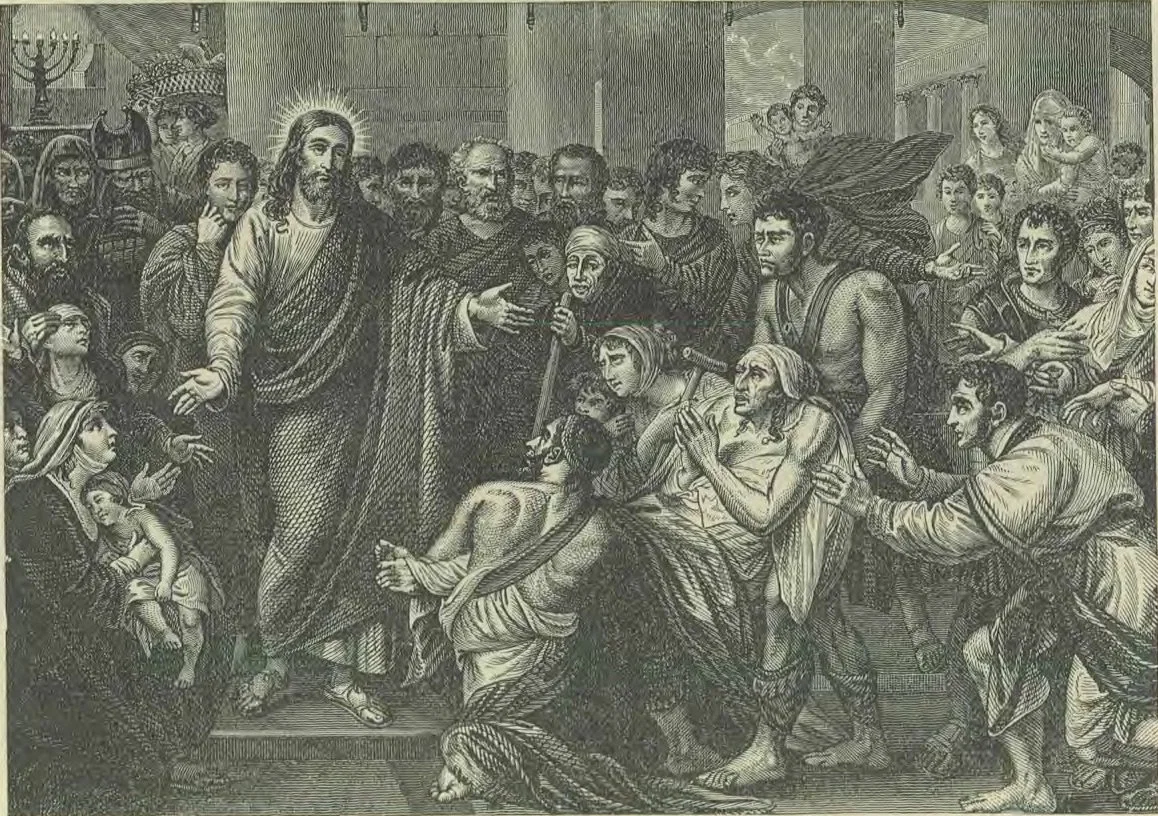
1. The news that Jesus had returned from Judea to Cana soon spread throughout Galilee and the region round about. It reached the ears of a nobleman in Capernaum, who was a Jew of some honor. He was much interested in what he had heard of the power of Jesus to heal the sick, for he had a son suffering with disease. The father had consulted the most learned physicians among the Jews, and they had pronounced the case incurable, and told him that his son must soon die.—“Redemption, or the First Advent,” page 15.
2. Jesus responds to the demands of the centurion by commanding him, “Go thy way; thy son liveth.” These brief and simple words thrill through the heart of the father; he feels the holy power of the speaker in every tone.—“Redemption, or the First Advent,” page 17.
3. One man had been afflicted by an incurable disease for thirty-eight years, and he had repeatedly visited the pool. Those who pitied his helplessness would bear him to and fro at the time when the waters were supposed to be troubled. But those stronger than himself would rush in before him, and seize the opportunity that he coveted.—“Redemption, or the First Advent,” page 20.

THE RAISING OF LAZARUS

INTERNATIONAL LESSON.—NO. 1.
(April 2, 1899.)

THE RAISING OF LAZARUS.

Lesson Scripture.—John 11:32–45.
Memory Verses.—Vs. 41–44.
Outline.—Jesus meeting with the sisters of Lazarus. Vs. 32–38. At the tomb of Lazarus. Vs. 39–45.
TIME: A. D. 30. PLACE: Jesus was at Bethabara, beyond Jordan, where John had baptized him, when he received the message that Lazarus was sick. Lazarus’s home was in Bethany, on the Mount of Olives, near Jerusalem. PERSONS: Jesus, Mary and Martha, Lazarus, the Jews.

QUESTIONS.

The Circumstances.—In what part of Jesus’ ministry did this lesson take place? What scene of his labors had he left? Matt. 19:1.
The Family at Bethany.—How many members in this family? Name them. By what act was one of them widely known? V. 2; 12:3–7. Why did Jesus love this family? What blessings would this friendship bring? Will Jesus be a member of your family? John 14:17, 20, 21. What must we do to have his presence? John 14:15, 23; 15:10; Luke 24:29. What proofs can you find that this family loved Jesus? John 12:2–7; Luke 10:38–42.
The Sick-Room.—Which one of the family was taken sick? Was it a dangerous sickness? What did the sisters do for their brother? What was the outcome of this sickness?
Jesus at Bethabara.—Where was Jesus at this time? John 10:4; What events had occurred at this place? John 1:28–34; Matt. 3:13–17. How far was Bethany from Bethabara? What did Jesus do after he had received the message from Bethany? Why this delay?
Report the discussion between Jesus and his disciples concerning Lazarus.
The Meeting of Jesus with the Bethany Sisters.—Where did Mary and Martha meet Jesus? What was their greeting? How could they know that Lazarus would not have died had Jesus been there? Had Jesus raised any from the dead before this? Luke 7:11–17; 8:49–56. What was Jesus’ reply? V. 23. What did Martha take this to mean? V. 24. What great doctrine did Jesus then teach her? What is the resurrection? Who only are to have this resurrection to life?
What does Jesus mean by saying that he is the resurrection? What message did Martha take to her sister? Does the Master call for us? In what ways? To what does he call us?
At the Tomb of Lazarus.—What two emotions did Jesus express? At what was he indignant? Why did Jesus weep? What does this teach us as to his tenderness and sympathy?
Relate the story of the resurrection of Lazarus. Why did Jesus pray? How was Lazarus bound? What kind of tomb was he in?

A GOOD PRESCRIPTION.

When times are bad, and folks are sad An' gloomy day by day, Just try your best at lookin' glad; An' whistle 'em away!
Don't mind how troubles bristle; Just take a rose or thistle; Hold your own, And change your tone, An' whistle! whistle! whistle!
A song is worth a world o' sighs; When red the lightnings play, Look for the rainbow in the skies; An' whistle 'em away!
Don't mind how troubles bristle; The rose comes with the thistle; Hold your own, An' change your tone, An' whistle! whistle! whistle!
Each day comes with a life that's new— A strange, continued story; But still, beneath a bend o' blue, The world rolls on to glory!
Don't mind how troubles bristle; Just take a rose or thistle; Hold your own, An' change your tone. An' whistle! whistle! whistle!
—Frank L. Stanton.

The Tenderness of "Jesus Wept"

WHAT tenderness there is in that one short verse of this lesson, “Jesus wept”! How close it brings Christ’s humanity to us! There is in it a touch of human nature which appeals to all, and shows that Jesus is brother to us—every one.

NOTE AND COMMENT

Ex-Governor Wm. R. Merriam has been appointed by President McKinley to the position of superintendent of the federal census to be taken in the year 1900.
A Great Missionary Movement.—The bishops of the Methodist Episcopal church have recently launched an educational and missionary enterprise of great magnitude, being a plan for the raising from among the people of that denomination the immense sum of $20,000,000, to be used in advancing the educational and missionary enterprises of the denomination.
The Havoc of War.—The devastation of war has, indeed, been enormous, and yet we are all prone not fully to realize the extent of its ravages. On this subject an ingenious statistician has deduced these figures: “It is estimated that since the days of the Trojan War, B. C. 1184, no fewer than 1,200,000,000 men have been sacrificed on the altar of the god of war. If it were possible to gather together these millions of war’s victims into one ghostly army, they would form a column, twenty-seven abreast, long enough to clasp the earth at the equator, with a residue of ten similar columns, stretching from London across Europe to Naples.”
An Immense Diamond.—A diamond, now on sale in London, is the largest and most valuable ever found, being held at the enormous price of five million dollars. It was discovered about one year ago in the Orange Free State, and is described as follows: “It is three inches long by two inches and a half at its thickest part, has a beautiful blue-white color, in shape and brilliancy resembles the most sparkling of icicles, and is one of the most dazzling objects ever beheld. It is known as the Jaeger-Fontien diamond, as it was found at the mine of that name. Its discoverer was a negro truckman, who, the morning before the mine passed into the possession of a purchasing syndicate, saw the stone, put his foot over it, picked it up as soon as he could do so without observation, carried it to the house of the manager, and delivered it into his hands.”
A Rare Old Coin.—Oftentimes things most rare and of the greatest value are found in the midst of the most unfavorable surroundings, and where least looked for. The following incident certainly illustrates this statement: “Some time ago a lot of pennies were received at the Treasury Department for redemption. Among them was a coin that was rejected. The treasury would not give one cent for it. A clerk in the office redeemed it, and gave it to Congressman Johnson, of North Dakota, who sent it to the Smithsonian to be identified, and later he received word that the coin is of the mintage of the year 284 A. D., and circulated in the time of the Emperor Diocletian. It is a very valuable relic, worth many times its weight in gold.” In just this same way may be found in the by-ways, hedges, and slums of the world, boys and girls, and men and women, who, to the careless, heedless, and unloving, may seem to be only so much worn-out and worthless coin, but who are in reality gems, in the rough, it may be, but yet of untold value, that shall one day be fit to shine forever “as the brightness of the firmament.”
Intelligent Aggressiveness.—One of the marvels of the closing nineteenth century is the wonderful rapidity with which the Mormons are extending a knowledge of their doctrine throughout the world, and are securing proselytes to their faith. Though we dissent radically from their peculiar beliefs and practises, may we not, as Christians, learn valuable lessons from their methods of missionary work? As the Baptist Flag remarks: “It seems that there is no general ‘organized work’ in reference to the matter, but there is an intense individual earnestness in the work. Over seventeen hundred missionaries are traversing the land, from house to house, scattering literature, preaching in schoolhouses and private families wherever they have opportunity, and they are doing some real work in planting their doctrines in many places throughout the country.” Instead of depending almost wholly on the support and backing of some committee or board, hundreds of this sect, without money and without scrip, go to distant parts of this and other countries, and spread abroad a knowledge of their faith. If believers in the special message of the everlasting gospel for this time should exhibit an earnestness and enthusiasm such as this, the glad tidings of our dear Lord’s return would soon be heralded to “every nation, and kindred, and tongue, and people.”

HOW HE KNEW IT.

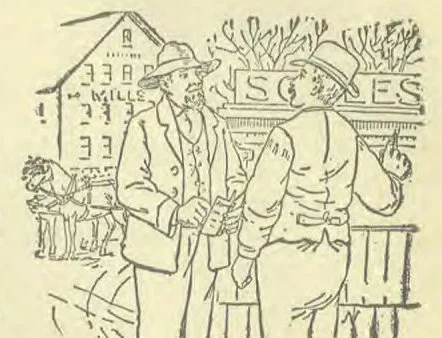
FARMER.—Can't you afford to pay more than 45 cents for No. 2 corn?
GRAIN BUYER.—That is the top of the market to-day. Your load weighs 2950 lbs. Have a seat while I figure up the amount.
FARMER.—(Opening Ropp's Calculator) Oh, I've got it already; had on 52 bus. and 38 lbs. and it comes to $23.70 (see pages 15 and 28.)
THE YOUTH'S INSTRUCTOR and Ropp's Calculator, for $1., the price of the magazine alone. See our offer to new INSTRUCTOR subscribers, week before last.

BOYS AND GIRLS

Can earn pocket money, and obtain a practical experience in canvassing by soliciting orders from their schoolmates and friends, for the “New Webster Dictionary and Vest-Pocket Library,” by E. E. Miles, recently advertised through our columns. It retails as follows:—
Bound in elegant cloth, red edges, indexed, 25 cents; the same, bound in morocco, gold stamp, gold edges, 50 cents; the same, bound in extra quality morocco, with calendar, memorandum, and stamp holder, 60 cents. For confidential terms to agents, address your State tract society, or the Review and Herald Pub. Co., Battle Creek, Mich.
Those who desire to earn a copy of the dictionary for themselves can do so by complying with the following conditions: We give the copy first described above for one new six months' subscription to the Youth's Instructor; the same book bound in morocco is given for one new yearly subscription; the one which retails at sixty cents will be given for one yearly subscription, and ten cents additional.

“HERALDS OF THE MORNING”

Is the title of a new book just issued by the Pacific Press, Oakland, Cal. It is from the pen of Elder A. O. Tait, one of the editors of the Signs of the Times, and is most interesting. The full title of this new book—“Heralds of the Morning: The Meaning of the Social and Political Problems of To-day, and the Significance of the Great Phenomena in Nature”—affords a clearer view of its scope. It presents in a positive, not argumentative nor negative, way the Biblical and social evidences of Christ’s second advent.
This book will be sold by subscription. It contains 279 pages, is profusely illustrated, and is gotten up in a neat and attractive style. Size, 6¼ x 8⅞ in. Cover design in ink, aluminum, and gilt. Issued in two styles. Standard edition, $1.25; Presentation edition, $1.50. Address your State tract society, or the Review and Herald Pub. Co., Battle Creek, Mich. Orders for this new book will be filled in about two weeks.

IT IS SELDOM

The case that goods are offered free, in every sense of the word; but we can assure our readers that they will not be disappointed if they answer the advertisement of E. E. Miles found on another page. Mr. Miles will give you something that will please you, and please your friends.

ARE YOU IN NEED

Of health crackers or other first-class cereal health foods? If so, write to the Battle Creek Bakery Co. Mr. Joseph Smith, founder and manager of this bakery, is in every way honest and reliable, and his prices are very reasonable. For a partial list of the foods, see the half-page advertisement which appeared in the following issues of this magazine: Vol. XLVI, Nos. 38, 39, 43, 44, 45, and 52.

“HOW TO GROW FLOWERS”

Is the title of a splendid floriculture magazine published monthly by the Floral Publishing Company, Springfield, O. Notice our special offers in connection with this magazine, on another page. For sample copy, address the publishers as above. In regard to any of the special combination offers, address the Youth's Instructor, Dep't “H. E.,” Battle Creek, Mich.

AN HONEST METHOD

Of doing business is used by Dr. E. J. Worst, Ashland, O., whose advertisement appears in this issue. He will actually send you the article advertised, upon trial, and after three days you may either send him the price of his inhaler, or return the same to him.

SUCCESS

Is the title of a most excellent weekly magazine published by the Success Co., New York City. It contains each week twenty large pages full of interesting and thrilling accounts of the lives of men who have become great. Fully illustrated. In order to appreciate its full worth, be sure to send to the publishers for a sample copy, mentioning the INSTRUCTOR. Subscription price is only $1.50 per year.
For only $2, we will send you both Success and the INSTRUCTOR one year. This offer applies to both old and new INSTRUCTOR subscribers. Address all orders to the YOUTH’S INSTRUCTOR, Battle Creek, Mich.
Continue reading: WE OFFER TO SEND YOU THE FOLLOWING:—