TEXT: “Be not deceived; God is not mocked: for whatsoever a man soweth, that shall he also reap. For he that soweth to his flesh shall of the flesh reap corruption; but he that soweth to the Spirit shall of the Spirit reap life everlasting.”
We are assured that God is acquainted with all our works. “Be not deceived; God is not mocked.” Our lives are all open before him with whom we have to do, and “he that soweth to his flesh shall of the flesh reap corruption.” What is it to sow to the flesh? It is to follow the desires and inclinations of our own natural hearts. Whatever may be our profession, if we are serving self instead of God, we are sowing to the flesh. The Christian life is a life of self-denial and cross-bearing. We are to endure hardness as good soldiers of Jesus Christ. Have we enlisted in the service of the Lord, and are we indeed his soldiers? If we are the soldiers of Christ, it is our business to follow his directions, to obey orders implicitly. We are not our own, and we cannot plan for selfish gratification and pleasure. We cannot inquire, What is for our convenience, but only, What are our orders? No one looks upon the life of a soldier as a life of self-pleasing and gratification.
We are on the battlefield today, and two great forces are ever contending for the mastery. The Word of God declares, “The flesh lusteth against the Spirit, and the Spirit against the flesh: and these are contrary the one to the other.” Ever since his rebellion and expulsion from heaven, Satan has been seeking to wrest souls from Christ. It would be well for every one of us who profess to be children of God, to inquire, In which army am I serving? Am I under the blood-stained banner of Prince Immanuel, or under the black banner of the prince of darkness?
My text declares that God is not mocked. God understands whether he has the whole heart’s service, or whether we are simply professors of religion. The truth of God must be enshrined in the heart, and we must be determined to fight the battles of the Lord, if we would come off conquerors with the final triumph of the truth; for the truth will triumph gloriously. What are you sowing in your daily life? Are you sowing to your flesh? Are you thinking only of your pleasure, your convenience? sowing to pride and vanity and ambition? “Whatsoever a man soweth, that shall he also reap.” If you are sowing faith, rendering obedience to Christ, you will reap faith and power for future obedience. If you are seeking to be a blessing to others, God will bless you. We should bring all the good possible into our lives, that we may glorify God, and be a blessing to humanity.
The Lord has made it possible for us to have a righteous character in this life, that we may reflect the image of Christ to the world, and bring hope and joy to others. The joy we give to others will be reflected upon us again; for as we sow, we shall reap. But if we educate our souls in the line of doubt, we shall reap doubt at a time when faith and confidence are most essential, and shall be powerless to hope and believe. If we talk doubt, and question the dealings of God, we shall have an abundant harvest of doubt and questioning to reap. We shall be sowing to the flesh, and of the flesh shall reap corruption.
“The fruit of the Spirit is love, joy, peace, long-suffering, gentleness, goodness, faith, meekness, temperance: against such there is no law. And they that are Christ’s have crucified the flesh with the affections and lusts.” Abundant provision has been made that all who desire to live a godly life may have grace and strength through Jesus, our divine Redeemer. The Christian’s life is not to be one of burdens and cares, although the cross must be lifted and the burdens borne; for the servants of God are to draw peace and strength from the Source of their strength, and in so doing they will find life full of happiness and peace.
He who seeks to serve God and mammon at the same time, will find only unrest and trouble; for a double-minded man is unstable in all his ways. When you have an eye single to the glory of God, it will be easy to serve your Lord, easy to walk in the path to heaven. The whole being must be consecrated to God; for our precious Saviour never shares a divided heart. Our inclinations and desires must be under the control of the Spirit of God, and then we shall be strengthened to fight the good fight of faith. We should daily ask, What are the Captain’s orders?
We are to be representatives of Jesus in this world. Are we fulfilling this solemn obligation, or are we misrepresenting our precious Lord, because of our unconsecrated lives? It is our privilege and duty to walk even as Christ walked; for “he that saith he abideth in him ought himself also so to walk, even as he walked.” Jesus said of his people, “Ye are the light of the world. A city that is set on a hill cannot be hid. Neither do men light a candle, and put it under a bushel, but on a candlestick; and it giveth light unto all that are in the house. Let your light so shine before men that they may see your good works, and glorify your Father which is in heaven.” How many, instead of glorifying God, instead of influencing others in the path of right, are swayed themselves by the evil influences that surround them.
The lack of devotion in others, the pride, the hardness of heart, all lead these half-hearted Christians to take a position of indifference and infidelity, and they fail to realize that they are to be representatives of Christ, that they are to prove to the world, by a life of godliness, that they are the true followers of Christ. Those who desire to be the disciples of the Lord must fix their eyes upon the Author and Finisher of their faith. They need not be in a state of uncertainty and unhappiness; for if they give themselves wholly to the Lord, they may have confidence in God. The religion of Christ is not a religion of mere emotion. You cannot depend upon your feelings for an evidence of acceptance with God; for feelings are variable. You must plant your feet on the promises of God’s Word, you must walk after the example of Jesus, and learn to live by faith. Satan may pour in his temptations upon you; but you have the promise of God, that “when the enemy shall come in like a flood, the Spirit of the Lord shall lift up a standard against him.” We should be faithful in the performance of our vows before God.
We are to cultivate the loveliness of Christian character, and to seek the inward adorning, that we may show forth the praises of him who hath called us out of darkness into his marvelous light. But how many seem to think only of the outward adorning, and they make it evident that they are not in Christ, by the apparel in which they deck themselves. They live to gratify self, to please the world, and have not an eye single to the glory of God. The Christian is not to live to please the world. “Come out from among them, and be ye separate, saith the Lord, and touch not the unclean thing; and I will receive you, and will be a Father unto you, and ye shall be my sons and daughters, saith the Lord Almighty.” Shall we not comply with this condition, when it involves so great a blessing and reward?
The religion of Christ never degrades the receiver; it ennobles and elevates. Upon certain conditions we are assured that we may become members of the royal family, children of the heavenly King. Is not this exaltation something worth seeking for? Through faith in Christ, and obedience to the requirements of his law, we are offered a life that shall run parallel with the life of God. And in that immortal life there shall be no sorrow, no sighing, no pain, no sin, no death. O that we might be more heavenly minded, and bring more of heaven into our life and conversation! But with all the rich promises of God, how many seem wholly absorbed in the things of earth! They are all taken up with the thought, What shall we eat? what shall we drink? and wherewithal shall we be clothed? God would not have us center our minds upon the things of this world. We are not to seek for our selfish gratification, but to center the mind upon Christ. Are you separating7yourself from everything that will separate you from God? If you are in close connection with God, you will talk of him, you will have an abundance in your heart of the things of heaven. Shall we not change the order of things, and sow to the Spirit? Why do you not appreciate your Redeemer more? Why do you not think of him, and talk of him to others? The Lord is waiting to do great things for his children who trust in him.
Do we expect to dwell with Christ in the eternal world? Then we must dwell with him here, that he may help us in every time of trial and temptation, and make us ready for his coming in the clouds of heaven. He will reward every man according to his works, and every secret thing will be brought into judgment. We shall find then that only those who have lived by every word that proceedeth out of the mouth of God will be saved. We must plant our feet on the Word, the solid rock of truth. We must search carefully throughout the Scriptures to see if we are indeed working the works of God. The beauty and grace of Christ must be woven into our characters. We cannot keep Christ so apart from our lives as we do, and yet be fitted for his companionship in heaven. He is to be the all in all of heaven, and must be our all in all upon earth.
If we are acquainted with Christ here, we shall be kind and courteous, tender-hearted, forbearing, patient. I entreat you to sow to the Spirit. Every temptation resisted, will give you power to sow to the Spirit in another time of trial. But I ask, How do your conflicts result now? Are you without a vital connection with Christ? If so, you will be overcome by the flesh, and the warfare between the flesh and the Spirit will terminate in defeat to the Spirit. You will lean to self-indulgence, to self-gratification. Oh, take hold of Christ’s strength, and make peace with him! Then you will be enabled to practice self-denial, and to sow to the Spirit. I point you to the cross of Calvary. The path from the manger to Calvary is marked with the footprints of self-denial. Who of you are willing to become partakers with Christ of his sufferings? “If we suffer, we shall also reign with him.” “For your sakes he became poor, that ye through his poverty might be rich.” We should be just as willing to bear shame, reproach, and suffering for the Majesty of heaven as he was to endure the cross for us.
Christ says, “Behold, I stand at the door, and knock: if any man hear my voice, and open the door, I will come in to him, and will sup with him, and he with me.” Oh, remove everything that obstructs the entrance to your heart, and let the Saviour in! Humble your hearts before God, that he may give you his Holy Spirit. Christ has said, “If any man will come after me, let him deny himself, and take up his cross, and follow me.” You cannot follow Christ unless you are willing to bear the cross at every step. “The friendship of the world is enmity with God.” We must take our journey through the world as pilgrims and strangers, clinging by living faith to the cross of Calvary.
The blessing of God will rest upon every soul that makes a full consecration to him. When we seek for God with all the heart, we shall find him. God is in earnest with us, and he wants us to make thorough work for eternity. He has poured out all heaven in one gift, and there is no reason why we should doubt his love. Look to Calvary. Christ died for you, and what greater evidence of God’s love could you ask than that which has been given in the life and death and intercession of Jesus?
God asks you to give him your heart. Your powers, your talents, your affections, should all be surrendered to him, that he may work in you to will and to do of his good pleasure, and fit you for eternal life. Accept the invitation of Christ. He bids you, “Come unto me, all ye that labor and are heavy laden, and I will give you rest. Take my yoke upon you, and learn of me; for I am meek and lowly in heart: and ye shall find rest unto your souls. For my yoke is easy, and my burden is light.” O that we might press toward the mark for the prize of our high calling in Christ Jesus! What more can God do than he has done? Let us empty our souls of all enmity, all foolishness, and by living faith connect with Jesus. Draw nigh to God, and he will draw nigh to you. Christ will pardon your transgressions, and receive you graciously.
Proper Treatment of Heretics
By L. H. CHRISTIAN
L. H. CHRISTIAN
Now and then it happens that a really good word is shunned because it has been woefully misused. This is true of the words “heresy” and “heretic.” The Jews said that Paul taught heresy when his teaching was the truth of God. The Roman Church and every other persecuting power have accused the children of God of heresy. The faithful Christians whom we revere as martyrs were scorned and held up as heretics. The heroes of today were the heretics of yesterday.
But while the children of the Lord have been arraigned as heretics and the truth of God decried as heresy, we must not believe that there is no such thing as heresy and heretics. The Scriptures speak of “damnable heresies” brought in by “false teachers.” 2 Peter 2:1. We also read of “a man that is a heretic.” A heretic is one that “upholds a doctrine varying from that of his church.”
The true church of Christ has always been troubled with those who pretended to have advance light, but who in reality led the people astray. These deceivers often desire to remain among the children of God. They even speak of persecution when the servants of God follow the example of Paul, who “separated the disciples” from the others. Acts 19:9.
Not long ago we met one of these men. He spoke of the servants of the Lord as a “Vatican Council.” The man declared he and his followers were “cruelly persecuted.” We asked him if his enemies had taken his Bible from him, and how many times he had been fined, or “beaten with rods,” like Paul, and how large a number of his brethren had been burned at the stake. We learned that the only suffering he and his fellows had endured was that they had been asked not to disturb a meeting which some others were having. Later they had been quietly disfellowshipped from the church.
The persecution of which these complain is the very treatment that the Bible tells us to give those that depart from the faith. We should not hate them nor fight them. We should treat them kindly yet firmly. They ought not to remain as members of our churches nor take part in our meetings. Though they say things about us which are untrue, we8must never speak thus of them. Indeed, the less we say to them or about them the better. Of course that will not please them. They love to argue; they have nothing else to do. But the remnant people of God, with a soul-winning message to all the earth, “cannot come down” to idle disputings.
The Bible teaches that when some arise among us who “cause divisions” and teach contrary to the truth, we are to “avoid them.” Rom. 16:17. When a person becomes a heretic, we are to admonish him once or twice. If he will not hear us, we are to “reject” him. Titus 3:10. Then he will find himself a “cast out” from the church. The third angel’s message is a sacred heritage. We cannot fellowship any person nor join any enterprise that so tampers with this message as to turn the truth of God into a lie.
Chicago, Ill.
The Sojourning of Israel
By F. D. STARR
F. D. STARR
“Now the sojourning of the children of Israel, who dwelt in Egypt, was four hundred and thirty years.” Ex. 12:40.
This verse has been misunderstood by some. It will be noticed that it is not stated that Israel was actually in Egypt four hundred and thirty years, but that this people who dwelt in Egypt had sojourned somewhere for that length of time.
The Septuagint makes the matter much clearer. In that version this text reads: “The sojourning of the sons of Israel, which they sojourned in the land of Egypt and the land of Canaan, was four hundred and thirty years.”
This is in harmony with history. The period is equally divided between the two countries, as it was two hundred and fifteen years from the time Abraham entered Canaan till Jacob’s family settled in Egypt, and then two hundred and fifteen more years till the nation of Israel left Egypt under Moses. Thus the period of four hundred and thirty years of Gen. 12:40, as well as that of Gal. 3:17, is seen to include the oppression of Abraham’s family by the heathen of Canaan, as well as by the Egyptians.
Some Steps Toward Its Accomplishment
By J. O. CORLISS
The Atonement — No. 9
Some Steps Toward Its Accomplishment
J. O. CORLISS
The study of the atonement as carried on in the earthly sanctuary, has revealed that it had to do only with the blotting out of sins previously repented of and carried by personal sacrifice into the first apartment of the sanctuary. The service thus performed was therefore called the cleansing of the sanctuary. Lev. 16:19. This cleansing of the sanctuary from the sins carried into it was necessary in order that the design for which the tabernacle was erected might be realized, namely, that God might dwell among his people (Ex. 25:8); for he could not consistently dwell among them while they cherished sin.
The day of atonement was therefore virtually a day of judgment; for if, when the yearly cleansing from sin took place, any one of the people had wilfully chosen not to have his sins carried into the sanctuary beforehand through a sin offering, he must bear his own sin. Then since all sin was removed from the camp on that day, if any retained his sins, he must of course be expelled from among the people of Israel.
This work in the earthly sanctuary was a type of the work in the heavenly sanctuary, where Christ is the High Priest. Every sinner has opportunity to confess his sins, thus putting them on the Victim of the cross, through whose body they are borne to the heavenly sanctuary (1 Peter 2:24), there to be atoned for. But if any one does not choose to avail himself of this gracious privilege, he must bear his own sin, and suffer the consequence of it.
This service in the most holy place can be nothing less than the closing work for a sinful race. It is really an investigation of men's life records preparatory to awarding each his just due. This could not be done until all the good and evil resulting from each individual's life had been measured. A moment's thought will make it clear that full awards could not have been meted out at death to Voltaire, Paine, and others of their class, for the reason that their influence for wrong did not die with them. The same is true of such good men as Whitefield, the Wesleys, and the various missionaries who have spent their lives in an attempt to rescue men from the toils of sin. These men, like Abel, still speak, and not until the last generation closes, can their influence for good or evil be fully told.
The life record of every member of the human race must pass in review before the heavenly tribunal. But when? Will the time be announced suddenly, without due warning from the seat of authority? The assurance has been given that 'the Lord God will do nothing, but he revealeth his secret unto his servants the prophets.' Amos 3:7. Again, it was said in the apostolic days that the Lord had even then appointed the day in which he would judge the world in righteousness by the Lord Jesus. Acts 17:31. It must be, therefore, that some sign has been given by which men may know when that solemn period is at hand.
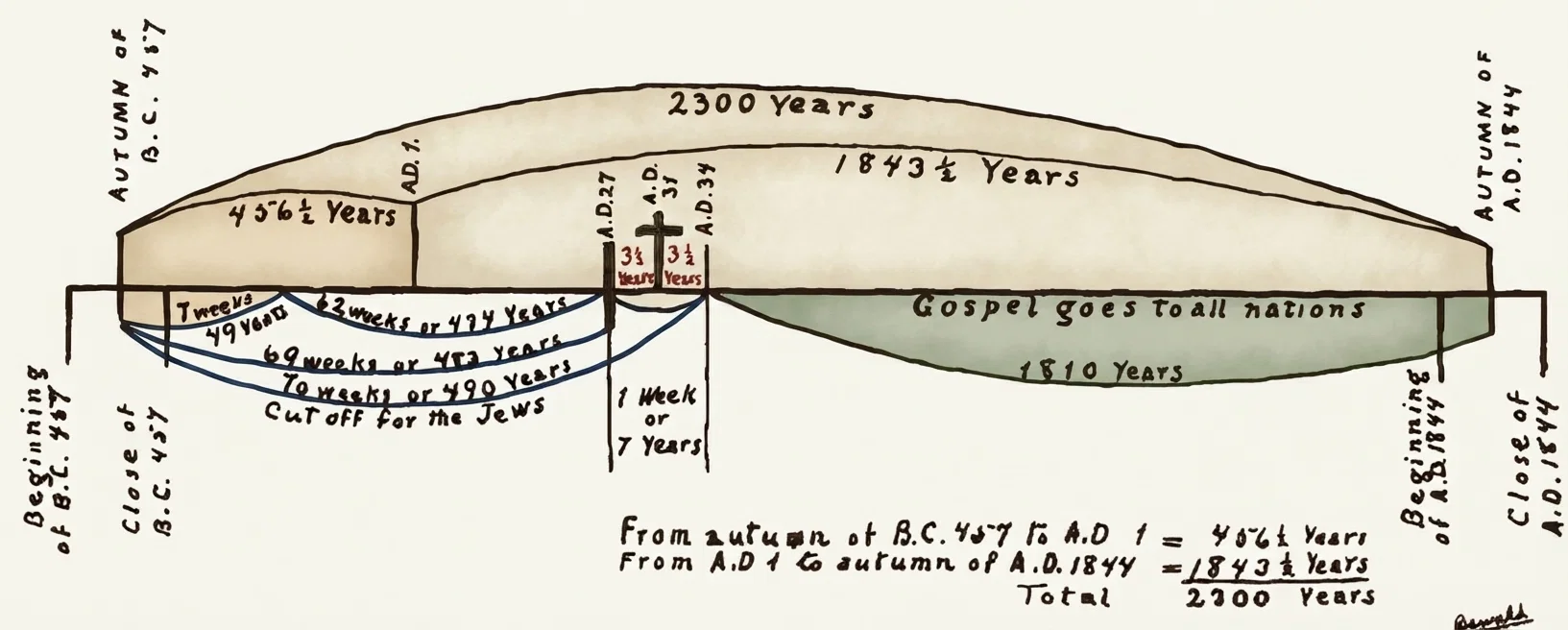
This very point was under discussion at one time by two heavenly beings, and this was what they said in the presence of a time-honored prophet: 'I heard one saint speaking, and another saint said unto that certain saint which spake, How long shall be the vision concerning the daily sacrifice, and the transgression of desolation, to give both the sanctuary and the host to be trodden underfoot? And he said unto me, Unto two thousand and three hundred days; then shall the sanctuary be cleansed.' Dan. 8:13, 14.
This cleansing could not possibly be applied to the earthly sanctuary; for that cleansing took place each year, while, taken literally, the period announced by the angel would cover more than six years. Again, the days mentioned could not have referred to literal time, since that would have brought the fulfilment of this prophecy within the days of Daniel's people. Besides, these days must be regarded as symbolic, for the prophet was distinctly informed that the vision would be fulfilled in 'the time of the end' (verse 17), and therefore not in the then near future.
The angel Gabriel was told to make the prophet fully understand the matter. We may well believe he did this; otherwise he would have been unfaithful to the trust committed to him. The prophet was obliged to wait for a time, and he 'set his face unto the Lord, to seek by prayer and supplication' the meaning of the strange revelation that had been given him.
As the time for the ending of the Babylonian captivity drew near, the prophet began earnestly to pray for God to shine once more, as in days of old, on deserted and desolate Jerusalem. Dan. 9:3-19. During this supplication the angel Gabriel again addressed Daniel, saying that he had now come to give him the understanding he sought concerning the point of time in the vision. Verse 22. Thus he began: 'Seventy weeks are determined ['cut off,' as set forth in Gesenius's Hebrew lexicon] upon thy people and upon thy holy city.' Dan. 9:24. Seventy weeks, or 490 days, of the 2300 as set forth in the vision, were thus declared to apply to the career of the house of Israel. These days were to close the special privileges of Israel as the people of God, and their place and work were to be taken by others. Isa. 65:1-10.
Sixty-nine of these seventy weeks, or 483 days, were to extend to the appearing of the long-looked-for Messiah, and this time was to be reckoned from the date of the commandment to restore and build Jerusalem, following the seventy years of captivity. Dan. 9:25. The word 'Messiah' translated into English is rendered 'anointed.' (See margin of John 1:41.) Christ was anointed to his work by the Holy Spirit at his baptism. Compare Acts 10:37, 38, with Luke 3:21, 22. The chronological date in the margin opposite the last text, in Bibles with dates opposite verses, gives the date of this anointing as A. D. 27.
Looking back for the beginning of the 483 years to the time of the commandment to restore and build Jerusalem, we subtract the 27 years from the 483 years, and the result is 456 full years. But turning to the book of Ezra (chap. 7:6, 8), we find that Ezra actually arrived at Jerusalem in fulfilment of the command given him, as late as the fifth month of the year 457 B. C. From that time to the close of the last day of the year A. D. 26 would be 26½ full years after Christ, so that the time between these dates would actually amount to but 482½ years. But if the date of Christ's baptism be set forward to the autumn of A. D. 27, to correspond to the autumn of 457 B. C., as it actually did occur, then we have the complete 483 years fulfilled according to the prophetic announcement. This result is the working proof that9symbolic days of Scripture refer to the same number of years as stated in the term of days used. A direct reference to this rule is found in Eze. 4:1-6, where the Lord said to the prophet, 'I have appointed thee each day for a year.'
Evidence of the correctness of the rule as applied in this case, and of the conclusion reached, is found in the fact that immediately following his baptism, the Saviour went forth and proclaimed, 'The time is fulfilled.' Mark 1:15. This could refer to no other definite time prophecy than that of the 2300 days, since the prediction pointing to the time of the anointing of the Messiah is found in no other prophecy than the one under consideration.
But there is yet the one remaining week of the 490 days to be considered. This was applied in the prophecy to the confirmation of the new covenant by the Messiah, and those associated with him in his earthly work. Dan. 9:27. Christ preached three and one-half years after his anointing, dying in the midst of the seventieth week, when the offerings of sacrifice and the oblations were to cease. This was attested to by the rending of the temple veil at the death cry of the divine Sacrifice. Matt. 27:50, 51.
Following the Saviour's death, his disciples preached to the Jews for another three and one-half years, or until the Jewish Sanhedrin, by open persecution of his followers, formally rejected the Saviour. Then God gave the commission to go to the Gentiles. Rom. 1:16; Acts 13:46. This would be in the autumn of A. D. 34.
And so ended the seventy weeks, or 490 days, cut off from the 2300 days to be devoted to the Jewish people. The remaining 1810 prophetic days, or years, added to the year A. D. 34, would reach to the year 1844 A. D. The significance of this date will be treated of in the next study.
Glendale, Cal.
T. E. BOWEN
By T. E. BOWEN
Nearing the End — No. 2
T. E. BOWEN
Let us consider what it will mean to the world when Jesus is directed by the Father in heaven to lay down his mediatorial censer as high priest in the most holy apartment of the sanctuary on high.
The Close of Christ’s Ministry
From the day of Adam’s transgression until the last sinner entreats for mercy, hope and salvation have been held out to the lost; but when Jesus ceases his intercession for sinful man, there will be no more atonement for sin, no more mediation through the death of Jesus on the cross.
“I saw angels hurrying to and fro in heaven. An angel with a writer’s ink-horn by his side returned from the earth, and reported to Jesus that his work was done, and the saints were numbered and sealed. Then I saw Jesus, who had been ministering before the ark containing the ten commandments, throw down the censer. He raised his hands, and with a loud voice said, ‘It is done.’ And all the angelic host laid off their crowns as Jesus made the solemn declaration, ‘He that is unjust, let him be unjust still: and he which is filthy, let him be filthy still: and he that is righteous, let him be righteous still: and he that is holy, let him be holy still.’”
“Every case had been decided for life or death. . . . As Jesus moved out of the most holy place, I heard the tinkling of the bells upon his garment; and as he left, a cloud of darkness covered the inhabitants of the earth. There was then no mediator between guilty man and an offended God. While Jesus had been standing between God and guilty man, a restraint was upon the people; but when he stepped out from between man and the Father, the restraint was removed, and Satan had entire control of the finally impenitent.”—Early Writings, pp. 279, 280.
We see to some extent even now what it means for the Spirit of God to be removed from men, its restraining influence withdrawn; but we cannot fully comprehend what it will mean to a lost world for Satan to have “entire control of the finally impenitent.” This will come to pass upon the day that Jesus ceases to plead the merits of his spilled blood.
Receiving the Kingdom
Jesus said that he was born into the world to be a king. “Pilate therefore said unto him, Art thou a king then? Jesus answered, Thou sayest that I am a king. To this end was I born, and for this cause came I into the world, that I should bear witness unto the truth.” “My kingdom is not of this world.” John 18: 36, 37.
The disciples, led on by Judas, sought to crown Jesus king; but he knew it was not in his Father’s plan that he should become king of the Jews only. His was to be a greater kingdom, and the time of establishing this kingdom was in the Father’s own keeping. Acts 1: 6, 7. The next great event before us is that of Jesus’ receiving his kingdom. In this event center the interests of heaven and earth. It is of supreme importance to every individual.
It must be observed, however, that Jesus is in heaven when he receives the kingdom, not upon earth. This coming to receive his kingdom is at the beginning of the time of trouble. His second personal coming takes place some time later, at the close of the time of trouble, when he comes to earth to get the subjects of his kingdom. It is important that these two events be not confused.
Of the coming at the beginning of the time of trouble, to receive his kingdom, we read: “I saw in the night visions, and, behold, one like the Son of man came with the clouds of heaven, and came to the Ancient of days, and they [the angels] brought him [Christ] near before him [the Father]. And there was given him dominion, and glory, and a kingdom, that all people, nations, and languages, should serve him: his dominion is an everlasting dominion, which shall not pass away, and his kingdom that which shall not be destroyed.” Dan. 7: 13, 14.
The Father Keeps Secret the Time When Jesus Receives His Kingdom
“Of that day and that hour knoweth no man, no, not the angels which are in heaven, neither the Son, but the Father. Take ye heed, watch and pray: for ye know not when the time is. For the Son of man is as a man taking a far journey, who left his house, and gave authority to his servants, and to every man his work, and commanded the porter to watch. Watch ye therefore: for ye know not when the Master of the house cometh, at even, or at midnight, or at the cockcrowing, or in the morning: lest coming suddenly he find you sleeping. And what I say unto you I say unto all, Watch.” Mark 13: 32–37.
There is no event on earth to mark the close of probation, until the plagues of God begin to fall upon the unsaved. Therefore Christ specially warns us to “watch.”
All Exhorted to Watch
“Jesus has left us word, ‘Watch ye therefore: for ye know not when the Master of the house cometh, at even, or at midnight, or at the cockcrowing, or in the morning: lest coming suddenly he find you sleeping. And what I say unto you I say unto all, Watch.’ We are waiting and watching for the return of the Master, who is to bring the morning, lest coming suddenly he find us sleeping. What time is here referred to? Not to the revelation of Christ in the clouds of heaven to find a people asleep. No; but to his return from his ministration in the most holy place of the heavenly sanctuary, when he lays off his priestly attire, and clothes himself with garments of vengeance, and when the mandate goes forth, ‘He that is unjust, let him be unjust still.’—Testimonies for the Church, Vol. II, p. 190.
It will be seen, therefore, that it is very important that the people of God be prepared for this sudden cessation of the priestly ministration of Jesus. We need to know the character of the event here spoken of, lest we confuse it with the events to take place some time after the closing of the door of mercy, such as the scenes of Armageddon and the actual appearing of Jesus as King of kings.
Genuine Visions from the Lord in the Remnant Church
By G. I. BUTLER
G. I. BUTLER
The vision of Ellen G. Harmon noticed in last week’s paper was the first of a long series given during a space of more than threescore years, and was granted at the very beginning of the history of the remnant church. This church the Revelator declared was to have “the Spirit of prophecy,” and the gift began to be manifest in its earliest days.
We will now take up the history of the full development of this blessed gift. Returning to Elder J. N. Loughborough’s10book, “Rise and Progress of Seventh-day Adventists,” page 93, we read as follows:—
“The first time I saw Mrs. E. G. White (formerly Miss Harmon) was on the first Sabbath in October, 1852. On that day I saw her in a vision that lasted over one hour. Since that time I have had the privilege of seeing her in vision about fifty times. I have been present when physicians have examined her while in this state, and I esteem it a pleasure to bear testimony to what I have seen and know. I trust a narration of the facts in the case may not be carelessly cast aside for the random suppositions of those who have never seen her in this condition.
“In passing into vision she gives three enrapturing shouts of ‘Glory!’ The second, and especially the third, fainter, but more thrilling than the first, the voice resembling that of one quite a distance from you, and just going out of hearing. For about four or five seconds she seems to drop down like a person in a swoon or one having lost his strength; she then seems to be instantly filled with superhuman strength, sometimes rising at once to her feet and walking about the room. There are frequent movements of the hands and arms, pointing to the right or left as her head turns. All these movements are made in a most graceful manner. In whatever position the hand or arm may be placed, it is impossible for any one to move it. Her eyes are always open, but she does not wink; her head is raised, and she is looking upward, but with a vacant stare, but with a pleasant expression, only differing from the normal in that she appears to be looking intently at some distant object. She does not breathe, yet her pulse beats regularly. Her countenance is pleasant, and the color of her face as florid as in her natural state.
“Her condition as to breathing, loss of strength, and being made strong as the angel of God touches her, all agree perfectly with the description given by the prophet Daniel of his own experience in vision when he says: ‘Therefore I was left alone, and saw this great vision, and there remained no strength in me: for my comeliness was turned in me into corruption, and I retained no strength.’ ‘For how can the servant of this my lord talk with this my lord? for as for me, straightway there remained no strength in me, neither is there breath left in me. Then there came again and touched me one like the appearance of a man, and he strengthened me, and said, O man greatly beloved, fear not: peace be unto thee, be strong, yea, be strong. And when he had spoken unto me, I was strengthened, and said, Let my lord speak; for thou hast strengthened me.’” Dan. 10: 8, 17-19.
Another testimony recorded on page 95 of Elder Loughborough’s book, is that of M. G. Kellogg, M. D., concerning Mrs. White’s first vision in Michigan, which was given during a meeting held at Tyrone, Livingston County, May 29, 1853:—
“Sister White was in vision about twenty minutes or half an hour. As she went into vision, every one present seemed to feel the power and presence of God, and some of us did indeed feel the Spirit of God resting upon us mightily. We were engaged in a prayer and social meeting, Sabbath morning, at about nine o’clock. Brother White, my father, and Sister White had prayed, and I was praying at the time. There had been no excitement, no demonstrations. We did plead earnestly with God, however, that he would bless the meeting with his presence, and that he would bless the work in Michigan. As Sister White gave that triumphant shout of ‘Glory! g-l-o-r-y!, g-l-o-r-y!’ which you have heard her give so often as she goes into vision, Brother White arose and informed the audience that his wife was in vision. . . .
“I am quite certain that she did not breathe at that time while in vision, nor in any of the several others which she had when I was present. The coming out of vision was as marked as her going into it. The first indication we had that the vision was ended, was in her again beginning to breathe. She drew her first breath deep, long, and full, in a manner showing that her lungs had been entirely empty of air. After drawing the first breath, several minutes passed before she drew the second, which filled the lungs precisely as did the first; then a pause of two minutes, and a third inhalation, after which the breathing became natural.”
A large number of other testimonials are given by eyewitnesses in various parts of the country, and many most remarkable circumstances are narrated, — surely enough to establish the facts as chronicled in Elder Loughborough’s book.
These open visions continued more or less frequently for many years of her life, and many were privileged to witness them. Elder Loughborough saw Mrs. White in vision as many as fifty times. On one occasion she was given a vision before an audience of hundreds of people in the Battle Creek Tabernacle.
Surely these things have not been done in a corner. These were “open visions,” given when many people were present; and the facts related are therefore indisputable. They were no doubt given thus openly to demonstrate their reality. However, many other visions were given less publicly. For nearly seventy years Mrs. White was widely known as one having visions from the Lord, and she was associated in public labor with ministers and other workers in all parts of this country, in Europe, and in Australia. Her labors have been most remarkable.
Begin the Day with God
By Bonar
Begin the day with God,
He is thy sun and day;
He is the radiance of thy dawn,
To him address thy lay.
Take thy first meal with God,
He is thy heavenly food;
Feed with and on him, he with thee
Will feast in brotherhood.
Thy first transaction be
With God himself above;
So shall thy business prosper well,
And all thy day be love.
— Bonar.
“Lo, I Am with You Alway”
By Mildred H. Wagner
MILDRED H. WAGNER
God knows the life which cares oppress;
He sees the hidden tear;
Just look to him when in distress,
For he is ever near.
When snares are in your pathway laid,
And sinks the heart with fear,
Know that the Lord will give you aid,
Believe that he is near.
Throughout the toilsome, weary days,
When life seems dark and drear,
Lift up the head with song and praise,
And know that God is near.