It was Talmage who said, “If you want to gather up all tender memories, all lights and shadows of the heart, all banquetings and reunions, all filial, fraternal, paternal, conjugal affections, and had only just four letters with which to spell out that height and depth and breadth and magnitude and eternity of meaning, you would write it all out with these four capital letters: H-O-M-E.”
It is said that “home” is the sweetest word in the English language. God made homes. He gave to man a home in Eden, before sin entered the world to sear the face of creation. The strongest bulwark of society today is the home; it should be a little heaven of love on earth, in which to live and prepare for the final home which awaits the faithful. The memory of a Christian home lingers with the traveler, and throws around him a saving power.
“Will you go back with me a few years, dear reader, in the history of the past, and traverse in imagination the gay streets and gilded saloons of Paris,15that once bright center of the world's follies and pleasures? Passing through its splendid thoroughfares is one (an Englishman) who has left his home and native land to view the splendors and enjoy the pleasures of a foreign country. He has beheld with delight its paintings, its sculpture, and the grand yet graceful proportions of its buildings, and has yielded to the spell of the sweetest music. Yet, in the midst of his keenest happiness, when he was rejoicing most over the privileges he possessed, temptations assailed him. Sin was presented to him in one of its most bewitching garbs. He drank wildly and deeply of the intoxicating cup, and his draft brought madness. Reason was overwhelmed, and he rushed out, all his scruples overcome, careless of what he did or how deeply he became immersed in the hitherto unknown sea of guilt.”
“The cool night air lifted the damp locks from his heated brow, and swept with soothing touch over his flushed cheeks. Walking on, calmer, but no less determined, strains of music from a distance met his ear. Following in the direction the sound indicated, he at length distinguished the words and air. The song was well remembered. It was ‘Home, Sweet Home.’ Clear and sweet the voice of some English singer rose and fell on the air, in the soft cadences of that beloved melody.
“Motionless, the wanderer listened till the last note floated away and he could hear nothing but the ceaseless murmur of a great city. Then he turned slowly, with no feeling that his manhood was shamed by the tear which fell as a bright evidence of the power of song.
“The demon that dwells in the wine had fled; and reason once more asserted her right to control. As the soft strains of ‘Sweet Home’ had floated to his ear, memory brought up before him his own ‘sweet home.’ He saw his gentle mother, and heard her speak, while honest pride beamed from her eye, of her son, in whose nobleness and honor she could always trust; and his heart smote him as he thought how little he deserved such confidence. He remembered her last words of love and counsel, and the tearful farewell of all those dear ones who gladdened that far-away home with their presence. Well he knew their pride in his integrity, and the tide of remorse swept over his spirit as he felt what their sorrow would be could they have seen him an hour before. Subdued and repentant, he retraced his steps, and with the vow never to taste of the terrible draft that could so excite him to madness was mingled a deep sense of thankfulness for his escape from further degradation. The influence of home had protected him, though the sea rolled between.”
The blight of sin is seen even in what should be homes. The enemy has done his best to darken that which should be of all places a place of joy, happiness, and light. Think of the homes where ignorance and discontent reign supreme, where there is no real love, no recognition of God. These places are not homes, but merely places of abode.
There are homes, palaces of the rich, adorned with all that wealth can supply. Exquisite paintings and magnificent works of art may adorn the walls, yet there may be no real love. The members of the household may be cold, jealous, and suspicious. Strife may reign, and though counted among the fashionable, known as the élite, they are not happy. They worship at the shrine of mammon. Their thoughts are not of God and the hereafter. Their chief end is to eat and drink. Such a home is but a cheerless sepulcher, an empty hollow hut at best.
The real home is the home where God is honored; where piety holds sway; where love is enthroned; where morning and evening the family are gathered around the altar of prayer, and after song and reading from the Scriptures of truth, all bow, and in prayer commit themselves to God, and plead for his protection. Such homes are the foundation of national stability and greatness. The home government is of far greater importance than the form of national government; for when the home goes down, the nation is doomed.
Home should be cheerful. Some homes, for fear some carpet or tapestry will be faded, have rooms with curtains drawn and darkened, to be opened only on special occasions. Let these musty dungeons be opened and used. Don’t wait for a funeral or a wedding. Make the children feel at home. No room is too fine for any member of the family, for he is worth far more than the room. No chair is too costly for any member of the family to occupy, for he is worth more than any chair. No house is too elegant to shelter a human head, for a man is worth more than any house. Love, not elegance and furniture, makes a home. A meal eaten off the head of a barrel where love reigns is far better than from a table of mahogany where hate and contention sit to croak.
“Home’s not merely four square walls,
Though with pictures hung and gilded:
Home is where affection calls,
Filled with shrines the heart hath builded.
Home! go watch the faithful dove,
Sailing ’neath the heaven above us;
Home is where there’s one to love.
Home is where there’s one to love us.”
“Home’s not merely roof and room,
It needs something to endear it;
Home is where the heart can bloom,
Where there’s some kind lip to cheer it.
What is home with none to meet,
None to welcome, none to greet us?
Home is sweet, and only sweet,
When there’s one we love to meet us.”
How many homes, even among professed Christians, are marred and often ruined by family jars, by fretfulness, irritability, unkind, sarcastic, sharp, cutting, snappy words and cross, surly glances. What a pity! A religion that is not lived in the home is of no value. And any religion that does not give us the victory over these miserable traits of character is a vain religion. Many will have to gain victories in their homes, or be lost. God expects love in the home. Gentle, Christian courtesy must be exhibited. Kindness must rule. Kind, gentle words and loving smiles cost nothing. Let kind words be spoken in the morning. They will lighten the cares of life all the day, and brighten the household. Let the last words at eventide be kind and loving. It may be before the sun rises, the span of life of a loved one may be finished; then it will be too late to recall the unkind, cutting words, and ask forgiveness. While the darkness of sin may hover over the homes of Egypt, let the light of love, joy, and all the blessing of the gospel brighten daily the homes of God’s remnant people.
Go Back and Do It
By William Byron Forbush
YESTERDAY morning an old, beggarly-looking man was standing beside the stairway that led to an elevated railway station, seemingly bewildered. I was in a hurry, and did not ask him where he wanted to go. Why didn’t I go back and do it?
My mother used to take great pains to think of lovely little surprises for me, and I used to take them as a matter of course. I see now how happy she could have been if I had ever thanked her. It is too late for me now to go back and do it.
I had a schoolmaster in a country school who fitted me for college more thoroughly than many a boy is fitted in a larger and more famous school. Often when I was in college I had good reason to thank him for his patience with me, but I never did. And it is now too late for me to go back and do it.
My chum did more for me than anybody else when I was a student; he was so honest and genuine and sensible, and so full of fine, manly purposes, and I was so much younger than he, and needed him so much. Every day of my life I am thankful for him, and I often tell others what he did for me, but I never told him. And now it is too late for me to go back and do it.
Tomorrow somebody else will do me a kindness. I shall be hurried and forgetful, but perhaps the memory of some kindnesses done by those of the past may make me willing to pass them on to those who are to come. And even if I hurry by, and feel timid about opening my heart by saying an appreciative word, still I can go back and do it.
Tomorrow somebody else will wave a hand to me or speak friendly about the weather in passing. Perhaps I shall remember that I shall not forever walk this friendly road, and that the number who wave to me is not unlimited. Even if I have passed them by without giving a sign of brotherhood, perhaps because they are poor or humble or because I myself am shy, still I can go back and do it.
I have yet some friends who mean more to me than any other friends I have ever had. They are close to me, and some of them are in the house where I live. I shudder to think that I might die or they might die before I have said to them all that is in my heart. I haven’t done it yet, but, thank God, I can still go back and do it.—William Byron Forbush, Ph. D., in Young People.
A Letter from Pua, Chile
By Mrs. J. C. Brower
DEAR BRETHREN AND SISTERS IN THE STATES, GREETING:—
After waiting more than a year, our little son's final operation was finished in January, and on February 9 our family of four set sail on the steamship “Heredia,” from New Orleans, La., for Chile, via the Canal Zone. Both children took slight colds crossing the gulf, and daughter showed decided weariness a time or two before reaching Colon, and also during the day we spent crossing the isthmus, but after we were aboard the “Huasco” and began our journey down the west coast, she seemed entirely well, and was bright and joyous all day long.
Her baby plans and conversation had long been full of Chile and the Pua school; many times she had packed her playthings, and with her dolls and Teddy Bear had begun the journey to Chile, only to find, when her play was over, that she must begin all over again. But now at last our plans were to be realized! We were really on our way! A happier family could not have been found.
The evening of the fourth day on board, we entered the bay at Guayaquil, Ecuador. Daughter seemed overpowered with sleep and unable to eat. But we supposed she only needed more sleep, and hoped morning would bring us her sunny, cheerful self again.
The Sabbath dawned clear and bright. We were very near the equator, but the sea air was pleasant and refreshing. Daughter was no better, and with anxious hearts we ministered to her, trusting to see her soon recover. She called for us to read to her, and I read and reread old copies of Our Little Friend. As I finished, she said, “Read more, and more, and more,” so hungry was her baby mind to hear and learn. That day as we sat on deck, I told her stories of children, and among others some in which the children had passed away. She said eagerly, “But, mother, it’s only sleep. You know Jesus says it’s only sleep, and when he comes he’ll wake them up.” Dear, trusting child!
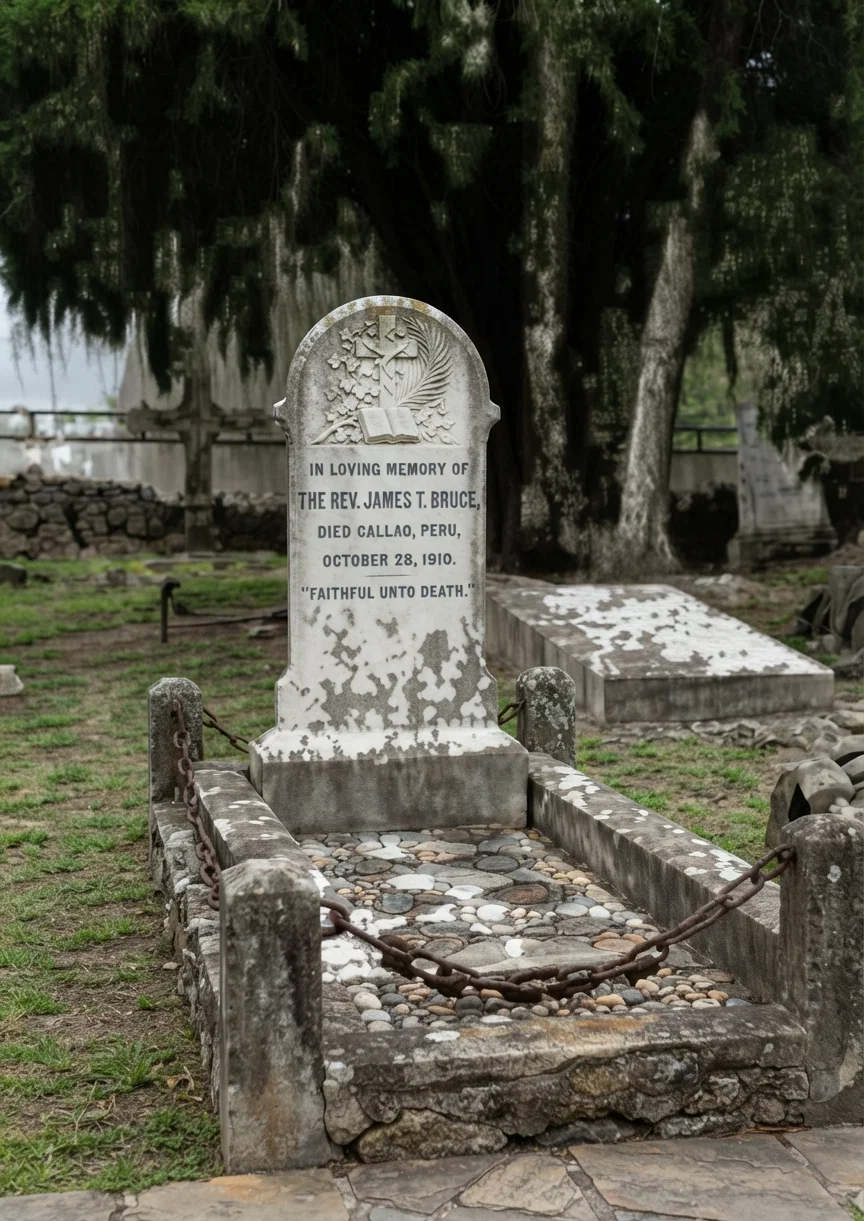
A FALLEN MISSIONARY, CALLAO, PERU
Next day she grew worse, and asked, “Mother, when shall we get to South America?” I replied, “Dear child, we are off the coast of South America now.” “But,” she persisted, “when shall we reach Chile? I am so tired of this boat and want to get to Chile.”
That night our beloved first-born fell asleep, lacking just a month of being five years of age. When we saw that death would rob us of her we loved so well, I whispered in her ear that she was falling asleep, but Jesus would wake her up again, and the angels would bring her to mother’s arms. She slowly nodded her head in understanding, and the bright, intelligent eyes grew dim in death.
We were far out at sea, but the good captain gave permission to carry her body to Callao. As soon as our sad experience became known to the passengers and crew, there was a feeling of sorrow and sympathy that seemed to knit all hearts as one. Our sorrow became theirs. The sunny, fair-haired girlie had won many friends, and now her brief days were ended. They insisted on defraying all expenses of the interment, even to purchasing the modest stone that was to mark her lowly resting place. Two days and a half we had her body in our cabin, and then the interment took place in Bella Vista cemetery, between Callao and Lima, Peru.
We continued our journey, and two weeks later reached Pua, four hundred and twenty-four miles south of Santiago, lonely and sad for our daughter.
As never before we long for our eternal home, where families will all be reunited, and where death will be unknown. Our courage in God was never greater. We rejoice in hope. How doubly precious is the light of present truth!
Our health is good, and we thoroughly enjoy our work. School began April 6, and is going nicely, although the attendance is small. We think Chile a wonderful country.
To the many who have written letters of sympathy, we express our appreciation. Your prayers in our behalf have been answered, and God has sent the comfort of his Spirit.
MRS. J. C. BROWER.
A General Meeting in Uruguay
By O. MONTGOMERY
THIS meeting was held from June 2 to 11, at the home of Sister Beskow, in Rincon del Cufre, a small place about thirty miles from San José, one of the principal railway stations of Uruguay. This is the first general meeting that has been held in the Uruguay Mission for about four years, and it was a season of great encouragement and spiritual uplift to the brethren and sisters in that part of the field. The weather was unusually cold. June is one of the winter months in this part of the world, and no stoves or fireplaces are provided in the homes. The attendance was not large, there being an average of about fifty throughout the meeting.
The Spirit of the Lord came in the first Sabbath, and there was an earnest consecration on the part of all. During the meetings some gave their hearts to the Lord for the first time, and those that had grown cold and careless renewed their covenant with the Lord. Some interest was developed as a result of the meetings, and it is hoped that with further labor some will accept the truth.
About $586 was paid in during the meeting, and $556 was raised to apply on the indebtedness of the mission building in Montevideo. The Sabbath school offering was $16.36. Uruguay has a gold basis for its currency, and a Uruguay peso is worth $1.03 U. S. gold. A resolution was passed adopting the plan of the Union Conference to raise eight cents gold a week per member.
The Uruguay Mission workers, Elder J. W. Westphal and Brother A. R. Sherman of the Austral Union, and the writer were in attendance at this meeting.
Besides the spiritual interests of the people, special attention was given to the church school, young people's, and colporteur work. A young people's society was organized, and officers were elected. It was arranged to start a good church school, and steps were taken for the securing of a teacher. Some rousing talks were given on the colporteur work, and Brother Sherman stayed a few days at the close of the meeting to encourage and help those who are engaged in this line of service.17
For some years Uruguay was a self-supporting mission field. During the last year or two, however, owing to the droughts and the locusts, it has had to have a little help. We are very strongly impressed, however, that it will not be long before the brethren there will again be able to handle their work. The prospects for the future in this mission are good.
Elder J. W. Westphal, the president of the Union, is acting as superintendent of the mission. Brother J. T. Thompson is the secretary-treasurer and field agent, and is doing much of the detail work of the mission in Brother Westphal's absence. Elder Nicolas Hansen and Brother Gualterio Thomann are conducting a series of meetings in Colonia, with a good interest, and we are hopeful that they will be able to gather out a company in that place.
O. MONTGOMERY.
Nebraska
By O. O. BERNSTEIN
OMAHA.— It is proved, over and over again, that properly conducted city evangelistic work brings gratifying results to any conference, both in converts and in increased tithe.
During two years and four months of labor in Minneapolis, Minn., we added to the church by baptism one hundred and thirty-four members. The tent and hall efforts cost $1,702, while the tithe alone from the new converts during this same time amounted to more than $3,500.
Ten months of aggressive work in Lincoln, Nebr., resulted in the baptism of sixty-eight persons, with the tithe of the Lincoln church doubled.
We are now in Omaha, conducting evangelistic work in a big tent 70 x 110 ft., which is erected on the “Billy Sunday” ground, at the corner of Fourteenth and Capitol Avenues. This is the sixth week of our effort. In spite of the intense heat, we have had good audiences with a growing interest. Last Sunday night our tent was well filled by an audience of intellectual people. Quite a number have begun keeping the Sabbath.
A check for $500 back tithe has been turned into the conference to be credited to the Omaha effort, and a number of smaller checks ranging from $25 to $100 have been received.
Besides the chorister and tent master, three Bible workers are associated in this effort. We are unable to keep pace with the growing interest. We expect a harvest of souls. Remember us in prayer.
O. O. BERNSTEIN.
A Visit to Our Foreign Churches in the East
By Steen Rasmussen
DURING the early and middle part of July, it was my privilege to make a general tour among some of our foreign churches in the Eastern States, in order both to become better acquainted with our foreign workers and to study plans for future policies.
I left Chicago July 6, and went directly to New York City. In this great metropolis we have one of the greatest, if not the greatest, foreign mission field in the world. With its teeming millions of every tongue and speech, we are here facing a problem of greater magnitude than most of us have realized. These people must in some way hear this everlasting gospel. The great question confronting us is, How is this going to be done? and who is going to do it? Every one will have to answer this question for himself according to the responsibility and burden the Lord is placing upon him.
It will be necessary that all join hands in this gigantic undertaking, and with the hearty cooperation of all, from the highest conference official down to the youngest member of the local church, we firmly believe this work can be done, and done quickly.
A good, strong work has for years been carried on in Greater New York among several foreign nationalities, such as the Germans, Swedes, and Danish-Norwegians. Something has also been accomplished in recent years among the Hungarians, Italians, Finns, Bohemians, and others. Still, the greater load of the burden is unmoved. We believe, however, that our brethren in the Greater New York Conference are awake to the seriousness of the situation, and will do all in their power to sound the gospel trumpet in scores of these foreign tongues.
On Sabbath morning, July 8, I met with our Bohemian-Slavish church in Newark, N. J. This church, which is composed of Bohemians, Slovaks, and Poles, has been raised up under the fostering care of Elder Paul Matula and his associates. The Lord has greatly blessed Brother Matula's labors, and we now have a well-organized church of sixty-two members here.
Another company, consisting of twelve Bohemians, has been organized in Bridgeport, Conn., with Brother T. Zaleha as leader. Sister Christina Kuk lish, one of our Bohemian Bible workers, has recently taken up work among her nationality in Perth Amboy, N. J. In Passaic, N. J., another little company meets for Sabbath services. Scattered believers are found in Burlington, N. J., Wyoming, Del., Philadelphia and Pittsburgh, Pa. There are prospects for a good, strong work this summer.
Arrangements have just been perfected by the Division, Lake Union, and Northern Illinois Conferences for Brother L. F. Kucera, a Bohemian, to go to Chicago to labor for those of his nationality. Sister Anna Soukup has been laboring in that great Bohemian center for some time, and the first fruits of her labors is one Sabbath-keeping family. Chicago, being the Bohemian center in the United States, with its more than 150,000 of that nationality, offers splendid opportunities for a good work to be done. Brother Kucera will, according to present arrangements, begin his work about the first of September.
In the afternoon of Sabbath, July 8, I went over to Brooklyn in order to meet with our Finnish brethren. This little group of faithful believers was organized on the twenty-fifth day of December, 1915. Brother R. Immonen has charge of the work here, and is assisted by Brother A. Hämara and two sisters. Elder H. C. J. Walleker also met with us, and we celebrated the ordinances of the Lord's house for the second time in the history of this little company. Two new members were taken into church fellowship, increasing the membership to twelve.
This summer the Finns have had conducted the first tent effort for them ever carried on, in New York City. From a letter received from Elder J. E. Jayne, president of the Greater New York Conference, we quote the following concerning the interest attending this effort: “Last Sunday night I visited the Finnish tent. They had a stereopticon on the twelfth chapter of Revelation. They were not able to seat the people. Perhaps fifty stood. This bids fair for a good harvest of souls among that nationality.”
From New York I went to South Lancaster, Mass., in order to meet Elder G. G. Roth, superintendent of our French work, and Elder F. C. Gilbert, leader of our Jewish work. I had a most pleasant visit with these two brethren. I was greatly impressed with the fact that the French, as well as the Jews, have been much neglected the last few years. Much more must be done for the Jews. The Spirit of prophecy plainly tells us that the message must go to the Jews, and that many of these lost sheep of the house of Israel will respond to the gospel invitation.
We need more literature in the French and in the Yiddish, and it is our earnest hope that if present plans mature, the Pacific Press Publishing Association will take hold of this literature work, which is of the utmost importance. There are good prospects for a wide circulation of some timely, up-to-date literature in these two tongues.
Requests for literature upon present truth in the Yiddish come to Elder Gilbert almost daily. By moving cautiously, we shall doubtless be able to reach many Jews who already look upon us as a people who have special light and an everlasting message to give the world.
On my way back to Chicago, I spent a few very profitable days in Takoma Park, placing with some members of the Division Conference and General Conference some of our present needs. It was a source of great encouragement to me to find a very appreciative attitude toward the foreign work.
I also stopped at Youngstown, Ohio, where I met with our Roumanian brethren. Brother John Klepe, who began the work in the Ohio Conference a few years ago, reports about forty believers. He has at present a good interest. Some very bright young people have accepted the message, and are now doing self-supporting colporteur work.
The one great need among most of these foreign nationalities is more literature in the simplest and cheapest but most attractive form possible. Something has already been done in distributing reading matter, and more will be done as soon as the International Branch of the Pacific Press Publishing Association gets into its new headquarters in Brookfield, Ill.
On this tour I met with workers and believers of eight different nationalities. On the whole, the outlook for our foreign work in this country was never brighter. With the sincere sympathy and hearty cooperation of conference leaders and officials, we look into the future with great hope, courage, and expectation. Our workers are of good courage, and are inspired with a firm determination to give the message quickly to their own nationalities.
It was a real pleasure to meet with these dear brethren and sisters of so many different tongues. We look to them to make a rapid and prosperous growth, to sound the message with power, and hasten the coming of the Master.
STEEN RASMUSSEN.
Louisiana Camp Meeting
By MEADE MCGUIRE
THE Louisiana Conference held its camp meeting at Alexandria, July 20-30. The grounds were said to be the best ever secured in this conference. The grass was good, and there was a sufficient number of massive live oak and pecan trees to furnish ample shade for all the tents. An excellent spirit pervaded the whole meeting. The attendance, which was about one hundred and twenty-five, was larger than at any previous camp meeting in the conference.
The president’s report showed an encouraging growth in the different departments of the work the past year. Deep regret was expressed because the illness of Elder S. E. Wight, president of the Union Conference, kept him from the meeting. The people were greatly blessed, however, by the labors of Elder Chas. Thompson of the Northern Union. Practically every one on the ground responded earnestly to the messages presented in the power of the Spirit.
Though few in number, and most of them poor in this world’s goods, the brethren and sisters manifested an excellent spirit of liberality. The cause of foreign missions and the new school enterprise were presented, and the contributions aggregated about $8.50.
Other laborers present from outside the conference were Elder B. W. Brown, president of the Kentucky Conference; I. W. Davis, the Union missionary field agent, who gave valuable instruction and prepared a good number for the colporteur18work; and Prof. Lynn H. Wood, the Union educational and Missionary Volunteer secretary, who was assisted by the writer in working for the fine little company of young people present.
Elder C. N. Sanders was reelected president, and the prospects for the coming year seem favorable. But the writer had occasion to think, many times, how little our people in the populous and prosperous conferences of the North and West realize the pitiable and distressing conditions which prevail in this great needy Southland because of the lack of means and laborers.
Louisiana has but four ordained workers, including the president. There are two or three other workers and some faithful canvassers. Yet there are just as many people as in some Northern conferences with a large constituency and twenty-five to fifty workers. The believers here are just as earnest and consecrated as our people are anywhere in the country. Brethren and sisters, do pray for God’s blessing to rest upon the little company of workers in this difficult and needy field.
August 27: The Lord requires faithfulness in small things.
August 28: God is a God of order.
August 29: Shall I have a place in the heavenly city?
August 30: Standing up for principle.
August 31: The Lord watches over his children.
September 1: How am I bearing the trials that the Lord allows to come to test me?
September 2: The wisdom of soul-winning.
The Prophet Daniel
“Though we have a more minute account of his early life than is recorded of that of any other prophet, yet his birth and lineage are left in complete obscurity, except that he was of the royal line, probably of the house of David, which had at this time become very numerous. He first appears as one of the noble captives of Judah, in the first year of Nebuchadnezzar, king of Babylon, at the commencement of the seventy years’ captivity, B. C. 606. Jeremiah and Habakkuk were yet uttering their prophecies. Ezekiel commenced soon after, and a little later, Obadiah; but both these finished their work years before the close of the long and brilliant career of Daniel. . . .”
“He is supposed to have died at Shushan, or Susa, in Persia, about the year B. C. 530, aged nearly ninety-four years, his age being the probable reason why he returned not to Judea with other Hebrew captives, under the proclamation of Cyrus.”
“His life affords a most impressive lesson of the importance and advantage of maintaining from earliest youth strict integrity toward God, and furnishes a notable instance of a man’s maintaining eminent piety and faithfully discharging all the duties that pertain to the service of God, while at the same time engaging in the most stirring activities, and bearing the weightiest cares and responsibilities that can devolve upon men in this earthly life.”—U. Smith.
The Book of Daniel
“It seems futile to attempt, in human language, adequately to extol the merits of this portion of divine revelation. This is the book upon which were based the calculations that showed that a great crisis was to take place in the great advent movement of over half a century ago. It is the ‘little book’ spoken of in19the tenth chapter of Revelation, which the angel held in his hand, open, and tantalizing, from which he made the proclamation that time should be no longer; the book whose contents were first so sweet and then so bitter, illustrating the experience of the church at the time when its hopes of the soon coming of the Lord were not realized.”—Starr.
“His prophecy is, in many respects, the most remarkable of any in the Sacred Record. It is the most comprehensive. It was the first prophecy giving a consecutive history of the world from that time to the end. It located the most of its predictions within well-defined prophetic periods, though reaching many centuries into the future. It gave the first definite chronological prophecy of the coming of the Messiah. It marked the time of this event so definitely that the Jews forbid any attempt to interpret its numbers, since that prophecy shows them to be without excuse in rejecting Christ.”—U. Smith.
Important Factor During Camp Meeting
By W. L. BURGAN
An excellent idea of what can be accomplished through the newspapers by reporting the daily proceedings at our camp meetings is given in the following letter that has been received from Elder T. G. Bunch, president of the Southern Idaho Conference:—
“We had a good press committee during our camp meeting in Boise, May 18-28, and they did excellent work in bringing our work before the public through the two dailies of Boise. Almost everything we gave them was printed, with good headlines. We secured considerable space in the two Sunday editions, and illustrated our articles with pictures of tents, ministers, etc.
“Our camp meeting created such an interest that we have moved the large pavilion farther into town, and shall begin a series of meetings Sunday night. I believe the newspaper work is responsible more than anything else for the interest created here, and it is impossible to estimate the good done through this line of work.
“We shall continue to use the newspapers as much as possible during our effort here. The ministers spoke to audiences ranging from 500 to 650 persons at a meeting, while the reported sermon in the newspaper the next day reached people all over the State, as well as in the eastern part of Oregon. It was the means of bringing many prominent people to our meetings, and of causing them to inquire concerning our work.
“After reading the report of Elder S. A. Nagel's lecture on China, the governor told one of our brethren he was sorry he did not hear it, and asked that Elder Nagel visit him, which he did.
“I should like to see in every church a newspaper agent who would consider it a part of his business to take advantage of every opportunity to get notices and reports concerning this message in the papers.”
Elder Bunch has been a strong advocate of the newspaper work during recent years, and has seen some excellent results from his newspaper reporting in the Southern Oregon Conference and in his present territory.
It is hoped that our brethren who are still planning for camp meetings this season will appreciate the importance of using this agency to announce the meetings, and by supplying daily reports of the proceedings to the papers attract strangers to the meetings.
W. L. BURGAN.
Camp Meeting at Ponoka
By C. F. McVAGH
THE camp meeting at Ponoka, Alberta, Canada, was well attended. About one hundred tents were pitched, and quite a number were accommodated in rooms in the town. Ponoka is in a bush country, about eighteen miles north of our school at Lacombe. The beautiful scenery and the shade were much appreciated by all. The weather was ideal for such an occasion.
The arrangements for the meetings and for the care of the people showed careful planning on the part of the conference management, and gave general satisfaction. Meetings were conducted in English, German, Russian, and Scandinavian. Dr. John Reith, of Walla Walla Sanitarium, was present, and gave good help along medical missionary lines. Elders E. W. Farnsworth, W. W. Eastman, and G. F. Haffner, and the writer, represented the general interests. The labors of Profs. A. V. Olson, E. C. Kellogg, and J. F. Simon were much appreciated. Brother W. L. Manfull found a live interest in the book work. The force of colporteurs in the field will be greatly strengthened. The camp meeting literature sales were very encouraging. Every call for spiritual advancement met with a ready response, and quite a number were baptized at the meeting.
During the meeting representatives from the field visited the school at Lacombe, and extensive repairs and improvements were authorized. About $6,000 was pledged for school and mission work. Elder H. H. Humann was reelected president, with the same executive committee, except that Elder Fred Johnston took the place of Brother Chas. Rick, who has moved from the field. Mrs. M. H. Crothers was elected secretary of the Sabbath school department. The work is moving forward, and the people are of good courage.
C. F. McVAGH.
Sweet and Low
By Mildred H. Wagner
MILDRED H. WAGNER
THROUGH the twilight softly stealing,
Sweet and low;
God’s sweet Spirit love revealing,
Sweet and low;
On the holy Sabbath evening,
Tenderly with all ’tis pleading,
Sweet and low.
Hark! a message dear it’s bringing,
Sweet and low;
And all hearts respond with singing,
Sweet and low;
As they hearken to the glory,
Angels chant the same old story,
Sweet and low.
Earth and heaven, yea, both are praising,
Sweet and low;
Joy bells everywhere are ringing,
Sweet and low;
On this holy Sabbath evening,
Love and peace those bells are pealing,
Sweet and low.
Missionary Volunteer Department
M. E. KERN — Secretary
MATILDA ERICKSON — Assistant Secretary
MRS. I. H. EVANS — Office Secretary
MEADE MACGUIRE
C. L. BENSON
J. F. SIMON — Field Secretaries
The Missionary Volunteer Report
By M. E. Kern
“We have an army of youth today who can do much if they are properly directed and encouraged.” This statement, made by Mrs. E. G. White more than twenty years ago, is surely fulfilled before our eyes today. In all parts of the world the advent youth are pressing into the Lord’s service.
That the readers of the REVIEW are greatly interested in the Young People’s Society of Missionary Volunteers we know. Nothing brings greater joy to the hearts of the older members of the church than to see the youth turning away from the pleasures of the world and giving themselves to the Lord’s work.
In the REVIEW of Dec. 16, 1915, was published a condensed statement of the missionary work reported by our young people from the beginning of the General Conference organized effort up to June 30, 1915. This represented the first fourteen years of our young people’s work. In this issue of the REVIEW is given a statistical report of the work done by our Missionary Volunteer Societies for the six months from July 1 to Dec. 31, 1915. While the report is by no means complete, the whole European Division being omitted, the totals are very encouraging.
From the first, we have endeavored to which emphasize personal work as fundamental. While, in some respects, personal work is the most difficult for our young people to do, this report shows that our Missionary Volunteers have made an average of four and one-third missionary visits per member during the time represented.
This report shows that our young people distributed more than 450,000 papers and over 400,000 tracts, besides more than 40,000 books.
And, best of all, the report shows that nearly fifteen hundred young people were converted.
As we all rejoice at the spiritual awakening among our youth, let us—older church members, parents, and workers—encourage the young people by our sympathetic interest and our prayers.