In the vision of the image the four successive world-empires of Babylon, Persia, Greece, and Rome were symbolized by the four successive metal portions of the figure, gold, silver, brass, and iron. The deterioration of the metals indicated decrease and limitation of absolute despotic power in these successive empires. The iron portion, symbolizing the empire rule of Rome, consisted of the legs and feet; and the fact that this part of the human figure ends in ten separate toes was employed in the prophetic symbolism to foretell that in its last stages the Roman Empire would enter upon a subdivided condition, and be broken up into separate kingdoms, such as exist at the present day.
But there is a further mark of division, and the deterioration of concentrated despotic power, that would characterize the fourth empire in its latter stage. The symbolic prophecy speaks of clay entering into the composition of the feet and toes, weakening the power, and lessening cohesion. As regards this division of clay and iron in the feet, Professor Birks says: “The course of history of the Roman Empire in its natural order points us at once to the period from Constantine to Augustus. . . . The division in the present verse (Dan. 2: 41) arises, not from the separation of the toes, but the mingling of the clay with the iron. Hence it denotes properly the loosened cohesion of government throughout the empire, now in a state of rapid decline from its original greatness. It was to be patched with foreign and barbarous elements, before the complete separation into many kingdoms. Such are the facts of history.”
The lessening of cohesion and diminution of united despotic power became a still more marked characteristic of the Roman Empire of the West, when, under the repeated invasions of Gothic barbarians, it eventually became broken up into that assemblage of separate kingdoms, which, as we have said, was symbolized in the vision by the ten toes, which has continued ever since, and which will continue till the final crisis arrives.
In the vision of the image it should be noted that the image itself is represented as remaining standing all through the succession of empires, till the Stone, symbolizing the coming of Christ, falls at the end, and breaks them all up together. Hence we may see the mistake of those who speak of a future re-construction of the image under a future individual antichrist. There is no destruction of the image till the Stone falls; therefore there is no reconstruction of it in the symbolism.
The successive metal portions of the image denote successive additions of territory, as each empire is formed, and also a transfer of supreme power to the new empire. Each metal, as it attains supreme power, rules also over the portions of the image above it. Thus the silver (or Persian) portion denotes the fresh territory added by the Medo-Persian Empire to that of Babylon, and the transfer of power over both to the new empire thus extended. So also with the brass. Similarly the iron portion of the image denotes the fresh territory of the Western Empire of Rome, which was added to the Eastern territories symbolized by the previous metals; and also that the supreme power over the whole was to be transferred to the new world-empire of Rome. Hence it is clear that, since the ten toes belong to the iron portion of the image, the kingdoms which they symbolize are to be sought, not in the Eastern territories of the previous empires, but only in that part of the Roman Empire which was not included in the Grecian brass, or Persian silver, or Babylonian gold; that is to say, only in the Western Roman Empire, chiefly represented by modern Europe.
This was pointed out long ago by the acute intellect of Sir Isaac Newton, and is absolutely necessary for understanding the meaning of the symbolism of the image; but it is persistently ignored by those who oppose the historical system of interpretation. . . .
We are now in a position to understand the vision of the four beasts in Daniel 7, to which we have before briefly alluded. The prophet says: “I saw in my vision by night, and, behold, the four winds of heaven brake forth upon the great sea. And four beasts came up from the sea, diverse one from another.” In verse 17 the angelic interpretation given of this is as follows: “These great beasts, which are four, are four kings, which shall arise out of the earth.” By comparing these two passages, we perceive that in prophetic imagery the stormy sea is a symbol of the earth with the peoples upon it in a state of unrest, or, as Keil puts it, of “the commotions among the nations of the world” out of which empires or kingdoms arise. We shall find exactly the same use of the symbol of the sea employed by St. John with reference to the beast or world-empire of which he speaks in Rev. 13: 1.
It is important to notice the prophetic or symbolic use of the word “kings” in this explanation given by the angel. We have previously mentioned that it is generally admitted—by the Futurist interpreters, Keil and Tregelles, as well as by all the best commentators—that in the prophetic visions of Daniel, “kings” often stands for “kingdom,” so that, as Tregelles says, “the words are used in passages of this kind almost in an interchangeable sense.” It is to be observed, further, that in this symbolical use of the term “king,” an empire or kingdom is regarded as being represented by the ruler, or rulers, for the time being, and this throughout the whole course of its duration. Hence we see that the full idea conveyed by the word “king,” when thus symbolically employed, is that of a dynasty, or succession of rulers reigning over an empire or kingdom—such dynasty, or headship, being regarded as collectively representing that empire or kingdom, the personal heads of the dynasty in succession being also regarded as individually representing the empire or kingdom for the time being.
This is shown, for instance, by the words addressed to Nebuchadnezzar in the vision of the image, “Thou, O king, . . . art the head of gold. And after thee [i. e., after the time of Babylonian dynasty of which he was then the representative] shall arise another kingdom inferior to thee,” referring to the Medo-Persian Empire, and its dynasty of rulers, which succeeded the Babylonian. And so, in the vision of the beasts, in the words we have already quoted, the angelic interpretation of the four beasts is that they are “four kings,” and immediately afterward the fourth beast is explained as being the “fourth kingdom” or empire—the kingdom, as Tregelles rightly says, being “regarded as headed up in its sovereign.”
Besides these passages from Daniel the “Speaker’s Commentary” gives an apt illustration of this meaning of the word “king” from Jer. 25:11,—“These nations shall serve the king of Babylon seventy years,”—on which it remarks that the word king here means “Nebuchadnezzar and his four successors.” In other words, the term means, as we have shown, a dynasty, or headship, of successive rulers in the same line over an empire or kingdom.
We shall see presently that a right understanding of this prophetic and symbolic use of the term “king” has a most important bearing upon the application of the same term by Daniel to the ten “horns” or “kingdoms” into which the fourth empire was to be divided; also to the remarkable “little horn,” or king, that was to rise into power among them (Dan. 7:8), which we shall prove to be the papal power. We shall also see, later on, the importance of this meaning of the word when we come to “the beast” of Revelation 13 and 17.—Daniel and the Revelation, by Joseph Tanner, London, Hodder and Stoughton, 1898, pages 161-171.
(To be concluded)
Nebuchadnezzar’s Image and World Monarchies
“THE form exhibited to Nebuchadnezzar is one ideal form, man in colossal majesty. The separate world-monarchies are but successive parts of one whole. The human commanding figure stands, its brightness excellent and the form thereof terrible, until the end. Human power, consolidated by human wisdom, has a majesty, lent to it by God, even while it abuses the God-intrusted gift. Three of these world-monarchies were to be displaced by the succeeding; the fourth by one, wholly unlike the four, not made with hands.”
Temperance in the Home
By Augusta C. Bainbridge
AUGUSTA C. BAINBRIDGE
“Pass the zwieback, Nellie, please,” said Mama Gray.
“Why do you eat so much zwieback, mama?”
“There, now, I suppose I must ‘fess,” as you used to say. Being careless, and often hurried, I have formed the bad habit of eating too fast, and now I want to reform and establish the good habit of eating slowly. Zwieback really must be chewed, even if it does make a noise; and it helps me to remember.”
“But it is so dry,” said Nellie.
“See here, sis,” said Joe, as he lifted his glass of water, and took a full swallow, “that takes care of it all.”
“But water is cold, and takes all the nice taste of my dinner out of my mouth,” said Nellie.
“Well, take a little wine or beer. Many people do, and claim it is for their health, that it even aids digestion,” said papa.
“I wonder if it does. Pass the beer, mama,” said the irrepressible Joe. That brought a laugh all around, which certainly helped digestion, even if the beer was lacking.
“You have been studying physiology at school, Joe. What are the organs of digestion?”
“Stomach, liver, pancreas, and intestines,” said Joe.
“Salivary glands, first of all,” said mama.
“Yes, sure,” smiled Joe, as he chewed hard on the zwieback, while the family wondered if it would be wise to adopt this food as a part of the daily menu in view of such a noise as it would create.
“Then the first part of digestion is mastication, and insalivation. You could grind up your food and mix a little water with it, and swallow it quite easily. But that would not prepare it for the next step; for water is not saliva. To be ready for the stomach, the food must be well mixed with saliva. Anything that would hinder the flow of saliva would hinder the first step in digestion. Now Joe, here is where your beer and wine do their first damage. They paralyze the nerves that control this flow, and the mouth feels dry. More liquid is wanted because the natural supply is cut off, and more beer or wine or water is used.”
“Then the more you use, the more you hinder the very thing you ought to help,” said Joe.
“Exactly so,” said papa. “Nellie, run up stairs and get your new hat, I shall want it in a moment,” he added.
“Now, Joe, where next does the food go?” said mama.
“Into the stomach.”
“Yes,” said papa. “Hold it up, Nellie, I want all of you to see that pink velvet ribbon,” as Nellie came in with the dainty piece of millinery in her hand. “That is a very good representation of the lining of a healthy stomach. It is a pink, velvety membrane, and when food is introduced, white, pearly spots like pin-heads appear in the nap of the velvet. That is the gastric juice; and it continues the work of digestion.”
“What harm does alcohol do here?” said Nellie.
“Taken when there is no food in the stomach, it inflames the pretty, velvety lining, causing red spots and lines to appear on its surface. It looks something as your eye does when you get a grain of sand in it.”
“Bloodshot,” supplied Joe.
“Yes, that is it, and if that condition is continued, intense inflammation and ulceration follow. If food is taken, it sours and decays, instead of digesting.”
“Well, I think I’d rather chew,” said mama.
“Yes, indeed,” said Nellie, “even if it was zwieback I was chewing. I’d rather be in danger of arrest for disturbing the peace than to have such an interior department as that.”
“Wherever alcohol comes in contact with any of the glands that secrete digestive juices, it paralyzes them, wholly or in part. It is not digested, but passes on through the alimentary canal doing its deadly work.”
“How does it affect the liver, papa?”
“The liver, you know, is a sort of filter. It strains the impurities from the blood. Next to the stomach, it suffers most from the use of alcohol, which not only disturbs its action, but produces in it a fatty degeneration that seriously interferes with its functions.”
“Then I should think that people who drink liquor either moderately or in excess, would weaken their vital organs?” said Joe, looking serious, and quite interested.
“Indeed they do. What were you reading about that a few evenings ago, mama?” said Mr. Gray.
“In all countries and climates, it has been proved that total abstainers live longer, and are less affected by epidemics and other diseases than drinkers, either moderate or excessive.”
“All right! What do you say, sis? ‘Away, away the bowl’? I will, will you?”
NEVER a day without thee, Master mine,
Never an hour!
How can I question that sure word of thine,
Or doubt its power?
Never a day without thee! All the way
Thy hand will guide,
Thy patient friendship be my hope and stay,
Whate’er betide.
Never a day without thee, thou hast said.
Why should I fear?
Why should I scenes of lonely darkness dread,
Or moments drear?
Never a day without thee, nor a night!
Till the ebb-tide
Of life, that lately bore me on its height,
Slow shall subside.
All the days with thee! — all the future days
Across that sea,
For this, my Pilot, I will sing thy praise
Eternally!
— Eliza Strang Baird.
How Governor Hughes’ Father Gave up Smoking
REV. HUGHES is a Baptist minister. He acknowledges himself a reformed smoker. He began smoking at sixteen years of age, and indulged much during his college life. He became such a slave to the habit that he could hardly do without smoking long enough to remain through the students’ evening prayer-meeting. But he managed to do so by taking a long smoke just before and another just after the service.
After ordination to the ministry he saw the incongruity of setting such an example to the young. So he tried to quit smoking. He gave it up again and again, only to return to it each time, because he tried only in his own strength.
Of his experience he further says: “One day I sat down with my Bible open. While filling my pipe, my eye came on the verse, ‘Whether therefore ye eat, or drink, or whatsoever ye do, do all to the glory of God.’ 1 Cor. 10:31. It came like a voice from heaven to me. I put my pipe back into the box and knelt down to pray. I said, ‘I don’t smoke for the glory of God.’ I had never realized that smoking was a sin. I know that it is a sin now. I vowed I would never touch tobacco again until I could do it to the glory of God, and I have never had the slightest desire for tobacco from that day to this.”—The Christian Advocate.
Home
“HOME is the father's kingdom, the children's paradise, the mother's world. It is the scene of a thousand little delights that never receive a name. Even its routine duties and hardest work are gladsome play spells, when the spirit is sunshiny, and when harmony prevails.”
W. A. BARLOW
By W. A. BARLOW
Santalia and the Santals— No. 7
W. A. BARLOW
Dr. Campbell, superintendent of the Santal Mission Press, has contributed the following note on the Kols and Mahles:—
“Besides the Santals there are several other Dravidian tribes in Santalia, some of whom still retain their ancient language and customs, but many have become more or less Hinduized, and have adopted the language spoken by the Hindus in the district.
“Two of those tribes which have been least affected by Hinduism are the Kols and Mahles. Many of the Kols and a considerable number of the Mahles are Christians. Of the Kols, who are variously known as Kol, Kolhe, or Karmali, no statistics as to numbers are available, the reason being that up till very recently they have been regarded as belonging to the Munda section of Kols who inhabit chiefly the Ranchi district, and have been included with them in census reports. The Karmali Kols disclaim any clanship with the Munda Kols, and say they are a separate tribe, and do not intermarry with them. Their language is more allied to Santali than to Mundari—the language of the Mundas—and has been classed by Mr. Grierson, in the “Linguistic Survey of India,” as a dialect of Santali. So far as the information available at present goes, the Karmali Kols appear to be mainly located in Hazaribagh, Manbhum, and the south of the Santal Parganas, and number considerably less than one thousand souls.
“In physique the Karmali Kols differ somewhat from the Santals. They are more lightly built, and the women are very often comparatively tall, and when young have remarkably fine figures. The predominant hue is very dark, but many are as fair as the fairest high-caste Hindu in the districts in which they live.
“They are divided into the same septs as the Santals, and in every instance each sept has the same totem. Like the Santals they are exogamous, but unlike them, they, to some extent, practise infant marriage. In the matter of religion they have adopted many Hindu ideas, and observe certain Hindu festivals.
“By profession, the Karmali Kols are iron smelters and blacksmiths. The districts in which they are located are rich in iron ore, which is smelted in rude furnaces erected under the shade of some large tree to shelter the workers from the glare of the sun. All their work is done in the open, and in the hot weather the furnaces are worked at night. The disappearance of the forest from many parts has interfered with the iron smelting industry, as it is becoming difficult to get a sufficient supply of charcoal, and the landholders are now almost everywhere levying a cess on each furnace provided with charcoal from their forests. Not being in a position to follow their own hereditary craft, many of them have taken to coal mining, and as they make good miners, their services are much in demand. They are more industrious than the Santals, and as they seldom possess land they are under less temptation to spend time in visiting relatives, and in hunting and fishing, which possess such great attractions for the Santal.
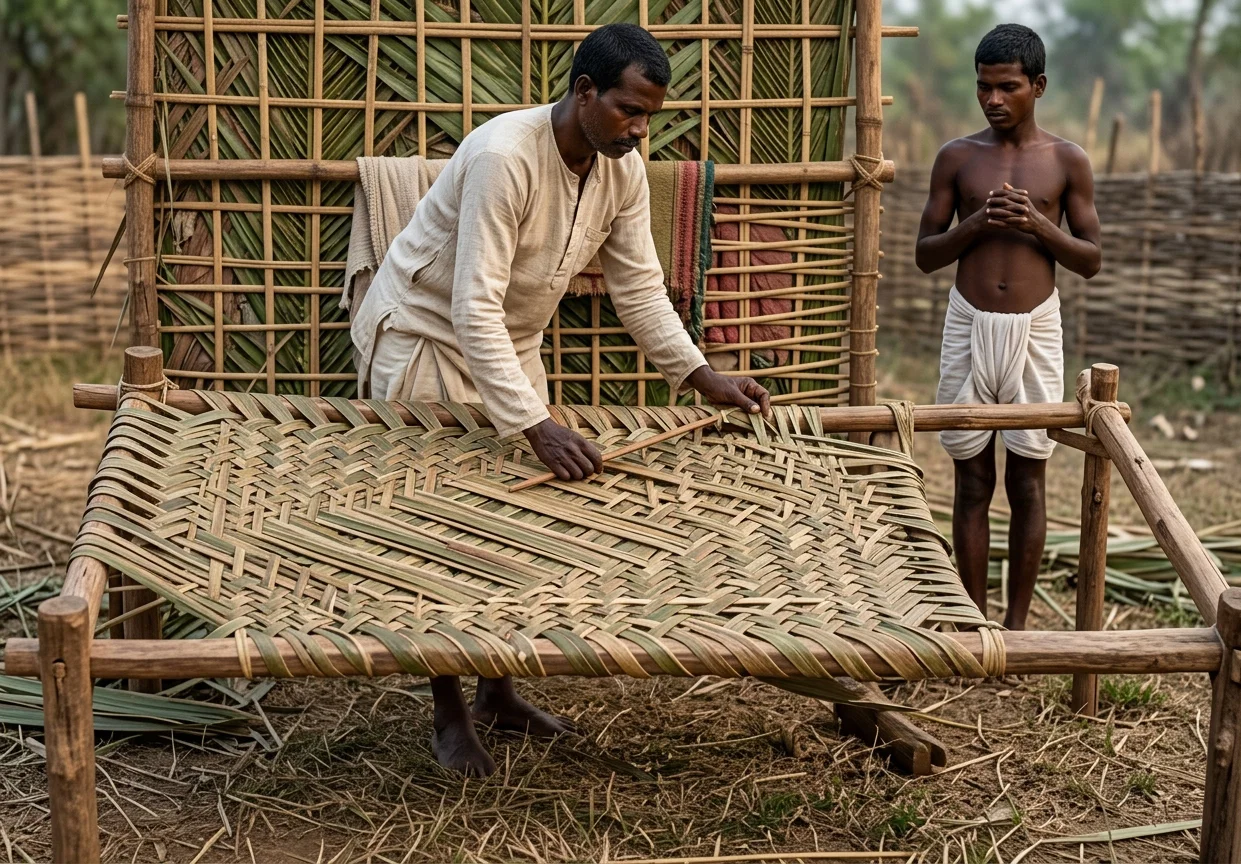
A NATIVE OF INDIA AT WORK
The Mahles are more numerous than the Karmali Kols, and are most largely represented in the districts of Manbhum, Lohardaga, Hazaribagh, Singbhum, and the Santal Pargannas. Their language differs very little from Santali, and their septs and totems are in many instances similar. Their religion is described by Mr. Risley in his ‘Tribes and Castes of Bengal,’ as a mixture of half-forgotten animism and Hinduism imperfectly understood. They practise both infant and adult marriage, and divorce is easy. A divorcee of either sex may remarry.
“By profession they are workers in bamboo, and make all the household bamboo ware used in the district. Their only implement is a curved knife, and measurements are made with the fingers. As a rule they are entirely dependent upon their trade for a living, very few of them possessing any land for cultivation. Mahle settlements are generally in close proximity to the hills on which bamboo,—the raw material from which they manufacture their wares,—is found.”
“Speed away! speed away, on your mission of light,
To the lands that are lying in darkness and night;
’Tis the Master’s command; go ye forth in his name,
The wonderful gospel of Jesus proclaim;
Speed away! Speed away! Speed away!”
Simultala, India.
The Baltic and the West-Russian Meetings
By GUY DAIL
GUY DAIL
In consideration of its size, its population, and the growth in its membership, it seemed best to the delegates assembled at Riga, October 26, to dissolve the North Russian Mission, and thus pave the way for the organization of two fields instead—the Baltic Conference, and the West Russian Mission. The conference was organized and held its first annual meeting October 26-29, in connection with the Russian Union meeting at Riga; the West Russian Mission held its first yearly session November 3-6, in Loppasch, Volhynia.
The territory of the Baltic Conference comprises the Baltic provinces (Courland, Livland, and Estland), and the governments of St. Petersburg and Pskof, with an area of about seventy-four thousand square miles, and a population of 6,296,300 (it is a little larger than North Dakota, but has over nineteen times as many inhabitants); membership, 383. During the Middle Ages the Lettic tribes of the Baltic Provinces were incorporated by the Knights of the Teutonic Order into the Holy Roman Empire; the reformed religion was accepted in the first half of the sixteenth century, and it brought with it freedom, enlightenment, and education, so that this is the most generally intelligent part of Russia—there are only about three per cent of the people unable to read and write, while it has been stated that of the Russians as a whole, seventy-three per cent can not read and write. The prosperity of the provinces is to be attributed to their excellent system of land tenure, to the skill and energy shown in the cultivation of the soil, and to their commerce and manufactures, as well as to the liberty and intelligence of the people.
During the five sessions of the conference, the forty delegates conducted their business in the most friendly manner, although they represented the Lettonian, the German, the Esthonian, and the Russian nationalities—nationalities that in the world exhibit very bitter race feelings in their dealings one with the other.
The resolutions offer thanks to God for the kind providence which has made it possible for the organization of the conference; express gratitude to the German Union for the help it has rendered the brethren here in the past; call for the establishment of a local poor fund in each church (a tenth of which is to be sent quarterly to the conference poor fund); recommend the circulation of our literature in the four leading languages of their field; agree to the principle laid down by the General Conference, that only such as are faithful in tithes and offerings be chosen for church or conference officers; pledge the loyalty of the field to our plan of raising means for local and foreign missionary work; and insist upon the support of the material fund for “Ministry of Healing”14(697 rubles were pledged, and ninety-eight rubles were given in cash toward this object), that the entire retail price of the books sold in Russia may aid in the establishment of the much-needed institutions in that field.
Elders L. R. Conradi, F. Andersson (of Finland), and J. T. Boettcher, and the visiting brethren from various parts of Russia, rendered excellent help at the meeting. In the evening, lectures were held in three localities—one for the Germans, one for the Lettonians, and one for the Esthonians and Russians.
The Sabbath-school contained one Russian, three Estonian, seven German, and ten Lettonian classes, with a membership of 230; donations, 25.8 rubles.
Elder Boettcher was chosen president for the coming year; he will be assisted by five canvassers, four Bible workers, one licentiate, and one minister. We trust our readers will ever remember this new field and its few workers.
The West Russian Mission includes the rest of what was earlier the territory of the North Russian Mission: Poland, and the governments of Kovno, Volhynia, Grodno, Minsk, and Vilna. Here is a field about as large as California, for its area is 159,000 square miles; but it contains 22,061,200 inhabitants (nearly fifteen times as many as live in the “Golden State”), who are to be told of the soon-coming Lord. Our membership here is 270.
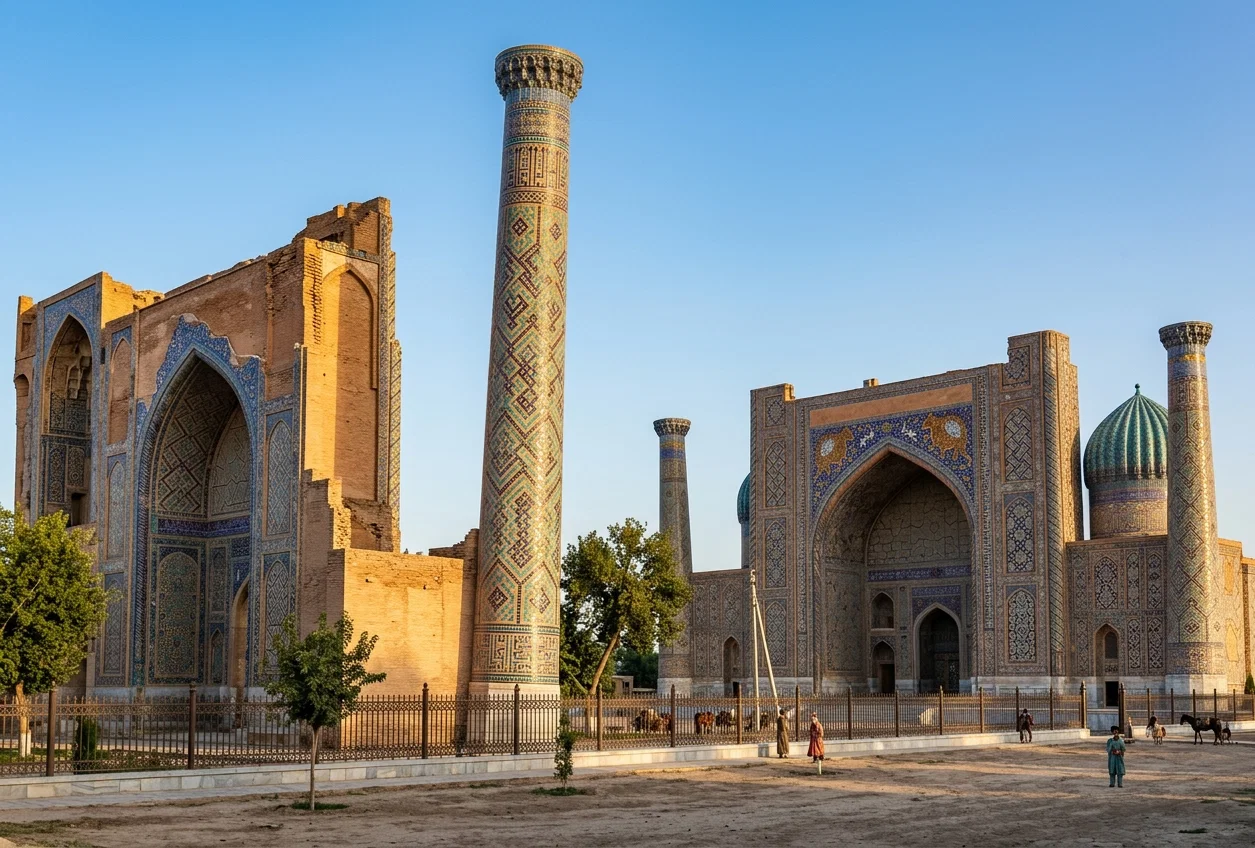
RUINS OF MOHAMMEDAN MOSQUE IN SAMARCAND
Although by far the larger number of the people are agriculturists, still, especially in Poland, there are cotton and woolen mills, engineering works and sugar-refineries, and mines of iron, zinc, and coal; and an increasing trade is carried on not only with the other parts of the empire, but also Polish manufactures are gaining a market in China, Persia, Asia Minor, and the Balkans.
Poles, Jews, Great- and Little-Russians, Lithuanians, and Germans, are the chief peoples of this part of Russia; Roman and Greek Catholics, Protestants, and Mohammedans are met with; so that one sees enough variety, so far as nationality and religion are concerned.
The same general topics referred to in the resolutions for the Baltic Conference were earnestly considered at this meeting. Elder Boettcher's help was highly appreciated. Although they have recently had rather a poor harvest in some parts of western Russia, still the brethren and sisters were so much interested in the institutional work that needs to be done here, that they raised 636 rubles toward the material fund for “Ministry of Healing.” They also manifested a sincere desire to help forward the cause in their field in every way possible. Elder D. P. Gaede was chosen superintendent of the West Russian Mission.
We wish for the dear friends in this field (who are assisted in their labors by two ministers, one licentiate, one Bible worker, and two colporteurs), the richest blessings of God, and a harvest of souls for the Master. To this end may they be remembered as we pray.
Hamburg, Germany.
A Missionary Visit in Uganda
By L. R. CONRADI
L. R. CONRADI
To one conversant with the history of missions, especially with the mission work in Africa, it will be most interesting to learn that this precious truth has also found its way into the “Japan of Africa,” a name given to Uganda, on account of its rapid development.
Last year, when the British Union Conference decided to open a mission on the shores of Lake Victoria Nyanza, the German East African Mission consented to Brother A. C. Enns, joining Brother A. A. Carscallen in selecting the new mission site. Brother Enns had been one of our pioneer missionaries in German East Africa, and had made such good progress in mastering the African languages that he was well able to assist Brother Carscallen in starting the mission. For awhile we feared for Brother Enns’ health, but God in his mercy raised him up again.
During Brother Enns’ illness, when he could not attend to the work on the building, some Uganda boys were secured to help erect the house, and Brother Enns improved the time he had during his sickness to labor with these Uganda lads. One of them, Sakariya, was a Christian, while the other, Kimera, was yet a heathen; but both were able to read, and as they had no literature save a part of the prayer-book, they were only too glad when Brother Enns let them have his Uganda Bible and Testament, and read with them as they had opportunity. He found they were very much interested and desired to ask many questions. Often when the Bible study was over, Sakariya would clasp the Bible in both hands, and kneel down, exclaiming, “Nungi nyo nyo! (O, how very, very good!) Brother Enns was free to speak with them about the main points of present truth.
When Sakariya was asked if he had been baptized as Jesus was, in the water in the river, he replied: “No; in the cathedral in Uganda they only had a little water.” Brother Enns was made happy a few days later, when Kimera came to him, wishing to be baptized. This means much, after only six months of instruction in the third angel’s message.
Brother Enns also went over the Sabbath question with them, which they gladly accepted; and they desired him to write down the texts on each subject separately, that they might carry the truth to their friends. Thus God has led us right to the border of the lake, and already brought us into contact with some honest souls in the interior—souls that are able to read, and have some knowledge of Christianity, and can thus be more quickly reached by present truth.
As the German Union Conference is anxious to extend its missionary operations, we wrote Brother Enns that, if it be possible, we should be pleased to have him take a trip around Lake Victoria Nyanza, the southern portion of which is in German territory, and thus see if there would be a good opening for us. Accordingly, he took the steamer, and went down the eastern shore of the lake, stopping at a number of German ports, and visiting as many mission stations as he could, seeing what other missionaries had been able to gain in that territory. It was told him that the Catholic missionaries were not liked in their field. When we first began work in German East Africa, we had thought of going into that well-populated country, but were then informed that the Catholics exercised such power that it would not be wise for us to attempt a mission there then. But it would now seem that the way is opening for us, and, in view of the increased experience our workers have had, the German Union hopes to start a mission on the southern shores of the lake within the next twelve months.
Having gathered important information concerning the German territory, Brother Enns went up the west side of the lake, to Uganda proper. Arriving in Ntebe, he was kindly received by one of the English missionaries, and had an opportunity of visiting some of his teachers. One of these teachers was so impressed that his eyes filled with tears, before Brother Enns could get through telling about the truth for this time, and he desired that some of our missionaries might return to give them more light.
Then Brother Enns went on to Mengo, the Uganda capital. There he was entertained by the Christian servants of Mr. Werner (the gentleman himself being absent), who made it as comfortable for him as they could. He was here eight days, and held Bible studies every evening. No less than fourteen became so deeply interested that they requested15that a missionary might be sent to instruct and baptize them.
Thus the good seed has been sown in the hearts of a number of honest Uganda people; and we can plainly see how Ethiopia is stretching out her hands for help. Going out one day, Brother Enns met a man on the street. They had a short conversation, and Brother Enns found that this man had just come from the Catholic Mission, where he had been attending the prayer service, and that he was one of the waiters in the royal palace. Brother Enns had an interesting talk with him, and before they got through, tears ran down this man’s cheeks, too, and he desired more light.
Brother Enns was invited to call on the regent and the two young Christian princes, Kabaka, who is eleven years of age, and his brother. These children are both well educated, and Brother Enns writes that they appear to be Christians, heart and soul. He was also requested to see Pastor Henry Wright, who seemed much interested in the work. The regent asked Brother Enns to supper, and desired our people to establish a medical mission in the province of Chagwe. They have been waiting for a hospital there for some time. The same request was also extended to us by the government physician. Brother Enns also had a pleasant visit with Bishop Tucker, and was invited, with him, next day to dine with Mr. Hardsley.
Brother Enns gives a very interesting account of the few weeks’ trip around this lake in the very heart of Africa. We see that honest souls are everywhere. Naturally, as they more or less have learned to read, and have the Bible in their own language, there is a wonderful opening before us. Now, as we are invited to commence medical work there, we surely ought to take steps soon; and still more means ought to be raised, that we may enter upon that work.
There seems no question whatever that, if we as a people take hold of the work there as we should, we shall not only reap many souls in the “Japan of Africa,” but we shall also find that this land sustains the same relation to Africa that such countries as Germany, England, Scandinavia, Switzerland, etc., have borne to the other parts of Europe. How much good could be done if our medical workers could heed that call, and, constrained by the love of Christ, and actuated by a real missionary spirit, enter the work there! How blessed it would be, too, if those who have sufficient means would now, in this most favorable time, give of their abundance to forward the work in this field.
To-day, we see the Gentiles coming to the light God has given us. Princes and governors are coming to the brightness of its rising glory. What we need is to lift up our eyes; and as these people gather together to come unto us, and call from afar, O that our hearts may be enlarged, and that we may truly arise and shine, so that God’s work may speedily be finished!