Your ShelfYour Projects

Review and Herald, Vol. 85, No. 3.

A Special Issue of* THE WATCHMAN
Earlier text: Aids for Bible Readers

Italy

ROME.—It gave us new courage to learn that another worker was to be added to the ranks in Italy. It is indeed a source of much comfort to know that those in the home field are thinking of us and our difficult place, the home of the papacy. We are thankful for the aid sent in the person of Brother Giraldi, and we pray that he may prove to be an instrument in God's hands for gaining many of his countrymen for the present truth. I had a long and pleasant visit with him, as he remained in this city with us for several days. He spoke to our little company on Sabbath and Sunday night. He has gone on to Naples.
Professor Fant is now laboring in Genoa, the birthplace of the famous navigator and discoverer of America. This is an energetic city, full of activity and life. It is growing very rapidly, and is becoming a prominent seaport. With Brother Fant is another Italian brother, by name Gaeta, a member of our Rome church. At the present time he is engaged in canvassing. He was formerly a canvasser of the Bible Society.
With Brother Benezet, in Turin, is Brother Bertalot, who is doing a good work selling our literature.
In this country we now have the principal points on the Mediterranean Sea occupied by our missions; so we form quite a good force on one side of Italy. We still lack Sicily on this side. A young man from that island is now with me. He is investigating the truth, and has a great desire to work there as a canvasser. I have been told that the other denominations have made excellent progress in their work in Sicily; in fact, in one place the Waldenses have converted to Protestantism a whole community, consisting of about fifteen thousand persons, with their mayor. I do not understand by this that all are members of the church; but while many are members directly, others are in favor of the Protestant religion as opposed to the Catholic.
Brother Fant made a trip to a town not far from here, this summer, and found, high up in the mountains, in an out-of-the-way place, a man who had been keeping the Sabbath with his family for ten years without the knowledge of another Sabbath-keeper in the world. He found the Sabbath while still a Catholic, without the aid of any one. One day he asked his priest why the Catholic Church observes Easter. He was given the usual explanation—that the councils enjoined it, etc. But this did not satisfy him, and he wanted to know what the Bible teaches about it. The priest told him he had only a Latin copy of the Bible, and sent him off without further ceremony.
The man happened to know of a Protestant who lived not far from there, and he went to him, and asked if he had a copy of the Scriptures. The Protestant gladly loaned him his, and he began to read it, to see what it taught about Easter. But while he found that it taught very little about this, he learned that it everywhere insisted on the observance of the Sabbath. He returned to his priest, and asked of him an explanation about this Sabbath question; but the former replied that the church had changed the day to Sunday. Thereupon the brother asked by what right the church changed the precepts of God. The priest then became angry, and called him an ignorant countryman, incompetent to enter into the reasons for the church's actions and authority, and sent him off.
He tried to get an explanation from the Protestants, but they could furnish only inadequate reasons, and he finally made up his mind to hold to the truth, and keep the Sabbath, although alone. He suffered many persecutions, both from the Catholics and from the Protestants, but he was firm. You can well imagine his joy when he heard that there were other Christians observing the seventh day, and standing for the same truth for which he had been combating so long. He received Brother Fant with open arms, and immediately began to invite his neighbors to come in and hear the truth. Many of them did come. Of course Brother Fant's stay was limited, so that we have not been able to follow up the work as yet. I received a good letter from this brother, in which he says, among other things: 'Blessed be God, who in his love has been pleased to comfort me, poor unworthy creature, by making known unto me brethren, full of charity, humility and brotherly love such as I never experienced before in my life. O brother, you can not imagine the great joy that has come to me by the revelation of these new brethren.' I shall not take the time to quote more, but will simply say, that he, with his family, has asked to be admitted into the church, and be one with those who keep the commandments of God and have the faith of Jesus. CHAS. T. EVERSON.

Annual Ingathering Service at Elkpoint, S. D.

We enjoyed so much our first ingathering service that we began last winter to plan for another. This was held Nov. 2, 1907. The church was canvassed early last spring to see what missionary enterprises the members would be willing to carry on solely for the Lord. At the same time the children were enlisted in the work. During the season many little missionary plans were set on foot; and all were interested to know what the outcome would be.
The chapel of the Industrial Academy was decorated for the occasion, and the program was rendered by the children. The interesting part was when the children, one by one, brought forward their offerings and told how they had earned them. When the collection was counted, it was found that the children had raised $20.19, and the older members $9.30; and pledges amounting to $24. This, with other donations received since, makes in all a total cash donation of $57.79. Of this $22.30 is sent to the Jewish Mission in Boston, and with it a list of twelve subscribers for the Jewish paper, Good Tidings of the Messiah. The remaining $35.49 goes, by the choice of the children, to the Southern field.
BERT RHOADS.

Notes From the Field

DECEMBER 14 I left Washington to attend some meetings in the West. On the way I made a brief visit to my boyhood home in Illinois. I left here about seventeen years ago to preach this message, and I have made only a few short visits since that time. These years have quickly passed, but they have made many changes. I visited the farm where I was raised, but others lived there. Everything I looked at seemed to have a history. The trees seemed like old friends. A marble monument in the cemetery marked the resting-place of my dear father and mother.
Most of the old neighbors have passed away also. My boyhood friends are beginning to look old. When the public school dismissed at noon, I stood on the street and saw a generation, not one of whom I knew, rush by. I was impressed as never before with the rapid flight of time, and the need of improving each day as it comes to us.
While here, I had the privilege of speaking in the Baptist church to a large congregation of old neighbors and friends concerning my visit to India and Egypt, and the progress of our work in these lands.
December 19-22 I joined my brother and a number of other laborers in the Kansas Conference in a general meeting at Oswego. There was a fair attendance from some of the surrounding churches. The Sabbath and evening services were held in the Methodist church, which was kindly given us free for this meeting. The pastor attended, and expressed himself as highly pleased with what he heard. The marked blessing of God was seen throughout the meeting. On the Sabbath a number sought God for victory over besetting sins. On Sunday consideration was given to the $150,000 fund. The weather was very unfavorable, and only fifty-one persons were able to reach the place of meeting. But at this meeting six hundred thirty dollars was raised in cash and pledges for this fund. This was an average of over twelve dollars for each person present, many of whom had already paid their quota, and had, the day before, given an annual donation to foreign missions. We commend this example to other churches. There seems to be no reason why the raising of this fund should take so long if it was pushed as it should be in the churches. We believe it to be the duty of church officers to take this matter up in their churches, and carry it forward to completion.
December 23 I stopped in Topeka. I was glad to meet some other workers here. In the evening I preached in the church upon the power which is in the truths of the third angel's message, as manifested in the transformation of life which it brings to those who receive it, and called attention to the warnings given us through the spirit of prophecy concerning the efforts being put forth to remove the old landmarks of the message. It is this message, and not another, which is to go with a loud cry.
G. B. Thompson.

The School at Pua, Chile

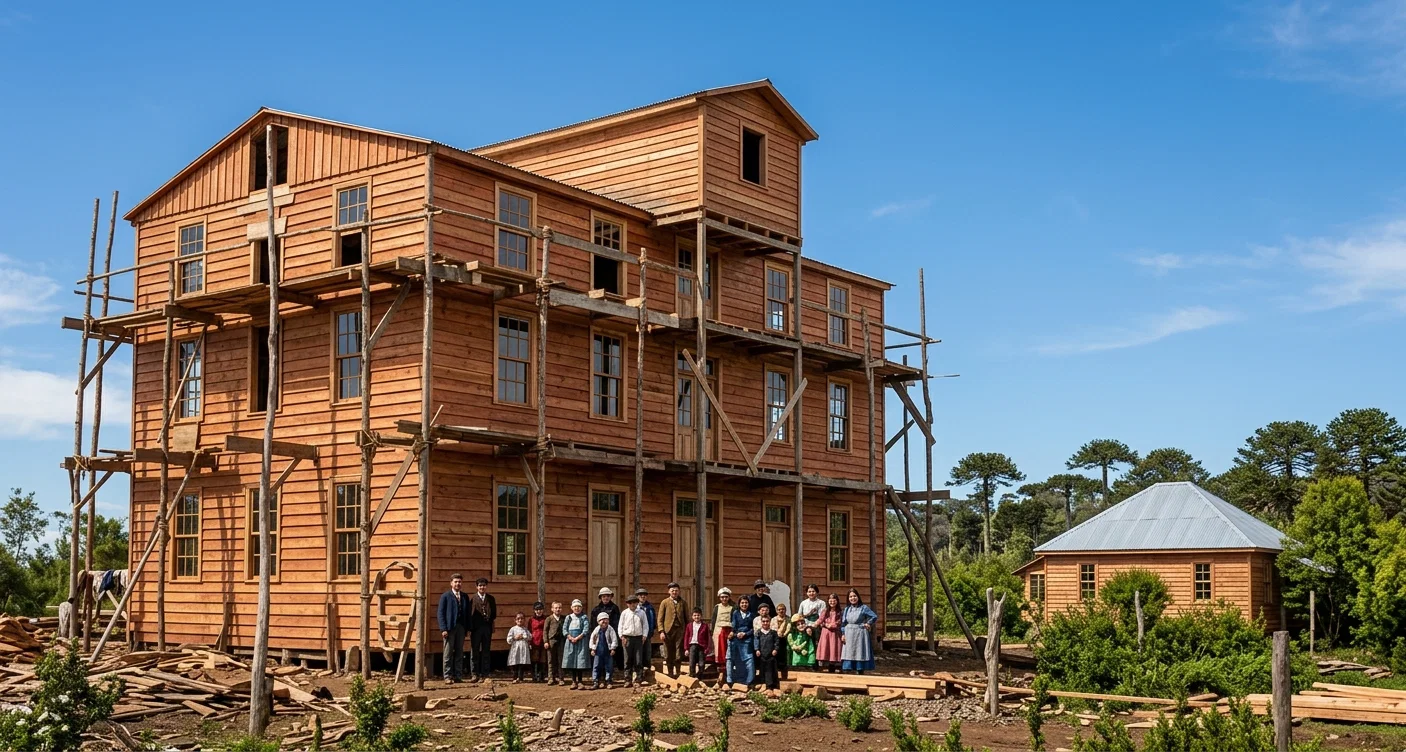
WITH this I am sending an illustration of the Púa school building, which is in process of construction. The building is fifty feet long, and twenty-nine and one-half feet wide. There will be a parlor, a dining-room, kitchen, office, and a sleeping room below, with a hall through the center. The second and the third floors will contain ten rooms each.
THE PUA SCHOOL BUILDING IN PROCESS OF CONSTRUCTION
The fourth story is composed of two nice rooms, which do not cover the whole house. There will be in all twenty-three sleeping rooms. The old building, which was erected by Brother H. F. Ketring, will be divided into two recitation rooms. The class rooms will be separated from the dormitory. This we believe will be very good for the general purpose of the school. The picture was taken after the institute closed, so that there are none of the institute students in it. We desire an interest in the prayers of God's people for the success of this branch of his work here.
F. H. WESTPHAL.

Eritrea, Northwest Africa

ASMARA.— We arrived safely, after having had a very pleasant journey the most of the way. The Lord led us to become acquainted with a Greek merchant on board the ship in the Red Sea, and he assisted us in getting through the whole way from Massowah to this place. He lives in the city, and whenever we need help, we go to him, and he is always ready to assist us. We have found but one other person, a hotel keeper, who can speak English. The Italians seldom learn a foreign language.
Asmara has a population of about fourteen thousand, and of these some fifteen hundred are Italians. It has a good climate; at this time of the year, the air is cold and fresh. We like the place and the country, and are becoming more and more interested in the people. They are not lazy; we see them always doing something—both men and women as well as children. The most of their homes are kept clean, their dirt floors being swept every day; and as we pass through their villages, we find the streets as clean. The women often sit outside of the door in the sun, making clay pots, or sewing, or embroidering—not sitting there idle. They are a tall, strong, good-looking people—not black, but of a dark-brown color. We hope soon to be able to do something for them. May the Lord help us quickly to learn their language, that we may teach them of the soon-coming Saviour.
P. N. LINDEGREN.

_North Pacific Union Conference_

The work in this part of the Lord’s vineyard is onward, and we have very many reasons for which to praise God. The last year has been a good one for our field and decided advance has been made in all departments of the work. During the year now closing there has been a real revival of the book work in our union, and our sales of subscription books during the year 1907 we trust will amount to twenty thousand dollars, an increase of eight thousand dollars over 1906. We are very glad for all this good literature that has gone out into the field, and we trust that God may bless it to the salvation of many souls.
There never has been such an interest in the educational work in this field as at present. A great desire has taken hold of the parents of our children that their young should receive a Christian education, and as a result of this, our college at Walla Walla, Wash., and the seven intermediate schools in different parts of the union are full to overflowing. Another intermediate school will be built next summer in the new conference of southern Idaho, and improvements made and facilities added to all these institutions. We greatly hope that from these schools there may go forth in due time many earnest laborers into the wide harvest-field.
The present debt of Walla Walla College is about twenty-four thousand dollars, and during the last year and a half a plan has been in operation to remove this cloud which so long has been hanging over our college. Quietly subscriptions have been taken among the people, and at this writing, December 23, nearly enough has been subscribed to liquidate this indebtedness, and there has been received into our Union Conference treasury, which is the custodian of the funds, the sum of $12,609.75 to apply on these notes. We hope by the time this article is read by the readers of the REVIEW, that at least fifteen thousand dollars of notes of Walla Walla College will have been paid, and the entire debt will be removed a little later on. We are glad also to report that on the $150,000 fund, our field has, according to the REVIEW of December 19, a credit of $9,307.07 on our apportionment of $12,181.68. Our conferences are working hard at the balance due from their fields, and we hope that our portion of this fund will soon be remitted to the General Conference treasurer. The raising of both of these funds practically in one year amounting in all to about thirty-seven thousand dollars has been quite a hard lift, but it has done us good, and brought to us a rich blessing. It is not likely that the money will ever be missed by any who have given.
Our sanitariums at Portland, Port Townsend, College Place, North Yakima, Salem, and Cottage Grove, Ore., are all enjoying a fair patronage, as are also the treatment rooms at Seattle and Spokane. Dr. J. E. Froom has also recently established treatment rooms in the city of Boise, Idaho, and reports that the outlook is good for work in that part of the field.
In consequence of the organization of the West Canadian Union Conference in October, the British Columbia Conference has been separated from our field and now forms a part of that organization. The Hawaiian Islands, also, which have formed a part of our Union since its organization, but which were never naturally connected with our field, by an action of the General Conference Committee at Gland, Switzerland, last spring, will be taken under the watch-care of the General Conference Committee after Jan. 1, 1908. Our Union Conference will still retain Alaska as a mission field, and trusts to do more in that hard and difficult field in the future than in the past.
Our first biennial session since our organization as a union will be held in College Place, Wash., January 31 to February 9. We expect a very encouraging meeting and a large measure of God’s blessing. Our laborers are having fair success in the field, people are accepting the truth, and our hearts are filled with courage for the future. Love, harmony, and union are in our midst, and for this we are profoundly grateful. The future looks bright to us, and our only desire is that our eyes may be single to the glory of God. W. B. WHITE.

Ecuador

CHONE.—Since the fourth of October Brother Casebeer and I have been out on a missionary trip. We stayed about ten days in and near Guayaquil selling small books and papers with reasonable success. Some who had bought from me a year ago were very glad to have the Señales again to read.
We have been here in the province of Manavi about a week. As the truth has never been preached or books been sold here, we expected to dispose of many papers and books. Our first stop was at Bahia, the second port of Ecuador, and perhaps the cleanest town of the country. The first day's work gave me thirty orders for “Patriarchs,” besides the sale of some small books. Brother Casebeer also sold many books. We are stopping now for a few days in Chone, and are having good success in selling literature, while waiting for the yearly church festival which takes place the thirtieth of this month. On that day many people come from the sugar plantations and cocoa farms, and we intend to put up a box stand to sell books to the passers-by.
Chone has the name of being one of the worst parts of Ecuador. Here all the men carry a long-bladed knife called the machete, which they use as a weapon, as an ax to chop wood, as a knife to cut their food, and for other purposes. It is said that out in the country surrounding Chone more die from the machete than from the fever.
In this town also we are doing well with the books. The first day I took twenty-five orders for “Patriarchs,” besides selling ten or twelve small books.
Fruit, especially oranges, is the largest I have seen in this country, which is noted for its cocoa, coffee, and ivorynuts. The people are very liberal and agreeable, if one knows how to deal with them. They are tired of the Catholic priests, so there are only a few of them, and these are seemingly poor. The people want something better. As we have only a short time to work before the rainy season comes, it seems best for us to spend our time in selling literature, leaving the meetings for next summer.
There are two missionary societies located in this province, but none at Bahia, or Chone, which seems to be the principal port of the country. One of our workers would do well we think at Bahia on the coast. It would be a good location, and in close connection with all towns of the province. We hope and pray that the Lord will soon provide some good laborer. The young people especially wish to learn English. One man here has three sons in the States, learning English.
THOS. H. DAVIS.

The Toluca (N. C.) School

This school was brought into existence some five years ago, when several of the leading citizens of this place earnestly requested the writer to come and start a school in their neighborhood. While visiting the place a meeting was called, and it was then decided to put up a building, the neighbors present donating lumber, labor, and some money. A lease of land was secured for a term of twenty-one years, paid up for the whole time, with the understanding that the land could be bought at a reasonable price. A good number of the citizens cut logs and hauled them to the mill, and inside of four days a building twenty by twenty-four by sixty-six feet, of seven rooms was being raised for a schoolhouse and a teachers’ home. Since then we have erected another building containing sixteen rooms as a home for students and a few orphan children. These buildings are nicely located in sight of the Blue Ridge Mountains, away from the din and the influence of town or city. There is no debt on the buildings or furnishings. We have fourteen acres of land to farm, a good barn, and two houses. In a short time we shall have two cows, a wagon, a buggy, and a few farm implements, with a very small capital in the bank to draw from. We have received some means from friends who are interested in our work, and to these we feel deeply grateful. We pray the Lord to reward them for their kindness.
We have sold our own home and are using the means to support students and workers, and while our means last, we shall continue the work, but we do not expect to go in debt. One lady has promised to pay the expenses of one of our boys who is lame. I trust she will never regret her generosity.
This work is quite an undertaking for a man seventy-four years of age, but as we look over the past eleven years spent in this kind of work, and see some of our students doing work in the harvest-field, sowing seeds of truth, we feel well paid for our effort. We feel thankful for the good work the following persons have done, teaching both at Hildebran and at Toluca schools: Wm. Johnston, Miss Naomi Worthen, Miss Anna Nicholan, Mrs. C. D. Wolf, Mr. Henry, Miss Minnie Holms, and Mr. Harry Smallwood. Eternity will show the faithful work done. Several hundred children have passed through these schools during the past eleven years. The writer has often wished that he could have had one year in such a school as this during the days of his wandering, when a homeless child. If any one who reads these lines desires to assist this work, such help will be appreciated.
D. T. SHIREMAN.

Bolivia

This is one of the most intensely Catholic countries in the world, and consequently one in which civilization is least advanced; yet there are some people who are willing to listen to the truth.
We have already about one hundred subscribers to our Spanish Signs (Señales de los Tiempos), and Bibles, books, and tracts have also been circulated to some extent. Several thousand pages of literature have been distributed, and people accept them eagerly.
We have meetings every evening, to which come from ten to fifty, generally about twenty. Most of them are students of the university; and several of them are showing an interest. The members of the Baptist Church also came to our meetings, and most of them are subscribers to our paper, and help distribute tracts which contain the law of God, etc.
At the end of the meeting on a recent Saturday night, I asked those present, what I should say to the people of other towns where I was going, if they would ask me how many had accepted the truth in Cochabamba, where I had been laboring now for several months. One stood up and said he was willing to obey the Lord, but he did not dare to promise in his own strength to keep the commandments. Then I told them I would present the question in other words. I asked them: “How many of you have decided to keep the commandments in the strength of the Lord? Show it by rising to your feet.” Then six stood up. We ended the meeting with a season of prayer, in which nearly all took part. So we see that the Lord is beginning to bless the work in this country, and is helping honest souls to stand for his precious present truth.
It is a privilege to be co-workers with the Lord. I never before realized so much the meaning of Gal. 4:19 as I do now. I am longing to see Christ formed in the people, and I am confident that the Lord has the same power now as in the days of old, and that some will really become so transformed as to show their Saviour in their lives.
When I think of the many people in this country who still are in ignorance of the soon coming of Jesus and of the law of his kingdom, I am anxious to see other laborers come and help give the message. It is not that I forget that there are many other countries that need workers also, but I see the need here more, because I am here where the need is felt. O, if I could only say something to awaken the lay members everywhere to prepare for work! I am sure that if they could see how we work here, they would be willing to put their hands to the plow also. Luke 9:62.
One day, as soon as I got up in the morning, a man came for Bible study; as soon as he went away, nine boys came, so we had to postpone breakfast for an hour or more. After these had gone, and we had eaten breakfast, several other boys came, and we had not finished the Bible class with them, when two grown students came for Bible studies. Dinner was ready then, but we postponed it to give them the instruction they wanted. In the afternoon several came, and in the evening we had the regular meeting; so we had six meetings that day. Frequently we have three studies in a day, and sometimes four; and we are confident that the word will not return empty. Isa. 55: 10, 11. Pray for the work in Bolivia, brethren, and you will have a part in the work here, and will rejoice in the day of gathering (Matt. 24: 31) when you see souls rescued from the dense heathenism of this dark land.
ED. W. THOMANN.

West Pennsylvania

THE little company at Indiana is increasing in numbers, two more families having located here this fall.
The school building is now ready for use, and the school has begun with sixteen students in attendance. The schoolhouse is twenty-four by thirty-two feet, and we are glad to say that we have no great debt on our hands; we owe less than one hundred dollars on lumber, and must secure a heating furnace, as we have only an ordinary stove at present. We shall need perhaps one hundred twenty-five dollars yet to complete the house. But we are all very thankful that we have a place for church and school work.
The week of prayer was a source of strength and courage to the Indiana church; victories were gained, and love for the truth binds hearts closer together.
When we came here a little less than two years ago, nothing was known of our message, and the people seemed quite prejudiced; but that is giving way now, and they are friendly.
At present the Sunday advocates are making a great stir in Indiana County. They have organized a county Sabbath Observance Association, and propose to place a secretary in every township in the county. More than forty arrests have been made within the last two months. We work quietly on the school farm every Sunday, and have not been molested. But how long we shall be able to do so, we can not tell. Our brethren have sold some copies of Liberty, and we shall do what we can to get the light before the people, but we are not able to do what we should like to do. One hotel keeper in Indiana bought five copies of Liberty when he understood that it was opposed to Sunday laws. Many of the people are not in harmony with the present movement in this county, and some say that if that is religion, they do not want any of it. Dr. Sharpe, the leader in the movement, visits the towns where Sunday work is supposed to be going forward, and when he finds people at work, appears against them as prosecuting witness.
J. W. WATT.

Canvassers’ Summary for November, 1907

AGENTS HOURS ORDERS VALUE
_Atlantic Union Conference_
Western New York 6 297 172 $ 280.05
Chesapeake 3 159 42 73.25
West Virginia 5 504 134 211.50
New York 5 407 249 323.50
Central New England 10 720 239 256.45
Maine 3 122 47 54.50
Vermont 1 18 3 9.00
Virginia 4 126 11 46.40
Southern New England 2 69 38 36.75
West Pennsylvania 5 225 91 141.37
Totals 44 2,647 1,026 1,441.77
_Lake Union Conference_
Ohio 13 619 361 419.00
Indiana 11 723 150 283.50
Southern Illinois 11 362 96 220.25
Northern Illinois 5 275 90 221.25
Wisconsin 14 623 128 307.35
North Michigan 2 89 58 79.75
Totals 56 2,691 883 1,531.10
_Southern Union Conference_
Alabama 4 570 ... 554.15
Cumberland 6 475 ... 301.15
Florida 3 108 ... 141.45
Georgia 10 584 ... 752.70
Louisiana 7 621 ... 688.40
North Carolina 8 516 ... 294.10
South Carolina 12 913 ... 752.70
Tennessee 12 835 ... 837.50
Totals 62 4,622 ... 4,322.15
_Central Union Conference_
Colorado 16 1,203 409 1,193.00
Kansas (two months) .. .. .. 2,042.75
Missouri 10 465 156 527.50
Nebraska 16 1,318 257 1,056.25
Wyoming 1 17 4 21.00
Totals 43 3,003 826 4,840.50
_Southwestern Union Conference_
Arkansas 2 106 36 100.00
Oklahoma .. 584 152 426.80
Texas 20 1,327 266 850.50
Totals 22 2,017 454 1,377.30
_North Pacific Union_
Western Oregon 5 153 61 111.00
Western Washington 3 162 64 57.95
Idaho 3 105 122 147.50
Montana 1 27 6 15.00
Upper Columbia 3 320 267 507.70
Totals 15 767 520 839.15
_Pacific Union Conference_
Arizona 1 ... ... 10.55
California 12 ... 841 1,112.45
Utah 2 ... ... 457.25
Totals 15 ... 841 1,580.25
_Australasian Union Conference_ .. 2,604 1,059 4,742.00
_British Union Conference_ 52 3,895 2,329 2,388.50
_Canadian Union Conference_ 6 147 116 135.25
_German Union Conference_ 262 21,952 ... 6,818.80
_General Summary_
Atlantic Union 44 2,647 1,026 1,441.77
Lake Union 56 2,691 883 1,531.10
Southern Union 62 4,622 ... 4,322.15
Central Union 43 3,003 826 4,840.50
Southwestern Union 22 2,017 454 1,377.30
North Pacific Union 15 767 520 839.15
Pacific Union 15 ... 841 1,580.25
Australasian Union .. 2,604 1,059 4,742.00
British Union 52 3,895 2,329 2,388.50
Canadian Union 6 147 116 135.25
German Union 262 21,952 ... 6,818.80
Grand Totals 577 44,345 8,054 $30,016.77

Calcutta Sanitarium

It is now one year since we landed in India—a year filled with varied experiences. We realize more than ever before that a Christian ought never to be discouraged at whatever may come, for we now see that things which at first we could not understand, were directed by a wiser mind, for our good in the end.
Since the sanitarium work has been established in Calcutta, it has been carried on under most trying circumstances, there being but few institutions operating under like conditions. In the European quarter where the sanitarium is located, the rents and other expenses are exorbitant, and this made it necessary either to charge a high rate for our work, or to operate at a loss.
Calcutta has a number of large government hospitals where people may receive good medical attention and care free, or at a very nominal charge.
The climate of Calcutta is very trying, and the institution has been short of workers, which meant that those here must overwork under these trying climatic conditions. This is the reason so many of our faithful nurses have broken down in health.
During the hot season, lasting for about seven months, every one who can leave Calcutta goes to the hills; thus a greater portion of the year our patronage is low. After we became better acquainted with the conditions and needs of this field, and studied carefully the instruction regarding locating our sanitariums, the conviction became strong that this institution should be located in a more favorable place.
As this matter was considered by the advisory board it was clear that God's hand was leading, for all had received definite impressions along this same line.
The Lord in a marked manner cleared up difficulties which seemed at first impossible to overcome.
After a careful study of the field, it was decided to locate the sanitarium in Mussoorie, the same station where our Mountain Mission Home is located. Mussoorie is an ideal location for a sanitarium. It is a beautiful little city, at an elevation of seven thousand feet, in the bosom of the Himalaya Mountains amid the most delightful mountain scenery, with a climate equal to Colorado. The cool, fresh air from the snow-capped mountains beyond does wonders for those who visit this place yearly to overcome the evil effects of the plains.
Adding to these natural advantages the sanitarium principles and methods, it would seem that here nature and science can meet under the most favorable conditions for the restoration of health. And here our medical workers will not be subjected to the debilitating climatic conditions while carrying on their taxing work.
We are now in the midst of packing and moving. By April 1, when the season in the hills opens, we shall be ready to receive our patients at the Mussoorie Sanitarium.
As the great burden which has hindered the advancement of this work is lifted, we confidently expect to see the medical work become the power in this field which it was meant to be, breaking down prejudice and preparing hearts to receive the truth either now or during the loud cry.
THE SANITARIUM AT CALCUTTA, INDIA
From all indications India will have some interesting reports to send in during the coming year. We hear the sound of a going, and you know what that means.
Keep a watch on India, and your hearts will rejoice in what the Lord is able to do.
H. C. MENKEL, M. D.

Current Mention

— With hundreds of militiamen present and martial law in force at Muncie, Ind., the cars were run about all day, January 5, manned by imported strike-breakers. Aside from the throwing of a few missiles, there was no disturbance.
— It is reported from Vancouver, British Columbia, that hundreds of Japanese ex-soldiers there have been ordered by the mikado to return at once to Japan. The French press has made much of this and other incidents, declaring that war between Japan and the United States is imminent.
— Victor Emanuel, king of Italy, was forcibly reminded of the hard times existing among his subjects, when driving January 7 to inspect a monument being erected to the memory of his grandfather. A great crowd of unemployed rushed for his carriage, shouting: “Give us bread or give us work.” The police dispersed the crowd.
— News has been received of heavy loss by storm and tidal waves on the Japanese coast. Nine steamers and forty sailing craft are reported to have foundered, with considerable loss of life. Nearly 600 fishing vessels were wrecked or carried away, and over one thousand buildings were flooded by tidal waves in which many were drowned.
— The first electric train was operated through the Hudson River tunnel between Hoboken, N. J., and Christopher Street, Manhattan, January 4, carrying a company of officials and other interested ones. The tunnel will probably be opened to the public the latter part of the month. On January 9 the regular passenger service was opened.
— For some days a “rent strike” has been in progress among the tenement dwellers on the East Side of New York. Because of the refusal of the renters to pay the rents charged, and the refusal of the landlords to reduce them, the courts were unable to meet the demand for dispossess papers. Many landlords were flooded by threats of having their houses visited by the fire department if the tenants are dispossessed.
— George A. Pettibone, accused of conspiring with Charles H. Moyer and William D. Haywood, the president and secretary of the Western Federation of Miners, to murder the former governor of Idaho, Frank Steunenberg, was acquitted January 4. At the same time the case against Moyer was dropped. Haywood was acquitted last summer.
— The annual report of Police Commissioner Bingham, of New York City, made public January 4, shows that there were more than double the number of arrests for felonies in 1907 than in the preceding year, and double the number of convictions. At the same time there were four times as many arrests and convictions for misdemeanors as in 1906.

Findings

Dr. R. S. Cummings, and wife, née Jessie Counselman, are in charge of the Paradise Valley Sanitarium, National City, Cal.
Dr. Estella Houser is lady physician in the Nebraska Sanitarium, at College View, Neb.
Dr. F. F. Abbott has accepted a position with Dr. H. F. Rand in the St. Helena (Cal.) Sanitarium.
Dr. Mary B. Dryden is associated, as lady physician, with Dr. Henry Habenicht in the Iowa Sanitarium.
The number of guests in the Paradise Valley (Cal.) Sanitarium is steadily increasing. About twenty are enrolled at present.
The Washington Sanitarium at Tacoma Park, and the Branch Sanitarium at Nos. 1 and 2 Iowa Circle are enjoying a good patronage. The former has twenty-five patients, and the latter a full house.

Medical Missionary Department

Conducted by the Medical Department of the General Conference
W. A. George, M. D., - - - Chairman
W. A. Ruble, M. D., - - - Secretary
Continue reading: A Review of the Religious Liberty Work for 1907, and the Outlook for 1908