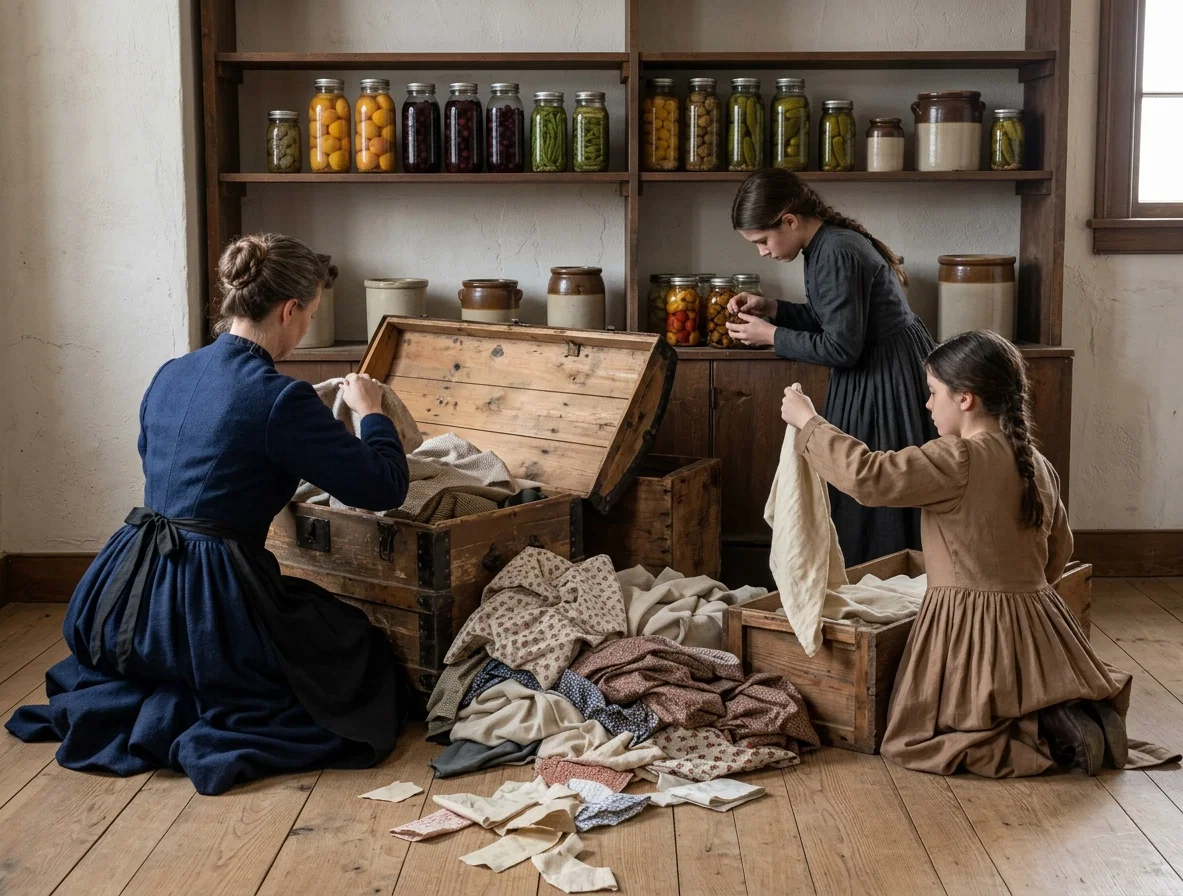
"THERE, now!" said Dora Lee, as she stepped from the little sitting-room into the kitchen, with pail and scrubbing-cloth in hand, "I believe this house is clean from one end to the other. If we only had a carpet for the front room, and new wall paper, and some white muslin curtains for the windows, it would be real nice and cozy. Seems as tho we might have a rag carpet. Grandma's house has a carpet in nearly every room in it, and some of them are just as pretty as boughten ones. Don't you s'pose we can make one, mother?"
Mrs. Lee, or Mattie Lee, as every one called her, looked up at her daughter's direct question with a wan smile on her pale face. "I did try to make one a long time ago," she answered with a sigh. "But I was sick a long time, and the rags were put away. When I got better I did not get them around again, there was so much else to do. After Frank and Bertie and Bessie were born I never could get any time."
"I remember it," said Dora; "Katie and I were little things then, but we thought we could help sew rags, but our rags wouldn't hold together. But I am fourteen now and Katie is twelve. We will sew all the rags if you will only cut them. Katie and I have talked it all over, and we mean business."
“The next day they ransacked trunks.”
"Well, dears, we might try it." And Mattie looked with a motherly pride at her two bright-faced girls with a more cheery, hopeful look on her face than it had worn for a long time. "If," she added anxiously, "I can get the money to buy the warp and to hire the weaving done. You know, my children, it is sometimes hard to get necessary things to eat and wear."
Dora and Katie knew that very well, and they also knew the reason why. Their meals were often scanty, and their clothes were so shabby that if it had not been for the presents that came so frequently from grandma's they would often have been without a decent suit of apparel in the house. They had often seen their mother weeping as tho her heart would break, and they knew it was because their father, Frank Lee, spent a great part of his wages at Hughes' tavern, for intoxicating drinks.
Frank Lee drank occasionally when Mattie Dixon married him, but as he worked hard, and provided fairly well for his family for several years, she felt no uneasiness.
But of late his visits to the tavern had been growing more frequent, and, as a consequence, he had grown morose and selfish, and the home comforts had sensibly diminished. The children learned to shun his presence when he returned from town, with flushed cheek and unnatural eye. Mattie, too, wept silently, for she had found that reproaches only angered him. Mattie was a frail little woman, illy fitted to bear the burden of poverty and the care of six small children.
Dora had grown strong and self-reliant from having to act as nurse and housekeeper in her mother's frequent illnesses. Into her sympathetic ear Mattie confided the sorrow of her life, which she felt too weak to bear alone. Dora was courageous and hopeful. "Don't cry, mother," she would say. "We'll have a prohibition law one of these days, and then Hughes will have to shut up his old rum-hole, and go to work for a living."
The great joy of the children's lives was going to Grandma Dixon's to stay a few days or a few weeks. There was seldom a time when there was not one of the children there, tho since Dora and Katie had become such a help at home, their visits had been shorter and less frequent. They keenly felt the difference between their own meagerly-furnished home and Grandma Dixon's white farmhouse, with its bright carpets, lace curtains, and well-supplied table.
Grandma felt sorry for Mattie and the children, and it was seldom that they came home without some addition to their wearing apparel and some dainty for their mother.
Since Dora's last visit her longings had taken shape in a resolve to have a rag carpet like grandma's.
"Perhaps," she said softly to her mother, "if the house was pretty and comfortable pa would like to stay at home better."
Tears came into Mattie's eyes, and a ray of hope into her heart. She entered into Dora's scheme with almost childish enthusiasm.
The next day they ransacked trunks and boxes and barrels, where they found plenty of material for their purpose. In fact, as Katie remarked, "more rags than anything else."
The cutting and sewing went steadily on for some weeks. Grandma promised to help about the coloring. Even Frank seemed quite interested, and praised the girls for their industry. Perhaps he felt a little self-reproach for his neglect and unkindness toward those nearest and dearest to him. At any rate, he worked more steadily and squandered less. Mattie seemed her old light-hearted self once more.
About the time the rags were weighed for the last time, and pronounced sufficient, Frank had finished a good job (he was a mason), and came home with plenty of money in his pocket.
"Now, Mattie," said he with a gay smile, throwing some bills into her lap, "here's the money for your carpet. Perhaps it will get the paper too."
"Frank, you are just as good as you can be!" said Mattie impulsively, throwing her arms around his neck.
"O, nonsense!" said Frank, but there was a mist in his eyes as he left the room. A sense of his unworthiness came over him, and he resolved to do better, to break the chains that bound him to so vile a habit, and to do his duty more faithfully to the little flock intrusted to his care.
That evening he seemed more like his old, cheery self, as he laughed and played with the little ones. The children were all delighted, and Mattie thought she had never been happier in her life.
For several weeks Frank came home with money in his pocket, or his hands filled with necessary supplies. It was in early autumn when the carpet came home from the weavers. It was unrolled on the floor for a general inspection.
"It is really prettier than I thought it would be," said Dora with a satisfied air.
"It is just beautiful," said Katie enthusiastically. "It is just as pretty as grandma's," was Lulu's comment, which, in Lulu's estimation, was the highest compliment that could be paid.
"It's a daisy," cried Frankie; and he would have turned summersaults on it if his mother had not held him back.
Bertie signified his appreciation of it by lying down and rolling over it.
"Pretty, pretty," lisped baby Bessie, patting the red and yellow and green stripes with her chubby fingers.
Mattie was as pleased as the children. Altho she11had been married fifteen years, this was the first carpet she had ever had.
Mrs. Harvey, a near neighbor, the most stylish of their acquaintance, came in the next day. "I really must compliment you, Mattie," said she; "I have seldom seen a prettier rag carpet. If you wanted to sell it, I would gladly give you sixty cents a yard for it, tho the usual price is fifty cents. I would like it for my dining-room."
"We don't want to sell it," said Mattie quickly. So the matter was dropped.
They decided to do the fall cleaning and to paper the little sitting-room before making the carpet. Frank had yielded to temptation more than once. In truth, he had not decided to quit drinking altogether, only to be very temperate, and spend more for his family, and less for himself.
Mattie worked beyond her strength during the papering and cleaning, and this, with the mental strain caused by anxiety for her husband, threw her into a slow fever, with frequent fainting spells. To relieve these a bottle of brandy was procured. Frank watched over her anxiously until she grew better, and slept naturally. He felt worn and exhausted, but could not eat or sleep. While striving to crush the restless craving within, it flashed into his mind about the brandy bottle on the stand by his wife's bedside. The demon within urged him on, and he arose from the old lounge in the kitchen, where he was trying to rest, and stole noiselessly into the room where his wife lay quietly sleeping.
(Concluded next week.)
HOW GEORGE MULLER SOUGHT GOD'S WILL.
IN 1877 Mr. Muller said that for forty-eight years he had sought to be guided by the will of God; and in doing this he had adopted certain methods. Following these methods he had never had occasion to retrace his steps nor to doubt God's guidance in the decisions he had made. Here is his method; it is good; try it:—
“1. I seek at the beginning to get my heart into such a state that it has no will of its own in regard to a given matter. A large share of the trouble with people generally is just here. Nine-tenths of the difficulties are overcome when our hearts are ready to do the Lord's will, whatever it may be. When one is truly in this state, it is usually but a little way to the knowledge of what His will is.
“2. Having done this, I do not leave the result to feeling or simple impressions; if so, I lay myself liable to great delusions.
“3. I seek the will of the Spirit of God through, or in connection with, the Word of God. The Spirit and the Word must be combined. If I look to the Spirit alone without the Word, I lay myself open to great delusions also. If the Holy Ghost guides us at all, He will do it according to the Scriptures, and never contrary to them.
“4. Next I take into account providential circumstances. These often plainly indicate His will in connection with His Word and Spirit.
“5. I ask God in prayer to reveal His will to me and to guide me aright.
“6. Thus, through prayer to God, the study of the Word, and reflection, I come to a deliberate judgment according to the best of my ability and knowledge; and then if my mind is at peace, and continues so after two or three more petitions, I go ahead accordingly. In trivial matters and in transactions involving most important issues I have found this method always effective.”
LESSON XI.—SUNDAY, JUNE 11, 1899.
CHRIST RISEN.
Lesson Scripture, John 20:11-20, R.V.
11 "But Mary was standing without at the tomb weeping; so, 12 as she wept, she stooped and looked into the tomb; and she beholdeth two angels in white sitting, one at the head, and 13 one at the feet, where the body of Jesus had lain. And they say unto her, Woman, why weepest thou? She saith unto them, Because they have taken away my Lord, and I know 14 not where they have laid Him. When she had thus said, she turned herself back, and beholdeth Jesus standing, and knew 15 not that it was Jesus. Jesus saith unto her, Woman, why weepest thou? whom seekest thou? She, supposing Him to be the gardener, saith unto Him, Sir, if Thou hast borne Him hence, tell me where thou hast laid Him, and I 16 will take Him away. Jesus saith unto her, Mary. She turneth herself, and saith unto Him in Hebrew, Rabboni; 17 which is to say, Master. Jesus saith to her, Touch Me not; for I am not yet ascended unto the Father; but go unto My brethren, and say to them, I ascend unto My Father and your 18 Father, and My God and your God. Mary Magdalene cometh and telleth the disciples, I have seen the Lord; and how that He had said these things unto her.
19 "When therefore it was evening, on that day, the first day of the week, and when the doors were shut where the disciples were, for fear of the Jews, Jesus came and stood in the 20 midst, and saith unto them, Peace be unto you. And when He had said this, He showed unto them His hands and His side. The disciples therefore were glad, when they saw the Lord."
Golden Text: "Now is Christ risen from the dead." 1 Cor. 15:20.
SUGGESTIVE QUESTIONS.
(1) What is said of Mary Magdalene on the morning of the resurrection? V. 11. Note 1. (2) Whom did she behold? What was their position? V. 12. (3) What did the angels say to Mary? What was her reply? V. 13. Note 2. (4) As she thus spoke, whom did she see near her? V. 14. Note 3. (5) What did Jesus say to Mary? Who did she think He was? How did she reply to His queries? V. 15. Note 4. (6) Then how did He address her? What was Mary's response? V. 16. (7) What did Jesus forbid her to do? Why? Upon what mission did He then send her? V. 17. Note 5. (8) How did Mary execute her mission? V. 18. (9) What were the disciples doing on the evening of that day? Who suddenly appeared in their midst? What salutation did He give them? V. 19; Luke 24:33-36. Note 6. (10) After this salutation what did Jesus do? Then what was the experience of the disciples? V. 20; Luke 24:38-43.
ONE MILLION SLAUGHTERED.
Are you, lady, particeps criminis?
ONE million bobolinks killed in one year! That bare statement has a throb of pity in it for those to whom sunny meadows and the song and perfume of the fields have a certain charm, which the money market lacks. It hardly needs the dependent statement that the million were killed to adorn women's bonnets—certainly, it requires no reflections upon the vanity and cruelty of the tender-hearted sex to point the futility of the sacrifice. Such reflections are too obvious, and, when made, belong too entirely with other details of the moral code the neglect of which seems a necessary consequence of the ease with which they are accepted.
Everybody knows that it is cruel to massacre birds; everybody knows that the massacre is due to women's adoption of fashion. Having been large-minded enough to grant this, why should everybody be troubled further? But Robert of Lincoln has won his own place in a good many hearts, and personal attachments are harder to put aside than moral obligations. We can not think of a million of him being slain in one year with quite the same calmness with which we admit that it is tyrannous, having a giant's strength, to use it like a giant; there are too many pictures before our eyes of riotous brilliancy of buttercups and daisies, heavy grasses swaying in the golden sunlight beneath the weight of a gay, live creature.
Gayly dressed,
Wearing a bright black wedding coat,
White are his shoulders and white his crest,
while in our ears sounds the bubbling song of the
"Braggart and prince of braggarts,
Pouring boasts from his little throat."
Decidedly it takes too much shine and melody out of the world not overstocked with them to silence one million of those insouciant, confident little throats in one year.—Hartford Courant.
THE "CYCLE STOOP."
THERE is cycling and cycling, cycling for pleasure and health, cycling for speed and money. The former, with the cycler erect, the lungs expanded, the pace not too rapid, is an exhilarating and healthful exercise, and the wheel thus used, with a proper saddle, is a blessing to many. It has also proved a blessing to many workingmen, enabling them to live out in the suburbs of large cities, in better surroundings and at less rent.
But the cyclist who rides for speed and fame and money, or he who imitates such, drops his handlebars, arches his back, raises his chin, and forms a double curvature—antero-posterior—in the spine, as the result of the constant humping of the back.
In addition to the "cycle stoop" we have the "bicycle face," developed by the bent professional or his amateur admirer. "God made man upright; but they have sought out many inventions," observes the wise preacher. The drop-handle riding is one of the inventions which bring man down from the upright position. Let cyclists be men, upright men.
NOTES.
By William N. Glenn
1. At the Tomb.—This lesson begins abruptly. The last lesson closed with the death of Jesus on the cross. The intervening circumstances of the burial, the setting of the watch, the official sealing of the tomb, and the resurrection, are all passed by, and we have brought to view Mary standing at the empty sepulchre weeping because her Lord was not there. From Mark's account we learn that there were three women at the tomb "very early in the morning of the first day of the week." Mark 16:1, 2. But as they were sent to tell the disciples what had occurred (Luke 24:10), it is evident that Mary Magdalene had returned to the sepulchre (compare first ten verses of lesson chapter and Mark 16:9). This first day of the week was not the Sabbath, for "the Sabbath was past" (Mark 16:1), and these women had "rested" upon it "according to the commandment" (Luke 23:55, 56).
2. Still in darkness.—Mary was still in darkness concerning the resurrection. She was weeping because she thought the body of Jesus had been taken to some other place, and her only anxiety was to know where it was, that she might do it further honor. All the teaching of Jesus regarding His resurrection, and a future life only through that means, had as yet been misunderstood.
3. Saw Jesus.—Not only were ministering angels there to care for the dead body of their Leader, and to speak words of comfort to the mourners, but Jesus Himself came just in the time of deepest sorrow. How much of sorrow might be assuaged from day to day if the afflicted ones would only have faith to see Jesus by their side, as well as to believe that His angels are "all ministering spirits sent forth to minister for them who shall be heirs of salvation." Heb. 1:14. True, Mary did not at first recognize Jesus, but He was there nevertheless.
4. "Why weepest thou?"—That was no time for weeping. The greatest victory in the history of the universe had just been accomplished in behalf of the disciples of Christ. Why should any of them be weeping? Why were they not all there rejoicing? Why were not all of them at the tomb early that morning to witness the resurrection? Had He not told them that He would rise again the third day? Matt. 16:21-23; Mark 8:31; Luke 9:18-22. The simple answer to these queries is the sad word "unbelief." Shall we heed the lesson? "This is the victory that overcometh the world, even our faith." 1 John 5:4.
5. "I am not yet ascended."—This is a positive refutation of the doctrine of the immortality of the soul. It is positive proof that Jesus Christ, the Son of God, died, and was dead until the third day. He "died for our sins according to the Scriptures," was "buried," and "rose again the third day according to the Scriptures." 1 Cor. 15:3, 4. This is emphasized by the further statement that "if Christ be not raised, your faith is vain; ye are yet in your sins." Verse 17. If Christ continued His life while the body was dead, and His immortal soul was in heaven during that time, then He did not die, and it was not true that He had not ascended. That, later in the day, He did permit His disciples to touch Him, is proof that He ascended that day, presented His offering to the Father in behalf of the human race, and returned to further prepare His disciples for their important work in the earth.
6. "Peace be unto you."—This was a repetition of the song of the angels when announcing His birth: "Peace on earth, good-will to men." The offering had now been accepted in Heaven, and the way of peace had been made sure for all who would walk in it. "Thou wilt keep him in perfect peace, whose mind is stayed on Thee; because he trusteth in Thee." Isa. 26:3. But for such only. "There is no peace, saith my God, to the wicked" (chap. 57:21); "the way of peace they know not" (chap. 59:8). "Being justified by faith, we have peace with God through our Lord Jesus Christ." Rom. 5:1. W. N. G.
To ALL interested in carrying the Gospel of Jesus Christ to the inhabitants of other lands, and who desire to assist in supporting missionaries already there and others who may engage in the work, the opportunity is given to make an offering to the FOREIGN MISSION BOARD of the Seventh-day Adventist denomination. Address, 1730 North Fifteenth Street, Philadelphia, Penn.