The Youth’s Instructor, Vol. 29, No. 49.

JAPANESE WORSHIP

The Youth’s Instructor

Dec 7, 1881

S. D. A. Publishing Association · Battle Creek, Mich. · Dec 7, 1881

JAPANESE WORSHIP.
Several weeks ago we had something about the Japanese people, their dress, and some of their strange customs, together with a picture and description of their curious houses. Those who have forgotten about it will do well to find the paper, and read the article again; for it will help you better to understand what we are going to say about their ways of worship.
The people of Japan have long had many different religions; but the three principal kinds are the Sinto religion, the Buddhist, and that of Confucius. Of these, the most ancient is Sintoism, which originally consisted in the worship of the sun and the elements. These they call the “great spirits.” The sun is still the chief object of veneration among the Sintos, but they also believe in an infinite number of inferior spirits, called the genii, or kami. These are mostly heroes canonized for their worthy deeds or illustrious virtues.
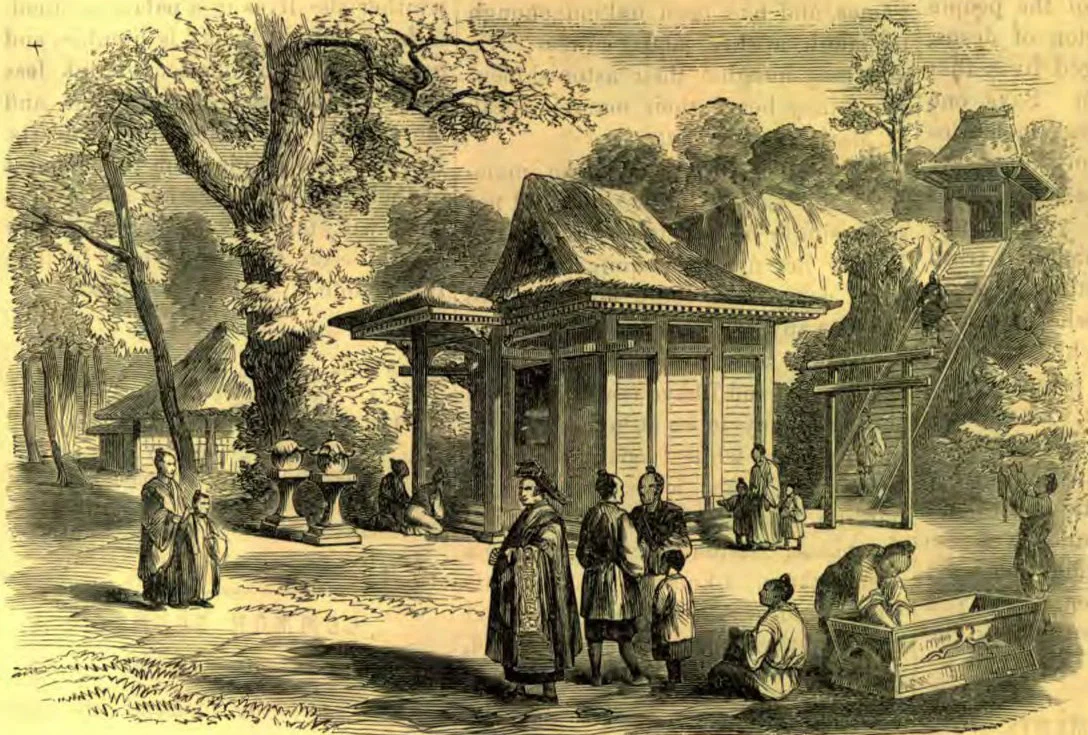
Numerous temples, called myas (royal residences or palaces), are erected to the sun and also to the inferior deities. In these temples, however, are no idols or images, but only large metal mirrors, or disks, in honor of the sun; and packets of white paper scraps, as a symbol of purity. On the walls are pictures of the horse, which they regard as a sacred animal, and the attendant of their sun-god. These chapels are adorned with flowers and green branches; and two lamps, a cup of tea, and one of wine, are also placed inside. The priests are called kanusi, or keepers of the gods. They live near the temple, and obtain their income chiefly from the offerings made on feast-days.
The worship paid to the spirits supposed to reside in the myas is very simple. The worshiper approaches the temple under the sacred gateways, until within a short distance of the door, when he stops, folds his hands in the attitude of reverence, mutters his prayers, and departs. On the festivals, or feast-days, he brings offerings of wine, rice-cakes, eggs, etc.
In the picture on this page is represented one of these Sinto temples at Yokohama (Yo-ko-ha'-ma), a city of Japan on the east coast of the island of Hondu. The town is mainly settled by foreigners, and is a favorite port for both English and Americans who visit Japan, because there they find not only those of their own countrymen, but many of the conveniences of their own land. The picture quite likely represents a scene on a feast-day, as numbers of the people seem to be going toward the temple with something in their hands.
Buddhism, however, has latterly become the most popular religion of Japan. This religion has Buddha for its chief deity, and was introduced into the country from the peninsula of Corea, in the sixth century. It has gradually gained ground, until it has almost taken the place of Sintoism, or rather, has mingled with it; for in many instances the same temple serves for both, and accommodates the mirrors of the kamis, together with the images of the Buddhist gods. The priests of Buddha in Japan are called bonzes, and are numerous and much respected. They frequently live in the temples, which do not differ materially from those of the Sinto, except that they are usually larger and finer. One who spent three years in the interior of Japan, says of them:—
“The Buddhist temples usually occupy the most picturesque sites, enshrined among thickly shaded groves, and secluded from the noise and bustle of the large cities. Approaching them through an avenue of trees, or ascending the hill-slope, you may see their massive roofs, carved pagodas, and huge bell-towers rising abruptly through the green foliage. The very atmosphere of sacred solitude surrounds them.”
“In one of these temples I was destined to live during my first year in Japan. With all its heathen rites and pagan darkness, I yet learned to call it my home. Under almost the same roof with me were the priests of Buddha, and the idols before whom incense was continually burning, filling the house with fragrance. The grounds of the temple covered several acres, and contained nearly a dozen buildings. Some of these were temples, others were small shrines, and the central building was a temple and dwelling combined. Here most of the worship was performed by day and night, and here I lived.
“Several massive gates led into the grounds. Under the largest stood two grim warriors, carved in wood and painted plaster, measuring fifteen feet in height, and holding giant spears, bows, and arrows, with which to guard the sacred portals of the temple. Colossal pines shaded the walks, and bamboo groves skirted the hillside. To the left, on the terraced slope of the hill, stood a Buddhist cemetery. A great bronze bell in the tower tolled solemn and slow, with a deep booming sound, every evening when the sun went down.
“At first I thought it quite romantic; I liked the retirement and the peaceful stillness, broken only by the prayers of the priests, and the measured beat of the drums accompanying the repetition of the musical words, ‘Buddha armida’; . . . but at last it became very lonely, as the romance and novelty faded out; and the clatter of drums and gongs in the temple, instead of being musical, became intolerable.”
Although the Buddhist is the most popular of the Japanese religions, there is a large body of the people who reject idol worship entirely, and found their rule of life on what they consider philosophical principles. These are the followers of Confucius, and form a sect known as Siuto, or the school of philosophers. This sect includes the people of the best education. They have no temples, or ritual, but pay supreme honor to Confucius, and religiously venerate their ancestors.
One thing which seems very strange to us is that there is no hostility between the different forms of religion among the Japanese. No religious disputes are heard of among them, much less do they bear one another any hate on such grounds. On the contrary, they think it a simple act of courtesy to visit from time to time one another’s gods, and do them reverence. Soon after the introduction of Christianity in the sixteenth century, some of the heathen priests petitioned the emperor to prohibit the new and foreign faith. He asked how many different religions there were in Japan? He was told there were thirty-five; upon which he remarked: “Where thirty-five religions are tolerated, we can easily bear with thirty-six; leave the strangers in peace.”
Missionaries and teachers from England and America have been sent to Japan, and they have taught the people not only the true religion, but many of the arts of civilization. The work has been slow, but within the last few years the results of the faithful labor bestowed are becoming more and more apparent. Many of the people gladly receive the religion of Jesus, and show by their changed lives that they really appreciate it. Says one missionary, “The happiest memories I have connected with my long stay in Japan are those of the hours spent with my Bible-class of young men. The eagerness with which the truth was received, the affectionate gratitude manifested by all who attended, the solemn assurance which the Divine Spirit gave of his presence, and the consciousness that I was presenting Christ to those who had never known him, gave an unction to my words, and filled me with an awe and enthusiasm which I cannot well describe. One of the young men said to me, ‘They are golden truths you are giving us, and they satisfy the soul.’” E. B.
SINTO TEMPLE AT YOKAHAMA.

THE LOVE OF GOD.

All things that are on earth shall wholly pass away, Except the love of God, which shall live and last for aye. The forms of men shall be as they had never been; The blasted groves shall lose their fresh and tender green; The birds of the thicket shall end their pleasant song, And the nightingale shall cease to chant the evening long. The kine of the pasture shall feel the dart that kills, And all the fair white flocks shall perish from the hills; The goat and antlered stag, the wolf and the fox, The wild boar of the wood, and the chamois of the rocks, And the strong and fearless bear, in the trodden dust shall lie; And the dolphin of the sea, and the mighty whale, shall die. And realms shall be dissolved, and empires be no more, And they shall bow to death, who ruled from shore to shore; And the great globe itself, so the holy writings tell, With the rolling firmament, where the starry armies dwell, Shall melt with fervent heat—they shall all pass away, Except the love of God, which shall live and last for aye.—From the Provençal of Bernard Rascas, by William Cullen Bryant.

MARION’S ORNAMENTS.

“Mamma,” said a little girl one morning, after she had sat by her mother some time, apparently very busy thinking, “I have a favor to ask of you: will you let me wear the gold watch and chain that Aunt Anne gave me a long while ago, you know? I will take great care of them; may I, mamma?”
Mrs. Clifford looked up from her work into her little daughter’s eager face.
“Why do you want to do that, Lucy?” she said. “I think you look much nicer as you are.”
“Oh, no, indeed, mamma! Do please let me wear them! Yesterday, when we were at grandpa’s, Ellen Baird had on the most beautiful watch; every one was looking at it, and saying how pretty it was. I did so wish I had had mine on—” “Oh! and mamma,” interrupted Carry, “will you buy me a hat like Minnie Oakley’s? You must have noticed it—it had the most beautiful long sweeping feather; and her sash was such a lovely blue, I never saw one like it before; do get us sashes like that, dear mamma. Do you know we were the only ones who had no sashes, except, indeed, Marion Elton? But then—she is not a lady; she—”
“I thought Marion Elton was the best dressed little girl amongst you,” said Mrs. Clifford, quietly. The children both exclaimed at once—
“Marion Elton! Why, mamma, how funny! She had not a single pretty thing on; she had nothing but a print frock and a plain white hat, with scarcely any trimming. Don’t you think you must have made a mistake, mamma?”
“I think not,” said her mamma; “I know Marion quite well, and I repeat, that I saw some beautiful ornaments on her; indeed, I wish I could have some of them for my own little daughters.”
The two children opened their eyes wide with astonishment; for to tell the truth, they had rather looked down upon little Marion, because she was poorly dressed; and they knew she did not live in a great house, like themselves and their little companions. They had neglected her, too, yesterday, leaving her out of their games, and had been unkind enough to laugh at her simple dress. So you may imagine their astonishment when they heard their mamma speak of Marion’s ornaments.
“Do tell us what you mean, mamma,” said Lucy. “I’m sure I did not see a single ornament about her, and I know her mother is quite poor, too, so of course she could not afford to buy her any.”
“Well,” says Mrs. Clifford, “I saw at least six, and I have reason to think she has many more at home. Don’t interrupt me while I count them up. In the first place, when you were all hunting for violets in the wood behind the house, Marion discovered quite a nest of them. I know some little girls who would have been quite quiet, and gathered them all, as fast as they could, for their own nosegays; but I observed that she ran immediately and told the others, and even helped some of the little ones to gather; then I saw that she had one very valuable ornament,—unselfishness. When little Fanny Hall fell down, and tore her nice new dress in the bushes, no one stopped to help her, for you were all in such a hurry to go and see the greenhouse with grandpa; but Marion ran back when she saw what had happened, soothed the little girl, and waited behind to pin up the tear in her dress; that showed me she possessed another very bright jewel,—loving-kindness. When George Keith pushed against her so rudely, and knocked over all her strawberries, she looked vexed for a moment, but directly after she spoke quite gently, and as she stooped to pick up the fruit, I saw two other very rare and precious ornaments; these were,—forbearance and patience. She never talked and laughed loudly. She had the beautiful jewel,—gentleness. And, lastly, I saw one ornament of great price; it shone so brightly that it lighted up all the other jewels. When you left her out of your games, and laughed and made fun of her because she had not a smart, blue sash, or a feather in her hat, then I saw it. Many children would have been angry and sullen, but Marion was as sweet-tempered and gentle as possible. She had the ornament of a meek and quiet spirit, which is, in the sight of God, of great price.” I observed several more precious jewels, but I will leave you to find them out for themselves, when you know her better. I have told you of six. Do you not agree with me, my children, that Marion Elton was at least as well dressed as Lucy and Carry Clifford?”
The little girls looked very much confused, and neither of them spoke for some time; at last, Lucy said, with tears in her eyes,—
“Mamma, if you will let me go and see Marion some day, I will try to—to make her forget our unkindness. Is she a lady, mamma?”
“If you mean—does she live in a grand house, with a great many servants and carriages, and a great deal of money, I must answer no; but, my child, all these things do not make a lady. People may have all these, and not be what I wish my Lucy to be, whether she lives in a palace or a cottage—a lady. A lady is humble, and gentle, and considerate. Think less about your outward adornment, and more of the ornaments of your hearts. Never value people from the richness of their dress. Education and experience will teach you some day how much better the inside may be than the outside.”—Home Companion.

COMMON SCENES.

IN THE FOREST.

Many are the pleasant thoughts linked by our memories of childhood, with the wild woods. After the long winter, what a relief it was to hear the loud “popping” of the trees as the frost yielded his hold. A hopeful sound too, was the long-drawn “pee de” of the titmouse, brave little bird, that with nut-hatch and blue-jay dared to brave the northern winter; that felt the first south wind, and heard in the sugar-camp the ringing of the “tapping gouge.”
Thousands, aye, sometimes millions of wood-pigeons flew backward and forward as if to distribute the blessings of spring; and when at last came the first mild showers, the moistened woods grew fragrant and green.
The little Spring-beauty and Adder’s-tongue, the Hepatica and uprolling feathery ferns were beneath our feet, and the white banners of the dogwood overhead. With the evening, came the plaintive notes of the whip-poor-will, starting mournful echoes into life among the hills.
Summer came, with its endless variety of birds and flowers and shimmering leaves. In the green summer woods every motion is graceful, every sound agreeable, every line a line of beauty. Each leaf and branch is swayed in graceful curves. Each sound, from the whispering of the wind in the pine tops to “the falling of the oak in the stillness of the forest,” affects us with a feeling of admiration or sublimity.
Here is growth of various kinds,—growths of a single night, resulting in as rapid decay; and growths of a century, yielding oak and pine for thousands of houses on the prairies and by the sea-side.
For richness of coloring, no scene save a grand sunset can compare with autumn woods. Well do I remember one October scene,—a green field of wheat, beautifully green, walled on three sides with lofty maples in whose flushed leaves seemed fixed the beauties of a whole summer’s sunsets, so gorgeous were they.
Again, there is in the forest always something new. The real lover of nature never sees two days, or two trees, and scarcely two flowers, exactly alike. Enough of variety exists everywhere to make her attractions infinite.
To the botanist, even the gayest flowers are not more attractive than the majestic old trees. By chance he finds their odd blossoms, and admires. He sees all the buds ready formed in the fall, and wonders that he never noticed it before. They are arranged, too, in perfect order,—upon the maple and box-elder they are opposite, in alternate pairs; upon the oak and plum, the first, sixth, eleventh, and sixteenth buds, counting from the base upward, are in a direct line, forming a row, and on each branch (if long enough) there will be five such rows.
Inspecting a branch of the black-oak, the botanist learns to his surprise that it has, at the same time, fresh flowers, and acorns of a year’s growth. Watching until October, he sees the acorns ripen and fall, nearly thirty months from the time when they began to form in the bud. The acorns of the white oak ripen within six months from the death of the blossoms which gave rise to them.
There are other things—small things—in the woods which we rarely notice. This moss-grown log on which we rest is covered with them. The hundreds of rounded patches, greenish and gray and brown, growing on the bare flat surface, and the scores of little gray shafts with crimson caps,—such are lichens, flowerless plants without distinct stems or leaves.
These delicate green plants, trailing along the crevices of the bark, and those erect in bunches, like miniature pine forests, are mosses, flowerless plants with stem and leaf distinct.
And now, like true lovers of nature, let us search for beauty; for when the green forest aisles in their wealth of dew and flowers and morning light have filled the mind with thoughts of God’s perfect work, ’tis then the discovery of one more new and beautiful flower brings the overflowing tear of admiration. GEO. R. AVERY.

The Blessing of Humble Gifts from Love

As there's never a tiny dew-drop, Or the morning's faintest ray, But may freshen a drooping blossom, Or usher the golden day; So there's never a gift so humble But a blessing it may prove, And be marked by our Heavenly Father, If it comes from a heart of love.

NEW-TESTAMENT HISTORY.

LESSON 59.—JESUS GIVES SIGHT TO ONE WHO WAS BORN BLIND.

And as Jesus passed by, he saw a man who was blind from his birth. And his disciples said, “Who did sin, this man or his parents, that he was born blind?” Jesus then answered, “Neither hath this man sinned nor his parents;” and intimated that the man’s condition gave opportunity for showing the power of God in healing him. He then went on to teach that we must work for God while the day lasts? for the night will come in which no man can work. Of himself, he said, “As long as I am in the world, I am the light of the world.” When he had thus spoken, he moistened some clay with spittle, and rubbed it on the eyes of the blind man, saying, “Go, wash in the pool of Siloam.” The man obeyed, and returned seeing.
When those who had known the blind man, saw him in this condition, they said, “Is not this he that sat and begged?” Some thought he must be the man, while others said, “He is like him.” But the man himself answered, saying, “I am he.” They then asked how his eyes were opened, and he said, “A man that is called Jesus made clay, and anointed mine eyes, and said unto me, Go to the pool of Siloam, and wash; and I went and washed, and I received sight.” On being asked where Jesus was, he said, “I know not.”
Then they took him to the Pharisees, who, when they had heard his story, said of Jesus, “This man is not of God, because he keepeth not the Sabbath-day.” They accused him thus, because he had healed this man on the Sabbath. But others said, “How can a man that is a sinner do such miracles?” So there was a division among the people,—some believing, and some denying. Finally they called the man again, and said unto him, “What sayest thou of him, that he hath opened thine eyes? He said, He is a prophet.” But the Jews, not yet satisfied, called the parents of him that had received his sight, and questioned them; saying, “Is this your son, who ye say was born blind? how then doth he now see?” Then said his parents, “We know that this is our son, and that he was born blind; but by what means he now seeth we know not, or who hath opened his eyes we know not: he is of age; ask him: he shall speak for himself.” His parents spoke in this way to avoid being condemned, and turned out of the synagogue; for it had been agreed among the Jews that whoever should confess that Jesus was the Christ should be cast out.
Again the unbelieving Jews called the man upon whom the miracle had been performed, and said unto him, “Give God the praise: we know that this man is a sinner.” But the man said, “Whether he be a sinner I know not: one thing I know, that, whereas I was blind, now I see.” Then they began to question him again, hoping, no doubt, to entangle him in his words. They said, “What did he to thee? how opened he thine eyes?” The man answered, “I have told you already, and ye did not hear: wherefore would ye hear it again? will ye also be his disciples?” But they reviled him, saying, “Thou art his disciple, but we are Moses’ disciples. We know that God spake unto Moses: as for this fellow, we know not from whence he is.” Then said the man, “Why, herein is a marvelous thing, that ye know not from whence he is, and yet he hath opened mine eyes. Now we know that God heareth not sinners; but if any man be a worshiper of God, and doeth his will, him he heareth. Since the world began, was it not heard that any man opened the eyes of one that was born blind. If this man were not of God, he could do nothing.” But the Jews said to him, “Thou wast altogether born in sins, and dost thou teach us? And they cast him out.”

QUESTIONS.

  1. As Jesus passed by, what unfortunate being did he notice? John 9:1.
  2. What question did his disciples ask concerning this man?
  3. What answer did Jesus give them?
  4. For what did this man’s misfortune give opportunity?
  5. What did Jesus then teach in regard to promptness?
  6. What did he say of himself?
  7. When he had thus spoken, what did he do?
  8. What did he tell the blind man to do?
  9. How did the man show his faith?
  10. What was the result of his obedience?
  11. As he was seen by those who had known him, what conversation took place among them?
  12. How did the man settle their doubts?
  13. What question did they then ask?
  14. Repeat his answer.
  15. What did he say on being asked where Jesus was?
  16. To whom was the man then taken?
  17. When they had heard his story, what did they say?
  18. Why did they accuse Jesus of breaking the Sabbath?
  19. What different opinion did some express?
  20. What state of things was thus brought about among the people?
  21. When questioned, what opinion did the man express who had been blind?
  22. What way did some of the Jews take to ascertain whether the man had really been born blind?
  23. Repeat the answer given by the parents, when questioned by the Jews.
  24. Why did they answer so evasively?
  25. What did the unbelieving Jews then say to the man upon whom the miracle had been performed?
  26. What reply did he make?
  27. For what probable purpose did they then begin to question him?
  28. What did they ask him?
  29. Give his answer.
  30. What taunting reply did they make?
  31. How did the man show the inconsistency of their remark,—that they knew not whence Jesus was?
  32. What did the proud and foolish Jews then say and do?

NOTES

Neither hath this man sinned, etc.—Jesus did not mean to affirm that this man nor his parents were without any sin, but that this blindness was not the effect of either his sin or theirs.
Wash in the pool of Siloam.—Josephus mentions the pool of Siloam frequently, and situates it at the mouth of the Valley of Tyropeon, or the Valley of Cheesemongers, where the fountain long indicated as Siloam is still found. It is on the south side of Mount Moriah, and between that and the valley of Jehoshaphat. The water at present flows out of a small artificial basin under the cliff, and is received into a large reservoir fifty three feet in length by eighteen in breadth. The small upper basin or fountain excavated in the rock is merely the entrance, or rather the termination, of a long, narrow underground passage beyond, by which the water comes from the Fountain of the Virgin. Why Jesus sent the man to wash here is not known. It is clear that the waters in themselves had no efficacy to open the eyes of the blind, but it seems probable that Jesus directed him to go there to test his faith, and to see whether he was disposed to obey in a case where he could not see the reason of it. An instance somewhat similar occurs in the case of Naaman, the Syrian leper.
Put out of the synagogue.—It is not probable that this refers to any immediate or violent putting forth from the place where they were. It rather refers to excommunication from the synagogue. Among the Jews there were two grades of excommunication: the one for lighter offenses, of which were mentioned twenty-four causes; the other for greater offenses. The first excluded a man for thirty days from the privilege of entering a synagogue, and from coming nearer to any of his family and friends than four cubits. The other was a solemn exclusion forever from the worship of the synagogue, attended with awful maledictions and curses, and an exclusion from all intercourse with the people. This was called the curse, and so thoroughly excluded the person from all communion whatever with his countrymen that they were not allowed to sell him anything, even the necessaries of life. It is probable that this latter punishment was what they intended to inflict if any one should confess that Jesus was the Messiah; and it was the fear of this terrible punishment that deterred this man's parents from expressing their opinions.—Buxtorf.
Dr. Clark, however, thinks that it is more likely to have been the lesser of these two punishments which was threatened those who confessed Jesus as the Christ.
He is of age.—He is of sufficient age to give testimony. Among the Jews this age was fixed at thirteen years.
Wast born in sins.—That is, that thou wast born in blindness,—a state which thus proved that either thou or thy parents had sinned, and that this was the punishment for it. . . . When men have no arguments, they attempt to supply their place by revilings; when they are pressed by argument, they reproach their adversaries with crime.—Barnes.
THE history of the man who was born blind, and cured by our Lord, is in every point of view instructive. His simplicity, his courage, his constancy, and his gratitude are all subjects worthy of attention and emulation. He certainly confessed the truth at the most imminent risk of his life; and therefore as Stephen was the first martyr for Christianity, this man was the first confessor. The power and influence of truth in supporting its friends and confounding its adversaries, are well exemplified in him; and not less so, that providence of God by which he was preserved from the malice of these bad men. The whole story is related with inimitable simplicity, and cannot be read by the most cold-hearted without extorting the exclamation, “How forcible are right words.”—Clarke.

SCENES IN THE LIFE OF CHRIST.

LESSON 46.—REVIEW.

  1. RELATE the parable by which Jesus showed what great things may come from small beginnings. Matt. 13 : 31, 32.
  2. By what parable did our Lord show that God works silently upon the hearts of men till their whole character is changed? Luke 13 : 20, 21.
  3. Relate the parable of the net and fishes, and tell its meaning. Matt. 13 : 47-50.
  4. Tell how Jesus stilled the tempest. Mark 4 : 35.
  5. What was the name of the country where Jesus and his disciples landed after the tempest was over?
  6. Give some description of the country.
  7. Tell who met Jesus at the shore, and what conversation followed. Mark 5 : 1.
  8. Describe the miracle by which these men were brought to their right mind.
  9. How did the people of the surrounding country find out what Jesus had done?
  10. What did they request him to do?
  11. Who begged that he might go with Jesus?
  12. What duty was pointed out to him?
  13. Who welcomed Jesus, on his return to the western shore of the lake? Luke 8 : 40.
  14. Who came in great haste to ask Jesus to come immediately to his house?
  15. Who was healed on the way to the ruler's house?
  16. Relate the circumstances connected with the miracle.
  17. What word was brought to the ruler before he reached his home?
  18. How did Jesus comfort him?
  19. Tell all that Jesus did at the ruler's house.
  20. What was the next miracle?
  21. Tell what these men did, and how they were healed.
  22. Describe the man who was then brought to Jesus.
  23. What was done for him?
  24. How did the people look upon this miracle?
  25. To whom did the Pharisees give the credit?
  26. What place did Jesus then visit?
  27. What did the people say when he began to teach in their synagogue?
  28. What reply did he make?
  29. What did the people lose by treating the Saviour so?
  30. What caused Jesus to pity the people, as he went preaching in the cities and villages of Galilee?
  31. How did he furnish them with more teachers?
  32. What instructions did he give these disciples?
  33. What did they do, as they went from place to place?

RELIGION AND DOCTRINE.

HE stood before the Sanhedrim; The scowling rabbis gazed at him; He recked not of their praise or blame; There was no fear, there was no shame; For one upon whose dazzled eyes The whole world poured its vast surprise, The open heaven was far too near, His first day’s light too sweet and clear, To let him waste his new-gained ken On the hate-clouded face of men.
But still they questioned, Who art thou? What hast thou been! What art thou now? Thou art not he who yesterday Sat here and begged beside the way; For he was blind.
—And I am he, For I was blind, but now I see. He told the story o’er and o’er; It was his full heart’s only lore; A prophet on the Sabbath-day Had touched his sightless eyes with clay, And made him see who had been blind; Their words passed by him like the wind Which raves and howls, but cannot shock The hundred-fathomed rooted rock.
Their threats and fury all went wide; They could not touch his Hebrew pride, Their sneers at Jesus and his band, Nameless and homeless in the land, Their boasts of Moses and his Lord, All could not change him by one word.
I know not what this man may be, Sinner or saint: but as for me, One thing I know, that I am he That once was blind, but now I see.
They were all doctors of renown, The great men of a famous town, With deep brows, wrinkled, broad, and wise Beneath their wide phylacteries; The wisdom of the East was theirs, And honor crowned their silver hairs; The man they jeered and laughed to scorn Was unlearned, poor, and humbly born; But he knew better far than they What came to him that Sabbath-day, And what the Christ had done for him, He knew, and not the Sanhedrim.
— Harper’s Magazine.

The Bible as a Book of Many Sciences

The Bible is an immense book. It is as wonderful for its richness and variety as for its magnitude. There is scarcely a branch of human knowledge upon which it does not shed some light. It is a book of diverse sciences, albeit its central science is that of salvation. To this all the rest bow as the sheaves of Hebron and the stars of heaven bowed to Joseph. In the unfolding of the plan of redemption which the Bible records, we find a treasure of history, of biography, of geography, of ancient, peculiar, and almost forgotten usages, such as no other book in the world contains.—Vincent.
Continue reading: TROT’S RUNAWAY