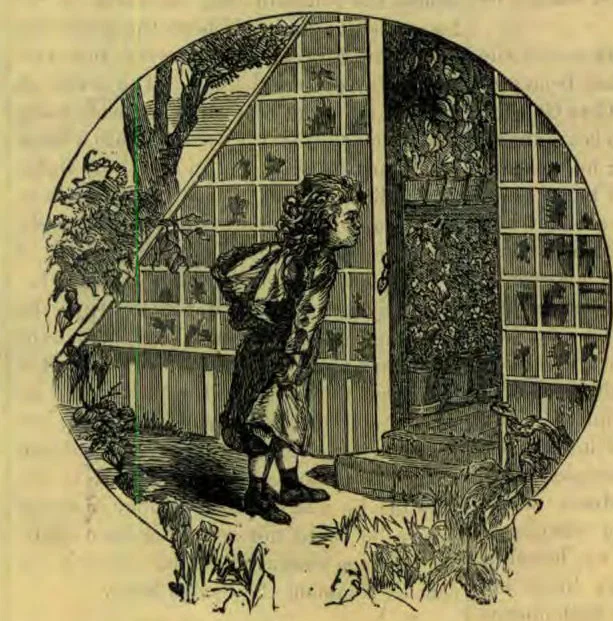
THE child had been named Alice, but when she was a wee little thing, they had some way got to calling her Trot; and so by the name of Trot she was known all through the village.
Now, Trot’s mamma was dead, and her papa, who was a doctor, was gone from home much of the time. They lived near the edge of the village, in a large old house, quite a way from the street. In front of the house, just outside the picket fence, was a long row of poplars, standing straight and tall, like so many soldiers. Inside the yard were pines and drooping elms, so that you could not see out to the street at all.
As we have said, Trot’s mamma was dead, so Aunt Jane kept house for them. Now, Aunt Jane was at heart a kind woman, and really loved little Trot; but she had such a stiff, stern way that you would never have thought she did. To be sure, Trot was always well dressed, and her hair nicely curled every morning; but that done, Aunt Jane’s duty was through. She never thought of taking Trot upon her lap or rocking her to sleep at night, as the child could dimly remember her mamma had done. So, as Trot had no brothers or sisters, it came to pass that she was left very much to herself; and in the summer she would wander day after day about the large yard, and play under the old trees, talking to her dolls and kittens as if they could understand what she said. Aunt Jane never worried about her so long as she came to her meals.
Now, Trot loved her father dearly, and it was a great treat to her when he would take her into his buggy and let her ride with him. Otherwise she seldom went out of the yard, for the gate-latch was too high for her to reach; and, besides, Aunt Jane had straightly charged her that she must never go out into the street alone. To be sure, she went with her aunt every Sunday to the village church, and sat in the straight-backed pew, and listened very hard to understand what the minister said; but Aunt Jane never let her stay to the Sunday-school afterward. After they went home, she must learn five verses from her little red Testament, and recite them to her aunt. But the late dinner over, Aunt Jane always went to sleep; and then Trot was free to wander about as on other days, only sometimes when papa was home, he would read her stories, and tell her about her mamma.
But one Sunday afternoon Trot wandered down the winding gravel-walk, and finding the gate open, she slipped out, and went trudging down the street. How nice it did seem to be out of that yard! and on and on she went, down the quiet village street, with her bonnet thrown back and her curls flying . Finally she came to a house beside which was a queer-looking glass building. She had often seen this before, but did not know what it was. True, she had been told that it was a “green-house,” but she had not the least idea what that meant. She was sure the house did not look green. But now she thought would be a good time to see what it was. So she went into the yard, and seeing no one around, she crept softly up to the open door, and peeped slyly in. Still she saw no one, and so she went inside.
And oh, what a beautiful place it was! On both sides of the long room were shelves, and on these were rows of green plants in earthen pots; and so many of them were in blossom. There were roses and fuchsias, and pinks, and many other flowers. Trot had never seen anything half so pretty. And as there was no one to forbid her, she picked a handful of the brightest. But after a while she heard some one coming, and beginning to be afraid, she crawled under the bottom shelf, and hid behind the plants. She thought that as soon as the folks went out, she would creep out and go back home; for Aunt Jane would wake up, and what would she say to find Trot gone!
Well, that night about dark a man came up the gravel-walk carrying in his arms a little girl, fast asleep, with a bunch of wilted flowers clasped in her hand. “Here, Doctor,” said he to Trot’s father, who met him at the door, “is a little ’un that I found asleep in my greenhouse when I watered my plants to-night; and my wife reckoned it was yours.”
“Did you ever!” said Aunt Jane, as, for once at least, she took the now sobbing child in her arms. “What did the child mean to give us such a scare? I’ve hunted high and low for her.”
Trot was pretty well frightened, and promised never to run away again; but she always knew what a greenhouse was, after that. E. R.
The Lily of the Valley, the Dewdrops, and the Snow.
By T. S. Arthur
A lily of the valley pushed up its green leaves as the spring opened, hung out its tiny white bells, and breathed its perfume on the air. Every evening a host of little dewdrops came and sat on its green leaves, or nestled in its white flower-bells, and the lily loved the dewdrops and took them into her heart.
All through the hot summer the lily dwelt in a cool retreat, shaded by tall forest trees, by lowly ferns, and by rankly-growing grasses, and dewdrops came to her every evening, sitting on her green leaves, nestling in her flower-bells, and going down to dwell in her loving heart. The lily was very happy.
Autumn painted the forest trees, and made the mountains and valleys look like splendid pictures. Then, as the days grew shorter and the frost fell, the leaves of the trees lost their rich coloring and dropped to the ground. And now the lily could look up through the leafless branches of the trees above her and see the blue sky and the bright sun. But the cold winds began to moan and sigh, and to rush down into the valley where the lily grew. As soon as their chill was felt by the dewdrops, they said: “Now we must go, sweet lily, but we will come again.”
And the lily was sad at this, and dropped her leaves as the gentle dewdrops crept out of her heart and were kissed away by the wind. Then all her leaves faded, and her stem withered, and she shrunk away into the ground. After this the frost came and built a prison of earth as hard as stone all about the lily.
Meantime, the dewdrops, borne away by the winter winds, rose in the air. Up, up, they went until they were lost in the clouds among sister drops, which had, like them, risen from the earth. Colder and colder it grew in this high region, until the drops were changed into pure white snow and came drifting down to the earth.
“How beautiful it was! Old men and children came out to look at the soft flakes that dropped through the air like the soft down of birds; not pattering noisily, as the rain, but touching all things gently and silently. Soon the dull, brown earth and every tree and shrub were clad in garments as white as innocence.
Down in its frozen cell slept the lily. It could not hear the snowflakes that dropped on the ground above its resting-place, even if their coming had not been in silence, for its sleep was like the sleep of death.
For many weeks the snow rested above the lily’s hiding-place, softening the frozen earth and drawing out the hard and chilling frost. Flake after flake melted and went down to search for the lily. At last they found her, and awakened her with kisses, and she said,—
“Oh, my sweet dewdrops! I thought you were gone forever.”
But they answered, “No, we have come to you again, as we told you when the winds bore us away and carried us into the sky. We came back as snow, and have softened and warmed the frozen earth over your head. The spring is almost here. Soon you can push up your green leaves and hang out your white bells, and then we will rest on your leaves again and creep into your fragrant blossoms.”
At this the lily’s heart thrilled with delight, and she began to make herself ready for the coming spring. A few weeks longer, and many more dewdrops came down and told the lily that all was ready above. And they gathered about her, and crept into her chilled heart, and like good angels, as they were to the lily, bore her up to the regions of air and sunshine. And then she spread forth her green leaves again, and hung out her row of white flower-bells, filling the air with sweetness. And every evening and morning the dewdrops came to her as of old, and she took them lovingly into her heart, and they were very happy.
—T. S. Arthur.
THE SEVEN TREES.
By Emma A. Smuller
The children begged for a story,
“Just one more story, please.”
As under the gnarled old apple,
They gathered about my knees,
While Friday’s sun was setting,
Behind the orchard trees.
So I said, “I’ll tell a story
And a riddle both in one,
About trees with bending branches,
Like those against the sun,
And you shall tell me the meaning,
When the little tale is done.
“A king had a lovely garden,
Wherein stood seven trees,
All laden with rosy apples,
More beautiful than these,
And so lowly bent the branches,
You might pluck the fruit with ease.
“Now this kind king called the children,
And he said, ‘Come gather free
From six trees the rosy apples,
But save the seventh tree;
If you love me, little children,
You will keep that one for me.’
“Were the children good and grateful,
To the king who loved them so?
I must not tell you the answer,
But you yourselves shall show;
And the meaning of the story
You may tell me if you know.”
Said the children, “We have gathered,
In the six days work and play,
All the six trees’ rosy apples,
And the King we will obey;
The seventh tree is the Sabbath,
We will keep the Sabbath-day.”
—Emma A. Smuller.
Do Not Laugh at Others' Appearance
It is very wrong to laugh at those who we think are not good-looking. Never laugh at God's works. You may think the oak-leaf not as pretty as the silver-maple; yet God made both. People who have defects in their appearance, and cannot help it are to be pitied. God does not accept a person because he is either good or bad looking, but because he has a good heart.